In Mumbai, Taxis Are Transforming Into Works of Art….

The Taxi Fabric project gives local designers a new vehicle to show off their work.

Image Taxi Fabric

The bright pink interior of this taxi, by artist Pranita Kocharekar, reflects the diversity of Mumbai.(Taxi Fabric)

When you hop into a taxi, there isn’t usually much to look at except out the window. But one graphic designer wants to change that by turning cabs in Mumbai into canvasses for emerging artists.

Sanket Avlani is the founder of Taxi Fabric, a project that has already turned seven of the city’s 50,000-plus taxicabs into works of arts. The interior of each taxi, from the ceiling and doors to the seats, has been specially designed by local Mumbai designers, and the designs themselves are inspired by India’s most populous city.

Take the latest taxi to get Taxi Fabric’s special treatment—the design, by 25-year-old typographer and designer Pavithra Dikshit, features jasmine flowers, peppers, and lemons against an eye-popping green background. Called “Urban Garden,” it’s Dikshit’s way of paying homage to Mumbai’s disappearing green space.

“As a fast-growing metropolis, it has building and buildings coming up in every space,” says Dikshit. “The green color is shrinking, so I wanted my taxi to show to all the green things around you.”

Other designs were inspired the daily life of a Mumbaikar—the different people you meet on the streets, from businessmen to children to vegetable vendors; and the personal stories of the cab drivers themselves.

Mumbai has a relatively small design community and an even smaller appreciation for the profession, says Avlani, who grew up in Mumbai and now works in London. “The design world is very small there, and most of the designers know each other,” he says. “If you wish to study design in India, not many people would understand or encourage it as much as they would in Europe or the United States.”

His hope is that the project will help spark conversation about the designs between taxi drivers and passengers. For Avlani, the iconic black-and-yellow taxis are the perfect medium because they’re everywhere.

”It’s so easy for people taking those taxis to react to those designs if the stories they tell are those that they recognize,” Avlani says. “If even the driver gets excited about it, it’s a win-win for everybody.”

As funding continues to trickle in from Taxi Fabric’s Kickstarter campaign, which runs until August 10, Avlani and his team hope to give at least 20 more cabs a special makeover by the end of the year.

Young designers and students who want to participate can submit a portfolioto the Taxi Fabric team, who will then select artists to work with. “We gauge if the designer can handle a project like this and if they can bring something new, and if the have their own style,” he says. Once accepted, artists will work with the team and, in some cases, cab drivers who want to be part of the program, to come up with a unique design.

The concept itself isn’t entirely new. It’s common for taxi drivers in Mumbai to customized their cars with colorful seat covers, eye-popping window decorations, lights, and little trinkets on the dashboard. “The taxi is like a desk at work. They spend their whole day in it so for them, it has to look interesting,”says Dikshit. “They don’t think that it attracts extra customers or anything, but it makes themselves feel good about spending [time] in it daily.”

But the bright pink, vibrant blue, and lively green colors that Taxi Fabric designers bring to cabs are a big step up from what drivers typically choose for their interior. Many drivers, Dikshit says, just go with fabric that’s already available at textile markets. “They’re very dull in color, like brown and maroon,” she says. “That’s how it’s always been, and nobody has the time to think about, ‘What if [the seat] is yellow?’”

Boring fabric doesn’t generate conversation, which Dikshit sees as a missed opportunity. “The drivers have their own stories, and they’re happy to discuss everything from politics to religion to traffic, to who they are as people,” she says. “You can almost consider them an extended part of the city landscape.”
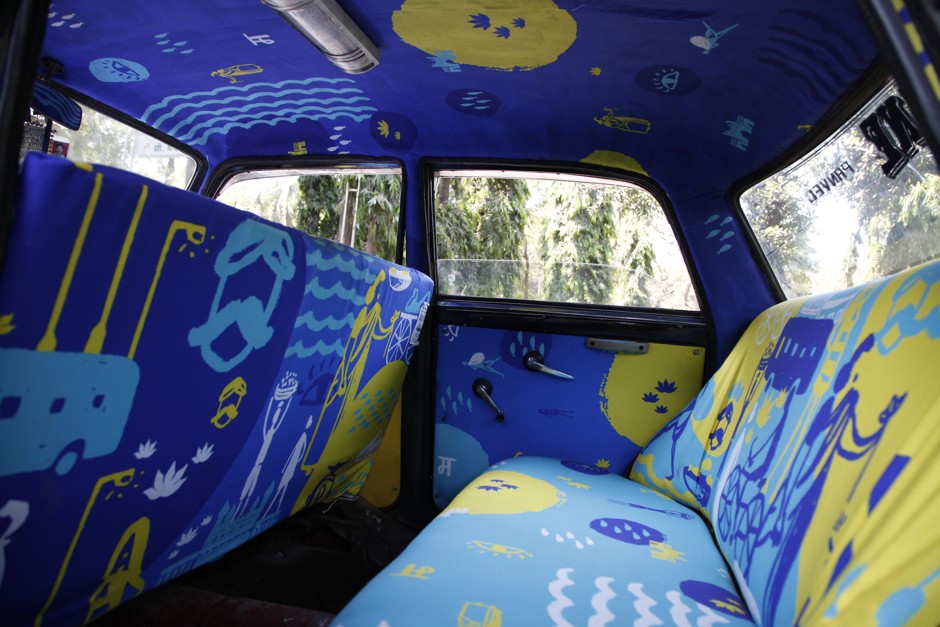
Designed by Tasneem Amiruddin, this taxi art design reflects the daily life of a Mumbaikar. (Taxi Fabric)
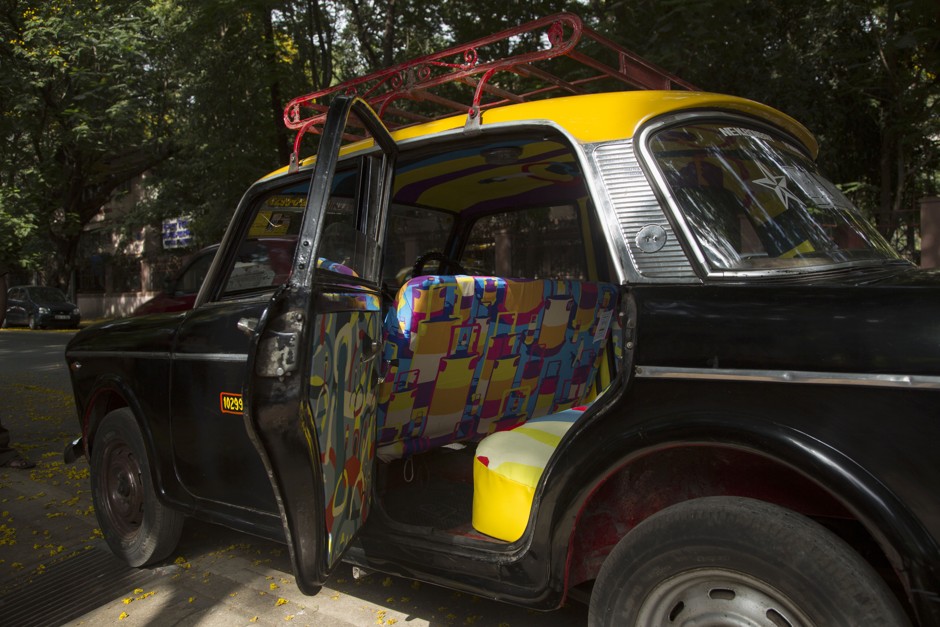
A design by Taxi Fabric creator Sanket Avlani pays homage to “dawaballas,” who deliver hundreds of thousands of hot lunches across the city every day. (Taxi Fabric)
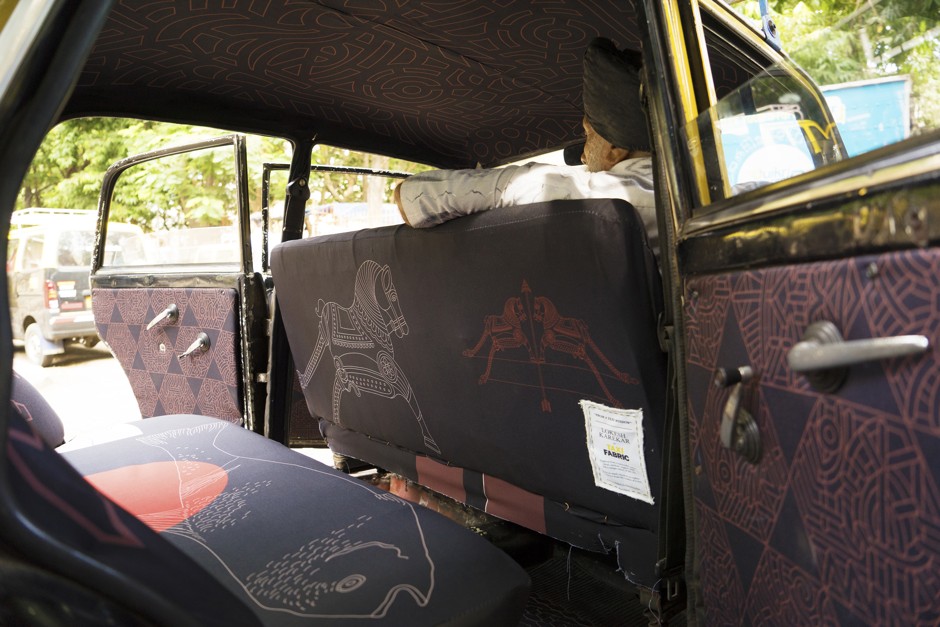
Artist Lokesh Karekar went for a minimalist design inspired by the 1980s. (Taxi Fabric)
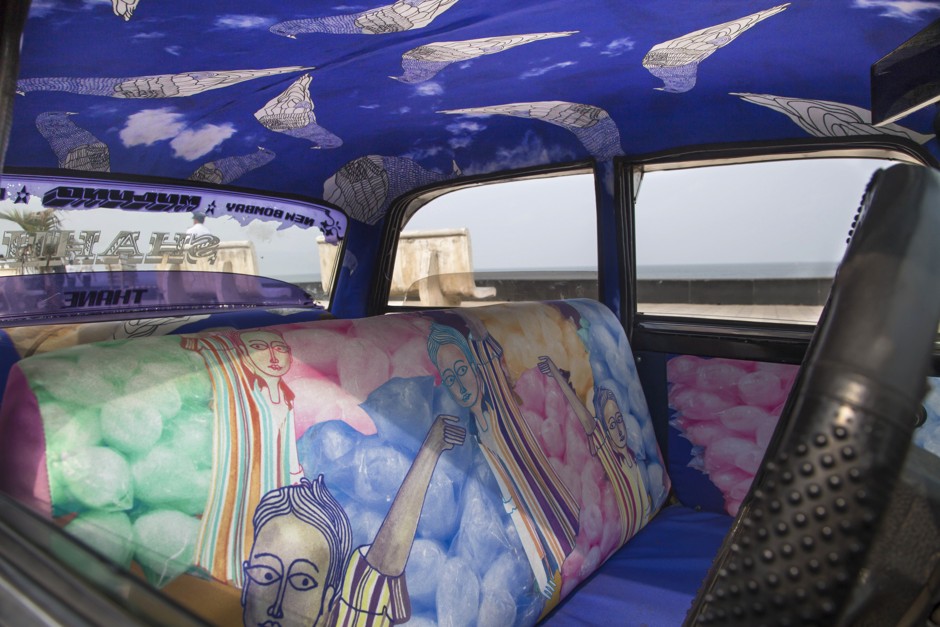
Guarav Ogale wanted his design to reflect the life of the taxi’s driver. (Taxi Fabric)

Source…..Linda Poon ….www.citylab.com

Natarajan

China Rolls Out the ‘World’s First Driverless Bus’…….

Not sure why there’s a driver right there, though.!!!

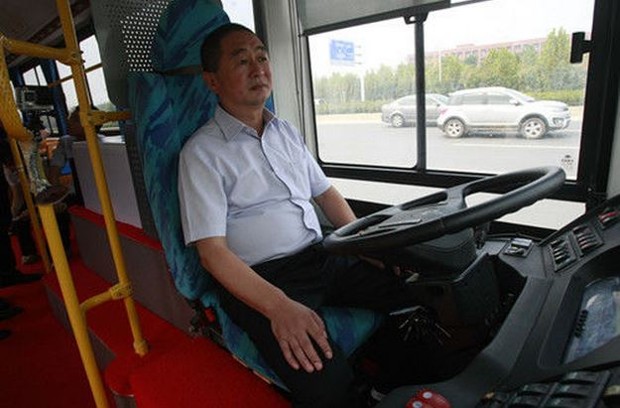
Notice anything odd about this bus tooling along a highway in China’s Henan Province?

Yutong

Look again. The dude behind the wheel is stretching his arms up like he’s dunking on someone—perhaps the execs at Google and Apple, as this thing is the “world’s first driverless bus,” according to manufacturer Yutong.

While tech companies in America have focused on personal automated cars, China has gone big with what could be the beginning of mass, unmanned bus transit. The spacious vehicle, unveiled at the end of August after three years of development, recently managed a 20-mile trip through the crowded city of Zhengzhou without crashing into other motorists or bursting into flames. That same driver stayed behind the wheel, true, but maybe as technology progresses he’ll be replaced with a Johnny-Cab robot.

The bus maneuvers with the help of cameras, laser radars, and a master controller that tells it to go faster and stop at signals. Yutong says in a press release it masterfully handled the road during one of its test drives:

With a distance of 32.6 km, the intercity road from Zhengzhou to Kaifeng has 26 traffic lights in total. Despite this and busy traffic, Yutong driverless bus successfully completed a series of highly complex driving acts, such as automatic lane change, overtake, and responding traffic lights. Without any human assistance, the bus arrived at its destination with its highest speed reaching 68 km/h (42 mph). According to some experts, the much improved active safety standard is the biggest advantage of unmanned vehicles as they are very likely to eliminate all kinds of traffic accidents.

The manufacturer also says the bus has an efficient driving style—one “that can only be attained by years of experience of an attentive and careful driver”—that will reduce energy waste and thus make the ride environmentally friendly. The company plans to put it through more tests, including running it on race lanes, before proceeding with real-world applications.

A reporting crew with RT took a spin on the bus last week. Have a look at the view from the front seat:

Source….

Natarajan

Message for the Day…” One’s own Breath is ‘mantra’…”

Sathya Sai Baba

People resort to gurus to receive mantras (mystically powerful formulae to be recited by them for their spiritual uplift); others seek medicine men and holy monks to get yantras (esoteric talismans to ward off evil forces); some others learn thanthras (secret rites for attaining superhuman powers) from scholars (pandits). But all of this is wasteful effort. One should accept the body as the thanthra, one’s own breath as the mantra and the heart as the yantra. There is no need to seek them outside oneself. When all words emanating from you are sweet, your breath becomes Rig Veda. When you restrict what you listen to and prefer only sweet speech, all that you hear becomes Sama gana(rendition of Sama Veda). When you do only sweet deeds, all that you do is Yajur homa (ritualistic sacrifice). Then you will be performing every day the Veda Purusha Yajna, the yajna which propitiates the noblest and highest Vedic Spirit!

India’s tech capital is being accosted by toxic foam….

Strange, puffy, dense clouds are descending on the streets of Bangalore, India’s technology capital. While whimsical-looking, they are actually puffs of a toxic foam inundating the city.

Documentary photographer Debasish Ghosh has captured images of the clouds floating around the city and overrunning the roads. The foam comes from Bellandur, a 1.4-square-mile lake that for years has been polluted by chemical and sewage waste. Every time it rains, the lake rises and wind lifts the froth up and carries it into the city.

lead_large

A pedestrian walks among clouds of toxic foam in Bangalore, India.

The toxic foam gets in the way of pedestrians and cars, creating awful traffic jams. It carries a stench so strong that it burns the nose. And if it comes into contact with your skin, you’ll get an itchy rash.

“It causes a nuisance,” Ghosh says.

Making matters worse, the froth is flammable. In May and June, the entire lake caught fire, leaving a 56-year-old man who was standing on a bridge above the lake with a ruptured cornea.

The froth has come every summer for more more than a decade now, but Ghosh says that this year is particularly bad. He’s been documenting the pollution since May, making sure to immediately clean his arms, hands, and face any time he gets too close.

38237fc6d

Debasish Ghosh  When it rains, the froth rises up and gets carried into the city by winds.

8e5dba071

Officials try to “hose” down the lake, using water to keep the foam from rising.

Residents in the area have filed numerous complaints to the city, according to Ghosh, but the government has done little to remedy the situation. Ghosh says since his photos were firstpublished by the BBC, the government has paid a bit more attention, but still not enough. For now, city officials try to keep the foam down whenever it rains by pumping water into the lake. “What happens is the water [mixes with] the foam at a high speed, and it disintegrates and doesn’t rise up,” says Ghosh. “That’s how they are controlling it at this point in time, so it doesn’t fall on people.”

Actually cleaning up Bellandur and other polluted lakes won’t be easy. Once known for being the home of nearly a thousand lakes, Bangalore has become known as the “land of a thousand sewage tanks,” instead. Today, after years of urbanization, only about 150 lakes still exist, according to the Deccan Herald.The rest are either used as garbage dumps or, when they dry up, filled in and put up for grabs.

“There’s so much pollution that it will take lots of time and lots of investment to bring this lake back to normal,” he says. “To what it was maybe two decades ago, when people say there would still be migratory birds in there.”

330429032

729af89f7

ac642804c

1d3a9d581

768942d6e

Read the original article on CityLab. Copyright 2015

Source….

http://www.businessinsider.com

Natarajan

Why Did Late President APJ Abdul Kalam Call Siddharth a Friend…?

Siddharth GJ is a motivational speaker, a father, a Certified Documentary Credit Specialist, and a friend of the late President APJ Abdul Kalam. He also has cerebral palsy. Siddharth’s journey has been, expectedly, full of challenges, but is nothing short of inspirational given all that he has achieved because of his determination and strong will.

How often does it happen that the President of India calls you his friend? That he can spot you in a crowd of thousands of people and talks about you in his many motivational speeches. This may be a dream for most of us but for Siddharth GJ it was a proud moment when the late President referred to him as a friend.

Siddharth has cerebral palsy. But he never let this come in the way of his succeeding at whatever he set his mind to. He excelled academically, found an intellectually challenging job, and also became a motivational speaker delivering over a hundred talks.

kalam

Kalam and Siddharth shared a great bond after their first meeting at Chennai airport. –

President Kalam read an article on Siddharth on an online portal that talked about Siddharth’s medical condition and how he overcame all the challenges to succeed in his life. Impressed by Siddharth’s resolve and perseverance, the President wrote to him and expressed a desire to meet him. They finally met at Chennai airport in December 2005.

“I still remember the day. It was December 2, 2005. My life changed after that. I made him a small presentation on issues faced by people with disabilities. He even talked about that at a conference, which gave me huge recognition. I will never forget my meeting with him. I was mesmerized by his presence,” Siddharth recalls.

President Kalam was so bowled over by Siddharth’s work that he talked about him at the inaugural speech of the First International and the Ninth Annual Conference of the Indian Academy of Cerebral Palsy.

Their bond grew stronger and they kept in touch and met a few more times. Siddharth recalls another incident when he had gone to attend a talk by President Kalam in Chennai. The President recognised his ‘friend’ from the stage and broke protocol to come and meet Siddharth in the crowd. 

“I loved meeting him because he did not make me feel that I was different. He treated me like a regular person. Often, people confuse cerebral palsy with mental illness. Which is so untrue because it is just a condition where the body and mind do not coordinate with each other. This affects the body posture and the way I behave. It has nothing to do with my intelligence,” says Siddharth.

Siddharth had jaundice when he was just three months old. His parents, who were simple villagers, did not realize the seriousness of the disease. The delay in treatment left Siddharth with the condition which makes him ‘different’ from others.

Siddharth has always found a happier way to fight the challenges.

Siddharth (R) has always found a happier way to fight challenges

“The news shattered everyone in the family but they were so supportive. They never let me feel that I was any less. They would treat me exactly the way they would treat my sister. If she got a scolding, so would I,” he recalls.

The couple knew that Siddharth might not be as well co-ordinated as other kids of his age but he was as intelligent as any ‘normal’ child.

“It was not until I turned eight that I stepped into a school. Then, gradually, teachers saw my capabilities and gave me double promotions. I excelled in my studies and cleared my 12th exam with 90 percent marks in spite of having a scribe who barely knew English. I had to work very hard to explain to him what I wanted to convey. I could not score more because my scribe was not allowed to do the practical exam and draw diagrams,” says Siddharth.

He then finished his Master’s in Economics and excelled in that as well. He was now eager to enter a new world where he could work and become financially independent.

But this was just the start of the struggle Siddharth had to face because he encountered challenges and rejections at every step.

Many companies dismissed his job applications in spite of his incredible academic background. “They thought I would not be able to perform well under pressure. They just judged my abilities without even testing me. I was hurt and disappointed,” says Siddharth.

The rejections continued for several years and then a positive change came into his life when he got his first job in 2005 with ABN AMRO Central Enterprises Services Pvt. Ltd., as an officer trainee in the bank’s document checking section.

Siddharth has received various awards and recognitions for his work.

“That moment I felt that all my tears and hard work have paid off. All the pain and struggle were a thing of the past and I was full of new energy, hope and passion. I was proud because I got a job due to my capabilities and on my terms,” he recalls.

But this wasn’t the end of his journey. It was, rather, a new beginning. His life took a complete turn when he became a Tedx speaker in Chennai and, since then, he has never looked back.

“I spoke in front of an audience of over 250 people and they gave me a standing ovation. It felt so great to share my experiences and, since then, I have been giving many motivational talks at various platforms and inspiring people to live a more positive life,” he says.

He currently works with IndusInd Bank Ltd., as manager. In fact, he is the first person in the country with cerebral palsy to be a Certified Documentary Credit Specialist. –

Siddharth with his family.

A Certified Documentary Credit Specialist is a professional who demonstrates a high level of practical knowledge and understanding of the complex issues associated with documentary credit practice, which is a set of rules on the issuance and use of letters of credit (a document from a bank guaranteeing that a seller will receive payment in full as long as certain delivery conditions have been met).

He met a beautiful girl and says he experienced “love at first sight.” He is happily married to her and has a toddler boy. “I see myself in my son. He runs around the house and I live my childhood through him as I could not do so,” he says.

“I can’t thank my mother and my sister enough for their support. Sometimes, after continuous rejection, I would be very rude to them but they always supported me and showed me the right path. They would go out of their way to make me feel loved and accepted. The day when I came out of denial, I became a calmer person and pursued my life in a better way,” he says.

Siddharth’s story is one of struggle but also of love and support from the family helping him defeat hardships. He has not just overcome hurdles in his own life but is also, with his inspirational talks, helping others with disabilities live a more positive life today.

Here’s one of his most inspirational talks –

All pics: siddharthjayakumar.com

Source….www.Shreya Pareek…www thebetterindia.com

Natarajan


Message for the Day…” Reflect over your entity well and discover who “You “are …”

The same person is king to his subjects, son to his parents, enemy to his enemies, husband to his wife, and father to his son. He plays many roles. Yet, if you ask him who he is, he would be wrong if he gave any of these relationships as his distinctive mark, for these marks pertain to physical relationship or activities. They denote physical kinships or professional relationships; they are names attached to temporary statuses. Nor can he reply that he is the head, the feet, the hands, etc., for they are but the limbs of the physical form. He is more real than all the limbs, and is infact beyond all names and forms which are falsities that hide the basic Brahman; he is known as ‘I’. Reflect over that entity well and discover who that ‘I’ really is. When it is so hard to analyse and understand your own entity, how can you pronounce judgement on other entities with any definiteness?

Sathya Sai Baba

Ever Wondered How Astronauts Get Into Their Spacesuits….?

photo credit: brownpau/Flickr (CC BY 2.0)

It turns out it’s even harder to get into a spacesuit than getting into a pair of skinny jeans after a few drinks.

NASA has released a video of astronaut Peggy Whitson putting on her spacesuit before an underwater training session. The video was filmed earlier this summer at the Neutral Buoyancy Laboratory at the Johnson Space Center in Houston, Texas. It’s fairly understandable that it’s a bit of a pain to put on when you appreciate the amount of equipment it has to hold. Essentially acting as a one-man spaceship, it has multiple layers of insulation, oxygen supplies, a power supply, communication equipment, and even an emergency propulsion system.

Source….www.iflscience.com

Natarajan

She Showed How It Is Possible for ONE Girl to Transform an Entire Village through Education …

Education was the last thing on the minds of Mallahipurva villagers. Especially for girls, who were considered as just extra hands to support the family. But one girl, Gudiya, fought all odds and became the first one in her village to pass Secondary School. She did not stop at just this. She started a school for other kids in her own house and made sure they embraced the gift of education too. This is how she brought about the transformation.

Mallahipurva village, located 150 kilometres from Uttar Pradesh’s state capital, Lucknow, is a perfect example of neglect and deprivation. Dominated by the mallahas, an impoverished lower caste fishing community, education was the last thing that children here had access to and women were only seen as extra working hands to make fishing nets and munj (wild grass) ropes. An added curse was the rampant production and consumption of country liquor made from the abundant Mahua flowers of the region.

It’s here that Gudiya, who is now in her mid-twenties, ushered in change by establishing a small school a few years back. She says, “I grew up in an environment where girls had no hope of ever leading a respectful life; even their mothers were alcoholics. The village boys, too, saw no scope in building a future and took to drinking early and aimlessly whiling away their time. Life was really tough. Just to get a square meal a day my parents had to make all of us work.”

Then when the mid-day meal scheme started in a nearby school Gudiya was sent there just so she would get something to eat – at least her parents had one mouth less to feed.

A girl spins the Moonj (jute) rope in her home at Mallahipurva in Rai Barielly district. (Credit: Anjali Singh\WFS)

A girl spins the Moonj (jute) rope in her home at Mallahipurva in Rai Barielly district. (Credit: Anjali Singh\WFS) –

That turned out to be a life changing decision. When I went to school, I realised what a wonderful thing education is and I decided to continue going to school,” she recalls.

Once her mind was made up, there was no turning back for this youngster, who hails from the only Brahmin family in her village and is one of 10 children – five girls and five boys. However, before going to school could be a regular thing she had to get her father, Babu Lal Sharma, to agree to her plan.

“It was not easy to convince my father. He had put me on the job of spinning the ‘munj’ ropes, which when sold got us some money to feed our family. But I didn’t back down and eventually he gave in,” she shares.

Gudiya paid for her schooling by making munj rope in her free time and her single-minded dedication was rewarded when she became the first girl in Mallahipurva to pass the Secondary School Certificate (SSC) exam in 2008.

Her father, Babu Lal, says, “I was tongue-tied when she told me the news and then gave the SSC certificate in my hand. It was a source of both happiness and apprehension for me. People in the village kept telling me that I was wrong in allowing her to do all this, but my heart said that this was her destiny, that she was meant to do this.

But passing an examination was not Gudiya’s sole ambition. She had bigger plans – she wanted to start a small school for all those children who could not afford formal education right in her village.

When she gathered the courage to speak to the elders about it and requested that some dedicated space be given to her to run the school, they flatly refused. So she once again went to her father to seek permission to allow Mallaha children to come into their home.

Being Brahmins this was considered not only sacrilegious by her parents but was also expressly prohibited by local religious heads. Nevertheless, Gudiya managed to coax consent out of her parents and to take classes IN the family verandah.

Gudiya interacts with the children at her school. (Credit: Anjali Singh\WFS)

Gudiya interacts with the children at her school. (Credit: Anjali Singh\WFS) –

The next big hurdle she had to overcome was getting the children to actually come. With around 100-odd families living in Mallahipurva and almost all the parents being addicted to country liquor, motivating them to send their children to study was far from easy.

“I went from house to house collecting children and getting them to class. Their parents were not happy and resisted my entreaties, but I never gave up. Then when a scheme called Child to Child Education was introduced by the New Delhi-based social organisation, Girija Devi Foundation, I signed up for it and attached my school to it. They helped me get books, food and even medical aid, all free of cost, for all those who came to study. Owing to this, support from parents too began to grow,” elaborates the inspiring young educator.

Of course, Gudiya did not abandon her school even after she got married and moved to Kanpur. In fact, she continues to keep a tab on what’s happening at her school from a distance, having handed over the reins to her younger sister, Soni. “My sister has studied up to Class Eight and is handling the school very well,” she says with a smile.

This school has proved to be a great hit with the students, who quickly finish up their household chores and rush to Gudiya didi’s classes – they are still called that.

What makes this classroom doubly beneficial for the little ones is the fact that those suffering from medical problems can avail of immediate and free treatment, thanks to the added benefits of the Foundation’s education initiative.

Gudiya, along with her father, Babu Lal Sharma, and sister, Soni, outside the school that is run from the verandah of their home. (Credit: Anjali Singh\WFS)

Gudiya, along with her father, Babu Lal Sharma, and sister, Soni, outside the school that is run from the verandah of their home. (Credit: Anjali Singh\WFS)

For instance, Nita, who is in her teens, has been able to get rid of her squint just because she joined Gudiya’s classes. She was 10 years old when she underwent an eye surgery through the medical aid provided for the children at the school. Indeed, according to Nita, Gudiya’s school has been a godsend. “Before the operation I had a squint and could not see very clearly. I used to overhear my mother tell my father that I would never get married because of the way I look and would have to work all my life spinning ropes and chopping fodder for the cattle. Then I joined school and during a medical check-up the doctor suggested an operation to correct the squint. These days, I can see and read properly and don’t feel shy about meeting people,” she says.

There are noticeable changes in the attitude of the local community as well. Says Gudiya, “In the beginning I had faced a lot of ridicule and hostility. Some even threatened me and my family, saying that I was ruining the established way of life in the village. The same people, however, are extending full support today. Earlier, the children were completely neglected – they would not eat food on time, wash or dress properly. There was a lack of sanitation that contributed to illnesses. Since both parents used to get drunk from the morning onwards, there was no one to take care of the kids. It’s a very different story presently. The children have learnt a lot and come to school neat and clean. They know how to take care of themselves and their siblings as well.”

Adds Nanhu, a former Pradhan of Mallahipurva, “The school has definitely made a difference. People still consume Mahua liquor but they have understood that their children should not do the same. Some have even started giving up their drunken ways and make sure to bring their children to the school at Gudiya’s home. I hope this change continues.”

Meanwhile, Gudiya has great hopes not just for herself but for her students, “I hope that one day each child from this school takes on the responsibility to teach others.” This young woman, who became a teacher almost by accident, has understood clearly the difference a dedicated teacher can make.

Source….Shreya Pareek ….www.thebetterindia.com
Natarajan

” Could you please tell me what is the english word for this situation ….” ?

Periyava_sitting

A family went to have the darshan of Maha Periyavaal. Along with them, they took one of their family friends who lived in the USA for some decades. The friend did not have any great faith in our religion, system and especially the monks wearing the saffron; he went along with him with utterly non-interested to meet Him. He was under the impression that Maha Periyavaal was a fundamentalist, an uneducated monk. This NRI had no great respect at all for Him. Not only that, he uttered such inauspicious things about Him, ‘what does He know? Does He know English?’.

There was a big throng of devotees at the Mutt and the family was standing in a decent distance from Him. As usual, Maha Periyavaal saw this family with His graceful eyes, and called all of them near to Him.

They all went near Him, the friend too.

After all the usual courteous enquiry towards the family, the Master looked at the NRI friend and asked about his details, including his name, whereabouts, his predecessors, where he is working etc etc.

Then He asked, ‘you are born in India, and you know Tamil; your wife was also born in India and should know the mother tongue. When you two converse will it be in Tamil or English?’

The friend replied ‘We never use Tamil at home, we use only English. The same goes for the kids also.’

Then Maha Periyavaal asked, ‘before speaking, you may have to think and conceive the sentence. Is the thought process in Tamil or English?’

The friend replied, ‘That too in English only’.

Some minutes later, an old lady came to have Maha Periyavaal Darshan.

Maha Periyavaal looked at the NRI person and said, ‘This old lady is now very poor, but once upon a time she was very rich. But even after she lost all the materialistic wealth her devotion towards the Mutt, Acharya and me has never changed even a bit. Could you please tell me what is the English word which will describe this unflinching devotion, which can’t be changed by external situations? I would like to know.’

The man was flummoxed. He thought and thought for a while but did not know that word.

Maha Periyaval smiled and told him, ‘please take your time and let me know’.

Even after some time, he could not come up with the required word.

Then Swamiji said, ‘Can I suggest one word? Could you please confirm whether the same can convey this meaning? EQUIPOISED’.

The man was spellbound and fell on Maha Periyavaal’s Feet to Pardon him for his ego..

source….www.mahaperiavaa.wordpress.com

Natarajan

படித்து ரசித்த கவிதை ….அணு நாயகன் அப்துல் கலாம் ….

மதம் பிடிக்கா மனிதர்
மனித நேயப் புருஷர்
தமிழ் படித்த விஞ்ஞானி
தமிழுக்கு கிடைத்த ஞானி!

எத்தனையோ பேர்
இப்பதவிக்கு வந்த போதும்
நீர் வந்த போது தானே
குடியரசுத் தலைவரென்ற கோபுரப் பதவி
சந்தனத்தை பூசிக் கொண்டது!

எத்தனையோ பேர்
தொட்டுப் போன நாற்காலியில்
நீர் அமர்ந்த பின் தானே
பட்டுப் பீதாம்பரங்களின்
பாரம்பரியத்தை உதறி
பருத்தி ஆடையில் பேசிக் கொண்டது!

மனப்பாடுகள் தீர
மனப்பாடங்கள் தந்தவர்
கணப்பாடுகள் மீற
கனவு காணச் சொன்னவர்!

சின்னத்திரையிலும்,
வண்ணத்திரையிலும் நடிக்காமல்
எண்ணற்ற இளசுகளின்
மனத்திரையிலும், மானசீகத்திலும்
வாழ்ந்த கதாநாயகர்!

இவரின் வருகைக்கு பின் தான்
கரிசல் காட்டுக்கும் கனவு வந்தது
இவரின் இருக்கைக்குப் பின்தான்
இஸ்ரோ தன் சிறகுகளை சிலிர்த்தது!

சாமானியனுக்கும்
சாம்ராஜ்ய பாஷை சொல்லிக் கொடுத்த
சாக்ரட்டீஸ் நீர்
சாதிக்கச் சொல்லியே
சரித்திரத்தை சரியான
பாதைக்கு ஓட்டிய சாரதி நீர்!

எவர் வருவர் உம்போல்
எவர்வரினும் இணையோ
உம்தாள் போல்
எம்மான் நீர் வாழ்க
இந்து சமுத்திரமாய்
நீர் வாழ்க!

Source— சுசீந்திரன், சென்னை.in http://www.dinamalar.com

Natarajan