A Green Taxi of Kolkata…”Rooftop Garden on an Ambassador Car.”..!!!

Dhananjay Chakroborty, a taxi driver in Kolkata, has decided to use his green hands and transform his taxi into a miniature, mobile garden. A green crusader on the move.

Imagine our surprise when we came across Mr. Dhananjay Chakraborty, a taxi driver in Kolkata, who has created a rooftop garden on his cab and has a mini green cavern in the trunk of his car with potted plants. It was truly an amazing and awe-worthy sight. He calls it the ‘subuj rath’ or the green chariot.

11167977_1434920233476298_4783039778295666790_n

The car has metal containers on the rooftop whose bottom is laid with soil, white sand and stone chips and the original green grass grows up with the aid of those mechanizations. It weighs about 65 kgs and cost Mr. Chakraborty about Rs. 22000 to build. It continues to cost him with the increased fuel consumption because of the added weight. However, Mr. Chakraborty said he does not mind it.

The Kolkata cabbie is 40 years old and works from the taxi stand at Tollygunge Karunamoyee in Kolkata. In fact, he has planted flowers at the taxi stand too.

His Taxi, an Ambassador, apart from having a green grass-bed on the roof, has eight potted plants in the trunk and has a green interior completely to promote the message that trees and plants should be planted and taken care of.

10897050_1376593789308943_6898522744511849688_n

Mr. Chakraborty’s project came to fulfillment in parts. It began three years ago when he potted a money plant in a beautiful glass bottle that a passenger had left behind in the back seat. Mr. Chakraborty took care of it and nurtured it, while keeping it in the Taxi.

The bigger idea of a green garden taxi, came from one of his friends who found something similar on Internet and suggested the initiative to Chakraborty. He, being so much in love with nature and trees, decided to give it a try.

1510041_1433449920289996_7066905048024457448_n

Making of the green taxi. Mr. Chakrobarty, with help, adjusting the metal tray onto the roof. His inspiration also came from fellow passengers who appreciated the small money plant that he had begun with. –

11205091_1433449970289991_1012660167758205488_n

The painting of the metal tray on the Subza Rath. He has also been distributing leaflets with messages and sketches that he has made to passengers who are curious and delighted by his initiative. –

He has also been distributing leaflets with messages and sketches that he has made to passengers who are curious and delighted by his initiative. –

11229960_1433449953623326_4358720428597478899_n

However, Mr. Chakraborty does not own the Taxi that he has morphed into a mobile awareness masterpiece on environmental preservation and conservation. He had to sell his taxi, about eight years ago, when he required funds for his treatment post an accident.

But the owner, Mr. Amrish Singh, who owns some five more taxis, has stood up in full support of Chakraborty’s efforts. He says that Dhananjay is one of the safest drivers out there, and since this is for a good cause, he cannot do anything but extend his full support

10422290_1376612839307038_9126793043859879048_n

This is how the Taxi looked before it underwent the transformation to become a miniature mobile garden.

Although, it was not an easy ride, some fellow drivers ridiculed him. In fact, most people before looking at it in a deeper perspective thought he was crazy to even think of such a thing. But Mr. Chakraborty did not pay it any mind, and decided to go on with the project anyway.

Mr. Chakraborty gives an added message. According to him, planting trees is not enough; taking care of them and nurturing them is crucial. Because tree planting initiatives keep happening but most of the saplings just wither away due to lack of water. It is time people, all of us, begin doing our bit.

10885530_1376612842640371_103575272624805763_n

Apart from being an eye opener on environment, there are other benefits of the plants and the grass in the car. Mr. Chakraborty drives a Non- AC Taxi and because of the plants, his taxi remains much cooler than any other non-AC taxi. –

Also, we believe people would be fascinated with such an idea. We know we are. So, the next time you are in Kolkata, do not miss a ride in the green taxi, or as Mr. Chakraborty likes to call it, the ‘sabuj rath’. –

Source….Surabhi Katyal….www.the betterindia.com

Natarajan


” Eat With it…and Then Eat it…” !!!

When Narayana Peesapati became aware of the harmful effects of plastic, not only to the environment but also to our health when used as cutlery, he was stunned. But he did not stop there. He came up with a solution that most of us wouldn’t have thought of, and actually made it happen!

“Whenever I travelled, I used to feel terribly guilty about using plastic cutlery because it created so much plastic waste. Why couldn’t we create an alternative?” asks 48-year-old Narayana Peesapati, the founder and Managing Director of Bakey’s Food Private Limited. Today, he has found a way to replace plastic cutlery with edible cutlery.

Ok, so plastic is bad for the environment. Everyone knows that. But what’s wrong with not washing plastic cutlery and putting it in one’s mouth? Narayana says it is because we “abuse and misuse plastic; plastic should not be applied to food.” He has said as much in this talk, where he gives many reasons as to why plastic, especially cutlery, should be taken out of our lives. Some of these reasons have to do with the manufacturing process for plastic cutlery (explained further down) and others with hygiene.

So does he have an alternative then? He does, and Narayana has been developing it since 2010. Bakey’s manufactures edible cutlery, including spoons in different shapes and chopsticks.

Edible spoons

Edible spoons

Bakey’s edible cutlery is made from a mix of jowar (sorghum), rice and wheat flour. The spoons and chopsticks do not get soggy if placed in water and food. They only soften after some time (10-15 minutes), and thus can be eaten easily at the end of the meal. Even if discarded, they decompose within five to six days, if not eaten by insects or rodents.

The idea about how to make the cutlery struck Narayana during a flight from Ahmedabad to Hyderabad, when he saw a passenger using a piece of Gujarati khakra as a spoon to eat dessert.

Why is plastic bad for your health?

Narayana Peesapaty at a Bakey's stall.

Narayana Peesapaty at a Bakey’s stall.

Plastic consists of many chemical components which are toxic and carcinogenic, and can leech into food. Narayana, who has been to several manufacturing units of plastic cutlery in the country, has observed that the way in which it is manufactured is not very safe for use with food.

“The irony is that there are very stringent food safety norms in India. But there are no norms when it comes to manufacturing the utensils in which we consume food,” he says.

In this very competitive market, he says, hygiene has become the first casualty of cost cutting. The process of cleaning the cutlery by manufacturing units in India that he visited, involved just a rag of cloth being used to wipe the final products that came out of the mould in which molten plastic was injected.

This, he feels, leaves consumers at the risk of plastic intake.

bakeys6

“Even after scraping the extra plastic, there are chances that some micro-granules of plastic get dislodged and can enter the body with our food if a spoon is not washed,” he says.

A thought even scarier than this struck Narayana when he noticed that in spite of such a huge consumption of plastic spoons, they are nowhere to be seen in the same numbers after disposal. This, he found, was because they were being reused, which makes plastic cutlery a source of bacterial contamination as well.

Why edible cutlery could be good for you

The spoons do not get soggy in food.

The spoons do not get soggy in food.

Prior to becoming a manufacturer of edible cutlery, Narayana was a researcher at the International Crop Research Institute for Semi Arid Tropics (ICRISAT), Hyderabad. Here, he undertook research on groundwater management, studying why groundwater levels were reducing. He concluded that producing less rice and more dryland crops like jowar would help stabilize the levels of groundwater. It was soon after this that he started thinking about creating a huge market for jowar, and this is one of the main reasons why jowar is the chief ingredients in edible cutlery.

With the product being widely acclaimed, Narayana has been able to communicate the ill effects of plastic to a wide audience.

Bakey’s cutlery has made a mark in the international market as well, with orders coming in from the US and UK.

Edible chopsticks

Being a new concept, working on the idea was a challenge initially, as there was no established technology. Everything had to be developed with learning and research. According to this report, it cost Narayana more than Rs. 60 lakhs to develop the prototype machines and moulds and get started (he had to sell two homes he owned to raise the money). But one of the bigger challenges now is to create an awareness about the harmful health effects of plastic. The use of plastic is also a behavioural issue according to Narayana—people accustomed to using plastic products will not find it easy to switch to edible cutlery.

Other than selling the cutlery directly from their website, Bakey’s also sets up stalls at places like organic bazaars and exhibitions. The company is only breaking even as of now and has not started making a profit, says Narayana.

Once it does, he hopes to develop an automatic machine for manufacturing the cutlery.

Edible dessert spoons

Based out of Hyderabad, the manufacturing unit is an all-women enterprise, which Narayana’s wife, who is currently working as a director in the company, will soon be taking over.

To know more about this initiative, you can write to Narayana at info@bakeys.com or visit their website here.

– See more at: http://www.thebetterindia.com/30465/edible-cutlery-in-india/#sthash.i0VEdVb7.dpuf

Source….www.thebetterindia.com

Natarajan


How an Artist is Changing Bengaluru Streets, One Pothole at a Time….

How an Artist is Changing Bengaluru Streets, One Pothole at a Time

Baadal Nanjundaswamy’s art work is incredible and delivers results. Image Courtesy: Facebook/Baadal Nanjundaswamy

As Bengaluru preps for the upcoming civic body polls on Saturday, it will be interesting to see how the scary crocodiles and gigantic anacondas that have appeared on the city’s water-logged and pothole-ridden roads recently will affect voters.

The city has been struggling with polluted lakes, garbage crisis, bad roads and crippling traffic management for a while now. Fed up with the state of affairs, local artists took it upon themselves to make sure the problems spoke for themselves, using imagination and art as their tools.

The charge has been led by Baadal Nanjundaswamy who shook up social media and local authorities (into making amends) by creating a life-size crocodile and swamp as an installation to highlight a pothole that hadn’t been fixed for days.

The crocodile did the trick and the pothole was filled. Since then, Mr Nanjundaswamy has been changing the face of Bengaluru pot holes, one brush stroke after another.

From transforming broken dividers into sutli bombs in one place and wrapped gifts in another, to painting huge faces around uncovered man holes, his art work is incredible and delivers results.

Check out some of his work below:

A little Diwali gift – major social media explosion in 3-2-1:

Photo Credit: Facebook/Baadal Nanjundaswamy

Bengaluru’s Secret Santa leaving them colorfully wrapped gifts for Christmas:

Photo Credit: Facebook/Baadal Nanjundaswamy

How about this Valentine’s Day proposal to civic body Bruhat Bengaluru Mahanagara Palike (BBMP)?

Photo Credit: Facebook/Baadal Nanjundaswamy

Or these fearsome faces with gaping mouths?

Photo Credit: Facebook/Baadal Nanjundaswamy

They needed a zebra-crossing, so that’s what they got – a zebra crossing the road:

Photo Credit: Facebook/Baadal Nanjundaswamy

Would you like a game of Hopscotch on one of Bengaluru’s streets? It could be fun but also might be the only thing you do for a while:

Photo Credit: Facebook/Baadal Nanjundaswamy
source…..www.ndtv.com
natarajan

15 must-do road trips in India…….

Here, the journey is your destination…

Most of us have been bitten by the travel bug, or so we assume. These 15 road trips across India, are a must if you are one of those who believe, “To travel is to live.” Bad roads, hiccups en route and unknown terrain, only add beauty to our travels. So go ahead and put these road trips on your bucket list.

Rediscover your love for travelling. Experience the warmth of people you have never met before. Explore the country. Make memories. Get inspired.

Let the adventures begin…

1. Manali to Leh

Manali to Leh

Photographs: Stephane Viau/Creative Commons

From June to September, the 450+ km stretch, invites you to enjoy a picturesque drive. With panoramic views of the Himalayas, driving thousands of feet above the sea level, it is one unforgettable journey.

2. Mumbai to Goa

Mumbai to Goa

Photographs: abcdz2000/Creative Commons

Leaving early in the wee hours of morning, driving through the Western Ghats and later along the Arabian Sea coast — reaching Goa in time for a late night party! Can it get any better?

3. Chennai to Pondicherry

Chennai to Pondicherry

Photographs: Sanyam Bahga/Creative Commons

Great roads (a blessing in India), scenic view and the sea breeze invites you for a long drive to a destination that is a photographer’s paradise and a foodie’s haven.

4. Ahmedabad to Kutch

Ahmedabad to Kutch

Photographs: Superfast1111/Creative Commons

Explore 400 kms of untamed roads and get a taste of wildlife in the land of contrasts. Get lost in the barren yet fascinating landscape of the Rann of Kutch. A drive to Kutch is incomplete without a visit to a few handicraft villages and the sight of the full moon in the Great Rann of Kutch.

5. Jaipur to Jaisalmer

Jaipur to Jaisalmer

Photographs: Adrian Sulc/Creative Commons

Visit the numerous forts, local attractions and eat at roadside dhabas as you embrace the warmth of the Rajasthani heritage.

6. Mangalore to Gokarna

Mangalore to Gokarna

Photographs: Jacob Abraham/Creative Commons

One beach destination to another. This four-hour long scenic drive along the Konkan coast, is for the beach lovers. With quaint unpopulated beaches and local sea food haunts along the way, pit stops are a must.

7. Guwahati to Shillong

Guwahati to Shillong

Photographs: Sandydessert/Creative Commons

Spanning two of India’s beautiful states — Assam and Meghalaya, this road trip entices you with amazing views of green valleys, little villages and rich sights.

8. Visakhapatnam to Araku Valley

Visakhapatnam to Araku Valley

Photographs: Adityamadhav83/Creative Commons

The gentle elevation, greenery and away from the hustle bustle of cities, makes it another destination for a road trip. Don’t miss a visit to the Borra caves and Katiki Watefalls.

9. Cochin to Munnar

Cochin to Munnar

Photographs: Ben3john/Creative Commons

Manoeuvre through the twisty and curvy roads, as you enjoy the greenery of the vast tea plantations of Munnar. Once the summer resort of the British, Munnar welcomes you with fog, mist and lovely small waterfalls.

10. Darjeeling to Pelling

Darjeeling to Pelling

Photographs: Shahnoor Habib Munmun/Creative Commons

Driving through scenic valleys and mountains, you will wish that this journey doesn’t come to an end. Get spell-bound by the spectacular view of the Himalayan range, stop by the little village bazaars and sip a cup of locally brewed tea and get lost in the abode of the gods.

11. Mysore to Ooty

Mysore to Ooty

Photographs: Adam Jones/Creative Commons

Cutting through Bandipur, a national park, you will get to see wildlife in its natural habitat. While it’s beautiful, be careful not to drive fast — small wild animals tend to cross the roads suddenly. Also, there’s ban on driving this route in the night. Nevertheless, the journey is as beautiful as its destination.


12. Mumbai to Mahabaleshwar

Mumbai to Mahabaleshwar

Photographs: Rishabh Tatiraju/Creative Commons

After passing through the beautiful Lonavala, as you inch closer to Mahabaleshwar, the hill presents some amazing views. Also stop by a strawberry farm on the way. Driving during the monsoon, the experience is adventurous and something that should feature on your bucket list.

13. Dharamshala to Bharmour

Dharamshala to Bharmour

Photographs: John Hill/Creative Commons

The journey laced with the beauty terraced fields reminds you a little of the Inca landscape in Peru. The pretty pined forest, dramatic now-capped mountains and the greenery extending to infinity, will mesmerise you.

14. Bangalore to Coorg

Bangalore to Coorg

Photographs: Leelavathy B.M/Creative Commons

Beat the humdrum of the IT city, drive through coffee estates, hues of greenery, and enjoy the sounds of crickets coupled with some awesome Coorgi cuisine.

15. Chandigarh to Kaza


Chandigarh to Kaza

Photographs: nikkul/Creative Commons

Listed among the ‘world’s deadliest roads,’ this road trip is only for the adventurous traveller. Driving the dangerous and bad roads, you are gifted with spectacular landscape, rugged moonscape of Spiti and lush mountains.

This is not the end of the list, just the beginning. The rest is for you to discover.

This Ernest Hemingway quote just summarises, everything: It is good to have an end to journey toward; but it is the journey that matters, in the end.

Source…Sindhu.M.V….www.rediff.com

Natarajan

Dashrath Manjhi Aka Mountain Man’s Story Is The Most Inspiring Thing You’ll Read Today…

Manjhi

Dashrath Manjhi, a poor landless labor moved a mountain in his lifetime, quiet literally! It took him 22 years but Manjhi shortened the travel between the Atri and Wazirganj of Gaya town from 55 km to 15 km. Not many are aware of this man’s greatness but thanks to Bollywood for converting his life story into a film. The film by Ketan Mehta is called Manjhi- The Mountain Man and is slated to release this Friday starring ace actors like Nawazuddin Siddiqui and Radhika Apte in lead roles. The story of a brave man who took the challenge of gifting accessibility to his remote village will inspire you beyond limit.

If you still haven’t heard of the man who fought with a mountain for more than two decades, his real story will move you!

1. Gehlour Ganj, Atri: A 300-foot tall mountain loomed between Atri block of Gaya, Bihar civilization in Wazirganj made commuting a difficult task for the locals

Dashrath Manjhi 1

2. Manjhi, a landless labourer worked in the fields on the other side of the mountain and lived with his wife, Falguni.

Manjhi 2

Manjhi belonged to a cast which was regarded the lowest of the low in a caste-ridden society. They were kept aloof from basic necessities like- water supply, electricity, a school and a medical centre.

3. Like everyday, Manjhi eagerly waited for his beloved wife Falguni who would bring lunch for him.  She did come to him that one eventful day, but her body had bruises and blood all over.

3

The treacherous trek up and around the mountain took hours. This led to frequent accidents and death of locals who lost their lives purely because reaching for medical facilities took hours. The nearest doctor was at Wazirganj, which was more than 70 kilometers over the mountain. Locals of the area cursed the inaccessibility but no one ever bothered to do anything about it. However, one man could wait no longer but that too alerted him after a tragedy. However, one day, Falguni tripped on loose rock, shattering her water pot. Not only she slid down several feet, she injured her leg. Manjhi could not save his wife and then he took a pledge.

4. “Jab Tak todenge nahi, tab tak chodenge nahi”- After losing his wife in 1959, Manjhi took up a challenge against the mountain and sold his goats to buy a hammer, chisel and crowbar.

Manjhi Story

“That mountain had shattered so many pots; claimed lives. I could not bear that it hurt my wife. If it took all my life now, I would carve us a road through the mountain.”- He said.

5. People called him a ‘lunatic’ but that did not deter him from his journey. After a struggle of 22 years (1960-1982), a tiny cleft across a rock wall opened up one day!

Mountain Man

He then went on to widen the cleft. Some several years later, he managed to carve out a passage 360 feet long and 30 feet wide.

Even though he lost his battle of life to cancer in 2007, thanks to Bollywood for converting his life into a film. Even when he was alive, people were totally awed by his will power and determination. Chief Minister Nitish Kumar agreed that once he had stood up and vacated his chair when Manjhi visited him in Janata Durbar in Patna.

Source…..Isha  Sharma… http://www.indiatimes.com

Natarajan

Two Indians Have Designed A Garbage Bin That Will Reward Users With Free WiFi…

Realising the need of the Internet in everyday life, two commerce graduates decided to give free WiFi to people in exchange of a cleaner surrounding with an unique initiative — a ‘WiFi Trash Bin’.

“When somebody dumps trash into a dustbin the bin flashes a unique code, which can be used to gain access to free WiFi, says Prateek Agarwal, one of the two founders of the initiative.

Mumbai-based Agarwal and his partner Raj Desai, a self taught programmer, travelled extensively to countries like Denmark, Finland, Singapore etc and realised that keeping surroundings clean needed apart from a difference in structure, a change in the attitude of people.

“We took a lot of help from countries like Finland, Denmark, Singapore etc and decided to build a system similar to that,” says Prateek Agarwal.

The duo hit upon the idea while visiting the NH7 Weekender a music festival which is spread around a large area and as music festivals go is home to music food drinks and of course a lot of garbage.

” …It took us six hours to find our friends. Since there was no network, we could not reach them through a phone call.

It was the trigger for the idea and we thought why not provide free WiFi to people using hotspots,” says Mr Agarwal.

Keeping the place clean and helping to connect with their friends were the driving force behind their innovative project.

The self-funded experiment with support from operator MTS proved to be a success at the various Weekender Festivals held in Bangalore, Kolkata and Delhi but is not operative at the moment.

The founders say they have received queries from GAIL and talks are in due process.

“We wanted to change the attitude of the people and how things are structured, thus affecting an individual’s behaviour,” says Raj Desai.

The venture, though not operative now aims to satisfy the need of Internet at every step in the modern day world.

“… We want to work more for it,” says Mr Agarwal.

The duo say they tend to setup a network of WiFi bins thus helping to bring about a behaviourial redesign among people.

The venture was recently showcased at “Networked India”, a unique initiative by Ericsson and CNN-IBN that aims to identify and facilitate clutter-breaking innovations in the field of connectivity and mobility.

Source…..www.huffingtonpost.com

Natarajan


” These Chennai Scientists Are Trying To Solve An Impending Agricultural Crisis…”

SALICORNIA BRACHIATA

VEDARANYAM, Tamil Nadu — On a sun-scorched wasteland near India’s southern tip, an unlikely garden filled with spiky shrubs and spindly greens is growing, seemingly against all odds.

The plants are living on saltwater, coping with drought and possibly offering viable farming alternatives for a future in which rising seas have inundated countless coastal farmlands.

Sea rise, one of the consequences of climate change, now threatens millions of poor subsistence farmers across Asia. As ocean water swamps low-lying plots, experts say many could be forced to flee inland.

“It’s hard to imagine how farmers will live,” said Tapas Paul, who as a World Bank official helped channel about $100,000 to help build the small garden a decade ago in a swampy, seaside town dominated by salt flats in southern Tamil Nadu state. “In the places subject to inundation and sea level rise, there are few options.”

A team of Indian scientists is searching for solutions to what they describe as a fast-approaching agricultural crisis. Their neatly plotted rows of naturally salt-tolerant plants, known as halophytes, could be a part of the answer. The scientists from the M.S. Swaminathan Research Foundation are also trying other approaches: tweaking genes and cross-breeding plants by conventional means to discover which might grow and even flourish.

“Sea level rise is inevitable, and we are not prepared,” said Swaminathan, who pioneered high-yield wheat and rice varieties for India in the 1960s. “The biggest problem in India is just the very large population. We can say people can relocate, but where could we even accommodate all those who need to move inland?”

Saltwater for a farmer long meant certain crop failure. Wartime foes sowed enemy fields with salt to ensure social collapse. Natural disasters such as the 2004 Asian tsunami left countless plots unproductive for years.

Asia’s coastal farmers, including millions impoverished in India, now face such problems. Climate change will bring stronger storms and warmer temperatures that expand ocean waters and melt ice caps and glaciers. As a result, seas are set to rise up to 1 meter (3.2 feet) in this century, according to the latest scientific forecasts.

Chellammal, a graceful, 65-year-old farming housewife in the Tamil Nadu village of Tetakudi, knows the nightmare of farming on salt-contaminated land too well.

“I struggled so long to get things to grow, but nothing worked,” said Chellammal, who goes by one name. “Every year just got worse until there was nothing left,” she said, crouched in a bright pink sari by her fields.

The land her family had saved for decades to buy went completely barren about five years ago, after a neighboring village took up shrimp farming when flooding from a nearby ocean canal salted their lands. The shrimp ponds were never lined properly, so their saltwater seeped into surrounding soils.

The farmland lost by Tetakudi’s 200 households now supports little more than a vast expanse of salt-tolerant shrubs called Suaeda maritime along with succulents called Salicornia brachiata, known to locals as “chicken feet.”

To the villagers, the bright green bushes are no better than weeds. Already, 12 families have boarded up their homes and left.

But scientists say suaeda is good for firewood. And salicornia species, which can tolerate nearly twice the salinity of seawater, have enormous potential as a biofuel crop, with seeds containing high concentrations of oil.

The problem, however, lies in realizing profits. For any crop to work on a large scale, inexpensive methods and machinery for harvesting will have to be developed. Then processing plants, production lines and markets would need to be built. As of now, none of that exists.

Chellammal is dubious, but interested.

“If we can make money from what we grow, we’ll try it. Why not?” she said. “Maybe all is not lost.”
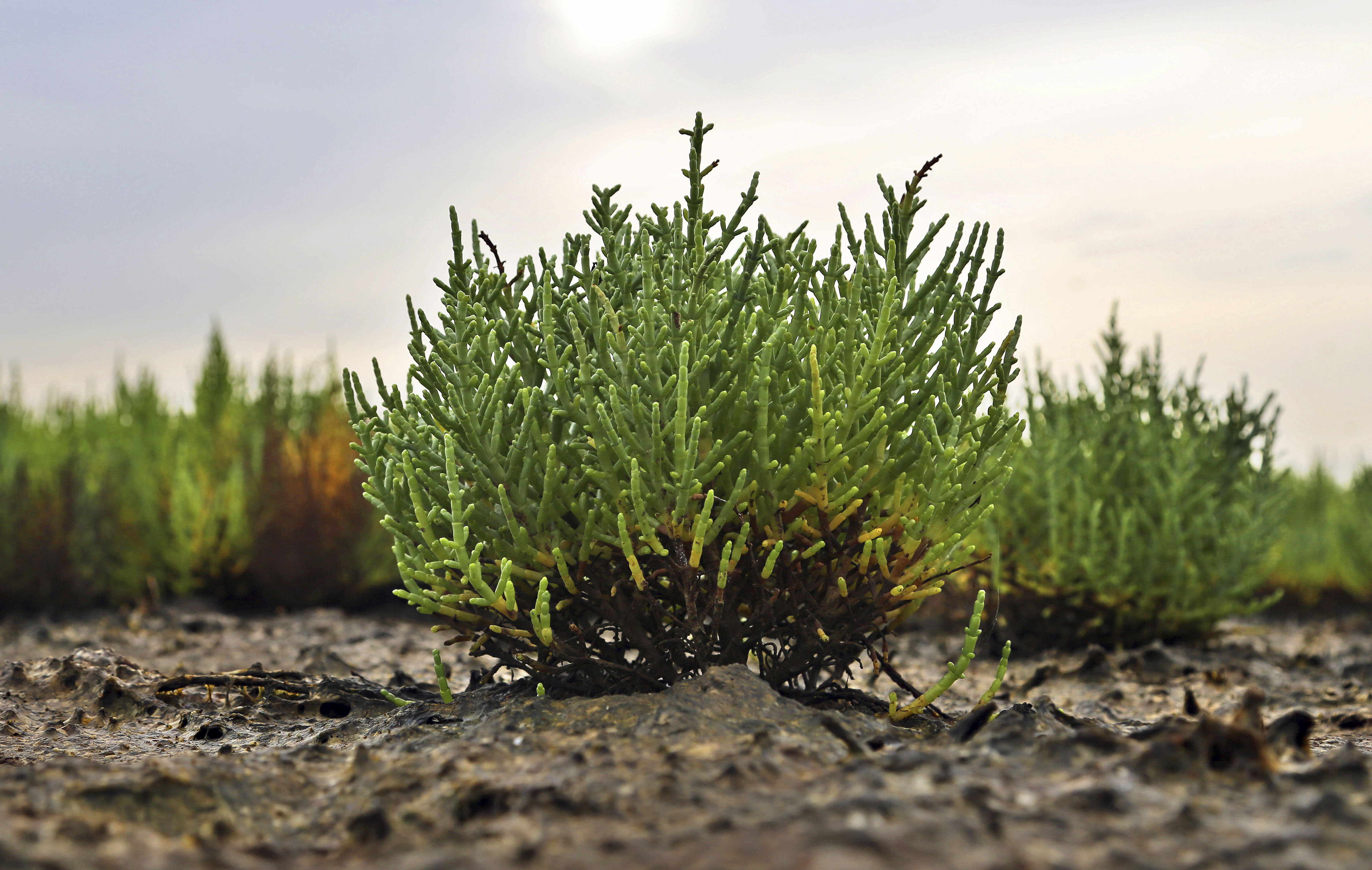
 

salicornia brachiata

In this June 16, 2015 photo, a wild-growing Salicornia brachiata, a halophyte known to locals as ‘€chicken feet’, thrives on fields tainted by saltwater from a neighbouring shrimp farm near Velankanni, India.

The timing for an agricultural crisis due to sea rise couldn’t be worse. India’s poor farmers already struggle with frequent flooding, drought and soils degraded by agrochemical overuse. Those on the coast are also hit by storms, with at least 27 of the 35 deadliest cyclones in history barreling through the Bay of Bengal before slamming into either India or Bangladesh.

India’s freshwater sources are also in peril, with over-tapped groundwater reserves so low the country is expected to have only half the water it needs by 2030. Grain production, meanwhile, has stalled around 260 million tons in recent years, despite global pressure for India to boost yields, eliminate waste and eradicate widespread poverty and malnutrition.

To feed its growing 1.26 billion population, India must increase food production 45 percent by 2050, for which experts say it may need to cultivate more land. Instead, about 1.2 million hectares (3 million acres) of its coastal farmland has been degraded by salt, according to India’s Central Soil Salinity Research Institute.

Inland, India has lost another 5.5 million hectares of arable farmland, out of its nationwide total of 163 million hectares, though India’s soil salinity troubles are exacerbated by industrial salt flats, a growing number of shrimp farms and the depletion of groundwater reserves. The trend will only continue as seawater creeps onto low-lying lands along the 7,500-kilometer (4,700-mile) coast that outlines the country along the Bay of Bengal, Indian Ocean and Arabian Sea.

“Saltwater agriculture is considered a futuristic area. But it really shouldn’t be,” said marine biologist V. Selvam, the M.S. Swaminathan foundation’s mustachioed director of coastal research. “Very soon there won’t be enough land and water to meet our needs.”

And India is not alone. Countries including Egypt, Bangladesh and much of Southeast Asia also face heavy saltwater intrusion and loss of farmland. Already, 62 million hectares, or 20 percent, of the world’s total 300 million hectares of irrigated farmland has been salinized to some extent. Another 50 centimeters (1.6 feet) of sea rise, which is just half of what’s expected by 2100, would swamp up to 1.9 million more hectares, the Intergovernmental Panel on Climate Change has said.

That will undermine the world’s ability to find the additional 120 million hectares of farmland it needs for a staggering 70 percent increase in food production to feed the world by 2050, according to the U.N. Food and Agricultural Organization.

Experts say there will be little choice but to grow some non-food crops along the coasts.

The world’s irrigated acreage could be increased by about 50 percent by reusing saline water and salinized crop fields for halophytes, said University of Arizona environmental sciences professor Edward Glenn.

“As with aquaculture replacing wild fisheries, it is inevitable that halophytes will have their day,” he said.

Sesuvium portulacastrum. Paspalum vaginatum. Prosopis juliflora.

These are just a few of the 350 known species of salt-tolerant plants that are candidates to become crops for the future. Saltwater plants are unlikely to become staple foods, because while often high in nutrients they’re also very salty and so should be eaten in moderation.

Species such as Salicornia europaea, also known as glasswort or samphire, are already sold in European markets as a fancy salad addition or side dish. The bright purple-and-white blossoms of Limonium are a florist’s delight, while another species called Atriplex or saltbush is eaten by sheep.

Supporters note a host of potential uses to make harvests profitable, including firewood, decorative flowers, kitty litter, nutritional supplements, cooking oil and biofuel. Cattle fodder is another possibility, and Indian herders already graze their cattle on thorny shrubbery by the sea.

Despite the potential, saltwater agriculture is still seen as a fringe topic, even after decades of research by universities worldwide along with studies and pilot projects in countries including Mexico, Pakistan, Jordan and Eritrea. The aviation company Boeing is also researching biofuels from saltwater plants.

India’s scientists aren’t waiting for markets to develop. Nor are they relying on just the halophyte garden to offer up new options.

They’re scouring coasts for wild grain species that might naturally tolerate some salinity, and using arduous breeding methods to create new salt-tolerant strains.


The foundation has also developed genetically modified rice using genes from mangrove trees. It says the resulting plant can tolerate salt concentrations of 12-15 grams per liter. Seawater is typically two to three times saltier, but that’s still a major improvement from currently cultivated rice varieties, which can handle only up to 3 grams per liter.

Genetic modification is considered the most difficult approach, because salt tolerance is a trait that involves numerous genes. But the molecular biologist leading the development of GM halophytic rice believes it’s essential.

“Conventional breeding just takes too long, and this problem is urgent,” said Ajay Parida, the foundation’s executive director. His work stalled in 2007 under an effective moratorium on field testing GMOs, but the Indian government is considering shifting its GM testing policy and Parida now expects his trials to start soon.

“We could eventually be cultivating wastelands and places considered entirely unsuitable,” he said. “But it’s only after crisis hits that people realize the magnitude of the problem and start pushing for an answer.”

Source….  |  Katy Daigle….www.huffingtonpost.com

Natarajn


An Indian diplomat’s gift to the people of the UAE….

Dr Tiju Joseph, an IFS officer who studied medicine, has set up the first public online blood donors registry in the UAE where he is currently posted. He speaks to Shobha Warrier/Rediff.com

Dt Tiju Joseph, Indian diplomat

Dr Tiju Thomas is a diplomat and a doctor by training. He studied medicine in Kottayam, Kerala, before becoming an Indian Foreign Service officer in 1999. Currently, he is posted as the Consul (Economic and Education, Press and Communication) in the United Arab Emirates.

After joining the consulate general in 2012, the doctor in him took him to some of the best hospitals in Dubai as the UAE has been honoured by the World Health Organisation for being among the top five countries in the world with the best blood transfusion services.

One of the hospitals he visited had a very large blood bank.

Doctors at the hospital told the consul about the blood shortage experienced by the hospitals in summer and during Ramadan.

Also, the shortage was more for rare blood groups.

“Blood donation goes down drastically when people fast and also when summer is at its peak. The UAE needs a lot of blood due to various health issues. I am told that more than 40% of the blood goes to thalassemia patients and they need blood regularly; on a fortnightly or monthly basis, Dr Thomas explained.

Thalassemia is a genetic blood disorder.

“The shortage of rare blood groups is because even in blood donation camps, donors with normal blood group are more, compared to rare groups. There is a shortage of such groups all the time which becomes acute during summer and Ramadan,” he added.

When Dr Thomas became aware of this problem and belonging to the rare O negative group himself, he donated blood right at that moment itself. He also promised a solution to the problem.

Back home, he wondered how he as an Indian could help the UAE where Indians are the biggest expat community. He thought of a blood donor registry, which is very common and successful in many cities in India, but a similar online registry was not available in the UAE.

“There are organisations with small groups who regularly donate blood, but the list is available only to them and not to the outside world. There was no way a hospital or a person in need could contact the regular donors. That is why I felt an exhaustive online public blood donor registry was needed which could be accessed by anyone,” Dr Thomas said.

The Consul started the process by first designing a Web site www.blooddonors.ae and then contacting various Indian organisations for their list of donors.

To his surprise, he found that they did not have a proper database of donors. The organisations were given the option to operate pages on the Web site where they could add, delete or correct the information.

They were also given the facility to add photographs of the blood donation drives organised by them.

“It took some time for us to develop all this. Though it was free for all and for a free Web site, being a diplomat, I had to get the necessary permission to go about it.”

On June 14 which is World Donation Day, the first and the biggest blood donor directory in the UAE had a soft launch, and on June 21 — International Yoga Day, Dr Thomas decided to officially launch the Web site.

“16,000 people had assembled to celebrate International Yoga day and we thought that would be the ideal day to launch the Web site too. Yoga is a gift of India to mankind, to the entire world. Similarly, this is a gift of the Indian community to the UAE community.”

Dr Thomas was overwhelmed by public enthusiasm. 110,000 visitors accessed the Web site.

“It is remarkable and I should thank the Indian community here for the response.”

The site has separate options for individuals and groups. Individual donors can go to the Web site and register themselves and there is a page for organisations, associations and large groups that can be contacted to organise instant blood donation drives in case of shortages.

Dr Thomas says 1,650 people have already registered. With the Sikh community group of 2,500 members already joining; the Dubai Kerala Muslim community organising a one week campaign to enrol 1,000 to 1,500 people; the Christian church giving a list of another 1,500 names; Bharatiyam, the friends of India offering to enrol their 1,000 members and also the Indian Schools Association promising to enrol parents and teachers once schools reopen — the response has been heartening.

Dr Thomas hopes to have at least 10,000 names in the registry very soon.

“This is only the beginning. The UAE has an Indian population of around 2.5 million. Though not all can and will donate, we are trying to get the maximum number of people from the age group of 18 to 55 to enrol in the registry. Anybody in need of blood can enter the Website and see the name of the donor, mobile number, gender, blood group and the last date of blood donation. Later on, we plan to add the donor id given by the Dubai blood bank so that anyone can reliably contact the person.”

Other than functioning as a registry, the Web site has many articles on blood and blood donation, both in English and Arabic, and also an audio visual game on how to match various blood groups.

As it was an Indian diplomat who launched such an initiative, it received a lot of media attention. Dr Tiju Thomas says African countries like Ethiopia and Kenya, and other Middle Eastern countries have evinced interest and requested him to replicate such a Web site in those countries.

“I believe this is how we build bridges between various nations and communities,” he says.

While it will be the blood banks at hospitals that would mostly use the registry, Dr Thomas says: “Even if a single person gets a life out of this registry, we will feel the work rewarding. India is very advanced as far as such registries are concerned, but many countries in the world are in need of such an initiative.”

“My dream is to see this is put to use in many countries to save lives. This is a stepping stone to a bone marrow registry and I see many other possibilities in the future.”

Source….Shobha  Warrier in www. rediff.com

Natarajan

India’s Mars Orbiter sends back stunning 3-D images of the largest known canyon in the solar system

While the rest of India was tasting patriotic waters on the account of the 69th Independence Day, India’s Mars Orbiter Mission, Mangalyaan, sent us pictures which made us proud yet another time.

The Mars Orbiter Mission sent some beautiful images of the largest known canyon from the Red planet – Mars.

These are the images of Valles Marineris,  a largest known canyon complex in the solar system. This picture was taken from a height of nearly 2000 km from Mars colored camera.

A 62 km wide valley named Opir Chasma can be seen bordered by high cliffs.

Mangalyaan reached Mars on September 2014. It was an ecstatic moment for the whole country as ISRO was successful in its maiden attempt. Many countries like the USA, Russia, and Europe have accomplished successful Mars missions.

And what’s more, this is not the first time that an image has been sent. Earlier, they sent images of Martian landmarks – Aurorae Chaos.

It’s a long terrain with irregular blocks.

What this image proved?
It showed signs of fluvial activity which means showing signs of water or similar substances which could have flowed there sometime in the past.

You can see more pictures taken by Mangalyaan here.

Well, there is no doubt that this image proved the mettle of Mangalyaan another time, but it also proved to be a perfect Independence Day present for everyone especially because many studies have been undertaken to know about any signs of life on Mars. May many more pictures come our way!
Built at the cost of just Rs 450 crores, the orbiter still has 39 kilograms of fuel it still has left in the tanks – which could mean a few more years of breathtaking pictures, among other things.

Well done!

News Source: Aparajita Mishra in Hindustan Times…. http://www.storypick.com and  www.scroll.in

Natarajan


22 Reasons To Believe Hinduism Is Based On Science….

Somebody has rightly said, “Hinduism is not a religion, it is a way of life.” Here Nature is of paramount importance and the Gods of Hinduism are basically different forms of Nature. It is amazing how various practice of Hinduism has an underlying scientific benefit. Let’s look at 22 Hindu rituals to see how scientific this ancient religion has been.

1. People are advised to worship Neem and Banyan tree in the morning. Inhaling the air near these trees, is good for health.

Neem and Banyan tree

2. If you are trying to look ways for stress management, there can’t be anything other than Hindu Yoga aasan Pranayama (inhaling and exhaling air slowly using one of the nostrils).


3. Hindu temples are built scientifically. The place where an idol is placed in the temple is called ‘Moolasthanam’. This ‘Moolasthanam’ is where earth’s magnetic waves are found to be maximum, thus benefitting the worshipper.

Moolasthanam

4. Every Hindu household has a Tulsi plant. Tulsi or Basil leaves when consumed, keeps our immune system strong to help prevent the H1N1 disease.


5. The rhythm of Vedic mantras, an ancient Hindu practice, when pronounced and heard are believed to cure so many disorders of the body like blood pressure. 

Vedic mantras

6. Hindus keep the holy ash in their forehead after taking a bath, this removes excess water from your head.

7. Women keep kumkum bindi on their forehead that protects from being hypnotised.

kumkum bindi

8. Eating with hands might be looked down upon in the west but it connects the body, mind and soul, when it comes to food.


9. Hindu customs requires one to eat on a leaf plate. This is the most eco-friendly way as it does not require any chemical soap to clean it and it can be discarded without harming the environment.

10. Piercing of baby’s ears is actually part of acupuncture treatment. The point where the ear is pierced helps in curing Asthma. 

Piercing of baby’s

11. Sprinkling turmeric mixed water around the house before prayers and after. Its known that turmeric has antioxidant, antibacterial and anti-inflammatory qualities.


12. The old practice of pasting cow dung on walls and outside their house prevents various diseases/viruses as this cow dung is anti-biotic and rich in minerals.

pasting cow dung


13. Hindus consider drinking cow urine to cure various illnesses. Apparently, it does balance bile, mucous and airs and a remover of heart diseases and effect of poison.

drinking cow urine

14. The age-old punishment of doing sit-ups while holding the ears actually makes the mind sharper and is helpful for those with Autism, Asperger’s Syndrome, learning difficulties and behavioural problems.

age old punishment

15. Lighting ‘diyas’ or oil or ghee lamps in temples and house fills the surroundings with positivity and recharges your senses.

Lighting diyas

16. ‘Janoyi’, or the string on a Brahmin’s body, is also a part of Acupressure ‘Janoyi’ and keeps the wearer safe from several diseases.

Janoyi

17. Decorating the main door with ‘Toran’- a string of mangoes leaves actually purifies the atmosphere.

Toran

18. Touching your elder’s feet keeps your backbone in good shape

Touching your elder’s feet

19. Cremation or burning the dead, is one of the cleanest form of disposing off the dead body.


20. Chanting the mantra ‘Om’ leads to significant reduction in heart rate which leads to a deep form of relaxation with increased alertness.

Chanting the mantra

21. Hanuman Chalisa, according to NASA, has the exact calculation of the distance between Sun and the Earth.

Hanuman Chalisa

22. The ‘Shankh Dhwani’ creates the sound waves by which many harmful germs, insects are destroyed.The mosquito breeding is also affected by Shankh blowing and decreases the spread of malaria.

Shankh Dhwani

Source….www.rookiestew.com

Natarajan