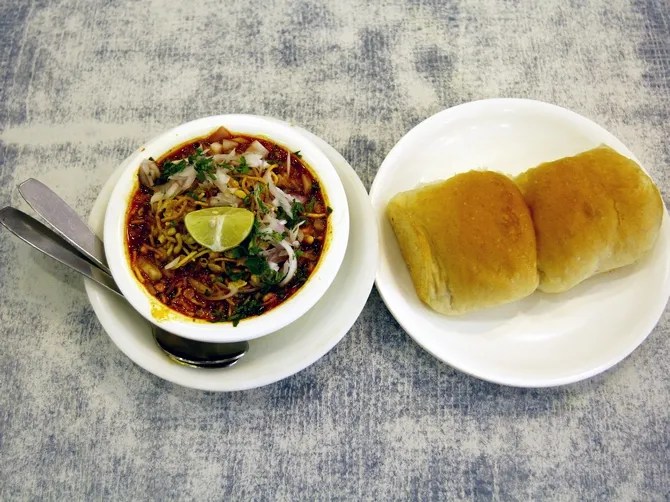
World’s Tastiest Vegetarian Dish….

Misal Pav, the delicious Maharashtrian snack served at Mumbai’s Aaswad restaurant won the prize at the global Foodie Hub Awards in London. 

The humble misal pav served at Dadar’s Aaswad restaurant has been named the world’s tastiest vegetarian dish at the Foodie Hub Awards in London.

Misal is a spicy curry made of moth beans or dried peas and served with boiled potatoes and garnished with raw chopped onions and farsan.

Often served with curds and pav (or bread), misal is a breakfast snack that is also eaten at lunchtime.

With its roots in the Kolhapur region of Maharashtra, the dish has several variations across the state.

Some variations get their names from the ingredients that go into it: Dahi Misal is misal served with curds and Shev Misal is, well, served with sev.

But most variations simply take the name from the region they are served in:

Puneri misal: Pune.

Khandheshi misal has its roots in Khandesh, the region in northwestern Maharashtra.

Nagpuri misal: Nagpur.

In Pune the spices are toned down but Mumbaikars prefer it spicy, says Kalyan Karmarkar who is the Foodie Hub Expert for Mumbai and who nominated Aaswad’s misal for the awards.

Kolhapur, largely believed to be the home of the misal, serves the spiciest variation of it and is called the Kolhapuri misal.

Located in the heart of Dadar in central Mumbai, just a hop-skip-and-jump from the headquarters of the Maharashtrian right wing political party, Shiv Sena, Aaswad was inaugurated by the late Bal Thackeray in 1986.

Today, Aaswad serves some 400 plates of misal pav every day.

Suryakant Sarjoshi, Aaswad’s owner who seems rather chuffed with this honour, tells us that it earns the restaurant about Rs 19,000 daily.

Then there is Vilas Taral who gives us a crash course in making the misal:

First moth beans, garlic and onions are boiled in water along with curry leaves.

Add grated coconut and misal masala and continue to boil.

Separately heat two tablespoons of oil and add mustard seeds, asafoetida, cumin seeds and garlic and add to the curry.

The final flourish comes in the form of farsan, sev, onions and tamarind chutney.

The dish is typically served with bread and butter.

Among several patrons of the restaurant is Vilas Gurav (62), a former police officer who was enjoying the dish when we arrived.

“I travelled all the way from south Mumbai just to have this misal. The quality is outstanding,” he says.

It is a sentiment that Kalyan Karmarkar echoes.

“Aaswad’s misal is always fresh, the amount of spices added is perfect and the quality of the farsan is very good. It doesn’t make you feel heavy because they don’t use inferior oil,” he says.

Besides misal, Aaswad is also famous for several other Maharashtrian dishes such as the thalipith, kothambir wadi, piyush and aam panna.

Aaswad
Shivaji Park, Dadar (W)
Mumbai
Tel: 022-2445-1871/2445-1876

As with all Indian dishes, misal is made differently across the state.

Every home has its unique misal recipe.

Source……www.rediff.com

natarajan

Things You Probably do not Know about Mohammad Ali Jinnah’s Family Roots in India…

While history buffs may already be aware of this; for those who are not, Mohammad Ali Jinnah’s roots are currently set in the affluent business family of the Wadias.

Mohammad Ali Jinnah, the leader of All-India Muslim League and the founding father of Pakistan, married his second wife Maryam Jinnah (Rattanbai “Ruttie” Petit Jinnah) in the year 1918, who gave birth to their only child Dina Jinnah in the year 1919, in London. It is through Dina that we know of Jinnah’s roots today.

But what is to be noted in this father and daughter relationship is the low point that hit them both, before the partition phase. The low point? It was Dina’s decision of marrying a non-Muslim that drove her father against his own daughter and, became the triggering cause of disputes revolving around South Court (Jinnah House) located in Malabar Hills, Mumbai.

Read on to find more about the same and other important events that followed in the life of Jinnah’s daughter, now known as Dina Wadia.

Dina’s marriage to an Indian Parsi was the spark that lit the fire

DJW_1

From left to right- Fatima Jinnah (Jinnah’s sister), Mohammad Ali Jinnah, Dina Jinnah

Jinnah tried to dissuade his daughter, but she remained headstrong about

her decision to marry Neville Ness Wadia. Jinnah’s assistant at that time, M C Chagla, recalls that Dina even tried to counter her father saying “Father, there were millions of Muslim girls in India. Why did you not marry one of them?” And owing to the fact that her mother Maryam was coincidentally also a Parsi before marrying Jinnah, Jinnah replied, “She became a Muslim”. In fact, in the autobiography of M C Chagla, “Roses in December”, it is allegedly mentioned thatJinnah disowned his daughter for her this decision.

Apparently, he worried that if Dina married a Parsi, it would be she who will have to change her religion.

Her relationship with her father became extremely formal. Dina lived in Mumbai with her husband and gave birth to a boy and a girl. After her marriage, she did not visit Pakistan until September of 1948, when she had to be there to attend her father’s funeral.

The Jinnah Mansion Dispute

DJW_3

When Jinnah returned to India from London to take charge of the Muslim league, he got himself made a palatial mansion called South Court (Jinnah’s house) by a British architect, in 1936. Pakistan’s then President Parvez Musharraf expressed his interest to the then Indian Prime Minister, Atal Bihari Vajpayee over acquiring the property and converting it into consulate. When Dina, who lived in NY then, got to know of this, she wrote to the PM saying that the mansion on the Malabar Hills should be handed to her and not to Pakistan.

Pakistani laws state that a person can be disinherited for violating Islamic rules and since Dina broke the Islamic law by marrying a Parsi, she can not claim her father’s property. However, to this, she countered through her counsel saying that Muslim law does not apply for her father who was a Khoja Shia (people from South Asia who converted to Islam) but instead, it is Hindu customary law that should technically be applied.

Dina’s second and final (till date) visit to Pakistan was in 2004

Dina with her son Nusli Wadia and grandsons Ness and Jehangir visited Lahore, Pakistan, in the year 2004 to watch Indo-PAK cricket match. Her this visit to Pakistan was straight after her first visit in 1948 and garnered a lot of public scrutiny. Dramatic talks of an old lady visiting as a foreigner, to a country founded by her own father, started going rampant. Although she and her son chose not to express their feelings to the public, they did visit the mausoleum of Jinnah, the museum located within the premises of the mausoleum, the tomb of her aunt Fatima, Flagstaff house Pakistan and her father’s house Wazir Mansion.

The Wadias as we know today

DJW_5

From left to right- Neville Ness Wadia (husband), Maureen Wadia (daughter-in-law), Jehangir (grandson), Nusli (son), Ness (grandson)

Dina’s husband Neville Ness Wadia, with whom she tied the knot defying her father and the religion’s laws, passed away in the year 1996. Neville was born in an already well established business family and succeeded his father as the chairman of Bombay Dyeing in 1952.

Nusli Wadia, Neville and Dina’s son, took over the company after his father’s retirement in 1977.

Ness and Jehangir are Nusli’s two sons. Now while we know Ness as the managing director of Bombay Dyeing and co-owner of IPL team Kings XI Punjab, Jehangir heads the budget airlines company Go Air.


Dina Wadia is the living legendary example of a strong woman who fought for what she believed in, even though it required her to go against the strict society norms of the early 90s.

Source.. Ananta Sharma in .www.storypick.com

Natarajan

” Untold Story of Indians Served in World war 1….”

Over one million people served in various battlefronts during World War I. And yet, even today, we know so very little about them.’

‘It is absolutely essential to acknowledge this part of India’s colonial history,’ Santanu Das tells Vaihayasi Pande Daniel/Rediff.com  

Indian soldiers training with bayonets.

Image: Indian soldiers training with bayonets.
Photograph courtesy: Imperial War Museums

A little over 10 years ago Santanu Das, who teaches English at King’s College, London, and whose fascination with World War I began with its poetry, started, on a whim, researching the Indian involvement in that war.

The sheer breadth of the statistics that confronted him was startling. And the attendant historical poignancy, of the duty India discharged for Britain, fascinating!

Das was hooked.

His examination of the Great War veered from poetry and became increasingly historical as he delved further and further into the lives of the brave, sturdy Indian soldiers who left Indian shores for distant and strange parts of the world to fight a war they had little understanding of.

They discharged their duty diligently and mostly with distinction, thousands of them dying far from home.

The result of Das’s research is his most recent work, 1914-1918: Indian Troops In Europe(external link), a visual history based on rare archival photographs from Europe and India.

It was published in India by Mapin, January 2015, and will hit bookstores in the US and Europe September 25, to mark the 100th anniversary of the beginning of the Battle of Loos, the major last battle fought by the Indian infantry on the Western Front before they were transferred to Mesopotamia.

Das was educated in Kolkata and Cambridge and is the author of Touch And Intimacy In First World War Literature(Cambridge, 2006) which was awarded the Philip Leverhulme Prize and is the editor of Race, Empire And First World War Writing (Cambridge, 2011) and theCambridge Companion To The Poetry Of The First World War (2013).

He is currently completing for Cambridge University Press a monograph titled India, Empire And The First World War: Words, Images, Objects And Music which formed the basis of a two-part series he presented for BBC Radio 4 titled Soldiers Of The Empire (external link).

Some of his archival material is showcased in a film titled From Bombay To The Western Front: Indian Soldiers Of The First World War (external link).

In an e-mail interview with Vaihayasi Pande Daniel/Rediff.com, Das describes, with a wealth of bittersweet details, the outstanding historical debt Britain owes the lowly but heroic Indian Sepoy:

How did you come to be interested in the history of Indian soldiers in World War I?

I was introduced to First World War poetry during my time at Presidency College, Kolkata.

It was while doing my first book, Touch And Intimacy In First World War Literature, that I became fully aware — and increasingly disturbed — by the enormity of the Indian involvement in the war and their erasure from ‘Great War and modern memory’. That was in 2004.

I then researched and found out that four million non-white men were drafted for the war in the European and American armies; over a million of them were Indians. And yet, even today, we know so very little about them. I became increasingly absorbed.

It was about this time — almost 10 years ago now — that I visited the French Institute at Chandernagore in West Bengal and discovered the broken and bloodstained glasses of ‘Jon’ Sen, the only non-white member of Leeds Pals Battalion, who was killed May 22, 1916. It was a revelation; there was no going back.

What particular challenges do we face in trying to recover the Indian experience of the First World War?

The majority of the Indian soldiers were semi-literate or non-literate and did not leave behind the abundance of diaries, memoirs, poems or novels that form the cornerstone of European memory of the First World War.

Indian soldiers, wounded during World War I, convalesce in England

Indian soldiers, wounded during World War I, convalesce in England. Photograph courtesy: British Library

Of course, we have the censored letters of the Indian soldiers: they were dictated by the sepoys to the scribes or occasionally written by the sepoys themselves, then translated and extracted by the colonial censors in order to judge the morale of the troops, and these extracts have survived today.

They are important documents, but are also problematic sources because of the process of mediation. Some of these letters are collected in a very helpful anthology by David Omissi (Indian Voices Of The Great War, 1914-1918).

In addition to these, we have hundreds of photographs of the Indian troops — in trenches, fields, farms, billets, markets, towns, cities, railway stations, hospitals, prisoners-of-war camps. Though framed by the European gaze, they are some of the most eloquent testimonies and capture most vividly the daily texture of their lives. In the absence of substantial written documents, these photographs break the silence around them.

Indeed, this is what prompted me to compile these photographs from various archives in India and Europe (France, Belgium, Britain and Germany) for my visual history 1914-1918 Indians Troops In Europe. A selection of pictures from this book can be found at here(external link).

Why are the Indian soldiers forgotten?

After the devastation of the war, Europe naturally turned its attention to its own dead, wounded and bereaved; the colonial contribution, visible and acknowledged during the war years, became increasingly sidelined in the post-war years in the ‘Great War and (European) memory’.

On the other hand, in India, the country’s involvement in the First World War was immediately followed — and gradually eclipsed — by a general sense of betrayal and disillusionment with British rule, the anti-Rowlatt act demonstrations and the massacre at Amritsar (Jallianwala Bagh) in 1919 and the gradual rise of the anti-colonial nationalist movement under the leadership of Gandhi.

In post-Independence years, the nationalist narrative understandably supplanted and almost erased the country’s participation in an imperial war. So the Indian contribution to the First World War gets written out of both the European and Indian narratives.

Yet, we are talking about the experience of over one million people who served in the various battlefronts during the First World War; it is absolutely essential to acknowledge their experience and this part of India’s colonial history.

In 1914-1918: Indian Troops In Europe (Mapin, 2015), I focussed on the most visible group — the ones who fought on the Western Front — through rare photographs from various archives across India and Europe.

In India And The First World War: Objects, Images, Words And Music, to be published by Cambridge next year, I seek to weave together the first socio-cultural history on the subject.

India’s involvement in the First World War cannot be confined to a narrow ‘military history,’ but has to be integrated into a much broader framework of cultural, social and political history.

However, to recover the Indian war experience does not, and in my view should not, involve any attempt to ‘glorify’ an imperial — or for that matter any — war or ‘celebrate’ the achievements of these soldiers. We are talking about traumatic events.

Moreover, these sepoys were the sentinels of the empire, let that be clearly acknowledged at the outset. Yet it is important to understand and analyse their involvement in the war without trying in any way to whitewash the ills of colonialism or falling prey to post-imperial nostalgia in any way.

Indeed we should try to understand the imperial war effort and the nationalist struggle in an expanded frame of reference that bears witness to the country’s complex and contradictory histories.

Indian bicycle troops at Somme, France, during World War I.

Image: Indian bicycle troops in Somme, France, during World War I.
Photograph courtesy: Wikimedia Commons

What are some of the most interesting nuggets of history that you might have uncovered about the Indian soldier in WWI during your research?

I have been researching this subject for nearly 10 years now.

In the Australian War Memorial in Canberra, I came once across a page in the diary of an Australian private where an Indian soldier had signed his name ‘Pakkar Singh’ in Urdu, Gurmukhi and English.

The most moving artefact I found was a pair of broken, bloodstained glasses belonging to ‘Jon’ Sen the only non-white member of the famous Leeds Pals Battalion — who was killed May 22, 1916. The discovery of the glasses led to a lot of media interest both in the UK and in India and to a short BBC documentary (external link).

A search through my extended family and friends in my hometown, Kolkata, revealed the war mementos of Captain Dr Manindranath Das: his uniform, whistle, brandy bottle and tiffin box, as well as the Military Cross he was awarded for tending to his men under perilous circumstances. Das was one among several distinguished doctors from the Indian Medical Services who served in Mesopotamia.

Over the years, I have had many such finds. I found this particular archival part of the research immensely moving: these objects are the mute witnesses to the war experiences of these men, the repository of what in my first book I call ‘touch and intimacy’.

Approximately how many Indians fought in World War I?

Although I provide more detailed figures in my book 1914-1918: Indian Troops In Europe, here are some rough statistics.

Between August 1914 and December 1919, India recruited, for purposes of war, 877,068 combatants and 563,369 non-combatants, making a total of 1,440,437 recruits; of them, over a million, including 621,224 combatants and 474,789 non-combatants, served overseas during this timeframe.

These included the infantry, artillery and cavalry units as well as sappers, miners and signallers, Labour and Porter Corps, Supply and Transport Corps, Indian Medical Service and Remount and Veterinary Services.

Where did they serve? Which battlefields?

During the war years, undivided India (which would today comprise India, Pakistan, Bangladesh and Burma) sent overseas seven expeditionary forces: the Indian Expeditionary Force A to Europe, IEFs B and C to East Africa, IEF D to Mesopotamia, IEFs E and F to Egypt and IEF G to Gallipoli.

In the course of the war, they served in almost all parts of the world — from the mud-clogged trenches of the Western Front and the vast tracts of Mesopotamia to the tetse-fly infested savannah of East Africa and the shores of Gallipoli; they also served in East and West Persia, Palestine, Egypt, Salonika, Aden, Tsingtao and Trans-Caspia.

Indeed, to follow the routes of the Indian sepoy during the First World War is to trace its global course.

Parisians cheer Indian soldiers after the Bastille Day Parade.

Image: The cover of Das’s latest book shows Parisians cheering Indian soldiers after the Bastille Day Parade.
Photograph courtesy: Santanu Das

What parts of India did they hail from? And what strata of society?

In 1914, India had the largest voluntary army in the world.

But the men were recruited from a very narrow strata of its huge population, comprising largely the peasant-warrior classes spread across northern and central India, the North-West Frontier Province, as well as the kingdom of Nepal, in accordance with the prevalent colonial theory of ‘martial races’.

A combination of shrewd political calculation, indigenous notions of caste and imported social Darwinism, it formed the backbone of British army recruitment in India.

It deemed that certain ethnic groups — such as Pathans, Dogras, Jats, Garwahlis, Gurkhas — were ‘naturally’ more war-like than others. These communities had often low literacy rates, were traditionally loyal and thus least likely to challenge the British Raj — very different from the politically active and articulate Bengalis who were cast as ‘effeminate’ and barred from joining the army.

Of its 600,000 combatants, more than half came from the Punjab (now spread across India and Pakistan) which saw some of the most intense recruitment campaigns.

How many casualties were there and what happened to their remains? 

Prime Minister Narendra Modi at the World War I Memorial in Neuve-Chapelle, France, April 11, 2015. Photograph: Press Information Bureau

Image: Prime Minister Narendra Modi at the World War I Memorial in Neuve-Chapelle, France, April 11, 2015. Photograph: Press Information Bureau  

It is difficult to provide a precise figure for the number of Indians killed and wounded in the First World War. Between 60,000 and 70,000 of these men were killed.

If one visits the battlefields of the Western Front, one comes across gravestones with their names and inscriptions etched in the appropriate language and carefully maintained by the Commonwealth War Graves Commission — not to mention the names of the Indians killed etched on the Menin Gate itself at Ypres.

One of the most moving places in the Western Front is the beautiful Indian memorial at Neuve Chapelle dedicated to the memory of the 4,700 Indian soldiers and labourers who have no known graves.

In the war cemetery in Dar-es-Salaam in Tanzania (then German East Africa), I have seen huge memorial tablets with the names of Indian combatants and non-combatants, but not a single gravestone. However I don’t know whether these men were cremated or the remains of these men were not found or it was decided as a matter of colonial (discriminatory) policy to commemorate them only on memorial tablet rather than bury them with individual gravestones (as with the white soldiers buried and honoured in the same cemetery in Dar-es-Salaam).

I understand that while the Indian soldiers, killed in Europe, were commemorated with individual gravestones, those — particularly the privates — killed in Mesopotamia and East Africa were denied such honour.

On the other hand, in Britain, where some of the wounded soldiers died, they were either buried in the Woking Cemetery or cremated at Patcham in the Sussex Downs, with appropriate religious rites.

In Iraq, the names of the Indian fallen are etched on the Basra Memorial. So the practice varied widely and it is difficult to pinpoint the exact impulses at work — sometimes it was race, sometimes religion, sometimes it was where they died, and sometimes a matter of contingency and the whim of the local authority.

In 2011, I edited a book, Race, Empire And First World War Writing. (Noted social theorist and an expert on the cultural and social history of World War I) Michele Barrett explores some of these issues in the ‘afterword’ to the book.

And what happened to the families left behind in India?

Devastation presumably, as with hundreds of thousands of families around the world, but we do not know the precise details. Many of the families these soldiers came from villages dotted around northern and north-west India and the North-West Frontier province. They were non-literate and hence have not left memoirs or diaries or letters.

There’s the extraordinary and immensely moving local tradition of songs of mourning sung by the village women which give us some insight into the grief and devastation the war caused across parts of North India, particularly in the province of Punjab.

The Punjabi poet Amarjit Chandan collected some of these songs. One of the songs goes (originally in Punjabi, here in Chandan’s translation):

War destroys towns and ports, it destroys huts
I shed tears, come and speak to me
All birds, all smiles have vanished
And the boats sunk
Graves devour our flesh and blood.

A few years ago, I interviewed Punjabi novelist Mohan Kahlon in Kolkata. He mentioned how his two uncles — peasant-warriors from Punjab — perished in Mesopotamia, and how his grandmother became deranged with grief. In the village, their house came to be branded aspagal khana (the mad house).

If you have any Indian First World War anecdote, papers or objects, please feel free to contact Santanu Das at santanu.das@kings.ac.uk

1914-1918: Indian Troops in Europe, by Santanu Das will be published (external link) in the US and Europe on September 25, 2015, to mark the 100th anniversary of the beginning of The Battle of Loos, by Mapin Publishing in hardback.

Vaihayasi Pande Daniel / Rediff.com

source….www.rediff.com
natarajan
“How IIT Kharagpur Researchers are ‘Leading a Green Revolution’ …”

Indrani Roy/Rediff.com traces how researchers at IIT-Kharagpur have managed to turn barren land of surrounding villages to multi-crop farmland

Prof PBS Bhadoria speaks to farmers

Dr P B S Bhadoria of IIT-Kharagpur speaks to the farmers of Khentia village in Kharagpur.

Jagannath Das, a farmer in his late 40s is surveying a farmland at Khentia village in Kharagpur.

The summer sun is merciless.

With the mercury at cruel 42 degrees, Das is sweating profusely but is smiling a happy smile.

“Five years ago, we could not imagine producing even a handful of paddy in this barren land of Khentia.

“But thanks to IIT Kharagpur professors, we can now grow paddy for our own consumption and can also farm soyabean, sweet corn, sesame, peanut etc,” Das tells  rediff.com.

Dilip Kumar Swain and PBS Bhadoria

Dilip Kumar Swain (left) and Dr PBS Bhadoria at Khentia village.

A group of researchers at the IIT-K, which is about 10 kms from the Khentia village, have ‘adopted’ 14 acres of erstwhile barren land and turned it productive.

The farmers of Khentia who are working in tandem with the IIT team now can not only grow their own food but can also nurture the dream of selling the extra produce directly to retailers bypassing the greedy middlemen.

“We are really happy to be involved in this project. We can now grow our food and can also make money by selling the cash crops like sweet corn, peanut, soyabean that we have started growing in our land,” says 70-year-old Gora Das.

According to the IIT team, Das is one of the most hardworking farmers of Khentia.

“During the initial months of land preparation, we saw him working round the clock de-weeding the fields and tilling it from dawn to dusk,” says Abhishek Singhania, a young member of the IIT team.

Baby steps

Vermicomposting

The IIT team helped the farmer prepare a special low-cost vermicompost.

“Our biggest challenge was to prepare this land, which has been lying unused for years, suitable for cultivation,” says P B S Bhadoria, an IIT faculty member who is leading this initiative along with 29 other teachers.

“The project was conceived a year back when our director Partha P Chakrabarti approached the central government and expressed his intent to do something on food security.

“The central government lauded the idea and agreed to support the move,” Bhadoria says.

The harvesting machine

Farmer Jagannath Das demonstrates the harvesting machine.

Thereafter, 14 acres of land from 14 farmers of Khentia was chosen for the Rs 16-crore (Rs 160-million) project.

The field work for the project started in October 2014.

The project involves three departments of IIT-Kharagpur — agriculture and food technology, biotechnology and industrial engineering.

At present, there are about 30 experts assisting Bhadoria.

The total span of the project is three years.

Convincing the farmers wasn’t easy

“Convincing the farmers was a daunting task. Initially, the farmers were not ready to hand over their land to the IIT people. There was some political tension as well.

“Farmers with differing political views tried to create complications,” Bhadoria tellsrediff.com.

“But these problems were sorted out after long discussions and we got the farmers’ nod to go ahead with our experiments on these barren lands,” he adds.

“Perhaps, the farmers too did not like the fact that the land was lying unproductive for years,” Bhadoria says.

Storage pit for crops

A storage pit for crops.

How the land was prepared

“Small adjacent pieces of land belonging to a single farmer were merged,” says Dilip Kumar Swain, associate professor, agricultural and food engineering department.

“Primary and secondary tillage was done by tractor-driven plough followed by levelling in November,” he adds.

“We did soil testing, which helped us determine the amount of fertiliser needed.”

“Earlier, the farmer would randomly use chemical fertiliser which often affected the land’s fertility.

“However, the 14 farmers who have partnered with us, now know the importance of soil testing before applying chemical fertiliser”, Swain says.

‘We gave importance to partnership’

“We wanted to bring the farmers into the project’s fold right from the beginning,” Bhadoria tells rediff.com.

“It had to be a collaborative project,” he adds.

“The understanding is, for one year, we will provide the farmers technical assistance, machines while they will provide free labour,” Swain tells rediff.com.

Peanut

Apart from paddy, the farmers of Khentia are also growing peanuts.

“And after a year, we plan to hand over the entire project to the farmers,” he adds.

“This way, the farmers will attain self sufficiency,” Swain says.

The farmers have been asked to form a cooperative wherein they will distribute the produce of the land according to their percentage of ownership.

“While this creates a bonding among them, it also instills a sense of competitiveness among the tillers of the soil,” Swain says.

Irrigation was the key

The IIT team developed an irrigation facility in December by:

  • installing a deep tube well in the area;
  • constructing a pump house and
  • by providing fencing protection of the cropped land

As part of the irrigation system development, a pond in the area was renovated to store rain water and grow fish. The pond was plastered with bentonite clay to check seepage.

According to Singhania, “The pond now takes care of the irrigation of the farmland to a large extent,” Singhania says.

The Khentia land

The Khentia village project.

How production was enhanced

The farmers were given training on the production technology of System of Rice Intensification.

This technology saves 80-90 per cent seed and 40-50 per cent water.

The farmers were introduced to organic rice production technology.

They were taught to supply essential nutrients to their crops by using organic manure.

Trainings were given on effective and proper use of bio-pesticides.

“With the help of these technologies, farmers of Khentia could now produce as much as two tonnes of rice per acre,” Swain tells rediff.com.

“Moreover, they were able to minimise the loss of crops occurring out of unseasonal rains this year,” says Bhadoria.

Agrees farmer Swapan Das.

“Apart from growing rice in abundance, we doubled the production of other crops as well. It’s a miracle,” Das tells rediff.com.

Initially, the farmers of Khentia wanted to grow rice only.

However, after studying the land, its water demand and fertility, the IIT team introduced high value, soil restoring crops like sweet corn, sesame, soybean and peanut.

Jagannath Das and Swapan Das

Farmers Jagannath Das and Swapan Das.

A low cost vermicompost is of great help

The IIT team helped the farmer prepare a special low-cost vermicompost by rotting cow dung, water hyacinth, farm wastes with 2.5-3 kg of eisenia foetida, a special species of earthworm in each bed of size 1.8mx1.2mx1m.

Each bed is expected to produce 100 kg of vermicompost in a single cycle of 60 days.

“Earlier, the farmers would burn the farm waste, causing pollution,” Singhania tells rediff.com

Soyabean cultivation

An IIT team member shows a soyabean fruit.

“We taught them to convert the farm wastes into an environment-friendly vermicompost which will cause any pollution but will give them a tool to practice organic farming,” he adds.

Singhania has his hands full making a sustainable farming-cum-marketing model so that once the IIT team leaves, the farmers can do everything on their own.

“We want to make them self-sufficient. They should grow their food, sell the extra produce to the retailers sans the middlemen and improve the condition of their land for sustenance,” Singhania says.

Future looks bright

The IIT-Kharagpur initiative has drawn accolades from the Union Human Resource Development Ministry, which has awarded the institute a grant of Rs 26 crore (Rs 260 million) to replicate the experiment in nine other villages.

The project has also been made a part of the Narendra Modi government’s Unnat Bharat Abhiyan.

The IIT has adopted surrounding villages of Polisa, Chakmakarampur, Paparara I and II, Sankua, Lachamapur, Kaliara-1 and 2 and Changual to replicate the experiment there.

IIT-Kharagpur director Partha P Chakrabarti couldn’t have been happier.

“To focus on food security is an absolute must and we just can’t afford to ignore agriculture,” he tells rediff.com.

IIT Kharagpur director

IIT Kharagpur director Partha P Chakrabarti.

“We often see farmers falling preys to advertisements and other marketing gimmicks,” says Chakrabarti.

“They have very little knowledge of technicalities of farming, quality of fertilisers and pesticides and end up paying for only those that are the most advertised.

“But as technical experts, we felt we should impart them the knowledge about farming.

“Since Kharagpur is surrounded by villages, we thought of starting the experiment here. “We are happy that our years’ of research in agriculture laboratories has borne fruit”, the director says.

Other Indian states like Bihar have approached the institute to start similar projects there.

Photographs: Dipak Chakraborty/Rediff.com

Indrani Roy / Rediff.com

Source….www.refiff.com
Natarajan

Meet Abhishek Singhania …an IIT Madras Graduate who works with Farmers…

Indrani Roy/Rediff.com meets Abhishek Singhania who left a bright career at PricewaterhouseCoopers, Mumbai, to work in a food security project at Khentia village in Bengal, as a research fellow.

Abhishek Singhania with farmers

Image: Abhishek Singhania (standing extreme right clockwise). Photograph: Dipak Chakraborty/Rediff.com

Abhishek Singhania is a strange young man. Graduating in metallurgy from Indian Institute of Technology – Madras in 2012, he got himself a dream job of a consultant at PricewaterhouseCoopers, Mumbai. But unlike the youngsters of his age, the cushy job that fetched him Rs 90K per month failed to satisfy him.

Instead, he wanted to dedicate his time to a job more meaningful, an endeavour that would have a direct and positive impact on the growth of India.

“I should be working with farmers instead,” Abhishek told himself.

A few months into his job at PwC, he was sent to Jeddah, Saudi Arabia, for six months on an assignment.

“There was no problem with the consultant’s job as such but an inner voice kept pestering me that I was not meant for this. I needed to do something else,” Abhishek told rediff.com.

“I started thinking deeply about my career and my future.

“I was not sure if I would continue with my job at PwC or join the automobile sector (I am passionate about cars) or agriculture,” Abhishek said.

“It was around this time that I started preparing for Graduate Record Examinations but soon lost interest.

“For some time, I have been reading reports of farmers’ suicides and they have perturbed me a lot,” Abhishek said.

“I thought if technical people like us can train these farmers, it can lead to better production and lesser suicides”.

Abhishek returned to India from Jeddah in June 2014.

He took a break from office and visited Temathani village near Kharagpur.

“I met the farmers there and discussed the problems that they face,” Abhishek said.

“I was taken aback by their sheer lack of knowledge,” he said.

“I could understand that they did not know how to treat the soil with right kind of fertilisers for higher production.

“I also realised that the farmers did not know how to save their crops from pests.

Abhishek Singhania (extreme right clockwise) experimenting with biochar

Abhishek Singhania (standing extreme right clockwise) experimenting with biochar. Photograph: Kind courtesy, Abhishek Singhania

“I came to know that they were often using the wrong pesticides that caused more harm to the soil than good.

One fine morning, Abhishek came to IIT Kharagpur from Temathani.

“I knew that this IIT alone has an agriculture department and food technology schools.

“I heard from a cousin of mine, who is a student here, that Dr PBS Bhadoria and Dr Dilip Kumar Swain, were doing a food security project here.

“When I met them they said a project is expected to take off soon in a village nearby.

They, however, could not give me a timeline. ”

In December, Abhishek resigned from PwC and went to Pondicherry to take a look at some organic farms and startups there.

The biochar is made

Image: The biochar is made. Photograph: Kind courtesy, Abhishek Singhania

“I was integrating within me all the necessary information about agriculture,” Abhishek said.

He revisited Kharagpur IIT in February end and after a second round of discussion with Bhadoria and Swain, he decided to join, as a research fellow, the duo’s Food Security Project at Khentia village located 10 km from the institute.

The fact that his stipend would now be a meagre 15K a month did not deter Abhishek even once.

“Rather, I was happy to have finally made up my mind”, he told rediff.com.

Now, Abhishek spends hours with farmers of Khentia village, teaching them essential skills of farming.

Under this project, a barren 14 acres of land has been ‘adopted’ from 14 farmers by the IIT team.

In a collaborative approach, wherein the farmers give free labour and the IIT team the technical knowhow, the land has been treated and made ready for cultivation.

Irrigation system has been revamped and the farmers can now produce rice for their own consumption (earlier they needed to buy rice from the market).

Riding on the success of abundant production of rice, Abhishek’s team has taught the Khentia farmers to produce soyabean, sweet corn, peanut and sesame.

“Target of our project is to make these farmers self-sufficent so that apart from growing their food themselves, they can enhance their income by selling the cash crops to the retail market.

The IIT team plans to give hands on training to the farmers only for a year and once the team feels that the farmers are confident and skilled enough to run the show themselves, the team will move out to other villages of Kharagpur to replicate the same project there.

Abhishek Singhania with a dhenki

Abhishek Singhania poses with a dhenki, machine used by rural folks to produce rice from paddy. Photograph: Dipak Chakraborty/Rediff.com

Abhishek leads the team of trainers from the IIT that keeps visiting the farmers regularly.

At present, he has his hands full making a sustainable farming-cum-marketing model so that once the IIT team leaves Khentia, the farmers there can do everything on their own.

“We want the farmers to form a cooperative that will work towards their interests and well being,” Abhishek told rediff.com.

Abhishek is also making environment-friendly biochar and biogas for the Khentia farmers.

“Generally the farmers burn the plant residue on the field after harvesting. In the process, most of the carbon from the plants get transferred back to the atmosphere in the form of carbon dioxide, carbon monoxide, methane, etc thereby increasing global warming,” Abhishek said.

“Instead, if we do pyrolysis in controlled conditions, we can retain a substantial amount of the carbon in the final product (biochar).

“Biochar increases soil fertility and has many other advantages.

“Our primary aim is to develop an ideal setup for producing biochar which should be simple so that farmers can operate it, it should be inexpensive and should have high efficiency.

“Till now we have done five experiments with 3 different set ups.”

“If my experiments on these products is successful here, I’ll carry them to other villages as well,” he told rediff.com.

As he guided us around the Khentia village in the scorching May heat, sweats covered Abhishek’s forehead.

But his smile spoke for itself how much he enjoyed this new assignment of his.

Isn’t this rigorous farm work tiring?

“Na didi, it’s fun. I had always dreamt about doing something meaningful in life. After a long wait, I have got an opportunity to follow my dream,” said a beaming Abhishek.

Abhishek Singhania poses with a rice storage container

Abhishek Singhania poses with a rice storage container. Photograph: Dipak Chakraborty/Rediff.com

Once his research at IIT-Kharagpur gets over, Abhishek wants to set up a firm that will lend technical assistance towards integrated farming.

After completing his research, Abhishek wants to travel to villages all over Bengal to interact with farmers and share his experience and knowledge with them.

“At present, with the current population, implementation of National Food Security Act requires 61 metric tones of foodgrains annually,” said Abhishek.

“Moreover, India needs to double its agricultural productivity by 2040 to reduce the supply and demand gap.”

These statistics, Abhishek said, outline the need for research in the field of food production.

“I am happy to be a small part of this gigantic research,” he told rediff.com.

Asked if he missed his high profile career at PwC, the young farming enthusiast said, “Not in the least. I am being true to my soul. I have transformed my passion into my profession.

“All that I ever wanted was to have a car of my own. I drive a Hyundai i10 now. What more can I ask for?” Abhishek said.

“For the entire six months of my stay at Jeddah, I stayed at Radisson. But here at Kharagpur IIT, I am staying in a small hostel room with a common washroom.

“The huge difference between my living arrangements here and there never bother me for a minute.

“We get only one life. Why waste it chasing frivolous things?”

Indrani Roy / Rediff.com in Kharagpur

Source………….www.rediff.com
Natarajan
>


How This Start-Up Helps Unorganised Blue-collar workers Get Better Jobs…

Bengaluru-based babajob.com is trying to help unorganised blue-collar workers get better employment.

Team that connects the employers with the right kind of workers

On learning that his boss needs another driver, autorickshaw driver Amit, in Bengaluru, recommends his cousin, Sumit. An out-of-work sharecropper, Sumit is hired, and his income doubles.

Anita works as a nanny for a well-to-do family in Mumbai. When another family she knows needs a cook, she recommends her sister, Sunita.

Most blue-collar jobs in India are offered and secured through such recommendations. But aspirations are changing and most employment seekers in the segment are now looking to work for brands that pay good salaries.

Dedicated to connecting the right job seeker with the right employer in this unstructured segment, Bengaluru-based start-up babajob.com uses the internet, mobile apps and a variety of other routes.

With a fresh round of capital from SEEK Ltd, an Australian online placement service, it now plans to expand.

Sean Blagsvedt, the man behind babajob.com

Fight against poverty

After nine years in Microsoft, Sean Blagsvedt moved to Bengaluru in 2004, to head the program management and advanced prototyping team of Microsoft Research India. He was focusing on mobile phones and technology in emerging markets.

“I came across a Duke University research study on poverty alleviation. It said the primary path out of poverty was income diversification by securing another job. The study also identified that successful income diversification involved knowing somebody with access to information about the jobs. This led to the idea for a Village LinkedIn, which gradually morphed into babajob.com,” said Blagsvedt, now chief executive officer (CEO) of the start-up, launched in 2007.

The main difficulty, said Blagsvedt, was reaching the job seekers – delivery guys, drivers, security guards and household helps. Most of them do not traditionally have internet access.

“We tried working with non-government organisations and telephone companies. But we found that mobile web and telephone services like Miss Call for a Job reached more people by using traditional media like the press. Connecting with aspirational job seekers was the most effective acquisition channel. It allowed us to reach three million job seekers in 2015.”

Missed call for a job

Two of the most frequent responses that successful job seekers provide babajob.com are 20 per cent salary raise and reduced commute to work.

The site now has about three million job seekers for 2.5 million vacant positions.

“Our primary point of contact is a missed call. A job seeker calls 08880004444. Then, our system automatically calls the number back and generates a profile for him/her through our interactive voice response system. The job seeker is registered on our website,” said Blagsvedt.

The company is now processing about 150,000 job applicants every month.

“According to our estimates, we are able to place nearly 2,000 job seekers every month. We have placed more than 500,000 job seekers since inception,” the CEO said.

The revenue model is simple. The service is free for job seekers but the employers have to pay for services, depending on the package they choose.

Each employer is assigned a recruitment support executive to optimise their campaign. Those who plan to hire in bulk get special packages. Applications through the website are about 47 per cent (combining WebApply and Web), mobile web applications account for 43.7 per cent of the traffic, while voice accounts for 9.2 per cent (including call centre), and Android has a 0.01 per cent share.

Experts feel it’s no mean task to raise awareness about digital platforms among job seekers from socio-economically disadvantaged backgrounds.

The company believes smartphones are becoming popular among blue-collar workers. The road ahead would involve expanding the digital footprint.

The firm did not share information about its revenue, but said it would look at providing value-added services to employers and job-seekers to boost margins.

The recent funding would be used to expand the team, develop the mobile app and improve services.

SEEK and its affiliate firms are the largest global online job marketplace across Africa, Australia, Bangladesh, Brazil, China, Mexico, New Zealand and southeast Asia.

In a statement it had said, “SEEK is a strong partner, with a common vision of using technology to connect as many to better jobs, especially in emerging markets.”

Asked about a possible geographical expansion, Blagsvedt did not rule it out. He said they were collectively excited about the association with SEEK and there was a lot to explore.

The target would be to reach hundreds of millions of people across the developing world in such a way that they are able to use the platform to seek jobs.

The start-up had earlier raised an undisclosed amount from GrayGhost Ventures and Khosla Impact in 2012, with a view to connecting all Indians to better jobs worldwide, especially in the Asia-Pacific.

FACT BOX

Founded: 2007

Founder: Sean Blagsvedt, Ira Weise & Vibhore Goyal,

Area of business: Mobile start-up dedicated to bringing better job opportunities to the informal job sector in the developing world

Funding: Undisclosed amount- GrayGhost Ventures & Khosla Impact (2012); $10 million from Australian online placement service provider SEEK (2015) 

EXPERT TAKE: Ravi Venkatesan

Babajob is attempting to use technology to organise an unorganised market. It is a great opportunity but there are many challenges. Both employers and job seekers have to be made aware and educated about the service.

This is no small challenge when you consider the socio-economic profile of job seekers.

The user experience has to be seamless even as you scale. Unit economics have to be improved so that scale-up results in good profitability.

I believe the lower income workers that companies like Babajob are targeting are rapidly adopting smartphones. However there is great variation across this population, especially as you go away from the major cities.

So, it will be important for Babajob to retain a hybrid approach, i.e both offline and online channels in order to provide widespread access.

Companies targeting this space will have to remain innovative and learn to leverage the old word-of-mouth networking techniques with a technology overlay to win in this market.

I would expect to see very strong growth in the customer base and repeat buying, improving unit economics driving rapid improvement in profitability.

Ravi Venkatesan is chairman, Social Venture Partners India.

Sohini Das

Source:
Natarajan

” To Bee or Not to Bee….”

Bees are an investment with high returns — the crop yield increases and products become healthier.

When bees are kept alongside farming activities, production increases between 20-200 per cent besides, of course, getting to sell honey on the market.

Shrikant Gajbhiye, founder of Bee The Change is helping spread awareness on bee keeping and its multiple merits. Read on to know more… 

Shrikant Gajbhiye

The new name for the butterfly effect is the ‘bee effect’, at least these days.

These buzzing clusters of little black and yellow insects pollinate almost 70 per cent of the crops that feed 90 per cent of humanity. But this  long and intricate natural chain, created by these busy bees, has been getting altered.

The sudden drop in bee populations worldwide is threatening the balance of the ecosystem with unpredictable consequences.

Shrikant Gajbhiye is the founder of Bee The Change, which offers free bee-keeping training to farmers and forest populations in Maharashtra.

He argues that when bees are kept alongside farming activities, production increases between 20 to 200 per cent besides, of course, getting to sell honey on the market.

A study in the UK has revealed that honeybees contribute £200 million a year with the services they indirectly enhance through their activities, and £1 billion with what they pollinate.

Similar studies are available in few other countries, but the function of bees in the food chain is the same everywhere.

In the US, some species of bees have virtually disappeared, the European Union has admitted their risk of extinction, and in India the number of the insects has drastically decreased — some point out RFR emitted by mobile phones and towers as one of the main causes. And this alarming fall in bee numbers is alarming everyone.

Given these assumptions, talking about ‘bee effect’ to indicate the massive consequences that can result from a relatively small cause, does not seem an exaggeration.

This is why Shrikant’s venture is not only about producing honey, but is directed towards broader outcomes.

Two years ago, after graduating from IIM Kozhikode, he took up a five-day hobby course on bee-keeping at a government institute in Pune, and fell in love with the striped honey-makers.

“I learnt some of the most amazing facts about bees and the role they play in the ecosystem by means of cross pollination.”

This opened my eyes not only on the key role bees play in nature, but also on the potential they have in changing the lives of people at the bottom of the pyramid,” Gajbhiye says.

Bee the Change trains the people in bee keeping

In the last few months, Bee The Change has trained more than 500 farmers and forest populations, and currently its network counts 50 trainees.

“As part of our operations, we meet farmers in rural areas and provide them with bee boxes and free training. Then, once they start bee-keeping, we buy back the honey at a pre-determined price. Ours is a not-for-profit outfit, and we generate income by selling this honey to retailers under our own brand.”

For farmers, the proceedings of honey and wax sales are only one of the numerous gains.

Bees are an investment with high returns — the crop yield increases and products become healthier.

“Bee-keeping and pesticides don’t really go hand in hand because chemicals cause the insects to die. So the farmers are asked to refrain from using pesticides while rearing the bees,” explains Shrikant.

This automatically reduces the use of pesticides.

Twenty-five Bee the Change trainees are working towards obtaining the certification for organic farming, which they usually apply for in groups generating cooperative work.

It is not easy to persuade farmers to take up the challenge because bee-keeping requires an investment.

“A bee box costs around Rs 5,000 and bees start producing honey only after a few months. Usually, in areas where we haven’t worked before, one out of ten farmers is willing to keep bees for a year. But once this farmer shows an exponential increase in crop production, others follow.”

Also, each bee colony can give as much as two more bee colonies through division each year providing additional income.

Shrikant Gajbiye explains the process of bee keeping

The organisation works with populations in the forests a little differently.

“We train them in techniques of natural honey hunting, which consists in extracting honey from existing combs without hurting the bees. This allows them to increase their income, and bees to be preserved in the wild.”

Be the Change also trains women in bee keeping

Gajbhiye says that there are very few organisations working on a similar models, but most of them working only with farmers, whereas Bee the Change includes populations living in the forests.

“Also, these organisations have priced their products in the premium range; whereas we have kept our product accessible,” he says.

Lack of training facilities for bee keeping in Maharashtra, unavailability of bee colonies, difficulties in maintaining a system of support for trainees, getting over negative preconceptions against bees, language barriers, and lack of funds are some of the challenges Bee The Change had to go through.

However, Gajbhiye says, “We dealt with these problems by getting ourselves trained first. We work with experts who help us with training and support, and importing colonies from elsewhere. We believe that exemplifying success stories is the best way of spreading awareness and gaining social interest.”

Currently, the number of colonies in nature is very low. This results in the costs of mobilising and installing these colonies is much higher than the price of the colonies itself.

“We are trying to rear the bee colonies in nature, breed them, and multiply them through our network to such levels that economies of scale can be exploited to increase our operational

efficiency,”says Srikanth.

Moreover, to further diversify the sources of income, Bee The Change is also planning to start training groups of women to produce organic honey and wax-based cosmetics.

The relevance of what Bee The Change is doing is undoubtedly huge and the team, which counts 20 volunteers, seems to have a great time in the process.

Shrikant Gajbhiye quotes Steve Jobs, “At least make a dent in the universe, else, why even be here.”

However, in a venture where resources are not abundant and ambition must scale up ten times faster that the venture itself, not a dent, but a revolution is the goal.

Source…..www.rediff.com

Natarajan

” Mystery of India’s Rapid Drift….”

The mystery of India’s rapid drift

India got a geologic boost that accelerated its drift toward Eurasia 80 million years ago, researchers suggest. The speed of the resulting impact created the Himalayas.

In this artist's rendering, the left image shows what Earth looked like more than 140 million years ago, when India was part of an immense supercontinent called Gondwana. The right image shows Earth today. Image credit: iStock (edited by MIT News)

A study in the journal Nature Geoscience on May 4, 2015 by team of MIT geologists offers an explanation for why the continent of India moved so rapidly toward Eurasia 80 million years ago.

More than 140 million years ago, India was part of an immense supercontinent called Gondwana, which covered much of the Southern Hemisphere. Around 120 million years ago, what is now India broke off and started slowly migrating north, at about five centimeters per year. Then, about 80 million years ago, the continent suddenly sped up, racing north at about 15 centimeters per year — about twice as fast as the fastest modern tectonic drift. The continent collided with Eurasia about 50 million years ago, giving rise to the Himalayas.

For years, scientists have struggled to explain how India could have drifted northward so quickly. Now geologists at MIT have offered up an answer: India was pulled northward by the combination of two subduction zones — regions in the Earth’s mantle where the edge of one tectonic plate sinks under another plate. As one plate sinks, it pulls along any connected landmasses. The geologists reasoned that two such sinking plates would provide twice the pulling power, doubling India’s drift velocity.

The team found relics of what may have been two subduction zones by sampling and dating rocks from the Himalayan region. They then developed a model for a double subduction system, and determined that India’s ancient drift velocity could have depended on two factors within the system: the width of the subducting plates, and the distance between them. If the plates are relatively narrow and far apart, they would likely cause India to drift at a faster rate.

The group incorporated the measurements they obtained from the Himalayas into their new model, and found that a double subduction system may indeed have driven India to drift at high speed toward Eurasia some 80 million years ago.

Based on the geologic record, India’s migration appears to have started about 120 million years ago, when Gondwana began to break apart. India was sent adrift across what was then the Tethys Ocean — an immense body of water that separated Gondwana from Eurasia. India drifted along at an unremarkable 40 millimeters per year until about 80 million years ago, when it suddenly sped up to 150 millimeters per year. India kept up this velocity for another 30 million years before hitting the brakes — just when the continent collided with Eurasia.

Leigh Royden is a professor of geology and geophysics in MIT’s Department of Earth, Atmospheric and Planetary Sciences. Royden said:

When you look at simulations of Gondwana breaking up, the plates kind of start to move, and then India comes slowly off of Antarctica, and suddenly it just zooms across — it’s very dramatic.

In 2011, scientists believed they had identified the driving force behind India’s fast drift: a plume of magma that welled up from the Earth’s mantle. According to their hypothesis, the plume created a volcanic jet of material underneath India, which the subcontinent could effectively “surf” at high speed.

However, when others modeled this scenario, they found that any volcanic activity would have lasted, at most, for five million years — not nearly enough time to account for India’s 30 million years of high-velocity drift.

Instead, the MIT researchers believe that India’s fast drift may be explained by the subduction of two plates: the tectonic plate carrying India and a second plate in the middle of the Tethys Ocean.

Celal Sengor is a professor of geological engineering at Istanbul Technical University who was not involved in this research. Sengor said:

India was going far too fast after it parted company with Africa-Madagascar and Australia. … Its speed northward, with respect to the rest of Eurasia, was faster than any plate motion we know today, or have inferred in the past across a single plate boundary. This paper not only has changed some of our ideas on the paleotectonics and paleogeography of the neo-Tethys, but has given us a new model about what double subductions can do.

Bottom line: According to a study published May 4, 2015 in the journal Nature Geoscience, India got a geologic boost that accelerated its drift toward Eurasia 80 million years ago.

Source…..www.earthsky.org

Natarajan


காந்தியை ஏமாற்றிவரும் இந்தியா…

சட்டத்தை மீறக் கூடாது என்ற உணர்வு ஹாங்காங் கல்விமுறையின் அடிப்படை போதனைகளுள் ஒன்று!

கடந்த வாரம் ஹாங்காங்கில் ஓர் இந்திய அங்காடிக்குப் போயிருந்தேன். பொருட்களை எடுத்துக்கொண்டு வரிசையில் நின்றேன். எனக்கு முன்னால் ஓர் இளம்பெண். கைபேசியில் தனது மூன்று வயது மகனின் குறும்புகளைப் பற்றிப் பெருமையாக அலுத்துக்கொண்டிருந்தார்- ஆங்கிலத்தில். கடைக்காரர் அந்தப் பெண் வாங்கியிருந்த காய்கறிகள், மளிகைப் பொருட்கள், நறுமணப் பொருட்கள், தின்பண்டங்கள் முதலானவற்றைத் தனித்தனி பிளாஸ்டிக் பைகளில் போட்டார். பின் அவற்றை இரண்டு பெரிய பிளாஸ்டிக் பைகளில் அடுக்கிக் கொடுத்தார்.

ஹாங்காங்கில் ஏப்ரல் ஒன்றாம் தேதி முதற்கொண்டு அங்காடிகளில் பிளாஸ்டிக் பைகள் கொடுக்கப்படக் கூடாது; வாடிக்கையாளர்கள் கேட்டுக்கொண்டால் மட்டும், பையொன்றுக்குக் குறைந்தபட்சம் 50 சதம் (ரூ. 4) கட்டணமாக வசூலித்துக்கொண்டு வழங்கலாம். என் முறை வந்தபோது கடைக்காரரிடம் கேட்டேன்: “அந்தப் பெண்ணிடம் பைகளுக்குக் கட்டணம் வாங்கினீர்களா?”. அவர் தலையைச் சரித்து என்னைப் பார்த்துக் கமுக்கமாகச் சிரித்தார். ஹாங்காங்கின் ஒரு லட்சம் அங்காடிகளில் நடைமுறைப்படுத்தப்படும் ஒரு சட்டம், ஓர் இந்திய அங்காடியில் வணிகராலும் பயனராலும் எவ்வித உறுத்தலுமின்றி மீறப்படுகிறது.

கிராமங்களில் சிலர் கேட்பார்கள்- ‘படித்தவன் மாதிரியா நடந்துகொள்கிறான்?’. படிப்பு பண்பைத் தர வேண்டும் என்பது எதிர்பார்ப்பு. நான் சந்தித்த கடைக்காரரும் இளம் பெண்ணும் படித்தவர்கள்தான். ஆனால், சட்டத்தை மதிப்பதும் சுற்றுச்சூழலுக்குக் கேடு விளைவிக்காமல் இருப்பதும் படித்தவர்கள் பின்பற்ற வேண்டிய பண்புகளாக அவர்களுக்குத் தெரியவில்லை.

இலகு ரயில்

ஒரு சம்பவம் நினைவுக்கு வருகிறது, நான் ஹாங்காங் வந்த புதிதில், இருபதாண்டுகளுக்கு முன்னால், புறநகர் ஒன்றில் உள்ள கட்டிடப் பணித்தலத்துக்கு உடன் பணியாற்றும் இளைஞன் என்னை அழைத்துச் சென்றான். மெட்ரோ ரயிலிலிருந்து இலகு ரயிலில் மாறிச் செல்ல வேண்டும். இலகு ரயில் புறநகர்களில் மட்டும் ஓடும், இரண்டு பெட்டிகள் மட்டுமே இருக்கும். தண்டவாளங்களும் நடைமேடையும் சாலையோரத்தில் அமைக்கப்பட்டிருக்கும். மெட்ரோ ரயில் நிலையங்களைப் போல பொது வெளியோ கட்டணக் கதவுகளோ இராது. பயணச்சீட்டு வாங்க சிறிய இயந்திரம் இருக்கும்.

சீட்டு இல்லாமலும் ரயிலில் ஏற முடியும், இறங்கவும் முடியும். நான் பணித்தலத்துக்குப் போகும்போதும் திரும்ப வரும்போதும் கவனித்துக்கொண்டே இருந்தேன். சீட்டு இல்லாமல் யாரும் பயணிக்கவில்லை. உடன் வந்த இளைஞனிடம் “இது உங்களுக்கு எப்படிச் சாத்தியமானது?” என்று கேட்டேன். “நாங்கள் இதைப் பள்ளிகளில் சொல்லிக் கொடுத்துவிடுவோம்” என்று பதிலளித்தான். அதாவது சட்டங்களை மதிக்க வேண்டும் என்று ஹாங்காங் பள்ளிகளில் சொல்லித்தருகிறார்கள்.

கல்வியும் சமூகமும்

நமது இந்நாளையக் கல்வித் திட்டத்தில் இப்படியான போதனைகளுக்கு இடமில்லை. கல்வி வணிகமயமாகி விட்டது. இந்தத் திட்டத்தில் படிக்கிறவர்கள் பண்பாளர்களாக வருவார்கள் என்று எப்படி எதிர்பார்க்க முடியும் என்பது கல்வியாளர்கள் சிலர் எழுப்பும் கேள்வி. இந்தக் கேள்வியில் நியாயமில்லாமல் இல்லை. ஆனால், கூடவே இன்னொரு கேள்வியும் எழுகிறது. கல்வி வியாபாரமாவதற்கு முன்னால் படித்தவர்கள் எல்லாம் பண்பாளர்களாக இருந்தார்களா?

1916-ல் நடந்த காசி காங்கிரஸ் மாநாட்டில் உரையாற்றிய காந்தியடிகள் மக்கள் பொது இடங்களைத் தூய்மையாக வைத்துக்கொள்வதில்லை என்று வருத்தப்படுகிறார். மாணவர்கள் ரயில் பெட்டிகளிலேறி அனைத்து இருக்கைகளையும் ஆக்கிரமித்துக்கொள்வது குறித்துக் கவலைப்படுகிறார். மாணவர்களைப் பற்றிக் கைப்புடனும் வசைப்பாங்குடனும் சொல்கிறார்: ‘அவர்கள் ஆங்கிலம் படித்திருக்கிறார்கள்’. தொடர்ந்து முயற்சித்தால் சுதந்திரத்துக்கு முன்னால் நமது பண்பு நலன்களை மேம்படுத்திக்கொண்டுவிடலாம் என்று நம்பிக்கை தெரிவிக்கிறார்.

‘மதுவையும் தீண்டாமையையும் ஒழிக்க வேண்டும், கதர் அணிய வேண்டும், புறத்தில் தூய்மையும் அகத்தில் நேர்மையும் வேண்டும்’ போன்ற போதனைகள் அவருக்கு அரசியல் விடுதலையைவிட முக்கியமானவையாக இருந்தன. காந்தியடிகள் சட்டத்தை மீறினார். அது எதிர்ப்பைக் காட்டுகிற அவரது போராட்ட வடிவம். சத்யாக்கிரகிகளிடம் அவர் வலியுறுத்திச் சொன்னார்: ‘பொதுச் சொத்துகளுக்குச் சேதம் விளைவிக்காதீர்கள்; போலீஸ் கைதுசெய்ய வந்தால் உடனே கீழடங்குங்கள்’. ஒரு நல்ல சிவில் சமூகம் சட்டத்தை மதிக்க வேண்டும் என்று அவர் நம்பினார்.

காந்தி தேசத்தின் இன்றைய நிலை என்ன? தாம்பரத்தில் அதிகாலை நேரத்தில் சில மாதங்களுக்கு முன்பு நான் கண்ட காட்சி எடுத்துக்காட்டாக அமையலாம். தென் மாவட்டத்திலிருந்து சென்னைக்கு வந்த பேருந்திலிருந்து அந்தக் குடும்பம் இறங்கியது. சாலையைக் குறுக்காகக் கடந்து மையத்தை அடைந்தது. அங்கே சாலையைப் பிரிக்கும் கட்டைச் சுவரின் மீது நான்கடி உயரத்துக்கு இரும்புக் கிராதி கட்டப்பட்டிருந்தது. நடுத்தர வயதிலிருந்த தந்தை முதலில் கிராதியிலேறி மறுபக்கம் குதித்தார். அடுத்து ஏழெட்டு வயதிலிருந்த மகன் உற்சாகமாகத் தாண்டிக் குதித்தான்.

தொடர்ந்து பதின்பருவத்திலிருந்த மகள் பயணப் பொதிகளை எடுத்துக்கொடுக்க மறுபக்கத்திலிருந்த தந்தையும் மகனும் வாங்கி வைத்துக்கொண்டார்கள். அடுத்தடுத்துத் தாயும் மகளும் மறுபுறம் தாவினார்கள். பிறகு மொத்தக் குடும்பமும் சாலையின் அடுத்த பாதியை குறுக்காகக் கடந்து சென்றது. ஏன் இத்தனை பிரயாசை? பேருந்து நிறுத்திய இடத்திலிருந்து சிறிது தொலைவில் பாதசாரிகள் கடப்பதற்கான வெள்ளைக்கோட்டுப் பாதை இருந்தது. அவ்வளவு தூரம் நடப்பதற்கு அவர்கள் தயாராக இல்லை. இந்தக் குடும்பத்தில் வளர்கிற சிறுவனுக்குச் சட்டத்தைக் குறித்து என்னவிதமான மதிப்பீடுகள் உருவாகும்?

ஹாங்காங் பள்ளிகளில் சட்டத்தை மதிக்க வேண்டும் என்பதை உணர்வுபூர்வமாகவும் அறிவுபூர்வமாகவும் சொல்லித்தருகிறார்கள். அதே வேளையில் மொத்த சமூகமும் சட்டத்தின் மாட்சிமையை (ரூல் ஆப் லா) பேணுவதைக் கடமையாகக் கொண்டிருக்கிறது. பிள்ளைகள் பள்ளியிலிருந்தும் கற்கிறார்கள், சமூகத்திட மிருந்தும் கற்கிறார்கள்.

காந்தி ஏமாந்தார்

இந்த இடத்தில் மூன்றாண்டுகளுக்கு முன்னால் எனக்கு ஏற்பட்ட அனுபவத்தைச் சொல்வது பொருத்தமாக இருக்கும். சென்னை உள்நாட்டு விமான நிலையத்தில் பாதுகாப்புச் சோதனைக்காக வரிசையில் நின்றுகொண்டிருந்தேன். அதிகாலை நேரம். நல்ல கூட்டம். மற்ற நகரங்களில் அலுவலகங்கள் திறக்கிற நேரத்திற்குள் போய்ச்சேர்கிற அவசரத்தில் கார்பரேட் கனவான்கள் வரிசைகளில் நின்றிருந்தார்கள். ஒரு இளைஞன் வரிசையை முறித்துச் சோதனை வாயிலை நோக்கி முன்னேறினான். நான் தடுத்தேன். தன்னிடத்தில் மடிக்கணினி இருக்கிறது, அதைத் தனியாகச் சோதிப்பார்கள், அதனால் முன்னால் செல்ல வேண்டும் என்றான். அந்நேரம் வரிசையில் நின்றவர்களில் பாதிப் பேர்களின் தோள்பட்டைகளில் மடிக்கணினிப் பைகள் தொங்குவதைச் சுட்டிக்காட்டினேன்.

தன்னுடைய விமானம் புறப்படுவதற்கு அதிக அவகாசமில்லை என்றான். வரிசையில் நிற்கும் பலருக்கும் அப்படியே என்றேன். இதற்கு மேல் என்னுடன் வாதிடுவது தன்னுடைய நேரத்தை வீணாக்குகிற செயல் என்று அவன் கருதியிருக்க வேண்டும். அவனது அடுத்த செய்கை நான் முற்றிலும் எதிர்பாராதது. ஏர்-இந்தியா விளம்பரத்தில் வரும் மகாராஜாவைப் போல் சிரம் தாழ்த்தி ‘ ஐயா, செல்லுங்கள்’ என்பதுபோல் கையை முன்னோக்கிக் காட்டினான். என்னை அவமானப்படுத்துவது அவன் நோக்கமாக இருக்கலாம். இந்த இளைஞனுக்கு இவ்வளவு சூழ்ச்சியைக் கற்றுத்தந்தது எது? அவன் கற்ற கல்வியா? அவன் வாழும் சமூகமா?

அந்த இளைஞனின் கண்களைப் பார்த்தேன். அதில் களிப்பு இருந்தது. மூன்றாண்டுகளுக்குப் பிறகு அதே களிப்பை ஹாங்காங் இந்திய அங்காடி வணிகரின் கண்களிலும் பார்த்தேன். அது ஆங்கிலக் கல்வி தந்த களிப்பு, சட்டத்தை மீறுவதால் உண்டாகிற களிப்பு, நூறாண்டுகளாகக் காந்தியை ஏமாற்றிவருகிற களிப்பு.

மு. இராமனாதன், ஹாங்காங்கின் பதிவுபெற்ற பொறியாளர், தொடர்புக்கு: mu.ramanathan@gmail.com

Source….www.tamil.thehindu.com

Natarajan

” Make in India…” A Must Watch VIdeo Clip…!!!

Please watch this u tube video of the  inauguration of industrial fair in Germany recently.
This is a must watch 15 minutes programme.
Particularly so as this clip will leave you speechless;
and, that we still have so much to showcase to the world.
Mind boggling performance.
And such precision and timing.

               
Indian cultural presentation at the worlds largest industrial fair, Hannover Messe, in front of top CEOs and Indian and German leaders. 
 If you don’t have full 15 mins, just watch  last 3 mins for an animated Lion entry… …such excellence from the Government of India wasn’t seen before on a world stage.  
Source……….www.you tube.com
Natarajan