Lesser Known Facts about Taj Mahal ….

What don’t you know about the Taj Mahal?

What don’t you know about the Taj Mahal? Source: Getty Images

IT’S no secret that the Taj Mahal is a monument of love, built by a Mogul emperor as the final resting place for his beloved queen who died giving birth to their 14th child in 1631.

What’s less known is that the white-marbled tomb was not her first resting place after death.

Queen Mumtaz Mahal in fact died some 900 kilometres away in central India’s Burhanpur town and was buried there, in a rose-tinted sandstone pavilion in her favourite deer park. The once opulent and richly decorated pavilion is now a sad, crumbling ruin, thanks to neglect and apathy by authorities and Burhanpur’s own 200,000 residents.

And it’s not the only gem in the treasure chest of this town, which even most Indians could not identify on a map.

Behind its dirty, unpaved streets and open garbage dumps, Burhanpur hides an abundance of magnificent Islamic monuments dating back to 15th century. Once an important trading and military outpost, Burhanpur slipped into margins of history in less than two centuries and is now nowhere to be found in any tourist advertisement.

On a recent trip, we found in Burhanpur the ruins of a riverside palace; airy pavilions with intricately carved pillars; grand stone mausoleums with latticed windows that throw filtered beams of dusty light on the graves inside; a royal bath house with cheerful paintings of birds and flowers; austere and imposing mosques with incredibly fine calligraphy, and a fort on a cliff with a mind-boggling view of the undulating plains below.

Each one of the town’s treasures is a reminder of India’s rich multicultural history and the contribution that about 800 years of Muslim rule made to the predominantly Hindu country’s heritage.

Mogul Queen Mumtaz Mahal's first resting place.

Mogul Queen Mumtaz Mahal’s first resting place. Source: AP

Many of the monuments in the town are in utter neglect. Infrastructure as basic as toilets and roads to the sites is missing. Open drains run along some important tombs, which are ravaged by overgrown shrubs. Mountains of garbage greet visitors.

“Every monument here tells a story. Every stone here says ‘come to me and listen to what I have to say’ but there is nobody to listen or to take care of them,” lamented Hoshang Havaldar, 60, who has lived all his life in Burhanpur, and runs one of only two decent hotels in the town.

Burhanpur was ruled by the founding Faruqi dynasty from 1400 to 1599 and by the fabled Moguls from 1600, when Emperor Akbar conquered it. His grandson, Emperor Shah Jahan, ran his military campaigns against southern kingdoms from Burhanpur, accompanied by his wife Mumtaz.

Emperor Shah Jahan had originally planned to build the Taj Mahal in Burhanpur.

Emperor Shah Jahan had originally planned to build the Taj Mahal in Burhanpur. Source: AP

She died while giving birth to their 14th child and was buried in a pavilion facing a small palace in a deer park.

Today, the Ahukhana, as the park was called, and its two buildings are one of the most dilapidated among Burhanpur’s treasures.

The sprawling park is locked up with no caretaker. Its rusty metal gates are tied by a chain loose enough to leave enough space for humans or animals to slip through. The grounds are overgrown with shrubs and weeds. Wild goats and cows roam freely. All that remain of the one-story pavilion are pillars and walls, some art work on them still visible. Its ceiling is no more.

For about six months, Mumtaz’s body remained in the pavilion while Shah Jahan made plans to build the Taj Mahal on the banks of the nearby River Tapti.

But unfortunately Burhanpur’s geography, geology and hydrology conspired against his plans.

According to historians, Shah Jahan wanted the monument to be of white marble, which was only available in the faraway Markana, making transportation difficult. River Tapti’s breadth was a little narrow where he envisaged the mausoleum — meaning it would not be reflected fully in the water on moonlit nights. Finally, the rock-bed just wasn’t right to hold up a building of that mass. As it turned out, Agra on the banks of majestically wide River Yamuna and not too far from Markana, was the perfect choice.

Mumtaz’s body was disinterred and taken to Agra, then the imperial capital of the Mogul empire that ruled India from 15th to 19th centuries. And so Burhanpur faded away.

One of the most beautiful monuments in Burhanpur is the tomb of Bilquis Jahan, the wife of Shah Jahan’s son. It is known as the Kharboozi Gumbaz, or Melon Dome, because of its distinctive dome and bulging walls that look like the fruit. An unimposing structure, it nevertheless stands out because of its shape and stunning interior — every corner of its walls and roof is decorated with murals in floral pattern, its colours as fresh as they were centuries ago.

But to get there we had to walk through a graveyard, where a horse lay dying in a ditch while little boys played nearby.

This is the real resting place.

This is the real resting place. Source: AP 

If you go

Burhanpur: Located in Madhya Pradesh state, about 180km from Indore, the city with the nearest airport. The drive from Indore takes about four hours. Madhya Pradesh State Tourism runs a hotel, Tapti Retreat,

SOURCE:::: http://www.news.com.au   Travel Column

Natarajan..

The Gift of Maria Montessori….

Maria Montessori

Maria Montessori

From a humble beginning, a great movement was born

As I write about one of the greatest educators of our times, Maria Montessori, my first question to myself is: “Why is a Waldorf teacher writing about Montessori”. Then I ask myself – why not? I think the first question comes from my conventional education and dogmatic beliefs. The second – from my unlearning over the years and becoming a free human being. To belong in one ideology or school of thought does not mean you can not see beauty in the other. So here is a Waldorf teacher from a completely different tradition, writing about Maria Montessori, not as a Montessorian but as someone deeply interested in learning how different educators used different lenses to view children and in doing so, how each one had a gift to give to them.

In early 1900, there existed in Rome a slum known as the San Lorenzo Quarter. Two buildings there housed the poorest class. During the day, the adults living at San Lorenzo would go off to work, the older children would be sent to school and the younger children between the ages of three and six began to vandalise the buildings, with no one to care for them. The governing body decided it would be less expensive to set aside one room for these kids and an adult as a caregiver than to continue to repair and repaint the whole building being damaged by these children. And, as history would have it, that caregiver was Dr. Maria Montessori. It was here in this Roman slum with those 60 children where she made discoveries that would direct her life’s work.

The news of her unprecedented success in Casa Dei Bambini or House of Children in San Lorenzo soon spread. Soon, Montessori was invited by several countries to set up centres for children. Alexander Graham Bell and Thomas Edison invited her to USA to give talks about her methods that gained immense popularity all over the world.

So what was it that was so special about her methods? Maria Montessori strongly believed that education is not what the teacher gives; education is a natural process spontaneously carried out by the human individual and is acquired not by listening to words but by experiences upon the environment. She writes about it: “Supposing I said there was a planet without schools or teachers, study was unknown, and yet the inhabitants – doing nothing but living and walking about – came to know all things, to carry in their minds the whole of learning , would you not think I was romancing? Well, just this, which seems so fanciful, is a reality. It is the child’s way of learning. This is the path he follows. He learns everything without knowing he is learning it, and in doing so passes little from the unconscious to the conscious, treading always in the paths of joy and love.’

Maria Montessori received a doctor of Medicine degree in 1896, the first woman in Italy to achieve this status. She campaigned vigorously on women’s rights. She wrote and spoke on the need for greater opportunities for women and was recognised in Italy and beyond as a leading feminist voice. It was this outspokenness and leadership in thinking that landed her in trouble. She was also vociferous about her anti-fascist views and was forced to go into exile.

And, the country that became her home in exile was India. The Theosophical Society invited her to in 1939 and she made Adyar, Chennai her home for eight years. It was here that she developed her work ‘Education for peace’. And she was nominated twice for the Nobel Peace Prize.

Today, most Montessori teachers use the materials used in Montessori classrooms – called the Didactic Apparatus, which was her discovery. But it would be a shame to reduce Montessori and her teachings to the mere apparatus. She and the children whom she crusaded for are much larger than that.

(Santhya is an educator and founder of Yellow Train) 

SOURCE:::::  Santhya Vikram in http://www.the hindu.com

Natarajan

Meet Australian Lady Leanne Murray …An Ardent Fan of Dhoni and his Team …..

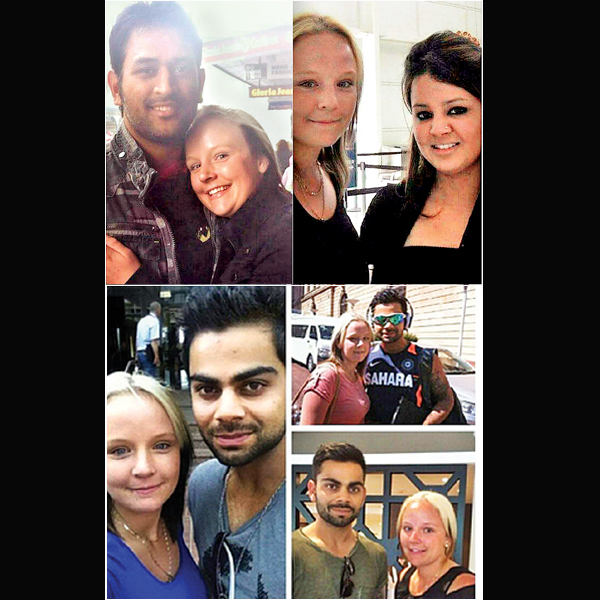
  • Leanne Murray with MS Dhoni, wife Sakshi and Virat Kohli Derek Abraham dna 

Management student Leanne Murray is also friends with others in team and quit job to watch the series Down Under this summer….

You don’t often see an Australian draped in an Indian flag. If you do, it must be Leanne Murray. A proud member of the ‘Swami Army’, the 23-year-old has been following MS Dhoni & Co. throughAustralia and New Zealand since 2007. Today, she is the undisputed No.1 fan of the Indian team in this part of the world. A few thousand selfies, some autographed jerseys and seamless access to the Men in Blue, she is the envy of many a supporter.

“I first saw Dhoni at a training session in Adelaide eight years ago. I had no idea who he was or how big an icon he was. I requested him for a photograph and I have not stopped ever since. I just fell in love with him that day,” she says. A 700-km drive from Adelaide, her hometown, to Melbourne for Sunday’s match is just another journey in Murray’s life. She has even traversed the Tasman Sea to watch the Indian team. “I went to New Zealand last year,” adds the management graduate.

Murray hasn’t gone to work since November. “A year ago, I told my boss that I want to attend each of the four Test matches as well as the World Cup. So I am actually on paid leave,” she gushes.

Murray doesn’t bother about the fact that Australia also have a cricket team. “I don’t really care about Australia,” she says as Dhoni & Co. go through the rigours of a four-hour-long training session at the Junction Oval. “I am not wearing my India shirt today. Otherwise, you’ll always see me in it. I don’t have an Australian shirt. And even if India were to play Australia, I’d be supporting India,” she says without batting an eyelid.

So what makes her love the Indian team so much? “It’s all because of Dhoni. He is just a calm guy and such a great leader. He is an inspiration. He just made me fall in love with the Indian team,” she says. Today, Murray counts the likes of Dhoni, Suresh Raina, R Ashwin, Mohammed Shami, Dinesh Karthik, R Vinay Kumar among her ‘friends’.

And guess what, she also plays the game. Actually, meeting the Indian players inspired me to take up the game. I didn’t know anything about cricket till 2007. About two years ago, I even enrolled myself in a cricket coaching clinic. I am a right-arm fast bowler and a left-handed batsman,” she informs. Within seconds, she rushes to her car, opens the boot and takes out a bat and a tennis ball. “Let’s play,” she says. Mind you, Murray is good at her game. A couple of journalists get a taste of her big hitting and neat bowling.

Murray has also strutted her stuff at the GM Cricket Academy in Delhi’s Najafgarh area. “I have played with the boys there. They really respect me,” she says. She knows Najafgarh is where Virender Sehwag hails from. “I have got a picture with him too. Do you want to see?” she enquires.

A casual look at her iPad confirms it’s a storehouse of collages. From Sachin Tendulkar to Virat Kohli to R Ashwin to Ravindra Jadeja, she has ‘framed’ them all. For the record, she has visited India on five occasions, including for the IPL.

Apart from Dhoni, Mohammed Shami is someone Murray admires a lot. “He is a nice bowler. In fact, he keeps giving me tips on bowling. The first thing he told me was to buy a cricket-specific pair of shoes,” she laughs. “We often talk on Skype,” she adds.

Murray has also met with Anushka Sharma and Sakshi Dhoni in New Zealand last year. “Sakshi was surprised I wanted a picture with her. But she was nice enough to pose for me,” Murray says. So did she tell her she “loves” Dhoni. “No, I didn’t. I am sure she knows of many women who do.”

SOURCE::::: http://www.dnaindia.com

Natarajan

Aero India Show Bengaluru … A Glimpse …

Aero India 2015, India’s largest airshow was underway at the Yelahanka Air Base in Bengaluru. Here are few glimpses of the aircraft in action.


Image: UK’s AeroSuperBatics team Breitling Wingwalkers performs in Bengaluru. Photograph: Shailendra Bhojak / PTI Photo

Image: Swedens aerobatic display team Scandinavian Air Show performs at Aero India 2015. Phortograph: Shailendra Bhojak/PTI
Photo

Image: A Rafale multi-role combat aircraft from Dassault Aviation of France manoeuvres at Asia’s premier air show at Yelhanka
Air Base. Photograph: PTI Photo

Image: The Red Bulls aerobatic display team performs in Bengaluru. Photograph: Ministry of Defence

Image: An SU-30 fighter aircraft takes off during the second day of Aero India. Photograph: PTI Photo

Image: Another great shot of India’s Light Combat Helicopter. Photograph: Twitter

Image: UK’s AeroSuperBatics team Breitling Wingwalkers performs in Bengaluru. Photograph: Shailendra Bhojak / PTI Photo

Image: A great shot of India’s Light Combat Helicopter. Photograph: MakeinIndia/Twitter

Image: A roaring take off by US F-16 at Yelahanka Air Base. Photograph: Ministry of Defence

Image: India’s Sarang aerobatic display team performing a routine. Photograph: Ministry of Defence

SOURCE::: http://www.rediff.com

Natarajan


Do you Know That the Largest Air Evacuation in History was done by India …?

When thousands of Indians were stuck in Kuwait during Gulf war, the Indian government executed the world’s largest air evacuation mission ever. The operation continued for almost two months and managed to airlift over 1,70,000 Indians. Here is all you need to know about the amazing effort!

Air India might be largely known today for delayed flights and poor service. But did you know that the largest air evacuation in the history of mankind was executed by the much aligned national airline of India? In 1990, the Indian government airlifted over 1,70,000 Indians from Kuwait with help of 488 flights in just 59 days. Air India entered into Guinness Book of World Records for the civil airline that had evacuated the most people till date.

Why the evacuation?

During the Gulf war in 1990, when Saddam Hussain invaded Kuwait, the Iraqis took over the city in a few hours leaving the entire country in a state of terror. This included the fairly significant Indian community there as well. While the Kuwaiti royal family escaped to Saudi Arabia, the general population suffered great tragedies and loss. The responsibility came on the Indian government to safely evacuate the Indian community from Kuwait and hence, the largest air evacuation mission took shape.

“We did not use the word ‘condemn’ in our statement [about the Iraqi attack], for two reasons: one, we were concerned about our nationals there; second, we still believed that there was some scope for a negotiated solution to the problem. We were keen to play a role. If we condemned the development openly, it would have been difficult for us to deal with Iraq,” said K.P. Fabian, former Ambassador of India who was head of the Gulf Division of the Ministry of External Affairs during the First Gulf War.

What made it difficult?

Evacuating the Indian community from Kuwait was not an easy task. People were not ready to leave behind everything they had spent their entire lives earning in Kuwait. They underestimated the gravity of the situation and were reluctant to leave their well-settled lives.

Also, many people living there did not have valid travel papers as they had handed them over to their employers who were either missing or dead.

“Meanwhile, another problem was brewing. One set of Air India crew was stranded in Kuwait, having flown in a flight earlier. The Air India pilots and staff threatened that unless we got this crew out, they would ground the flights. The threat was indeed serious. As per Ministry of Overseas Indians (MOIA) annual report 2012-13, there are over 25 million overseas Indians across the globe and whenever need arises, it is the government’s responsibility to bring back the country’s citizens safely. Not only just the evacuation during Gulf war, Indian government has successfully executed many such missions. It was decided that the Foreign Minister should go to Baghdad and Kuwaitand urgently arrange repatriation of our nationals” said Fabian.

Also, Indian people took shelter in various schools and other buildings in various parts of Amman. They had to travel from various places to the Amman airport. It could not be predicted when these people would arrive and due to this, flights got delayed a lot. The crew had to stay on duty for a much longer time than the stipulated duty hours which created a lot of tiffs.

How did they do it?

Indian government officials went to Kuwait to meet Saddam Hussain and get him on board the arranged repatriation of Indian nationals.

“We conveyed our official viewpoint and also our plans to evacuate our nationals. He listened to our views and repeated his known position, and agreed to facilitate the repatriation of our nationals,” said Fabian.

As the help reached on August 14 (12 days after the invasion had taken place), Indian citizens were angry as they were expecting a quicker intervention by the Indian government. But, the then Foreign Minister I.K. Gujral quickly brought the crowd under control and in no time had them shouting “Bharat Mata ki Jai”.

Initially, a few military aircrafts were arranged to evacuate the elderly, women and children. But due to a lengthy air space clearance procedure, this did not seem like a feasible solution. So the government turned to Air India for assistance.

You should have seen us. We were operating out of a hotel room in Amman with very little space and carrying out all our operations from there,” MP Mascarenhas, who organised the operation as the airline’s regional director in the Gulf & Middle East, told Scroll.

The Indian Air Force deployed its IL 76 aircraft for a steady communication link between Kuwait and Delhi government officials. The situation was severe and required immediate help and attention. The Kerala government came forward and dispatched food items for the Indian nationals in Kuwait.

“My suggestion was that we needed to first pick up mothers with babies, other children, women, sick and old people. And also, on the basis of some kind of distributive justice, we needed to select people from every region,” said Fabian.

There were far more people to be evacuated than expected. But, the coordination and team work of the people on the mission managed to evacuate all the Indian nationals out of the country. There was also a Pakistani Airline crew stranded in Kuwait and they wished to be evacuated by Indian aircrafts. On humanitarian grounds, the Indian officials agreed.

The successful operation that started on August 14 1990, continued for almost 2 months and created history, finally coming to an end on October 11.

Other notable achievements

This was not the only successful evacuation and heroic act by the Indian government. “Operation Sukoon” in 2006 by the Indian Navy was another great operation to evacuate Indian, Sri Lankan and Nepalese nationals, as well as Lebanese nationals with Indian spouses, from the conflict zone during the 2006 Lebanon War. Four naval ships – INS Mumbai, INS Betwa and INS Brahmaputra and oil tanker INS Shakti – executed the successful operation.

Another successful evacuation “Operation Blossom” took place in 2011 when mass protests against the military broke out in Libya. Around 8,000 Indians were evacuated with help from Indian Navy’s INS Jalashwa (an amphibious transport dock ship) and a destroyer INS Mysore – both these ships together could carry around 1,200 people at one go – and the fleet tanker the INS Aditya.

The Indian government has time and again proved that it leaves no stone unturned in bringing back its people safely to the country in times of distress anywhere in the world. Kudos to all the heroes who have showed immense courage and humanity in the toughest of times.

– See more at: http://www.thebetterindia.com/15179/heres-need-know-largest-air-evacuation-history-india/#sthash.53OtJbOP.dpuf

SOURCE:::: http://www.the betterindia.com

Natarajan

3 Indian Airports Among the World’s Best….

Three airports from India have bagged the Airports Council International’s Airport Service Quality Awards.

Photograph, courtesy: Ramesh NG/Wikimedia Commons

The Indira Gandhi International Airport has been ranked as the best airport in the world in the 25-40 million passengers per annum category.

The survey rates each airport’s performance in 34 key service areas under eight major categories including access, check-in, security, airport facilities, food and beverage providers.

Seoul’s Incheon airport is ranked as the world’s best airport in the above 40 million passengers’ category.

Two Indian airports won the award in the 25-40 million passengers’ category, while one bagged the third place in the 5-15 million category…

Take a look at the world’s best airports…

Photograph, courtesy: Krokodyl/ Wikimedia Commons

Indira Gandhi International Airport, New Delhi

Rank: 1

Indira Gandhi International Airport is the busiest airport in India.

The airport is managed by Delhi International Airport Limited (DIAL), a joint venture between the AAI and GMR Group-led consortium.

“The journey was never easy especially after holding the No 2 mark for last three years. We can now justifiably claim to be the world’s best,” Prabhakara Rao, chief executive, DIAL said in a statement.

With the new Terminal 3, the Delhi international airport has become South Asia’s largest aviation hub.

Photograph, courtesy: Kaichinshih/Wikimedia Commons

Taipei Taoyuan, Taiwan

Rank: 2

One of five airports in the country, Taipei Taoyuan is the largest airport in Taiwan.

Last year also, it bagged the world’s second best airport award from ACI.

“Airports are more than simply points of departure and arrival. At the end of the day, good business acumen comes down to a simple equation: better service, improved traffic and a healthier bottom line,” said Angela Gittens, Director General, ACI World.

Photograph, courtesy: Chongqing Jiangbei International Airport

Chongqing Jiangbei International Airport, China

Rank: 3

One of the busiest airports in the world, Chongqing Jiangbei International Airport has been regularly winning award for its best services.

Photograph, courtesy: Baycrest/ Wikimedia Commons

Shanghai Hongqiao International Airport, China

Rank: 4 

Shanghai Hongqiao International Airport is a hub for China Eastern Airlines, Shanghai Airlines, Juneyao Airlines and Spring Airlines.

It is one of the busiest airports in China.

Photograph: Rajesh Karkera/Rediff.com

Chhatrapati Shivaji International Airport, Mumbai

Rank: 5

It is the second busiest airport in India, after Delhi airport.

The airport has five operating terminals spread over an operational area of 8 square kilometers.

A world class terminal T2 was recently opened last year for international operations at the Mumbai airport.

The airport is run by Mumbai International Airport Limited (MIAL), a joint venture between the AAI and GVK group-led consortium.

Rajiv Gandhi International Airport, Hyderabad

The Rajiv Gandhi International Airport (RGIA) in Hyderabad has bagged the third position in the 5-15 million passengers per annum category.

The Hyderabad airport was ranked as the best airport in 2009 and 2010, third-best in 2011, and second-best in 2012.

Natarajan


Meet Sudhir and Bashir @ Adelaid Oval Today …!!!

Sudhir and Bashir, who have become national icons for their enthusiasm for cricket, can well sum up the essence of India-Pakistan sporting rivalry
  • Sudhir Kumar Chaudhary and Mohammed Bashir at the Adelaide Oval on Saturday

You will struggle to find a pair of fans who can sum up the essence of India-Pakistanrivalry more emphatically than Sudhir Kumar Chaudhary and Mohammed Bashir.

You know of Sudhir — Muzaffarpur native, Sachin Tendulkar devotee, painted face, painted body, conch shell and all that. Bashir, on the other hand, is from Chicago. His family runs a very successful restaurant, Ghareeb Nawaz, on Devon Avenue. He has suffered three heart attacks. He is also diabetic and carries a plethora of medicines with him at all times.

Both made their presence felt at the Adelaide Oval on Saturday.
Sudhir was the first to arrive. No sooner than the Indian team started its match-eve preparations the 34-year-old made his way to the enclosure right below the Sir Donald Bradman pavilion. Within seconds, he took off his shirt

and revealed his extremely lean, well-toned physique replete with tri-colours and an emotional ‘Miss-u Tendulkar 10’ message on his back. Out came the flag and that conch shell too. Basically, Sudhir was in his element.
“India khele aur hum nahin aaye; kya kabhi aisa ho sakta hai? (India playing and me not coming; has it happened ever?)” he asks with a wink. The subject of dna’s JBM cover story (A decade of worship: Sachin Tendulkar’s biggest fan…) in October 2013, Sudhir then took out a letter from his bag. “See this! Boss wrote a letter on my behalf,” he said. The ‘boss’ in question was Tendulkar. And the letter was addressed to the visa officer of the Australian embassy in New Delhi.

“Dear Sir, I am writing to confirm that Mr Sudhir Kumar Chaudhary has been an ardent supporter of the Indian Cricket Team and has become a national icon due to his enthusiasm,” Tendulkar wrote. Providing details of Sudhir’s sponsors, he requested the officer to provide his biggest fan with a visa for the entire duration of the tournament. “I got visa in just one day,” Sudhir said. Soon, he was the most wanted man at the Adelaide Oval. The Indian team took a backseat.

About an hour later, Bashir appeared out of nowhere. Sporting a free-flowing green jubba with the words “Jis desh mein Ganga behti hai, us desh ki meri biwi hai (My wife hails from the land where river Ganga flows). Bashir took short, painful steps towards the practice area. “Has Dhoni arrived?” he enquired. When one answered in the affirmative, he said, “He is the one who gives me tickets. Everytime. He has been blessed with a baby girl. God willing he will win lead India to World Cup win again. Par kal toh jeetega bhai jeetaga, Pakistan jeetega (But tomorrow Pakistan will win),” It was a lesson in voice modulation.

Soon, the enclosure was brimming with fans of both countries. Mothers, grandmothers, children, grandchildren, boys, men… there was everyone. It was sloganeering at its intense best.

Luckily, no one was hurt.

Bashir then spoke about his wife, who hails from Hyderabad. “She is everything to me. But she keeps telling me “why do you get embarrassed. Every time India will win,” he said.

Bashir and Sudhir then joined the rest of the fans outside the stadium where they celebrated with dhols and what not. “This time there will be Diwali in Pakistan,” Bashir said.

“Yeah sure, but next year. Is baar toh jeetega bhai jeetega India jeetega (this time India will win),” Sudhir retorted.

A hug sealed the issue.

SOURCE:::: Derek Abraham in www .dnaindia.com

Natarajan

A Rewind…. When a 41 year old Former Captain came out of Retirement to Lead Australia against India

When the 41-year-old former captain came out of retirement to lead Australia against India…

India’s tour of Australia in 1977-78 was completely overshadowed by the arrival of Kerry Packer’s World Series Cricket (WSC), unleashed on the world six months earlier, which left the home side fielding a virtual third XI under Bob Simpson, a 40-something captain who had retired from the game a decade earlier. Despite that, the series proved exciting and Simpson’s comeback triumphant.

Bob Simpson drives on his way to 176 in Perth, in what was his fifth first-class match in a decade

Bob Simpson drives on his way to 176 in Perth, in what was his fifth first-class match in a decade © ESPNcricinfo Ltd 


In May 1977, news broke that media mogul Packer, frustrated by his inability to secure TV rights for cricket for his fledgling TV channel, had decided to organise games of his own. Capitalising on the low amounts cricketers were paid, particularly in Australia, he signed up more than 50 players for his enterprise.

With his “circus” – as the establishment and media dismissively labelled the venture – taking place in parallel to the Australian season, it meant that the national selectors sat down in October 1977 with almost two dozen of their more likely choices unavailable.

The Australian Cricket Board (ACB) did all it could to frustrate WSC, barring it from all major cricket grounds, and going to court to prevent it referring to games as Tests or from calling their side Australia.

Packer believed that given the national side was bereft of all the leading players – and most second-string ones as well – the public would turn their backs on the official Test series. The establishment feared the same.

A divided Australian team had lost the Ashes in England in the summer, and few seemed able to predict who they would pick to face the Indians, let alone who would lead them. Craig Serjeant, a 26 year-old batsman who had made his debut that summer, was one of the favourites, if only because he was one of the few established cricketers not to have signed for Packer. The other leading candidate was John Inverarity, a 33-year-old allrounder who had played the last of his six Tests five years earlier.

So the announcement that Simpson, a 41-year-old who had retired from the game in 1968, had been hauled out of retirement to lead the side was met with shock but almost no dissent. Indeed, journalists at the press conference at which the news was made public broke into spontaneous applause.

Among those close to the game there was a general belief Simpson was still good enough. “He has a wonderful batting technique,” Keith Miller said, “and is fitter at the moment than he has been for years.”

Simpson, who had been made the offer the previous month, had been a top player and had led Australia 28 times after taking over the captaincy from Richie Benaud in 1963. He averaged 48 with the bat in his 52 Tests and was a brilliant slip fielder and useful legspinner and had continued to play regularly after retiring and had scored a hundred for grade side Western Suburbs at the start of the season.

The ACB made clear it was not expecting miracles. Praising Simpson’s “experience and technical knowhow” it added: “Irrespective of the runs he may make Simpson will make a significant contribution to Australian cricket in the coming season.”

Simpson was an old-school leader and wasted no time in saying he felt that the Australians had become undisciplined. In England the side had come under fire for their slovenly appearance and attitude. “It starts in getting the players proud to represent their country,” he said. “I’ll be looking to restore some of the lost guidance.”

And whatever the board felt, he had no intention of not pulling his weight in the side. “I wouldn’t have made myself available if I didn’t think I would get runs. I have never surrendered my wicket easily. I have always considered it my obligation to my team, myself and spectators to get runs.

“Undoubtedly the success I have enjoyed in grade cricket in the past, and this year, made easier my decision to come back. If I had not been scoring runs, I would not have considered a return just as a figurehead.”

He admitted he had been approached “almost every year” to resume for his state in the decade since he retired, repeatedly declining as he felt New South Wales were good enough without him. But with Packer players missing from the Sheffield Shield, things had changed. “The special conditions this year have made it necessary for an experienced player to be at the helm.”

At the beginning of November, Simpson returned as captain of New South Wales, the side he led to their last Sheffield Shield title 12 years earlier. He had three matches before the first Test to find his feet.


In Perth, NSW lost to Western Australia by four wickets. Simpson made 14 and 5 and took three wickets. He then led his side to a nine-wicket win over South Australia, making 66 in his one outing. His final game was against the Indians, where he scored 58 and 94. He had proved he had not lost his ability with the bat, especially against spin.

India headed into the first Test with wins in all four of their matches against the states; on two previous tours of Australia they had never beaten a state side. But they were aware the opposition they had been facing were weak.

Australia’s squad contained six uncapped players. Simpson aside, they boasted 36 Test appearances between them, of which 22 belonged to Jeff Thomson – he had signed for Packer but subsequently changed his mind. Only Serjeant, named as vice-captain, Thomson and Kim Hughes survived from the XI that had played Australia’s previous Test at The Oval three months earlier.

In the fortnight before the opening Test, WSC had launched to poor attendances and a generally lukewarm response. The first Test between Simpson’s almost unknown Australia and India in Brisbane was nervously watched by both the ACB and WSC, as it directly clashed with Packer’s Supertest in Melbourne. The official Test was a cracker and attracted 32,000 to the Gabba; the Supertest drew a little over 13,000.

In Brisbane, Simpson was dismissed for 7 in the first innings, falling to the spin of Bishan Bedi. In his last Test before this one, in January 1968, he had been dismissed by Bedi, also for 7. Australia gained a slender 13-run lead on the first innings before Simpson made a vital 89 second time round. India, chasing an improbable 341 to win, fell 16 runs short.

The second Test, in Perth, was no less exciting. India took an eight-run first-innings lead – Simpson’s six-and-a-half hour 176 keeping them at bay almost alone – but lost by two wickets as Australia chased down 342 with 22 balls remaining. Again, crowds were larger than expected.

India kept the series alive with comprehensive wins in the third and fourth Tests, but Australia, anchored by Simpson’s 100 and 51, won the decider by 47 runs on the sixth day. Nevertheless, India made 445 in pursuit of 493, the highest losing total in the fourth innings of a Test; when they were 415 for 6, a remarkable win was still on the cards.

Simpson’s return had proved more successful than anyone had dared hope. Not only had he forged a winning side from a batch of youngsters, he had done so by leading from the front with 539 runs at 53.90. Financially, a thrilling Test series had won out over WSC’s garish, hyped Supertests.

But the tide was about to change. Shortly before the final Test, almost 25,000 watched a WSC limited-overs game under floodlights. Packer, with white balls, coloured clothing and a variety of gimmicks, had found what the public wanted. Cricket would never be the same again.

SOURCE:::: MARTIN WILLIAMSON  in http://www.espncricinfo.com

Natarajan

Kashmir Willow Bat … An Important Player in Cricket World cup !!!

A look at Kashmiri willow bat factory, as sales boom during this World Cup season.

World Cup Fever in India… From The Streets to the Banks of Ganga…In Photos !!!

 Indian Hindu Veda Vidyalaya (School) students play cricket on the bank of the river Ganga near Sangam in Allahabad on February 12, 2015. AFP

Indian Hindu Veda Vidyalaya (School) students play cricket on the bank of the river Ganga near Sangam in Allahabad on February 12, 2015. AFP

 The Indian fans are pretty serious about their cricket, even if it's not played professionally. Perfection, dedication and determination while playing is the mantra even in gully cricket. AFP

The Indian fans are pretty serious about their cricket, even if it’s not played professionally. Perfection, dedication and determination while playing is the mantra even in gully cricket. AFP

 It doesn't matter what the playing surface is. Whether it be concrete or sand. Such is the passion of cricket in India that people start playing cricket as soon as they find open spaces. AFP

It doesn’t matter what the playing surface is. Whether it be concrete or sand. Such is the passion of cricket in India that people start playing cricket as soon as they find open spaces.

 And yes.....The concentration never drops.....AFP

And yes…..The concentration never drops..

 The bowling actions vary and the batsmen have a tough task of playing bouncers, beamers and pacy deliveries without any protective gear. AFP

The bowling actions vary and the batsmen have a tough task of playing bouncers, beamers and pacy deliveries without any protective gear

 On field dives, howlers, comical running and chaos. It's absolute fun watching a game of gully cricket on the streets of India or on the sands along the Ganga. AFP

On field dives, howlers, comical running and chaos. It’s absolute fun watching a game of gully cricket on the streets of India or on the sands along the Ganga.

SOURCE:::: http://www.firstpost.com

Natarajan