SOURCE:::: http://www.glasbergen.com
Natarajan
Both Europe 24 and North Atlantic Skies were designed to give an overview of the daily complexity and volumes of air traffic across the UK and Europe and to do so in a way that was cinematic and exciting to watch. I think we were able to do that to great effect, but we now want to take you a little deeper.
We are therefore very excited to publish UK 24 – your guided tour to some of what makes UK aviation work.
Our airspace is busy, complex and there is a lot going on. Each year we manage around 2.2 million movements, peaking at over 8,000 a day (although there are around 7,000 on this particular day), with only 5.5 seconds delay per flight attributable to NATS. Obviously there are the flows of large aircraft from the airports into and out of the UK, but there is also a lot of activity outside controlled airspace. UK 24 is designed to help visualise the breadth and depth of UK aviation and why airspace is such an important asset.
The day starts with the bow wave of transatlantic traffic heading towards the UK on their organised and separated tracks. This is quickly joined by traffic from Europe and the first waves of departures from UK airports. Over a short period of time the traffic levels grow to show the main trunk roads of airspace as well as the hubs around London, Manchester and central Scotland.
We then move to give a unique view of the holding stacks over London and how they are a fundamental part of the Heathrow operation, providing the constant flow of traffic that makes it the world’s busiest dual runway airport with 1,350 movements a day.
Our tour then take us around the UK, including the other major airports, our two control centres in Swanwick and Prestwick, some general aviation traffic and examples of military training off the east coast of England and near to North Wales. We then dwell on the spider’s web of helicopter tracks that originate from Aberdeen, taking people and vital supplies to and from the North Sea oil and gas rigs.
We hope you enjoy this insight into the complexity and beauty of a day of UK air traffic and the value of airspace as the invisible infrastructure that makes it all work.
The aviation sector and its supply chain generates over £20bn per year in economic output and directly employs circa 220,000 people. At Heathrow alone, goods worth £133 billion were shipped in and out last year, more than the combined value of goods transiting through the UK’s two largest ports, Felixstowe and Southampton.
Aviation is on average a much more productive sector than the rest of the economy; each pound spent on upgrading our aviation infrastructure is expected to generate over £5 in return. In addition aviation is a significant growth sector within key regions for UK trade, for example China, the Middle East and Turkey have ambitious plans to more than double their capacity.
Without additional capacity in the UK, we risk the rapid growth in traffic and its associated commerce being focused elsewhere.
SOURCE:::: Brendan Kelly in http://www.nats.aero.blog
Natarajan Continue reading

Maria Montessori
As I write about one of the greatest educators of our times, Maria Montessori, my first question to myself is: “Why is a Waldorf teacher writing about Montessori”. Then I ask myself – why not? I think the first question comes from my conventional education and dogmatic beliefs. The second – from my unlearning over the years and becoming a free human being. To belong in one ideology or school of thought does not mean you can not see beauty in the other. So here is a Waldorf teacher from a completely different tradition, writing about Maria Montessori, not as a Montessorian but as someone deeply interested in learning how different educators used different lenses to view children and in doing so, how each one had a gift to give to them.
In early 1900, there existed in Rome a slum known as the San Lorenzo Quarter. Two buildings there housed the poorest class. During the day, the adults living at San Lorenzo would go off to work, the older children would be sent to school and the younger children between the ages of three and six began to vandalise the buildings, with no one to care for them. The governing body decided it would be less expensive to set aside one room for these kids and an adult as a caregiver than to continue to repair and repaint the whole building being damaged by these children. And, as history would have it, that caregiver was Dr. Maria Montessori. It was here in this Roman slum with those 60 children where she made discoveries that would direct her life’s work.
The news of her unprecedented success in Casa Dei Bambini or House of Children in San Lorenzo soon spread. Soon, Montessori was invited by several countries to set up centres for children. Alexander Graham Bell and Thomas Edison invited her to USA to give talks about her methods that gained immense popularity all over the world.
So what was it that was so special about her methods? Maria Montessori strongly believed that education is not what the teacher gives; education is a natural process spontaneously carried out by the human individual and is acquired not by listening to words but by experiences upon the environment. She writes about it: “Supposing I said there was a planet without schools or teachers, study was unknown, and yet the inhabitants – doing nothing but living and walking about – came to know all things, to carry in their minds the whole of learning , would you not think I was romancing? Well, just this, which seems so fanciful, is a reality. It is the child’s way of learning. This is the path he follows. He learns everything without knowing he is learning it, and in doing so passes little from the unconscious to the conscious, treading always in the paths of joy and love.’
Maria Montessori received a doctor of Medicine degree in 1896, the first woman in Italy to achieve this status. She campaigned vigorously on women’s rights. She wrote and spoke on the need for greater opportunities for women and was recognised in Italy and beyond as a leading feminist voice. It was this outspokenness and leadership in thinking that landed her in trouble. She was also vociferous about her anti-fascist views and was forced to go into exile.
And, the country that became her home in exile was India. The Theosophical Society invited her to in 1939 and she made Adyar, Chennai her home for eight years. It was here that she developed her work ‘Education for peace’. And she was nominated twice for the Nobel Peace Prize.
Today, most Montessori teachers use the materials used in Montessori classrooms – called the Didactic Apparatus, which was her discovery. But it would be a shame to reduce Montessori and her teachings to the mere apparatus. She and the children whom she crusaded for are much larger than that.
(Santhya is an educator and founder of Yellow Train)
SOURCE::::: Santhya Vikram in http://www.the hindu.com
Natarajan
An Engineer was unemployed for long time. He could not find a job so he opened a medical clinic and puts a sign up outside: “Get your treatment for $500, if not treated get back $1,000.”
One Doctor thinks this is a good opportunity to earn $1,000 and goes to his clinic.
Doctor: “I have lost taste in my mouth.”
Engineer: “Nurse, please bring medicine from box 22 and put 3 drops in the patient’s mouth.”
Doctor: “This is Gasoline!”
Engineer: “Congratulations! You’ve got your taste back. That will be $500.”
The Doctor gets annoyed and goes back after a couple of days later to recover his money.
Doctor: “I have lost my memory, I cannot remember anything.”
Engineer: “Nurse, please bring medicine from box 22 and put 3 drops in the patient’s mouth.”
Doctor: “But that is Gasoline!”
Engineer: “Congratulations! You’ve got your memory back. That will be $500.”
The Doctor leaves angrily and comes back after several more days.
Doctor: “My eyesight has become weak.”
Engineer: “Well, I don’t have any medicine for this. Take this $1,000.”
Doctor: “But this is $500…”
Engineer: “Congratulations! You got your vision back! That will be $500.”An Engineer was unemployed for long time. He could not find a job so he opened a medical clinic and puts a sign up outside: “Get your treatment for $500, if not treated get back $1,000.”
One Doctor thinks this is a good opportunity to earn $1,000 and goes to his clinic.
Doctor: “I have lost taste in my mouth.”
Engineer: “Nurse, please bring medicine from box 22 and put 3 drops in the patient’s mouth.”
Doctor: “This is Gasoline!”
Engineer: “Congratulations! You’ve got your taste back. That will be $500.”
The Doctor gets annoyed and goes back after a couple of days later to recover his money.
Doctor: “I have lost my memory, I cannot remember anything.”
Engineer: “Nurse, please bring medicine from box 22 and put 3 drops in the patient’s mouth.”
Doctor: “But that is Gasoline!”
Engineer: “Congratulations! You’ve got your memory back. That will be $500.”
The Doctor leaves angrily and comes back after several more days.
Doctor: “My eyesight has become weak.”
Engineer: “Well, I don’t have any medicine for this. Take this $1,000.”
Doctor: “But this is $500…”
Engineer: “Congratulations! You got your vision back! That will be $500.”
SOURCE::::: www.joke a day.com
Natarajan
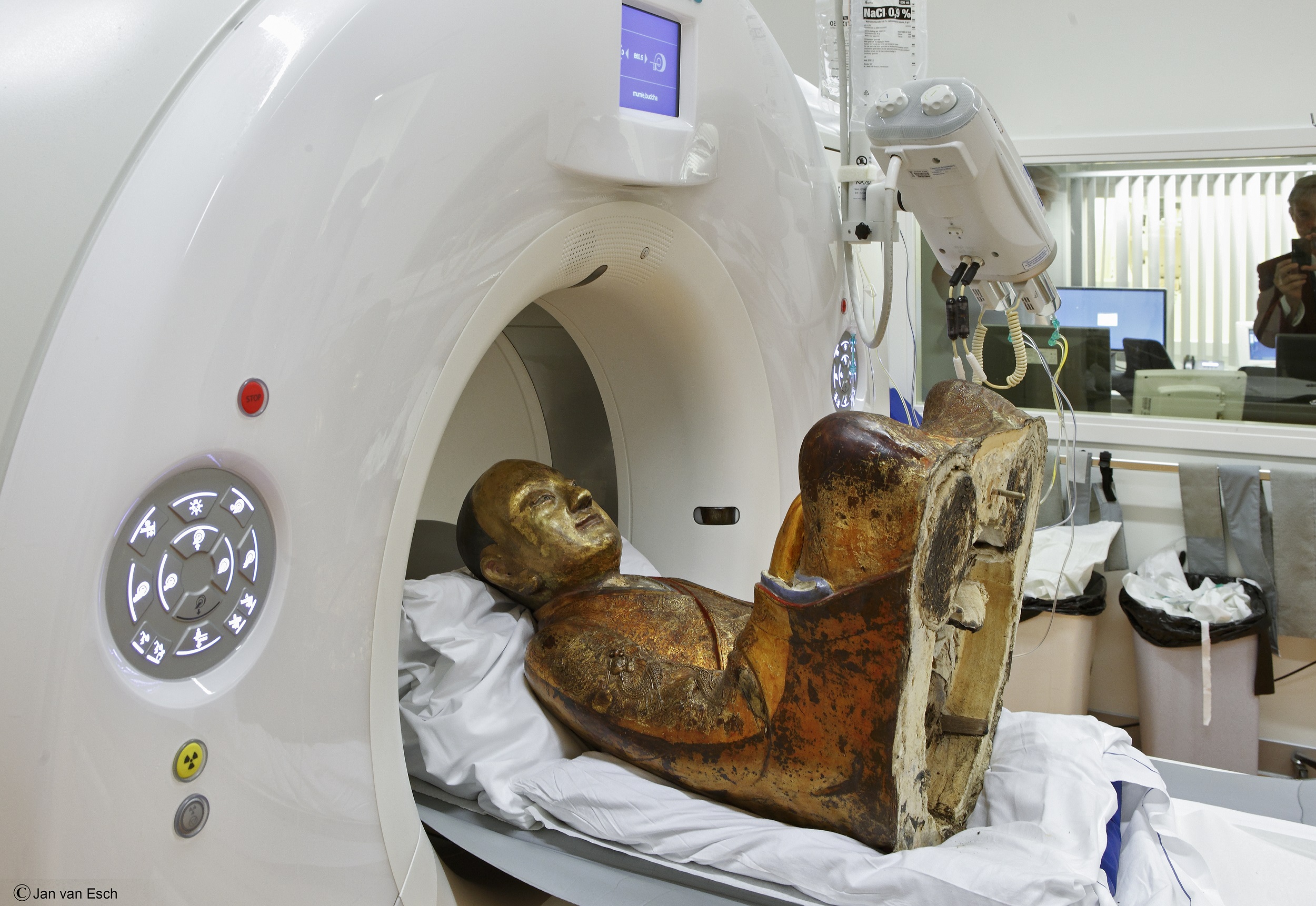
The mummified remains of a monk have been revealed inside a nearly 1,000-year old Chinese statue of a Buddha.

The mummy inside the gold-painted papier-mâché statue is believed to be that of Liuquan, a Buddhist master of the Chinese Meditation School who died around the year 1100, researchers said. It’s the only Chinese Buddhist mummy to undergo scientific research in the West.
The statue was on display last year at the Drents Museum as part of an exhibit on mummies. It was an cited as an example of self-mummification, an excruciating, years-long process of meditation, starvation, dehydration and poisoning that some Buddhist monks undertook to achieve enlightenment and veneration.
When the exhibit ended in August, a CT scan at the Meander Medical Center in the Netherlands revealed the seated skeleton. Samples taken from organ cavities provided one big surprise: paper scraps printed with ancient Chinese characters indicating the high-status monk may have been worshiped as a Buddha.
A CT scan has revealed a mummified Chinese monk inside a Buddha statue. The remains date back about 1,000 years. Video provided by Newsy Newslook
The finding was first reported in December but did not get wide notice. Irish Archaeology carried a report over the weekend, which apparently started the news ball rolling.
But the revelation is not, as some reports claim, “a shocking discovery,” The History Blog notes: “It was known to be inside the statue all along … that’s why it was sent to the Drents Museum in the first place as part of the Mummies exhibition.”
The mummy’s existence was discovered in 1996 when the statue was being restored in the Netherlands, Live Science writes, explaining what was found, how its age was determined and when the first detailed skeletal imaging was performed.
DNA tests were conducted on bone samples, and the Dutch team plans to publish its finding in a forthcoming monograph.
Researchers still have not determined whether the monk mummified himself, a practice that was also widespread in Japan and that was outlawed in the 19th century. If he did, the process was gruesome, asAncient Origins explains:
For the first 1,000 days, the monks ceased all food except nuts, seeds, fruits and berries and they engaged in extensive physical activity to strip themselves of all body fat. For the next one thousand days, their diet was restricted to just bark and roots. Near the end of this period, they would drink poisonous tea made from the sap of the Urushi tree, which caused vomiting and a rapid loss of body fluids. It also acted as a preservative and killed off maggots and bacteria that would cause the body to decay after death.
In the final stage, after more than six years of torturous preparation, the monk would lock himself in a stone tomb barely larger than his body, where he would go into a state of meditation. He was seated in the lotus position, a position he would not move from until he died. A small air tube provided oxygen to the tomb. Each day, the monk rang a bell to let the outside world know he was still alive. When the bell stopped ringing, the tube was removed and the tomb sealed for the final thousand day period of the ritual.
At the end of this period, the tomb would be opened to see if the monk was successful in mummifying himself. If the body was found in a preserved state, the monk was raised to the status of Buddha, his body was removed from the tomb and he was placed in a temple where he was worshiped and revered. If the body had decomposed, the monk was resealed in his tomb and respected for his endurance, but not worshiped
If you find yourself in Budapest before May, the Buddha mummy statue is on display at the Hungarian Natural History Museum.
SOURCE::::: Michael Winter, USA TODAY …www.usatoday.com
Natarajan