Clingstone: The House on The Rock…!!!

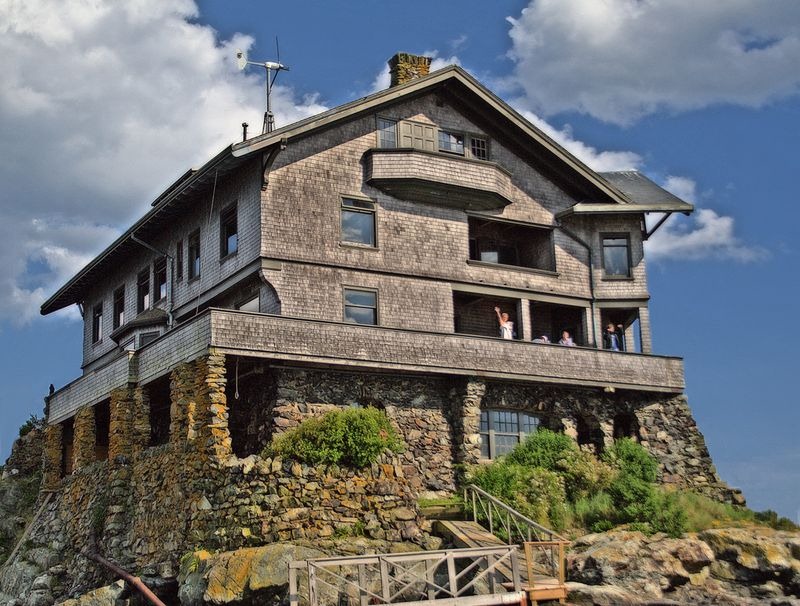
Perched on top of a small, rocky island in Narragansett Bay, near Jamestown, Rhode Island, the United States, is a three-story, cedar shingle mansion built by Philadelphia socialite Joseph Lovering Wharton in 1905. Wharton had built the house as an act of defiance after the government seized his land and summer home that he had in the Fort Wetherill area in south Jamestown, to enlarge the fort at the end of the 1800s. Angered at being ousted from his property, Wharton decided to build a house where no one could bother him, and Clingstone happened. One source claims that the name “Clingstone” was suggested when someone remarked that it was “a peach of a house”. Clingstone is a botanical term for fruits that has a hard stone-like seed inside. Or perhaps, the name is a reference to the way the house clings to the rock.

clingstone-house-6

Photo credit: mansion-homes.com

In spite of its perilious location in the sea, the Clingstone has managed to survive more than a hundred years, weathering countless storms and hurricanes. Originally there was a long stone jetty with gymnasts’ rings and bars, but it was blown away by the Great Hurricane of 1938. The house itself, which sits only 20 feet above sea level, survived with minimal damage. Now Clingstone’s current owner, Henry Wood, a distant cousin of Wharton, regularly goes out to Clingstone with his three grown sons to watch the yearly hurricanes in action.

Henry Wood, who is a Boston-based architect, had bought the house in 1961. It had been lying vacant for two decades after the death of Wharton’s widow in 1941. When Wood acquired it, the house was in a shabby condition with all its windows smashed, the floors rotten and covered with pigeon droppings, and the roof mostly gone.

Wood and his sons take pride in their environment-friendly renovations of the house. The house is totally off the power grid. A windmill on the roof provides electricity, while photovoltaic cells charge a bank of batteries in the basement for additional power. Rainwater collected from the roof into a 3,000-gallon cistern provide water for washing and cleaning. Drinking water comes from a sea-water filtration system. Water is heated by solar panels. The house even has a composting toilet. The compost is then used to fertilize the garden.

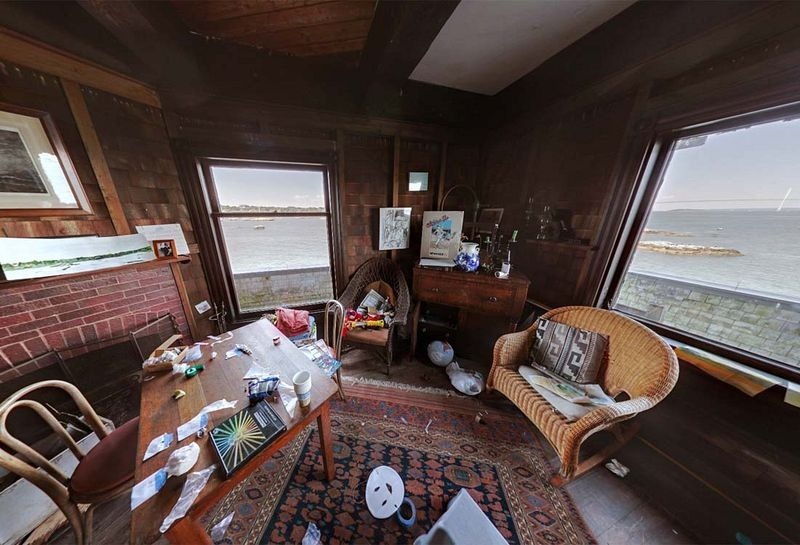
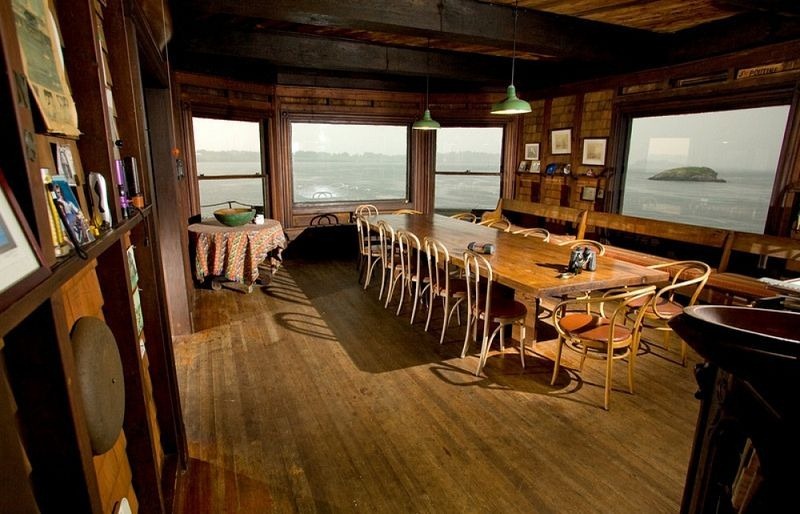
Although refitting the house with green technology has certainly been expensive, Wood has managed to cut corners by acquiring furnishings from thrift shops or yard sales. Windows, light fixtures and doorknobs were scavenged from old buildings that were torn down. The long cypress dining room table was retrieved from the bottom of a cistern.

Today, the house has 23 rooms, including 10 bedrooms and five bathrooms. Visible from the shores, the house is known by locals as “The House on a Rock”.

clingstone-house-5


Photo credit: mansion-homes.com

clingstone-house-22

Photo credit: G.E.Long/Flickr

clingstone-house-10

Photo credit: mansion-homes.com

clingstone-house-21

Photo credit: Eric Jacobs

clingstone-house-1

Photo credit: mansion-homes.com

Source…..www.amusingplanet.com

Natarajan


Cabin Pressure and Oxygen Supply Aboard Commercial Aircraft….

How Cabin Pressure and Oxygen Supplies are Maintained Aboard Commercial Aircraft

Because the economics of having large oxygen tanks aboard airliners simply doesn’t work out (not to mention that the air quality inside the plane would rapidly become unpleasant if fresh air wasn’t constantly supplied, regardless of the oxygen levels), commercial airplanes have a very clever system installed to solve the problem of ultra-low pressure atmosphere at cruising altitudes.

In most modern airliners (the Boeing 787 Dreamliner not withstanding), outside air is “bled off” from the compressor stage of the turbine engines and eventually piped into the passenger areas. However, a bit of processing is needed first as the compressed air is extremely hot (on the order of nearly 400 degrees Fahrenheit

or 200 degrees Celsius) at this stage. Thus, before it enters the passenger compartment, it is first allowed to expand and is run through a heat exchanger and air cycle system to cool it off sufficiently. This system also can work as a heater, with some of the hot air mixed in with the cooled air to regulate cabin temperature.

1280px-Turbofan_operation.svgOnce cooled and filtered, the pressurized air, which now has sufficient oxygen density to keep people happily conscious, is piped into the cabin area, usually at levels around 12 psi (about equivalent to atmospheric pressure at 7,000 feet).  Why 12 psi instead of something like sea-level pressures of about 14.7 psi? 12 psi is sufficient for the majority of passengers while simultaneously reducing the structural strain on the aircraft itself over something like sea level atmospheric pressures.

As for the air already in the cabin, this is vented out through an outflow valve (or multiple valves in larger aircraft), usually located near the rear of the plane. (FunNote: Before smoking was banned on commercial aircraft, the area around this outflow valve was generally stained dark brown from tobacco smoke.)

This outflow valve opens and closes automatically to maintain a steady pressure inside the cabin, while the entire system is ensuring that fresh air is continually being piped into and eventually blown out of the aircraft. In fact, while many complain of airplanes seeming “stuffy,” this system ensures that all the air in the aircraft is being completely replaced on average every 2-3 minutes. Yes, that means that your car, house or office is likely significantly more “stuffy” than a commercial airplane flying at 35,000 feet.

(Note: the Boeing 787 Dreamliner handles cabin pressurization a little differently, using a modernized version of the old, somewhat inefficient, electric compressor system seen on many older aircraft.)

Unfortunately, sometimes planes lose cabin pressure. Whatever the cause, the loss of pressure (usually set at atmospheric pressures past 14,000 ft) will result in oxygen masks deploying. From here, useful consciousness may only last as little as 5-15 seconds, depending on remaining cabin pressure, which is why it’s critical to immediately put your mask on, rather than helping someone else first. You can help them much better when you’re not unconscious or dead.

So how do these airline oxygen masks actually work? It turns out, the economics of having a centralized oxygen tank to provide even emergency oxygen for passengers likewise simply doesn’t add up. Similarly, having tiny individual pressurized oxygen tanks also isn’t feasible. In fact, these masks aren’t hooked up to any tank or air line at all. So how are you able to breathe oxygen through them?
Science.

While designs can vary slightly, in general, when you pull on the device to place it over your face, the tug on the mask’s lanyard releases a spring-loaded mechanism that sets off a small explosive charge. (Yep.) The resulting spark triggers a mixture of lead styphnate and tetracene to generate heat, which will eventually cause a chemical reaction that produces oxygen for your mask. (This is why they tell you to tug on the mask to get the oxygen flowing- you’ve got to set off the explosive charge to get the whole thing going.)

That’s right. What you breathe through the mask didn’t begin as pure oxygen. Rather, the plane is equipped with numerous small chemical oxygen generators (also known as “oxygen candles,” about the size of a small package of tennis balls) which contain a mixture of mostly sodium chlorate (NaClO3), less than 5% barium peroxide (BaO2) and less than 1% potassium perchlorate (KClO4). When these chemicals are heated by the lead styphnate and tetracene, each undergoes a reaction that ultimately results in a fair bit of filtered, life sustaining oxygen running through the tube to you.
Of course, you might also smell a faint burning odor, but this is nothing to be alarmed about; it just assures you that the system is working. In fact, if the plane is actually on fire, the masks usually won’t deploy, so as not to make the fire worse with the extra oxygen.

This brings us to the question of why the plastic bag on the breathing apparatus won’t necessarily inflate as you’re using the device. More than just cosmetic, the bags serve as something of a reservoir for oxygen. If you aren’t taking a breath at all (and have a good seal with the mask tight against your face) the bag keeps the precious, continuously flowing oxygen from escaping into the thin air around you, enabling more of the collected oxygen to be taken in when you do take a breath.  When this is happening, or you are breathing out with the valves on the mask releasing much of the used air, the bag may begin to inflate as oxygen collects. When you breathe in, it will deflate.

So why won’t it always inflate at least a little to show its working? To begin with, you may not have a great seal with the mask on your face, particularly if you have facial hair.  This will allow any produced oxygen (and air you exhale) to more readily escape. (As long as the mask is reasonably secure on your face,

this should still provide you with sufficient oxygen to get by on as long as the plane isn’t flying above 40,000 feet and the pilot does his or her job and gets the plane down below 10,000 feet as rapidly as safely possible.)

Even if you have a good seal, however, the rate at which the oxygen is generated is often not enough to fully inflate the masks’ bag before you take deep, potentially panicky breaths, deflating it. This is simply because the oxygen generation isn’t on-demand (for the passengers anyway), but simply a continuous-flow production of oxygen.

Despite the potentially slow production, the chemical oxygen generators do provide oxygen at a sufficient rate to sustain passengers, generally designed such that peak oxygen production occurs right away (when the plane may be at very high altitude) with the oxygen production rates tailing off over the course of approximately 12-20 minutes before the system burns itself out.

This should be long enough for the pilots to get the plane low enough so that the air pressure is high enough for (relatively) normal atmospheric breathing. And if you’ve ever been lucky enough to be in this sort of situation, you know that those pilots can get the plane from altitudes like 35,000+ feet to safer atmospheric levels alarmingly quickly in an emergency; while it may not be literally true, it at least can seem like roller coasters have nothing on them, which is a good thing in this case.

Source….www.today i foundout.com

natarajan

 

Image of the Day…”Moonset Viewed From the International Space Station”

Earth's moon photographed from low Earth Orbit with blue at bottom of frame

Expedition 47 Flight Engineer Tim Peake of the European Space Agency took this striking photograph of the moon from his vantage point aboard the International Space Station on March 28, 2016.  Peake (@astro_timpeake) shared the image on March 30 and wrote to his social media followers, “I was looking for #Antarctica – hard to spot from our orbit. Settled for a moonset instead.”

Image Credit: ESA/NASA

Source….www.nasa.gov

Natarajan

வாரம் ஒரு கவிதை ….” வாக்கு உன் செல்வாக்கு ” !

வாக்கு  உன்  செல்வாக்கு !
…………………..
உன் கையில் தான் இருக்கு தம்பி இந்த
நாட்டின் நம்பிக்கை …
வாக்குறுதி   பல கொடுத்து பல  பேர் வாக்கு கேட்டாலும்
யாரும் அரியணை ஏற முடியுமா உன் செல்வாக்கு இல்லாமல் ?
பலர் சொல்லும் வாக்கை மட்டும் நம்பி உன் வாக்கை ஒரு செல்லாத வாக்கு
ஆக்கிவிடாதே  தம்பி …ஒன்று மட்டும் உறுதி தம்பி !
உன் செல்வாக்கின் முன் மற்றெல்லாம் ஒரு செல்லா காசுதான் !
இதோ வந்து விட்டது தருணம் ..உன் செல்வாக்கை மற்றவர்
தெரிந்து கொள்ள …புரிந்து கொள்ள !
மறக்காமல் பறை சாற்று உன் செல்வாக்கு  என்னவென்று !
Natarajan
5 april 2016

The Black Dot: A Beautiful and Inspiring Story…!!!

This beautiful story has a simple, yet important message. I hope as many people as possible give it a read. I know I am happy I read it, as it gave me a few things to think about in my own life. Sometimes it is the simplest of stories that make us ponder the most.

the black dot

the black dot

the black dot

the black dot

the black dot

the black dot

the black dot

the black dot

the black dot

the black dot

the black dot

Source…..www.ba-bamail.com

Natarajan

Message for the Day…” Your heart is the lock and your mind is the key …”

Sathya Sai BabaThough it is hard to restrain the mind, it can be diverted. When the mind steeped in the secular world is diverted toward Divinity, it gains in moral strength. The mind steeped in the worldly matters makes you a prisoner of the world, whereas a mind steeped in God secures liberation for you. Your heart is the lock and your mind is the key. When you turn the key to the left, it locks. But if you turn the key to the right, it unlocks. It is the turning of the key that makes the difference. Hence the mind is the cause for your liberation as well as bondage. What then is liberation (Moksha)? It is not an air-conditioned mansion, but a state devoid of delusion (Moha). Majesty and morality lie in diverting the mind from the world to God. It is this simple and powerful concept that really contributes to your progress and prosperity.

Secret Rooms Inside Abandoned Sewers….!!!

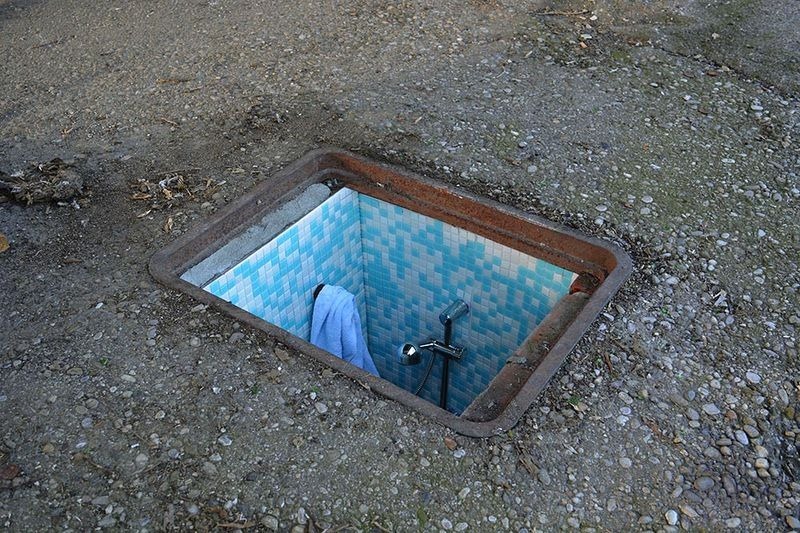
Italian street artist Biancoshock has just finished installing a couple of secret, miniature rooms, hidden under manhole covers, inside an abandoned sewer somewhere in the streets of Milan. This satiric “intervention” —a word that the artist uses for all his artworks— was inspired by the hundreds of people who are forced to live in extreme conditions, such as inside sewers, as in Bucharest where some 600 people live underground. Biancoshock calls this tiny project “Borderlife”.

If some problems can not be avoided, make them comfortable. -Biancoshock

biancoshock-borderlife-1


biancoshock-borderlife-3

biancoshock-borderlife-2

via Colossal

Source…..www.amusingplanet.com

Natarajan

He is 24, blind, and CEO of a Rs 10-crore company…Meet Srikanth Bolla !

Srikanth Bolla, CEO of Bollant Industries, has set his sights on changing lives

Get rid of him. That was the first thing that neighbours told Srikanth Bolla’s parents when they came to see him soon after his birth in a remote village in the east coast of Andhra Pradesh 24 years ago. Bolla was born sightless.

That’s what, he says, scores of parents ordinarily did and still do – abandon babies born with disabilities. Instead, Bolla’s parents, who owned a small piece of land in the village and earned only about Rs 20,000 a year, chose to give him an education.

Today, Bolla is the CEO of Hyderabad-based Bollant Industries, a company with a turnover of around Rs 10 crore that employs uneducated and physically challenged people to manufacture eco-friendly, disposable consumer packaging solutions out of natural leaf and recycled paper.

Recently, Ratan Tata invested an undisclosed amount in the company. Other investors include Srini Raju of Peepul Capital, Satish Reddy of Dr Reddy’s Laboratories and Ravi Mantha, one of India’s more prolific angel investors.

Bolla started out by accompanying his father to the farm but found he could not be of much help. So his father decided to send him to school, which was some 5 km away from home. For two years, he says, nobody acknowledged his presence in school and he was made to sit on the last bench. Fellow students did not accept him during physical training periods.

For the first time in his life, he says, he felt he was the poorest child in the world because he was so lonely.

His father then moved him to a school for special children in Hyderabad, where he started topping his class and also played chess and cricket. Later, he worked with former president APJ Abdul Kalam on the Lead India project, a movement to empower the youth through value-based education.

However, despite scoring 90 per cent in Class X, he was not allowed to take up the science stream because, he claims, he was blind. “I was made blind by the perception of people,” he says. With the option of science refused to him, everybody thought he would settle for the commerce stream. Instead, Bolla sued the state government. “Moving away from the problem is not in my blood,” he says.

After six months of fighting it out, he was allowed to take up science with the rider that he was doing so “at his own risk”. By this time, half of the academic year was over and Bolla did not have books or any other study material.

A mentor at the college he joined converted all lessons into audio books. Bolla passed with 98 per cent. But another hurdle followed. He says he was not allowed to apply for competitive exams because he was blind.

So, he started applying to universities in the United States and got admission in four of them, including the Massachusetts Institute of Technology (MIT) and Stanford University. He opted for MIT and was its first international blind student.

In 2012, after graduating from MIT, he launched Bollant Industries. The company now has around 450 employees, 60 per cent of whom are differently-abled.

The company, with five plants in Andhra Pradesh, Telangana and Karnataka, has started work to set up a larger facility at Sri City in Andhra Pradesh with an investment of Rs 10-15 crore. It currently exports 10-15 per cent of its produce to the US, Australia and Germany.

Life, he says, has taught him many lessons. Compassion is one of them. “Compassion,” he says, “is not about giving a coin to a beggar at the traffic signal. It’s showing somebody the way to live and giving them the opportunity to thrive.”

The world looked at him and said you can do nothing, says Bolla. “But I look up at the world and say I can do anything.”

Photograph, kind courtesy: Massachusetts Institute of Technology

Source…..www.rediff.com

Natarajan

How one story of the betterindia.com generated impacts all around …Read This One ..

Every time our readers like and share TBI stories they are not just spreading positivity and hope, they are also creating an impact that may not at first be visible. Here’s one such story, of a young adoptive parent to a special child, which went viral and created ripples greater than we had imagined.

On January 1, 2016, Aditya Tiwari became the youngest single adoptive parent in India by legally adopting a special child Binny. He named him Avnish.

Aditya fought a 2-year-long battle against the system and society to become a single father.

1

On January 12, 2016, we wrote about ‘How Aditya Fought All Odds to Become India’s Youngest Single Parent to Adopt a Special Child’ and, like always, our readers helped us spread this positive story like wildfire. The article got lakhs of views and 33,000+ shares too (so far).

Avnish turned two on March 16, 2016. On this occasion, his father Aditya could not thank you all more for the huge impact you created simply by clicking ‘share’ on his story.

Here are some of the things that have happened in his life since the story was published on TBI:

1. Parents of children with Down’s Syndrome reached out to him for inspiration and help.

2. Aditya benefitted too. NGOs and physiotherapists reached out to support him.

AT1

The NGOs that had special kids helped him learn more about the disability and ways to deal with it, whereas many physiotherapists offered to treat Avnish for free.

“Ms. Rekha Ramchandran from Down Syndrome Federation of India called me after reading your article. Since then she is supporting me in any way possible to nurture Avnish,” Aditya informed The Better India.

3. The legal struggle and victories inspired many citizens.

In our previous article we had explained how Aditya had to fight a legal battle because the age bar for single adoptive parents in India was 30 and he was just 27 when he decided to adopt Avnish. He kept fighting the system until the age limit was reduced to 25.

“Atul Vidyalaya, Valsad, Gujarat, invited me as a chief guest on January 26, 2016. I was surprised by this and asked them why I was selected, as I had done nothing other than just adopting a child. The Principal replied that it was not just an adoption but it was a trend-setting decision and the struggle behind it makes me a hero. He said he would like the children of his school to become like me. That was the biggest compliment I could ever get,” says Aditya.

4. Thirty other children like Avnish, who were at the same orphanage as him, were also impacted.

During his struggle to adopt Avnish, Aditya came to know about 30 other kids who were illegally being sent to foreign countries. The adoption agency was reported and its licence was cancelled.

These 30 kids are legally registered now and a few of them have also been adopted.

5. HIV positive children will also have a home now.

bennie5

After word spread, an NGO called Palawi from Pandharpur, Maharashtra, which had 98 HIV positive children, called Aditya. They told him these kids were not allowed to go to regular schools and were not accepted by society either, so the NGO had an in-house school and orphanage for them. However, these kids also long to have families but the NGO does not have permission to give them for adoption. Aditya, who is well-versed with adoption proceedings and laws by now, asked them to send all the documents immediately. He then forwarded them to CARA and the Central Government. Aditya is now fighting for the rights of these kids.

“It used to be that previously, if a child was born to an HIV positive mother, he/she used to be infected too. But now, with proper medication and good care, these babies become negative within 18 months. There are many parents who are ready to adopt these kids but we do not have the permission to give them for adoption. Being in a remote area, we explained our concern to the local authorities but did not know any other further procedures. My mother read the article about the legal battle that Aditya Ji fought for Avnish. So we called him to seek help. And he has been a great support since then,” says Dimple Ghadge of Palawi.

6. Law students got to learn a lot.

bennie3

Aditya’s story became an interesting project for law students, who found an opportunity to learn about the adoption law through him. A few documentaries have already been made by law students on Aditya and Avnish – among these are two by LLM Pune University and Jai Hind College, Mumbai. Bhopal Jagran Lake City University is also making a film on them.

7. Foreign nationals sought help for adoption.

IMG-20160319-WA0007

Friday magazine- UAE

Aditya’s story reached foreign shores, and was also published in several magazines of UK and U.A.E, after which many foreign nationals called him to seek help with the adoption procedure in India. Aditya was more than happy to help them.

8. Aditya was the first man to be presented the ‘Real Life Hero’ award by his company, Barclays, on Women’s Day recently. Aditya takes pride in telling this to us.

FB_IMG_1458292057610

9. Film makers have started contacting Aditya.

You might soon watch a film based on the life of Aditya and Avnish – a well-known Bollywood production house and a regional production house too have contacted him for the same.

10. The most wonderful impact.

binny

Binny, who is Aditya’s son Avnish Tiwari now, has shown tremendous improvement since he became a part of Aditya’s family.

“I met the parents of a 10-year-old child with Down’s Syndrome before I adopted Avnish. They told me how difficult it is to raise such children. Avnish had 70-80% Down’s Syndrome. The doctors told me that he would never be able to walk in his life. But in just three months it seems his Down’s Syndrome is just 15-20%. He can hold and stand and tries to stand without support too sometimes. The parents of the 10-year-old child were surprised to see this and have invited me home to help them. My son has set an example for everyone,” says Aditya with a smile.

Source….Manabi Katoch in http://www.the betterindia.com

Natarajan

How a Railway Officer from Chennai Became Foster Father to 200 Children of Farmers from Maharashtra…

Meet Ajeet Saxena – foster father to over 200 children of farmers in Maharashtra. This railway official has dedicated his life to the welfare of these kids, who are all known as Ajeet Saxena’s children wherever they go.

In 2008, a farmer in the Vidarbha region of Maharashtra committed suicide. He was survived by his wife, four children, and his very old father. Three of the four children were girls. The eldest daughter, Deepa, was 14 at the time. Sapna was 11, and Swati was about 7 years old. The family was thoroughly shaken by their loss. They had no hopes for the future, no prospects and no dreams. But what happened next was something they never expected.

Today, Deepa is 22 years old and is working in a hospital after finishing her diploma in nursing. Sapna recently completed the same and Swati is in the second year of a BSc Yoga Education course in Bengaluru. They are educated, confident, and completely aware of how they want to plan their futures. The one person who made it all possible for them is Ajeet Saxena – a man who refers to these three girls and 200 other children from the region as his own.

He is their foster father, a philanthropist who is hand-holding and mentoring children of farmers in Vidarbha, while providing also financial support for their education.

ajeetsaxena3

After seeing these girls for the first time, I sat inside their hut and cried, thinking of what would happen to them. They had nothing to look forward to,” he says.

Ajeet, who is currently posted as the Chief Commercial Manager of Southern Railways in Chennai, embarked on this journey with a desire to help farmers and stop them from committing suicide. It started with the many stories of farmer suicides that were all over the news in those days. Ajeet was deeply moved. He saw two options before him – to go home, watch the news and feel sorry, or to get up and do something sustainable. Choosing the latter, he took 10 days of leave from work and headed to Vidarbha. There, with the help of some volunteers of the Sarvodaya Movement in Sevagram village, he met 29 families of farmers in about 15 villages.

“The highest amount of money for which a farmer had committed suicide in the area was about Rs. 45,000. And the average amount was Rs. 15,000. I was completely heartbroken. But I felt that the situation could be handled if more people came on board. With farmers giving up their lives for just Rs. 15,000, I was sure people would be willing to step in and help,” he recalls. With that thought in mind, Ajeet returned to Chennai after giving the farmers his phone number and asking them to call him in case they felt depressed.

Being a regular speaker on spirituality, he addressed many people in a Rotary Club in Chennai, a few days after he returned. To his surprise, when he told the listeners about the devastating condition he had witnessed, there were many who came forward asking what they could do to help:

“I saw the inherent goodness in people and realised that everybody wants to do their bit but they just don’t know how to move forward.”

ajeetsaxena1

Ajeet Saxena with 10 nursing students in Chennai and his 6-year-old daughter Sharanya

By this time, Ajeet was sure he wanted to do something for the farmers to augment their incomes. But this was before he received the news that another farmer had committed suicide. This farmer’s daughter was a student of Class 11 and he had taken some loans to support her education. And now, suddenly, the young girl was left in the lurch.

“It was after this incident that I reached a final decision – I didn’t want any children from the region to drop out of school and wanted to support their education.”

ajeetsaxena2

Meeting at Sewagram Ashram

He opened bank accounts in the villages for some of these children and started talking to various people he knew to find someone who would be willing to help. One of his friends agreed to sponsor the education of 15 children, some others said they would sponsor three or four kids, and so on. The amounts were set – Rs. 250 per month for children studying up to Class 5, Rs. 400 for those between Classes 6-9, and Rs. 500 for children in Classes 9-12. Each person who agreed to sponsor the education of a child could transfer the amount directly to the child’s bank account. “I know that education for school children in the age group of 6-14 is already free. But this money acts as an incentive for their parents or relatives to not push them into child labour,” says Ajeet.

Within two months, a girl named Rajni called Ajeet and said – “After meeting you, I have a lot of hope that I can do something in life. I want to take up a course in nursing and I am in a bus to Amravati right now.” Rajni found that the fee for that course was Rs. 2 lakh. When she informed Ajeet, he just asked if she was willing to study in any other college, and then talked to the authorities at a nursing school in Chennai. They agreed to enrol her and told Ajeet he could pay the fee later. In this way, Rajni became the first girl from the village to travel outside and finish her education.

She learnt Tamil and English, finished her course, worked in Global Hospital in Chennai for about a year, and has now shifted to Nagpur.

ajeetsaxena5

“All children in the region were very hopeful after this development. And that was when a college named Mahila Maha Vidyalay in Nagpur came to know about us. They were willing to accommodate 10 girls to study there and live in their hostel. They were also ready to take the fee at a later stage,” says Ajeet.

Today, all 200 children, a majority of whom are girls, are known as Ajeet Saxena’s children in Vidarbha. Three girls have moved to Latur for teachers’ training courses, 10 girls are in nursing and four are completing BSc Yoga Education in Bengaluru.

ajeetsaxena4

The four girls (left and right) studying BSc Yoga

Ajeet arranges the funds by writing to his friends, well-wishers and several organizations, seeking sponsors. His intervention is no longer limited to children of farmers who have committed suicide, but all children in the region who come from financially weaker backgrounds.

He is also setting up a trust named Sharnagat Foundation in Nagpur to take this initiative forward at a larger scale. Ajeet visits Sevagram once every three months and lives there for two days to ensure that children are receiving their money on time and nothing is being misused by their parents or relatives.

“The amount of difference I have been able to make in the lives of these children with zero investment from my side is what keeps me moving forward. I feel that all of us should start thinking beyond our own families and handhold at least one child who cannot afford his/her education. All my children are very confident now. They are not at anyone’s mercy. And seeing them succeed gives me immense satisfaction,” he concludes.

You can contact Ajeet by writing to him at ajeet_samadhi@hotmail.com.

Source….Tanaya Singh in http://www.the betterindia.com

Natarajan