Message for the Day….” Remember the name of God Every minute….”

Sathya Sai Baba

Look at the blossoms in the garden! When the gardener plucks the flowers, the buds exult that tomorrow is their turn to be gathered into the gardener’s hands, and their faces are full of joy when they unfold in that hope. Do they feel any sadness? Do their faces droop? Are they any the less bright? No. The moment they know that the next day is their turn, they make themselves ready with great gusto and excitement. In the same way, you must be ready on the path of spiritual practice! Enthusiastically remember the name of the Lord every minute, without worrying and feeling sad that your turn is tomorrow or because someone died today. For people who transformed themselves into spiritual aspirants, their mind (manas)is Mathura, the birthplace of Lord Krishna), their heart is Dwaraka (Lord Krishna’s playground), and their body is Kashi (holiest land of Lord Shiva).

WHY DOES THE NEW YEAR BEGIN ON JANUARY FIRST IN MANY COUNTRIES…?

Because Julius Caesar said so.

Early Roman Calendar

Since long before Caesar’s time, date keeping was dicey. In fact, the 355-day Roman calendar that immediately preceded Caesar’s Julian, worked on a four year cycle where every other year, an additional month was inserted between February (Februarius), the last month of that calendar year, and March (Martius), the first month of the year; this was done in order to catch the calendar up with the Earth’s orbit of the Sun. That additional month, called the Mensis intercalaris, brought in the missing 22 or 23 days, and to even things up, took another five days from February in the years it was present.

Since the calendar had been designed to ensure the proper observance of religious dates, priests, calledpontifices, were responsible for declaring when theinterclaris month should begin and end. Since these priests were also involved with politics, they sometimes:

newyears

Misused their power by intercalating days or not intercalating them, merely in order to lengthen or shorten some magistrate’s year of office, or to increase the gains of some government contractor, or to inflict loss upon him.

By the time Caesar came around, the Roman calendar was in shambles, and in 46 BC, Julius Caesar commanded that it be changed.

Julian Calendar

The Julian calendar’s beginnings were as crazy as the old Roman calendar at its worst:

In order to wipe out the consequences of past neglect, it was necessary that the year 46 BC (called by Macrobius the annus confusionis) should extend to 445 days. The normal number of 355 days had already been increased by the addition of the ordinary 23 days, inserted after Feb. 23. As many as 67 days, divided into two menses intercalares . . . were now interposed between November and December. . . . This year thus consisted of 15 months.

After this “year of confusion,” the new calendar really started. Intercalation was abolished, and each year was increased to 365 days, with a leap year added every fourth year (quarto quoque anno) to February. The months of the calendar after Caesar’s shake-up followed the old Roman calendar closely and most are familiar to us even today: Ianuarius, Februarius, Martius, Aprilis, Maius, Iunius, Guintilis, Sextilis, September, October, November and December.

Along with these changes, Caesar set the New Year to January 1.  Why? Since 153 BC, January 1 was the day new consuls in Rome took office and Romans had commonly used the name of the two consuls to identify a specific year in question.  Thus, by officially making January 1 start the New Year, it simply lined up with the consular year.

As to why the consular year started on January 1 instead of the original Roman Calendar New Year’s day of March 1, this isn’t known.  That said, there are references that seem to imply that January 1 may have begun marking the New Year as early as 189 BC, which precedes when the consular year started beginning on that day.

One proposed reason for this switch is that January is thought by most to have been named after the god of transitions and beginnings, Janus, during the reign of the second King of Rome, Numa Pompilius, who lived from 753-673 BC.  Thus, it was naturally enough for the Romans to eventually decide to make the switch. However, whether this is the reason or not is very much up for debate.

Gregorian Calendar

Although the Julian Calendar was relatively accurate, its use of 365.25 days in a calendar year, as opposed to the precise 365.2425 days, over centuries, created a discrepancy in the calendar. In fact, by the time Pope Gregory XIII (1572-1585) became the Bishop of Rome, the Julian calendar had lost 10 days.

It was this discrepancy that brought about the reformed calendar. Actually beginning 20 years before the calendar took effect with the Council of Trent in 1563, church leaders wanted to restore the spring equinox to the date it was when the First Council of Nicaea was convened in 325 (by 1563, the equinox was falling on March 11, rather than March 21).

As simple as making a Papal decree, Gregory issued the Inter gravissimas on February 24, 1582, and nearly eight months later, the last day of the Julian calendar, October 4, 1582, was followed by the first day of the Gregorian calendar, October 15, 1582. Voila!

Today, the Gregorian calendar is the unofficial calendar of the United States and the United Nations, as well as most countries in the world.

New Year’s Day

Since before even Caesar’s time, people celebrated the New Year. In ancient Babylon, this began after the spring equinox in March, and part of the celebration including subjecting the king to ritual humiliation. In fact, “if royal tears were shed, it was seen as a sign that Marduk [a god] was satisfied and had symbolically extended the king’s rule.”

After he was murdered by a small group of his “friends” (“Et tu, Brute?”), the Roman Senate made Caesar a god on January 1, 42 BC, a date which coincided with the time-honored practice of making offerings to Janus in the hope of having good fortune throughout the year.

Throughout the Middle Ages in Europe, January 1st’s New Year’s celebrations were discouraged, as they were seen by church leaders as a pagan practice.  Instead, other days were often used as a substitute varying from nation to nation.  This changed when the Gregorian calendar was instituted and, at least in the Catholic nations, January 1 once again became the official New Year, and it slowly spread from there with the Gregorian calendar.

Bonus Facts:

  • As mentioned, many protestant nations ignored the Gregorian calendar for some time. England stuck to the Julian Calendar until 1751 before finally making the switch. Orthodox countries took even longer to accept the change in calendars. Russia, for one did not convert to the Gregorian calendar until after the Russian Revolution in 1917. The funny thing was, in 1908, the Russian Olympic team arrived 12 days late to the London Olympics because of it.
  • Under the Gregorian calendar we do not have a leap year every four years, since to properly align the calendar with the Earth’s orbit, an additional day is required in only 97 out of 400 years. So, leap years are calculated as follows:

Every year that is exactly divisible by four is a leap year, except for years that are exactly divisible by 100, but these centurial years are leap years if they are exactly divisible by 400. For example, the years 1700, 1800 and 1900 are not leap years, but the year 2000 is.

source….www.today i foundout.com

Natarajan

Magic Bank Account…!!!

This is really worth reading.  I hope you enjoy it. 

An interesting perspective – One never might have really looked at it this way –

               THE MAGIC BANK ACCOUNT

Imagine that you had won the following *PRIZE* in a contest: Each morning your bank would deposit $86,400 in your private account for your use.  However, this prize has rules:

The set of rules:

1. Everything that you didn’t spend during each day would be taken away from you.

2. You may not simply transfer money into some other account.

3. You may only spend it.

4. Each morning upon awakening, the bank opens your account with another $86,400 for that day.

5. The bank can end the game without warning; at any time it can say,“Game Over!”. It can close the account and you will not receive a new one.

What would you personally do?


You would buy anything and everything you wanted right? Not only for yourself, but for all the people you love and care for. Even for people you don’t know, because you couldn’t possibly spend it all on yourself, right?

You would try to spend every penny, and use it all, because you knew it would be replenished in the morning, right?

ACTUALLY, This GAME is REAL …

Shocked ??? YES! 

Each of us is already a winner of this *PRIZE*. We just can’t seem to see it.

The PRIZE is *TIME*

1. Each morning we awake to receive 86,400 seconds
as a gift of life.

2. And when we go to sleep at night, any remaining time is Not credited to us.

3. What we haven’t used up that day is forever lost.

4. Yesterday is forever gone.

5. Each morning the account is refilled, but the bank can dissolve your account at any time WITHOUT WARNING…

SO, what will YOU do with your 86,400 seconds?

Those seconds are worth so much more than the same amount in dollars.  Think about it and remember to enjoy every second of your life, because time races by so much quicker than you think.

So take care of yourself, be happy, love deeply and enjoy life!

Here’s wishing you a wonderful and beautiful day. Start “spending”….

“DON’T COMPLAIN ABOUT GROWING OLD…!”

SOME PEOPLE DON’T GET THE PRIVILEGE.!

Source….Input from a friend of mine

natarajan

” Jaw-dropping images of Earth from space in 2015″

Astronauts on board the International Space Station beamed back some spectacular views of Earth this year.

The Earth Observations team at NASA’s Johnson Space Center selected the 15 best photographs, which we’ve republished here.

Astronauts aboard the International Space Station took this image of Adele Island, off Australia’s north coast, on June 11, 2015. The tiny island is only 2.9 kilometres (2 miles) long.

Astronauts aboard the International Space Station took this image of Adele Island, off Australia’s north coast, on June 11, 2015. The tiny island is only 2.9 kilometres (2 miles) long.

This image shows landscapes of the arid Sahara and the dark green marshes of Lake Chad, which stand out in the foreground.

This image shows landscapes of the arid Sahara and the dark green marshes of Lake Chad, which stand out in the foreground.

Hawaii’s Kilauea volcano is seen on the left in a photo taken in February.

Hawaii’s Kilauea volcano is seen on the left in a photo taken in February.

The peaks of Colombia’s Santa Marta are so high that trees cannot grow. The highest peak has a permanent snow cap and is the only place where snow can be seen from the tropical beaches of the Caribbean coast.

The peaks of Colombia’s Santa Marta are so high that trees cannot grow. The highest peak has a permanent snow cap and is the only place where snow can be seen from the tropical beaches of the Caribbean coast.

Southern Scandinavia is illuminated under a full moon in this image, which also features a green aurora to the north and the Baltic Sea, seen as a black patch in the lower right of the photo.

Southern Scandinavia is illuminated under a full moon in this image, which also features a green aurora to the north and the Baltic Sea, seen as a black patch in the lower right of the photo.

The Paraná River, South America’s second-largest, pours brown muddy water into a wide estuary known as the River Plate.

The Paraná River, South America’s second-largest, pours brown muddy water into a wide estuary known as the River Plate.

The snow-covered Himalaya range is seen near the China–India border.

The snow-covered Himalaya range is seen near the China–India border.

Laguna Colorada, a lake in the Bolivian Andes Mountains, lies at 4,300 metres (14,100 feet) above sea level. Algae in the water is responsible for the lake’s deep red-brown color.

Laguna Colorada, a lake in the Bolivian Andes Mountains, lies at 4,300 metres (14,100 feet) above sea level. Algae in the water is responsible for the lake's deep red-brown color.

Fish farms are seen on the coast of China’s northeast province of Liaoning.

Fish farms are seen on the coast of China’s northeast province of Liaoning.

This September image shows the winding border between Pakistan and India, one of the few places on Earth where an international boundary can be seen at night.

This September image shows the winding border between Pakistan and India, one of the few places on Earth where an international boundary can be seen at night.

Brightly-coloured salt ponds are seen on the coast of Tunisia’s port city, Sfax.

Brightly-coloured salt ponds are seen on the coast of Tunisia's port city, Sfax.

Red-brown coastal lagoons are seen on this stretch of Western Australia’s coastline, in a photo taken on June 11.

Red-brown coastal lagoons are seen on this stretch of Western Australia's coastline, in a photo taken on June 11.

This photo, taken on June 15, shows the northern tip of Massachusetts’ Cape Cod.

This photo, taken on June 15, shows the northern tip of Massachusetts' Cape Cod.

The Mekong River, Southeast Asia’s largest river, flows on the border between Thailand and Laos. Heavy monsoon rainfall at the end of July created a red-brown channel of floodwater.

The Mekong River, Southeast Asia’s largest river, flows on the border between Thailand and Laos. Heavy monsoon rainfall at the end of July created a red-brown channel of floodwater.

A red sprite — a major electrical discharge thought to occur during large thunderstorms — is captured above the white light of an active thunderstorm high over Missouri or Illinois.

A red sprite — a major electrical discharge thought to occur during large thunderstorms — is captured above the white light of an active thunderstorm high over Missouri or Illinois.

Source……..

Message for the Day….” The Lord showers grace on those endowed with righteousness, irrespective of race, wealth and gender.”

These are the two chief enemies of every spiritual aspirant: Conceit (that you know everything) and Doubt (Is it or is it not). Simply decide to be firmly fixed in your reality. If that is pure, everything is pure. If that is true, everything is true. If you wear blue eyeglasses, you see only blue, even though Nature is resplendent with many colours. So too, if the world appears to you as full of differences, that is due only to the fault in you. If all appears as one love, that too is only your love. The feelings within you, is the cause in both situations. The question that may arise next is whether the Lord has faults, for He too identifies faults. The Lord only searches for goodness in a devotee, not faults and sins. Your assessment of the Lord is dependent on your feelings. The Lord showers grace on those endowed with righteousness, irrespective of race, wealth and gender.

Sathya Sai Baba

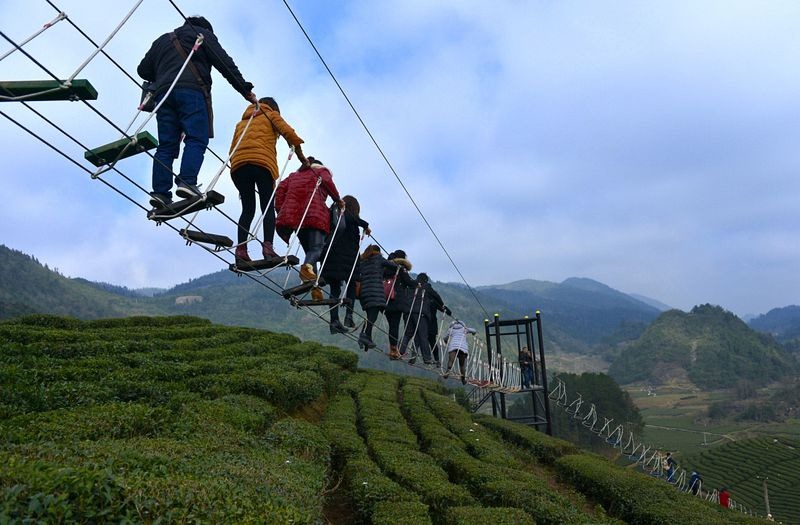
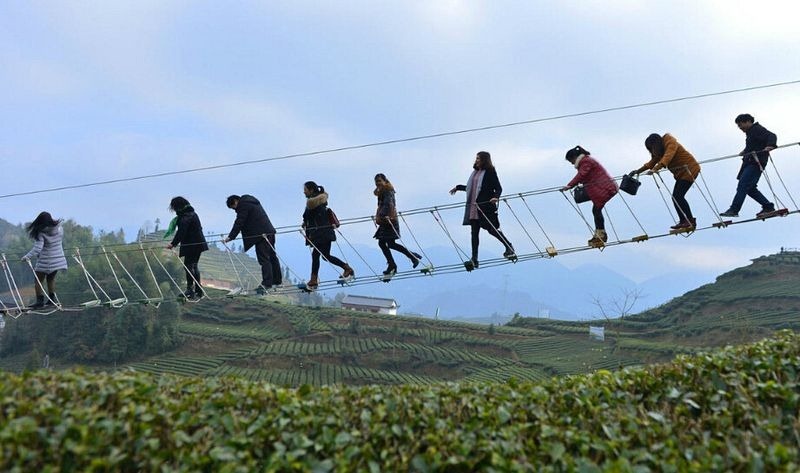
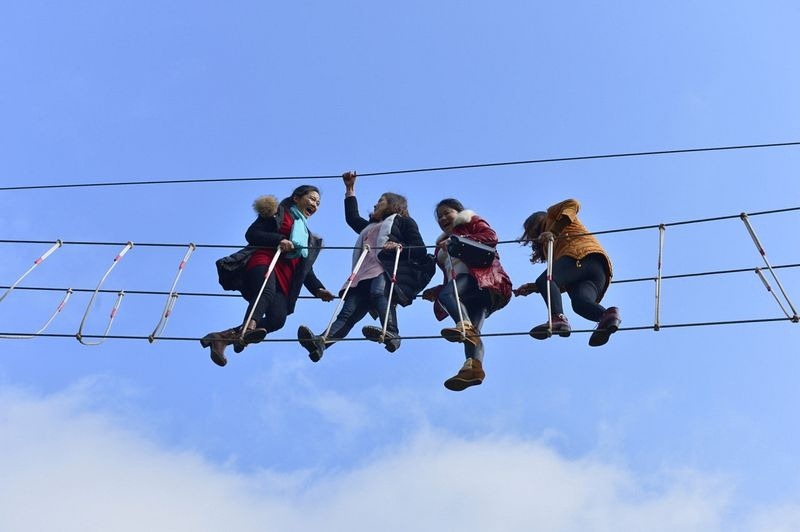
A Daredevil Aerial Walkway Over a Tea Park in China…..

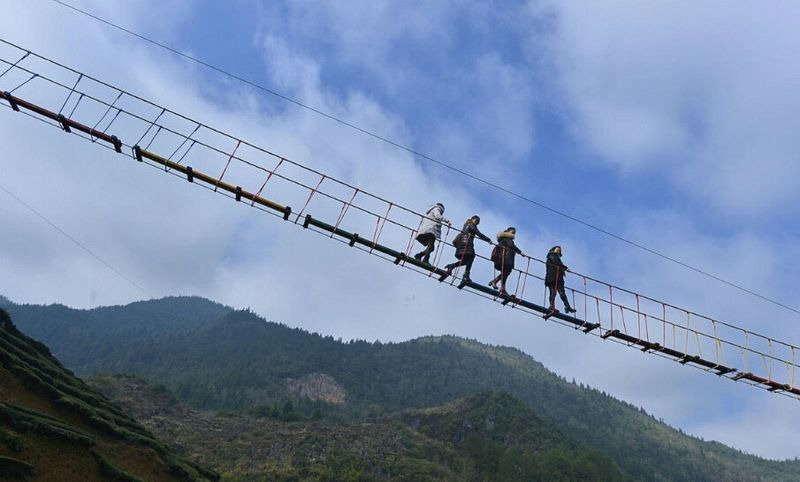
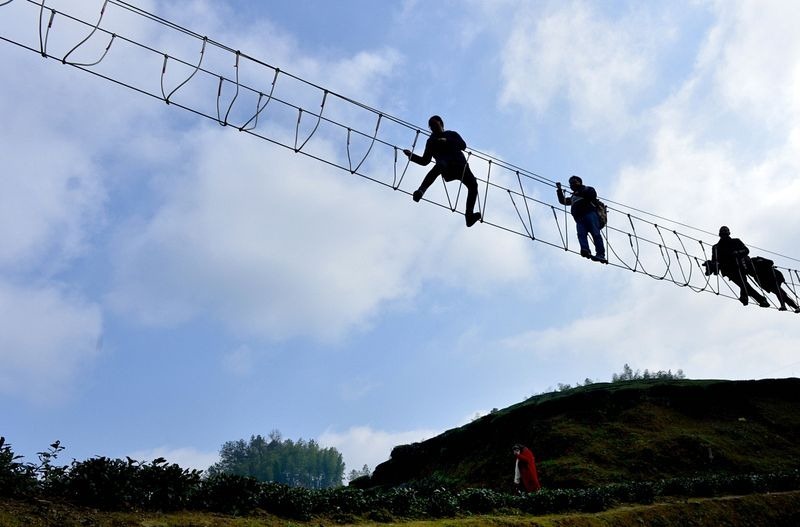
What’s more dangerous than a glass-bottom bridge? A bridge without a bottom, of course!

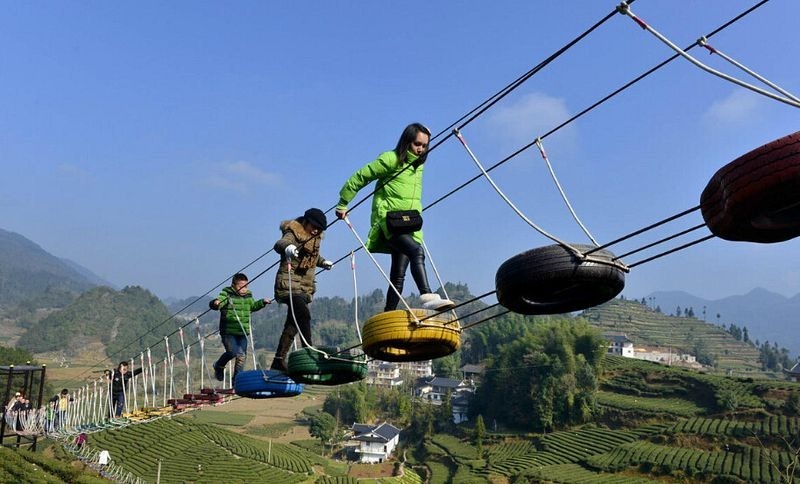
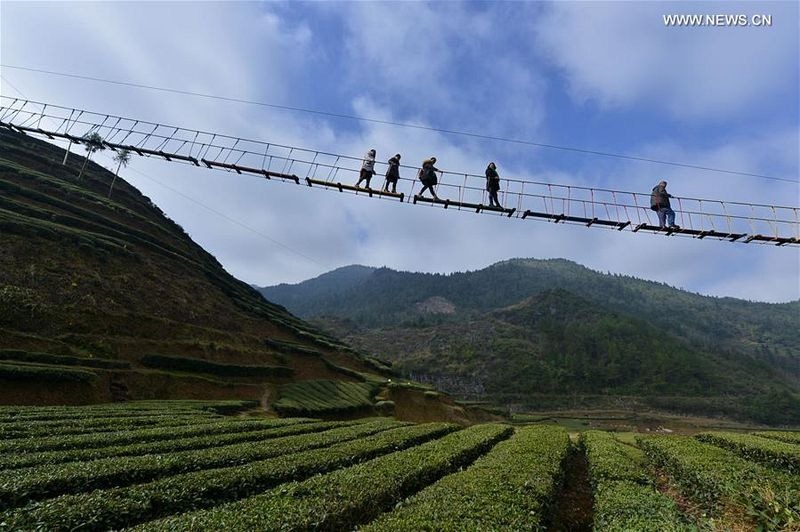
Such an aerial walkway buttressed by only ropes has opened at a tea park in Xuan’en County, in central China’s Hubei Province. The “air corridor” is suspended at least a dozen feet above the tea fields, and more than thirty feet at places, and runs for a length of about 1,000 meters. Only ropes, short wooden planks or tires are provided in the name of walkways. The scary attraction has drawn hundreds of tourists to the tea park already.

Xuan’en Country is located within the hinterlands of the Tujia and Miao ethnic minority group’s autonomous prefecture of Central China’s Hubei Province. It is part of the Wuling Mountain region in the upper reaches of the Yangtze River. This area has an ancient history of tea production.

air-corridor-xuanen-tea-park-7

air-corridor-xuanen-tea-park-1

air-corridor-xuanen-tea-park-2

air-corridor-xuanen-tea-park-3

air-corridor-xuanen-tea-park-4

air-corridor-xuanen-tea-park-5

air-corridor-xuanen-tea-park-8

Sources: China.com / JSChina.com.cn / xinhuanet.com

Source….www.amusingplanet.com

Natarajan

Rainy Russian Street Photography Looks Like Oil Paintings….!!!

St. Petersburg-based Russian photographer Eduard Gordeev captures delicate cityscape scenes by taking photos in the rain. Flowing rain drops blur the colors and diffuse light, resulting in photos that have a strong resemblance to Impressionist oil paintings.

Though the series mostly features Russia’s St. Petersburg and its widely recognized landmarks, some captivating shots from Lisbon can be found there as well. Nothing gloomy about the rain here, just pure Russian romance!

More info: nau.35.photo.ru (h/t: mymodernmet)

rain-street-photography-glass-raindrops-oil-paintings-eduard-gordeev-32

rain-street-photography-glass-raindrops-oil-paintings-eduard-gordeev-20

rain-street-photography-glass-raindrops-oil-paintings-eduard-gordeev-3

rain-street-photography-glass-raindrops-oil-paintings-eduard-gordeev-9

rain-street-photography-glass-raindrops-oil-paintings-eduard-gordeev-16

rain-street-photography-glass-raindrops-oil-paintings-eduard-gordeev-2

rain-street-photography-glass-raindrops-oil-paintings-eduard-gordeev-22

vrain-street-photography-glass-raindrops-oil-paintings-eduard-gordeev-17

rain-street-photography-glass-raindrops-oil-paintings-eduard-gordeev-30

Source……..Agata Gri in http://www.boredpanda.com

natarajan

Unusual Airport Runways Around the World….!!!

1. Gisborne
Airport, New Zealand

This North Island airport is one of the few in the
World that has a railway line running through its runway. Both the railway
And the airport are active, so let’s hope they are precise about their
Scheduling.

2. Juancho E. Yrausquin Airport, Saba Island

Blink and you might miss it. With only 400m in length, this Caribbean island has the shortest commercial

air strip on the planet. Obviously, this tiny runway is only suitable for small aircraft.

3. Courchevel Altiport, France

This airfield high in the French Alps is a convenient yet treacherous drop-off point for wealthy skiers

at the chi-chi Courchevel slopes. In fact, there are ski runs no far from the 1,762 ft (537 m) mountaintop

runway. Frequent fog, snow, ice and low clouds make it even more extreme. You’ll want to make sure your

small plane or helicopter pilot is well trained.

4. Don Mueang Airport, Thailand

There aren’t many airports in the world that have an 18 hole golf course right amongst the runways. Fore!

5. Tenzing-Hillary Airport, Nepal

If you’re planning on trekking to Mount Everest, chances are you’ll arrive via this small Nepalese airport

in Lukla. It has a short runway with a 9,334 feet (2900 meter) drop off the edge. Not for the faint of heart.

6. Agatti Aerodrome, Lakshadweep, India

This 4000 feet long island runway doesn’t leave much margin for error. A few more inches, and passengers

are going to be swimming sooner than they bargained for.

7. Barra International Airport, Scotland

Barra International Airport, on a remote northern island in Scotland, has the only beach runway for scheduled

flights in the world. At high tide, some of the runways are underwater..

8. Gibraltar International Airport

These are red lights you don’t want to run..

9. Gustaf III Airport, Saint-Barthélemy

This runway is so tiny, only planes with a maximum of 20 people can land here. That helps keep St. Barts

an exclusive upscale Caribbean haven for the rich and famous.

10. Kansai International Airport, Japan

With land at a premium in Japan, they decided to build this major airport on an artificial island offshore in

Osaka Bay. If its ocean setting doesn’t give you chills, its also regularly subjected to earthquakes, typhoons

and storm surges. Oh, and the island is also sinking. This airport’s construction and constant reinforcement

makes it the most expensive civil works project in modern history.

11. Madeira Airport, Portugal

The previous airport on this Portuguese archipelago was notoriously challenging due to its short runway

surrounded by high mountains and the ocean. So, they extended it with an impressive – yet frightening –

platform supported by 180 columns off the edge of the land.

12. Narsarsuaq Airport, Greenland

This runway is short and sweet whether you’re coming or going. It is considered one of the world’s most

challenging approaches.. Pilots have to fly up a fjord known for its turbulence and wind gusts.

13. Savannah-Hilton Head International Airport

A pair of grave makers are embedded into Runway 10 at this airport, in remembrance to the Dotson Family who

used to own the land. One of the graves dates back to 1857. The law states that next of kin need to authorize

the moving of family graves, and when they couldn’t be located, the airport engineers let them be.

14. Wellington Airport, New Zealand

This airport in New Zealand’s capital city has a short runway, so only smaller aircraft can land there.

It’s known for turbulent landings due to the channeling effect of the Cook Strait creating gusty winds.

15. Princess Juliana International Airport, Sint Maarten

This beachside airport on the Dutch side of Saint Martin is right across the street from Maho Beach. It is

known for its extremely low-altitude flyover landing approach, and tourists flock here to experience the rush

of the planes overhead. Definitely one of the craziest airport runways you got to see to believe.

16. Ice Camp Barneo, North Pole

This snowy strip not far from the North Pole is open for just 4 weeks per year. Built on a drifting ice

base, it’s a fully functional runway suitable for cargo planes like the Antonov AN-74. Perhaps Santa

Claus uses it too.


Curiosity’s 10 best images of Mars in 2015….

As of December, 2015, Curiosity has acquired over 292,000 images from Mars’ surface. Here are our picks for the top 10 images by the rover in 2015.

Strata rocks and dark sand in an area that has been named

Strata rocks and dark sand in an area that has been named ‘Kimberley.’ The strata in the foreground dip towards the base of Mount Sharp, indicating flow of water toward a basin that existed before the larger bulk of the mountain formed. The images obtained by NASA’s Curiosity rover in October, 2015, led scientists conclude there were ancient lakes on this area. Credits: NASA/JPL-Caltech/MSSS

Since its August 5-6, 2012 landing on Mars – an event known to space scientists as seven minutes of terror – NASA’s Curiosity rover has been studying the surface of Mars. Its job now is to determine whether the Gale Crater area, the area in which it landed, ever had the right conditions to support microbial life. As of December, 2015 – using its 17 cameras – Curiosity has acquired over 292,000 images from the surface of Mars. The images on this page are our picks of some of the best images captured by the rover in 2015.

Curiosity has seen a lot of layered rocks on the surface of Mars, like these amazing rocks captured on July, 2015. Credits: NASA/JPL-Caltech/MSSS

Curiosity has seen a lot of layered rocks on the surface of Mars, like these amazing rocks captured in July, 2015.Read more about this image. Credits: NASA/JPL-Caltech/MSSS

The rover mission’s official name is the Mars Science Laboratory. The rover itself is 9 feet (about 3 meters) long and 7 feet (about 2.7 meters) wide, and weighs about 2,000 pounds (900 kg).

 It is not Arizona or Utah...this is planet Mars as seen by Curiosity on September, 2015.  This image shows regions that include a long ridge teeming with hematite, an iron oxide. Just beyond is an undulating plain rich in clay minerals. And just beyond that are a multitude of rounded buttes, all high in sulfate minerals. The changing mineralogy in these layers of Mount Sharp suggests a changing environment in early Mars, though all involve exposure to water billions of years ago. Image via NASA/JPL-Caltech/MSSS

It’s not Arizona or Utah … this is planet Mars as seen by Curiosity on September, 2015. This image shows regions that include a long ridge teeming with hematite, an iron oxide. Just beyond is an undulating plain rich in clay minerals. And just beyond that are a multitude of rounded buttes, all high in sulfate minerals. The changing mineralogy in these layers of Mount Sharp suggests a changing environment in early Mars, though all involve exposure to water billions of years ago. Image via NASA/JPL-Caltech/MSSS

Sunset in Mars' Gale Crater. NASA's Curiosity Mars rover captured the sun setting on April 15, 2015 from the rover's location in Gale Crater. The color has been calibrated and white-balanced to remove camera artifacts. Mastcam sees color very similarly to what human eyes see, although it is actually a little less sensitive to blue than people are. Dust in the Martian atmosphere has fine particles that permit blue light to penetrate the atmosphere more efficiently than longer-wavelength colors. That causes the blue colors in the mixed light coming from the sun to stay closer to sun's part of the sky, compared to the wider scattering of yellow and red colors. Image via NASA/JPL-Caltech/MSSS

Sunset on Mars. The Curiosity rover captured the sun setting on April 15, 2015 from the Gale Crater. The color has been calibrated and white-balanced to remove camera artifacts. The rover’s ‘Mastcam’ sees color very similarly to what human eyes see, although it is actually a little less sensitive to blue than people are. Dust in the Martian atmosphere has fine particles that permit blue light to penetrate the atmosphere more efficiently than longer-wavelength colors. That causes the blue colors in the mixed light coming from the sun to stay closer to sun’s part of the sky, compared to the wider scattering of yellow and red colors. Image via NASA/JPL-Caltech/MSSS

Two orbiters that were already studying Mars when Curiosity arrived. They are the Mars Reconnaissance Orbiter, and Mars Odyssey. These two act as satellites, relaying pictures and data from the rover back to Earth.]

Diverse composition of mineral veins at the

Diverse composition of mineral veins at the ‘Garden City’ site investigated by Curiosity suggests multiple episodes of groundwater activity. The prominent mineral veins vary in thickness and brightness, and include: 1) thin, dark-toned fracture filling material; 2) thick, dark-toned vein material in large fractures; 3) light-toned vein material, which was deposited last. Researchers used the Mastcam and other instruments on Curiosity in March and April 2015 to study the structure and composition of mineral veins at Garden City, for information about fluids that deposited minerals in fractured rock there. Image via NASA/JPL-Caltech/MSSS

Because color images use much more data or bandwidth to be transmitted to our planet, a lot of black and white images are sent to the orbiting spacecraft that occasionally passes over t

he rover’s location for a short time. However, some color images are eventually sent.

This is an area lining the northwestern edge of Mount Sharp. The scene combines multiple images taken with the Mast Camera on NASA’s Curiosity Mars rover on Sept. 25, 2015. Dunes are larger than wind-blown ripples of sand or dust that Curiosity and other rovers have visited previously. You can see the dark dunes by clicking again after opening this panorama. Image via NASA/JPL-Caltech/MSSS

Giant antennas at California (USA), Australia and Spain compose the Deep Space Network that receives pictures and data from the Mars spacecraft as well as from other interplanetary spacecraft.

A Selfie on Mars. Curiosity extended its robotic arm and used the camera on the arm's end to capture this self portrait on October 6,2015. The image was taken at the

A selfie on Mars. Curiosity extended its robotic arm and used the camera on the arm’s end to capture this self portrait on October 6, 2015. The image was taken at the ‘Big Sky’ site, where its drill collected the mission’s fifth taste of Mount Sharp. Image via NASA/JPL-Caltech/MSSS

Dark rocks on route to Mountains. Diverse terrain is visible on this image taken on Mount Sharp on April 10, 2015. The color has been approximately white-balanced to resemble how the scene would appear under daytime lighting conditions on Earth. Image via NASA/JPL-Caltech/MSSS]

Dark rocks on route to mountains. Diverse terrain is visible on this image taken on Mount Sharp on April 10, 2015. The color has been approximately white-balanced to resemble how the scene would appear under daytime lighting conditions on Earth. Image via NASA/JPL-Caltech/MSSS

Damage on the aluminum wheels is evident after 7 miles (11.3 km) on the odometer of the Curiosity rover. Mars' terrain and diverse rocks led to more wheel damage than was expected. However scientists think the 20 inches (51 cm) wheels may permit the rover to continue its mission. Image via NASA/JPL-Caltech/MSSS

Damage on the aluminum wheels is evident after 7 miles (11.3 km) on the odometer of the Curiosity rover. Mars’ terrain and diverse rocks led to more wheel damage than was expected. However scientists think the 20 inches (51 cm) wheels may permit the rover to continue its mission. Image via NASA/JPL-Caltech/MSSS

A Solar Eclipse from Mars. Curiosity captured Phobos, one of the two small martian moons passing in front of the Sun in July, 2015. Although Phobos is only about 14 miles (22.5 km) in diameter, it orbits Mars at just 6,000 km ( 3,728 miles) which is relatively close. Image via NASA/JPL-Caltech/MSSS

A Solar Eclipse from Mars. Curiosity captured Phobos, one of the two small martian moons passing in front of the Sun in July, 2015. Although Phobos is only about 14 miles (22.5 km) in diameter, it orbits Mars at just 6,000 km ( 3,728 miles) which is relatively close. Image via NASA/JPL-Caltech/MSSS

Where is Curiosity right now? The rover is located in an area of Mount Sharp that has been named Namib dune. The rover is analyzing the composition and grain size of a ripple.

Source….www.earthsky.org

Natarajan

” நாமும் பிறக்க வேண்டும் புதிதாக , புத்தாண்டுடன் சேர்ந்து …” !!!


பிறக்கிறது  புது ஆண்டு… வரும் ஆண்டு சிறப்பாக , செழிப்பாக
மாறட்டும்,  நம் யாவருக்கும் !
நாமும் பிறக்கவேண்டும் புதிதாக , புத்தாண்டுடன் சேர்ந்து !
மறு பிறவி விவாதம் ஒரு விடை இல்லா கேள்வி …மனிதப் பிறவி
நமக்கு ஒரு இரவு முழுக்க உறக்கம் ….காலையில் கண் விழிப்பு..
இப்படி நித்தம் நித்தம் காலையில் நாம் எடுப்பது ஒரு  புதுப்  பிறவியே !
மொத்தத்தில் இதுவே நமக்கு மறு பிறவி !
எதிர் வரும் ஆண்டில் அல்லன  நீக்கி  நல்லன கொண்டு நம்
பயணம்  நாம் தொடர்ந்தால்
மறு பிறவி நித்தமும்  காணும்  நாம்  நிச்சயம்  பிறப்போம்
புதிதாக , புது ஆண்டுடன் சேர்ந்து ஒரு தனிப் பிறவியாக !!!
Natarajan
30 Dec 2015