Message for the Day…” Make Earnest efforts to please God …”

Sathya Sai Baba

When you satisfy God, the entire world will be satisfied with you. If God disowns you, then the world will also disown you. Hence, there is no need for you to make efforts to please this person or that person. Do not waste your life in the pursuit of mean and petty desires. Make earnest efforts to please God. When you please God and become dear to Him, the entire world will become yours. Thyagaraja sang, “Oh Rama! If I have Your Grace (Anugraha), all the nine planets (navagraha) will become subservient to me.” To become recipients of God’s grace, treat the pairs of opposites like pleasure and pain, happiness and sorrow, praise and blame with equal-mindedness. Always contemplate on God’s Divine Name and become deserving of His love. Once you become the recipients of God’s love, you need not be afraid of anything. You will achieve everything in life. Therefore, develop equal-mindedness and make efforts to earn divine grace.

Message for the Day…….” Distinction between the ordinary Person and Spiritual aspirant…”

Sathya Sai Baba

Spiritual aspirants must carefully understand the distinction between the conduct of the ordinary (sahaja) person and spiritual aspirant. The ordinary person has no fortitude (sahana), is conceited (ahamkara), and is full of desires related to the world, through which the person is trying to have a contented existence. Aspirants engaged in contemplation of the Lord (Sarveswara-chinthana) as ceaselessly as the waves of the sea, accumulate the wealth of equality and equal love to all, and are content in the thought that all is the Lord’s and nothing is theirs. Unlike the ordinary person, the spiritual seeker won’t easily bend before grief, loss, anger or hatred or selfishness, hunger, thirst or fickleness. Aspirants should master all good things as much as possible and journey through life in fortitude, courage, joy, peace, charity, and humility. Realise that tending the body is not all-important, and bear even hunger and thirst patiently and engage uninterruptedly in contemplation of the Lord.

Siachen Miracle – Army Jawan Found Alive, Buried Under 25 Feet of Snow for 6 Days!

Miracles happen! And the Army jawan who was found alive after remaining buried under 25 feet of snow for six days, is a living example of an amazing miracle.

Lance Naik Hanaman Thappa was found in a critical condition after six days of rescue efforts on the Siachen glacier.

siachen2

Source: Twitter

10 Army personnel including a Junior Commissioned Officer (JCO) and nine other ranks of Army’s 19 Madras Regiment were stationed at an altitude of 19,600 feet on the Siachen Glacier in Jammu and Kashmir. On February 3, they were hit by a massive avalanche, and rescue operations have been on since then. The base was located on the Saltoro ridge, close to the Line of Control (LoC) with Pakistan.

On February 4, a Defence Spokesperson had said that the hopes of finding anyone alive were “very remote”. And later, the Indian Army had declared them presumed dead.

After probable locations of the incident were identified by the rescue team with the help of specialised equipment, they had to cut through up to 40 feet of ice at multiple locations. Frequent snow blizzards, extreme freezing temperatures and low visibility made the search operation very difficult.

Army teams have been sifting through huge mass of ice in the hazardous region where temperatures range between minus 42 and minus 25 degrees Celsius.

siachen1

Source: Twitter

“It was a miraculous rescue, all efforts are being made to evacuate Lance Naik Hanaman Thappa to the RR hospital in the morning,” Lt Gen D S Hooda, Northern Army Commander, told PTI.

Five bodies have been recovered so far, and four of them have been identified.

“The teams are working round the clock and observing all precautions since the unstable ice and snow in the region could trigger fresh avalanches. Rescue efforts will continue till all our soldiers are found,” said an Army spokesperson.

On Friday, the Ministry of Defence had released the names of all 10 soldiers who were hit by the avalanche:

1. Subedar Nagesha TT – village Tejur, Hassan district, Karnataka.
2. Havildar Elumalai M – village Dukkam Parai, Vellore district, Tamil Nadu.
3. Lance Havildar S Kumar – village Kumanan Thozhu, Teni district, Tamil Nadu.
4. Lance Naik Sudheesh B – village Monroethuruth, Kollam district, Kerala.
5. Lance Naik Hanamanthappa Koppad – village Betadur, Dharwad district, Karnataka.
6. Sepoy Mahesha PN – village HD Kote, Mysore district, Karnataka.
7. Sepoy Ganesan G – village Chokkathevan Patti, Madurai district, Tamil Nadu.
8. Sepoy Rama Moorthy N – village Gudisatana Palli, Krishna Giri district, Tamil Nadu.
9. Sep Mustaq Ahmed S – village Parnapalle, Kurnool district, Andhra Pradesh.
10. Sepoy Nursing Assistant Suryawanshi SV – village Maskarwadi, Satara district, Maharashtra

The survivor is a resident of Betadur village in Dharwad district of Karnataka.

“We are happy. The entire village is happy and relieved. We were eagerly waiting for some news for past few days. It was difficult to even believe that he was saved. Now, we need everyone to pray for his survival,” his uncle told The News Minute.

Source…….Tanaya Singh in http://www.the betterindia.com

Natarajan

Zika Virus – All You Need to Know…

The ongoing Zika virus outbreak has created fear and uncertainty throughout the world because no-one knows how to contain it or cure it as yet. With that being said, I figured that the best way to protect myself from infection was to inform myself. Here are the five W’s of the Zika virus, and how to protect yourself from contracting it:

Who discovered the Zika virus?

Image Source

Zika was first discovered by scientists in 1947, when a rhesus monkey (pictured) living in Uganda’s Zika forest developed an unknown febrile illness. They were able to isolate a new transmissible agent from the sick monkey, and, in 1952, named it Zika after the forest in which it was discovered.

The first recording of human infection was also made in 1954 after a serological (the study of bodily fluids) survey was conducted on people in Uganda and neighboring Nigeria. Some 50 out of 84 people tested were found to have developed antibodies.

Another study conducted in India around the same time showed that a significant number of the people tested had developed Zika-specific antibodies, indicating the likelihood that the virus has long been present in various human populations.

What is the Zika virus?

The Zika virus is a virus that’s spread by daytime-active mosquitoes that are part of the Aedes genus. They originated in tropical and subtropical zones, however they have now spread around the world. The only place they cannot be found is in Antarctica. Human activity has been in part to blame for the spread of Aedes mosquitoes. An example of this can be seen in how the Asian tiger mosquito made it to the Americas thanks to the used tire trade.

Some 1 in 5 people that are infected with the Zika virus through a mosquito bite actually become ill, and the symptoms they exhibit include fevers, rashes, joint pains, conjunctivitis (redness in the eye), muscle pain and headaches.

The incubation period for the virus is unknown, however it is believed to range from a few days to one week. Its symptoms usually last for the same period. People do not usually get sick enough to go to hospital if infected with the Zika virus, and it is very rare to hear of a death from the virus too.

Zika is related to dengue and yellow fevers, as well as the Japanese encephalitis (inflammation of the brain) and West Nile viruses. It is diagnosed with a specialized blood test, however there is no known cure or vaccine. There have been some media reports of the virus being transmitted sexually, however more evidence is needed to confirm whether this is a cause for widespread concern. Even if it is, the likelihood of this taking place remains very low.

Where did the current Zika virus outbreak start?

While Zika spread through equatorial Africa and Asia between 1951 and 1981, a bona-fide Zika outbreak wasn’t reported until 2007. That took place on the Pacific island of Yap, and thus remained relatively contained.

The current Zika outbreak first began last year in Brazil. Researchers suggested that the virus arrived in the country from French Polynesia sometime during 2014. In May 2015, a dengue-like disease outbreak took hold in northern, northeastern and southeastern Brazil. Many patients were exhibiting flu-like symptoms, followed by rashes and joint pain.

The outbreak reached Colombia by October 2015, before reaching other South American countries, as well as the Caribbean in November and December. At the time of writing, there were also confirmed cases in Central America, the United States, Australia and Europe. In fact, the World Health Organization has said that it expects Zika to spread throughout the entire Americas in the coming weeks.

When should you be concerned about the Zika infection?

Zika is said to have the most severe effects on pregnant women and children, however anyone is vulnerable to infection. If you have visited one of the affected countries and are exhibiting any of the symptoms mentioned in this article, see a doctor as soon as possible. He or she may prescribe blood tests to conduct further investigations should there be suspicion of you having contracted the virus.


Why has Zika become an international health concern?


As aforementioned, the ongoing Zika outbreak commenced in Brazil in May 2015. The main cause for concern over the virus is the fact that there has been a huge spike in births of babies with microcephaly in the affected regions of that country. That is why the virus’ movement is being tracked and reported on all over the world.

Microcephaly is a condition where a baby’s head is much smaller than expected. It occurs because a baby’s brain has not developed properly during pregnancy, or because it stops growing after birth, resulting in a smaller head size. While it can be an isolated birth defect, it can also occur in combination with other major defects, such as developmental delay, intellectual disability and proneness to seizures.

In a nutshell, the World Health Organization is doing what it can to halt Zika’s progress in order to protect unborn children. Currently the biggest fear is that there will be an explosion of microcephaly cases around the world.

How to Protect Yourself From Contracting Zika


– Avoid traveling to countries where the virus has been confirmed.

– If you must, wear long-sleeved shirts and pants.

– Stay somewhere air-conditioned or use windows and door screens to keep any mosquitoes outside.

– Sleep under a mosquito bed net if possible.

– Use insect repellent.

– If you have a child, dress in clothing that covers the arms and legs and use mosquito netting to cover cribs or strollers.

– Treat your clothing with permethrin (a synthetic insecticide), or purchase permethrin-treated items.

–  Use protection if you intend to sleep with someone who has just returned from traveling in a Zika-affected region.

Source……….www.ba-bamail.com

Natarajan

Message for the Day…” True Living consists in the Realisation of God …”

Education and other things that make one grow and become big are of no use for spiritual progress; they bring about only spiritual downfall. That is why the world is called the ‘illusory universe’ (maya-prapancha). Truth, in whatever illusion it is immersed, will only shine more effulgently, for such is the nature of truth. How can we say that the objective world, which undergoes modifications every minute, waning and waxing with the waywardness of appearing and disappearing, is eternal truth? The characteristic of a spiritual aspirant is the attainment of Truth, not the search of the unreal in this evanescent world. In this false world, there can be no true living(satya-achara). There can be only false living (mithya-achara). True living consists in the realisation of the Lord. This must be borne in mind by everyone every moment of one’s life.

Sathya Sai Baba

Inca Tern: The Bird With A Magnificent Moustache…!!!

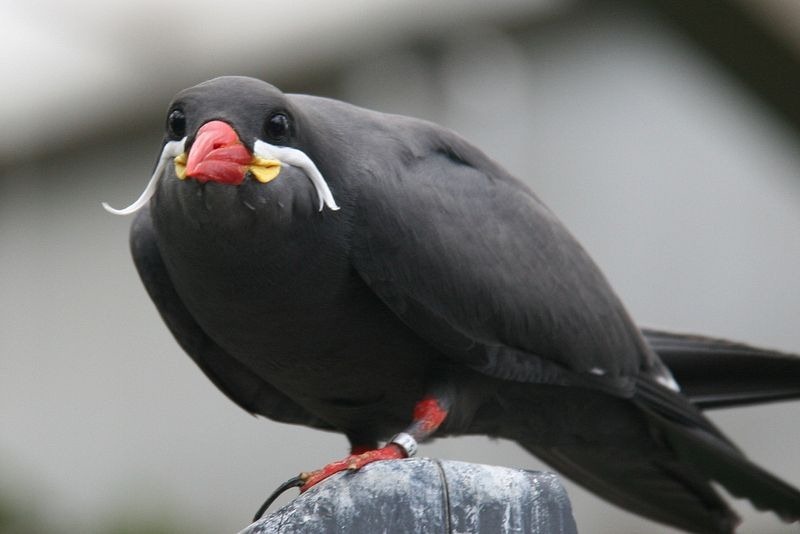
The Bougainville moustached kingfisher might be the one with word “moustache” in its name but it’s the dark grey plumaged Inca tern of the family Sternidae that sports the most magnificent whiskers.

The Inca tern features a pair of striking Dali-like white handlebar moustache of specialized feathers that grow out from the fleshy yellow gape at the corners of its brilliant red beak. The moustache is not male exclusive, it’s shared by the females as well. Aside from being an unusual ornament and a matter of pride, the length of the bird’s moustache is also a reliable signal of its body condition —the longer the moustache, the healthier the birds. Inca terns with longer moustaches tend to mate together and have more and larger chicks.

inca-tern-1

Photo credit: one_green_star/Flickr

Inca terns breed along the west coast of South America from northern Peru to central Chile, a region once ruled by the mighty Inca Empire which gives the species its name. This is where the cold nutrient-rich Humboldt current flows just off-shore, carrying with it swarms of small ocean fish such as anchovies which the bird feeds on. It spots its prey from the air, and then dives into the water to grab meals with its pointed beak. The birds also scavenge scraps from sea lions, dolphins, and fishing boats, but small fishes are its staple diet.

Reduction of anchovy stocks due to commercial fishing and excessive guano harvesting which destroys breeding ground has led to major decline in population of the Inca tern. Once numbering in the millions, the current population estimate is just over 150,000 birds, and the species is now listed as near threatened by the International Union for the Conservation of Nature. Although fishing for anchovies has been banned in Peru, and guano harvesting is also regulated, natural factors such as recurring cyclones and predators such as rats and cats on some islands can also prevent nesting or reduce breeding success.

inca-tern-4

Photo credit: Henry T. McLin/Flickr

inca-tern-5

Photo credit: Rob Albright/Flickr

inca-tern-2

Photo credit: Cristóbal Alvarado Minic/Flickr

inca-tern-6

inca-tern-8

Photo credit: Pete/Flickr

inca-tern-9

Photo credit: Phera Laster/Flickr

Sources: Birdlife.org / ABCBirds.org / Post-Gazette

Source….www.amusing planet.com

Natarajan

Message for the Day……” The Present Precious Life is not meant for throwing away just like that …”

Sathya Sai Baba

Those who are agitated by doubts about what to accept and what to reject, those who are blinded by illusion, and those who cannot distinguish between darkness and light, death and immortality — all these should approach great people who can show the path to understand the eternal truth – the self-illumined basis of all creation. Then both this world and heaven will be merged in the same effulgence! For the sake of this realisation, one should have deep yearning and hard, disciplined practice. This human birth is the consequence of countless good deeds, and it should not be cast aside; the chance must be fully exploited. As the Kenopanishad says, “This present precious life should not be thrown away.” When there are so many chances of saving oneself, isn’t it a big loss to waste them all? For all those who are slaves of pride and animal traits, this awareness in time is most important. Delay is fruitless; it is as silly as starting to dig a well when the house catches fire.

Parents Don’t Have to Worry About Their Child’s School Bus Anymore. All Thanks to This 15-Year-Old!

Parents are often worried about the safety of their children whenever they are going to or coming back from school. Why is the bus late? Did my child reach safely? Did my child get on the bus? But not anymore! A 15-year-old has developed a solution in the form of an app.

Getting irritated because your school bus is stuck in a traffic jam due to heavy rains is one thing. But to reach home late, find your parents worried, and develop an app so they won’t be stressed the next time – that’s called combining innovation with care. Arjun S. is a 15-year-old student of Class 10 in Velammal Vidhyashram School in Chennai. He has developed an app that can help parents track the position of their children’s school buses whenever they want.

“I got the idea after a cyclone hit Chennai in 2012. I reached home late one day and my parents were really scared because they had no way of finding out if I was safe. I thought that if there could be a way to track school buses easily, it would be so much better for parents and school authorities. I was learning more about building apps and the android programming language at that time, and decided to find a solution,” says Arjun.

The young boy’s love for technology led to the development of LOCATERA – an app to find out where exactly a school bus is located at any given time, and to know if a particular child is there in the bus or not.

track a school bus

“I have been using computers since the age of two. My dad had a system and I would stack up some pillows on the chair to reach the keyboard to use some basic electronics simulation software. My parents were always careful about giving me age-appropriate tools for using the system,” he says, talking about his interest in this field.

The first app developed by Arjun was called Ez School Bus Locator. He shared it with many schools, including his own, and collected the feedback from administrators and parents about their specific requirements. “I collected the information about the schools’ basic requirements and modified the app accordingly. LOCATERA is a modified version of Ez School Bus Locator, and it came two years after the first one. Unlike other solutions that require some kind of hardware installation, all this app needs is the presence of a phone inside the bus,” he adds.

LOCATERA is basically a tri-app solution, which means three apps working together. These include the attendant, admin, and parent apps.

1. LOCATERA attendant:

track a school bus

This app captures the location of the bus and shares it with parents and the school if required. The bus attendant can install and keep it on his/her phone. The attendant adds all students to the app by scanning their Quick Response (QR) Code-based ID cards, using bar code scanning, as and when the students board or get off the bus. Student activities are recorded on the Cloud – to be used by schools in case of emergencies.

2. LOCATERA admin:

track a school bus

The admin version has to be with the administrator of the school transport system so he/she can see all the buses together, locate the position of a particular bus, get information about it, and find out which students are present in the bus at any given time.

3. LOCATERA parent:

track a school bus

Parents have to get their mobile numbers verified before they get access to the app. Once they are in, they can find the location of the bus by clicking on the ‘Bus on Map’ option. Alternatively, they can tap on ‘Bus Location’ and ‘Distance & Time’ options to find out the exact address of the bus and how soon the child will reach home. To find out if the child is there in the bus or not, they just have to select the ‘Child in Bus’ option. Parents who don’t have android phones can give a missed call to the attendant’s phone whenever they want the information. The LOCATERA attendant looks into the bank of registered numbers to find out which parent has called. He/she then sends an SMS with information about the child and the bus location.

Arjun used Massachusetts Institute of Technology (MIT)’s programming tool called MIT App Inventor to develop LOCATERA. It is basically a programming language tool with a more graphical user interface, instead of codes.

Arjun submitted the app to ‘Google India Code to Learn Contest 2015’ and was declared the winner. He also won the MIT ‘App of the Month (Best Design)’ award in December 2012 for Ez School Bus Locator.

Among other awards, he also received the 2014 ‘National Child Award for Exceptional Achievements for Computer Technology’, which was initiated by the Ministry of Women and Child Development, Government of India.

track a school bus

“I would like to work in the field of computer science itself, and would like to go to IIT or MIT or something like that,” says Arjun, talking about his future plans.

He also started a company named LateraLogics in 2012, which has several products including some other apps that Arjun has developed over the past three years. Currently, only the demo version of LOCATERA is available on Play Store, for all three stakeholders. Those who want to use the complete version can fill out the LOCATERA Flexi Plan Enquiry Form to receive the pricing details for that particular school. Arjun keeps receiving constant feedback from the schools that are already using it.

As he is also preparing for his board exams, Arjun has a tough time juggling his studies and his passion. “But I somehow manage it,” he says.

track a school bus

Arjun at the award ceremony

He also likes to play the keyboard, and is a badminton enthusiast in his free time.

“We have been supporting Arjun from a very young age…He has always been passionate about technology. We gave him the right kinds of tools from the start and he has always been serious about what he does. He does a lot of research and discusses his ideas before finalising anything. We are also in touch with the state and Central government to see how the app can be implemented all over the country. The Ez School Bus Locator version is free of cost and it is being used in more than 10 countries right now. We think it can be used in India as well,” says Arjun’s father Santhosh Kumar.

The agreement for using the app for one academic year includes a one-time activation fee (per child, per year) and a monthly maintenance fee option (per month, per child). After a successful pilot project in his school, Arjun is having discussions with other schools for implementation the same. Trial runs have been scheduled for some schools in Tamil Nadu, Kerala, and other parts of the country as well.

The agreement for using the app for one academic year includes a one-time activation fee (per child, per year) and a monthly maintenance fee option (per month, per child). After a successful pilot project in his school, Arjun is having discussions with other schools for implementation the same. Trial runs have been scheduled for some schools in Tamil Nadu, Kerala, and other parts of the country as well.

“Look for problems around you and get inspired by them. You’ll see a lot of opportunities to make this world a better place using your own skills,” is Arjun’s advice to other youngsters like him.

Download the demo versions of the app here:
LOCATERA attendant
LOCATERA admin
LOCATERA parent

You can find other details about installing the app here.

Source…….Tanaya Singh in http://www.the betterindia.com

Natarajan

Message for the Day…….” When purity and love come together, there is Ananda {Bliss}….”

Sathya Sai Baba

Develop the quality of love. Fill your entire life with love. This was the prayer which the Gopikas addressed to Krishna. A life without love is utterly barren. You are the embodiment of love. Love has to be directed towards what is true. Such love must be your life-breath. Embodiments of the Divine Atma! Esteeming love as the essence of Divinity, you must engage yourselves in loving service to society. Why is it that so many lakhs of people have gathered here today? There must be some compelling reason for it. You must be seeking something which you have not found in your native place. Here there is Divine Love. What has drawn all people here is the power of Divine Love – that is the bond uniting hearts. At the root of all this is purity. Where there is purity, there love grows. When purity and love come together, there is Ananda (bliss). Whatever work we do, whatever sacrifices we perform, they are not of much use in the absence of love.


5 body language mistakes to avoid……

Did you know that nodding too much can make you seem spineless or sycophantic?

Read on to find out how you can perfect your body language.

Body language mistakesAre you questioning why certain things aren’t going your way even when you’re saying all the right things?

Maybe it’s not about your words at all. Maybe it’s something else.

In an interpersonal, normal interaction, our body talks a lot more than our mouth does.

It certainly doesn’t help that the message it puts across is vague and is perceived differently by different people.

You do not have to be saying something for your audience can easily read into it.

A simple action like flexing your fingers can speak a thousand words and give out messages that can either make or break the conversation.

Here are five body language mistakes we commit, but never notice.

#1. The lean

While making conversation, many of us get carried away and become unaware about our bodily movements.

The forward and backward lean is something that sneaks in and ruins our conversation without us even realising it.

Leaning slightly forward during a conversation signifies interest but a little more and you could be playing the risky terrain that is personal space.

The ideology of personal space varies across cultures and one must be mindful of maintaining a decent distance from the person they are conversing with.

Leaning backwards however screams blatant disinterest and disrespect.

It tells the opposite person that either you do not consider him worth listening to or are just going to counter him irrespective of what he says.

When the conversation is about your responsibilities, a backward lean could make you look laid back and uncaring.

To understand this little concept of leaning better, draw front and backward slanting lines on a piece of paper and concentrate on the emotions you counter while drawing each line.

#2. The limb cross

Crossing your limbs, be it your arms or ankles, is a statement your body is making.

This statement, however, is not a very positive one.

Crossing your arms during a conversation makes you look defensive and while answering questions, in fight mode

If you cross your arms during a seminar or a lecture, it gives off the ‘I don’t find you worth listening to’ vibe.

Crossing your ankles with your legs spread in front of you during a serious conversation is also a no-no. It makes you look disinterested and too relaxed.

#3. The excessive nod

It is a good practice to nod at people while listening to them as it shows you are interested in what they are talking and are paying attention.

Although sometimes, when we are bored, tired or genuinely do not wish to pay attention to the person talking, we nod too much to make up for it.

Now, you may not realize it, but the person you are talking to may find this constant nodding patronising and insulting.

This puts people off and gives of a very bad impression about you.

You can be assumed to be arrogant or too self-indulging, people won’t bother taking your exhaustion into account.

Also, nodding too much can make you seem spineless or sycophantic.

Next time when you are tired or disinterested to pay attention to the conversation, be mindful of how often you nod, you could also count to forty-five in your head before every nod.

#4. The constant eye-contact

What happens when you maintain constant eye-contact? You come off as creepy.

It is well known how important maintaining eye contact with your audience is, but if your audience is just one person, it is important to look away for a few seconds.

Looking at the person for too long will make them feel uncomfortable and make your conversation awkward.

Also remember to not look at the person’s mouth or forehead.

A safe area to look at is the triangle that the eyebrows and nose make.

Staring at the forehead intimidates the person while staring at the mouth seems inappropriate.

#5. The fidget mania

Everybody is familiar with this. Either you are guilty of it or have felt the irritation it causes.

Constant fidgeting is a sign of nervousness, insecurity and instability. It shows lack of confidence and trust.

During a conversation, fidgeting may also be perceived as a sign of dishonesty and deceit.

Constant shaking of your leg, twisting your fingers, tapping your fingers on a table or playing with a pen are some common blunders we sub-consciously commit and overlook.

In order to control your fidgeting, make sure your hands are relaxed by your side while standing and resting casually on your thighs while sitting.

Keep conscious of your legs and reduce wobbling. Also, no matter how anxious you feel, do not allow your hands to go anywhere near your face.

This is something many people do very often and don’t realise it.

Touching your face constantly doesn’t paint a very confident and reliable picture of you, so refrain from doing this.

With our usual mindless bodily actions creating space for unnecessary miscommunication, it is necessary to pay heed to the small blunders we commit.

How to use body language to your advantage

1. Exude power, spread your presence

Simply standing with your legs a little further apart and claiming more space through gestures, builds a powerful aura around you.

The more space you claim, more power you seem to command.

Since power helps calm, you will also do away with your nervousness.

2. Sit straight

Sitting straight will automatically make you look and feel attentive, confident and enthusiastic.

3. Gesture while talking

Usage of gestures (in a moderated amount) involves and invites your audience into the conversation.

It also gives you a more open and intelligent look.


Illustration: Dominic Xavier/Rediff.com

Source………www.rediff.com

Natarajan