Image of the Day….” Desert in Bloom ” !!!

Blossoming Atacama desert in Chile

Hundreds of millions of flowers bloomed in the Atacama Desert in Chile this year, linked to 2015’s ongoing strong El Niño.

View larger. | Flowers in the Atacama, November 1, 2015.  Photo by Yuri Beletsky.

View larger. | Flowers in the Atacama, November 1, 2015. Photo by Yuri Beletsky.

Earlier this week, we began hearing about the amazing desierto florido (desert in bloom) taking place in the Atacama, in Chile. It corresponds to the ongoing strong El Niño, which is a periodic warming of Pacific Ocean waters off the northern Chile’s coast. The El Niño caused more rainfall than usual over the Atacama, which caused hundreds of millions of flowers to germinate and bloom. Yuri Beletsky – who has contributed other beautiful photos of the Atacama to EarthSky – captured this image. He wrote:

Pretty amazing we still see flowers in the desert! I was driving down from the mountain and was astonished by the amount of flowers we still can see – it’s been almost a month (!) after the their normal season. Here is an image taken just with my cell phone. This year is truly exceptional here in Chile due to El Niño phenomenon.

We’ve got lots of clouds, high humidity, and no wonder the desert is full of life now.

I hope you’ll enjoy it!

Thank you, Yuri!

Just as El Niño is cyclical, so the unusual flower blooms in the Atacama are known to come and go about every five to seven years. That’s according to Pedro León Lobos, a botanist with Chile’s Institute of Agriculture and Livestock Research (IRA), in an interview with National Geographic published earlier this week.

By the way, Chile is prone to frequent earthquakes, and the Acacama Desert is north of Coquimbo, Chile, where a strong 6.8-magnitude quake struck earlier today (November 7, 2015).

Bottom line: 2015 featured an unusually prolific bloom of flowers in the Atacama Desert in Chile, tied to this year’s El Niño.

Source….www.earthsky.org

Natarajan

Image of the Day…. “Elephant Foot Glacier” ….

The Elephant Foot Glacier in northeastern Greenland, looks like a bowl of batter that has been poured over a pan. The sheer pressure of the zillion-ton ice has broken through the mountain and spilled into the sea in a near symmetric, fan-shaped lobe. Such glaciers are known as piedmont glaciers, and the Elephant Foot Glacier is a perfect example of it. Its shape is so distinct that it stands out dramatically from its surroundings when viewed from high above.

Glaciers are one of the most extraordinary of the earth’s natural phenomena. These rivers of frozen snow accumulated over centuries of precipitation are so densely packed that it exceeds its overall ablation. They are in a constant state of flux, flowing down in the direction of the slope towards a valley or a water body. You can’t really tell if it’s moving but come back in a few decades and you will be able to see thedramatic change in the landscape.

elephant-foot-glacier-4

Photo credit: unknown

The Elephant Foot Glacier is located on the Kronprins Christian Land peninsula. It is not connected to Greenland’s main ice sheet. Rather, it’s part of a network of glaciers and ice caps that hangs around the periphery of the island. Research has shown that as a whole, these outlying glaciers and ice caps account for 5 to 7 percent of Greenland’s total ice coverage, but they are responsible for 20 percent of its contribution to sea level rise.

Another example of piedmont glaciers is the Malaspina Glacier in southeastern Alaska. 65-km long and 45-km wide, it is the largest piedmont glacier in the world. The glacier arises where several valley glaciers, primarily the Seward Glacier and Agassiz Glacier, spill out from the Saint Elias Mountains onto the coastal plain facing the Gulf of Alaska.

elephant-foot-glacier-1

Photo credit: Thobu/Panoramio

elephant-foot-glacier-2

Photo credit: eggertsae/Panoramio

elephant-foot-glacier-6

Photo credit: phys.org

malaspina-glacier-1

Malaspina Glacier. Photo credit: Bob Mattson/Panoramio

Sources: NASA / Wikipedia

Source….www.amusingplanet.com

Natarajan

One of India’s largest drugmakers is crashing after the FDA revealed it ‘significantly violated’ US regulations….

— Dr Reddy’s Laboratories Ltd, India’s second-largest drugmaker, has received a “warning letter” from US regulators over inadequate quality controls at three manufacturing plants producing drugs for cancer and other diseases.

The warning is the latest in a string of incidents that have hurt the industry’s reputation and slowed its growth in the world’s largest drug market, where India supplies more than 40% of the generic and over-the-counter medicines.

Dr Reddy’s said the FDA warning meant it would not receive US approvals for drugs made at the plants until it fixed the problems, a blow for business at a company that relies on the US for a majority of its sales.

Dr. Reddy's Laboratories Chairman Satish Reddy

REUTERS/Shailesh Andrade 

Chairman of Dr. Reddy’s Laboratories, Satish Reddy, at a news conference in Mumbai on August 5.

The affected plants account for more than 10% of the company’s sales.

Dr Reddy’s said a production halt may not be required, but the news caught investors by surprise, sending shares to their lowest level in four months.

“We are probably looking at flat to declining earnings in FY 2017, while earlier we were expecting growth,” said analyst Nimish Mehta, founder of Research Delta Advisors.

Analysts warned the move by the US Food and Drug Administration would hit US sales for at least the next two years, as the launch of key products may be delayed.

“There is no indication in the warning letter that we need to stop manufacturing, but we will be examining the contents and deciding our strategy,” Dr Reddy’s CFO Saumen Chakraborty told the Indian television news channel ET Now.

The FDA inspected the company’s Srikakulam, Miryalaguda, and Duvvada drug-manufacturing sites in November, January, and February, and it almost immediately issued initial notices asking the group to rectify some problems.

But the company was unable to fix the issues to the satisfaction of the FDA, and it was hit with a warning letter. Such letters are issued by the agency when it finds a manufacturer has “significantly violated” its regulations.

“We had absolutely no idea it could escalate to this level,” Siddhanth Khandekar of ICICI Securities said.


Data records

Dr Reddy’s said the agency’s concerns with the plants related to quality-control procedures and how data was recorded. It did not provide details.

The FDA has already banned plants of other Indian firms, such as Wockhardt Ltd and Ranbaxy Laboratories Ltd, a unit of the country’s largest drugmaker Sun Pharmaceutical Industries Ltd, after finding faulty, fudged, or incomplete data records in recent years.

Both companies have been unable to get their plants cleared by the agency, more than two years after the bans.

But analysts say the FDA considers data integrity issues to be the most serious, typically requiring at least two years to be remedied to its satisfaction.

Dr Reddy’s CEO G V Prasad said the group was revamping its quality systems as a result.

The FDA has increased the number of inspections of foreign plants supplying to the US over the past year, exposing quality-control issues at several Indian drugmakers. India plants of multinational drugmakers, such as Novartis and Mylan, have also come under fire.

Industry executives say they have been improving their manufacturing and systems, but sanctions continue.

Dr Reddy’s makes drug ingredients at the Srikakulam and Miryalaguda plants, and cancer medicines at the Duvvada plant.

(Reporting by Zeba Siddiqui in Mumbai; Editing by Anand Basu and Clarence Fernandez)

Read the original article on Reuters. Copyright 2015. Follow Reuters on Twitter.

Source….

Earthquake-Resistant Houses? These Residents of Uttarakhand Had Cracked It 900 Years Ago! ….

Despite being located in an earthquake-prone region, residents of Uttarkashi do not hesitate in constructing multi-storey houses. These elaborate buildings in Rajgarhi area of Uttarkashi district of Uttarakhand are perfect examples of splendid architecture as well as earthquake-resistant engineering.

Called Koti Banal, these buildings have been named after a village in the district and have successfully survived many minor and major earthquakes in the past ten centuries.

Screen Shot 2015-11-03 at 1.42.28 pm

Screen Shot 2015-11-03 at 1.42.16 pm

Even the extremely disastrous earthquakes, in recent times the 1991 and the 1999 ones that killed thousands of people and caused immense damage to property including many concrete structures in the state, could not move these buildings. One such building in Guna has been standing tall for more than 728 years now.

Koti Banal style came into existence about 900 years ago and is hailed as one of the finest specimens of architecture as well as of earthquake-resistant design. The houses are built using locally available materials like stone-filled solid platforms and there is an extensive use of wood, which offer special advantages over other materials during earthquakes.

Screen Shot 2015-11-03 at 1.41.59 pm

The height of these houses is usually 7 to 12 metres above the base. The traditional houses usually have five storeys. Some of the key features of these houses include a simple layout of the structure; construction on an elaborate, solid and raised platform; incorporation of wooden beams all through the height of the building at regular intervals; small openings and shear walls.

Extensive use of locally available wood was made in these homes since wood is an elasto-plastic material with the ability to absorb the brunt of an earthquake.

The sole objective behind the construction of these houses was safety and not much attention was paid to the comfort of the inhabitants. This reason has led to many such dwellings being abandoned in recent times.

Screen Shot 2015-11-03 at 1.41.48 pm

People have also started destroying these structures in order to use the building material for the construction of new and modern houses. Lack of awareness is further causing the slow death of these traditional houses which represent a strong cultural heritage.

Photos and inputs from : Dr. Piyoosh Rautela and Girish Chandra Joshi. Check out their full report on these extra ordinary structures.

Watch the video that explains more about the technique – –

Featured image: www.worldfpa.org]

source….Shreya Pareek

http://www.the betterindia.com

Natarajan


Message for the Day…” Start Searching for the Faults and Weaknesses within Yourself First…”

The unceasing toil of each succeeding day has as its aim and justification this consummation: to make one’s last days sweet and pleasant. But each day also has its evening. If the day is spent in good deeds, then the evening blesses us with deep, invigorating and refreshing sleep, the sleep about which it is said that it is akin tosamadhi. One has only a short span of life on earth. But even in this short life one can attain divine bliss by using the time wisely and carefully. Two people may be same in appearance, and might have ostensibly been of the same mould and also grown under the same conditions, but one could turn out to be an angel while the other stays on with their animal nature. What’s the reason for this differential development? It is habits, the behaviour formed out of these habits, and the character into which that behaviour has solidified. People are creatures of character. Hence the very first spiritual practice (sadhana)is to search for the faults and weaknesses within yourself and to strive to correct them to become perfect.

Sathya Sai Baba

Runway Over The Highway at Leipzig/Halle Airport…

The Leipzig/Halle Airport, sometimes called Schkeuditz Airport, is located in Schkeuditz, Germany and serves both Leipzig and Halle – two of the largest cities in the country. Lack of space required the modern airport terminal structure to spill over the adjacent motorway and railway that intersects the runway at right angles. To make room for the runway without affecting vehicular traffic on motorway A14 and rail traffic, three bridges were constructed over the motorway and the tracks, that allowed the parallel runways to extend to their full length of 3.6 km. These bridges are called Taxiways. Aircrafts would taxi on these taxiways at the time of takeoff and landing, while vehicles ply on the motorway below.

Taxiway E7 and E8 on the east are used as one way taxis and connect the terminal with the northern runway, while the third taxiway W1 in the west is used in both direction.

Leipzig-Halle-airport-0

Leipzig-Halle-airport-5

Leipzig-Halle-airport-1

Leipzig-Halle-airport-2

Leipzig-Halle-airport-4

Photo credit

Source…..www.amusingplanet.com

Natarajan

Message for the Day…” ‘seva’ is the highest path of Devotion which wins the Grace of God…”

Sathya Sai Baba

Today, we are confronted everywhere by statistics parading quantities and reports in glowing terms. Do not bother about adding to the number or achieving a target. I value quality, not quantity. Genuine and intensive devoted service offered in a few spots or villages is more fruitful than superficial service offered to a large number. Convince yourselves that life cannot continue long without others serving you and you serving others. Every relationship – be it master-servant, ruler-ruled, guru-disciple, employer-employee, or parents-children and so on – is bound by mutual service. Everyone is a sevak (servitor). The farmer and labourer whom you serve, produce by their toil your food and clothing as their service to you. Remember that the body, with its senses-mind-brain complex has been awarded to you to be used for helping the helpless. Seva is the highest of paths of Devotion which wins the Grace of God. Service promotes mental purity, diminishes egoism and enables one to experience, through empathetic understanding, the unity of mankind.

Mysore Gets India’s First Visually -Handicapped Friendly Railway Station …

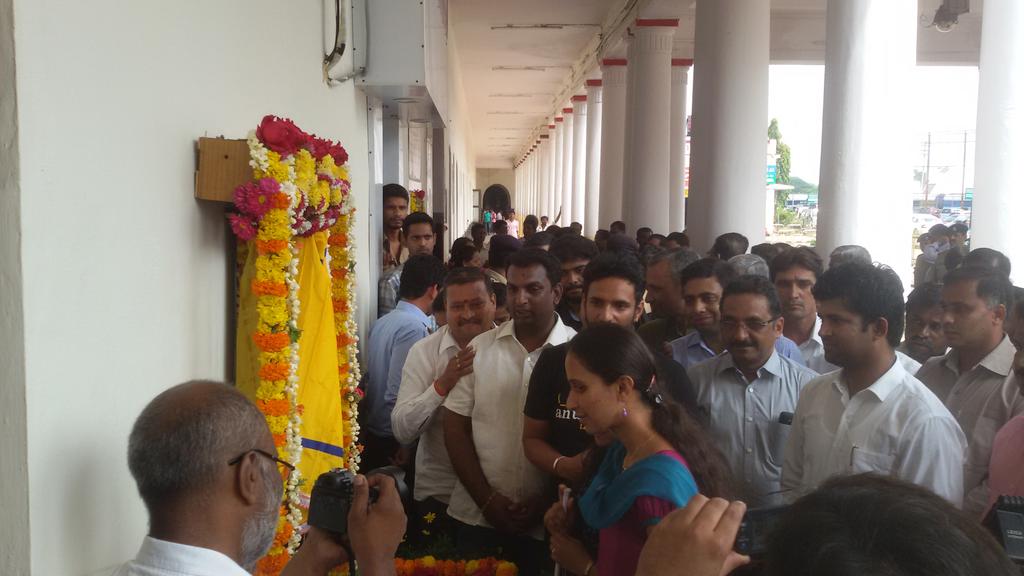
Mysuru Railway Station has become the first railway station in India to be visually impaired friendly.

With the aim of helping visually impaired passengers travel independently, features like tactile maps and train schedules in Braille were unveiled at the station.

mysuru1

Source: Twitter

Anuprayaas, a non-government organization working for the welfare of visually challenged persons, along with south-western railway officials, started working on this project about a month ago. The first phase was inaugurated on November 3, and two more phases are being planned. The installations at the station include the following:

  • Tactile maps to give people an idea about the physical layout of the station. It is basically a map with raised surfaces that describes the distance and location of the entrance, platforms, counters, washrooms etc. The map informs people where they are, which side to turn and how many steps to take to reach a help desk.
  • Train itinerary sign board that provides train names their schedules in Braille. These are fixed signboards and do not provide real time information like electronic boards.
  • 400 metallic Braille signs have been installed at about ten places on each platform. Placed along the railing of the staircase leading to various platforms, they provide directions and platform information.
  • Restaurants, canteens and food plazas in the railways station will not have Braille menu cards too.

27-year-old Pancham Cajla is the founder of Anuprayaas, and he started working on this project along with five of his friends. Mysuru MP, Pratap Simha, inaugurated the facility.

“As a part of the railway department, I went to organizations and met blind people. We asked them about what they would expect from a blind-friendly railway station,” Arun Kumar Singh, Telecom engineer with the South-Western Railways who helped in the execution of the project, told The News Minute.

During the testing period, the NGO brought many visually impaired people to check the features. Until people became aware of this facility, volunteers from the NGO will help the passengers. Anuprayaas is planning to go digital, improve the tactile maps, and introduce more disabled friendly battery cars in the second phase.

Embedded image permalink

Sowmya visually challenged girl inaugurating tactile map of mysuru station with all utilities & train time table

https://twitter.com/DrmMys

Source…. Tanaya Singh ….www.the better india .com

Natarajan

WHY STANDING IN ONE PLACE MAKES YOUR LEGS MORE SORE THAN WALKING…?

Why does standing in one place for a long time make my legs and feet sorer than walking the same amount of time?

Working retail, waiting tables, standing in line at the amusement park or just shopping with mom, anyone who’s ever been stuck on their feet for a long time more or less standing still knows that it’s much more tiring than walking the equivalent amount of time.  But why?

First, when you stand, your legs aren’t resting, even beyond just supporting your weight. Instead, your body sways very slightly. To keep you upright, a few muscles, particularly those in your calves, are constantly working, making very small adjustments that you probably aren’t consciously aware of. On the other hand, when you walk, the burden is distributed across more muscle groups. Muscles swinging the arms help propel them, core muscles keep you stable, butt muscles complete your stride, and the legs of both the calves and the thighs are employed.

Second, when you’re standing still, each foot and leg supports about half of the body’s weight, but neither ever gets a rest. On the other hand, when walking, each time a foot is raised the muscles formerly helping to balance you get a little break as does the bottom of your foot. While only a small break each instance, this totals to about half the time being in more or less a resting state other than the muscles required to lift your foot off the ground.

Walking

Third, when you stand, the blood and lymph fluids pool in your feet, calves and ankles, because your heart cannot efficiently pump the blood all the way up from your feet by itself. This is why if you stand in one place for long periods, you might notice that your feet and lower legs swell a little.

Because the heart isn’t up to performing this task efficiently, it relies in part on muscle contractions that occur when you walk and move about. As David J Tibbs in Varicose Veins and Related Disorders, states,

Only the peripheral pumping mechanism (musculovenous pumping) can cause full venous flow against gravity. This forceful pumping action is brought about when multiple veins are compressed by contraction of surrounding skeletal muscle. The valves direct the blood heartwards and prevent it from falling back again. Thus, by this simple arrangement, the harder the muscles work, the more vigorously is the massive flow of blood generated by this activity returned towards the heart.

Thus, when you stand in one place, your muscles are receiving less oxygen and other such things they need to operate at peak efficiency compared to when you walk around.


Fourth, when you stand, the entire load of your body rests on the same place – the underside of your feet, and particularly on the balls and heels. Beyond one side getting the aforementioned break about half the time, when you walk, different parts of your feet bear the load at different times.

Fifth, standing is sometimes much more boring than walking, particularly if you are at work with nothing mentally engaging to do (or watching your mom shop…). With nothing to occupy your mind, it can wander to how tired you are and how much your feet hurt. On the other hand, when walking, your brain will be more occupied since you must constantly assess the situation and avoid obstacles. Thus, standing may also seem even more tiring because you are just more aware of how your legs and feet are feeling.

Sixth, if you walk fast enough (or jog), your body will release neurochemicals that make you feel better, including adrenaline that pumps the heart faster, providing more oxygen to the muscles and brain, as well as endorphins that improve mood.

Bonus Facts:

  • In addition to those muscles mentioned, walking also works out the muscles around the pelvis, including the external abductors and internal adductors, belly muscles in the front and spinal muscles in the rear.
  • As with standing, anytime a person remains upright, venous pooling will occur; in some situations, such as when a construction worker remains suspended in a “fall harness” (the device that saves his life after a fall) but is unable to move his legs significantly, the pooling of blood can reach a critical level. As more blood pools in the legs (which aren’t moving enough to send it back up to the heart), the heart rate increases at first, and then will slow significantly. Without sufficient blood to bring fresh oxygen to the brain, the victim first loses consciousness, and if left in that condition, renal failure and even death can occur. (See: Suspension Trauma)
  • The average U.S. adult walks about 5,900 steps each day. Health experts recommend this be raised to at least 7,000 – the amount the average Japanese person gets in a day.
  • Interestingly, in a 2004 study of American Amish, it was shown that women got in more than 14,000 steps each day, and men more than 18,000. If only they had Fitbits to have the data to brag with;-)
  • Australians average almost 9,700 steps each day, and the Swiss get just a bit less than that.
  • The idea that “10,000 steps each day” is required for optimum health comes from an early Japanese pedometer from the 1960s called manpo-kei (“10,000 steps meter”). That said, the Centers for Disease Control does not recommend any particular number of steps, and instead suggests adults get 150 minutes of moderate activity each week.

Source….www.today i foundout.com

Natarajan

Potholes Could Soon Be a Thing of the Past….Thanks to Thermocol….!!!

Potholes on the streets of almost all cities in India don’t just make our rides uncomfortable, but also cause fatal accidents. According to the Road Accident Report (2014) published by the Road Transport and Highways Ministry, 6,672 people lost their lives due to potholes and badly designed speed breakers last year.

However, if the ministry goes ahead with its latest proposal of using thermocol fill in place of soil as the base for construction, pothole complaints can soon be resolved.

Photo Credit: Flickr

In a meeting headed by Union Minister Nitin Gadkari last month, the ministry asked some consultancy firms to submit cost analysis report of the use of Geofoam for construction on highways, in comparison with the conventional soil fills. An expert committee was constituted earlier this year to recommend new materials for construction of highways.

Geofoam is primarily used to provide lightweight void fill on highways, during road constructions, for building embankments, parking lots constructions, etc. It is basically expanded polystyrene (EPS) or extruded polystyrene (XPS) manufactured into large lightweight blocks. Polystyrene is one of the most widely used plastics around the world. And EPS is a rigid closed-cell foam structure made of pre-expanded polystyrene beads. It is widely used for manufacturing daily utility goods like plates, boxes, bowls, packaging material, etc. XPS also consists of closed cells, and it provides higher stiffness to materials it is used in, like craft and architectural models.

Countries like Europe, Japan, and the US have been using Geofoam for road construction. In India, the Border Road Organization has been using it for constructing roads on difficult terrains. Geofoam requires less manpower as it is all about lifting the sheets and placing them at the required spot. It is approximately 1% the weight of soil and less than 10% the weight of other lightweight fill alternatives. Because of being so light, Geofoam also reduces the weight applied on the underlying soil or solid structure. It can also be easily cut and shaped as per the requirement giving engineers the freedom to be more specific about the design. Additionally, it is very durable and does not break down. So the material does not spread to the surrounding soil thereby keeping a check on pollution.

Keeping these advantages in mind, the ministry has issued an order that project reports for all future road construction projects should consider alternative design combinations. With the use of thermocol, a brand of Geofoam, the cost of road repairs can be reduced by 30 percent, and the time required can also be significantly decreased.


“The best part is that Geofoam is 100 times lighter than the soil and does not expand or contract with changing temperatures like extreme winter or heat. It does not get washed away by floods or landslides. We are using large amounts of healthy soil for road construction, which could be avoided if we use Geofoam,” a senior ministry official told The Indian Express. –

Source…….Tanaya Singh…www.the betterindia.com

natarajan