SOURCE:::: http://www.glasbergen.com
Natarajan
Both Europe 24 and North Atlantic Skies were designed to give an overview of the daily complexity and volumes of air traffic across the UK and Europe and to do so in a way that was cinematic and exciting to watch. I think we were able to do that to great effect, but we now want to take you a little deeper.
We are therefore very excited to publish UK 24 – your guided tour to some of what makes UK aviation work.
Our airspace is busy, complex and there is a lot going on. Each year we manage around 2.2 million movements, peaking at over 8,000 a day (although there are around 7,000 on this particular day), with only 5.5 seconds delay per flight attributable to NATS. Obviously there are the flows of large aircraft from the airports into and out of the UK, but there is also a lot of activity outside controlled airspace. UK 24 is designed to help visualise the breadth and depth of UK aviation and why airspace is such an important asset.
The day starts with the bow wave of transatlantic traffic heading towards the UK on their organised and separated tracks. This is quickly joined by traffic from Europe and the first waves of departures from UK airports. Over a short period of time the traffic levels grow to show the main trunk roads of airspace as well as the hubs around London, Manchester and central Scotland.
We then move to give a unique view of the holding stacks over London and how they are a fundamental part of the Heathrow operation, providing the constant flow of traffic that makes it the world’s busiest dual runway airport with 1,350 movements a day.
Our tour then take us around the UK, including the other major airports, our two control centres in Swanwick and Prestwick, some general aviation traffic and examples of military training off the east coast of England and near to North Wales. We then dwell on the spider’s web of helicopter tracks that originate from Aberdeen, taking people and vital supplies to and from the North Sea oil and gas rigs.
We hope you enjoy this insight into the complexity and beauty of a day of UK air traffic and the value of airspace as the invisible infrastructure that makes it all work.
The aviation sector and its supply chain generates over £20bn per year in economic output and directly employs circa 220,000 people. At Heathrow alone, goods worth £133 billion were shipped in and out last year, more than the combined value of goods transiting through the UK’s two largest ports, Felixstowe and Southampton.
Aviation is on average a much more productive sector than the rest of the economy; each pound spent on upgrading our aviation infrastructure is expected to generate over £5 in return. In addition aviation is a significant growth sector within key regions for UK trade, for example China, the Middle East and Turkey have ambitious plans to more than double their capacity.
Without additional capacity in the UK, we risk the rapid growth in traffic and its associated commerce being focused elsewhere.
SOURCE:::: Brendan Kelly in http://www.nats.aero.blog
Natarajan Continue reading
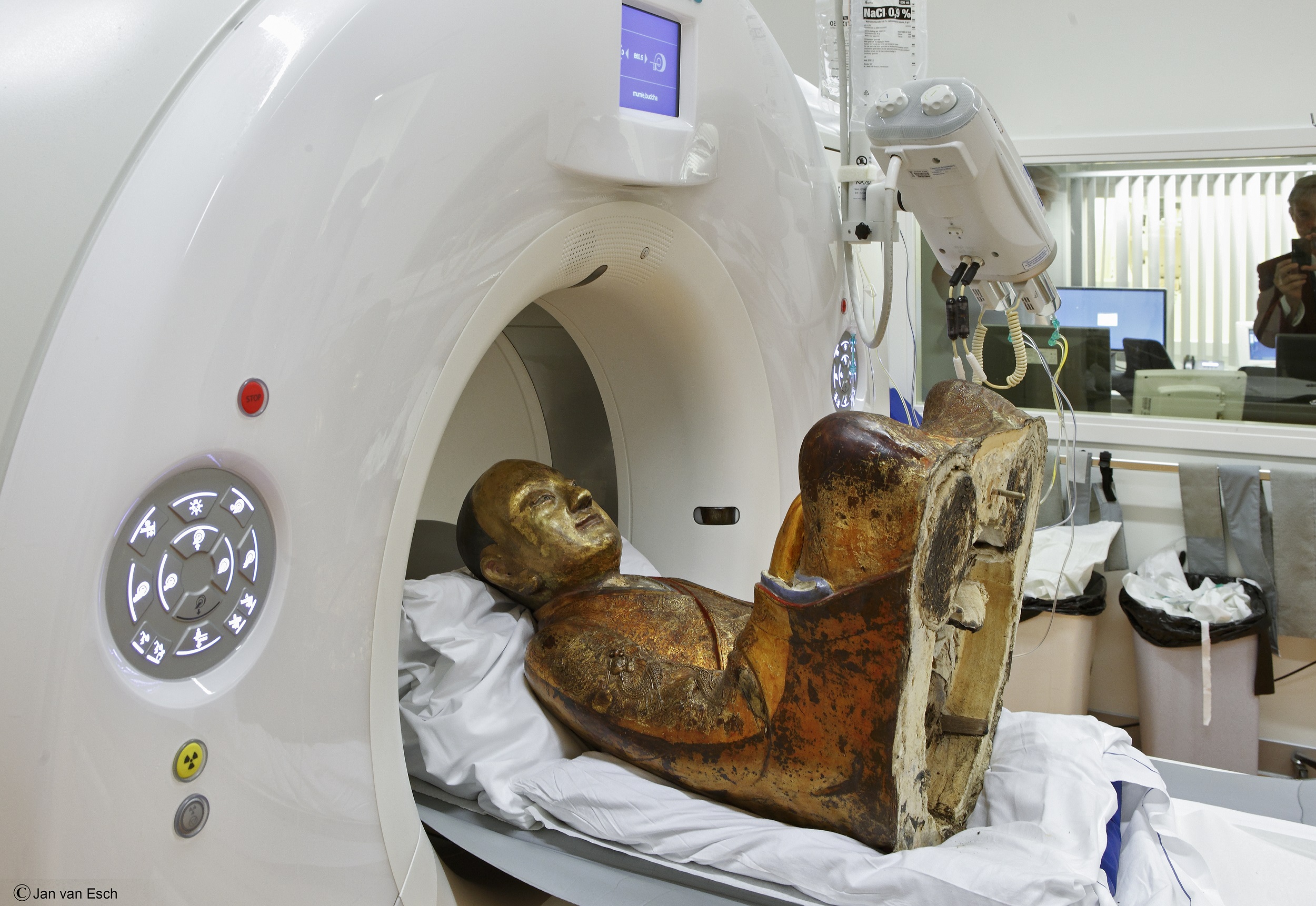
The mummified remains of a monk have been revealed inside a nearly 1,000-year old Chinese statue of a Buddha.

The mummy inside the gold-painted papier-mâché statue is believed to be that of Liuquan, a Buddhist master of the Chinese Meditation School who died around the year 1100, researchers said. It’s the only Chinese Buddhist mummy to undergo scientific research in the West.
The statue was on display last year at the Drents Museum as part of an exhibit on mummies. It was an cited as an example of self-mummification, an excruciating, years-long process of meditation, starvation, dehydration and poisoning that some Buddhist monks undertook to achieve enlightenment and veneration.
When the exhibit ended in August, a CT scan at the Meander Medical Center in the Netherlands revealed the seated skeleton. Samples taken from organ cavities provided one big surprise: paper scraps printed with ancient Chinese characters indicating the high-status monk may have been worshiped as a Buddha.
A CT scan has revealed a mummified Chinese monk inside a Buddha statue. The remains date back about 1,000 years. Video provided by Newsy Newslook
The finding was first reported in December but did not get wide notice. Irish Archaeology carried a report over the weekend, which apparently started the news ball rolling.
But the revelation is not, as some reports claim, “a shocking discovery,” The History Blog notes: “It was known to be inside the statue all along … that’s why it was sent to the Drents Museum in the first place as part of the Mummies exhibition.”
The mummy’s existence was discovered in 1996 when the statue was being restored in the Netherlands, Live Science writes, explaining what was found, how its age was determined and when the first detailed skeletal imaging was performed.
DNA tests were conducted on bone samples, and the Dutch team plans to publish its finding in a forthcoming monograph.
Researchers still have not determined whether the monk mummified himself, a practice that was also widespread in Japan and that was outlawed in the 19th century. If he did, the process was gruesome, asAncient Origins explains:
For the first 1,000 days, the monks ceased all food except nuts, seeds, fruits and berries and they engaged in extensive physical activity to strip themselves of all body fat. For the next one thousand days, their diet was restricted to just bark and roots. Near the end of this period, they would drink poisonous tea made from the sap of the Urushi tree, which caused vomiting and a rapid loss of body fluids. It also acted as a preservative and killed off maggots and bacteria that would cause the body to decay after death.
In the final stage, after more than six years of torturous preparation, the monk would lock himself in a stone tomb barely larger than his body, where he would go into a state of meditation. He was seated in the lotus position, a position he would not move from until he died. A small air tube provided oxygen to the tomb. Each day, the monk rang a bell to let the outside world know he was still alive. When the bell stopped ringing, the tube was removed and the tomb sealed for the final thousand day period of the ritual.
At the end of this period, the tomb would be opened to see if the monk was successful in mummifying himself. If the body was found in a preserved state, the monk was raised to the status of Buddha, his body was removed from the tomb and he was placed in a temple where he was worshiped and revered. If the body had decomposed, the monk was resealed in his tomb and respected for his endurance, but not worshiped
If you find yourself in Budapest before May, the Buddha mummy statue is on display at the Hungarian Natural History Museum.
SOURCE::::: Michael Winter, USA TODAY …www.usatoday.com
Natarajan
If you think your kid is a-lot like you, then you’re probably right. You’d be surprised to discover that it’s pretty much the same in the animal kingdom…

KOALAfied parent.

The HAREitage is clear…

This might end in a CATastrophy.

A whole new meaning to riding BEARback…

“You’ve GOAT to be kidding me!”

Me & my dad ROLL together.

Small copyCAT…

There will be a pun here… Eventually…

Hug me, mom! I just had a nightMARE…

Just LION around..

No PANDAmonium here…

See? Grass is not so BAAAHd..

Don’t worry, they won’t be looking down at you for long…

Dad, you’re the COOLest…

Dad, the other kids said I’m fat! -Don’t worry son, they’re HIPPOcrites..

Like me, my son has a good APEtite…

I Love MEOW!

Are you staying on my back on PORPOISE?!
SOURCE:::: http://www.ba-bamail.com
Natarajan

Incheon International Airport won best airport for the Asia-Pacific region and best airport by size. Source: Getty Images
BALLOTS have been cast and the results are in. After surveying more than 550,000 passengers, the Airports Council International (ACI) has announced the winners of the 2014 Airport Service Quality (ASQ) Awards.
Reported in FlyerTalk, the trade group’s annual awards recognise the best of the best in airport passenger service, measuring 34 key service indicators.
“Airports are more than simply points of departure and arrival,” said Angela Gittens, director general of ACI World. “They are complex businesses in their own right. As such, a focus on serving the passenger has become increasingly important to ensuring success.”
Gittens noted there were many repeat airports on the list of winners, as well as many “new faces” that suggest promising changes.

Incheon International Airport in South Korea won for the Asia-Pacific region. Source: Supplied
First-place winners by category are as follows:
Best Airport by Region
Africa — Sir Seewoosagur Ramgoolam International Airport (MRU)
Asia-Pacific — Incheon International Airport (ICN)
Europe — Keflavík International Airport (KEF)
Latin America-Caribbean — José Joaquín de Olmedo International Airport (GYE)
Middle East — Queen Alia International Airport (AMM)
North America — Indianapolis International Airport (IND)

Keflavík International Airport was voted the best airport in the European region. Picture: Super Jet International. Source:Flickr
Best Airport by Size (Passengers per Year)
2 to 5 Million — José Joaquín de Olmedo International Airport (GYE)
5 to 15 Million — Haikou Meilan International Airport (HAK)
15 to 25 Million — Gimpo International Airport (GMP)
25 to 40 Million — Indira Gandhi International Airport (DEL)
Over 40 Million — Incheon International Airport (ICN)

Indira Gandhi International Airport made the cut for the best airport by size. AFP PHOTO/RAVEENDRAN Source: AFP
Best Small Airport (Fewer Than 2 Million Passengers) by Region
Africa — Upington Airport (UTN)
Asia-Pacific — Langkawi International Airport (LGK)
Europe — Murcia-San Javier Airport (MJV)
Latin America-Caribbean — Bachigualato Federal International Airport (CUL)
North America — Victoria International Airport (YYJ)

Victoria International Airport was the best small airport in North America. Picture: Andy M. Smith. Source: Flickr
Best Improvement by Region
Africa — Sir Seewoosagur Ramgoolam International Airport (MRU)
Asia-Pacific — Netaji Subhas Chandra Bose International Airport (CCU)
Europe — Pulkovo International Airport (LED)
Latin America-Caribbean — Las Américas International Airport (SDQ)
North America — San Antonio International Airport (SAT)

A new passenger terminal building of Pulkovo International Airport made it best airport by improvement for the Europe region. Source: Getty Images
SOURCE:::: news.com.au
Natarajan
Aero India 2015, India’s largest airshow was underway at the Yelahanka Air Base in Bengaluru. Here are few glimpses of the aircraft in action.

Image: UK’s AeroSuperBatics team Breitling Wingwalkers performs in Bengaluru. Photograph: Shailendra Bhojak / PTI Photo

Image: Swedens aerobatic display team Scandinavian Air Show performs at Aero India 2015. Phortograph: Shailendra Bhojak/PTI
Photo

Image: A Rafale multi-role combat aircraft from Dassault Aviation of France manoeuvres at Asia’s premier air show at Yelhanka
Air Base. Photograph: PTI Photo

Image: The Red Bulls aerobatic display team performs in Bengaluru. Photograph: Ministry of Defence

Image: An SU-30 fighter aircraft takes off during the second day of Aero India. Photograph: PTI Photo

Image: Another great shot of India’s Light Combat Helicopter. Photograph: Twitter

Image: UK’s AeroSuperBatics team Breitling Wingwalkers performs in Bengaluru. Photograph: Shailendra Bhojak / PTI Photo

Image: A great shot of India’s Light Combat Helicopter. Photograph: MakeinIndia/Twitter

Image: A roaring take off by US F-16 at Yelahanka Air Base. Photograph: Ministry of Defence

Image: India’s Sarang aerobatic display team performing a routine. Photograph: Ministry of Defence
SOURCE::: http://www.rediff.com
Natarajan



 Take off with Natarajan