Pencil Tip Miniature Art …See it To Believe It !!!

Pencil Tip Art Creations You Must See

Dalton Ghetti creates miniature works of art resting solely on the tips of lead pencils. What is even more impressive is the fact that he doesn’t rely on the use of a microscope or magnifying lens to sculpt out his phenomenal creations. This is one exhibit you must literally see to believe!

You can see more of Dalton’s miniature masterpieces on his website here.

A Lead Pencil Tribute to “The King” 
Miniature Carvings on Lead Pencil Tips
A Heart Shaped Locket Dangles Inside the Pencil 
Miniature Carvings on Lead Pencil Tips

“The Tools of the Trade” 
Miniature Carvings on Lead Pencil Tips

Dalton’s “tools of the trade” include; a razor blade, a sculpting knife, a sewing needle, and a few No. 2 pencils.
A Few Marvelous Miniature Creations 
Miniature Carvings on Lead Pencil Tips

Dalton carves a wide variety of designs, which range from a horse figurine to a perfectly shaped hammer.
The Talented Artist Takes a Moment to Appreciate his Work 
Miniature Carvings on Lead Pencil Tips

The Brazilian-born artist currently resides in Bridgeport, Connecticut, and is a carpenter by trade. He began his artistic hobby over 25 years ago as a form of meditation.
The Beginning of a New Design 
Miniature Carvings on Lead Pencil Tips

The Entire Alphabet from A to Z 
Miniature Carvings on Lead Pencil Tips

Patience is a most important virtue in this line of work, since the vast majority of the carvings take several months to complete. The alphabet carving seen here took almost 2 years and a half to finish!
Chain Links on a Pencip Tip 
Miniature Carvings on Lead Pencil Tips

Cheers
Miniature Carvings on Lead Pencil Tips

A Microscopic Sewing Button 
Miniature Carvings on Lead Pencil Tips
“The Cemetery Collection”
Miniature Carvings on Lead Pencil Tips
Over a hundred sculptures have broken off while Dalton was working. He displays the discarded pieces, which he refers to as “The Cemetery Collection”, on a Styrofoam bed as a reminder of past mistakes.
Would You Care to Have a Seat?
Miniature Carvings on Lead Pencil Tips

Patience is the Key to Finishing Each Unique Design 
Miniature Carvings on Lead Pencil Tips

A Miniature Mailbox 
Miniature Carvings on Lead Pencil Tips

You Might Need a Magnifying Lens to Spot the Cross Here
Miniature Carvings on Lead Pencil Tips

Another Unique Creation  
Miniature Carvings on Lead Pencil Tips

Does Anybody Have a Screwdriver? 
Miniature Carvings on Lead Pencil Tips

Dalton Spends A Long Time Carving Specific Details Out 
Miniature Carvings on Lead Pencil Tips

Pencil Nunchuks That Would Make Bruce Lee Proud
Miniature Carvings on Lead Pencil Tips

A Pair of Chained Hearts 
Miniature Carvings on Lead Pencil Tips

He has made over 100 carvings, including a very touching 9-11 memorial tribute titled 3,000 Tears, which you can see here.
If The Shoe Fits…
Miniature Carvings on Lead Pencil Tips
source
H/T: twistedsifter.com & solentnews.biz

SOURCE::::: http://www.ba-bamail.com

Natarajan

Jan 8 2015

HAMPI….A Place For Architectural Beauties and Heritage Sites …

If you are seeking an opportunity to virtually transport yourself to the times of kings and their kingdoms, to the times of heroic battles and battlefields and to the times of long forgotten wonders that hand carved this land for you to unravel, then this is the place for you. Furthermore, Hampi is one of the most safest places to be at.

Hampi calls you to witness the eccentric charm of valued monuments, of its beauty, that lies in the ruins of its UNESCO recognized sights. Located at the distance of 341 k.m. from Bengaluru, the easiest way to reach Hampi is either to take a bus or train, which is easily available from major towns and cities.  The nearest railway station is Hospet.

1. Go fancy or go local, it’s totally upto you!

Image source

A five million star hut over a five star hotel. What TO say ?


2. Hire a cycle or a bike, maybe?

Image source

This is undoubtedly the cheapest and the most recommenced means of transport. This way you’ll cover all the stretches closely.


3. The glorious step well

Image source

Another great architectural beauty  !


4. The Virupaksha temple

Image source

Recognized as a UNESCO World Heritage Site, this temple is going to be a delight for your eyes.


5. The coracle boats

Image source

Tungabhadra River wouldn’t be the same without coracle boats. You’ll have a great time using them.


6. The boulder-strewn landscapes

Image source

Regardless of how much I say, Hampi’s monuments will always possess more charm than the one expressed in words.


7. Matanga Hill

Image source

This is one of the most talked about places in Hampi. You just have to be here.


8. Vittala temple

Image source

Rediscover your love amid this stone chariot of Vittala Temple.


9. Krishna Temple Complex

Image source

The majestic pillars of this temple will leave you mesmerized for longer than usual.


10. Bukka’s aqueduct

Image source

Nothing fancy about this place, just some beauty lying unnoticed.


11. Farms as seen from Anjaneyadri Hill

Image source

…and you’d wonder! Since when there was so much godliness around?


12. Zanana Enclosure

Image source

Numerous intriguing fables took birth here. A secluded place which was left for the royal women.


13. Tungabhadra River in Hampi

Image source

Ahuh! What a delight.


14. Elephant Stables

Image source

This is one of the least destroyed structures of Hampi. This oblong is demanding you to pay a visit.


15. Pampa Sarovar

Image source

This sarovar made to sacred ponds mentioned in the Hindu epics and  scriptures.


16. South India Unplugged

Image source

Every shopper’s delight; the markets here, will leave you wanting for more. Just Shop.


17. Rock Climbing

Image source

Two steps up and one step down. That’s how you do it here. Hampi is a highly regarded rock climbing destination.


18. Watch as the Sun goes down

Image source

Just breathe and watch the beauty turning its face towards the lunar light.


19. Hampi’s Hippie Island

Image source

You always wanted to see that. Always. A part of you that rebelled enough to rebel will find solace here.


20. Discover your secret hideout

Image source

For your friends. Just for them.

The architectural aura of Hampi is akin to numerous fantasies. It is sure to take you back to the times of imperial beauty and legacy. Once you’re there, you are bound to get mesmerized amid the ruins.

SOURCE:::: Shewali Tiwari  in www.storypick.com

Natarajan

Jan 8 2015

Amazing Scientific Reasons Behind Hindu Traditions !!!

1.  Joining Both Palms Together To Greet

nepal-girl

In Hindu culture, people greet each other by joining their palms – termed as “Namaskar.” The general reason behind this tradition is that greeting by joining both the palms means respect. However, scientifically speaking, joining both hands ensures joining the tips of all the fingers together; which are denoted to the pressure points of eyes, ears, and mind. Pressing them together is said to activate the pressure points which helps us remember that person for a long time. And, no germs since we don’t make any physical contact!


2. Why Do Indian Women Wear Toe Ring

rong toe

image courtesy

Wearing toe rings is not just the significance of married women but there is science behind it. Normally toe rings are worn on the second toe. A particular nerve from the second toe connects the uterus and passes to heart. Wearing toe ring on this finger strengthens the uterus. It will keep it healthy by regulating the blood flow to it and menstrual cycle will be regularized. As Silver is a good conductor, it also absorbs polar energies from the earth and passes it to the body.


3. Throwing Coins Into A River

Talakaveri coins desinema

The general reasoning given for this act is that it brings Good Luck. However, scientifically speaking, in the ancient times, most of the currency used was made of copper unlike the stainless steel coins of today. Copper is a vital metal very useful to the human body. Throwing coins in the river was one way our fore-fathers ensured we intake sufficient copper as part of the water as rivers were the only source of drinking water. Making it a custom ensured that all of us follow the practice.


4. Applying Tilak/KumKum On The Forehead

kumkum desinema

On the forehead, between the two eyebrows, is a spot that is considered as a major nerve point in human body since ancient times. The Tilak is believed to prevent the loss of “energy”, the red ‘kumkum’ between the eyebrows is said to retain energy in the human body and control the various levels of concentration. While applying kumkum the points on the mid-brow region and Adnya-chakra are automatically pressed. This also facilitates the blood supply to the face muscles.


5. Why Do Temples Have Bells

temple_bell desinema

People who are visiting the temple should and will Ring the bell before entering the inner sanctum (Garbhagudi or Garbha Gruha or womb-chamber) where the main idol is placed. According to Agama Sastra, the bell is used to give sound for keeping evil forces away and the ring of the bell is pleasant to God. However, the scientific reason behind bells is that their ring clears our mind and helps us stay sharp and keep our full concentration on devotional purpose. These bells are made in such a way that when they produce a sound it creates a unity in the Left and Right parts of our brains. The moment we ring the bell, it produces a sharp and enduring sound which lasts for minimum of 7 seconds in echo mode. The duration of echo is good enough to activate all the seven healing centres in our body. This results in emptying our brain from all negative thoughts.


6. Why We Start With Spice & End With Sweet:

indian thali desinema

Our ancestors have stressed on the fact that our meals should be started off with something spicy and sweet dishes should be taken towards the end. The significance of this eating practice is that while spicy things activate the digestive juices and acids and ensure that the digestion process goes on smoothly and efficiently, sweets or carbohydrates pulls down the digestive process. Hence, sweets were always recommended to be taken as a last item.


7.  Why Do We Applying Mehendi/Henna On The Hand And Feet

mehandi

Besides lending color to the hands, mehndi is a very powerful medicinal herb. Weddings are stressful, and often, the stress causes headaches and fevers. As the wedding day approaches, the excitement mixed with nervous anticipation can take its toll on the bride and groom. Application of mehndi can prevent too much stress because it cools the body and keeps the nerves from becoming tense. This is the reason why mehndi is applied on the hands and feet, which house nerve endings in the body.


8. Sitting On The Floor & Eating

sit on floor and eat

This tradition is not just about sitting on floor and eating, it is regarding sitting in the “Sukhasan” position and then eating. Sukhasan is the position we normally use for Yoga asanas. When you sit on the floor, you usually sit cross legged – In sukhasana or a half padmasana  (half lotus), which are poses that instantly bring a sense of calm and help in digestion, it is believed to automatically trigger the signals to your brain to prepare the stomach for digestion.


9. Why You Should Not To Sleep With Your Head Towards North

sleep south

Myth is that it invites ghost or death but science says that it is because human body has its own magnetic field (Also known as hearts magnetic field, because the flow of blood) and Earth is a giant magnet. When we sleep with head towards north, our body’s magnetic field become completely asymmetrical to the Earth’s Magnetic field. That cause problems related to blood pressure and our heart needs to work harder in order to overcome this asymmetry of Magnetic fields. Apart from this another reason is that Our body have significant amount of iron in our blood. When we sleep in this position, iron from the whole body starts to congregate in brain. This can cause headache, Alzheimer’s Disease, Cognitive Decline, Parkinson disease and brain degeneration.


10. Why We Pierce Ear

ear ring

Piercing the ears has a great importance in Indian ethos. Indian physicians and philosophers believe that piercing the ears helps in the development of intellect, power of thinking and decision making faculties. Talkativeness fritters away life energy. Ear piercing helps in speech-restraint. It helps to reduce impertinent behavior and the ear-channels become free from disorders. This idea appeals to the Western world as well, and so they are getting their ears pierced to wear fancy earrings as a mark of fashion.


11. Surya Namaskar

suryanamaskar 3

Hindus have a tradition of paying regards to Sun God early in the morning by their water offering ritual. It was mainly because looking at Sun rays through water or directly at that time of the day is good for eyes and also by waking up to follow this routine, we become prone to a morning lifestyle and mornings are proven to be the most effective part of the day.


12. Choti On The Male Head

Student of university of Madras

Sushrut rishi, the foremost surgeon of Ayurveda, describes the master sensitive spot on the head as Adhipati Marma, where there is a nexus of all nerves. The shikha protects this spot. Below, in the brain, occurs the Brahmarandhra, where the sushumnã (nerve) arrives from the lower part of the body. In Yog, Brahmarandhra is the highest, seventh chakra, with the thousand-petalled lotus. It is the centre of wisdom. The knotted shikhã helps boost this centre and conserve its subtle energy known as ojas.


13. Why Do We Fast

fasting desinema

The underlying principle behind fasting is to be found in Ayurveda. This ancient Indian medical system sees the basic cause of many diseases as the accumulation of toxic materials in the digestive system. Regular cleansing of toxic materials keeps one healthy. By fasting, the digestive organs get rest and all body mechanisms are cleansed and corrected. A complete fast is good for heath, and the occasional intake of warm lemon juice during the period of fasting prevents the flatulence. Since the human body, as explained by Ayurveda, is composed of 80% liquid and 20% solid, like the earth, the gravitational force of the moon affects the fluid contents of the body. It causes emotional imbalances in the body, making some people tense, irritable and violent. Fasting acts as antidote, for it lowers the acid content in the body which helps people to retain their sanity. Research suggests there are major health benefits to caloric restriction like reduced risks of cancer, cardiovascular diseases, diabetes, immune disorders etc.


14. The Scientific Explanation Of Touching Feet (Charan Sparsh)

feet

Usually, the person of whose feet you are touching is either old or pious. When they accept your respect which came from your reduced ego (and is called your shraddha) their hearts emit positive thoughts and energy (which is called their karuna) which reaches you through their hands and toes. In essence, the completed circuit enables flow of energy and increases cosmic energy, switching on a quick connect between two minds and hearts. To an extent, the same is achieved through handshakes and hugs. The nerves that start from our brain spread across all your body. These nerves or wires end in the fingertips of your hand and feet. When you join the fingertips of your hand to those of their opposite feet, a circuit is immediately formed and the energies of two bodies are connected. Your fingers and palms become the ‘receptor’ of energy and the feet of other person become the ‘giver’ of energy.


15. Why Married Women Apply Sindoor Or Vermillion

Aishwarya-Rai_sindoor

It is interesting to note that that the application of sindoor by married women carries a physiological significance. This is so because Sindoor is prepared by mixing turmeric-lime and the metal mercury. Due to its intrinsic properties, mercury, besides controlling blood pressure also activates sexual drive. This also explains why Sindoor is prohibited for the widows. For best results, Sindoor should be applied right upto the pituitary gland where all our feelings are centered. Mercury is also known for removing stress and strain.


16. Why Do We Worship Peepal Tree

pipal

Peepal’ tree is almost useless for an ordinary person, except for its shadow. ‘Peepal’ does not a have a delicious fruit, its wood is not strong enough for any purpose then why should a common villager or person worship it or even care for it? Our ancestors knew that ‘Peepal’ is one of the very few trees (or probably the only tree) which produces oxygen even at night. So in order to save this tree because of its unique property they related it to God/religion.


17. Why Do We Worship Tulsi Plant

thulsi


Hindu religion has bestowed ‘Tulsi’, with the status of mother. Also known as ‘Sacred or Holy Basil’, Tulsi, has been recognized as a religious and spiritual devout in many parts of the world. The vedic sages knew the benefits of Tulsi and that is why they personified it as a Goddess and gave a clear message to the entire community that it needs to be taken care of by the people, literate or illiterate. We try to protect it because it is like Sanjeevani for the mankind. Tulsi has great medicinal properties. It is a remarkable antibiotic. Taking Tulsi everyday in tea or otherwise increases immunity and help the drinker prevent diseases, stabilize his or her health condition, balance his or her body system and most important of all, prolong his or her life. Keeping Tulsi plant at home prevents insects and mosquitoes from entering the house. It is said that snakes do not dare to go near a Tulsi plant. Maybe that is why ancient people would grow lots of Tulsi near their houses.


18. Why Do We Worship Idol

statue

Hinduism propagates idol worship more than any other religion. Researchers say that this was initiated for the purpose of increasing concentration during prayers. According to psychiatrists, a man will shape his thoughts as per what he sees. If you have 3 different objects in front of you, your thinking will change according to the object you are viewing. Similarly, in ancient India, idol worship was established so that when people view idols it is easy for them to concentrate to gain spiritual energy and meditate without mental diversion


19. Why Do Indian Women Wear Bangles

Girls-Bangles-1

Normally the wrist portion is in constant activation on any human. Also the pulse beat in this portion is mostly checked for all sorts of ailments. The Bangles used by women are normally in the wrist part of ones hand and its constant friction increases the blood circulation level. Further more the electricity passing out through outer skin is again reverted to one’s own body because of the ring shaped bangles, which has no ends to pass the energy outside but to send it back to the body.


20. Why Should We Visit Temple?

why-visit-temples

Temples are located strategically at a place where the positive energy is abundantly available from the magnetic and electric wave distributions of north/south pole thrust. The main idol is placed in the core center of the temple, known as “*Garbhagriha*” or *Moolasthanam*. In fact, the temple structure is built after the idol has been placed. This *Moolasthanam* is where earth’s magnetic waves are found to be maximum. We know that there are some copper plates, inscribed with Vedic scripts, buried beneath the Main Idol. What are they really? No, they are not God’s / priests’ flash cards when they forget the *shlokas*. The copper plate absorbs earth’s magnetic waves and radiates it to the surroundings. Thus a person regularly visiting a temple and walking clockwise around the Main Idol receives the beamed magnetic waves and his body absorbs it. This is a very slow process and a regular visit will let him absorb more of this positive energy. Scientifically, it is the positive energy that we all require to have a healthy life.


SOURCE::::www.desinema.com/hindutraditions

Natarajan

Jan 8 2015

World”s Safest Airline ….

QANTAS has been named the world’s safest airline, after a year when fatal air accidents soared above the 10-year average.

In a report published by AirlineRatings.com last night, Qantas was lauded for amassing “an extraordinary record of firsts” in safety and operations over its 94-year history. It also has a fatality free record in the jet era.

The company’s rating system, which is endorsed by the International Civil Aviation Organization, a United Nations agency, takes into account a variety of factors related to audits from aviation’s governing bodies and lead associations as well as government audits and the airlines’ fatality records.

Operational histories and incident records were also analysed.

Qantas was named the leader in terms of real-time monitoring of its engines across its fleet using satellite communications.

“Doing so allows the airline to detect problems before they become a major safety issue,” the report says.

The airline was also described as a leader in the development of an avionics system that provides a direct data link communication between the pilot and the air traffic controller, as well as the development of flight data recorders to monitor plane and crew performance.

The flying kangaroo wins for its safety and operations.

The flying kangaroo wins for its safety and operations. Source: Getty Images

The report comes after what was “in no doubt” a bad year for airline safety, AirlineRatings.com said, adding 2014 included some of the industry’s most tragic and bizarre incidents.

“Certainly, 21 fatal accidents with 986 fatalities — higher than the 10-year average — is sickening. However, the world’s airlines carried a record 3.3 billion passengers on 27 million flights,” the report says.

AirlineRatings.com said the high number of deaths came despite the number of accidents for 2014 being at a record low 21 — one for every 1.3 million flights.

“Two of the crashes last year — MH370 and MH17 — were unprecedented in modern times and claimed 537 lives,” the report says.

“Flashback 50 years and there were a staggering 87 crashes killing 1,597 when airlines carried only 141 million passengers — five per cent of today’s number.”

Air New Zealand made the top 10 of the world’s safest airlines.

Air New Zealand made the top 10 of the world’s safest airlines. Source: Supplied

The report rates 449 airlines. Making up the remainder of the top 10 in alphabetical order were Air New Zealand, Cathay Pacific, British Airways, Emirates, Etihad Airways, EVA Air, Finnair, Lufthansa and Singapore Airlines.

Low-cost carriers were also included in a separate list, with Jetstar making the top 10 along with Aer Lingus, Alaska Airlines, Icelandair, Jetblue, Kulula.com, Monarch Airlines, Thomas Cook, TUI Fly and Westjet.

AirlineRatings has been used by millions of passengers from 232 countries and its safety rating.

SOURCE:::: http://www.news.com.au

Natarajan

Jan 7 2015

” இட்லிக்கு உண்டோ இணை …. ” !!!


The greatness of idlis!During the pre-independence days, an Iyer and a Britisher were travelling by the Howrah Express train, from Madras to Calcutta.  The train left Madras Central railway station at 8 p.m. sharp, and the next morning at 7 a.m., it was at Vijayawada.The Britisher had a sumptuous Spencer’s breakfast, delivered to him by a butler, in livery.  But the Iyer opened the top box of his 4-compartment, steel tiffin carrier, and ate two idlis.Lunch at Waltair station (asVisakhapatnam was then called), was a heavy meal served to the Britisher, by the Railway Refreshment stall.  But the Iyer only opened the second box of his tiffin carrier, pulled out 4 idlis, and ate them with relish.  The Britisher was curious, as to what was happening.  But being a Britisher, kept his stiff-upper-lip posture on.

But when the scene repeated, during dinner at Berhampur, the Britisher could no longer contain himself, and enquired from the Iyer, ” Sir, what are those white things you have been eating, all along? ”

The Iyer replied, ” Sir, these are called intelligence tablets.   We South Indians, can live on them for days, together. ”

Britisher: ” But how do you make them ? ”

The Iyer went into an elaborate description, of the raw materials and processes, of making idlis.


Britisher : ” Can you please give me a couple of them?  But you need not give them to me free of charge.  I’ll be happy to pay you, whatever price you quote. “
The Iyer thought for a while, and said, “Actually, I have only three more of them left, for        tomorrow morning’s breakfast.  But since I am going to my relative’s place, I can spare them for you.  But they will cost you, 20 Indian Rupees each “.The Britisher paid up immediately, happy that he was so lucky.  The next morning, at the Howrah railway station in Calcutta, as they were about to part ways, the Britisher asked the Iyer, “But tell me sir, are you sure you have told me the entire process, without leaving out any details? “.Iyer replied, “Yes, I told you all the details”.

Britisher: “Then why were those intelligence tablets, so costly?”

The Iyer  replied,”See?!  You ate only 3 of them last night, and they have already started working?!”

SOURCE::::: input from a friend of mine
Natarajan
Bonus ::::  An Instant Kavithai on our Great Idli …. Penned by me when i was 14 years old… Now I am 65 !!!

மதியம் போல் வெண்மை  பொதிய மலை தமிழின் தன்மை

விதி முறையால் சட்டினியும் சாம்பாரும் சார சுவை அளிக்கும்

அந்த இட்டிலுக்கு உண்டோ  இணை  !!!

 நடராஜன்
JAN  7  2015
 

It may look like Snow covered Alps… But ….

Incredibly deceiving images of what can easily be mistaken for snow-covered Australian mountains have been released.

But do not be fooled. Instead, what the pictures really show are stunning pyramids of plain, white salt.

These were taken five years ago, when Emma Phillips was on a mission to find the perfect location for her final assignment to wrap up her photography course.

Her vision was to capture images of an industrial location near the city of Melbourne but this proved to be quite an arduous process.

Instead, she left her hometown and spent two months in the Nullabor Plain out in the Western Australian desert.

There she came across an abandoned salt refinery and found exactly what she was looking for

Read more: http://www.dailymail.co.uk/news/article-2898419/Eerie-pictures-abandoned-salt-middle-desert.html#ixzz3O2Lq00bg

Incredibly deceiving images of what can easily be mistaken for mountains of snow have been released by Melbourne-based photographer Emma Phillips

For the first time, the photographer has published the photos in her book 'Salt' which shows the vastly treeless landscape of the Nullabor Plain

During her time in the desert, she paid a visit to an abandoned salt refinery and found the perfect location for her final assignment

The whole experience was 'desolate, eerie and beautiful', the 25-year-old told Daily Mail Australia

For the first time, the photographer has published the photos in her book ‘Salt’ which shows the vastly treeless landscape of the Nullabor Plain.

The whole experience was ‘desolate, eerie and beautiful’, the 25-year-old told Daily Mail Australia.

She was particularly impressed with the way ‘the buildings seemed to disappear and the way the salt shimmered in the sun’.

About 18 images have been published in ‘Salt’, which is available online.

SOURCE:::: http://www.dailymail.co.uk

Natarajan

6 Jan 2015


Image of the Day… Super Moon !!!

What most call a Blue Moon isn't blue in color. It's only Blue in name. This great moon photo from EarthSky Facebook friend Rebecca Lacey in Cambridge, Idaho.

What does a full supermoon look like? Astronomers say you can’t really detect any difference with your eye between a supermoon and any ordinary full moon. This great moon photo is from EarthSky Facebook friend Rebecca Lacey in Cambridge, Idaho.


SOURCE::: http://www.earthsky.org

Natarajan

Jan 6 2015

Image of the Day…Full Moon Day Today !!!

Full moonrise by Mohamed Laaifat Photographies in Normandy, France.Full moonrise, above, by Mohamed Laaifat Photographies in Normandy, France.

Tonight, the moon is full. This full moon falls on January 5, 2015 at 4:53 Universal Time. Although the moon turns full at the same instant worldwide, the clock time – and possibly the date – differs by time zone. For the mainland United States, the moon reaches the crest of its full phase on this Sunday evening on January 4 at 11:53 p.m. EST, 10:53 p.m. CST, 9:53 p.m. MST or 8:53 p.m. PST.

The January 2015 full moon is the first full moon after the December 21 solstice. In North America, we often this full moon the Wolf Moon, Old Moon or Moon After Yule.

Astronomically speaking, the moon is full at the moment that it’s most opposite the sun in its orbit (180o from the sun in celestial or ecliptic longitude). For general reference, however, we can say the moon is full all night tonight, lighting up the nighttime from dusk until dawn.

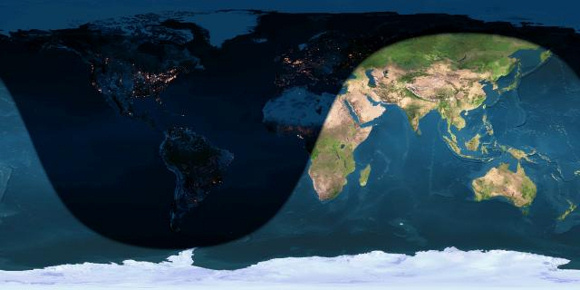
Day and night sides of Earth at the instant of the January 2015 full moon (2015 January 5, at 4:53 UTC) Image credit: Earthview

Elsewhere around the world, the moon reaches the crest of its full phase at different times on the clock. Looking at the worldwide map above, you can see that the full moon comes at midnight in South America and northeastern North America, at sunrise in Africa and the Middle East and at noon in eastern Asia. All these places will see a full-looking moon lighting up the sky tonight from dusk until dawn.

But to see the moon at the instant of full moon, the moon has to be above your horizon on the nighttime side of the world.

In both the Northern and Southern Hemispheres, the January sun – unlike the January full moon – rises south of due east and sets south of due west. In the Northern Hemisphere, these far-southern risings and settings of the sun give us the short days of winter. South of the equator, the same far-southern sunrises and sunsets bring long summer days. Meanwhile, the full moon lies opposite the sun, mirroring the sun’s place in front of the backdrop stars for six months hence.

And that’s why tonight’s moon – like the sun in summer – will follow a high path across the sky as seen from the northern part of the globe – and a low path as seen from the southern.

This January full moon rises north of due east around sunset, climbs highest in the sky around midnight and sets north of due west around sunrise.

Bottom line: Watch the full moon shine from sundown to sunup on the night of January 4, 2015.

SOURCE::: http://www.earthsky.org

Natarajan