” In our days, Hardware was Found in Hardware Shop and name of Software was Never Heard … ” !!!!

The Best Answer an Older Person Can Give

Some time ago, a loving gradnson was talking to his grandmother about modern life. He asked for her opinion on everything that has been going on in the last few years. His grandmother gave him a long look and said: “Well, let me see…
I was born before:
* penicillin
* television

old lady

* frozen foods
* Xerox
* contact lenses
* Frisbees and
* the pill
There were no:
* credit cards
* laser beams or
* ball-point pens
Man had not yet invented:
* pantyhose
* dishwashers
* clothes dryers
* and the clothes were hung out to dry in the fresh air and
Nor has man walked on the moon yet.
Your Grandfather didn*t live together until we got married. There were very few single mothers.
Until I was 25, I called every man older than me, “Sir.”
And after I turned 25, I still called policemen and every man with a title, “Sir.”
We were before gay-rights, computer-dating, dual careers, daycare centers, and group therapy.
Our lives were governed by the Ten Commandments, good judgment, and common sense.
We were taught to know the difference between right and wrong and to stand up and take responsibility for our actions.
Serving your country was a privilege; living in this country was a bigger privilege.
We thought fast food was what people ate during Lent.
Having a meaningful relationship meant getting along with your cousins.
Draft dodgers were those who closed front doors as the evening breeze started.
Time-sharing meant time the family spent together in the evenings and weekends, not purchasing condominiums.
We never heard of FM radios, tape decks, CD*s, electric typewriters, yogurt, or guys wearing earrings.
We listened to Big Bands, Jack Benny, and the President*s speeches on our radios.
If you saw anything with *Made in Japan * on it, it was junk.
The term *making out* referred to how you did on your school exam.
Pizza Hut, McDonald*s, and instant coffee were unheard of. We had 5 & 10-cent (5 and dime) stores
where you could actually buy things for 5 and 10 cents.
Ice-cream cones, phone calls, rides on a streetcar, and a Pepsi were all a nickel.
And if you didn*t want to splurge, you could spend your nickel on enough stamps to mail 1 letter and 2 postcards.
You could buy a new Ford Coupe for $600, but who could afford one? Too bad, because gas was 11 cents a gallon.
In my day:
* “grass” was mowed,
* “coke” was a cold drink,
* “pot” was something your mother cooked in and
* “rock music” was your grandmother*s lullaby.
* “Aids” were helpers in the Principal*s office,
* “chip” meant a piece of wood,
* “hardware” was found in a hardware store and.
* “software” wasn*t even a word.
We volunteered to protect our precious country.
No wonder people call us “old and confused” and say there is a generation gap.
How old do you think I am?
Read on to see… Are you ready??
*
*
*
*
*
*
*
*
*
*
*
*
*
*
*
*
*
*
*
*
*
*
*
*
This woman would be only 65 years old.

old lady

She would have been born in late 1950.
Gives you something to think about, doesn’t it?
So much has changed in one lifetime. !!!
Natarajan

Watch Sunday Spacewalk on March 1…

NASA astronaut Terry, Virts Flight Engineer of Expedition 42 is seen working to complete a cable routing task while near the forward facing port of the Harmony module on the International Space Station. February 21, 2015. Image credit: NASA

NASA astronaut Terry, Virts Flight Engineer of Expedition 42 is seen working to complete a cable routing task while near the forward facing port of the Harmony module on the International Space Station. February 21, 2015. Image credit: NASA

On Sunday (March 1, 2015) two NASA astronauts aboard the International Space Station (ISS) will perform the last of Expedition 42’s scheduled spacewalks. The spacewalk will begin around 6:10 a.m. Central Time and is expected to last about 6 hours, 45 minutes. NASA Television coverage on Sunday will begin at 5 a.m. Central time. Watch here

NASA astronauts Barry Wilmore and Terry Virts completed the first spacewalk on February 21 and the second on Wednesday (February 25.)

The spacewalks are designed to prepare the orbiting laboratory for future arrivals by U.S. commercial crew spacecraft. The astronauts are laying cables along the forward end of the U.S. segment to bring power and communication to two International Docking Adapters slated to arrive later this year. The new docking ports will welcome U.S. commercial spacecraft launching from Florida beginning in 2017, permitting the standard station crew size to grow from six to seven and potentially double the amount of crew time devoted to research.

When astronaut Terry Virts returned the airlock after Wednesday’s spacewalk, he reported a minor seepage of water in his helmet. The Mission Management Team reviewed the status of spacewalk preparations as well as an analysis of the minor seepage of water and on Friday morning, the team expressed a high degree of confidence was that the suit’s systems are all in good shape and gave approval to proceed with Sunday’s spacewalk as planned.

Spacewalk specialists reported that Virts’ suit — serial number 3005 — has a history of what is called “sublimator water carryover”, a small amount of residual water in the sublimator cooling component that can condense once the environment around the suit is re-pressurized following its exposure to vacuum during a spacewalk, resulting in a tiny amount of water pushing into the helmet.

Spacewalkers Terry Virts and Barry Wilmore work outside Pressurized Mating Adapter-2. Image credit: NASA TV

Spacewalkers Terry Virts and Barry Wilmore work outside Pressurized Mating Adapter-2. Image credit: NASA TV

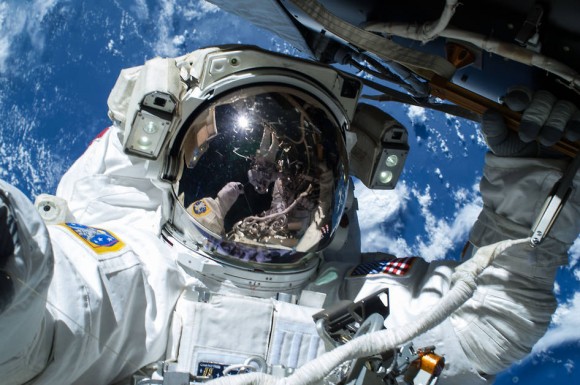
NASA astronaut Barry Wilmore works outside the International Space Station on the first of three spacewalks preparing the station for future arrivals by U.S. commercial crew spacecraft, Saturday, February 21, 2015. Fellow spacewalker Terry Virts, seen reflected in the visor, shared this photograph on social media.  View larger. \  Image credit; NASA

NASA astronaut Barry Wilmore works outside the International Space Station on the first of three spacewalks preparing the station for future arrivals by U.S. commercial crew spacecraft, Saturday, February 21, 2015. Fellow spacewalker Terry Virts, seen reflected in the visor, shared this photograph on social media.
View larger. | Image credit: NASA

During Sunday’s spacewalk, Virts and Expedition 42 Commander Barry Wilmore will deploy 400 feet of cable along the truss of the station and install antennas as part of the new Common Communications for Visiting Vehicles (C2V2) system that will provide rendezvous and navigational data to visiting vehicles approaching the station, including the new U.S. commercial crew vehicles

NASA astronaut Terry Virts Flight Engineer of Expedition 42 on the International Space Station is seen working to complete a cable routing task while the sun begins to peak over the Earth’s horizon on February 21 2015. Image credit: NASA

NASA astronaut Terry Virts Flight Engineer of Expedition 42 on the International Space Station is seen working to complete a cable routing task while the sun begins to peak over the Earth’s horizon on February 21 2015. Image credit: NASA

All three spacewalks are in support of the long-planned ISS reconfiguration from its current configuration, which was designed to support visiting Space Shuttles, to its new configuration optimived for future visiting commercial crew and cargo vehicles.

While cargo vehicles attach to the ISS using the process of berthing, whereby they are captured with the station’s robotic arm and positioned below a berthing port prior to being bolted into place, commercial crew vehicles will not use this method.

This is because the process of un-berthing takes a long time to complete, since cables and ducting between the visiting spacecraft and the ISS must first be manually disconnected, control boxes installed, hatches closed, and then the visiting spacecraft must be maneuvered away from the station with the robotic arm.

This means that berthing ports cannot support a rapid evacuation of crew from the ISS should it ever be necessary, which will be one of the primary roles of the commercial crew vehicles as they serve as “lifeboats” during their crew’s stay at the ISS.

Instead, crewed vehicles will attach to the ISS via a process of docking, whereby the visiting spacecraft flies itself all the way into its docking port and attaches via a capture ring striking a corresponding attachment mechanism..

The leading end effector of the Canadarm2 (bottom foreground) will be lubricated Wednesday when astronauts Barry Wilmore conduct their second spacewalk.  Imge credit: NASA TV

The leading end effector of the Canadarm2 (bottom foreground) will be lubricated Wednesday when astronauts Barry Wilmore conduct their second spacewalk. Image credit: NASA TV

Bottom line: NASA astronauts Barry Wilmore and Terry Virts aboard the International Space Station (ISS) completed the first of three spacewalk on February 21, 2105 and the second on February. On Sunday (March 1, 2015) they will perform the last of Expedition 42’s scheduled spacewalks. The astronauts are securing cables to prepare the orbiting laboratory for future arrivals by U.S. commercial crew.

SOURCE::::www.earthsky.org

Natarajan

Selfie of Curiosity ‘Mojovae’ Site on Mount Sharp of MARS !!!!


This self-portrait of NASA’s Curiosity Mars rover shows the vehicle at the “Mojave” site, where its drill collected the mission’s second taste of Mount Sharp.

The scene combines dozens of images taken during January 2015 by the Mars Hand Lens Imager (MAHLI) camera at the end of the rover’s robotic arm.  The pale “Pahrump Hills” outcrop surrounds the rover, and the upper portion of Mount Sharp is visible on the horizon.  Darker ground at upper right and lower left holds ripples of wind-blown sand and dust.

An annotated version, Fig. A, labels several of the sites Curiosity has investigated during three passes up the Pahrump Hills outcrop examining the outcrop at increasing levels of detail. The rover used its sample-collecting drill at “Confidence Hills” as well as at Mojave, and in late February was assessing “Telegraph Peak” as a third drilling site.

The view does not include the rover’s robotic arm.  Wrist motions and turret rotations on the arm allowed MAHLI to acquire the mosaic’s component images. The arm was positioned out of the shot in the images, or portions of images, that were used in this mosaic. This process was used previously in acquiring and assembling Curiosity self-portraits taken at sample-collection sites “Rocknest” (http://photojournal.jpl.nasa.gov/catalog/PIA16468), “John Klein” (http://photojournal.jpl.nasa.gov/catalog/PIA16937) and “Windjana” (http://photojournal.jpl.nasa.gov/catalog/PIA18390).

Curiosity used its drill to collect a sample of rock powder from target “Mojave 2” at this site on Jan. 31, 2015.  The full-depth, sample-collection hole and the shallower preparation test hole beside it are visible in front of the rover in this self-portrait, and in more detail at http://photojournal.jpl.nasa.gov/catalog/PIA19115 .  The Mojave site is in the “Pink Cliffs” portion of the Pahrump Hills outcrop. The outcrop is an exposure of the Murray formation, which forms the basal geological layer of Mount Sharp.  Views of Pahrump Hills from other angles are at http://photojournal.jpl.nasa.gov/catalog/PIA19039 and the inset at http://mars.jpl.nasa.gov/msl/multimedia/images/?ImageID=6968 .

The frames showing the rover in this mosaic were taken during the 868th Martian day, or sol, of Curiosity’s work on Mars (Jan. 14, 2015).  Additional frames around the edges to extend the amount of terrain included in the scene were taken on Sol 882 (Jan. 29, 2015).  The frames showing the drill holes were taken on Sol 884 (Jan. 31, 2015).

For scale, the rover’s wheels are 20 inches (50 centimeters) in diameter and about 16 inches (40 centimeters) wide.  The drilled holes in the rock are 0.63 inch (1.6 centimeters) in diameter.

MAHLI was built by Malin Space Science Systems, San Diego. NASA’s Jet Propulsion Laboratory, a division of the California Institute of Technology in Pasadena, manages the Mars Science Laboratory Project for the NASA Science Mission Directorate, Washington. JPL designed and built the project’s Curiosity rover.

More information about Curiosity is online at http://www.nasa.gov/msl and http://mars.jpl.nasa.gov/msl/.

Credit: NASA/JPL-Caltech/MSSS

SOURCE:::::: http://www.nasa.gov

Natarajan

Image of the Day…. ISS astronauts’ Space Walk Today… Feb 25…

Today’s spacewalk – the 2nd of 3 planned – began at 7:10 a.m. EST (1210 UTC) and will last 6.5 hours. This post has links to today’s live coverage, plus spectacular images from Saturday’s spacewalk.

NASA astronaut Barry Wilmore works outside the International Space Station on the first of three spacewalks preparing the station for future arrivals by U.S. commercial crew spacecraft, Saturday, February 21, 2015. Fellow spacewalker Terry Virts, seen reflected in the visor, shared this photograph on social media.  View larger. \  Image credit; NASA

NASA astronaut Barry Wilmore works outside the International Space Station on the first of three spacewalks preparing the station for future arrivals by U.S. commercial crew spacecraft, Saturday, February 21, 2015. Fellow spacewalker Terry Virts, seen reflected in the visor, shared this photograph on social media.
View larger. | Image credit: NASA

Today – February 25, 2015 – beginning at 7:10 a.m. EST (1210 UTC), International Space Station (ISS) astronauts are performing the second of three spacewalks to prepare the orbiting laboratory for future arrivals by U.S. commercial crew spacecraft. NASA TV coverage has begun and will go until 2 p.m. EST (1900 UTC) Wednesday. Watch here

NASA astronauts Barry Wilmore and Terry Virts completed the first spacewalk on February 21 and the third is scheduled for Sunday, March 1.

The spacewalks are designed to lay cables along the forward end of the U.S. segment to bring power and communication to two International Docking Adapters slated to arrive later this year. The new docking ports will welcome U.S. commercial spacecraft launching from Florida beginning in 2017, permitting the standard station crew size to grow from six to seven and potentially double the amount of crew time devoted to research.

NASA astronaut Terry Virts Flight Engineer of Expedition 42 on the International Space Station is seen working to complete a cable routing task while the sun begins to peak over the Earth’s horizon on February 21 2015. Image credit: NASA

Ground controllers have maneuvered the space station’s large robotic arm Canadarm2 in place for work planned for Wednesday’s spacewalk. Spacewalkers Barry Wilmore and Terry Virts will start their spacewalk at 7:10 a.m. EST to lay more cables and lubricate one of Canadarm2’s two latching end effectors, which serve as tip or base for the robotic arm. They will also prepare the Tranquility module for the relocation of the Permanent Multipurpose Module and the new Bigelow Expanded Activity Module later this year.

All three spacewalks are in support of the long-planned ISS reconfiguration from its current configuration, which was designed to support visiting Space Shuttles, to its new configuration optimived for future visiting commercial crew and cargo vehicles.

While cargo vehicles attach to the ISS using the process of berthing, whereby they are captured with the station’s robotic arm and positioned below a berthing port prior to being bolted into place, commercial crew vehicles will not use this method.

This is because the process of un-berthing takes a long time to complete, since cables and ducting between the visiting spacecraft and the ISS must first be manually disconnected, control boxes installed, hatches closed, and then the visiting spacecraft must be maneuvered away from the station with the robotic arm.

This means that berthing ports cannot support a rapid evacuation of crew from the ISS should it ever be necessary, which will be one of the primary roles of the commercial crew vehicles as they serve as “lifeboats” during their crew’s stay at the ISS.

Instead, crewed vehicles will attach to the ISS via a process of docking, whereby the visiting spacecraft flies itself all the way into its docking port and attaches via a capture ring striking a corresponding attachment mechanism.

The leading end effector of the Canadarm2 (bottom foreground) will be lubricated Wednesday when astronauts Barry Wilmore conduct their second spacewalk.  Imge credit: NASA TV

Bottom line: NASA astronauts Barry Wilmore and Terry Virts aboard the International Space Station completed the first of three spacewalk on February 21, 2105. The second is scheduled for Wednesday, February 25 and the third for Sunday, March 1. The astronauts are securing cables to prepare the orbiting laboratory for future arrivals by U.S. commercial crew.

SOURCE::::: http://www.earthskynews.org

Natarajan

Mummified Monk Inside Buddha Statue …. ?

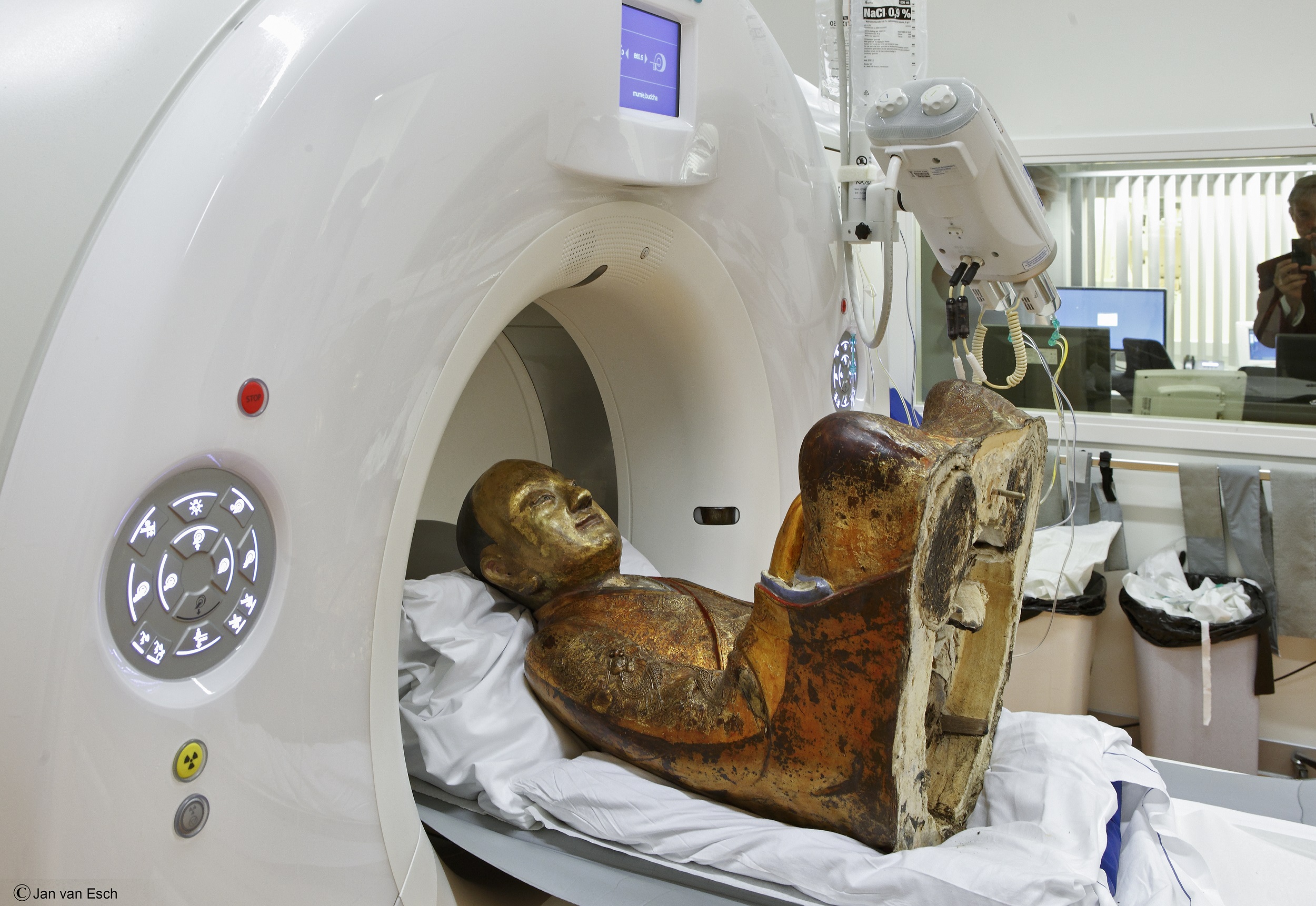
The mummified remains of a monk have been revealed inside a nearly 1,000-year old Chinese statue of a Buddha.

635603189441117628-mummy-buddha

The mummy inside the gold-painted papier-mâché statue is believed to be that of Liuquan, a Buddhist master of the Chinese Meditation School who died around the year 1100, researchers said. It’s the only Chinese Buddhist mummy to undergo scientific research in the West.

The statue was on display last year at the Drents Museum as part of an exhibit on mummies. It was an cited as an example of self-mummification, an excruciating, years-long process of meditation, starvation, dehydration and poisoning that some Buddhist monks undertook to achieve enlightenment and veneration.

When the exhibit ended in August, a CT scan at the Meander Medical Center in the Netherlands revealed the seated skeleton. Samples taken from organ cavities provided one big surprise: paper scraps printed with ancient Chinese characters indicating the high-status monk may have been worshiped as a Buddha.

A CT scan has revealed a mummified Chinese monk inside a Buddha statue. The remains date back about 1,000 years. Video provided by Newsy Newslook

The finding was first reported in December but did not get wide notice. Irish Archaeology carried a report over the weekend, which apparently started the news ball rolling.

But the revelation is not, as some reports claim, “a shocking discovery,” The History Blog notes: “It was known to be inside the statue all along … that’s why it was sent to the Drents Museum in the first place as part of the Mummies exhibition.”

The mummy’s existence was discovered in 1996 when the statue was being restored in the Netherlands, Live Science writes, explaining what was found, how its age was determined and when the first detailed skeletal imaging was performed.

DNA tests were conducted on bone samples, and the Dutch team plans to publish its finding in a forthcoming monograph.

Researchers still have not determined whether the monk mummified himself, a practice that was also widespread in Japan and that was outlawed in the 19th century. If he did, the process was gruesome, asAncient Origins explains:

For the first 1,000 days, the monks ceased all food except nuts, seeds, fruits and berries and they engaged in extensive physical activity to strip themselves of all body fat. For the next one thousand days, their diet was restricted to just bark and roots. Near the end of this period, they would drink poisonous tea made from the sap of the Urushi tree, which caused vomiting and a rapid loss of body fluids. It also acted as a preservative and killed off maggots and bacteria that would cause the body to decay after death.

In the final stage, after more than six years of torturous preparation, the monk would lock himself in a stone tomb barely larger than his body, where he would go into a state of meditation. He was seated in the lotus position, a position he would not move from until he died. A small air tube provided oxygen to the tomb. Each day, the monk rang a bell to let the outside world know he was still alive. When the bell stopped ringing, the tube was removed and the tomb sealed for the final thousand day period of the ritual.

At the end of this period, the tomb would be opened to see if the monk was successful in mummifying himself. If the body was found in a preserved state, the monk was raised to the status of Buddha, his body was removed from the tomb and he was placed in a temple where he was worshiped and revered. If the body had decomposed, the monk was resealed in his tomb and respected for his endurance, but not worshiped

If you find yourself in Budapest before May, the Buddha mummy statue is on display at the Hungarian Natural History Museum.

SOURCE::::: Michael Winter, USA TODAY …www.usatoday.com

Natarajan

This Date in Science…. Feb 20…1962…. John Glenn First American To orbit Earth !!!

This date in science: John Glenn first American to orbit Earth
John Glenn and Friendship 7
On February 20, 1962, John Glenn became the first American to orbit the Earth. He made three turns around the planet before returning safely.

February 20, 1962. John Glenn became the first American to orbit the Earth on this date. He made three turns around the planet before returning safely in his space capsule, which was called Friendship 7. He followed two Russian cosmonauts in making this early orbit of our planet: Yuri Gagarin ( April 1961) and Gherman Titov (August 1961).

While Glenn was in orbit, NASA controllers received an indication that the heat shield on his craft had come loose. They instructed Glenn not to jettison the rockets underneath the heat shield during re-entry, because the rockets might be able to hold the shield in place. Fortunately, the indication turned out to be a false alarm.

Glenn returned to space at age 77 aboard the space shuttle Discovery in 1995, making him the oldest person to fly in space. His mission’s primary scientific aim at that time was to study the effects of spaceflight on seniors.


John Glenn climbs into the Friendship 7 spacecraft just before making his first trip into space on February 20, 1962. Photo via NASA

John Glenn and Friendship 7

Here's What John Glenn saw on February 20, 1962.  Just 5 minutes and 44 seconds after launch, Glenn offered his first words about the view from his porthole: “This is Friendship 7. Can see clear back; a big cloud pattern way back across towards the Cape. Beautiful sight.” Three hours later, at the beginning of his third orbit, Glenn photographed this panoramic view of Florida from the Georgia border (right, under clouds) to just north of Cape Canaveral. His American homeland was 162 miles (260 kilometers) below. “I have the Cape in sight down there,” he noted to mission controllers. “It looks real fine from up here. I can see the whole state of Florida just laid out like on a map. Beautiful.”  Image via NASA
Here’s What John Glenn saw on February 20, 1962. Just 5 minutes and 44 seconds after launch, Glenn offered his first words about the view from his porthole: “This is Friendship 7. Can see clear back; a big cloud pattern way back across towards the Cape. Beautiful sight.” Three hours later, at the beginning of his third orbit, Glenn photographed this panoramic view of Florida from the Georgia border (right, under clouds) to just north of Cape Canaveral. His American homeland was 162 miles (260 kilometers) below. “I have the Cape in sight down there,” he noted to mission controllers. “It looks real fine from up here. I can see the whole state of Florida just laid out like on a map. Beautiful.” Image via NASA
Here’s what John Glenn saw on February 20, 1962. Just 5 minutes and 44 seconds after launch, Glenn offered his first words about the view from his porthole: “This is Friendship 7. Can see clear back; a big cloud pattern way back across towards the Cape. Beautiful sight.” Three hours later, at the beginning of his third orbit, Glenn photographed this panoramic view of Florida from the Georgia border (right, under clouds) to just north of Cape Canaveral. His American homeland was 162 miles (260 kilometers) below. “I have the Cape in sight down there,” he noted to mission controllers. “It looks real fine from up here. I can see the whole state of Florida just laid out like on a map. Beautiful.” Image via NASA
Bottom line: John Glenn became the first American to orbit Earth on February 20, 1962. His space capsule was called Friendship 7.

Bottom line: John Glenn became the first American to orbit Earth on February 20, 1962. His space capsule was called Friendship 7.

SOURCE:::: www. earthskynews.org

Natarajan

Have you Heard about these Aircraft Designs … ?

The 20th century saw an amazing array of new vehicles – from cars to ships to submarines and airplanes. Some of these designs are still used today, their basic premise being so dead on. However, some designs were less than ideal, and what follows are the aircraft designs that just weren’t as good as the rest, but are still fascinating to see. Enjoy this collection of strangely designed planes.

weird planes

weird planes

weird planes

weird planes

weird planes

weird planes

weird planes

weird planes

weird planes

weird planes

weird planes

weird planes

weird planes

weird planes

weird planes

weird planes

weird planes

weird planes

weird planes

weird planes

weird planes

weird planes

weird planes

weird planes

weird planes

weird planes

weird planes

weird planes

SOURCE:::: http://www.ba-bamail.com

Natarajan

A Frozen Niagara Falls …. Now a Winter Wonderland !!!

Frozen niagra falls

Frigid temperatures and wicked wind chills have been ravaging the northeast over the past week and the prolonged below-freezing temperatures have turned Niagara Falls into a winter wonderland.

The above image shows the American side of the famous falls on Tuesday when temperatures dropped to 6 degrees Fahrenheit around the Great Lakes. The American side of the Niagara Falls is much more likely to freeze than the more iconic shoehorn-shaped Canadian side.

Still, the American side is far from frozen solid. Water is still flowing, but layers of ice sheets have built up around the water.

The crazy temperatures haven’t kept tourists away. Last year when the falls partially froze, the site got more visitors than any other winter day on record, according to USA Today.

Frozen niagra fallsTourists visit the frozen falls on Feb. 17.

The sheer volume and speed of the water plummeting over the falls makes it impossible to completely freeze over. However, the mist that constantly wafts up from the rushing water can freeze into sheets of ice during the winter. Those ice sheets combined with frozen slush flowing down from Lake Eerie can make the falls look frozen:

Frozen niagra fallsA rainbow appears over Niagara Falls on Feb. 17.

Here’s what the American side of the falls looks like when it’s not frozen over:

Niagara falls

Bitter cold temperatures over President’s Day weekend also froze the Bryant Park fountain in New York City. Central Park hovered around 3 degrees — the coldest it’s been in over a decade.

Frozen bryant park fountainThe Bryant Park fountain frozen over  
Natarajan

3 Indians among 100 Shortlisted For Oneway Trip to MARS…

The Red Planet's surface. File photo.
Reuters

The Red Planet’s surface. File photo.

Three Indians, two women and one man, have made it to the list of 100 applicants who will move on to the next round of an ambitious private mission that aims to send four people on a one-way trip to Mars in 2024.

From the initial 202,586 applicants, only 100 hopefuls have been selected to proceed to the next round of the Mars One Astronaut Selection Process, The Netherlands-based non-profit organisation Mars One has announced.

The project aims to set up a human colony on Mars and eventually around 40 people will be sent to the red planet on a permanent basis. The finalists will train for seven years and Mars One will begin sending out four at a time from 2024.

The Mars 100 Round Three candidates include 50 men and 50 women with 39 from the Americas, 31 from Europe, 16 from Asia, 7 from Africa, and 7 from Oceania.

The Indian candidates include 29-year-old Taranjeet Singh Bhatia, who is studying Doctorate in Computer Science at the University of Central Florida.

The other two are Ritika Singh, 29, who lives in Dubai, and Shradha Prasad, 19, from Kerala.

The second round of the application process last year had shortlisted 44 Indians, of whom 27 were men and 17 were women.

The third round has selected 100 candidates from a pool of 660 after they participated in personal online interviews with Norbert Kraft, Chief Medical Officer.

During the interviews the candidates had a chance to show their understanding of the risks involved, team spirit and their motivation to be part of the life changing expedition.

“We were impressed with how many strong candidates participated in the interview round, which made it a very difficult selection,” said Norbert Kraft.

The next selection rounds will focus on composing teams that can endure all the hardships of a permanent settlement on Mars.

The candidates will receive their first shot at training in the copy of the Mars Outpost on Earth and will demonstrate their suitability to perform well in a team.

Keywords: Mars OneSpace Mission

SOURCE:::: http://www.the hindu.com

Natarajan

Image of the Day… Wind Sculpted Frozen Sand…!!!

Wind sculpted this frozen sand in Michigan

It was cold in the upper U.S this weekend, when Joshua Nowicki noticed and captured these cool frozen sand formations.

View larger. | Photo by Joshua Nowicki.

It was fiercely cold in the U.S. state of Michigan this past weekend, when Joshua Nowicki posted this cool photo at EarthSky Facebook. He said these interesting formations were created by the wind eroding the frozen sand at Silver Beach County Park in Saint Joseph, Michigan on February 14, 2015. The largest one, he wrote, was about 12 inches (30 cm) tall.

Thank you, Joshua!

How cold was it in Michigan? Dangerously cold. Mlive.com/weather wrote that – at 7 a.m. Sunday morning, February 15, 2015 – every reporting site except Port Hope and Munising was below zero Fahrenheit.

SOURCE:::: http://www.earthskynews.org

Natarajan