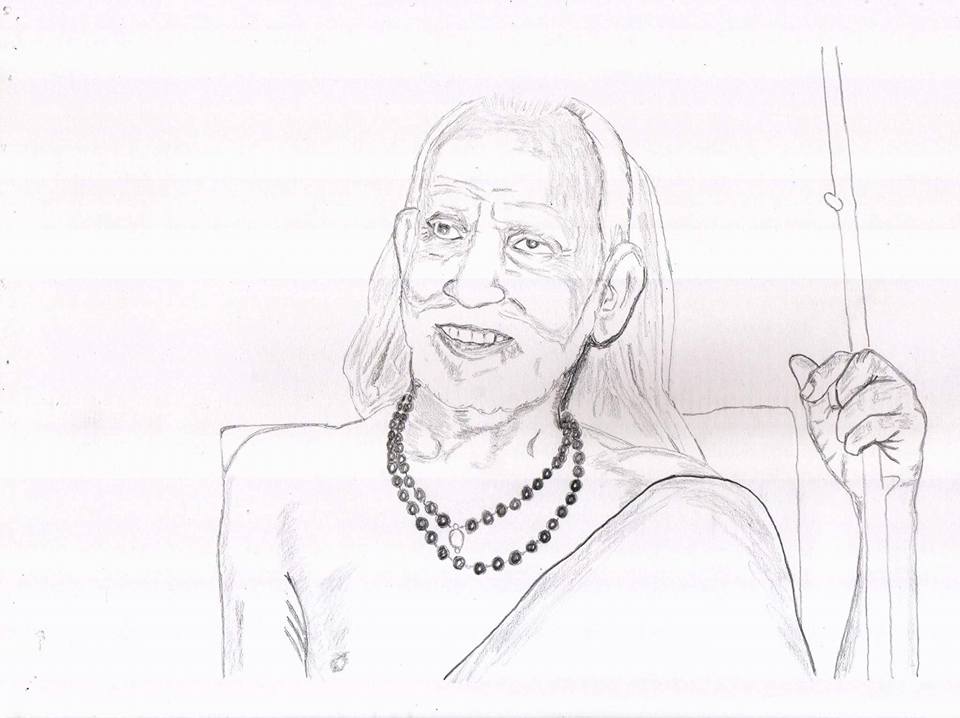
Message for the Day…”No one should become desperate and give up Prayers…”

Sathya Sai Baba

Truly, the prayers of the great act as an invitation even for the advent of the Lord. In the external world, when the subjects need any convenience or help, they approach the rulers and inform them of their request. So also, in the internal state, when there is no possibility of achieving and acquiring devotion, charity, peace, and truth, the great and good people who desire to achieve them pray to the Lord within themselves. Then, listening to their prayers, He Himself comes into the world and showers His grace on them. Ramayana and Bhagavata reveal that Lord Rama and Krishna incarnated as an answer to the prayers of the sages. Thus prayers should be offered again and again for the realisation of the task. No one should become desperate and give up prayers if they don’t result immediately in the advent of the Lord.

The Mysterious Caves of Mustang, Nepal……

The Kingdom of Mustang, bordering the Tibetan plateau, is one of the most remote and isolated region of Nepalese Himalaya. Once an independent Buddhist kingdom, Mustang was annexed by Nepal at the end of the 18th century, but retained its status as a separate principality until the 1950’s when the area was more closely consolidated into Nepal. Because of its sensitive border location, Mustang was off-limits to foreigners until 1992. The relative isolation of the region from the outside world has helped Mustang preserve its ancient culture which is more closely tied to Tibet than to Nepal.

The landscape is also unlike anything that is to be found anywhere else in Nepal —deep gorges carved by the Kali Gandaki River, and strangely sculptured rock formations. The cliffs’ face are pitted with an estimated 10,000 ancient cave dwellings, some of which are perched more than 150 feet above the valley floor. No one knows who dug them, or how people even scaled the near vertical rock face to access them. Some of the caves appear almost impossible to reach even to experienced climbers.

mustang-caves-4

Photo credit: National Geographic

Most of the caves are now empty, but others show signs of domestic habitation —hearths, grain-storage bins, and sleeping spaces. Some caves were apparently used as burial chambers. The several dozen bodies that were found in these caves were all more than 2,000 years old. They lay on wooden beds and decorated with copper jewelry and glass beads.

In other caves, skeletons dating from the 3rd to the 8th centuries, before Buddhism came to Mustang, had cut marks on the bones that may have been inflicted during the practice of sky burial, where the body’s flesh is sliced into small pieces and left to be eaten by vultures. Sky burial is still practiced in many remote regions in the Himalaya.

Archeologists believe that the caves in Mustang were used in three general periods. They were first used some 3,000 years ago as burial chambers. Then around 1,000 years ago, they became primarily living quarters, perhaps to escape battles and intruders into the valley. Finally, by the 1400s, most people had moved into traditional villages and the caves became places of meditation. Some of these caves were turned into monasteries such as the Luri Gompa, the Chungsi Cave monastery and the Nyiphuk Cave Monastery, all of which were built around and inside the caves.

Luri Gompa is one of the most famous in Mustang. The monastery is set on a ledge, at least a hundred meter high from the ground, in one of the many natural pillar like sandstone structures. A winding footpath climbs all the way from the bottom of the valley to a single entrance door that leads into two interconnecting chambers. The outer chamber contains a shrine, while the inner chamber —the main treasure of Luri Gompa— is beautifully decorated with a series of paintings depicting Indian Mahasiddhas — saints who were said to have achieved siddhi, or extraordinary powers by meditation. No documentation pertaining to this mysterious gompa or monastery has been found, but the wall paintings appear to be have been made in the 14th century or even earlier.

mustang-caves-1

Photo credit: National Geographic

mustang-caves-3

Photo credit: National Geographic

mustang-caves-5

Photo credit: National Geographic

mustang-caves-6

mustang-caves-7

Photo credit: nepaladvisor.com

mustang-caves-8

Photo credit: David Rengel/Washington Post

luri-gompa-2

Luri Gompa. Photo credit: Bob Witlox/Flickr

luri-gompa-3

luri-gompa-4

Frescos in the ceilings of Luri Gompa. Photo credit: library.brown.edu

Sources: Nat Geo / library.brown.edu / www.oneworldtrekking.com

Source……..www.amusingplanet.com

Natarajan

இந்த வாரக் கவிதை ….” துணையாய் தொடரும் நிழல்கள் “!!!

துணையாய் தொடரும் நிழல்கள் ….
………………………..
பிறந்த மண்ணை முத்தமிடும் குழந்தை தன்  அன்னையின் நிழலில்
மழலை அது நடை பயிலும்   தந்தையின் நிழலில் !
ஒரு நல்ல ஆசானின் நிழலில் கல்வி ….தக்க பருவத்தில்
இல்லறம் செழிக்க நல்லற நிழலாய் தொடரும்  ஒரு வாழ்க்கை துணை !
துணையாய் தொடரும் நிழல்கள்  இப்படி எத்தனை எத்தனை… ஒருவர்
வாழ்வில் !
காலம் மாறும் …காட்சியும் மாறும் !  தொடரும் நிழல் துணையும்
உருமாறும் !…
காலத்தின் கோலத்தில் மாற்றம் பல நிகழ்ந்தாலும் தொடர்ந்து
உறு துணையாகும் ஒரே ஒரு நிழல்…  நம் வாழ்வில் !
காட்சியும்  சாட்சியும் தேவை இல்லை இந்த நிழலுக்கு !
அதுதான் நம் மனசாட்சி !  வாழ்க்கையின்  நல்லாட்சிக்கு
என்றும் துணையாக தொடரும்  அதன் அரசாட்சி !
Natarajan

Message for the Day…” Get rid of Desire and Hatred and experience the Divinity inherent within …”

Who is Lord Shiva, and where is He to be found? Many answers are given, including Kailash as His place of residence. The true answer is, ‘Isavasyam Idam Sarvam’ (All this is pervaded by Isa). He is omnipresent. There is no place, object or being where God is not present. Correct your outlook and recognise this unity in the apparent diversity around you. When God is omnipresent, what need is there to go in search of Him? The search is meaningless. If one gets rid of attachment and hatred, one will experience the Divinity inherent within. This is the sadhana (spiritual exercise) one has to do today – to get rid of desire and hatred which conceal the God within. Many people ask: “Swami! Show us the way.” All you have to do is to go back to the source from which you came. Where is the need for seeking the way? The Bhagavatha has declared that it is the natural destiny of every living being to go back to where each one came from.

Sathya Sai Baba

” Bond Between Parent and Child is Universal ….”!!!

The minute you become a parent, your whole world is dedicated to making sure you’re child (or children) is safe, feels loved and grows to become wise to the world. In the adorable photos below, you can see creatures of all shapes and sizes rearing their young in the wild. Not only will these photos make you feel warm and fuzzy – they’ll also show you that the bond between a parent and a child is universal, regardless of the physical form it takes:

parent love

parent love

parent love

parent love

parent love

parent love

parent love

parent love

parent love

parent love

parent love

parent love

parent love

parent love

parent love

parent love

parent love

parent love

parent love

parent love

parent love

parent love

parent love

parent love

parent love

Source…..www.ba-bamail.com

Natarajan

Message for the Day…..” Never forget that Nothing is as Powerful as God’s name to Protect us “

Arms and bombs cannot save the world. God’s Grace alone can save the world. Hence your foremost duty is to pray for His grace. Prayer is supremely important and this awareness is needed in your daily living, at every step. Never forget that nothing is as powerful as the Lord’s Name to protect you. When you sing alone, your heart is merged in the song. When many sing together, the prayer acquires a divine power. Hence Guru Nanak commended community singing. With melody and rhythm, you must impart feeling to your song to make the bhajan a sacred offering. A tune (raga) without feeling (bhava) is a disease (roga). Giving up conceit and exhibitionism, sing bhajans in a spirit of humility and devotion, with the full awareness of the power of the Lord’s Name. This is the right way to dobhajans. When all participants sing in unison, sacred vibrations are produced, and the divine energies released fill the whole universe.

Sathya Sai Baba

Breaking stereotypes: ‘We are stronger than we think’ !!!

We had asked you, dear readers, share your experience if you’re a woman who has broken stereotypes.

Here, Vandana Chaudhary shares her story.

Vandana Chaudhary

I am Vandana Chaudhary, 33 years, and presently live in Vizag.

I have always enjoyed sports like badminton and cricket.

I also run marathons occasionally. But cycling, and that too 80 kilometres, is something I never fathomed in the wildest of my dreams.

It all started in August 2013, when I first bought my Firefox (MTB) and enjoyed riding it casually on Dolphin hill (my residence).

In the first few months, I could barely do 4 to 5 km at a stretch, without running out of breath.

Gradually, I improved my timing and was able to do 12 km (with a steep elevation) within six months.

However, I never thought I was good enough to participate in a cycling tour, which had professional cyclists as participants.

In December 2014, the ‘Tour of Eastern Ghats (TEG)’ was organised.

It was time to send in our names and I was still in two minds if I would be able to ride half the distance, let alone complete it.

Nevertheless, with immense encouragement from my husband (Anand V), I decided to give it a shot, with my humble six geared cycle.

Vandana Chaudhary at the start line

On the D-day, while standing at the starting line, I felt terribly intimidated by shiny, sleek Cannondales, Treks and Meridas around.

My heart sunk further, when I saw all of them zooming past me on their 24-geared bikes.

With low spirits already, I decided to continue, slow and steady, with my hubby following me in our black Santro.

Every time I would slow down, he would shout out aloud a word of encouragement like , “C’mon Vandana, you can do it, you are almost there”.

When the group stopped for a quick lunch, I was the last one to reach.

Post lunch, many participants decided to drop out due to exhaustion. That’s when I decided, it is not important to win the race, but it’s important to complete it.

I started with rejuvenated vigour and cycled my way through the fields, mountains and lakes. All this while, Anand trailing me and cheering me.

At one point of time, the organisers asked me to stop and use the towing truck, like others had as it was getting too late.

Sensing my disappointment, Anand stepped up and said, “She will not give up even if it meant riding in pitch dark”.

In the end, I proudly wish to reveal that there were just three of us who completed the entire route, the other two being Naval officers.

That day, for the first time I realised, what a little bit of will power and self belief can achieve

I still feel a sense of pride when I think of how I decided not to give up despite the darkness, pain and exhaustion.

“We are stronger than we think” — I will never stop believing this!

Photographs: Kind courtesy Vandana Chaudhary

Source…….www.rediff.com

Natarajan

India’s Water Warrior Has a Solution for India’s Droughts. The Best Part – We Can Play a Role Too!

Ayyappa Masagi has successfully implemented water conservation projects across states, industries, farms, and homes.

For anyone who is worried about India’s water crisis, Ayyappa Masagi’s solution is simple – conserve. This man – popularly referred to as Water Magician, Water Gandhi, and Water Doctor – firmly believes that by the year 2020 India can manage its water resources well and be a water-efficient country. And if Ayyappa has his way, the country may just end up achieving this goal.

Ayyappa is famous for reversing the fortunes of thousands by getting them to practise rainwater harvesting and water conservation.

masagi1

He has also recharged more borewells and constructed more lakes than probably anyone else in the country.

But he hasn’t always been actively involved in conserving water. In fact, for many years, Ayyappa was an engineer for Larsen and Toubro (L&T), before he started working in this field. Ayyappa was born into a family of poor farmers in Gadag district in Karnataka. And it is his experiences with agriculture that made him study water in his later years.

“In my childhood we faced plenty of water problems. I used to wake up with my mother at 3 am to go and fetch water. This used to happen so often that I took an oath to try and conserve water every day. In fact, throughout my growing years, I thought of ways to conserve water,” he says.

Ayyappa went through many struggles before he could get an education and get employed. His mother sold her gold so he could complete his diploma in mechanical engineering. He worked at BEML, Bengaluru, before joining L&T, where he worked for 23 years.

During his years in L&T, Ayyappa found it hard to resist the call of the earth.

He gave in and purchased six acres of land in a village in Gadag.

masagi4

“In this dry region, I planted crops like rubber and coffee. I wanted to prove that one could grow these crops with whatever rain one gets. Though I was successful in the first two years my crops soon dried up due to a severe drought. The year after that, they were destroyed by floods. Though people mocked me at that point, I didn’t take it to heart. I was determined to find a solution,” he says.

This is how Ayyappa started researching how water, which is abundant at least once a year, can be conserved for the dry season. In his quest for answers, he met with experts like Anna Hazare and Rajendra Singh of Rajasthan.

After a long study, Ayyappa realised that recharging borewells and practising non-irrigational agriculture methods were the answers to the water problems farmers faced.

“I decided to use my farm as my own R&D lab. I implemented these techniques and reaped a good harvest in the two subsequent years, in the face of flood and famine. I was encouraged by the success and started spreading the message about borewell recharging and non-irrigational agricultural techniques. I tested these methods on the farms in my neighbourhood and found they worked there as well. This is what prompted me to reach out to more people,” he says.

Gradually, he quit his job at L&T and decided to work towards making India a water-efficient nation.

“We always blame nature. But that is unfair. It is we who have encouraged uncontrollable development and encroached upon land. Then how can we complain when a place like Chennai receives the rain meant for a year in three days?” asks Ayyappa.

In 2004, Ayyappa received the Ashoka Fellowship for his conservation efforts.

masagi3

A year later, he established the Water Literacy Foundation, in a bid to reach out to more people and spread the message of conservation.

In 2008, Ashoka approached Ayyappa to start a for-profit wing of the Water Literacy Foundation. This is how Rain Water Concepts was launched.

Today, he finds solutions to water problems based on the size of the farm, the availability of resources, and the person’s budget. Ayyappa has orchestrated thousands of conservation projects across 11 states. He has also created over 600 lakes in the country, for which he found mention in the Limca Book of Records.

Ayyappa’s ideas are simple. He considers the earth to be the biggest filter. He captures the water, filters it and then stores it underground. His pit-based rainwater harvesting system is a structure made of boulders, gravel, sand, and mud. When it rains, water trickles through the gravel and sand. It slowly charges the subsoil. This process continues and ensures the soil is always charged with water. This method also prevents water from evaporating.

He also specialises in watershed management, inter-basin water transfer, recycling of water, etc.

masagi2

“Do you know how much water every person wastes while having a bath? This water is not bad water. It can actually be reused,” he says.

Ayyappa not only provides services to individuals but to corporates and other educational institutions as well. He has also managed to create a community of ‘water warriors’ who practise his methods and educate others about them.

“Our country doesn’t need grand plans like river-linking to tackle the problem of water shortage. In fact, that project is an unnecessary expense for the government. If we need to save water, every farmer and ever organisation should plan ahead. And if they do, this country will soon become water-efficient,” he says.

Ayyappa Masagi can be contacted at waterliteracyfoundation@yahoo.com

Source…..Meryil Garcia in http://www.the betterindia.com

Natarajan

Hundreds of South Koreans Visit Ayodhya Every Year. This Is Why…!!!

The holy city of Ayodhya, in Uttar Pradesh, plays host to hundreds of South Koreans every year – who come to pay their tributes to the legendary queen Hur Hwang-ok. According to legend, queen Hur Hwang-ok, also known as Princess Suriratna, was the princess of Ayodhya before she went to South Korea and married King Kim Suro of Karak Clan in 48 AD. It is believed that she reached Korea on a boat, and was the first queen of King Suro of Geumgwan Gaya. She was 16-year-old when she got married and is considered the first queen of Gaya Kingdom.

It is because of the presence of her monument in Ayodhya that around 60 lakh people of the Karak clan consider the city as their maternal home. The memorial was first inaugurated in 2001 in Ayodhya and more than a hundred historians and government representatives, including the North Korean ambassador to India, were present during the ceremony. Seven million Koreans, representing the Kimhae Kim clan, Hur clan and Incheon Yi clan, trace their ancestry to the royal union.

In South Korea, her tomb is located in Kimhae and there is a stone pagoda in front of it. It is said that the pagoda is made of stones that she brought from Ayodhya.

Tomb of Heo Hwang-ok in Gimhae, South Korea

Tomb of Heo Hwang-ok in Gimhae, South Korea

Source: Wikimedia

Describing how she landed in Gaya when she first met the king, she said that the heavenly lord (Sange Je) appeared in her parents’ dreams and told them to send her to the Korea as the king had not found a queen yet. Legend states that the queen died at the age of 157.

During Prime Minister Narendra Modi’s visit to South Korea in May last year, the two countries agreed that a bigger monument of the princess will be built in Ayodhya. Recently, during a meeting with the Korean delegation, Uttar Pradesh CM Akhilesh Yadav said that the memorial would be constructed according to the Korean architecture. He asked Kim Ki-jae, President of Central Karak Clan Society, to provide the design of the monument so that the government can proceed.

Featured image for representation only. Source: Flickr

Source…….Tanaya Singh in http://www.the betterindia.com

Natarajan


Message for the Day…” Who will uproot our internal enemies…” ?

Police and rulers can overcome only external foes; they have no power to destroy the internal enemies. The internal foes, the six enemies(arishadvarga) that operate inside a person, can be uprooted only by the teachings of the Lord, love of God, and the company of the holy and the great. The world suffers harm at the hands of wicked people when the police and the authorities fail in their duties. Similarly, the world is enveloped in darker ignorance when ‘great’ spiritual aspirants give up the path of world welfare, become victims of sense enjoyment and nurture ambition to earn name and fame. Spiritual elders are the rulers of the internal state; administrative authorities are the rulers of the external state. The whole world will bask in peace and joy only when worldly authorities and spiritual aspirants realise their duties and perform them with the right attitudes, with the welfare of all at heart, remembering the omnipotence of the Lord.

Sathya Sai Baba