Message for the Day…” To meditate on God, there is no fixed time , or place…”

There are no limitations of time or space for the establishment of oneself in the contemplation of the Omnipresent Lord. For this, there is nothing like a holy place or a special time. Wherever the mind revels in contemplation of the Divine that is the holy place! Whenever it does so, that is the auspicious moment! Then and there, one must meditate on the Lord. Hence scriptures reveal, ‘To meditate on God, there is no fixed time or place. When and where the mind so desires, then and there is the time and place!’ (Na kaala niyamo yathra, na deshasya sthalasya cha Yathrasya ramathe chittham, thathra dhyanena kevalam.) The world can achieve prosperity through disciplined souls whose hearts are pure and who represent the salt of the earth. To promote the welfare of the world, from this very minute, everyone should pray for the advent of such holy personages, and deserve the blessings of the great, and forget the sufferings of your daily living.

Sathya Sai Baba

Butcher’s Broom: Can Fruits Grow on Leaves…….?

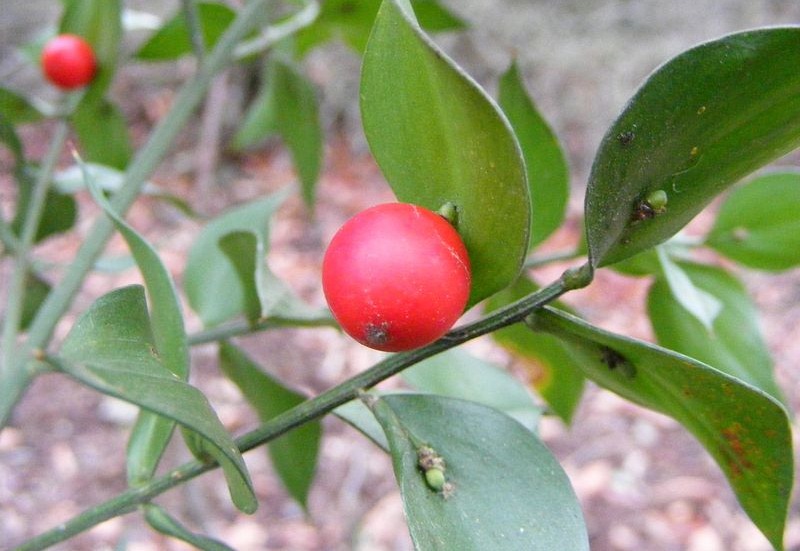
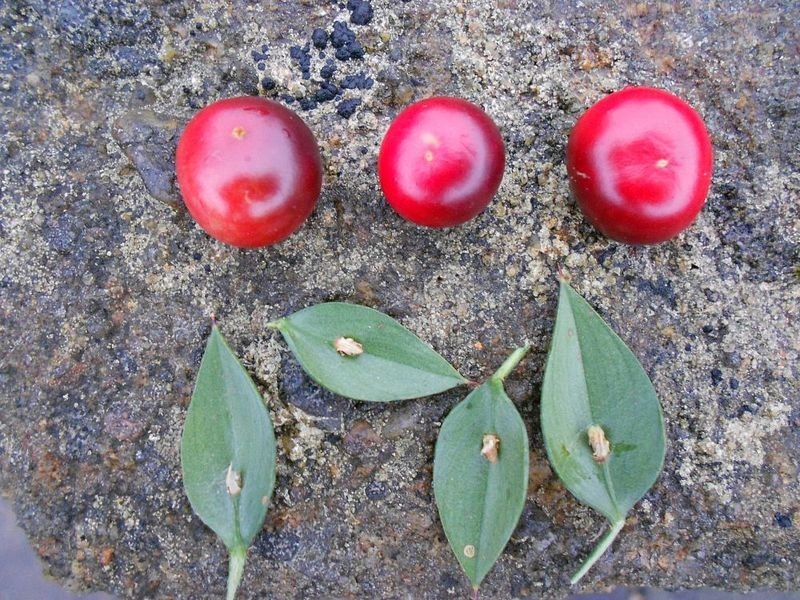
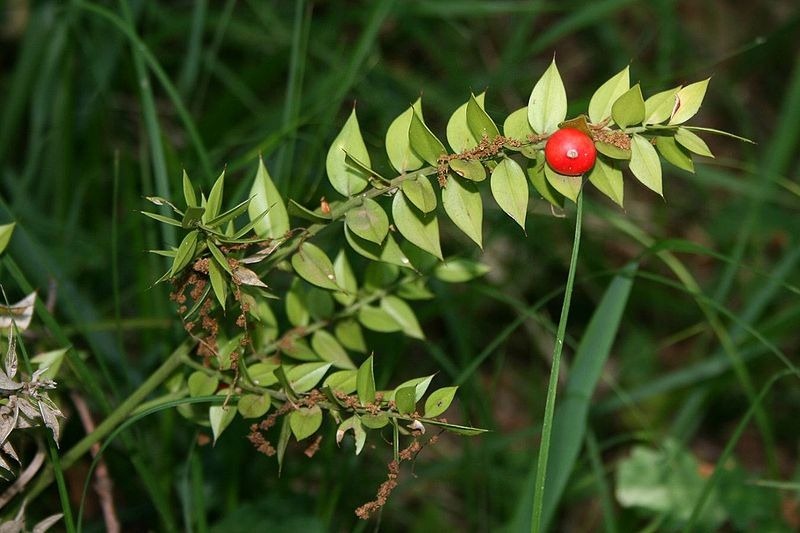
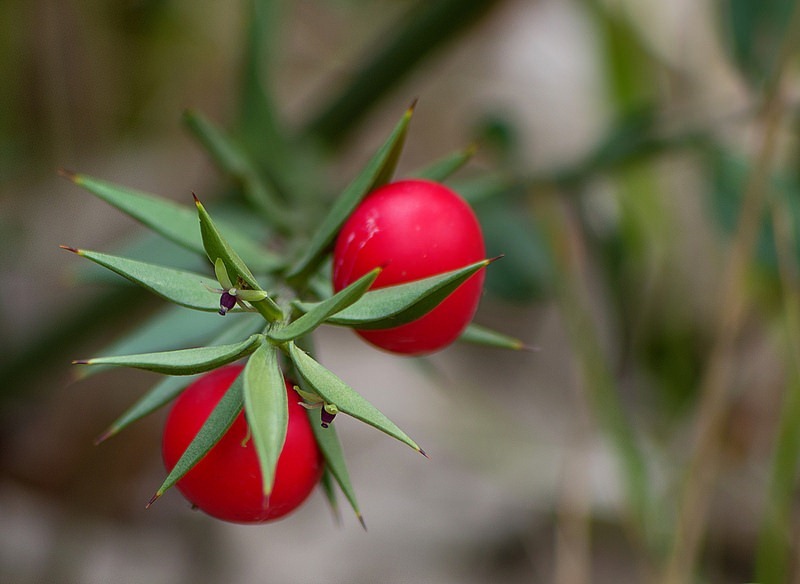
Butcher’s Broom, or Ruscus aculeatus, is a low-growing perennial shrub with tough, erect, stems and very rigid leaves that terminate in a sharp spine. From the center of the leaves grow small greenish-white flowers that blossom in early spring and develop into red berries in autumn. The tiny red berries are attached directly to the leaves by a short stem, making it a very strange looking plant.

The Butcher’s broom, however, is not breaking any rules of the plant kingdom, because what appears to be leaves are actually modified stems called cladodes, that have been flattened to not only look like leaves but serve their function as well.

ruscus-aculeatus-1

Photo credit: Gil Costa/Flickr


Butcher’s broom is widely distributed, from Iran to the Mediterranean and the southern United States. They have been used for more than 2,000 years as laxative and diuretic and to treat various ailments such as hemorrhoids, varicose veins, itching, and swelling. The young shoots of the plant are also eaten like those of asparagus. The stiff twigs were once bundled together and used by butchers to keep their cutting boards clean, from which came its common English name: butcher’s broom. It is also known by others names such as “Knee Holly”, because of its knee height, “Jew’s Myrtle”, for its use during the Feast of Tabernacles, “Sweet Broom” and “Pettigree”, although its meaning is not clear.

Extracts of butcher’s broom have been used throughout the ages, but the medicinal use of this plant did not become common until the last century. Investigation in the 1950s indicated that butcher’s broom could induce constriction of veins, because of which it is still widely used for treating certain circulatory diseases. It also contains an alkaloid which inhibits the passing of sodium ions across the cell membrane and thus is an effective anti-arrhythmic substance.

Butcher’s broom is also widely planted in gardens and its berries used as decorations.

ruscus-aculeatus-2

Photo credit: www.herbco.com

ruscus-aculeatus-3

Photo credit: stories.rbge.org.uk

ruscus-aculeatus-4

Photo credit: herbier.sesa-aude.fr

ruscus-aculeatus-6

Photo credit: Franz Xaver/Wikimedia

ruscus-aculeatus-7

Photo credit: Hans Hillewaert/Flickr

ruscus-aculeatus-8

Photo credit: Katya/Flickr

Sources: Drugs.com / Botanical.com / Plant World Seeds via mantisshrimp.wordpress.com

Source….www.amusingplanet.com

Natarajan

This 2-Year-Old Was One of the Youngest Rescue Volunteers during Chennai Floods….

At the time when many parts of Tamil Nadu were flooded due to incessant rains last year, and thousands of people were struggling to live through every passing day, there were a few localities in Chennai that remained unaffected. A. Vicky Kumar is the resident of one such area – there were no roadblocks, no power cuts, no loss to life and property. But he was deeply moved on seeing the plight of the rest of the city and his fellow citizens. With the view of helping as much as he could, he gathered about 12 volunteers including his wife Vishakha, and they set out to help in rescue operations. They called themselves ‘The C Team’. Closing their businesses for the entire month of December, the team started visiting slums, relief camps and individual homes to deliver rescue materials like food, clothing and medicines to people in need.

One of the most special volunteers of The C Team was Vicky’s 2-year-old daughter, Jiya. The student of a preschool named Developing Roots in Chennai, Jiya was a part of every field operation the team conducted.

“Many friends and well-wishers told us not to take her along for field work as she may fall sick stepping in to the dirty waters but we never bothered regarding what could happen because the need of the hour was to help the needy,” says Vishakha.

The entire team, including Jiya, were also recognized among thousands of other volunteers who put in their hearts and souls to work for Chennai, and she received a plant sapling and a certificate of appreciation from the music industry maestro Illayaraja, on December 17, 2015.

Jiya will be three years old this March. Kudos to her parents who were not scared of uncertain situations and ensured that their daughter got a glimpse of what such social activities look like, to make her understand the importance of helping others in need.

Have a look at her – busy during work.

jiya1

jiya2

jiya3

jiya4

jiya5

jiya6

Source….Tanaya Singh in http://www.the betterindia.com

Natarajan

Joke of the Day… Wrong card…!!!

A new business was opening and one of the owner’s friends wanted to send him flowers for the occasion. They arrived at the new business site and the owner read the card, which said: “Rest in Peace.”

The owner was angry and called the florist to complain.

After he had told the florist of the obvious mistake and how angry he was, the florist replied:

 “Sir, I’m really sorry for the mistake, but rather than getting angry, you should imagine this – somewhere, there is a funeral taking place today, and they have flowers with a note saying:
Congratulations on your new location!‘”

Source……www.ba-bamail.com

Natarajan

” You’re Never Too Old to Play Holi. This Ad Proves That Age is no Bar…” !!!

You're Never Too Old to Play Holi. This Ad Proves That Age is no Bar

Screengrab taken from YouTube video uploaded by ParachuteAdvansed

It’s the festival of colour, eating gujiyas and creating mayhem with buckets of water but most of all Holi is about having fun with your loved ones – age no bar whatsoever.

This new ad, made by a popular hair product brand, is set in a senior citizens’ home and shows that you are never too old to play Holi. The video shows an excited resident waking up at the break of dawn to prep for the festival. He changes into an old kurta, waves away his morning tea and pockets gulal to smear on his friends at the old age home. No one notices his excitement except a female resident.

So he goes to the verandah ready to have some fun – only no one else seems interested in playing Holi the way he planned. Even the youngsters who come to visit the residents only sprinkle a dusting of colour as a festive greeting.

As the senior citizen Holi enthusiast sits by disappointed, both fists full of gulal, something awesome happens. We’ll let you watch the video to see how one person’s infectious excitement manages to bring colour to an entire home.

https://youtu.be/gPMjKIUNGDI
Source…..www.ndtv.com and http://www.you tube.com
Natarajan

Soon, Eat Meat Without Killing Animals for It, Thanks to This Indian-American Scientist & His Team !!!

Memphis Meats Inc., a San Francisco-based company founded by three scientists, has developed a new technique to produce meat from stem cells of animals. Uma S Valeti, an Indian-American cardiologist, is the CEO and one of the co-founders of Memphis Meats.

By bringing meat production into the lab, this team can soon make it possible for people to eat meat without actually killing animals.

memphis1

Source: YouTube

According Uma Valeti, the meat is sustainable, healthier, safer, and cruelty free. It does not lead to any side effects like bacterial contamination or high saturated fat. Additionally, the technique produces 90 percent less greenhouse emissions and does not require antibiotics as used in traditional meat production.

For the production, the team identifies cells that are capable of renewing themselves, from a targeted animal. These cells are then provided with oxygen and nutrients like sugar, minerals, etc. while they develop inside bio-reactor tanks into skeletal muscle and can be harvested in nine to 21 days. The team is currently working on beef, chicken and pork cells, and have already conducted test runs on beef meat.

“Our goal is to be in restaurants in three years and retail in five years. In 2021, we want to be in retail or even earlier,” Uma Valeti told PTI.

The first manufacturing base will be set up in the US and he added that they are also exploring ideas about setting centres in India and China very soon.

Cardiologist Uma Valeti is an associate professor of medicine at the University of Minnesota and president of the Twin Cities American Heart Association. Other members of the team include Nicholas Genovese, a stem cell biologist, and Will Clem, a biomedical engineer who owns a chain of barbeque restaurants in Memphis, Tennessee.

Currently, even though the source cells can be collected without killing the animals, the process starts with the help of fetal bovine serum that is drawn from the blood of unborn calves. Memphis Meats is working on replacing the serum with a plant-based alternative very soon, to completely end the practice of extracting it from animals.

“Our concept is simple. Instead of farming animals to obtain their meat, why not farm the meat directly? To that end, we’re combining decades of experience in both the culinary and scientific fields to farm real meat cells—without the animals—in a process that is healthier, safer, and more sustainable than conventional animal agriculture,” says their website.

Source…Tanaya Singh in http://www.the betterindia.com

Natarajan


The Golden Temple’s Community Kitchen Goes Organic, Grows Its Own Vegetables without Pesticides…

Visitors of the Golden Temple in Amritsar are soon to be served healthy, freshly produced organic food at the community kitchen. The management committee has made a landmark decision to adopt organic farming to grow its own grains, fruits and vegetables, free of chemicals.

A new mission undertaken by The Shiromani Gurdwara Parbandhak Committee (SGPC), they also aim to inspire farmers to take up organic farming and cut down on the use of chemical products.

The SGPC now grows its own organic vegetables and fruits on 40 acres at Gurdwara Gurusar Satlani Sahib and Patiala.

Golden Temple, Amritsar

The Golden Temple, Amritsar. Source: Wikimedia Commons.

In the first phase of its experimental model, carrots, cabbages, spinach, and fenugreek or methi seeds from this farm have been successfully grown. About 10 quintals of organic produce are sent to the gurudwara every one or two days, according to SGPC officials.

The Punjab Agro Industries Corportation Limited (PAIC) was instrumental in helping the SGPC to test its soil and suggest options for organic farming. The experts at PAIC also advise them on how to replace pesticides and the use of organic fertilisers. They’ve suggested the use of neem patta, lassi and cow urine, among others.

The langar, or community kitchen, at the Golden Temple is the world’s largest free kitchen. It is popular for serving food to everyone irrespective of caste, religion or background. The gurudwara’s community kitchen, Guru Ramdas Langar Hall, receives nearly 100,000 people. It serves 200,000 roti made of 7000 kilograms of wheat flour, 1200 kilograms of rice, and 1300 kilograms of daal. The kitchen is manned by 450 dedicated people and many volunteers.

The SGPC is the apex organisation of Sikhs that manages all the gurudwaras in Punjab, Haryana and Himachal Pradesh. After its success at the Golden Temple, the move would be replicated to other gurudwaras in the country.

Source….Neeti Vijaykumar in http://www.the betterindia.com

Natarajan

How One Man Is Making Indian Museums Fun, Interactive and Inclusive…..!!!

The dismal and decrepit state of most Indian museums is no secret. But architect and designer Abhishek Ray and his team are trying to change the experience of museum visits by creating spaces with appropriate exhibition displays, good lighting and graphics, and interactive audio visual systems that keep visitors engaged.

Antiques trafficking, damage from seepage and other maintenance issues,  lack of qualified staff – Indian museums suffer from many woes. A 2011 UNESCO report on Indian museums was also scathing in pointing out a long list of deficiencies, among them poor lighting and maintenance, incorrect signage and lax security. In 2012, a parliamentary committee report said, “Our museums are in a bad shape. Only 10% of the acquisitions are put on display and those are not even rotated regularly. Museum stores and galleries are in poor condition.”

Meet the man who is trying to address at least some of these issues. Abhishek Ray, an architect and designer, wants to make Indian museums more fun, interactive and inclusive.

“I want to change the way museums are perceived today. Museums tell a story and it should be an interesting one,” he says.

Abhishek Ray

Abhishek Ray

Abhishek is the principal architect at Matrika Design Collaborative. Over the last decade, Abhishek and his team have been working on museum development projects from their inception to their execution.  With comprehensive services – ranging from historical and art research to creating spaces using appropriate exhibition displays, lighting and graphics accentuated with interactive audio visual systems to keep visitors engaged in learning about our cultural heritage of India – the team has been changing the experience of a museum visit.

The team closely works on each museum.

The team works on providing better lighting and displays

“We noticed that museums have not changed at all since decades in India. I have no living memory of visiting museums in my childhood and today we need to engage children with our museums and cultural spaces at a very early age. We work with the government and non governmental organisations to redesign existing cultural spaces and to develop new ones in order to conserve our heritage,” he says.

Matrika Design Collaborative is now developing one of the first dedicated textile museums that showcases the history and conservation of embroidery from the western region of Kutch, Gujarat at Bhuj.

The museum is a part of the Living and Learning Design Centre for local embroiderers and craftspeople, where visitors will gain extensive understanding of the rich heritage of embroidery from the communities themselves.

Innovation, says Abhishek, comes through engaging the community in the development of the museum or cultural space.

“If we intend to showcase their culture and traditions it is imperative for us to involve them at various stages of inception. A classic example is how the LLDC museum in Kutch has been developing around documenting the lives of embroiderers by recording their oral histories, their art and lifestyles,” he says.

They convert a museum from a boring place to an interactive place.

Abhishek and his team convert a museum from a static space to an interactive one.

They also recently commissioned a small exhibition for Godrej Industries, wherein they designed a humble exhibition focused on the pioneering work carried out by Shri Ardershir Godrej in developing India’s first safe, which, till today, is one of the mainstays of the products rolled out by the industrial giant. Coupled with a trivia based display on the events around the year 1914 (the year when the first safe was fabricated in India), they put together a host of rare documents that profiled the story of safe-making at Godrej.

Overall, by using presentations, online art guides, mobile apps, and making the places more comfortable for people with special needs, Abhishek and his team are making museums both physically and intellectually inclusive.

The USP lies in the design of the museum which is also a challenge.

Their USP lies in museum design

They are currently developing a unique outreach programme, a Museum on Wheels for the Chhatrapati Shivaji Maharaj Vastu Sangrahalaya, Mumbai (formerly Prince of Wales Museum), where the self contained museum bus would travel to urban, peri-urban and rural areas of Maharashtra to spread education by means of an interactive mobile museum.

The bus is fitted with exhibition cases, audio video hardware, etc. It will cater to municipal schools, adult education camps and artists’ conclaves in rural districts of India.

From improving the look of existing locations to coming up with new museums, the team has been preserving Indian heritage in amazing ways.

From improving existing museums to coming up with new ones, the team has been preserving Indian heritage in amazing ways.

The development of the Shastra Museum (Museum on Arms and Armory of the Sikhs) in Amritsar, alongside the Toshakhana (Royal Treasury), is a project that Abhishek and his team are proud of. It holds some of the most exquisite weapons used by the Sikh armies under the leadership of Maharaja Ranjit Singh.

The narrative here builds around the development of traditional weapons and their transition to mechanised weapons and modern artillery in the late 19th Century.

“We have designed unique solutions where children are given an understanding of the science behind weapons and fortification systems, categorically ruling out their association with violence and war,” says Abhishek.

Innovation has found a new meaning through inclusion of children and people with special needs at the New Shri Pratap Singh Musuem in Srinagar, Jammu and Kashmir.

The team has dedicated a complete gallery to children’s activities. The 100,000 square feet museum is also completely accessible to people with special needs.

Abhishek is now working on coming up with more such interesting exhibition and museum ideas.

Abhishek and his team are now working on more innovative ideas.

The challenge for the future, says Abhishek, lies in demystifying the realm of heritage and culture for people at large. Implementation of unique ideas and changing mindsets of people who sit at the helm of affairs is going to be a big challenge.

“We need to redefine the experience of the cultural space by reinventing the narrative and this can be achieved when policy makers, curators, archivists, designers, and users come together in a collaborative format to work out the best ways to tell the story of our culture and heritage through tangible and intangible ways,” he concludes. 

To know more about the team’s work check out their website – www.matrika.in

Source…..Shreya Pareek in http://www.the betterindia.com

Natarajan

Message for the Day….” Contemplate on Spiritual wisdom…”

Devote your time to the service of the world, with faith in the Lord, regardless of its fruits. Then you become blessed. Otherwise, though the body may be inactive, the mind will be very busy, committing acts on its own. People with such minds fall prey to karma in spite of their not doing anything! When a person has the mind fixed on contemplation of God and the pursuit of truth, though the body and senses do acts that are of service to the world, they won’t be affected by them; though they do actions (karma), they are still non-doers of action. This is the lesson from Bhagavad Gita. The heart of the person who doesn’t strive to cultivate the mind with holy thoughts is certain to be the paradise of evil and wickedness. Everyone who hopes to rise to greatness, seeks one-pointedness and aspires for salvation, must bear this in mind. Spiritual wisdom alone is the cause of liberation.

Sathya Sai Baba

Image of the Day… Total solar eclipse of March 9 2016 …

View larger. | March 9, 2016, total solar eclipse from Palu, Indonesia.  Photo by Justin Ng of Singapore.

View larger. | March 9, 2016, total solar eclipse from Palu, Indonesia. Photo by Justin Ng of Singapore, who wrote: “Sun’s corona extends millions of kilometers into space and it is visible to the unaided eye during a total solar eclipse. During totality, temperature at my location dropped by 10 to 15 degrees Celsius and I was able to see planet Venus and Mercury when the area became dark. I took 12 different exposures during totality to cover as much dynamic range as possible and stacked them in Photoshop to produce this image.”

Source…..www.earthsky.org

Natarajan