Alaska Airlines Space Bins will give passengers almost 50 percent more space overhead for carry-on bags. Within two years, nearly half of Alaska Airlines’ fleet will be fitted with the larger bins, the airline said. (Boeing)
Is the end of scrambling for overhead bin space near?
Boeing revealed new overhead bins on its Boeing 737s that will give passengers almost 50 percent more space for carry-on luggage.
Alaska Airlines is one of the first major airlines outfitted with Boeing’s bigger and wider bins, it dubbed Space Bins, which will fit six bags instead of four.
In order to do that, it’s sacrificing about 2 inches of head space, says Boeing.
But the move could mean savings for passengers who spent $3.5 billion last year on fees to check their bags–and are trying to find ways around check bag fees, which average around $25 per bag.
On Alaska’s 737-800, the expanded bin space will increase the number of bags that can fit overhead from 118 to 178 — a difference of 60 more standard sized bags.
“Alaska is relentlessly focused on making the travel experience better,” Sangita Woerner, Alaska Airlines vice president of marketing said in a release. “We’ve been on a mission to improve our cabin experience for several years and Space Bins are part of a $150 million investment we’ve made to make flying more comfortable and enjoyable.”
Within two years, nearly half of Alaska Airlines’ fleet will be fitted with the larger bins, the airline said. Delta will also have Space Bin 737s in early 2016 and United has also committed to the bins.
But that doesn’t mean you can bring on a bigger bag— the size limitations for carry-ons on Alaska will stay in place.
Dharma is the moral path, which is the light; the light is bliss (ananda). Scriptures convey that Dharma is the essence of spiritual wisdom (jnana). Dharma is characterized by sacredness, peace, truth, and fortitude. Dharma is yoga (union); it is truth (sathya). Its attributes are justice, sense control, sense of honour, love, dignity, goodness, meditation, sympathy, and nonviolence. It leads you onto universal love and unity. It is the highest discipline and the most profitable. All this ‘unfoldment’ began with Dharma;this is stabilized by truth (sathya). Truth is inseparable fromdharma. Truth is the law of the universe, which makes the sun and moon revolve in their orbits. Dharma is the course, the path, the law. Wherever there is adherence to morality, there you can see the law of Truth (sathya-dharma) in action. In the Bhagavata too, it is said, “Where there is Dharma, there is Krishna; where there are both Dharma and Krishna, there is victory.”
A newlywed farmer and his wife were visited by her mother, who immediately demanded an inspection of the place. The Farmer had genuinely tried to be friendly to his new mother-in-law, hoping that it could be a friendly, non-antagonistic relationship.
To no avail, she kept nagging them at every opportunity, demanding changes, offering unwanted advice and making life unbearable to the farmer and his new bride. While they were walking through the barn, the farmer’s mule suddenly reared up and kicked the mother-in-law in the head, killing her instantly.
At the funeral service a few days later, the farmer stood near the casket and greeted folks as they walked by. The pastor noticed that when ever a woman would whisper something to the farmer, he would nod his head yes and say something. Whenever a man walked by and whispered to the farmer, however, he would shake his head, no and mumble a reply.
Very curious as to this bizarre behavior, the pastor later asked the farmer what that was all about. The farmer replied, “The women would say, ‘What a terrible tragedy’ and I would nod my head and say, ‘Yes, it was.’ The men would ask, ‘Can I borrow that mule?’ and I would shake my head and say,
The Google.com domain name was offered for sale on Google’s own website buying service
A man who briefly bought and owned the Google.com web domain has been rewarded by the search giant.
An administration oversight allowed US student Sanmay Ved to buy the right to control the domain on 29 September.
The oversight left him in charge of Google.com for about a minute until Google caught on and cancelled the transaction.
Now Mr Ved has been given a cash reward for spotting the error, which he has decided to donate to charity.
Google declined to comment on the story.
Mr Ved detailed his experience in a post on the LinkedIn site saying that he had been keeping an eye on Google-related web domains for some time because he used to work at the search giant. Mr Ved is currently an MBA student at a US college.
In the early hours of 29 September he noticed a for sale sign next to the Google.com name while browsing sites on Google’s own website-buying service.
He used a credit card to pay the $12 (£8) fee to grab google.com and got emails confirming he was the owner. Almost immediately he started getting messages intended for Google’s own web administration team.
This was followed by a cancellation message sent by the website buying service which said he could not take over Google.com because someone else had already registered it and his $12 payment was refunded.
Now it has emerged that Mr Ved has been given a “bug bounty” by Google’s security team for revealing the weakness in the domain buying system. The internal emails Mr Ved received while in charge of google.com have been passed to this team.
Mr Ved decided to give the cash to an Indian educational foundation and in response, Google doubled the reward.
Calling our parents anything other than mom, dad or one of the many variations thereof is an almost alien concept to many (and in some cultures is considered downright rude). So why is it we refer to our parents in this way? Where did it come from and perhaps, more curiously, is there any culture that forgoes this seemingly universal nickname custom for parental figures?
The words can be traced back to the 1500s for “dad” and the 1800s for “mom”. As with so many etymologies, where these words were first uttered and by whom is a mystery. Even the Oxford English Dictionary has admitted that they have “no evidence” on where the word “dad” originated. The word “mom”, on the other hand, is a slightly different story and it’s widely believed that the word was born from the much older word “mamma” which itself can be traced back to the 1500s in English. This, in turn, can be traced back to Latin where “mamma” meant “breast” or “teat”. From this word, we also got the word “mammalia” and later “mammal” to describe animals that suckle their young.
This brings us to the amazing part- a word extremely similar to “mom” occurs in almost every language on Earth. We don’t mean that there is a word for “mom” in every language; we mean that the word for “mom” is shockingly similar across nearly all of the most commonly spoken languages on Earth.
For example, if you wanted to address your mother in Dutch you’d say “moeder”, if you were to travel to Germany on the other hand you’d call her “mutter” while over in Italy you’d refer to her as, “madre”. Now we know what you’re thinking, those are all European languages. So let’s mix things up a bit and list the words for mom or mother in some more, shall we say, “exotic” languages, from an English speaker’s point of view, and see if you start to notice a pattern:
Chinese: Mãma
Hindi: Mam
Afrikaans: Ma
Ancient Egyptian: Mut
Swahili: Mama
As you can clearly see from this list, there’s a very peculiar trend with “mom” in various languages in that it’s nearly universally pronounced with an “m” sound. If you’re still not convinced or think that we’re perhaps cherry picking examples, here’s a pretty exhaustive list of ways to say “mother” in a number of languages for you to peruse at your leisure. With a few exceptions, our favorite of which is the Mapunzugun “Ñuke”, you’ll note that they pretty much all employ an “m” and often a “ma” sound.
As for the word “dad”, while there is certainly more variation in the ways to address your man-mum in foreign languages, similar trends can be observed. For example, the word “Papa” is present in several languages including Russian, Hindi, Spanish and English, while slight variations on it appear in German (Papi), Icelandic (Pabbi), Swedish (Pappa) and a number of other languages across the globe. Likewise in Turkish, Greek, Swahili, Malay and several other languages the word for dad is “Baba” or a variation of it.
The current working theory to explain this fascinating phenomenon is that the words parents use to refer to themselves are derived from the babblings of their child during its “baby-talk” phase. It has been observed that babies, regardless of where in the world they’re born, naturally learn to make the same few sounds as they begin to learn to speak. It has also been noted that during the babbling stage, babies will create what is known as “protowords” by combining nonsensical combinations of consonants and vowels.
The really interesting part about these protowords is that they’re consistent across different cultures for reasons that aren’t quite clear. The words babies make in this early babbling stage tend to use the softer contestants like B, P and M, often leading to the creation of otherwise non-words like baba, papa and mama by the child in question.
It’s further theorised that as these are often the first sounds babies are able to make consistently, parents came to use them to refer to themselves, which explains why words like “mama”, “papa,” “dada”, “tata” and “baba” are present in so many languages as a way of addressing one’s parents. It’s usually less complex to say than the parent’s real names and works as a substitute that ultimately sticks.
As to why the “ma” sound in derivations like “mamma” came to be assigned to women instead of men, it is generally thought that it derived from the sound babies make while suckling or feeding. It’s noted that the only sound a baby can really make while its mouth is full of his or her mother’s life giving bosom is a “slight nasal murmur” or a repeated “m” sound. Further, when the baby is hungry and sees the object of its foodie desires, it is not uncommon for the baby to, as linguist Roman Jakobson put it, “reproduced [it] as an anticipatory signal”. While no one can prove this is how “mom” and its predecessor “mamma” came about, it would at the least explain why there is an almost universal trend of the word for mother in varying languages utilising the “m”, and often “ma” sound.
There is no such precise theory for why the word “dad” was specifically chosen (presumably from “dada”), but this lack of a good reason to assign “dada” to male parents over other variations like “papa”, “tata”, “baba”, etc. is perhaps why there is such variation on this one in terms of which repeated consonant is used to go along with the a’s in a given culture.
So is there any culture in which this nicknaming practise isn’t observed? There are certainly examples of cultures that don’t adhere to the idea of a nuclear family, but as far as applying similar types of nicknames to parental figures, not really… At least as far as we could find and we’re usually very good at this sort of thing and spent more hours than we care to admit trying to find the obligatory exception. But if you happen to be an anthropologist or just someone who knows different and you know of an exception where children don’t commonly give their parental figures (whether truly their biological parents or not) some sort of nickname, please do let us know. We came up empty on it, which makes us a little uncomfortable as there seemingly always is at least one exception somewhere for just about any issue. Is this an exception to the rule that there is always an exception? It would seem so.
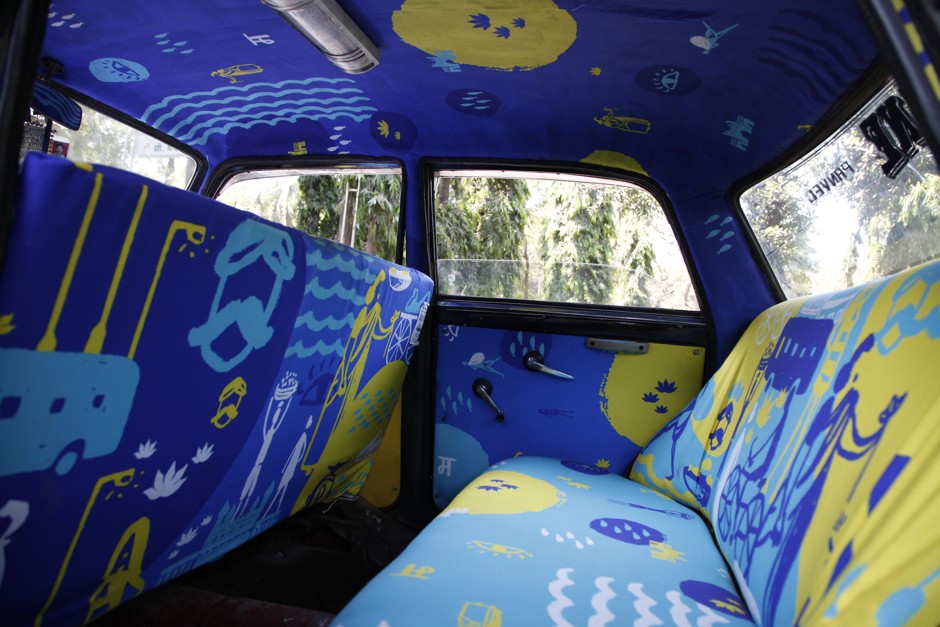
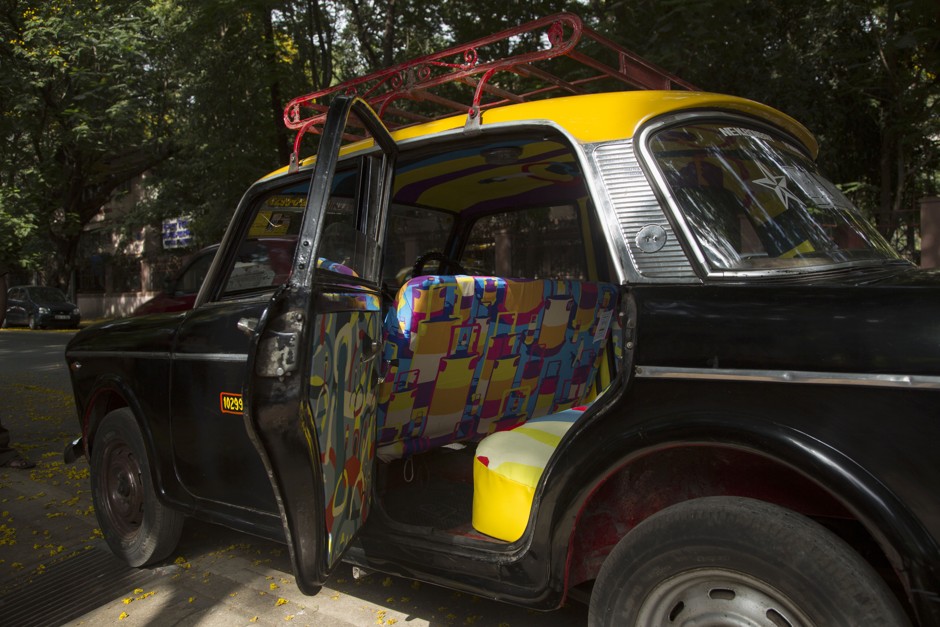
The Taxi Fabric project gives local designers a new vehicle to show off their work.
The bright pink interior of this taxi, by artist Pranita Kocharekar, reflects the diversity of Mumbai.(Taxi Fabric)
When you hop into a taxi, there isn’t usually much to look at except out the window. But one graphic designer wants to change that by turning cabs in Mumbai into canvasses for emerging artists.
Sanket Avlani is the founder of Taxi Fabric, a project that has already turned seven of the city’s 50,000-plus taxicabs into works of arts. The interior of each taxi, from the ceiling and doors to the seats, has been specially designed by local Mumbai designers, and the designs themselves are inspired by India’s most populous city.
Take the latest taxi to get Taxi Fabric’s special treatment—the design, by 25-year-old typographer and designer Pavithra Dikshit, features jasmine flowers, peppers, and lemons against an eye-popping green background. Called “Urban Garden,” it’s Dikshit’s way of paying homage to Mumbai’s disappearing green space.
“As a fast-growing metropolis, it has building and buildings coming up in every space,” says Dikshit. “The green color is shrinking, so I wanted my taxi to show to all the green things around you.”
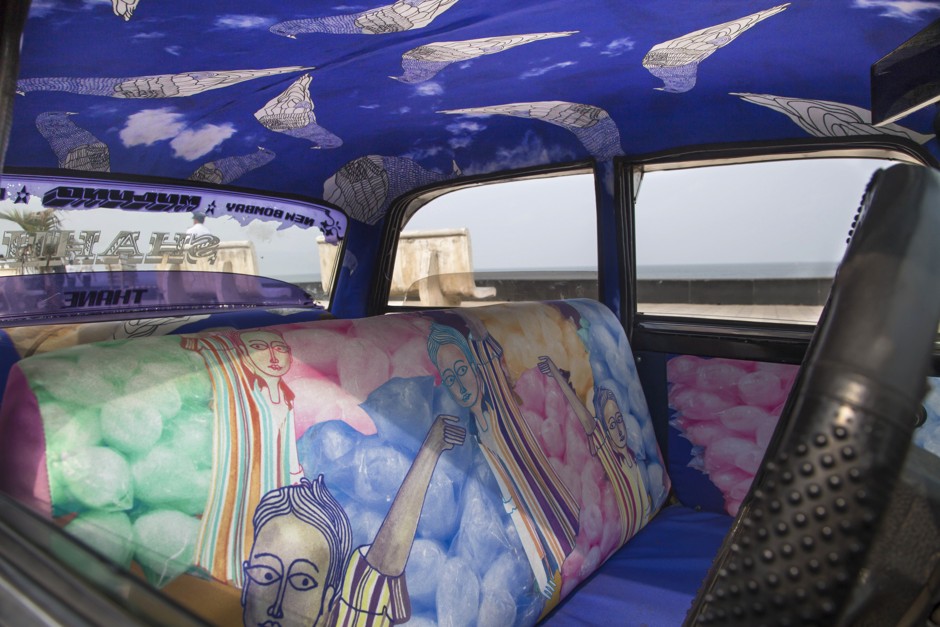
Other designs were inspired the daily life of a Mumbaikar—the different people you meet on the streets, from businessmen to children to vegetable vendors; and the personal stories of the cab drivers themselves.
Mumbai has a relatively small design community and an even smaller appreciation for the profession, says Avlani, who grew up in Mumbai and now works in London. “The design world is very small there, and most of the designers know each other,” he says. “If you wish to study design in India, not many people would understand or encourage it as much as they would in Europe or the United States.”
His hope is that the project will help spark conversation about the designs between taxi drivers and passengers. For Avlani, the iconic black-and-yellow taxis are the perfect medium because they’re everywhere.
”It’s so easy for people taking those taxis to react to those designs if the stories they tell are those that they recognize,” Avlani says. “If even the driver gets excited about it, it’s a win-win for everybody.”
As funding continues to trickle in from Taxi Fabric’s Kickstarter campaign, which runs until August 10, Avlani and his team hope to give at least 20 more cabs a special makeover by the end of the year.
Young designers and students who want to participate can submit a portfolioto the Taxi Fabric team, who will then select artists to work with. “We gauge if the designer can handle a project like this and if they can bring something new, and if the have their own style,” he says. Once accepted, artists will work with the team and, in some cases, cab drivers who want to be part of the program, to come up with a unique design.
The concept itself isn’t entirely new. It’s common for taxi drivers in Mumbai to customized their cars with colorful seat covers, eye-popping window decorations, lights, and little trinkets on the dashboard. “The taxi is like a desk at work. They spend their whole day in it so for them, it has to look interesting,”says Dikshit. “They don’t think that it attracts extra customers or anything, but it makes themselves feel good about spending [time] in it daily.”
But the bright pink, vibrant blue, and lively green colors that Taxi Fabric designers bring to cabs are a big step up from what drivers typically choose for their interior. Many drivers, Dikshit says, just go with fabric that’s already available at textile markets. “They’re very dull in color, like brown and maroon,” she says. “That’s how it’s always been, and nobody has the time to think about, ‘What if [the seat] is yellow?’”
Boring fabric doesn’t generate conversation, which Dikshit sees as a missed opportunity. “The drivers have their own stories, and they’re happy to discuss everything from politics to religion to traffic, to who they are as people,” she says. “You can almost consider them an extended part of the city landscape.”
Designed by Tasneem Amiruddin, this taxi art design reflects the daily life of a Mumbaikar. (Taxi Fabric)
A design by Taxi Fabric creator Sanket Avlani pays homage to “dawaballas,” who deliver hundreds of thousands of hot lunches across the city every day. (Taxi Fabric)
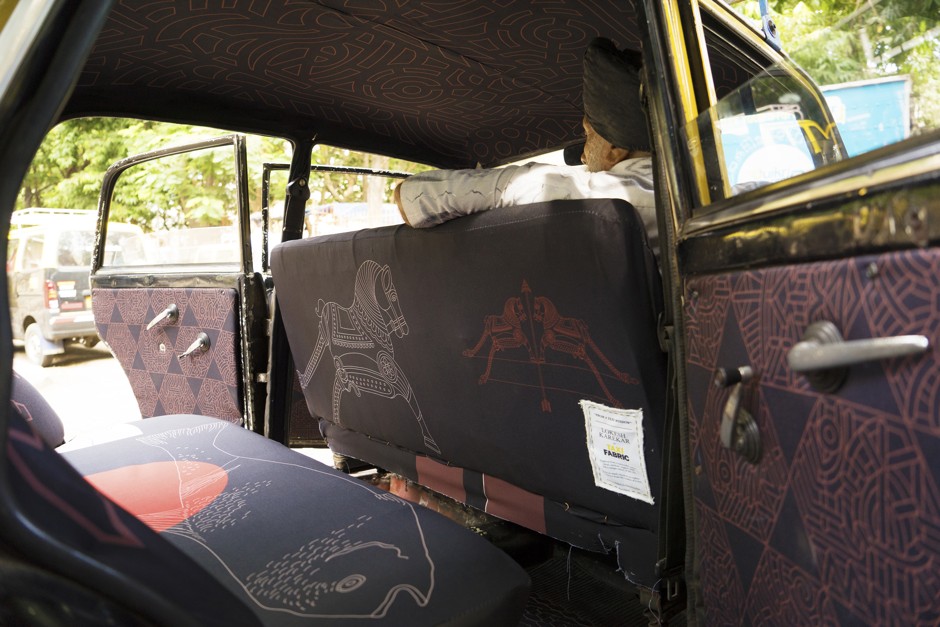
Artist Lokesh Karekar went for a minimalist design inspired by the 1980s. (Taxi Fabric)
Guarav Ogale wanted his design to reflect the life of the taxi’s driver. (Taxi Fabric)
Look again. The dude behind the wheel is stretching his arms up like he’s dunking on someone—perhaps the execs at Google and Apple, as this thing is the “world’s first driverless bus,” according to manufacturer Yutong.
While tech companies in America have focused on personal automated cars, China has gone big with what could be the beginning of mass, unmanned bus transit. The spacious vehicle, unveiled at the end of August after three years of development, recently managed a 20-mile trip through the crowded city of Zhengzhou without crashing into other motorists or bursting into flames. That same driver stayed behind the wheel, true, but maybe as technology progresses he’ll be replaced with a Johnny-Cab robot.
The bus maneuvers with the help of cameras, laser radars, and a master controller that tells it to go faster and stop at signals. Yutong says in a press release it masterfully handled the road during one of its test drives:
With a distance of 32.6 km, the intercity road from Zhengzhou to Kaifeng has 26 traffic lights in total. Despite this and busy traffic, Yutong driverless bus successfully completed a series of highly complex driving acts, such as automatic lane change, overtake, and responding traffic lights. Without any human assistance, the bus arrived at its destination with its highest speed reaching 68 km/h (42 mph). According to some experts, the much improved active safety standard is the biggest advantage of unmanned vehicles as they are very likely to eliminate all kinds of traffic accidents.
The manufacturer also says the bus has an efficient driving style—one “that can only be attained by years of experience of an attentive and careful driver”—that will reduce energy waste and thus make the ride environmentally friendly. The company plans to put it through more tests, including running it on race lanes, before proceeding with real-world applications.
A reporting crew with RTtook a spin on the bus last week. Have a look at the view from the front seat:
People resort to gurus to receive mantras (mystically powerful formulae to be recited by them for their spiritual uplift); others seek medicine men and holy monks to get yantras (esoteric talismans to ward off evil forces); some others learn thanthras (secret rites for attaining superhuman powers) from scholars (pandits). But all of this is wasteful effort. One should accept the body as the thanthra, one’s own breath as the mantra and the heart as the yantra. There is no need to seek them outside oneself. When all words emanating from you are sweet, your breath becomes Rig Veda. When you restrict what you listen to and prefer only sweet speech, all that you hear becomes Sama gana(rendition of Sama Veda). When you do only sweet deeds, all that you do is Yajur homa (ritualistic sacrifice). Then you will be performing every day the Veda Purusha Yajna, the yajna which propitiates the noblest and highest Vedic Spirit!
Strange, puffy, dense clouds are descending on the streets of Bangalore, India’s technology capital. While whimsical-looking, they are actually puffs of a toxic foam inundating the city.
Documentary photographer Debasish Ghosh has captured images of the clouds floating around the city and overrunning the roads. The foam comes from Bellandur, a 1.4-square-mile lake that for years has been polluted by chemical and sewage waste. Every time it rains, the lake rises and wind lifts the froth up and carries it into the city.
A pedestrian walks among clouds of toxic foam in Bangalore, India.
The toxic foam gets in the way of pedestrians and cars, creating awful traffic jams. It carries a stench so strong that it burns the nose. And if it comes into contact with your skin, you’ll get an itchy rash.
“It causes a nuisance,” Ghosh says.
Making matters worse, the froth is flammable. In May and June, the entire lake caught fire, leaving a 56-year-old man who was standing on a bridge above the lake with a ruptured cornea.
The froth has come every summer for more more than a decade now, but Ghosh says that this year is particularly bad. He’s been documenting the pollution since May, making sure to immediately clean his arms, hands, and face any time he gets too close.
Debasish Ghosh When it rains, the froth rises up and gets carried into the city by winds.
Officials try to “hose” down the lake, using water to keep the foam from rising.
Residents in the area have filed numerous complaints to the city, according to Ghosh, but the government has done little to remedy the situation. Ghosh says since his photos were firstpublished by the BBC, the government has paid a bit more attention, but still not enough. For now, city officials try to keep the foam down whenever it rains by pumping water into the lake. “What happens is the water [mixes with] the foam at a high speed, and it disintegrates and doesn’t rise up,” says Ghosh. “That’s how they are controlling it at this point in time, so it doesn’t fall on people.”
Actually cleaning up Bellandur and other polluted lakes won’t be easy. Once known for being the home of nearly a thousand lakes, Bangalore has become known as the “land of a thousand sewage tanks,” instead. Today, after years of urbanization, only about 150 lakes still exist, according to the Deccan Herald.The rest are either used as garbage dumps or, when they dry up, filled in and put up for grabs.
“There’s so much pollution that it will take lots of time and lots of investment to bring this lake back to normal,” he says. “To what it was maybe two decades ago, when people say there would still be migratory birds in there.”






 Take off with Natarajan