How One Man Is Making Indian Museums Fun, Interactive and Inclusive…..!!!

The dismal and decrepit state of most Indian museums is no secret. But architect and designer Abhishek Ray and his team are trying to change the experience of museum visits by creating spaces with appropriate exhibition displays, good lighting and graphics, and interactive audio visual systems that keep visitors engaged.

Antiques trafficking, damage from seepage and other maintenance issues,  lack of qualified staff – Indian museums suffer from many woes. A 2011 UNESCO report on Indian museums was also scathing in pointing out a long list of deficiencies, among them poor lighting and maintenance, incorrect signage and lax security. In 2012, a parliamentary committee report said, “Our museums are in a bad shape. Only 10% of the acquisitions are put on display and those are not even rotated regularly. Museum stores and galleries are in poor condition.”

Meet the man who is trying to address at least some of these issues. Abhishek Ray, an architect and designer, wants to make Indian museums more fun, interactive and inclusive.

“I want to change the way museums are perceived today. Museums tell a story and it should be an interesting one,” he says.

Abhishek Ray

Abhishek Ray

Abhishek is the principal architect at Matrika Design Collaborative. Over the last decade, Abhishek and his team have been working on museum development projects from their inception to their execution.  With comprehensive services – ranging from historical and art research to creating spaces using appropriate exhibition displays, lighting and graphics accentuated with interactive audio visual systems to keep visitors engaged in learning about our cultural heritage of India – the team has been changing the experience of a museum visit.

The team closely works on each museum.

The team works on providing better lighting and displays

“We noticed that museums have not changed at all since decades in India. I have no living memory of visiting museums in my childhood and today we need to engage children with our museums and cultural spaces at a very early age. We work with the government and non governmental organisations to redesign existing cultural spaces and to develop new ones in order to conserve our heritage,” he says.

Matrika Design Collaborative is now developing one of the first dedicated textile museums that showcases the history and conservation of embroidery from the western region of Kutch, Gujarat at Bhuj.

The museum is a part of the Living and Learning Design Centre for local embroiderers and craftspeople, where visitors will gain extensive understanding of the rich heritage of embroidery from the communities themselves.

Innovation, says Abhishek, comes through engaging the community in the development of the museum or cultural space.

“If we intend to showcase their culture and traditions it is imperative for us to involve them at various stages of inception. A classic example is how the LLDC museum in Kutch has been developing around documenting the lives of embroiderers by recording their oral histories, their art and lifestyles,” he says.

They convert a museum from a boring place to an interactive place.

Abhishek and his team convert a museum from a static space to an interactive one.

They also recently commissioned a small exhibition for Godrej Industries, wherein they designed a humble exhibition focused on the pioneering work carried out by Shri Ardershir Godrej in developing India’s first safe, which, till today, is one of the mainstays of the products rolled out by the industrial giant. Coupled with a trivia based display on the events around the year 1914 (the year when the first safe was fabricated in India), they put together a host of rare documents that profiled the story of safe-making at Godrej.

Overall, by using presentations, online art guides, mobile apps, and making the places more comfortable for people with special needs, Abhishek and his team are making museums both physically and intellectually inclusive.

The USP lies in the design of the museum which is also a challenge.

Their USP lies in museum design

They are currently developing a unique outreach programme, a Museum on Wheels for the Chhatrapati Shivaji Maharaj Vastu Sangrahalaya, Mumbai (formerly Prince of Wales Museum), where the self contained museum bus would travel to urban, peri-urban and rural areas of Maharashtra to spread education by means of an interactive mobile museum.

The bus is fitted with exhibition cases, audio video hardware, etc. It will cater to municipal schools, adult education camps and artists’ conclaves in rural districts of India.

From improving the look of existing locations to coming up with new museums, the team has been preserving Indian heritage in amazing ways.

From improving existing museums to coming up with new ones, the team has been preserving Indian heritage in amazing ways.

The development of the Shastra Museum (Museum on Arms and Armory of the Sikhs) in Amritsar, alongside the Toshakhana (Royal Treasury), is a project that Abhishek and his team are proud of. It holds some of the most exquisite weapons used by the Sikh armies under the leadership of Maharaja Ranjit Singh.

The narrative here builds around the development of traditional weapons and their transition to mechanised weapons and modern artillery in the late 19th Century.

“We have designed unique solutions where children are given an understanding of the science behind weapons and fortification systems, categorically ruling out their association with violence and war,” says Abhishek.

Innovation has found a new meaning through inclusion of children and people with special needs at the New Shri Pratap Singh Musuem in Srinagar, Jammu and Kashmir.

The team has dedicated a complete gallery to children’s activities. The 100,000 square feet museum is also completely accessible to people with special needs.

Abhishek is now working on coming up with more such interesting exhibition and museum ideas.

Abhishek and his team are now working on more innovative ideas.

The challenge for the future, says Abhishek, lies in demystifying the realm of heritage and culture for people at large. Implementation of unique ideas and changing mindsets of people who sit at the helm of affairs is going to be a big challenge.

“We need to redefine the experience of the cultural space by reinventing the narrative and this can be achieved when policy makers, curators, archivists, designers, and users come together in a collaborative format to work out the best ways to tell the story of our culture and heritage through tangible and intangible ways,” he concludes. 

To know more about the team’s work check out their website – www.matrika.in

Source…..Shreya Pareek in http://www.the betterindia.com

Natarajan

That Time an Olympic Rower Stopped to Let Some Ducks Swim By and Still Won the Gold Medal…

Born in Sydney Australia in 1905, Henry Robert Pearce, better known as Bobby Pearce, dominated the world of competitive rowing throughout the 1920s and 1930s and was extremely popular with fans of the sport due to a combination of the ease with which he seemed to best opponents and his affable personality. Perhaps the greatest example of both of these things in action was the time Pearce stopped mid-race to allow a duck and her ducklings to pass in front of him and still won.

This particular anecdote from Pearce’s life occurred at the 1928 Summer Olympics in Amsterdam during the quarter final of the single sculls event in the Sloten canal. For anyone unfamiliar, the single sculls is essentially a race between individual opponents along a body of water and it has been a staple of the Olympic program since 1896.

Prior to taking part in the quarter final event at the 1928 Olympics, Pearce had already made quite a splash with locals by beating his previous two opponents by nearly 30 seconds each, winning his first event with such a comfortable lead that, according to a contemporary report from the Sydney Morning Herald, he pulled up before the finish line to wait for his opponent to catch up a little.

Pearce’s opponent on the fateful duck match quarter final was a Frenchman called Vincent Saurin, a powerful rower who during his career would win nine national titles and medal at three European championships. Despite his opponent’s pedigree, Pearce was able to effortlessly pull away and secure himself a near half-minute lead before the half way mark of the 2000 metre race.

In an interview with historian Henry Roxborough in 1976, Pearce recounted what happened next.

“I heard wild roars from the crowd along the bank of the canal. I could see some spectators vigorously pointing to something behind me, in my path. I peeked over one shoulder and saw something I didn’t like, for a family of ducks in single file was swimming slowly from shore to shore. It’s funny now, but it wasn’t at the time for I had to lean on my oars and wait for a clear course…”

“Had to lean on my oars…” isn’t quite accurate.  He could have simply plowed through them, but chose to pull up. While all this was happening, Saurin made up the lead Pearce had secured and, showing far less concern for the welfare of the ducks than Pearce had, capitalised on his opponents’ unlikely stint as a duck crossing guard and blew past him, stealing himself a five length lead before Pearce started rowing again.

Remarkably, in the final 1,000 metres of the race, not only did Pearce catch up to the Frenchman, but he was able to once again get far enough ahead to secure an almost 30 second lead by the finish line. In the end, Pearce finished the race with a time of 7:42.8 vs. Saurin’s 8:11.8.

This, in of itself would be impressive, but it should also be noted that not only was Pearce able to beat Saurin by nearly half a minute after coming to a complete stop in the middle of the race, but in that race he also finished with the fastest time of any of the eight competitors that round.

We should also probably mention that this was during the elimination portion of the competition meaning Pearce had risked his chance of winning an Olympic medal for his country in his first Olympics to let the ducks pass.

Unsurprisingly, Pearce ultimately won the gold medal for that event, beating out the previously undefeated American Kenneth Myers with a new world record for the 2,000 metre event with a time of 7:11.0. This record stood for an astounding 44 years, finally beaten in 1972 by Yuri Malishev of the Soviet Union.

As for the formerly undefeated Myers, his time in that face-off was a nearly equally remarkable 7:20.8, which would have been a new world record, beating the old by almost 15 seconds, if not for Pearce’s time.

(For reference, today the world record is currently held by Mahé Drysdale of New Zealand with a time of 6:33.35, which he set in Poland in 2009.  As for the Olympic record, it was recently set in 2012 in London by Tim Maeyens of Belgium with a time of 6:42.52 in the first heat. However, the gold medal in that Olympics went to Drysdale with a time of 6:57.82 seconds in the final.)

Despite his incredible talent, as Pearce was barred from competing for money if he wished to continue competing in the Olympics, he struggled to make ends meet for much of his early life, even being unemployed during the early 1930s, scraping a living by collecting scrap paper at the Sydney Showgrounds. His fortunes turned around, however, when he met Scottish whisky magnate Lord Dewar, who happily offered Pearce a job selling his whisky as his official Canadian representative, prompting Pearce to move to Canada, where he lived the rest of his life.

Despite the move, Pearce continued to compete for Australia in the 1932 Olympics, in which he defended his title, winning the gold by narrowly beating out American William Miller by a mere 1.1 seconds in the final.  While that was a close finish, it should be noted that the nearest competitors behind those two finished a whopping 30 seconds back.

Shortly after the 1932 Olympics concluded, Pearce decided to turn pro, barring him from future Olympics, but at least allowing him to earn some money at his greatest skill while his body was still up to it.

Pearce’s professional career was decidedly uneventful… by which we mean he won every event he took part in and none of his races involved ducks. He eventually retired undefeated as an adult in 1938. That same year, he even managed to win a title defense race in Toronto just a few days after his wife unexpectedly died. In fact, while we know he must have lost several matches before his first competitive victory at 14 years old, the only definitive record we could find of Pearce ever losing a sculling match was his first one when he was six years old, which was a 16 year old and under youth competition.  He finished second in that race.
After retiring from the sport, Pearce tried his hand at being a professional wrestler before joining the Canadian war effort during WW2 as part of the Naval reserves. He served in the navy until 1956, retiring as a lieutenant commander. He subsequently spent the rest of his life selling whisky on behalf of Lord Dewar in Canada, later dying of a heart attack at the age of 70 in 1976

Source………..www.today i foundout.com

Natarajan

The Feng Shui Skyscrapers of Hong Kong….!!!

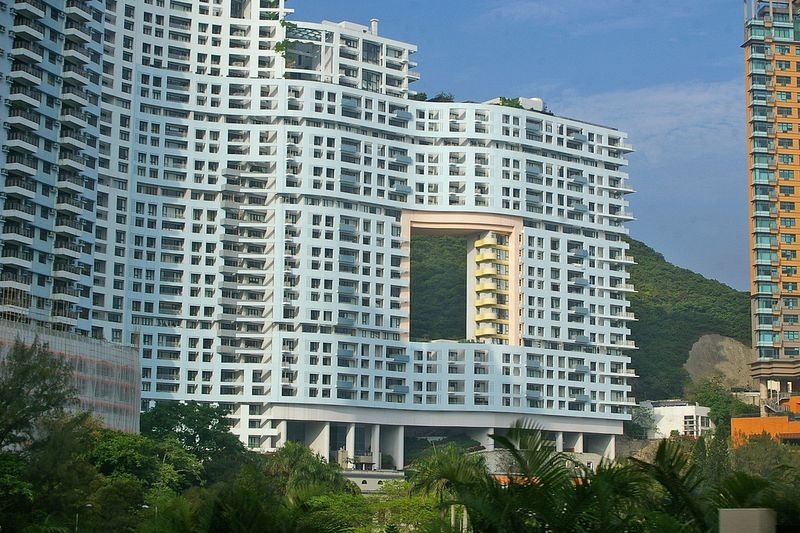
In Hong Kong, a city with one of the most beautiful skyline, the plan and design of a building is determined as much as by architects and engineers as by feng shui masters. This ancient Chinese philosophy of positioning objects and buildings in harmony with nature to bring about good fortune, is deeply rooted in Hong Kong’s culture. Everything from the orientation of a building, the shape of the building, the position of the entrance and position of furniture within are believed to influence the prosperity of a business or the homeowner. Because of this belief, feng shui practitioners are consulted in almost every new home purchase and office floor plans, and even enormous architectural and engineering projects around this island nation are dictated to a large degree by feng shui. It’s not apparent but examples of feng shui practice are almost everywhere in Hong Kong.

hong-kong-dragon-holes-2

Why do these buildings have holes in the middle? Keep reading for the answer. Photo credit: shottapaul/Flickr

Feng shui was suppressed in mainland China during the Cultural Revolution in the 1960s but has made a dramatic revival in recent years, especially in the superstitious South. Even in modern Central, where feng shui is regarded as superstition, most developers still consult feng shui experts because they figure it’s better to be safe than sorry. Indeed, many corporations set aside a portion of their annual budget for feng shui consultation. Some of the suggestions that feng shui experts offer can be as simple as repositioning the desk of the CEO or placing coins under the carpet. Others can be as expensive as demolishing and reconstructing parts of the building.

When the famous HSBC headquarters with two bronze lions sitting in front were built in the mid-1980s, the escalators were reoriented from their original straight position to an angle with the entrance to prevent evil spirits from flowing straight off the Victoria Harbor and into the office.

feng-shui-hsbc-3

The HSBC building in Hong Kong. Photo credit: Ishak J/Flickr

The Bank of China Tower, on the other hand, neglected good feng shui practices and is now considered so unlucky that it sits empty most of the year. The tower with its many sharp edges is also said to be leaking its negative energy to its surrounding businesses. The owner of the Lippo Centre, which faces one of the building’s edges, went bankrupt and had to sell the building. Similarly, the Government House, which also faces one of the angles of the Bank of China Tower, had its share of troubles.

To prevent such misfortunes from befalling HSBC, the bank had two cannon-like structures installed at the top of their building. These cannons, which are pointed towards the Bank of China building, supposedly protects HSBC from the dreaded Bank of China Tower’s negative energy by deflecting the energy back to its source.

Hong Kong’s growth in recent years has been attributed to good feng shui. Its geographical location with the mountains behind and waters in front is said to be excellent in accordance to feng shui principles. Legend holds that these mountains are home to the dragons that are said to be the bearer of positive and powerful energy. This energy blows through Hong Kong as the dragons make their way from the mountains to the sea to drink and bathe.

This explains why many buildings along the waterline have gaping holes in the middle. These holes provide the dragons an unobstructed path to the water, so that the winds of positive energy continue to flow through the city.

hong-kong-dragon-holes-1

The “dragon hole” of The Repulse Bay building in Hong Kong. Photo credit: Paul Griffin/Flickr

hong-kong-dragon-holes-3

Photo credit: See-ming Lee/Flickr

hong-kong-dragon-holes-5

Photo credit: See-ming Lee/Flickr

Sources: NY Times / Discover Hong Kong / A Passport Affair / Wall Street Journal Blog

Source…….www.amusingplanet.com

Natarajan

This date in science: Yuri Gagarin’s birthday….9th March

He was a Russian Soviet pilot and the first human to travel to space, in 1961. Later, he became one of the world’s true heroes …


“Let’s go! (Poyekhali!)” Image via ESA.

March 9, 2016. Yuri Alekseyevitch Gagarin (1934 – 1968) would have been 82 today. He became the first human ever to travel into space on April 12, 1961, flying into orbit around Earth for 89.1 minutes in Russia’s Vostok 1 spacecraft. He circled the Earth once and flew as high as 200 miles (327 km). The entire mission, from launching to landing lasted 108 minutes.

Yuri was born on a small farm west of Moscow. His father was a bricklayer, a carpenter, and a farmer. His mother was a milkmaid. He was the third in a family of four children.

During the Second World War, the Gagarin family was broken apart as two of Yuri’s older sisters were taken into labor camps by the Nazis. The Gagarins were forced out of their house, and dug a hideout in the ground, where they stayed until the end of the war. After the war, the family moved to Gziatsk.

Gagarin was inspired to become a pilot while still a teenager. When a Russian Yak fighter plane was forced to land in a field near his home, the praise those pilots received left a mark on the young Gagarin. He wanted to be like them.

He studied to become a foundryman (a foundry is a factory that melts metals in special furnaces and pours the molten metal into molds for making products). He was singled out for his skillfulness to further his studies in the Saratov Technical School.

Vostok 1 via Wikimedia Commons.

Vostok 1 via Wikimedia Commons.

There, his dream to become a pilot took root, as during his 4th and last year at Saratov, he had the chance to join a local flying club. He learned to operate a plane, and flew by himself for the first time in 1955.

That same year, he also graduated from school, and was recruited by the Soviet Army.

At the advice of his flying mentor, he joined the Soviet Air Force, and went on studying at the Orenburg School of Aviation. There, he was taught to fly MIGs.

During his studies at Orenburg, he also met his future wife, Valentina Ivanova Goryacheva, who was a nursing student at the time.

In November, 1957, when Gagarin was 23, he graduated from Orenburg with honors and married Valentina. Later, the couple had two girls, Yelena, and Galina.

In 1959, after the Russians succeeded at photographing the far side of the moon for the first time with Luna 3, many – including Yuri – felt it was about time for the first man to be sent to space. He and a few other men were accepted for cosmonaut training in 1960 after a lot of selection.

The selected candidates underwent not only physical training, but also mental and psychological training.

Gagarin was known for his good humour, perseverance, and calm.

On April 12, 1961, the Russians amazed the world by launching Vostok 3KA-3 (Vostok 1) from the Baikonur Cosmodrome with Yuri Gagarin aboard. Vostok means East in Russian.

East for sunrise, and for the rise of the Space Age.

Hear a recording of Yuri Gagarin saying “poyekhali” (“let’s go”) before the launch.

Yuri  Gagarin in Warsaw in 1961.  Image via Wikimedia Commons.

Yuri Gagarin in Warsaw in 1961. Image via Wikimedia Commons.

Gagarin on a visit to Sweden, 1964.  Image via Wikimedia Commons.

Gagarin in Sweden in 1964. Image via Wikimedia Commons.

After coming back from space, Gagarin became an international celebrity. Khrushchev awarded him with the title of Hero of the Soviet Union.

His dream had come true.

Gagarin and his wife began touring the world, where Yuri was decorated for his legendary accomplishment. It’s rumored that Gagarin didn’t handle his fame very well, however.

In 1962, he was appointed as a deputy of the Soviet Union, and he was elected to the Central Committee of the Young Communist League. But Gagarin was not entirely happy. He felt he didn’t train to fly only once. He wanted to fly more, but – according to the stories about him – those around him tried to stop him for fear of losing the great Soviet hero.

In 1963, Gagarin later became deputy training director of the Cosmonaut Training Center outside Moscow. Later, the training center was named for him.

The following year he started extensive training to become a fighter pilot. He died on March 27, 1968, at the age of 34 due to the crash of a MiG – 15UTI that he and colleague Vladimir Seryogin were flying from the Chkalovski Air Base.

Their bodies were collected near the small town of Khirzach, and were cremated. Their ashes are a part of the Kremlin Building in the Red Square, in Moscow.

Yuri's plaque at the Kremlin in Moscow, via Wikimedia Commons.

Yuri’s plaque at the Kremlin in Moscow, via Wikimedia Commons.

Bottom line: Born on March 9, 1934, Yuri Alekseyevitch Gagarin (1934 – 1968) was the first human being ever to travel into space. His historic flight took place on on April 12, 1961, when he orbited Earth for 89.1 minutes in Russia’s Vostok 1 spacecraft.

Source……www.earthsky.org

Natarajan

The Mysterious Caves of Mustang, Nepal……

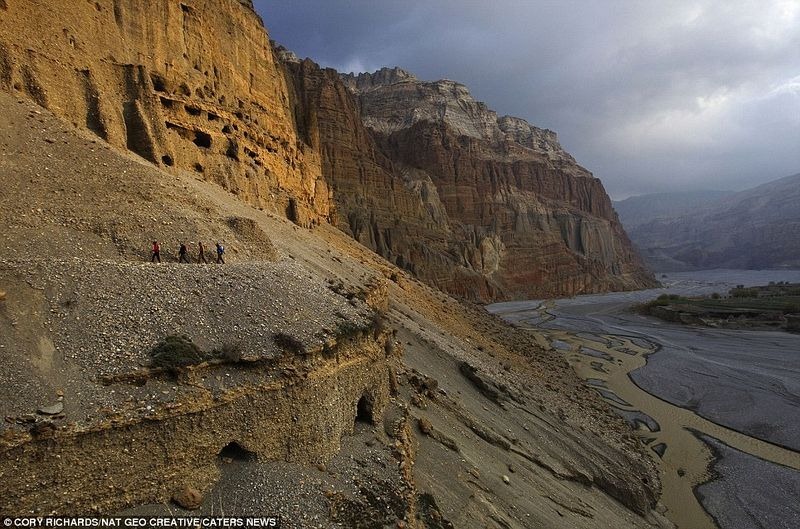
The Kingdom of Mustang, bordering the Tibetan plateau, is one of the most remote and isolated region of Nepalese Himalaya. Once an independent Buddhist kingdom, Mustang was annexed by Nepal at the end of the 18th century, but retained its status as a separate principality until the 1950’s when the area was more closely consolidated into Nepal. Because of its sensitive border location, Mustang was off-limits to foreigners until 1992. The relative isolation of the region from the outside world has helped Mustang preserve its ancient culture which is more closely tied to Tibet than to Nepal.

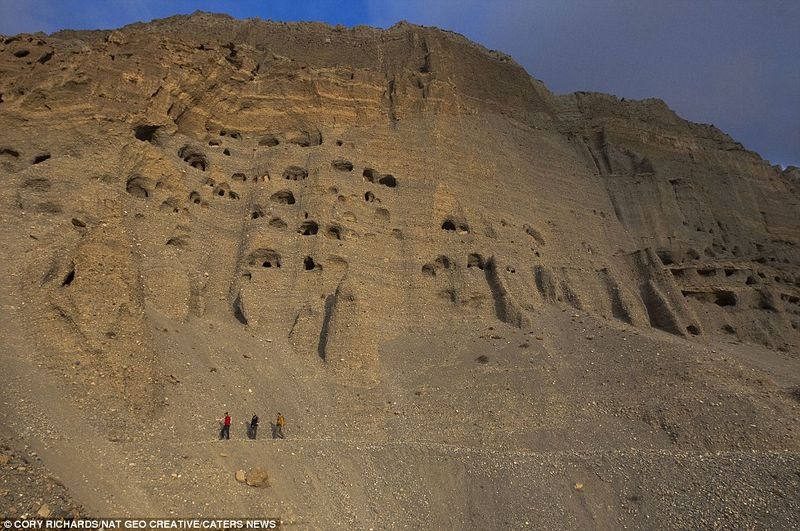
The landscape is also unlike anything that is to be found anywhere else in Nepal —deep gorges carved by the Kali Gandaki River, and strangely sculptured rock formations. The cliffs’ face are pitted with an estimated 10,000 ancient cave dwellings, some of which are perched more than 150 feet above the valley floor. No one knows who dug them, or how people even scaled the near vertical rock face to access them. Some of the caves appear almost impossible to reach even to experienced climbers.

mustang-caves-4

Photo credit: National Geographic

Most of the caves are now empty, but others show signs of domestic habitation —hearths, grain-storage bins, and sleeping spaces. Some caves were apparently used as burial chambers. The several dozen bodies that were found in these caves were all more than 2,000 years old. They lay on wooden beds and decorated with copper jewelry and glass beads.

In other caves, skeletons dating from the 3rd to the 8th centuries, before Buddhism came to Mustang, had cut marks on the bones that may have been inflicted during the practice of sky burial, where the body’s flesh is sliced into small pieces and left to be eaten by vultures. Sky burial is still practiced in many remote regions in the Himalaya.

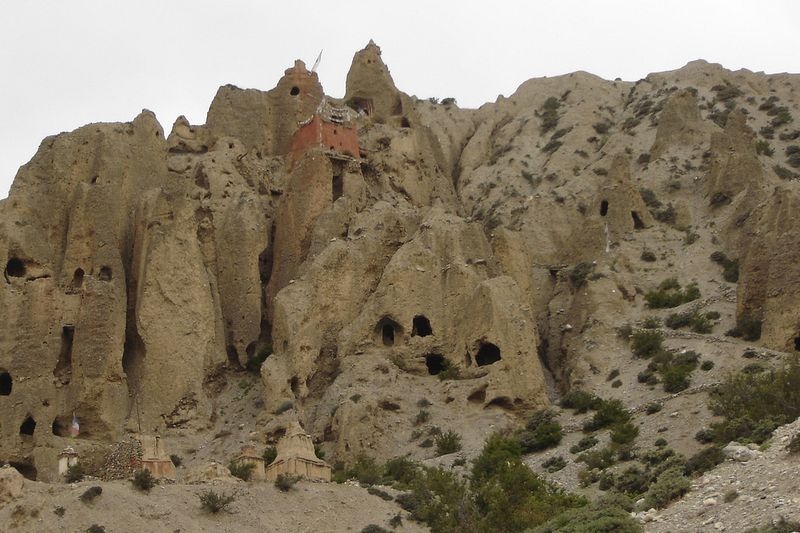
Archeologists believe that the caves in Mustang were used in three general periods. They were first used some 3,000 years ago as burial chambers. Then around 1,000 years ago, they became primarily living quarters, perhaps to escape battles and intruders into the valley. Finally, by the 1400s, most people had moved into traditional villages and the caves became places of meditation. Some of these caves were turned into monasteries such as the Luri Gompa, the Chungsi Cave monastery and the Nyiphuk Cave Monastery, all of which were built around and inside the caves.

Luri Gompa is one of the most famous in Mustang. The monastery is set on a ledge, at least a hundred meter high from the ground, in one of the many natural pillar like sandstone structures. A winding footpath climbs all the way from the bottom of the valley to a single entrance door that leads into two interconnecting chambers. The outer chamber contains a shrine, while the inner chamber —the main treasure of Luri Gompa— is beautifully decorated with a series of paintings depicting Indian Mahasiddhas — saints who were said to have achieved siddhi, or extraordinary powers by meditation. No documentation pertaining to this mysterious gompa or monastery has been found, but the wall paintings appear to be have been made in the 14th century or even earlier.

mustang-caves-1

Photo credit: National Geographic

mustang-caves-3

Photo credit: National Geographic

mustang-caves-5

Photo credit: National Geographic

mustang-caves-6

mustang-caves-7

Photo credit: nepaladvisor.com

mustang-caves-8

Photo credit: David Rengel/Washington Post

luri-gompa-2

Luri Gompa. Photo credit: Bob Witlox/Flickr

luri-gompa-3

luri-gompa-4

Frescos in the ceilings of Luri Gompa. Photo credit: library.brown.edu

Sources: Nat Geo / library.brown.edu / www.oneworldtrekking.com

Source……..www.amusingplanet.com

Natarajan

Hundreds of South Koreans Visit Ayodhya Every Year. This Is Why…!!!

The holy city of Ayodhya, in Uttar Pradesh, plays host to hundreds of South Koreans every year – who come to pay their tributes to the legendary queen Hur Hwang-ok. According to legend, queen Hur Hwang-ok, also known as Princess Suriratna, was the princess of Ayodhya before she went to South Korea and married King Kim Suro of Karak Clan in 48 AD. It is believed that she reached Korea on a boat, and was the first queen of King Suro of Geumgwan Gaya. She was 16-year-old when she got married and is considered the first queen of Gaya Kingdom.

It is because of the presence of her monument in Ayodhya that around 60 lakh people of the Karak clan consider the city as their maternal home. The memorial was first inaugurated in 2001 in Ayodhya and more than a hundred historians and government representatives, including the North Korean ambassador to India, were present during the ceremony. Seven million Koreans, representing the Kimhae Kim clan, Hur clan and Incheon Yi clan, trace their ancestry to the royal union.

In South Korea, her tomb is located in Kimhae and there is a stone pagoda in front of it. It is said that the pagoda is made of stones that she brought from Ayodhya.

Tomb of Heo Hwang-ok in Gimhae, South Korea

Tomb of Heo Hwang-ok in Gimhae, South Korea

Source: Wikimedia

Describing how she landed in Gaya when she first met the king, she said that the heavenly lord (Sange Je) appeared in her parents’ dreams and told them to send her to the Korea as the king had not found a queen yet. Legend states that the queen died at the age of 157.

During Prime Minister Narendra Modi’s visit to South Korea in May last year, the two countries agreed that a bigger monument of the princess will be built in Ayodhya. Recently, during a meeting with the Korean delegation, Uttar Pradesh CM Akhilesh Yadav said that the memorial would be constructed according to the Korean architecture. He asked Kim Ki-jae, President of Central Karak Clan Society, to provide the design of the monument so that the government can proceed.

Featured image for representation only. Source: Flickr

Source…….Tanaya Singh in http://www.the betterindia.com

Natarajan


These 11 Rare Paintings of India Were Recently Released by the New York Public Library…

The New York Public Library has digitized and released a collection of about 1,80,000 items, including pictures, manuscripts, posters, paintings, etc., and all of them are free for download and use by everyone.

From maps of Asia to amazing photographs of New York City, the collection has them all. Amongst these is a vast collection of 178 original coloured paintings of India, illustrating the trade, costumes, and culture of the country. The paintings were made between 1780 and 1858, and their digital versions look excellent. With camels and elephants, salt trade and temples – the amazing collection will take you way back in time.

Here is a look at 11 of these beautiful paintings:

india1

Hunting scene – leopard attacking one of two elephants

india10

india9

Man ploughing field with two oxen

india8

india6

Two elephants pulling an elaborate carriage, with mahouts and attendants

india7

india5

A female spinner

india4

Camel, an important mode of transportation

india3

Snake charmers

india2

Aristocrats standing on a dais with ornate rugs

Toddy gatherers in landscape with palm trees

Toddy gatherers in landscape with palm trees

All pictures: The New York Public Library
Story courtesy: Sharath Ahuja

Source……..Tanaya Singh in http://www.the betterindia.com

natarajan

” I Survived the Pan Am Hijack During Which Neerja Bhanot Lost Her Life…”

Musician Nayan Pancholi recounts how he lost his eye but survived the Pan Am flight hijack in 1986.

It was September 5, 1986. Our tickets got confirmed at the last moment on Pan-Am Flight-73, which was headed from Mumbai to New York, via Karachi and Frankfurt. We were a group of singers and music composers from Ahmedabad, who were going to perform in different cities of USA. At that time, I was just 21 years old. Our flight took off from Mumbai and landed in Karachi around 4.30 a.m. There were some passengers who got off at Karachi. Cleaners entered the aircraft and were just about the leave. This is when four armed men in airport security clothes entered the aircraft from the business class side. We were seated in economy class at the rear of the plane.

Suddenly, there were screams and three or four shots were fired in the air. One terrorist had a machine gun in his hand, another had grenades and a belt full of bullets, while the other two had many guns and grenades with them.

Everyone was told to have their hands locked above their heads. I just can’t forget that sight. Two terrorists were standing in the front and the other two were standing near the rear. In no time, Neerja Bhanot, the senior flight purser, informed the captain and the other crew members in the cockpit to flee the aircraft.

The captain, the co-pilot, and the cockpit crew had left the aircraft. Except Neerja, all other flight attendants were tied up with ropes. The terrorists used Neerja to communicate with the airline.

There were more than 350 passengers in the plane. To scare us, they even killed a person named Rakesh Kumar and threw him out of the plane.

Then, they started collecting our passports. Somehow, Neerja hid some passports of American citizens under the seats. They kept on shouting and screaming at us in Arabic and continued firing shots in the air. After some time, in the afternoon, they offered us sandwiches. But who on earth can eat food in such a difficult situation?

In the evening, they allowed everyone to go to the toilet, one after the other, by crawling on the floor with our hands locked over our heads.

I still remember, exactly after 17 hours of them hijacking the flight, the fuel ran out. Due to this, the generator of the plane went off, leading to darkness. After the lights went off, the terrorists panicked and started firing aggressively at us. They also started throwing grenades.

I saw many people die in front of my eyes.

Nayan Pancholi was just 21 years old, when the Pan Am flight was hijacked in Karachi.

Nayan Pancholi was just 21 years old when the Pan Am flight was hijacked in Karachi.

My own group director and another girl from the group were shot dead.

I was seated near the emergency exit. I tried to open the emergency exit door, but couldn’t do it. After giving it a second try, it opened, but at the same time a grenade hit me in the left eye. And in a moment, I was down on the ground.

After that, I was taken to the terminal by the army and was later shifted to the hospital. I was given treatment at a hospital in Karachi. After 48 hours, the Indian Airlines flight took all the Indians back home. I was then taken to Jaslok Hospital in Mumbai. But, my eye couldn’t be treated there. So, I was taken to Chicago in the US for treatment, but the doctors there too couldn’t save my left eye.

This incident has had a deep impact on me. It was a very bad day for humanity. That day, nobody saw religion, caste, or creed in each other. That day we saw each other as humans and wanted to help and save each other. It’s as simple as that in end.

This article has been shared via Humans of Amdavad.

About the author: Nayan Pancholi is a singer and composer based in Ahmedabad. He is one of the survivors of the Pan Am plane hijack in 1986.
Source…..www.the betterindia.com
Natarajan

The Boiling River….!!!

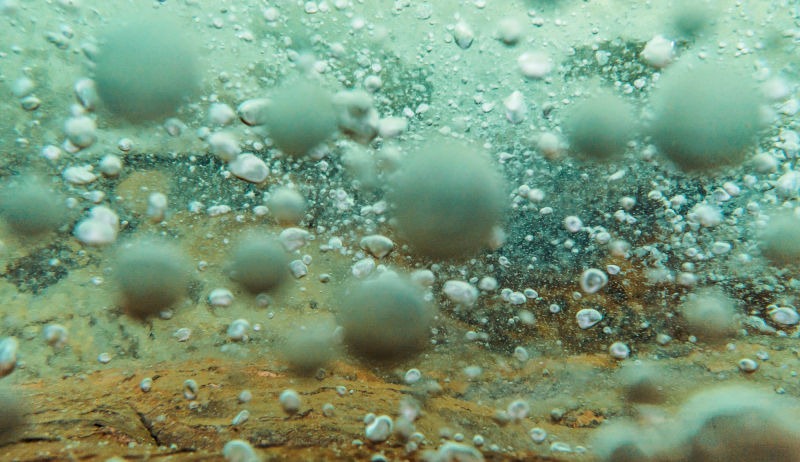
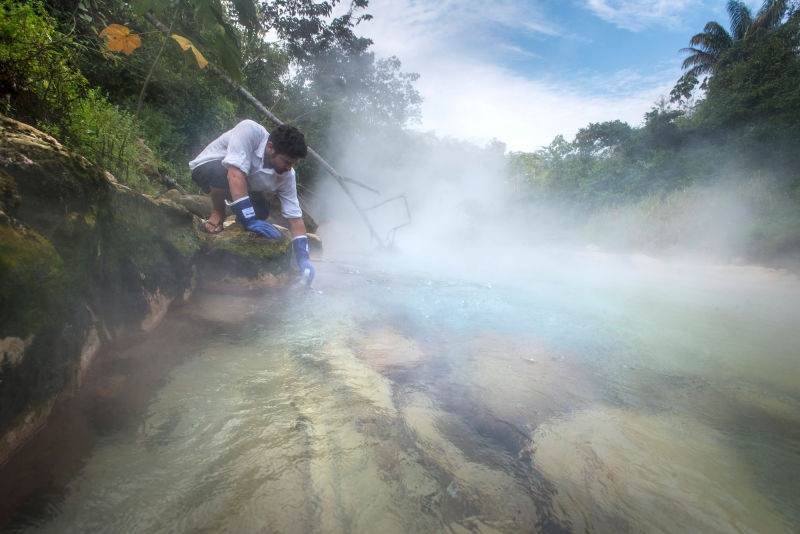
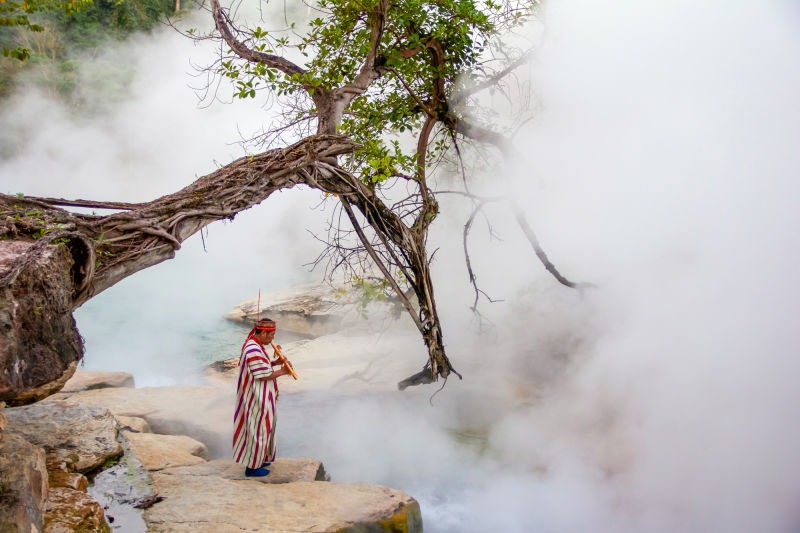
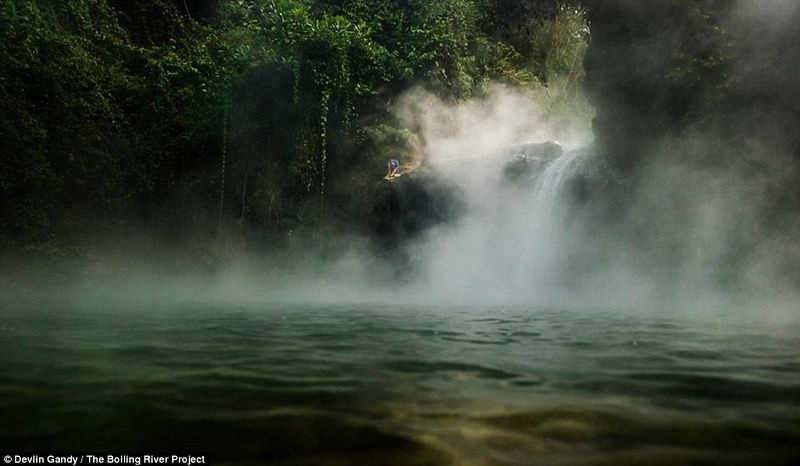
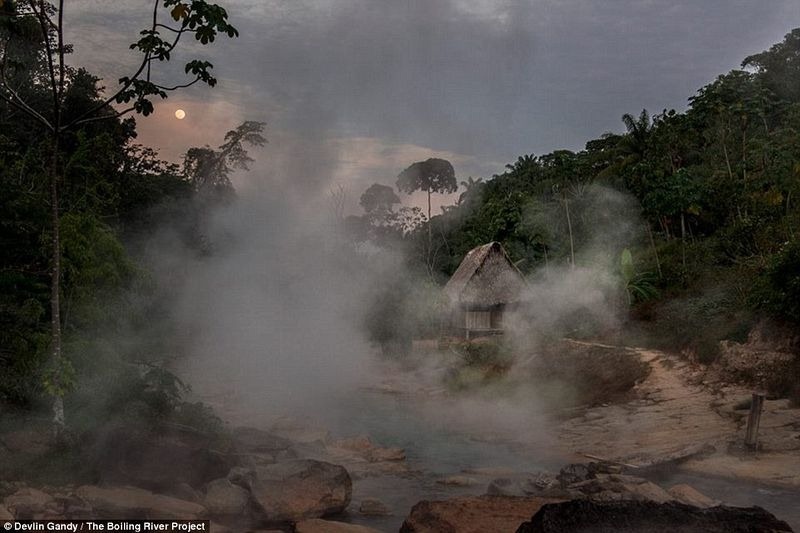
Deep in the Amazon rainforest, in Mayantuyacu, Peru, flows a river so hot its water actually boils. The locals call it “Shanay-timpishka” which loosely translates to “boiled with the heat of the sun.” They believe that the hot water is released by a giant serpent called Yacumama, “Mother of the Waters,” who is represented by a large serpent head-shaped boulder at the river’s headwaters.

The river is about 25 meters wide and 6 meters deep, but only 6.4 km long. The water temperature ranges between 50 and 90 degree centigrade, with small portions touching 100 degrees, hot enough to cause third-degree burns within seconds. Many unfortunate animals have fallen into the river and got killed. While there are documented hot springs in the Amazon, nothing is as large as Shanay-timpishka.

mayantuyacu-boiling-river-6

Photo credit: Devlin Gandy

Each year, a handful of tourists visit Mayantuyacu to experience the traditional medicinal practices of the Asháninka people. But aside from a few obscure references in petroleum journals from the 1930s, scientific documentation of the river is non-existent. Somehow, this natural wonder has managed to elude widespread notice for over seventy five years. For most Peruvians, the river is only a legend. Geologists dismissed it because they argued that it would take a tremendous amount of geothermal heat to boil even a small section of a river, and the Amazon basin lies 400 miles from the nearest active volcano.

Andrés Ruzo, a geothermal scientist at the Southern Methodist University, had no reason to believe the river exists, but the stories intrigued him. Ruzo first heard about the river from his grandfather when he was twelve years old. According to the story he was told, the river was discovered by Spanish conquistadors when they headed deep into the rainforest in search of gold. Some of the men who returned spoke about a dangerous land filled with poisoned water, man-eating snakes, starvation, disease, and a river that boils from below.

Twenty years after his grandfather told him about the river, Ruzo finally found someone who had actually seen the river —his own aunt.

Ruzo has now written a book on the phenomenon, The Boiling River: Adventure and Discovery in the Amazon. He is also conducting detailed geothermal studies of the boiling river, and collaborating with microbial ecologists to investigate the extremophile organisms living in its scalding waters. Ruzo hopes that his book will bring attention to this natural wonder and the increasing threat it has been facing from illegal loggers.

“In the middle of my PhD, I realized, this river is a natural wonder,” Ruzo said. “And it’s not going to be around unless we do something about it.”

mayantuyacu-boiling-river-5

mayantuyacu-boiling-river-4

Photo credit: Sofia Ruzo

mayantuyacu-boiling-river-1

Photo credit: Devlin Gandy

mayantuyacu-boiling-river-3

Photo credit: Devlin Gandy

Sources: Gizmodo / National Geographic via Presurfer

Source…..www.amusing planet.com

Natarajan

This date in science: John Glenn first American to orbit Earth….

On February 20, 1962, John Glenn became the first American to orbit the Earth. He made three turns around the planet before returning safely.

John Glenn and Friendship 7

February 20, 1962. John Glenn became the first American to orbit the Earth on this date. He made three turns around the planet before returning safely in his space capsule, which was called Friendship 7. He followed two Russian cosmonauts in making this early orbit of our planet: Yuri Gagarin ( April 1961) and Gherman Titov (August 1961).

While Glenn was in orbit, NASA controllers received an indication that the heat shield on his craft had come loose. They instructed Glenn not to jettison the rockets underneath the heat shield during re-entry, because the rockets might be able to hold the shield in place. Fortunately, the indication turned out to be a false alarm.

Glenn returned to space at age 77 aboard the space shuttle Discovery in 1995, making him the oldest person to fly in space. His mission’s primary scientific aim at that time was to study the effects of spaceflight on seniors.

John Glenn climbs into the Friendship 7 spacecraft just before making his first trip into space on February 20, 1962. Photo via NASA

John Glenn and Friendship 7

John Glenn and Friendship 7

Here's What John Glenn saw on February 20, 1962.  Just 5 minutes and 44 seconds after launch, Glenn offered his first words about the view from his porthole: “This is Friendship 7. Can see clear back; a big cloud pattern way back across towards the Cape. Beautiful sight.” Three hours later, at the beginning of his third orbit, Glenn photographed this panoramic view of Florida from the Georgia border (right, under clouds) to just north of Cape Canaveral. His American homeland was 162 miles (260 kilometers) below. “I have the Cape in sight down there,” he noted to mission controllers. “It looks real fine from up here. I can see the whole state of Florida just laid out like on a map. Beautiful.”  Image via NASA

Here’s what John Glenn saw on February 20, 1962. Just 5 minutes and 44 seconds after launch, Glenn offered his first words about the view from his porthole: “This is Friendship 7. Can see clear back; a big cloud pattern way back across towards the Cape. Beautiful sight.” Three hours later, at the beginning of his third orbit, Glenn photographed this panoramic view of Florida from the Georgia border (right, under clouds) to just north of Cape Canaveral. His American homeland was 162 miles (260 kilometers) below. “I have the Cape in sight down there,” he noted to mission controllers. “It looks real fine from up here. I can see the whole state of Florida just laid out like on a map. Beautiful.” Image via NASA

Bottom line: John Glenn became the first American to orbit Earth on February 20, 1962. His space capsule was called Friendship 7.

Source……www.earthsky.org

Natarajan