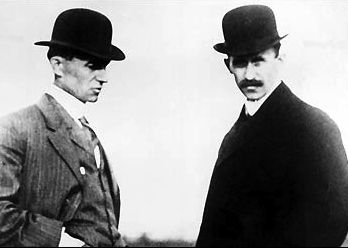
This Day in Science… Wright Brothers’ First Flight !!!

December 17, 1903. On this date, two Ohio brothers – Wilbur and Orville Wright – made the first bonafide, manned, controlled, heavier-than-air flight. It was the first airplane, and it took off at 10:35 a.m. with Orville Wright on board as pilot. He flew their vehicle, called theFlyer, for 12 seconds over 120 feet (about 37 meters) of sandy ground just outside Kitty Hawk, North Carolina.

One of the world’s most famous early photographs serves to commemorate the flight.

The Wright brothers' airplane on its first powered flight on December 17, 1903.  Via Library of Congress.

Wilbur and Orville Wright.

Two years later, the Wrights wrote in a patent application that their airplane design:

… provide[s] means for guiding the machine both vertically and horizontally … combining lightness, strength, convenience of construction, and certain other advantages.

Were the Wright brothers always destined for the skies? It’s known that their father gave them a rubber-band-powered flying toy when they were still children. The toy was made of cork and bamboo, with a paper body.

By 1899 – when Wilbur was 33 years old and Orville was 28 – the brothers were already learning everything they could about the science of aeronautics and the history of attempted human flight. Their first airplane were gliders, which they tested on the long, isolated beaches of Kitty Hawk. By 1902, they had built a glider that could be manned and controlled by a human pilot. It held a world record for gliding over 600 feet (nearly 200 meters).

Their first powered aircraft had a 40-foot (12-meter) wingspan, weighed 750 lbs, and had a 12-horsepower engine.

That first flight in December 1903 marked the beginning of a new era of global travel and relatedness.

By the way, at the time they received their patent for their airplane in 1906, several other aviators of the day claimed to have been the first to use the Wrights’ method of turning the airplane by warping or twisting the wings. But this part of the design, too, was included in the Wrights’ patent. In 2013, a story came to light about another would-be aviator, Gustave Whitehead, whose first flight supposedly beat the Wright brothers by two years. Thus far, that story has not been supported and is not accepted by aviation scholars.

Bottom line: The first airplane soared for 12 seconds over 120 feet (about 37 meters) of sandy ground just outside Kitty Hawk, North Carolina on December 17, 1903.

SOURCE:::: http://www.earthsky.org

Natarajan

” திருப்பாவை , திருவெம்பாவை தெரியுமா …” ?

திருப்பாவை- திருவெம்பாவை பத்தி தெரியுமா?”

நன்றி-சக்தி விகடன் & பால ஹனுமான்.

ஒருநாள், பிரதோஷம் மாமா மடத்துக்குச் செல்லும்போது, திருவரத ஓதுவார் என்பவரும் தெருவில் தன் பரிவாரங்கள் புடைசூழ வந்தாராம். வழிநெடுக, தேவார- திருவாசகப் பாடல்களைப் பாடிக்கொண்டும், ‘நமசிவாய வாழ்க! நாதன்தாள் வாழ்க!’ என்று கோஷம் இட்டுக்கொண்டும் ஓதுவாரும் அவருடன் வந்தவர்களும் வர, பிரதோஷம் மாமாவுக்குச் சின்னதாக ஒரு வருத்தம். அவர், ‘அருணாசல சிவ’ எனும் நாமத்தைச் சொல்லியபடியே வருவது வழக்கம். ஆனால், அன்றைக்கு ஓதுவார் பாடியதால், அவர் சொல்வது தடைப்பட்டது.

ஸ்ரீரமணரிடம் அதீத ஈடுபாடுகொண்ட பிரதோஷம் மாமா, ஸ்ரீரமணர் அருளிய ‘அருணாசல சிவ’ எனும் திருநாமத்தை, எல்லோரையும் சொல்லச் சொல்வார். அதேபோல், ஓதுவார் உட்பட அங்கிருந்தவர்களிடம், ‘அருணாசல சிவ’ என்று சொல்லும்படி வலியுறுத்தினார். அதேநேரம் மனதுள் ஒரு எண்ணம்… ‘நமசிவாயமும் அருணாசல சிவமும் வேறு யார்? மகாபெரியவாள்தானே?!’

அனைவரும் மடத்துக்கு வந்து பெரியவாளைத் தரிசித்தனர். ஓதுவார் விடைபெற்றுச் சென்ற சிறிது நேரத்தில், ‘ஓதுவார் எங்கே?’ என்று கேட்டார் காஞ்சி மகான். அங்கிருந்தவர்கள், ஓதுவார் சென்றுவிட்டதைத் தெரிவித்தனர். உடனே, பிரதோஷம் மாமாவை அழைத்துப் புத்தகம் ஒன்றைக் கொடுத்த மகாபெரியவர், ”இந்தப் புத்தகம் எந்த வருஷம் வெளியானதுன்னு ஓதுவாரைக் கேட்டுத் தெரிஞ்சுண்டு வா!” என்றார். அந்தப் புத்தகம், திருவாசகம்!

காஞ்சிபுரத்தைவிட்டு வேறெங்கும் செல்வதில்லை என்றிருந்த பிரதோஷம் மாமா,மகானின் கட்டளையை நிறைவேற்ற சென்னை செல்லவேண்டிய நிலை. சென்னையில் ஓதுவாரைத் தேட, ஒரு துணை தேவையாக இருந்தது. தன் மீது அன்பு கொண்டிருந்த அன்பர் ஒருவரை உதவிக்கு அழைக்க நினைத்தார். அன்ப ரைச் சந்திக்கும் பொருட்டு, தான் ஏற்கெனவே வேலை பார்த்த அலுவலகத்துக்குச் சென்றார்.ரிடையர்டு ஆனபிறகு இவர் அங்கு செல்வது இதுவே முதல் முறை.

மாமாவைப் பார்த்ததும், அங்கிருந்த வேறொரு நண்பர், ”ஆச்சரியமா இருக்கு சார்! கடிதம் எழுதிப்போட்டு உங்களை வரச்சொல்லணும்னு நினைச்சுட்டிருந்தேன். உங்களுக்குச் சேர வேண் டிய அரியர்ஸ் பணம் ஆயிரம் ரூபாய்க்கும் மேலே வந்திருக்கு. நீங்க இன்னிக்கு வரலேன்னா, திரும்பவும் அக்கவுன்ட்ஸ் செக்ஷனுக்கே போயிருக்கும். அப்புறம் வாங்கறது கொஞ்சம் கஷ்டம்தான்!” என்றார்.

அந்தக் காலத்தில் ஆயிரம் ரூபாய் என்பது மிகப்பெரிய தொகை. இந்தத் தொகை கிடைப்பதற்கு, மகாபெரியவா சிறிதாக விளையாடி, அருளியிருக்கிறார் எனச் சிலிர்த்தார் பிரதோஷம் மாமா.

ஆனால், இத்தோடு முடியவில்லை ஆச்சரியம்!

பிறகு, சென்னையில் அந்த ஓதுவாரைக் கண்டுபிடித்து, நூல் வெளியிடப்பட்ட விவரத்தைக் கேட்க, ‘தெரியாது’ என்று ஓதுவார் சொல்ல, வேறு சிலர் மூலமாக விவரங்களைச் சேகரித்துக்கொண்டு, மடத்துக்குச் சென்றார் பிரதோஷம் மாமா. அங்கே, இவர் கூறியதையெல்லாம் செவிமடுத்த மகாபெரியவா, திருவாசகப் புத்தகத்தை நீட்டி, ”முதல்லேருந்து சில பக்கங்களைப் படி” என்றார்.

புத்தகத்தை வாங்கிப் பிரித்ததும், ஆடிப் போனார் பிரதோஷம் மாமா. எடுத்ததும், ‘நமசிவாய வாழ்க!’ என்று துவங்கும் சிவ புராணம்தான் தென்பட்டது.

‘அருணாசல சிவனும் நமசிவாயமும் வெவ்வேறல்ல’ என்பதைப் பிரதோஷம் மாமாவுக்கு சூசகமாக உணர்த்தி விட்டார் மகாபெரியவா!

திருப்பாவை- திருவெம்பாவை பற்றிய சம்பவம் ஒன்றையும் தெரிவித்தார் அகிலா கார்த்திகேயன்.

அது 1949-ஆம் வருடம். மகாபெரியவா திருவிடை மருதூரில் இருந்தார். ஆச்சி அம்மையார் ஒருவர், தினமும் புத்தகம் ஒன்றை எடுத்து வந்து,பெரியவாளுக்கு முன்னே பாடிவிட்டுச் செல்வார். ஒருநாள் ராமமூர்த்தி என்பவரிடம், ”அந்த அம்மையார் பாடற திருப்பாவை- திருவெம்பாவை பத்தி தெரியுமா?” என்று கேட்டார் பெரியவா.

அவருக்கு ஒன்றும் தெரியவில்லை. உடனே அவரை, தேவராஜ பாகவதர் என்பவரிடம் அனுப்பி, ‘திருப்பாவை- திருவெம்பாவைப் பாடல்களை வெளியில் பாடச் சொன் னால், எல்லாரும் பாடுவார்களா?’ என்று கேட்டு வரச் சொன்னார். ராமமூர்த்தியும் பாகவதரைச் சந்தித்தார். அவரோ, ”இந்தப் பாட்டுக்கள் யாருக்குத் தெரியும்? ஒருத்தரும் பாடமாட்டாங்க” என்று சொல்லிவிட்டார்.

இதை அப்படியே வந்து மகாபெரியவாளிடம் தெரிவித் தார் ராமமூர்த்தி. உடனடியாக திருப்பாவை- திருவெம்பாவை மாநாடு நடத்துவதற்கான ஏற்பாடுகளைச் செய்தார்காஞ்சி மகான்!

மார்கழி பிறந்ததும் ராமமூர்த்தி என்பவரையும் கண்ணன் எனும் அன்பரையும் அழைத்து, கையில் விளக்கும் புத்தகமுமாக யானையின் மீது உட்கார்ந்தபடி, ஸ்ரீமகாலிங்க ஸ்வாமி திருக்கோயிலின் நான்கு வீதிகளிலும், திருப்பாவை- திருவெம்பாவை பாடல்களைப் பாடும்படி உத்தரவிட்டார். பிறகு, பெரியவாளின்ஆசியுடன், திருப்பாவை- திருவெம்பாவை மாநாடும் சிறப்புற நடைபெற்றது.

அதையடுத்து, சங்கீதக் கச்சேரிகளிலும் திருப்பாவை- திருவெம்பாவைப் பாடல்களையும் வித்வான்கள் பாடத் துவங்கினர். கி.வா.ஜ. போன்ற தமிழறிஞர்கள், இந்தப் பாடல்களை விளக்கிச் சொற்பொழிவாற்ற ஆரம்பித்தனர். அதுமட்டுமா? அப்போதைய இந்து சமய அறநிலையத் துறையின் ஆணையராக இருந்த உத்தண்டராமன் என்பவரிடம், ”மார்கழியில், எல்லாக் கோயில்களிலும் திருப்பாவை- திருவெம்பாவை மாநாடு நடத்த ஏற்பாடு செய்யுங்கள்” என்று அருளினார்மகாபெரியவா.

அதே போல், சுவாமிகளின் உத்தரவை சிரமேற்கொண்ட டி.கே.பட்டம்மாள், எம்.எல்.வசந்தகுமாரி, அரியக்குடி ராமானுஜ ஐயங்கார் போன்றவர்கள், திருப்பாவை- திருவெம்பாவை பாடல்களைப் பாடிப் பரப்பினார்கள்!

சில காலம் கழித்து, ராமமூர்த்தியிடம்… ”அந்த ஆச்சி அம்மையார் பாடின பாட்டுக்களை, யாரும் பாடமாட்டானு சொன்னேளே… இப்ப யாராவது பாடறாளா?” என்று குறுஞ் சிரிப்புடன் கேட்டார் காஞ்சிப் பெரியவா. இதில் நெக்குருகிப் போன ராமமூர்த்தி, ”பெரியவா ஈஸ்வர ஸ்வரூபம். அவா நினைச்சா நடக்காததே இல்லை” என்று சொல்லிச் சிலாகித்தாராம்.

பிறகு ஒருமுறை, தஞ்சாவூரில் யாரிடமோ பேசிக் கொண் டிருக்கும்போது, ”இப்ப திருப்பாவை- திருவெம்பாவைப் பாடல்களை, எல்லா இடத்துலயும் எல்லாரும் பாடறான்னா, அது இவனாலதான்!” என ராமமூர்த்தியைச் சுட்டிக் காட்டிச் சிரித்தாராம்பெரியவா.!

நன்றி – சக்தி விகடன்

Attachments:

1380411_805270559515167_8265340876734836171_n.jpg

SOURCE::::www.periva.proboards.com

Natarajan

Read more: http://periva.proboards.com/thread/8375/#ixzz3M4thYdDg

” Early Mona Lisa ” …Identical Twin of the One in Louvre !!!

‘Early Mona Lisa’: Unveiling the one-in-a-million identical twin to Leonardo da Vinci painting

Scientific tests suggest Da Vinci started working on the ‘Early Mona Lisa’ in 1503, ten years before the one in the Louvre

A second painting of the Mona Lisa thought to be produced a decade earlier than the one on display in the Paris Louvre has been unveiled in Singapore.

Scientific tests suggest that Leonardo da Vinci started working on the “Early Mona Lisa” in 1503, ten years before the one in the Louvre, but left it unfinished.

It was acquired by an English nobleman in 1778. But it was not until 1913 that Hugh Blaker, an art connoisseur, rediscovered the portrait. He brought the artwork back to his studio in Isleworth, south-west London, to restore it.

The work, which shows a younger woman against a different backdrop from the more familiar version, changed hands several times before it was passed to an international consortium in 2008.

The painting was presented to the media in 2012 by the Mona Lisa Foundation, which had compiled 35 years of research and tests. It published more findings the following year, leading most da Vinci scholars to believe that the second Mona Lisa is indeed the Italian’s work of art.

The painting will be on exhibit at Singapore’s Arts House until February 11 next year and is expected to reach Europe later in the year.

SOURCE:::: Kunal Dutta in http://www.independent.co.uk

Natarajan

Story of Rock Garden as Revealed by its Creator Nek Chand Who Has Turned 90 !!!…

His statues have ended up in museums around the world. AFP PHOTO/NARINDER NANU.

His statues have ended up in museums around the world. AFP PHOTO/NARINDER NANU. Source: AFP

DEEP inside his massive garden of handmade waterfalls and sculptures, Nek Chand recalls toiling away secretly in the dead of night for a staggering 18 years to create his wonderland in north India.

Riding his bicycle after dark to a state-owned forest, Chand spent night after night clearing patches of ground and transforming the landscape into a majestic garden that would eventually cover eight hectares.

Waterfalls, gardens and sculptures dot the serene environment. Source: AFP/NARINDER NANU

Waterfalls, gardens and sculptures dot the serene environment. Source: AFP/NARINDER NANU Source: AFP

“I started building this garden as a hobby” in the 1950s, Chand told AFP in a rare interview on the eve of his 90th birthday on Monday.

“For 18 years nobody came to know. There was a forest here, who would come here and what for? There were no roads to come and go,” Chand said nostalgically, seated in the garden that has become a major tourist attraction, drawing thousands of visitors a day.

Indian visitors in the Rock Garden, built by self-taught Indian artist Nek Chand Saini ov

Indian visitors in the Rock Garden, built by self-taught Indian artist Nek Chand Saini over the course of 18 years AFP/NARINDER NANU. Source: AFP

After the deadly violence and upheaval of partition in 1947, India set about building a capital for Punjab state, carved out of a region that stretched across the border into newly formed Pakistan.

From the tonnes of building materials and rubbish that followed, Chand carefully collected what he considered gems while working as a lowly roads inspector in the upcoming Chandigarh city.

Pottery pieces, glass, tiles and even broken bathroom sinks were used to make sculptures of men and women, fairies and demons, elephants, monkeys and gods.

Pottery pieces, glass, tiles and broken household items wre used to create this wonderlan

Pottery pieces, glass, tiles and broken household items wre used to create this wonderland. AFP PHOTO/NARINDER NANU Source: AFP

“I had many ideas, I was thinking all the time. I began carrying all the material on my bicycle and collecting it here,” Chand said of his garden of mosaic pathways, hidden chambers and courtyards.

“I did three to four rounds on my cycle each day. I saw beauty and art in what people said was junk.”

‘Like reliving Willy Wonka’

When his secret was finally discovered in 1976, authorities threatened demolition, claiming Chand had violated strict land laws.

But an amazed public rallied behind him, leading to his appointment as head of the newly opened Rock Garden of Chandigarh.

Chand stepped up his creation of hundreds of sculptures — mostly made from broken household material and discarded personal items including electric sockets, switches, bangles and bicycle frames.

Riding his bicycle after dark to a state-owned forest, Chand spent night after night clea

Riding his bicycle after dark to a state-owned forest, Chand spent night after night clearing patches of ground and transforming the landscape into a majestic garden AFP/NARINDER NANU. Source: AFP

Some made of broken glass bangles show girls dancing, others of ceramic pieces depict men at a party pouring glasses of whiskey.

Ticket sales grew as word of the secret garden spread, with some 3,000 people from across the country and overseas now wandering through daily.

“It’s so amazing. It’s something like reliving Willy Wonka and the Chocolate Factory,” Jasmine Paul, a resident of Vancouver who was holidaying in India, told AFP.

“It is just like the fairy tales that you grow up reading.” With no formal education in art or sculpture, Chand drew inspiration from his childhood when he played near a river flowing through his village in what is now Muslim-majority Pakistan.

Sculptures made from discarded household items. AFP PHOTO/NARINDER NANU

Sculptures made from discarded household items. AFP PHOTO/NARINDER NANU Source: AFP

Chand and his family were forced to flee across the border during partition because they were Hindus, finally settling in Chandigarh, the shared capital of Punjab and Haryana states.

“That is why there is a childlike quality to the sculptures,” said Alan Cesarno, a British volunteer with the Nek Chand Foundation that was set up in 1997 to raise funds for the garden’s upkeep.

“When you look around you realise that it is actually a child’s version of a fantasy kingdom,” he told AFP standing next to one of the several waterfalls.

Self-taught Indian artist Nek Chand Saini on the eve of his 90th birthday. AFP PHOTO/NARI

Self-taught Indian artist Nek Chand Saini on the eve of his 90th birthday. AFP PHOTO/NARINDER NANU. Source: AFP

Conservation challenges

Chand’s statues have found their way into museums across the world, including at the National Children’s Museum in Washington, the American Folk Art Museum in New York and the RIBA gallery in Liverpool in 2007.

Back home, the garden is facing conservation challenges, including a lack of funds from the state government which takes the ticket sales, according to volunteers.

Vandalism has been reported more than once and enthusiastic visitors often climb or lean on the structures, damaging their fragile pieces.

“In a country known more for slums and garbage dumps, the rock garden stands as an exceptional example,” said Mani Dhillon, a volunteer involved in the garden’s upkeep.

“It is perhaps the only place of its kind in the entire world. The administration and the people must realise its importance, they must come forward and save it before it’s too late,” she told AFP.

Magical waterfalls enchant its visitors. AFP PHOTO/NARINDER NANU

Magical waterfalls enchant its visitors. AFP PHOTO/NARINDER NANU Source: AFP

While Chand still oversees the garden as its founding head with near daily visits, his age and failing eyesight mean he can no longer spend the long hours needed to create new sculptures.

He is however undaunted by the challenges facing his more than half a century’s work, saying he has faith in God from which he draws his strength.

“I am not scared of anything. Had I been scared, how would I have worked in the dead of the night in the jungle?”

SOURCE:::: http://www.news.com.au

Natarajan

5 Things Lucky People Do …

Author Ashwin Sanghi says that it is indeed possible to ‘attract’ good luck! Here’s how!

Ashwin Sanghi is the author of four bestselling books — The Rozabal Line, Chanakya’s Chant, The Krishna Key and Private India, the last of which he co-authored with the American bestselling writer James Patterson.

Sanghi’s next book, like all his previous ones, is also a page-turner. But 13 Steps to Bloody Good Luck also happens to be his first work of non-fiction.

In it, Sanghi suggests that while some people are ‘luckier’ than others, it is also possible to ‘attract’ good luck your way.

Lady Luck, he says, isn’t all that fickle after all because we can ‘train’ ourselves to be lucky!

So what is it exactly that lucky people do?

Speaking to Rediff.com, Sanghi lists out five important things that most lucky people seem to do:

1. Lucky people grow and strengthen their network

Luck hates loneliness. It’s almost impossible to be lucky alone. A story that will illustrate this point is that of Sitar maestro Pandit Ravi Shankar.

Ravi Shankar was a music director with All India Radio (or AIR) from 1949 to 1956. VK Narayana Menon, Director of AIR, introduced Shankar to the renowned violinist Yehudi Menuhin.

Menuhin invited Shankar to perform in America.

In America, Shankar became friends with Richard Bock, founder of World Pacific Records.

Shankar executed several recordings at Bock’s studio.

The American rock band The Byrds who also used to record there heard Shankar’s music and incorporated some of his music into their tracks.

These tracks came to the attention of George Harrison of the Beatles and Harrison soon visited India to study the sitar under Ravi Shankar.

The Beatles went on to use the sitar in their ‘Norwegian Wood’ track.

Shankar’s association with The Beatles got him invited to Woodstock and made him the most famous Indian musician on the planet by 1966.

That’s called the network effect.

2. Lucky people listen to their intuition and develop it

All of us seem to have two voices inside us.

The first is intuition, our ‘inner wizard’.

It tries to tell us what we should be doing and what will be good for us.

The second voice inside us is the ‘inner critic’, which sends a steady stream of destructive thoughts directed towards us and others.

Ignoring the critic and listening to the wizard is a key trait of lucky people.

An example of intuitive good luck is the story of Conrad Hilton, the legendary founder of Hilton Hotels.

Hilton claimed that his incredible success as a hotelier was often due to his lucky hunches.

On one particular occasion, Hilton submitted a sealed bid of $165,000 to buy a rundown Chicago hotel in a sealed bid auction.

The next morning, something didn’t feel right. Acting on his intuition, he submitted another bid of $180,000.

When the bids were examined, Hilton’s was the winning bid.

The next highest offer was $179,800.

3. Lucky people are willing to try new things

The overall willingness of lucky people to try new things simply increases the number of opportunities that come their way thus increasing their good luck.

Consider the story of the great painter Henri Matisse. Matisse went to Paris to study law and started working as a court administrator in Le Cateau-Cambresis after gaining his qualification.

Following an attack of appendicitis in 1889, he underwent a period of convalescence.

His mother bought him some art supplies so that he could keep himself occupied even though Matisse had never painted in his life.

Little did his mother realise that her son would discover ‘a kind of paradise’ as he later described the experience.

He decided to become an artist, deeply disappointing his father by that decision but going on to become one of the greatest painters ever.

The good luck would simply not have kicked in without Matisse’s openness to try a new activity.

4. Lucky people make the best of bad situations, stay positive and persevere

Lucky people are simply those who use every bad situation to the best of their abilities.

The life stories of some of the ‘luckiest’ people reveal that most of them thrived under conditions of adversity.

Beethoven composed his best-known masterpieces after he became deaf while Sir Walter Raleigh wrote History of the World during his 13 years in prison.

The Discovery of India was written by Jawaharlal Nehru during his imprisonment in Ahmednagar Fort from 1942 to 1946 while Martin Luther translated the Holy Bible while confined in the Castle of Wartburg.

With a sentence of death hanging over him, Dante wrote The Divine Comedy during 20 years of exile.

5. Lucky people stay alert and informed

Most lucky people have understood that calming the mind is a key method to increase alertness.

Lucky people find their own unique ways to tame their minds.

Hence they are better able to deal with difficult or stressful situations in their lives.

Often it is this alertness that allows ‘lucky’ people to spot opportunities when they arise.

Consider the case of Ray Kroc, the person credited with creating the McDonald’s franchising system.

The brothers Richard and Maurice McDonald had established McDonald’s, a fast food restaurant.

The restaurant used Castle Multimixers to make milkshakes.

Ray Kroc supplied these machines to McDonald’s among others.

When Ray noticed that the McDonald brothers had purchased eight Multimixers in a very short period of time, he visited their San Bernardino restaurant to investigate.

Seeing their efficient operation convinced Ray that their scientific restaurant processes could be converted into a national franchising opportunity.

He quickly offered to become a franchising agent for the brothers and opened McDonald’s Inc’s very first restaurant in Des Plaines, Illinois.

He eventually bought out the company from the brothers in 1961 for $2.7 million.

Good luck for Ray Kroc?

Yes. But his good luck only happened because he was alert to a sudden spike in the sales of Castle Multimixers!

SOURCE::: http://www.rediff.com

Natarajan

” Origin of Filter Coffee … Not From India “… Surprising !!!… Read More !!!

The Heartbreaking Truth About Indian Foods That Are Not Indian at All !!!

You’ve been eating and drinking them all your life without knowing the actual origins! We bet you never knew these Indian foods are not Indian at all but are a gift of foreign influences.

1. Samosa

Samosa

Getty

That delicious samosa you always munch on as a tea-time snack or when sudden hunger-pangs hit is not Indian at all! The triangular potato/meat-filled savoury dish that is easily found on every street-corner actually has origins in the Middle East. Originally called ‘sambosa‘, the Indian samosa was actually introduced to the country sometime between the 13th and 14th century by traders of the Middle East. But whatever, we’re just happy we get to hog these yummy yummy snacks!

2. Gulab Jamuns

Gulab Jamuns

Getty

Ooh. We’re sure your mouth is already watering. The very thought of these calorie-filled dough balls, deep-fried and then soaked is enough to send anyone to food heaven. And what’s more, this dish is so versatile that you can enjoy it hot, cold or simply at room temperature. But the favourite Indian dessert originated in the Mediterranean and Persia. Though the original form of the dessert is called luqmat al qadi and made of dough balls deep fried, soaked in honey syrup and sprinkled with sugar, once it reached India, the recipe was modified. How we wish it was lunch-time already!

3. Vindaloo

Vindaloo

Getty

The very sound takes you to the beaches of Goa and a relaxed family lunch. But the very spicy meat curry is not Goan at all! Vindaloo has it’s roots in Portuguese cuisine and it has been adapted from the very famous carne de vinha d’alhos which is the Portuguese name for Vindaloo. Originally, Vindaloo was made of wine, pork and garlic and that is how it derived it’s name (vin – wine, alhos – garlic) though Indians modified it by using palm vinegar, pork/beef/chicken and multiple spices. Though the original recipe does not use potatoes, Indians modified the recipe further by using potatoes as the word “aloo” in Vindaloo means potato in Hindi. Now you know where that sudden piece of potato popped up from between those meat chunks.

4. Shukto

Shukto

Mix and Stir

This mouth-watering Bengali delicacy is another surprise which has it’s origins in Portuguese cuisine. The Portuguese influence extended all the way from Goa to Eastern Bengal or Bangladesh and the influences are visible in Bengali food even today. Shukto is prepared from Karela or Bitter Gourd which is Indian in origin but was prepared by the Portuguese in olden days. Slowly, Indian influences like multiple other vegetables and a dash of milk/sweet to cut the spice were added to the dish. Just be happy you get to savour this amazing dish today!

5. Chai

Chai

Getty

The unassuming comfort drink of almost every Indian is in no way true desi. Famous the world over as chai (Starbucks has a Chai Latte on their menu), tea has it’s origins in China. While the Chinese used it as a medicinal drink, the Britains soon discovered it and loved it’s versatile nature. Now, the British being British wanted to cut China’s monopoly in the tea market. So, they brought the humble ‘chai’ to India (by teaching cultivation techniques to the tribals in North-East India plus offering incentives to Britons who wanted to cultivate in India). And it has been a part of India ever since! In fact, it was only in the 1950s that tea became so popular. Now, don’t suddenly look down into that cup you’re sipping from while reading this!

6. Dal Bhaat

Dal Rice

Getty

Dal Bhaat or Dal-rice is a comfort food all over India. There are even variations of this food like the Khichdi which are very popular among Indians. Though dal bhaat seems like a very simple, Indian dish, it is not Indian at all. Dal bhaat is actually of Nepali origin and it was through North Indian influences that the dish entered India and spread throughout the region. We’re sure you’re going to dream of the Himalayas the next time you’re eating this simple food!

7. Rajma

Rajma

Getty

Rajma chawal has quickly spread from being a North Indian staple to being loved by most Indians. The dish which is as popular as the North Indian chole-bhature is a wholesome meal in itself. However, the preparation of Rajma or the kidney bean in Rajma chawal is not Indian. The bean was brought to India through Central Mexico and Guatemala. The initial preparation or soaking and boiling the beans and adding a few spices is adapted from Mexican recipes. Rajma is a staple in Mexican diet even today though it’s Indian variants are quite different from the Mexican preparations. The bean and recipes prepared using Rajma are famous in North India and the locals often add Indian spices and vegetables like onions and tomatoes to make it tangy. Cool, isn’t it?

8. Bandel Cheese

Bandel Cheese

Getty

This is another staple Bengali dish which has Portuguese influences. While the cheese was developed in India and has it’s origins in Eastern India, it was created by the Portuguese using their own techniques for making cheese and breads. The cheese which has developed into a wide variety today was originally available in just one variety. Over time, people experimented and created the smoked flavor of Bandel cheese. It was the fermentation techniques of the Portuguese that helped developed this cheese and in the olden days, it was made by Burmese cooks under Portuguese supervision.

9. Naan

Naan

Getty

This is one dish that is loved all over the world. A type of leavened bread, Naan is a staple of North India and is available in almost all North Indian restaurants across the country. The Americans and Europeans have recently discovered the joys of this bread and love pairing it with their chicken tikka. However, naan is not Indian but was brought to India during the Mughal era. Naan has it’s roots in Persian cuisine though the form of leavened bread is actually Iranian. The soft, melt-in-the-mouth bread is surely a favourite but trying different forms with rose-water, khus or stuffed naan might actually tingle your taste buds!

10. Jalebi

jalebi

We even have an item number associated with this delicious sweet! How can it not be Indian? But it isn’t. Jalebi is actually from the Middle East though different variations of the sweet were found across different Asian regions. Originally called zalabiya (Arabic)or the zalibiya (Persian), the dish was brought to India by Persian invaders. Today, the dessert Jalebi is famous all over the country in different forms. While North India loves their thin and crispy jalebis, the South Indian version consists of thicker and have a slightly different shape. Jaangiri and Imartee are variations of the Jalebi. Wow! So many variations of just one sweet. No wonder you thought it was Indian!

11. Filter Coffee

Filter Coffee

“What?”, you say, “How can Filter coffee not be Indian? Well, filter coffee became popular in India pretty late, in the 1950s, around the same time Chai began to get traction. Coffee was not a part of India till the 16th century when it was smuggled into the country, by Baba Budan, on his pilgrimage to Mecca. On returning, he cultivated coffee and the drink soon became popular. Indians would drink coffee without milk or sugar in place of liqueur. Filter coffee was popularised by Coffee Cess Committee when they set up their first Coffee House in then Bombay in 1936. So much information! Time for a kaapi break?

source:::: http://www.indiatimes.com

Natarajan

Strange … But True !!!

The U.S. Accidentally Dropped An Atomic Bomb On South Carolina In 1958 !!!

The Cold War is over, but there are still plenty of remnants from its troubles across the American landscape. One major reminder of this era is the crater in Mars Bluffs, South Carolina, where the Air Force accidentally dropped an atomic bomb in 1958. This site was one of the biggest military blunders of the entire Cold War. It’s a miracle that no one was killed.

Walter Gregg and his family were minding their own business on March 11, 1958. Suddenly, a giant explosion out of nowhere rocked the property and nearly destroyed their house. After Gregg accounted for his family members (none of whom were injured), he wondered what exactly happened.

Unbeknownst to Gregg, on that same spring morning, a B-47 Stratojet was flying in the skies over his property. The bomber was on its way to the U.K. to take part in a war game exercise. At that time, all bombers in the air were required to carry an atomic payload. This was because of the off-chance that nuclear war broke out while they were in the air. This particular bomber carried a Mark 6 atomic bomb, like the one pictured below.

Luckily, this particular Mark 6 bomb did not have its nuclear rod inserted. Otherwise, what happened would have been much, much worse.

As the bomber passed over Gregg’s house, a warning light went off. Something was wrong with the bomb’s docking system. Apparently, the locking pin was not engaged properly. That’s when navigator Captain Bruce Kulka went to investigate. However, while he was trying to fix the locking pin, Kulka accidentally pressed the bomb’s emergency release.

The weight of the 8,500 pound bomb forced the bay doors open. The bomb plummeted towards the woods of Mars Bluff. When the bomb landed, it left a 75-foot-wide, and 30-foot-deep crater in the forest near Gregg’s house. Here is what the impact site looks like today.

Luckily, no one died in the explosion, but it did level several buildings on Gregg’s property and damage nearby houses. Just imagine how much worse it would have been if the bomb was armed with its nuclear material.

The military paid Gregg and his family $54,000 to rebuild what was destroyed by the bomb and to keep things quiet. It was also around this time when a new rule was put in place requiring planes to make sure that their payloads were locked before take-off.

You can still see some pieces of the original bomb dropped on Mars Bluff at a local museum.

Via: Atlas Obscura

Talk about a big “oopsie.” I can’t believe the flight crew didn’t think to check if the bomb was secured properly before taking off. This could have kicked off World War III if the bomb was actually armed with its nuclear rod. What a simple mistake. Luckily, we’re all around now to laugh about it.

SOURCE::::www.viralnova.com
Natarajan


M.S. Subbulakshmi in Thiagaraja Aradhana Festival 1986…. A Video Clip


SMT.M.S.SUBBULAKSHMI—MEMORIAL DAY–11TH DECEMBER.
———————————————————————————————
,
11th December 2014 marks the tenth anniversary of the demise of
Smt.M.S.Subbulakshmi, QUEEN OF MELODY. She will live in our hearts
with her divine music. Her “Rama nannu Brovara ” comes to help you to
pay homage to her. Please also enjoy her other songs on the site.
SOURCE:::You Tube
Natarajan


The First Computer Programmer !!!

The First Computer Programmer

Ada LovelaceAda Lovelace was born on December 10, 1815 and was the  daughter of Lord Byron. She never knew her father as he had left England for good in her early years and he died when she was 9 years old.  Lovelace was initially taught mathematics, something which was not typical for women of the age, due to the fact that her mother was trying to drive out any insanity that may have come from Lord Byron.  Ada showed an aptitude for math and science and one of her later tutors, the famous mathematician and logician Augustus De Morgan, noted that her exceptional skill in mathematics might someday lead her to become “an original mathematical investigator, perhaps of first-rate eminence.”  How right he was.

Besides her other accomplishments, Lovelace was the world’s first computer programmer all the way back in 1842. How did she do this when computers as we know them wouldn’t be invented until long after her death? Well, it turns out there was one Turing Complete computer designed in the mid-19th century.

You see, there are a lot of different ways to make a computer where the way it works “under the hood”, so to speak, is very similar to modern day computers which are “Turing Complete”. If you aren’t familiar, the class of machines known as “Turing Complete”, more or less, are just machines that can produce the result of any calculation.  Or, more aptly, that the machine can be used to simulate the simplest computer such that it is able to do everything this simplest computer can do.  Since this theoretical simplest computer, a “Turing Machine”, can do anything the most complicated computer can do, then any machine that can do everything it can do can also perform any calculation a modern day computer can do, assuming we are ignoring memory sizes and the like (assuming infinite memory).

There was one such computer designed by Charles Babbage in the 1800s. Babbage set out to build a machine that was capable of doing a variety of mathematical calculations correctly every time, getting rid of the inherent errors that happen when humans do calculations by hand.  Babbage’s earliest “computers” that he designed were not Turing Complete, however.  In addition to this, his computers did not run on electricity, but rather were entirely mechanical.  Some of his designs ran on steam, while others needed to be hand cranked to turn the thousands of gears and parts.

Babbage’s first “Difference Engine”, as he called it, was made up of over 25,000 parts, and would have weighed roughly fifteen tons.  However, it was never completed in terms of constructing the machine he had designed; it was only half built.  He then came up with a second Difference Engine, which was an improvement on the uncompleted first Difference Engine, capable of returning mathematical results up to 31 digits.  He never completed building this one either; though he did complete the designs for these machines that have since been proven to work.   For instance, in 1991, his second model of the Difference Engine was constructed and was demonstrated to work by doing a series of calculations.  In 2000, the printer he designed that hooked up to the Difference Engine was constructed and was also shown to work.

After failing to build the second Difference Engine, primarily due to funding problems, Babbage began designing a much more complex machine, which he called the “Analytical Engine”.  The Analytical Engine, unlike his Difference Engines, could be programmed using punch cards, very similar to how early electrical computers were programmed (note: there is some evidence that Ada Lovelace was the one that suggested this improvement to him).  This would then allow someone to make some program with the punch cards once and be able to use this program over and over again, without having to manually do everything every time they wanted to do some operation.

This machine was also able to automatically use results of previous calculations in future calculations.  So you could simply put in a program, crank the gears and let the machine work, spitting out all the results of your program’s execution.  This and other aspects of the underlying architecture made this machine surprisingly similar in architecture to how modern day computers work.  As such, Charles Babbage is known as the “father of the computer”.

Like his early machines that were way ahead of their time, this one was simply designed, never built.  Had he built it, it would have been the first machine ever to be Turing Complete.  Thus, in terms of capabilities, again assuming infinite memory, his machine would have been able to do any calculation a modern day computer could do.

Ada Lovelace, nicknamed by Babbage “The Enchantress of Numbers”, was impressed by Babbage’s Analytical Engine design and between 1842 and 1843 she translated an article by Italian mathematician Luigi Menabrea covering the engine.  She then supplemented the article with notes of her own on the engine, with the notes being longer than the memoir itself.  In these added notes, she included the world’s first computer program that would use the machine to calculate a sequence of Bernoulli numbers and has since been shown to be a valid algorithm that would have run correctly had the Analytical Engine ever been built.

Besides this, she also was one of the first to see that this computer Babbage designed could likely someday be used to do more than just crunch numbers, such as be used for music and other non-mathematical purposes.

Ada died a mere 9 years or so after writing this program, at the very young age of 36 years old on November 27, 1852, from uterine cancer and bloodletting by her physicians.

SOURCE::: www. today i found out .com
Natarajan

‘பாரதி’ பிறந்த கதை !!!…. பாரதியார் பிறந்த நாள் …11th Dec …

பாரதி பிறந்தநாள் டிசம்பர்: 11

சுப்ரமணிய பாரதியின் அப்பா சின்னசாமி, அந்தக் காலத்திலேயே பருத்தி ஆலை வைச்சிருந்தாரு. எதிர்காலத்தில் தொழிற்பேட்டை ஒன்றை உருவாக்கும் கனவோட இருந்தாரு. மகன் வளர்ந்தவுடன் அந்தத் தொழிற்பேட்டையை கவனித்துக் கொள்வான்னு நினைச்சாரு.

சுப்ரமணியனோட அம்மா ஐந்து வயசுலேயே இறந்து போயிட்டாங்க. அதோட சுப்ரமணியனுக்குப் படிப்புல பெரிசா ஆர்வம் இல்ல. பள்ளிக்கூடம் முடிஞ்ச ஒடனே தோப்பு, தோட்டம்னு சுத்திப் பார்க்கக் கிளம்பிடுவாரு. அப்புறம் அடிக்கடி தாத்தாவோட வீட்டுக்கும் போவாரு. அவரோட தாத்தா இலக்கியம், பாட்டெல்லாம் வாசிச்சுக் காட்டுவாரு. சுப்ரமணியனுக்குத் தமிழ் இலக்கணமும், தமிழ்க் காப்பியங்களும் ரொம்பவும் பிடிச்சிருந்துச்சு.

மற்றொரு பக்கம் பாடத்தைப் படிக்காமல், வீட்டுப் பாடம் செய்யாம பள்ளிக்கூடம் போன சுப்ரமணியனுக்குத் தண்டனை வழங்கினாங்க. “எனக்கு என்ன பிடிக்கிதோ, அதை யாரும் சொல்லித் தர மாட்டாங்களா”ன்னு சுப்ரமணியன் ஏங்கினான்.

சீக்கிரத்திலேயே பார்வையற்ற ஒரு படிப்பாளியைக் கண்டுபிடிச்சு, அவர்கிட்ட கம்ப ராமாயணத்தைக் கத்துக்கிட்டான். அதுக்கப்புறம் சொந்தமாகவே சுப்ரமணியன் தமிழ் இலக்கணம் கத்துக்க ஆரம்பிச்சான்.

ஒரு நாள் சுப்ரமணியனோட நண்பன் ஒருவன் எட்டயபுரம் ராஜாவோட அரண்மனைக்கு அழைச்சுட்டுப் போனான். ஏதாவது ஒரு குறளின் முதல் வார்த்தையையோ அல்லது ஒரு வெண்பாவின் ஒரு பகுதியையோ சொன்னால், சுப்ரமணியன் உடனடியா எஞ்சிய அடிகளைச் சொன்னான். சுப்ரமணியன் நகைச்சுவையா பேசுறதையும் கவிதை சொல்றதையும் எட்டயபுரம் ராஜா ரசிச்சார்.

“இவன் ஒரு குழந்தை மேதை. பெரிய கவிஞன் ஆவதற்கான அறிவு, உங்க மகன்ட்ட இருக்கு”ன்னு சுப்ரமணியனோட அப்பாகிட்ட சொன்னார் எட்டயபுரம் ராஜா.

ஏற்கெனவே சுப்ரமணியன் செஞ்ச விஷயங்கள் பிடிக்காம இருந்த அவனோட அப்பா, தன் மகன் இப்படிக் கவிதையே கதின்னு இருந்துறக்கூடாதுன்னு நினைச்சாரு. அதனால திருநெல்வேலில ஒரு ஆங்கிலப் பள்ளிக்கு சுப்ரமணியனை படிக்க அனுப்பினார். அப்படிச் செஞ்சா எல்லாம் மாறிடும்னு அவர் நினைச்சாரு.

அங்கேயும் சுப்ரமணியனோட நகைச்சுவை உணர்வும், கவிதை எழுதுற திறனும் சக மாணவர்கள்கிட்ட பிரபலமாச்சு.

ஒரு நாள் வகுப்பறையில சுப்ரமணியன் கொஞ்சம் கண் அசந்துட்டான். சுப்ரமணியனை எழுப்பி, நடத்துன பாடத்தில இருந்து ஆசிரியர் கேள்வி கேட்டார். சுப்ரமணியனுக்கோ பதில் தெரியல. கோபமடைஞ்ச ஆசிரியர், “மேகம் மழையைப் பொழியறது போல, நீ கவிதை சொல்வேன்னு கேள்விப்பட்டேன். ஆனால், நான் கேட்ட கேள்விக்கு உன்கிட்ட பதிலே இல்லையே”ன்னு கேட்டாரு.

“மெத்தப் படித்த ஆசிரியரே, ஒரு விஷயத்தை நீங்க மறந்துட்டீங்க. மேகங்கள் மகிழ்ச்சியை வெளிப்படுத்தத்தான் மழை பொழிகின்றன. நீங்க கேள்வி கேட்கிறதால இல்ல”ன்னு பட்டென்னு பதில் சொன்னான் சுப்ரமணியன். ஆனா, இறுதிப் பரீட்சைல ஃபெயிலான அவன் ஊருக்குத் திரும்பினான்.

இதனால் வருத்தப்பட்ட அவனுடைய அப்பா, எட்டயபுரம் ராஜாவைப் பார்த்து அரசவை பணியில சுப்ரமணியனைச் சேர்த்துவிட்டார். ராஜாவோட நண்பர்கள் சிலருக்கு சுப்ரமணியனைப் பிடிக்கல. அவர்கள்ல ஒருத்தர், “நீங்க பெரிய புத்திசாலி போலத் தெரியுது. ஆனா, பரீட்சைல தோத்துப் போயிருக்கீங்களே” என்று மறைமுகமாகக் கிண்டல் செய்ய ஆரம்பிச்சாரு.

இதனால ரெண்டு பேருக்கும் இடையே வாக்குவாதம் ஏற்பட்டுச்சு. கல்வியைப் பற்றி ஒரு விவாதம் நடத்தலாம்னு முடிவாச்சு. முதல்ல எதிர்த் தரப்பு ஆள் பேசினார். அடுத்ததாகப் பேச ஆரம்பிச்ச சுப்ரமணியன், எல்லோரும் ஆச்சரியப்படுற மாதிரி அற்புதமாகப் பேசினார். அவருடைய வாதம் எதிராளியையும் வசப்படுத்துச்சு.

அந்த விவாதம் முடிஞ்சதும், ஒரு முதிர்ந்த பண்டிதர் எழுந்து சுப்ரமணியன்கிட்ட போனாரு. “நீ உன் வயசை மீறுன புத்திசாலித்தனத்தோட இருக்கிறாய். அதனால், நீ ஒரு பாரதி (அனைத்தும் அறிந்த பண்டிதர்)”ன்னு பட்டம் சூட்டினார்.

அதுக்கப்புறம் சுப்ரமணியனை, எல்லோரும் பாரதின்னே கூப்பிட ஆரம்பிச்சாங்க. உலகம் போற்றும் கவிஞரா மாறின அவர், சுப்ரமணிய பாரதியாராக ஜொலித்தார்.

SOURCE:::: http://www.tamil.the hindu.com
Natarajan