The Gift of Maria Montessori….

Maria Montessori

Maria Montessori

From a humble beginning, a great movement was born

As I write about one of the greatest educators of our times, Maria Montessori, my first question to myself is: “Why is a Waldorf teacher writing about Montessori”. Then I ask myself – why not? I think the first question comes from my conventional education and dogmatic beliefs. The second – from my unlearning over the years and becoming a free human being. To belong in one ideology or school of thought does not mean you can not see beauty in the other. So here is a Waldorf teacher from a completely different tradition, writing about Maria Montessori, not as a Montessorian but as someone deeply interested in learning how different educators used different lenses to view children and in doing so, how each one had a gift to give to them.

In early 1900, there existed in Rome a slum known as the San Lorenzo Quarter. Two buildings there housed the poorest class. During the day, the adults living at San Lorenzo would go off to work, the older children would be sent to school and the younger children between the ages of three and six began to vandalise the buildings, with no one to care for them. The governing body decided it would be less expensive to set aside one room for these kids and an adult as a caregiver than to continue to repair and repaint the whole building being damaged by these children. And, as history would have it, that caregiver was Dr. Maria Montessori. It was here in this Roman slum with those 60 children where she made discoveries that would direct her life’s work.

The news of her unprecedented success in Casa Dei Bambini or House of Children in San Lorenzo soon spread. Soon, Montessori was invited by several countries to set up centres for children. Alexander Graham Bell and Thomas Edison invited her to USA to give talks about her methods that gained immense popularity all over the world.

So what was it that was so special about her methods? Maria Montessori strongly believed that education is not what the teacher gives; education is a natural process spontaneously carried out by the human individual and is acquired not by listening to words but by experiences upon the environment. She writes about it: “Supposing I said there was a planet without schools or teachers, study was unknown, and yet the inhabitants – doing nothing but living and walking about – came to know all things, to carry in their minds the whole of learning , would you not think I was romancing? Well, just this, which seems so fanciful, is a reality. It is the child’s way of learning. This is the path he follows. He learns everything without knowing he is learning it, and in doing so passes little from the unconscious to the conscious, treading always in the paths of joy and love.’

Maria Montessori received a doctor of Medicine degree in 1896, the first woman in Italy to achieve this status. She campaigned vigorously on women’s rights. She wrote and spoke on the need for greater opportunities for women and was recognised in Italy and beyond as a leading feminist voice. It was this outspokenness and leadership in thinking that landed her in trouble. She was also vociferous about her anti-fascist views and was forced to go into exile.

And, the country that became her home in exile was India. The Theosophical Society invited her to in 1939 and she made Adyar, Chennai her home for eight years. It was here that she developed her work ‘Education for peace’. And she was nominated twice for the Nobel Peace Prize.

Today, most Montessori teachers use the materials used in Montessori classrooms – called the Didactic Apparatus, which was her discovery. But it would be a shame to reduce Montessori and her teachings to the mere apparatus. She and the children whom she crusaded for are much larger than that.

(Santhya is an educator and founder of Yellow Train) 

SOURCE:::::  Santhya Vikram in http://www.the hindu.com

Natarajan

Message For the Day…” Life Has got Greater Meaning and Deeper Significance …”

One has only a short span of life on earth. But even in this short life one can attain divine bliss, by wisely and carefully using the time. Two people, same in appearance, ostensibly of the same mould, and also grown under the same conditions, but one turns out to be an angel while the other stays on with one’s animal nature. What’s the reason for this differential development? Habits, behaviour formed out of these habits, and the character into which that behaviour has solidified. People are creatures of character. To a superficial observer, life appears to be a rotation of eating and drinking, toiling, and sleeping. But verily life has a much greater meaning, and a deeper significance. Life is a sacrifice (yajna). Each little act is an offering to the Lord. If the day is spent in deeds performed in this spirit of surrender, what else can sleep be except total immersion in the Godhead (samadhi)? 

Sathya Sai Baba

Message For the Day…” What is Immortality …” ?

We must clearly understand the meaning of ‘death’ and ‘immortality’. We regard death as synonymous with all kinds of strength in the body being lost. In other words, death is the ebbing away of the life force from the body. If the life force remains in the body forever, we regard that situation as immortality. This is incorrect. To be able to completely identify oneself with the aspect of God and completely forget the aspect of the body is true immortality. If at all times we are totally immersed only in the thought of the body and its comforts, and forget the aspect of Atma, that is death. It is only when we are able to clearly recognise the connection between birth and death that the sacred desire for securing immortality will sprout in us. There is birth and death for the body, but there is no birth or death for the Atma. To be able to understand this eternity of theAtma is the real meaning of attaining immortality.

Sathya Sai Baba

Message For the day…” Search for the faults and weakness within yourself First…”

If your minds revel in external objects and in purposeless observation and criticism of the outside world, how then can it be trained to be steadfast? Ask yourself this question: ‘Great souls (mahatmas) and sages were also people like me. If they could attain perfection, so can I if I follow their method. What profit do I get spending my time in discovering the faults and weakness of others?’ Thus the first spiritual practice (sadhana) is to search for the faults and weaknesses within yourself, and to strive to correct them and become perfect. The unceasing toil of each succeeding day has as its aim and justification this consummation: to make one’s last days sweet and pleasant. But each day also has its evening. If the day is spent in good deeds, then the evening blesses us with deep sleep, invigorating refreshing sleep, the sleep which is said to be akin to samadhi.   

Sathya Sai Baba

Message For the Day… ” One Common Divine Present in Everyone is the Basis for Brotherhood amongst all of Humanity…”

In the present Age of Kali, there is so much hatred between brothers. When there is no unity within the family, is it possible to bring about unity amidst all persons in this world? In many platform speeches, people address each other as brothers and sisters. We must ask ourselves whether such words are coming from the depths of our hearts or whether we are simply reading them from a piece of paper. If you truly mean the words ‘brothers and sisters’ from the depths of your heart, you most definitely will win the grace of the Lord and good consequences will follow. Never worry or fear that you may have to distribute your ancestral property, or share wealth with those whom you address as brothers and sisters. It is necessary and sufficient if you realise and accept that one common Divine is present in every one of you and is the basis for brotherhood amongst all of humanity. 

Sathya Sai Baba

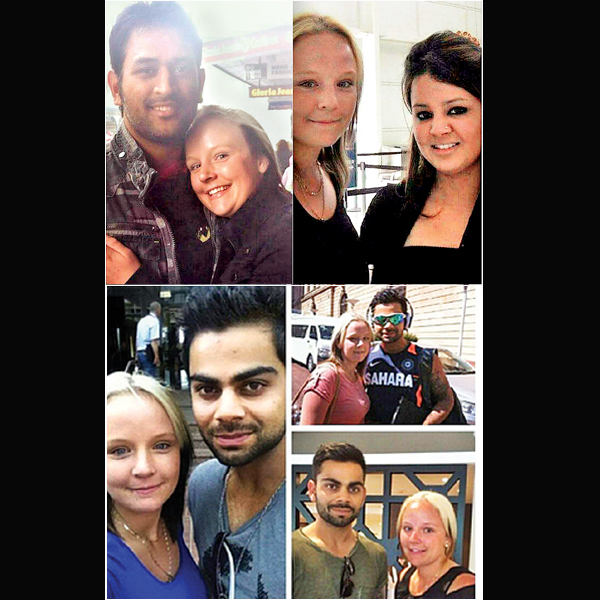
Meet Australian Lady Leanne Murray …An Ardent Fan of Dhoni and his Team …..

  • Leanne Murray with MS Dhoni, wife Sakshi and Virat Kohli Derek Abraham dna 

Management student Leanne Murray is also friends with others in team and quit job to watch the series Down Under this summer….

You don’t often see an Australian draped in an Indian flag. If you do, it must be Leanne Murray. A proud member of the ‘Swami Army’, the 23-year-old has been following MS Dhoni & Co. throughAustralia and New Zealand since 2007. Today, she is the undisputed No.1 fan of the Indian team in this part of the world. A few thousand selfies, some autographed jerseys and seamless access to the Men in Blue, she is the envy of many a supporter.

“I first saw Dhoni at a training session in Adelaide eight years ago. I had no idea who he was or how big an icon he was. I requested him for a photograph and I have not stopped ever since. I just fell in love with him that day,” she says. A 700-km drive from Adelaide, her hometown, to Melbourne for Sunday’s match is just another journey in Murray’s life. She has even traversed the Tasman Sea to watch the Indian team. “I went to New Zealand last year,” adds the management graduate.

Murray hasn’t gone to work since November. “A year ago, I told my boss that I want to attend each of the four Test matches as well as the World Cup. So I am actually on paid leave,” she gushes.

Murray doesn’t bother about the fact that Australia also have a cricket team. “I don’t really care about Australia,” she says as Dhoni & Co. go through the rigours of a four-hour-long training session at the Junction Oval. “I am not wearing my India shirt today. Otherwise, you’ll always see me in it. I don’t have an Australian shirt. And even if India were to play Australia, I’d be supporting India,” she says without batting an eyelid.

So what makes her love the Indian team so much? “It’s all because of Dhoni. He is just a calm guy and such a great leader. He is an inspiration. He just made me fall in love with the Indian team,” she says. Today, Murray counts the likes of Dhoni, Suresh Raina, R Ashwin, Mohammed Shami, Dinesh Karthik, R Vinay Kumar among her ‘friends’.

And guess what, she also plays the game. Actually, meeting the Indian players inspired me to take up the game. I didn’t know anything about cricket till 2007. About two years ago, I even enrolled myself in a cricket coaching clinic. I am a right-arm fast bowler and a left-handed batsman,” she informs. Within seconds, she rushes to her car, opens the boot and takes out a bat and a tennis ball. “Let’s play,” she says. Mind you, Murray is good at her game. A couple of journalists get a taste of her big hitting and neat bowling.

Murray has also strutted her stuff at the GM Cricket Academy in Delhi’s Najafgarh area. “I have played with the boys there. They really respect me,” she says. She knows Najafgarh is where Virender Sehwag hails from. “I have got a picture with him too. Do you want to see?” she enquires.

A casual look at her iPad confirms it’s a storehouse of collages. From Sachin Tendulkar to Virat Kohli to R Ashwin to Ravindra Jadeja, she has ‘framed’ them all. For the record, she has visited India on five occasions, including for the IPL.

Apart from Dhoni, Mohammed Shami is someone Murray admires a lot. “He is a nice bowler. In fact, he keeps giving me tips on bowling. The first thing he told me was to buy a cricket-specific pair of shoes,” she laughs. “We often talk on Skype,” she adds.

Murray has also met with Anushka Sharma and Sakshi Dhoni in New Zealand last year. “Sakshi was surprised I wanted a picture with her. But she was nice enough to pose for me,” Murray says. So did she tell her she “loves” Dhoni. “No, I didn’t. I am sure she knows of many women who do.”

SOURCE::::: http://www.dnaindia.com

Natarajan

Joke of the Day…. ‘ You are in Airplane … ‘ !!!

A pilot is flying a small single engine plane with a lot of really important execs on board into Seattle airport. There is fog so thick that visibility is 10m, and his instruments are out. He circles looking for a landmark and after an hour, he is low on fuel and his passengers are very nervous.

At last, through a small opening in the fog he sees a tall building with one guy working alone on the fifth floor.

Circling, the pilot banks and shouts through his open window: “Hi, where am I?”

The solitary office worker replies: “You’re in an airplane.”

The pilot executes a swift 275 degree turn and executes a perfect blind landing on the runway five miles away. Just as the plane stops, the engines cough and die from lack of fuel. The stunned passengers asked the pilot how he did it.

“Simple,” replies the pilot, “I asked the guy in that building a simple question. The answer he gave me was 100 percent correct but absolutely useless; therefore, that must be Microsoft’s support office, and from there, the airport is just 5 miles away on a bearing of 87 degrees!”

SOURCE:::: http://www.joke a day.com

Natarajan

Winner Airports For Airport Service Quality Awards ….

Awards recognise airports with the best passenger service

Incheon International Airport won best airport for the Asia-Pacific region and best airpo

Incheon International Airport won best airport for the Asia-Pacific region and best airport by size. Source: Getty Images

BALLOTS have been cast and the results are in. After surveying more than 550,000 passengers, the Airports Council International (ACI) has announced the winners of the 2014 Airport Service Quality (ASQ) Awards.

Reported in FlyerTalk, the trade group’s annual awards recognise the best of the best in airport passenger service, measuring 34 key service indicators.

“Airports are more than simply points of departure and arrival,” said Angela Gittens, director general of ACI World. “They are complex businesses in their own right. As such, a focus on serving the passenger has become increasingly important to ensuring success.”

Gittens noted there were many repeat airports on the list of winners, as well as many “new faces” that suggest promising changes.

Incheon International Airport in South Korea.

Incheon International Airport in South Korea won for the Asia-Pacific region. Source: Supplied

First-place winners by category are as follows:

Best Airport by Region

Africa — Sir Seewoosagur Ramgoolam International Airport (MRU)

Asia-Pacific — Incheon International Airport (ICN)

Europe — Keflavík International Airport (KEF)

Latin America-Caribbean — José Joaquín de Olmedo International Airport (GYE)

Middle East — Queen Alia International Airport (AMM)

North America — Indianapolis International Airport (IND)

Keflavík International Airport was voted the best airport in the European region. Picture

Keflavík International Airport was voted the best airport in the European region. Picture: Super Jet International. Source:Flickr

Best Airport by Size (Passengers per Year)

2 to 5 Million — José Joaquín de Olmedo International Airport (GYE)

5 to 15 Million — Haikou Meilan International Airport (HAK)

15 to 25 Million — Gimpo International Airport (GMP)

25 to 40 Million — Indira Gandhi International Airport (DEL)

Over 40 Million — Incheon International Airport (ICN)

Indira Gandhi International Airport made the cut for the best airport by size. AFP PHOTO/

Indira Gandhi International Airport made the cut for the best airport by size. AFP PHOTO/RAVEENDRAN Source: AFP

Best Small Airport (Fewer Than 2 Million Passengers) by Region

Africa — Upington Airport (UTN)

Asia-Pacific — Langkawi International Airport (LGK)

Europe — Murcia-San Javier Airport (MJV)

Latin America-Caribbean — Bachigualato Federal International Airport (CUL)

North America — Victoria International Airport (YYJ)

Victoria International Airport was the best small airport in North America. Picture: Andy

Victoria International Airport was the best small airport in North America. Picture: Andy M. Smith. Source: Flickr

Best Improvement by Region

Africa — Sir Seewoosagur Ramgoolam International Airport (MRU)

Asia-Pacific — Netaji Subhas Chandra Bose International Airport (CCU)

Europe — Pulkovo International Airport (LED)

Latin America-Caribbean — Las Américas International Airport (SDQ)

North America — San Antonio International Airport (SAT)

A new passenger terminal building of Pulkovo International Airport made it best airport b

A new passenger terminal building of Pulkovo International Airport made it best airport by improvement for the Europe region. Source: Getty Images 

SOURCE:::: news.com.au

Natarajan

Message For the Day…” Impartial Vision is Auspicious Vision …”

The lion, though crowned as the king of the forest, turns back every few steps while walking through the woods, because it is afraid of being pursued. Fear in the mind will make your vision falter. Violence within the heart distorts the vision and distracts the sight. Be vigilant! You must practice and develop impartial vision. All creation must appear equally auspicious in your eyes. You must look upon all with as much love and faith as they have in themselves, for absolutely nothing is evil in creation – no, not even an iota! Evil appears as such only through faulty vision. Creation is colored only by the nature of the glasses you wear. By itself, every creation is eternally pure and holy. Hence you must cultivate one-pointed steadfastness (ekagrata) in whatever you do. Impartial vision (sama-drishti) is auspicious vision (subha-drishti).  

Sathya Sai Baba

Interpersonal Communication Between Parents and Children…An Eye opener !!!

Phrases You Shouldn’t Say to Your Child

Raising a child puts parents in complex situations and presents them with many challenges. Nowadays there is a greater awareness of the importance of interpersonal communication within the family unit. It often feels like many of the old barriers between parents and their offspring have been torn down, especially when compared to the previous generation.

The tone parents use with their kids, as well as what they say requires ongoing sensitivity and awareness. There are times when you think that what you tell your child is exactly what they need to hear, but end up causing damage rather than encouraging them. The following are the ten most commonly used sentences parents say to their kids but shouldn’t.

Parenting

1. “Hurry up!”Your son finally learned to tie his shoelaces on his own, but it takes a very long time, your daughter is playing with her breakfast instead of eating it, and both of them are going to be late for school. Being a good parent, you want to make sure they’re not late for school, so you blurt out a “hurry up!”. Instead of getting them to speed up, you’re actually causing them stress. Soften your tone and say “let’s hurry” instead. This tells your child that you’re on the same team rather than making them feel like you’re blaming them. An even better option would be to turn it into a game (“Let’s see who finishes their breakfast fastest!”).

2. “You’re okay.”

When your child is in distress and crying, your parental instinct will tell you to reassure them by telling them that it’s okay. The only problem is, that when you tell them they’re okay, the message they get is that you are ignoring their distress. The reason your kid is crying is because they are not ok. What you should do instead is give them a hug and acknowledge their situation (“That was a scary moment”), and then ask them if they want a kiss or a Band-Aid to make it better.

Parenting

3. “Practice makes perfect.”The core of the saying is true – the more time you devote to learning a skill, the better you will become at it. However, the message your child is hearing is “what you’re doing is not perfect”. It puts pressure on your child to excel out of fear of disappointing you. Children beat themselves up feeling like they keep practicing, yet they’re still not good enough. The way to encourage your child to improve is by showing them how great improving feels, giving them a sense of pride in their own advancement.

4. “I’m on a diet.”

It’s great to stay healthy, but your kid doesn’t need to hear about it. Whether you’re checking your weight every day, calling yourself “fat” or repeating the “I’m on a diet” mantra – your child hears it, and it may lead to them developing an unhealthy body image. You can lead by example and say “I’m eating healthy because I like how it feels” or “It’s a lovely day, I think I’ll go for a run.” Using this type of phrasing will encourage your child to join you in a positive way.

5. “Great job.”

You may think that using such generic affirmation phrases helps build your child’s confidence, but research has shown that it actually makes them dependent on your affirmation instead of their own motivation. Congratulate your kid when they earned it and be more specific (“You were really good at sharing today” or “Nice pass, I like how you looked for your teammates”).

Parenting

6. “Let me help.”How many times have you seen your kid struggling with a task or a game and rushed to their aid? Even though the intention is good, doing it too soon can undermine your child’s independence and cause them to always look at others for answers. Your best way to help them is to ask guiding questions such as “Do you think that piece should go there? Why do you think that? Okay, let’s try it.”

7. “We can’t afford that.”

Every parent had to endure their child begging for something at the store, and often the easiest way out is to state money trouble. The only problem is that your child interprets that as you not being responsible, or that the family unit is in financial danger, which leads to stress. It will also cause anger if you then buy something expensive for the house, making them feel like their needs are unimportant to you. You can tell them that you won’t buy them the toy or candy that they want because you’re “saving money for more important things”. If your child persists in the matter, it can be a great doorway into a conversation about finance and saving.

8. “No dessert until you finish your meal.”

This phrase teaches the kid the value of the dessert rather than the meal. It makes the child want the dessert more and feel like the meal is nothing but an obstruction. The correct phrasing is similar but subtly different: “First we eat our meal, then we eat the dessert”. It may sound the same, but it doesn’t make the meal feel like punishment, but rather like a natural step.

Parenting
9. “Don’t talk to strangers.”While this is sound advice, it’s difficult for a young child to understand. Children associate “stranger” with a scary or unpleasant person, and might be encouraged to talk to someone who is nice to them. You may also drive your kid away from policemen and other civil servants they don’t know who may be able to help them. Add to that the fact that many child abductions occur by someone the child has previously known, and you have a rule of thumb that isn’t effective. The correct way to protect them, is to ask them “What do you do if a person you don’t know offers you candy and a ride home?” and let them explain to you the proper course of action and correct them if needed. It is also recommended to repeat this safety mantra: “If anyone makes you feel scared, confused, or sad, you need to tell me straight away.”

10. “Be careful.”

Using this phrase when you see your child doing something potentially dangerous can distract them and actively cause an accident. The correct course of action is to move quietly and calmly closer to them while keeping an eye on what they’re doing.

Parenting

H/T: parents.com  SOURCE:::: http://www.ba-bamail.com

Natarajan