Places Where Three Time Zones Meet……..

When Italian mathematician Quirico Filopanti first sounded the idea of time zones in his book Miranda! published in 1858, he proposed that the world be divided longitudinally into 24 equal time zones, where each zone differs from the last by one hour. But the real world is rarely that simple. Influenced by political, geographical and social changes, the world adopted a much more complicated system where time zones differed by three-quarter, half and even quarter of an hour. Today there are as many as 40 different time zones.

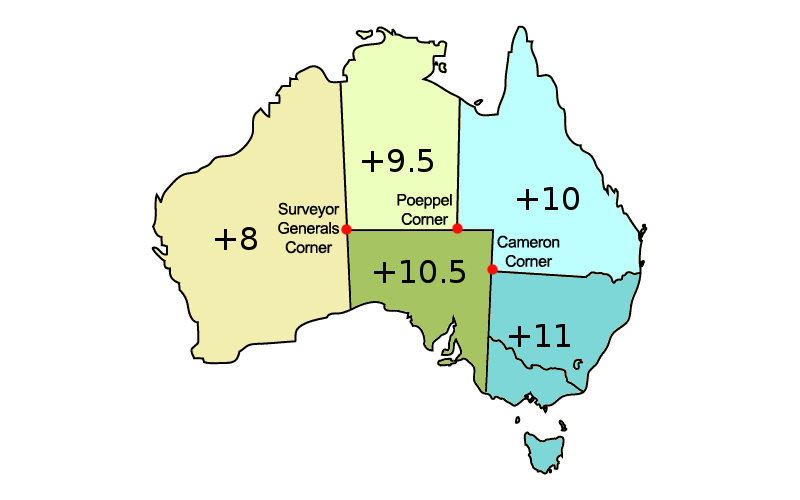
With so many different time zones around it’s imperative that some of them would meet at more than one point. There are exactly twenty-two places, according to various sources, where more than three time zones meet. Some of them are obvious, such as tri-point boundaries between nations observing different time zones. The strangest ones are located in Australia because the way the country’s different states follow time.
 

australia-tri-points

The time zones of Australia and the three state corners where three time zones meet.

Australia has three time zones, but from spring until autumn when New South Wales and South Australia adjust their clocks for daylight-savings, two additional time zones appear that horizontally break up the country’s two easternmost time zones into four. These time zones, which differ from each other by 30-minutes, meet at three different places. The most popular of them is Cameron Corner in the outback of eastern Australia, where the boundaries of states of Queensland, South Australia, and New South Wales meet. The other ones are Poeppel Corner (located at the corner of Queensland, South Australia and the Northern Territory) and Surveyor Generals Corner (located at the corner of South Australia, Western Australia and the Northern Territory). Standing at any one these locations allows any person to be at three different points of time at the same time. To take advantage of this anomaly, more than a thousand people descended on the tiny settlement of Cameron Corner on December 31, 1999, so they could celebrate the arrival of the new millennium three separate times.

cameron-corner-1

Marker at Cameron Corner. Photo credit: Kris H/Flickr


cameron-corner-2

Marker at Cameron Corner. Photo credit: Geoffrey Rhodes/Flickr


poeppel-corner

Marker at Poeppel Corner. Photo credit: Mark161/Panoramio

surveyor-generals-corner

Marker at Surveyor Generals Corner. Photo credit: jeza1/Panoramio

Another interesting place where a bunch of time zones meet is Antarctica. Being located on the South Pole, where every line of longitude meet, you might be tempted to think that all time zones meet here, but this is not the case, as time zones rarely adhere to geographical divisions. Because of the extreme day-night cycles near the times of the June and December solstices in Antarctica it is difficult to determine which time zone would be appropriate. Instead, researchers working on various stations in the Antarctic Circle observe time zones of the country the station is owned by, or the time zone of their supply base. For example, McMurdo Station and Amundsen–Scott South Pole Station use New Zealand time due to their main supply base being Christchurch, New Zealand. Many areas —those labeled in red in the map below— have no time zone at all, and follow Universal Time, by default.

antarctica-time-zones

Photo credit: Phoenix B 1of3/Wikimedia

Sources: CN Traveler / iO9

Story credit….www.amusingplanet.com
Natarajan

The Floating Forest of Homebush Bay, Sydney….

The affluent suburb of Homebush Bay on the south bank of the Parramatta River, in the inner west of Sydney, was once the dumping ground for a large range of industrial wastes including a few decommissioned ships. Private companies would pay a monthly fee to the Maritime Services Board, and tow in vessels that had outlived their useful lives in order to break them up to salvage steel and parts that could be reused. Ship-breaking operations began in 1966, but ended prematurely before all the ships moored in the bay could be broken down. At least four ships’ hull and the remains of several barges and smaller vessels are still visible in Homebush Bay. These are protected under the historic Shipwrecks Act, 1976 which applies to all shipwrecks over seventy five years old. One of the most photogenic shipwreck in Homebush Bay is that of SS Ayrfield.

ss-ayrfield-homebush-bay-4

Photo credit: Rodney Campbell/Flickr

SS Aryfield began its life as SS Corrimal at Grangemouth Dockyard Company, United Kingdom in 1911. It was a steel-hulled, single screw, steam collier of 1,140 tons and 70 meters in length. SS Corrimal was purchased by the Commonwealth Government and used to transport supplies to American troops stationed in the Pacific region during WWII. In 1950, it was sold to Bitumen and Oil Refineries Australia Pty Ltd and in 1951 sold to the Miller Steamship Company Ltd and renamed Ayrfield. The ship was decommissioned in 1972, and sent to Homebush Bay for breaking-up.

The shipbreaking yard ceased operation before SS Aryfield could be torn apart. Now abandoned and lying in the shallow waters of Homebush Bay, the ship has become home to a lush green, miniature floating forest.

ss-ayrfield-homebush-bay-1

Photo credit: Brent Pearson/Flickr

ss-ayrfield-homebush-bay-2

Photo credit: Rodney Campbell/Flickr

ss-ayrfield-homebush-bay-3

Photo credit: Steve Dorman/Flickr

ss-ayrfield-homebush-bay-5

Photo credit: Gafa Kassim/Flickr

ss-ayrfield-homebush-bay-7

Photo credit: Tina Reynolds/Flickr

ss-ayrfield-homebush-bay-8

Photo credit: Travis Chau/Flickr

Sources: Afloat.com / Wikipedia

Source….www.amusingplanet.com

Natarajan

Moon expense claims, MacGyver moments and other interesting Buzz Aldrin facts…

Former NASA astronaut Buzz Aldrin is pretty clear with about his thoughts on travel to Mars.

AMERICAN astronaut Buzz Aldrin is best remembered for being the second man to set foot onto the surface of the moon during NASA’s Apollo 11 mission.

However, there is much more to the famed astronaut than meets the eye.

Here are 10 facts about 85-year-old that might surprise you.

1. BORN TO WALK ON THE MOON

Buzz’s parents were Edwin Eugene Aldrin Sr and Marion Aldrin.

Nothing seems out of the ordinary here until you discover the mother of the man selected for the Apollo 11 mission was actually born Marion Moon.

So that means Buzz’s career choice was either destiny or a very big coincidence.

2. HIS OWN FIRST ON THE MOON

He may not have been the first man to set foot on the moon, but Buzz Aldrin does hold the dubious honour of being the first man to urinate there.

While making his way down the lander’s ladder, nature came calling and Buzz was forced to perform a lunar leak into a special bag in his space suit.

3. EXPENSE CLAIM

For many, being able to set foot on the moon would be a prestigious honour, but for Buzz it wasn’t enough.

Once returning to Earth, he submitted an expense claim for the Apollo 11 mission, which asked to be reimbursed $AU46.33.

The claim was very accurate in its depiction of “points of travel” with Buzz detailing his travels from Houston to Cape Kennedy to the moon to the Pacific Ocean to Hawaii and then back to Houston.

As the documents show “government meals and quarters” were provided throughout the July 1969 mission, Buzz did not place a claim for those.

However, he did claim for the use of a car for travel between airports on his way to the launch at Cape Kennedy.

The claim was paid by NASA.

4. COOL AS A CUCUMBER

After exploring the surface of the moon, Neil Armstrong and Buzz Aldrin made their way back into the lander so they could start their return journey to Earth.

However, once inside, Buzz discovered a broken circuit breaker lying on the floor of the module.

Following a brief search, it was discovered the circuit breaker was from the ascent engine — a vital component required to lift the lander off the moon.

After phoning mission control for advice, the astronauts were to told they would have to wait overnight for a solution.

So with the possibility of an indefinite stay on the moon surface looming, Buzz did something strange.

He spread out on the floor of the landing module and went to sleep, obviously completely unfazed by the hiccup.

5. MOVE OVER MACGYVER

The following morning, Buzz was told getting the breaker pushed back in was the only solution to getting the lander back into space.

With the component being electrical and his fingers being too large to do the job, Buzz began searching for a tool to use.

The solution came in the form a felt-tipped pen he had in the shoulder pocket of his space suit.

After successfully pushing the circuit breaker in with his pen, the lander was ready for takeoff.

Even more impressive was the fact Buzz still has the very same pen sitting in his home.

6. CUSTOMS DECLARATION

If you think being on the first mission to the moon excludes you from filing those pesky customs declarations, you are sadly mistaken.

Upon returning to Earth, all of the astronauts on board Apollo completed and signed customs forms declaring they were brining “Moon rock and Moon Dust” back.

7. BECOMING BUZZ

Buzz Aldrin was born Edwin Eugene Aldrin Jr on January 20, 1930 in Montclair, New Jersey.

However, his family wasn’t all that keen on the name and ended up nicknaming him Buzz.

The nickname evolved from his younger sister who struggle to pronounce “brother” and would often say “buzzer”.

He legally changed his name in 1988.

8. FLYING HIGH

Long before he was an intergalactic traveller, Buzz had an interest in flying.

This saw him being a test pilot for US Navy and also serving a stint as a fighter pilot.

While on combat missions in Korea, Buzz earned the Distinguished Flying Cross medal for destroying two MIG’s and damaging another.

9. THOSE BLACK MARKS

There is iconic picture of Buzz Aldrin standing on the moon, but closer inspection shows there are two mysterious black marks on the front of his spacesuit.

These are the result of Buzz’s failed attempt to reboard the lander on the surface of the moon.

When trying to jump up to the lander, Buzz didn’t provide enough force and collected his shins on the button rung of a ladder.

Buzz Aldrin has a completely white suit, except for the marks on his shins.

Buzz Aldrin has a completely white suit, except for the marks on his shins.Source:News Corp Australia

10. ALL YOU NEED IS A PUNCH IN THE FACE

There are many conspiracy theories floating around questioning the legitimacy of the moon landing.

It is fine to speculate, just don’t approach Buzz Aldrin with your suspicions because if you call him a fraud, he might just punch you in the face.

Matthew Dunn news.com.au

Source….www.news.com.au

Natarajan

Australia’s Taronga Zoo has one of the rarest monkeys in the world…..

Taronga Zoo is celebrating the newest addition to its family with the birth of an orange Francois’ Langur — one of the rarest monkeys in the world.

The baby monkey, named “Nangua” after the Mandarin word for pumpkin, was born earlier in the month.

While young Francois’ Langurs are born with bright orange hair, as they get older it turns black.

According to senior primate keeper, Jane Marshall, the mother, Meili, and the other females have been closely protecting the baby.

“Noel (another female in the group) has taken on the role of allomother, carrying the baby about 50% of the time,” said Marshall.

Baby monkey 3

This gives mum a break to eat and rest, but as soon as the baby whimpers she races straight back over to him.”

Nangua is Meili’s second baby at Taronga, following the birth of Tam Dao in 2011. The father, Bobo, was brought to Sydney from Beijing Zoo in 2010, as part of the international breeding program for the endangered species.

Here are the photos.

“Meili has shown her calmness and experience since the birth, cradling and protecting the baby,” said Marshall.

“Meili has shown her calmness and experience since the birth, cradling and protecting the baby,” said Marshall.

Nangua has begun to explore his exhibit on Taronga’s Rainforest Trail to the delight of keen-eyed visitors.

Nangua has begun to explore his exhibit on Taronga’s Rainforest Trail to the delight of keen-eyed visitors.

“He’s still quite wobbly on his legs, but his head control is very strong and he’s gripping and climbing well,” said Marshall.

“He’s still quite wobbly on his legs, but his head control is very strong and he’s gripping and climbing well,” said Marshall.

The adults are starting to let him climb off them briefly, which shows they’re happy with his progress.”

The adults are starting to let him climb off them briefly, which shows they’re happy with his progress.”

Photo Credit….Taronga Zoo…Facebook

Source……..

http://www.businessinsider.com

Natarajan

வானவில் பெண்கள்: இயற்கை வழியில் செல்லும் பேராசிரியர்….

விஜயலட்சுமி, படம்: கண்ணன்

விஜயலட்சுமி, படம்: கண்ணன்

இப்போது மக்களிடம் சுற்றுச்சூழல் குறித்த விழிப்புணர்வு ஓரளவு ஏற்படத் தொடங்கியிருக்கிறது. ஆனால் ரசாயன உரங்களின் பாதிப்பு குறித்தும் பற்றியும் நம் பாரம்பரிய விவசாய முறைகளைக் குறித்தும் மக்கள் ஆர்வம் காட்டாத எண்பதுகளிலேயே மண்புழு வளர்ப்பில் ஈடுபடத் தொடங்கியவர் பேராசிரியர் ஜி.எஸ்.விஜயலட்சுமி. தென்னிந்தியாவில் மண்புழு வளர்ப்பு தொடர்பான விழிப்புணர்வை அடிமட்டம்வரை எடுத்துச்சென்றவர்களில் முதன்மையானவர். குறிப்பாக, திருநெல்வேலி மாவட்டத்தில் மட்டும் சுமார் 49 மண்புழு வளர்ப்பு தொட்டிகளை அமைத்திருக்கிறார். தமிழக அரசின் பசுமைப் படை சார்பாகக் கழிவு மேலாண்மையை முக்கியக் கடமையாக எடுத்துச் செயல்படுத்தி வருகிறார்; திருநெல்வேலி மாவட்டத்தில் சுமார் 10 ஆயிரம் மரங்களுக்கு மேல் நட்டிருக்கிறார். கடல்வாழ் உயிரினப் படிப்பில் இந்தியாவில் முதன்முதலில் முனைவர் பட்டம் பெற்றவர். ஆஸ்திரேலியாவில் 1981-ல் நடைபெற்ற உலகச் சுற்றுச்சூழல் மாநாட்டில் அவர் அளித்த ஆய்வுக் கட்டுரைக்காக அப்போதைய இந்தியப் பிரதமர் இந்திரா காந்தி அவரைப் பாராட்டிக் கடிதம் எழுதியிருக்கிறார். 1975-ல் திருநெல்வேலி மாவட்டம் குற்றாலம் பராசக்தி கல்லூரியில் ஆசிரியர் பணிக்குச் சேர்ந்த அவர் அன்று முதல் இன்றுவரை காளான் வளர்ப்பு, மீன் வளர்ப்பு, மண்புழு வளர்ப்பு, மரம் நடுதல் எனச் சுற்றுச்சூழல் சார்ந்த பல செயல்பாடுகளில் தொடர்ந்து ஈடுபட்டுவருகிறார்.

பணி நிறைவு பெற்றுவிட்ட பிறகும் விஜயலட்சுமி ஓய்வாக அமரவில்லை. இப்போதும் அதே சுறுசுறுப்புடன் செயல்பட்டுவருகிறார். “பராசக்தி கல்லூரியில் கிடைத்த ஊக்கத்தால் கழிவுப் பொருள்கள் உதவியுடன் காளான் வளர்ப்பு, மீன் வளர்ப்பு போன்றவற்றில் ஈடுபட்டேன்” என்று சொல்லும் அவர், 1962-லேயே இந்தியாவிலேயே முதன்முறையாகக் கல்லூரி அளவில் பராசக்தி கல்லூரியில் சாண எரிவாயு அமைப்பு நிறுவப்பட்டிருந்ததைப் பெருமையுடன் குறிப்பிடுகிறார். அப்போது அமைத்த சாண எரிவாயு அமைப்பு இன்றுவரை தொடர்ந்து செயல்பட்டுக்கொண்டிருக்கிறது என்பதை ஒரு குழந்தையின் குதூகலத்துடன் தெரிவிக்கிறார்.

பராசக்தி கல்லூரியில் சாண எரிவாயு அமைப்பிலிருந்து கிடைத்த கழிவுப் பொருள்கள் மூலம் மீன் வளர்த்திருக்கிறார். சாதாரண நீரில் மீன் வளர்ப்பதைவிட இந்தக் கழிவுப் பொருள் நீரில் மீன் வளர்ப்பதால் பத்துப் பதினைந்து நாட்களுக்குள் மீன் உணவான மிதவை உயிரிகள் மிகவும் விரைவாக உற்பத்தியாகிவிடும் என்கிறார் பேராசிரியர் விஜயலட்சுமி. மீன் வளர்ப்பில் கிடைத்த உற்சாகத்தால் கழிவு நீரில் காளான் வளர்க்கத் தொடங்கியதாகவும் தெரிவிக்கிறார் அவர்.

“செயற்கையாகக் காளான் வளர்க்கலாம் என்னும் உத்தி இப்போது நன்கு பரவி திருநெல்வேலி மாவட்டம் முழுவதுமே இந்தக் காளான் வளர்ப்பு பலன் தரத் தொடங்கியிருக்கிறது” என்கிறார் விஜயலட்சுமி. தென்காசி அருகே இருக்கும் வல்லம் கிராமத்தை அதற்கு உதாரணமாகக் குறிப்பிடுகிறார்.

1980-ல் மதுரை விவசாயப் பல்கலைக்கழகத்தில் ஒரு கருத்தரங்கில் கலந்துகொண்டபோது, அவர் சந்தித்த பல்கலைக்கழக டீன் கிருஷ்ணமூர்த்தி என்பவர்தான் காளான் வளர்ப்பில் கிடைக்கும் வைக்கோல் கழிவிலிருந்து மண்புழுவை வளர்க்கலாம் என்ற திட்டத்தைச் சொல்லியிருக்கிறார். அதுதான் பேராசிரியர் விஜயலட்சுமிக்கு உந்துதலாக இருந்துள்ளது. ‘மண் புழு மண்ணிலேயே இருக்கிறதே அதை ஏன் செயற்கையாக வளர்க்க வேண்டும்?’ என விஜயலட்சுமி கேட்டிருக்கிறார். அதற்குப் பதிலளித்த கிருஷ்ணமூர்த்தி, ‘நீங்கள் நினைப்பது போல் அல்ல, இப்போதெல்லாம் மண்ணைத் தோண்டினால் மண்தான் வரும், மண்புழு வராது’ என்று சொல்லியிருக்கிறார். அந்தப் பதில்தான் மண்புழு வளர்ப்பை நோக்கி விஜயலட்சுமியைத் திருப்பியது. மண்புழு வளர்ப்பு தொடர்பாக பெங்களூர் விவசாயக் கல்லூரியில் பணியாற்றிய முனைவர் ராதா அவருக்குத் தேவையான ஆலோசனைகளை வழங்கியுள்ளார். இயற்கையான எல்லாக் கழிவுகளிலும் மண்புழுவை வளர்க்கலாம் என முனைவர் ராதா தெரிவித்துள்ளார்.

“இந்திய மண்புழு, ஆப்பிரிக்க மண்புழு, சீன மண்புழு ஆகிய மூன்று வகைகளை நான் வளர்த்திருக்கிறேன். சீன மண்புழுவையும், ஆப்பிரிக்க மண்புழுவையும் வளர்க்க மண்ணே தேவையில்லை, வெறும் இலையிலும் கழிவுகளிலுமே அவை வளரும்” என்கிறார் பேராசிரியர் விஜயலட்சுமி. மேலும், “சீன மண்புழு ஒன்றரை அங்குலம் நீளமே இருக்கும். எனவே அதிக இடம்கூடத் தேவையில்லை. இலை, தழைகளை மட்டுமே அவை சாப்பிடும். தினசரி சாணிப்பால் மட்டும் தெளிக்க வேண்டும். நாற்பத்தி ஐந்து நாட்களில் உரம் தயாராகிவிடும்” என்கிறார் அவர்.

இப்போதும் குற்றாலம் அருகே இருக்கும் தனது வீட்டின் அருகே செயல் விளக்கம் செய்து காட்டுவதற்காக மண்புழு உரக் கூடம் ஒன்றை நடத்திவருகிறார். இவரது செயல் விளக்கப் பயிற்சியின் மூலம் சிறு சிறு தொழிற்சாலைகளில் தங்களுக்குக் கிடைக்கும் கழிவுப் பொருளிலிருந்து மண்புழு உரம் தயாரிக்கத் தொடங்கியிருக்கிறார்கள். கல்லூரி மாணவிகளுக்கு மண்புழு வளர்ப்பு தொடர்பான ஆலோசனைகளையும் அறிவுரைகளையும் வழங்கிவருகிறார்.

“மண்புழு உரம், மற்ற உரங்களைவிட சிறப்பானது. தீங்கிழைக்கக்கூடிய பாக்டீரியாக்கள் மண்புழு உரத்தை நெருங்காது. ஒரு ஏக்கருக்கு இரண்டு டன் மண்புழு உரம் போதுமானது. இதனுடன் மேல் உரம், அடி உரம் போட்டால் போதும்” என்று சொல்லும் விஜயலட்சுமி, மண்புழு உரத் தயாரிப்பை லாப நோக்கில் செயல்படுத்தக் கூடாது என்பதையும் வலியுறுத்துகிறார்.

Source……ரிஷி…. http://www.tamil.thehindu.com
Natarajan

Fun-loving Sports You’ve Never Heard of….!!!

You think you know the sports, don’t you? Everyone has heard of soccer, football, rugby, tennis, swimming and running, but not everyone knows about wife-carrying or chess boxing. Different sports are enjoyed by people in different climates and countries. Here are 10 of the most unusual and fun-loving sports events from around the world, some of these may seem truly bizarre!
1. Sepak takraw

unusual sports

Source
A popular sport in Southeast Asia, this action pack game resembles volleyball but instead of hands, players use their feet, knees, chest and head to move the ball, made from soft wood. The International Sepak Takraw Federation holds competitions with teams from over a hundred countries.

2. Quidditch

unusual sports

Source
This sport was first described in the popular Harry Potter book series, which involves a semi-contact ball sport, played on broomsticks. Real world enthusiasts have invented a land version which is played on a hockey field. The game first began in US colleges and has spread across the states. Supporters refer to the game as muggle quidditchbecause muggles are what the series characters call non-magic folk.

3. Tuna tossing

unusual sports

Source
This sport began in South Australia in the small fishing community of Port Lincoln. It was inspired by the local fishermen who would toss fish onto their trucks with a force and used as a way to  spice up the local festival. The winner is the person who throws a 20 pound fish the furthest. Nowadays the competition has become somewhat cleaner: participants use a rubber fish.
4. Toe wrestling

unusual sports

Source
This sport is similar to arm wrestling with players attempting to pin down their opponents toes for three seconds. Players play with their bare feet and alternate between their left and right feet, and play the best of three rounds. There are separate men and women’s divisions. The World Toe Wrestling Championship has been ongoing since the 1970’s and enjoys growing participation.
5. Chess boxing

unusual sports

Source
This unlikely combination of sports involves brains and brawn. Competitors play 11 alternating rounds of chess and boxing for 3 minutes each. This little known sport has fans in Germany, India, Russia and the UK.

6. Hotdog eating contest

unusual sports

Source
One of the more prominent forms of competitive eating; the rules involve participants trying to eat as many hot dogs as they can in a ten minute period. The sport began in US county fairs and has gained recognition due to Nathan’s Hotdog Eating Contest, held annually on the 4th of July. The sport has spawned a huge industry and enjoys popularity in the US, Canada, and Japan.
7. Man vs. horse marathon

unusual sports

Source
This marathon began as a way to settle a pub argument in 1979 when Welsh locals Gordon Green and Glyn Hones wondered who would win a marathon: a horse or man. Ever since then an annual 22 mile |(35.4 km) marathon is held in Welsh Town, Wales with both men and horses running. Men have won on two occasions, but usually the horses are seen winning. If a human wins, they are eligible to win a $40,000 cash prize.
8. Redneck games

unusual sports

Source
Held in East Dublin, Georgia every summer since 1996 this athletic event involves unique sports you might not usually see in any other sporting context. Some of the events include toilet seat tossing, seed spitting, mud belly flops, armpit serenades and dumpster diving.
9. Wheelbarrow racecourse

unusual sports

Source
You might have played this as a kid, using a friend’s legs as the wheelbarrow. Some people make this activity a competitive race. Some participants even have taken to using real wheelbarrows. In Kenya, there is a race called “To Hell’s Gate on a Wheelbarrow” so named after the National Park that holds the 5 kilometer (3.1 miles) race course.  Funds raised from this fun event go to conservation efforts for the park.
10. Wife carrying

unusual sports

Source
While this activity sounds like it could be a race held in a quaint European town this sport enjoys global appeal. The game has its origins in Finland where local women were commonly abducted. The World Wife Carrying World Championship has teams competing from Australia, Germany, Great Britain, Estonia, Ireland, and the United States. The United States team is competitive: participants need to win their state championship to qualify for the global championship. Despite the title, any team of two can participate.

Source…..www.ba-bamail.com

Natarajan

Image of the Day…Northwest Australia From the Space Station’s EarthKAM…

Blue water and coastline photographed from space station

This stunning image of the northwest corner of Australia was snapped by a student on Earth after remotely controlling the Sally Ride EarthKAM aboard the International Space Station. The EarthKAM program allows students to request photographs of specific Earth features, which are taken by a special camera mounted on the space station when it passes over those features. The images are posted online for the public and students in participating classrooms around the world to view.

EarthKAM is the only program providing students with such direct control of an instrument on a spacecraft orbiting Earth, teaching them about environmental science, geography and space communications.The project was initiated by Dr. Sally Ride, America’s first woman in space, in 1995 and called KidSat; the camera flew on five space shuttle flights before moving to the space station on Expedition 1 in 2001. In 2011, NASA and Sally Ride Science installed a new camera system in a downward-pointing window on the station. This camera system is responsible for taking and downloading student image requests.

Image Credit: NASA/EarthKAM.org

Source…www.nasa.gov

Natarajan

Musician Darren Hanlon recounts a Muslim Uber driver’s reaction to the Paris terrorist attacks…

Australian singer and songwriter Darren Hanlon has told of his encounter with a Muslim Uber driver.

FOLK rocker Darren Hanlon has illustrated the heartbreaking impact of the Paris attacks in an account of a Saturday night Uber ride that has gone viral.

Hanlon, a singer and songwriter from Gympie who has toured with Courtney Barnett, is in Sydney ahead of his Wednesday gig at Giant Dwarf Theatre.

Posting on his Facebook page, he told of the emotional outburst by the Muslim driver who picked him up outside a Sydney car dealership after he missed his bus stop.

“I sunk down in the seat and we settled into the usual small talk, his shift hours and workload,” Hanlon wrote.

“I looked over and could see even with him sitting down he was small framed, his chin almost in line with the top of the steering wheel.”

After some lighthearted discussion about the perils and pitfalls of GPS navigation, the conversation shifted to the more grave topic of the terrorist attacks that had rocked the French capital overnight.

“I can’t understand these who go around killing other people … in cold blood”, Hanlon heard the Indian-born driver say.

“Although it’s been on everyone’s mind today it was still an abrupt shift,” he wrote.

“He’d dovetailed it into the conversation as if he’d been waiting to. I recognised the moment that sometimes happens in the driver/passenger relationship where the banal switches to the deeply personal, the freedom allowed strangers who are trapped in a finite time period together.”

Straightening himself in his seat, Hanlon said, he sat quietly and listened as the driver confessed: “I’m a Muslim … And this is not what I was taught as a child”

“The etymology of the word Islam comes from a word that means peace.”

“The etymology of the word Islam comes from a word that means peace.”Source:Facebook

The driver told Hanlon he had spent most of the day praying at the Zetland mosque after hearing of the deadly attacks the killed at least 129 people and left at least 150 wounded.

Hanlon said he emphasised: “These people say they act under the name of Islam. I’ve studied religion, theology. The etymology of the word Islam comes from a word that means Peace.”

A discussion ensued about the ways religious texts, including the Koran, are misconstrued by those who seek to serve their own needs.

“The finance banker will use certain lines to justify his actions, just as the jihadist will do the same,” Hanlon wrote.

“I looked over to see him wipe tears from his eyes.”

He said he queried whether the Koran had a basic law, like that of the Bible’s Ten Commandments, stating “thou shalt not kill”.

“‘Of course!’ he exclaimed, ‘The second highest law says that if you kill a single soul it’s like killing the soul of all humanity. If you save a single soul, you save all humanity.’”

Hanlon said the pair sat in the car continuing to talk after reaching his destination on King St, mourning both the innocent victims in Paris and the young men “whose minds have been brainwashed”, concluding that love was “the only defence” against the terror threat.

“I didn’t wanna write this as some kind of statement,” Hanlon’s post concluded.

“I just want to tell you about my brief random conversation with a sad Muslim Sydney Uber driver, whose religion is being taken from him.”

The Facebook post drew more than 12,000 likes, but some commenters expressed scepticism about whether the story was true.

Hanlon told news.com.au the encounter happened exactly as described, that he jotted it down soon afterwards and had quoted the driver as precisely as possible when recalling the conversation.

Source…..dana.mccauley@news.com.au

Natarajan

This terrifying ‘tsunami cloud’ just engulfed Sydney harbor…….

sydney storm

People in Australia were probably terrified when they saw this apocalyptic-looking storm cloud rolling toward the coast of Sydney on Friday.

Sydney was battered by heavy rain and strong winds throughout the day, along with other areas along the east coast, despite severe-weather warnings being canceled.

The suburb of Mona Vale recorded 27 millimeters of rain in three hours after the eerie approach of this wedge-shaped spectacle, commonly known as a shelf cloud or a tsunami cloud.

Australia is no stranger to the shelf-cloud phenomenon and can experience a few such clouds in a year.

These bizarre clouds essentially take the shape of the thunderstorm by forming along the leading edge of the gust front. They can be as low down as a few hundred feet, and Accuweathersays a lot of false tornado alerts can be linked to sightings of shelf clouds.

According to ABC News, there have been no reports of damage so far, but at least 44 people sent out calls for help along the coastline.

YouTube

A severe-weather warning is still in place for locations further north, with residents being told to prepare for large hailstones, more heavy rain, and potential damage from gale-force winds.

Sydney residents took to social media to post spectacular pictures of the incoming storm, and in true Australian style, one Facebook user even asked whether anyone would like to join him in surfing out the storm.

WHY STANDING IN ONE PLACE MAKES YOUR LEGS MORE SORE THAN WALKING…?

Why does standing in one place for a long time make my legs and feet sorer than walking the same amount of time?

Working retail, waiting tables, standing in line at the amusement park or just shopping with mom, anyone who’s ever been stuck on their feet for a long time more or less standing still knows that it’s much more tiring than walking the equivalent amount of time.  But why?

First, when you stand, your legs aren’t resting, even beyond just supporting your weight. Instead, your body sways very slightly. To keep you upright, a few muscles, particularly those in your calves, are constantly working, making very small adjustments that you probably aren’t consciously aware of. On the other hand, when you walk, the burden is distributed across more muscle groups. Muscles swinging the arms help propel them, core muscles keep you stable, butt muscles complete your stride, and the legs of both the calves and the thighs are employed.

Second, when you’re standing still, each foot and leg supports about half of the body’s weight, but neither ever gets a rest. On the other hand, when walking, each time a foot is raised the muscles formerly helping to balance you get a little break as does the bottom of your foot. While only a small break each instance, this totals to about half the time being in more or less a resting state other than the muscles required to lift your foot off the ground.

Walking

Third, when you stand, the blood and lymph fluids pool in your feet, calves and ankles, because your heart cannot efficiently pump the blood all the way up from your feet by itself. This is why if you stand in one place for long periods, you might notice that your feet and lower legs swell a little.

Because the heart isn’t up to performing this task efficiently, it relies in part on muscle contractions that occur when you walk and move about. As David J Tibbs in Varicose Veins and Related Disorders, states,

Only the peripheral pumping mechanism (musculovenous pumping) can cause full venous flow against gravity. This forceful pumping action is brought about when multiple veins are compressed by contraction of surrounding skeletal muscle. The valves direct the blood heartwards and prevent it from falling back again. Thus, by this simple arrangement, the harder the muscles work, the more vigorously is the massive flow of blood generated by this activity returned towards the heart.

Thus, when you stand in one place, your muscles are receiving less oxygen and other such things they need to operate at peak efficiency compared to when you walk around.


Fourth, when you stand, the entire load of your body rests on the same place – the underside of your feet, and particularly on the balls and heels. Beyond one side getting the aforementioned break about half the time, when you walk, different parts of your feet bear the load at different times.

Fifth, standing is sometimes much more boring than walking, particularly if you are at work with nothing mentally engaging to do (or watching your mom shop…). With nothing to occupy your mind, it can wander to how tired you are and how much your feet hurt. On the other hand, when walking, your brain will be more occupied since you must constantly assess the situation and avoid obstacles. Thus, standing may also seem even more tiring because you are just more aware of how your legs and feet are feeling.

Sixth, if you walk fast enough (or jog), your body will release neurochemicals that make you feel better, including adrenaline that pumps the heart faster, providing more oxygen to the muscles and brain, as well as endorphins that improve mood.

Bonus Facts:

  • In addition to those muscles mentioned, walking also works out the muscles around the pelvis, including the external abductors and internal adductors, belly muscles in the front and spinal muscles in the rear.
  • As with standing, anytime a person remains upright, venous pooling will occur; in some situations, such as when a construction worker remains suspended in a “fall harness” (the device that saves his life after a fall) but is unable to move his legs significantly, the pooling of blood can reach a critical level. As more blood pools in the legs (which aren’t moving enough to send it back up to the heart), the heart rate increases at first, and then will slow significantly. Without sufficient blood to bring fresh oxygen to the brain, the victim first loses consciousness, and if left in that condition, renal failure and even death can occur. (See: Suspension Trauma)
  • The average U.S. adult walks about 5,900 steps each day. Health experts recommend this be raised to at least 7,000 – the amount the average Japanese person gets in a day.
  • Interestingly, in a 2004 study of American Amish, it was shown that women got in more than 14,000 steps each day, and men more than 18,000. If only they had Fitbits to have the data to brag with;-)
  • Australians average almost 9,700 steps each day, and the Swiss get just a bit less than that.
  • The idea that “10,000 steps each day” is required for optimum health comes from an early Japanese pedometer from the 1960s called manpo-kei (“10,000 steps meter”). That said, the Centers for Disease Control does not recommend any particular number of steps, and instead suggests adults get 150 minutes of moderate activity each week.

Source….www.today i foundout.com

Natarajan