Aero India Show Bengaluru … A Glimpse …

Aero India 2015, India’s largest airshow was underway at the Yelahanka Air Base in Bengaluru. Here are few glimpses of the aircraft in action.


Image: UK’s AeroSuperBatics team Breitling Wingwalkers performs in Bengaluru. Photograph: Shailendra Bhojak / PTI Photo

Image: Swedens aerobatic display team Scandinavian Air Show performs at Aero India 2015. Phortograph: Shailendra Bhojak/PTI
Photo

Image: A Rafale multi-role combat aircraft from Dassault Aviation of France manoeuvres at Asia’s premier air show at Yelhanka
Air Base. Photograph: PTI Photo

Image: The Red Bulls aerobatic display team performs in Bengaluru. Photograph: Ministry of Defence

Image: An SU-30 fighter aircraft takes off during the second day of Aero India. Photograph: PTI Photo

Image: Another great shot of India’s Light Combat Helicopter. Photograph: Twitter

Image: UK’s AeroSuperBatics team Breitling Wingwalkers performs in Bengaluru. Photograph: Shailendra Bhojak / PTI Photo

Image: A great shot of India’s Light Combat Helicopter. Photograph: MakeinIndia/Twitter

Image: A roaring take off by US F-16 at Yelahanka Air Base. Photograph: Ministry of Defence

Image: India’s Sarang aerobatic display team performing a routine. Photograph: Ministry of Defence

SOURCE::: http://www.rediff.com

Natarajan


This Date in Science…. Feb 20…1962…. John Glenn First American To orbit Earth !!!

This date in science: John Glenn first American to orbit Earth
John Glenn and Friendship 7
On February 20, 1962, John Glenn became the first American to orbit the Earth. He made three turns around the planet before returning safely.

February 20, 1962. John Glenn became the first American to orbit the Earth on this date. He made three turns around the planet before returning safely in his space capsule, which was called Friendship 7. He followed two Russian cosmonauts in making this early orbit of our planet: Yuri Gagarin ( April 1961) and Gherman Titov (August 1961).

While Glenn was in orbit, NASA controllers received an indication that the heat shield on his craft had come loose. They instructed Glenn not to jettison the rockets underneath the heat shield during re-entry, because the rockets might be able to hold the shield in place. Fortunately, the indication turned out to be a false alarm.

Glenn returned to space at age 77 aboard the space shuttle Discovery in 1995, making him the oldest person to fly in space. His mission’s primary scientific aim at that time was to study the effects of spaceflight on seniors.


John Glenn climbs into the Friendship 7 spacecraft just before making his first trip into space on February 20, 1962. Photo via NASA

John Glenn and Friendship 7

Here's What John Glenn saw on February 20, 1962.  Just 5 minutes and 44 seconds after launch, Glenn offered his first words about the view from his porthole: “This is Friendship 7. Can see clear back; a big cloud pattern way back across towards the Cape. Beautiful sight.” Three hours later, at the beginning of his third orbit, Glenn photographed this panoramic view of Florida from the Georgia border (right, under clouds) to just north of Cape Canaveral. His American homeland was 162 miles (260 kilometers) below. “I have the Cape in sight down there,” he noted to mission controllers. “It looks real fine from up here. I can see the whole state of Florida just laid out like on a map. Beautiful.”  Image via NASA
Here’s What John Glenn saw on February 20, 1962. Just 5 minutes and 44 seconds after launch, Glenn offered his first words about the view from his porthole: “This is Friendship 7. Can see clear back; a big cloud pattern way back across towards the Cape. Beautiful sight.” Three hours later, at the beginning of his third orbit, Glenn photographed this panoramic view of Florida from the Georgia border (right, under clouds) to just north of Cape Canaveral. His American homeland was 162 miles (260 kilometers) below. “I have the Cape in sight down there,” he noted to mission controllers. “It looks real fine from up here. I can see the whole state of Florida just laid out like on a map. Beautiful.” Image via NASA
Here’s what John Glenn saw on February 20, 1962. Just 5 minutes and 44 seconds after launch, Glenn offered his first words about the view from his porthole: “This is Friendship 7. Can see clear back; a big cloud pattern way back across towards the Cape. Beautiful sight.” Three hours later, at the beginning of his third orbit, Glenn photographed this panoramic view of Florida from the Georgia border (right, under clouds) to just north of Cape Canaveral. His American homeland was 162 miles (260 kilometers) below. “I have the Cape in sight down there,” he noted to mission controllers. “It looks real fine from up here. I can see the whole state of Florida just laid out like on a map. Beautiful.” Image via NASA
Bottom line: John Glenn became the first American to orbit Earth on February 20, 1962. His space capsule was called Friendship 7.

Bottom line: John Glenn became the first American to orbit Earth on February 20, 1962. His space capsule was called Friendship 7.

SOURCE:::: www. earthskynews.org

Natarajan

Do you Know That the Largest Air Evacuation in History was done by India …?

When thousands of Indians were stuck in Kuwait during Gulf war, the Indian government executed the world’s largest air evacuation mission ever. The operation continued for almost two months and managed to airlift over 1,70,000 Indians. Here is all you need to know about the amazing effort!

Air India might be largely known today for delayed flights and poor service. But did you know that the largest air evacuation in the history of mankind was executed by the much aligned national airline of India? In 1990, the Indian government airlifted over 1,70,000 Indians from Kuwait with help of 488 flights in just 59 days. Air India entered into Guinness Book of World Records for the civil airline that had evacuated the most people till date.

Why the evacuation?

During the Gulf war in 1990, when Saddam Hussain invaded Kuwait, the Iraqis took over the city in a few hours leaving the entire country in a state of terror. This included the fairly significant Indian community there as well. While the Kuwaiti royal family escaped to Saudi Arabia, the general population suffered great tragedies and loss. The responsibility came on the Indian government to safely evacuate the Indian community from Kuwait and hence, the largest air evacuation mission took shape.

“We did not use the word ‘condemn’ in our statement [about the Iraqi attack], for two reasons: one, we were concerned about our nationals there; second, we still believed that there was some scope for a negotiated solution to the problem. We were keen to play a role. If we condemned the development openly, it would have been difficult for us to deal with Iraq,” said K.P. Fabian, former Ambassador of India who was head of the Gulf Division of the Ministry of External Affairs during the First Gulf War.

What made it difficult?

Evacuating the Indian community from Kuwait was not an easy task. People were not ready to leave behind everything they had spent their entire lives earning in Kuwait. They underestimated the gravity of the situation and were reluctant to leave their well-settled lives.

Also, many people living there did not have valid travel papers as they had handed them over to their employers who were either missing or dead.

“Meanwhile, another problem was brewing. One set of Air India crew was stranded in Kuwait, having flown in a flight earlier. The Air India pilots and staff threatened that unless we got this crew out, they would ground the flights. The threat was indeed serious. As per Ministry of Overseas Indians (MOIA) annual report 2012-13, there are over 25 million overseas Indians across the globe and whenever need arises, it is the government’s responsibility to bring back the country’s citizens safely. Not only just the evacuation during Gulf war, Indian government has successfully executed many such missions. It was decided that the Foreign Minister should go to Baghdad and Kuwaitand urgently arrange repatriation of our nationals” said Fabian.

Also, Indian people took shelter in various schools and other buildings in various parts of Amman. They had to travel from various places to the Amman airport. It could not be predicted when these people would arrive and due to this, flights got delayed a lot. The crew had to stay on duty for a much longer time than the stipulated duty hours which created a lot of tiffs.

How did they do it?

Indian government officials went to Kuwait to meet Saddam Hussain and get him on board the arranged repatriation of Indian nationals.

“We conveyed our official viewpoint and also our plans to evacuate our nationals. He listened to our views and repeated his known position, and agreed to facilitate the repatriation of our nationals,” said Fabian.

As the help reached on August 14 (12 days after the invasion had taken place), Indian citizens were angry as they were expecting a quicker intervention by the Indian government. But, the then Foreign Minister I.K. Gujral quickly brought the crowd under control and in no time had them shouting “Bharat Mata ki Jai”.

Initially, a few military aircrafts were arranged to evacuate the elderly, women and children. But due to a lengthy air space clearance procedure, this did not seem like a feasible solution. So the government turned to Air India for assistance.

You should have seen us. We were operating out of a hotel room in Amman with very little space and carrying out all our operations from there,” MP Mascarenhas, who organised the operation as the airline’s regional director in the Gulf & Middle East, told Scroll.

The Indian Air Force deployed its IL 76 aircraft for a steady communication link between Kuwait and Delhi government officials. The situation was severe and required immediate help and attention. The Kerala government came forward and dispatched food items for the Indian nationals in Kuwait.

“My suggestion was that we needed to first pick up mothers with babies, other children, women, sick and old people. And also, on the basis of some kind of distributive justice, we needed to select people from every region,” said Fabian.

There were far more people to be evacuated than expected. But, the coordination and team work of the people on the mission managed to evacuate all the Indian nationals out of the country. There was also a Pakistani Airline crew stranded in Kuwait and they wished to be evacuated by Indian aircrafts. On humanitarian grounds, the Indian officials agreed.

The successful operation that started on August 14 1990, continued for almost 2 months and created history, finally coming to an end on October 11.

Other notable achievements

This was not the only successful evacuation and heroic act by the Indian government. “Operation Sukoon” in 2006 by the Indian Navy was another great operation to evacuate Indian, Sri Lankan and Nepalese nationals, as well as Lebanese nationals with Indian spouses, from the conflict zone during the 2006 Lebanon War. Four naval ships – INS Mumbai, INS Betwa and INS Brahmaputra and oil tanker INS Shakti – executed the successful operation.

Another successful evacuation “Operation Blossom” took place in 2011 when mass protests against the military broke out in Libya. Around 8,000 Indians were evacuated with help from Indian Navy’s INS Jalashwa (an amphibious transport dock ship) and a destroyer INS Mysore – both these ships together could carry around 1,200 people at one go – and the fleet tanker the INS Aditya.

The Indian government has time and again proved that it leaves no stone unturned in bringing back its people safely to the country in times of distress anywhere in the world. Kudos to all the heroes who have showed immense courage and humanity in the toughest of times.

– See more at: http://www.thebetterindia.com/15179/heres-need-know-largest-air-evacuation-history-india/#sthash.53OtJbOP.dpuf

SOURCE:::: http://www.the betterindia.com

Natarajan

Flying Mega -Yacht …. Nicest Plane Ever !!!

(Photo: Greenpoint)(Photo: Greenpoint)

TSA guards with cold hands who insist on patting you down. Babies who spend the entire flight screaming in a piercing five-octave range. Flight delays so long you actually could have saved time walking.

All of those indignities we would happily bear, if only we could take all of our flights on this plane.

A ridiculously tricked-out Boeing 747-8, whose interior was refurbished by Washington-based Greenpoint Technologies, has just been delivered to an unidentified private owner. According to the Robb Report, it’s the first Boeing 747-8 (which is Boeing’s largest passenger jet) to receive Greenpoint’s VIP treatment.  And it is stunningly luxurious.


While Greenpoint hasn’t released many details about what Luxury Launches calls a “flying mega-yacht,” its website is full of digital art that give a hint as to what you’ll find aboard. It includes:

A conference room from which you and your enforcers can plot world domination:

(Photo: Greenpoint)(Photo: Greenpoint)

A luxurious office from which you can call everyone you’ve ever known and brag about your new plane:

(Photo: Greenpoint)(Photo: Greenpoint)

A master bedroom so large that allows you to scoff at the lie-flat first class seats in which “the paupers” are forced to recline:

(Photo: Greenpoint)(Photo: Greenpoint)

A pair of airy and spacious lounge areas in which to sit down with a drink and contemplate how awesome your life is that you can fly on a plane like this:

(Photo: Greenpoint)(Photo: Greenpoint)

How much does a flying palace like this cost? No one’s saying. But the Boeing 747-8, the world’s largest passenger jet, goes for about $350 million and the price tag for this VIP customization has been ball-parked at an additional $250 million

But if you have the means, this is just the plane to make you love flying again — where the worst part of the flight would be having to land.

SOURCE:::::  www.in.news.yahoo.com

Natarajan

How an 11 Year old Girl got to Name the Planet Pluto … !!!

An 11-year-old British girl is responsible naming the planet Pluto, the once ninth planet of our solar system, after her grandfather read about the dwarf planet’s discovery at the family breakfast table.

pluto

The girl, Venetia Burney, recalled the event in an interview with NASA in 2006,

Venetia_Burney

“I think it was on March the 14th, 1930 and I was having breakfast with my mother and my grandfather. And my grandfather read out at breakfast the great news and said he wondered what it would be called. And for some reason, I after a short pause, said, “Why not call it Pluto?” I did know, I was fairly familiar with Greek and Roman legends from various children’s books that I had read, and of course I did know about the solar system and the names the other planets have. And so I suppose I just thought that this was a name that hadn’t’t been used. And there it was. The rest was entirely my grandfather’s work.”

Burney’s grandfather, Falconer Madan, the ex-head librarian at the Bodleian at Oxford, was so pleased by his granddaughter’s proposed name that he suggested it to Herbert Hall Turner, a retired astronomer who held the title of Astronomer Royal.

Turner immediately wired the idea to American astronomers at Lowell Observatory. The planet was officially named a in May 1930.


Despite many rumors that Burney named the planet Pluto after the Greek god of the underworld or that the first two letter “PL” are in honor of Percival Lowell, the founder of Lowell Observatory, Burney seems to have named the planet Pluto because it sounded good to her. “I just thought it was a name that hadn’t been used so far, and might be an obvious one to have,” Burney told NASA.

There was also a rumor that the planet was named after Pluto the dog because both, the cartoon and the planet, came out in 1930. However, Pluto the dog was originally named Rover in 1930. It wasn’t until 1931 that the beloved cartoon dog took the name Pluto, meaning that the dog took the name of the planet.
This article originally appeared at Modern Notion. Copyright 2015. Follow Modern Notion on Twitter
Read more: http://modernnotion.com/little-girl-named-pluto/#ixzz3SELJkgOQ

SOURCE::::

http://www.businessinsider.com

Natarajan

3 Indian Airports Among the World’s Best….

Three airports from India have bagged the Airports Council International’s Airport Service Quality Awards.

Photograph, courtesy: Ramesh NG/Wikimedia Commons

The Indira Gandhi International Airport has been ranked as the best airport in the world in the 25-40 million passengers per annum category.

The survey rates each airport’s performance in 34 key service areas under eight major categories including access, check-in, security, airport facilities, food and beverage providers.

Seoul’s Incheon airport is ranked as the world’s best airport in the above 40 million passengers’ category.

Two Indian airports won the award in the 25-40 million passengers’ category, while one bagged the third place in the 5-15 million category…

Take a look at the world’s best airports…

Photograph, courtesy: Krokodyl/ Wikimedia Commons

Indira Gandhi International Airport, New Delhi

Rank: 1

Indira Gandhi International Airport is the busiest airport in India.

The airport is managed by Delhi International Airport Limited (DIAL), a joint venture between the AAI and GMR Group-led consortium.

“The journey was never easy especially after holding the No 2 mark for last three years. We can now justifiably claim to be the world’s best,” Prabhakara Rao, chief executive, DIAL said in a statement.

With the new Terminal 3, the Delhi international airport has become South Asia’s largest aviation hub.

Photograph, courtesy: Kaichinshih/Wikimedia Commons

Taipei Taoyuan, Taiwan

Rank: 2

One of five airports in the country, Taipei Taoyuan is the largest airport in Taiwan.

Last year also, it bagged the world’s second best airport award from ACI.

“Airports are more than simply points of departure and arrival. At the end of the day, good business acumen comes down to a simple equation: better service, improved traffic and a healthier bottom line,” said Angela Gittens, Director General, ACI World.

Photograph, courtesy: Chongqing Jiangbei International Airport

Chongqing Jiangbei International Airport, China

Rank: 3

One of the busiest airports in the world, Chongqing Jiangbei International Airport has been regularly winning award for its best services.

Photograph, courtesy: Baycrest/ Wikimedia Commons

Shanghai Hongqiao International Airport, China

Rank: 4 

Shanghai Hongqiao International Airport is a hub for China Eastern Airlines, Shanghai Airlines, Juneyao Airlines and Spring Airlines.

It is one of the busiest airports in China.

Photograph: Rajesh Karkera/Rediff.com

Chhatrapati Shivaji International Airport, Mumbai

Rank: 5

It is the second busiest airport in India, after Delhi airport.

The airport has five operating terminals spread over an operational area of 8 square kilometers.

A world class terminal T2 was recently opened last year for international operations at the Mumbai airport.

The airport is run by Mumbai International Airport Limited (MIAL), a joint venture between the AAI and GVK group-led consortium.

Rajiv Gandhi International Airport, Hyderabad

The Rajiv Gandhi International Airport (RGIA) in Hyderabad has bagged the third position in the 5-15 million passengers per annum category.

The Hyderabad airport was ranked as the best airport in 2009 and 2010, third-best in 2011, and second-best in 2012.

Natarajan


Have you Heard about these Aircraft Designs … ?

The 20th century saw an amazing array of new vehicles – from cars to ships to submarines and airplanes. Some of these designs are still used today, their basic premise being so dead on. However, some designs were less than ideal, and what follows are the aircraft designs that just weren’t as good as the rest, but are still fascinating to see. Enjoy this collection of strangely designed planes.

weird planes

weird planes

weird planes

weird planes

weird planes

weird planes

weird planes

weird planes

weird planes

weird planes

weird planes

weird planes

weird planes

weird planes

weird planes

weird planes

weird planes

weird planes

weird planes

weird planes

weird planes

weird planes

weird planes

weird planes

weird planes

weird planes

weird planes

weird planes

SOURCE:::: http://www.ba-bamail.com

Natarajan

Image of the Day…. ” Selfie with Venus and Mars…” !!!

Selfie with Venus and Mars

The planets Venus and Mars are about to be amazing in the western sky after sunset. Watch for them. Cool selfie from Jean-Baptiste Feldmann in France!

Selfie by EarthSky Facebook friend Jean-Baptiste Feldmann in France.  Thank you, Jean-Baptiste!

Isn’t this a cool image of the planets Venus (brighter) and Mars (above) in the western twilight sky? French photographer Jean-Baptiste Feldmann posted it at EarthSky Facebookover this past weekend (February 14-15, 2015).

It’s a beauty in and of itself and also because Venus and Mars are about to be amazing in the western sky after sunset. By this coming weekend, these two worlds will be at their closest since 2008. They won’t be this close again until 2017. What’s more, the moon is now coming back to the evening sky, and Venus and Mars and the waxing crescent moon will create some amazing sky scenes in the west after sunset, especially on February 20. Watch for them!

SOURCE:::: http://www.earhskynews.org

Natarajan

This Date …Feb 13…. .. BirthDay of Chuck Yeager… The 1st Pilot to Break the Sound Barrier…

February 13, 1923. Chuck Yeager, the first pilot to break the sound barrier, was born in Myra, West Virginia on this date in 1923.

Yaeger enlisted in the Army Air Corps in September 1941, at the age of 18. He fought in World War II before being assigned to fly high-performance aircraft at Edwards Air Force Base in 1947.

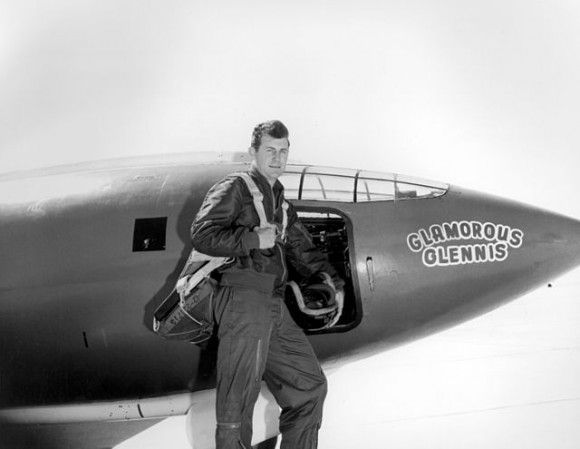
On October 14, 1947, Yeager piloted a plane called Glamorous Glennis to Mach 1.06, just over the speed of sound.

Dubbed the fastest man alive, he also won the prestigious Collier Trophy in aviation even as he continued setting speed records.

The plane in which he broke the sound barrier is on display at the Smithsonian National Air and Space Museum in Washington, D.C.

Yeager’s adventures were popularized in a 1980s satirical book and movie, both called The Right Stuff.

He currently lives California.

Yeager in front of the Bell X-1, which, as with all of the aircraft assigned to him, he named Glamorous Glennis after his wife.  Image via Wikimedia Commons.

Bottom line: On February 13, 1923, Chuck Yeager, the first pilot to break the sound barrier, was born in Myra, West Virginia.

SOURCE:::: http://www.esrthskynews.org

Natarajan

” This Russian was Mystified by How Americans act on Planes …” !!!

Aeroplane tropical sunset

It’s easy to mistake certain social customs of Americans that might suggest strong personal connections where none are intended. For example, Americans are more likely than those from many cultures to smile at strangers and to engage in personal discussions with people they hardly know. Others may interpret this “friendliness” as an offer of friendship. Later, when the Americans don’t follow through on their unintended offer, those other cultures often accuse them of being “fake” or “hypocritical.”

Igor Agapova, a Russian colleague of mine, tells this story about his first trip to the United States:

I sat down next to a stranger on the aeroplane for a nine-hour flight to New York. This American began asking me very personal questions: did I have any children, was it my first trip to the U.S., what was I leaving behind in Russia? And he began to also share very personal information about himself. He showed me pictures of his children, told me he was a bass player, and talked about how difficult his frequent travelling was for his wife, who was with his newborn child right now in Florida.

In response, Agapova started to do something that was unnatural for him and unusual in Russian culture — he shared his personal story quite openly with this friendly stranger thinking they had built an unusually deep friendship in a short period of time. The sequel was quite disappointing:

I thought that after this type of connection, we would be friends for a very long time. When the aeroplane landed, imagine my surprise when, as I reached for a piece of paper in order to write down my phone number, my new friend stood up and with a friendly wave of his hand said, “Nice to meet you! Have a great trip!” And that was it. I never saw him again. I felt he had purposely tricked me into opening up when he had no intention of following through on the relationship he had instigated.

The difference between American and Russian cultures here can be described as peach and coconut models of personal interaction.

In peach cultures like the United States or Brazil, to name a couple, people tend to be friendly (“soft”) with others they have just met. They smile frequently at strangers, move quickly to first- name usage, share information about themselves, and ask personal questions of those they hardly know. But after a little friendly interaction with a peach person, you may suddenly get to the hardshell of the pit where the peach protects his real self. In these cultures, friendliness does not equal friendship.

In coconut cultures such as France, Germany, or Russia, people are more closed (like the tough shell of a coconut) with those they don’t have friendships with. They rarely smile at strangers, ask casual acquaintances personal questions, or offer personal information to those they don’t know intimately. It takes a while to get through the initial hard shell, but as you do, people will become gradually warmer and friendlier. While relationships are built up slowly, they tend to last longer.

SOURCE:::: ERIN MEYER,  in www. businessinsider.com.au

Natarajan