” Jaw-dropping images of Earth from space in 2015″

Astronauts on board the International Space Station beamed back some spectacular views of Earth this year.

The Earth Observations team at NASA’s Johnson Space Center selected the 15 best photographs, which we’ve republished here.

Astronauts aboard the International Space Station took this image of Adele Island, off Australia’s north coast, on June 11, 2015. The tiny island is only 2.9 kilometres (2 miles) long.

Astronauts aboard the International Space Station took this image of Adele Island, off Australia’s north coast, on June 11, 2015. The tiny island is only 2.9 kilometres (2 miles) long.

This image shows landscapes of the arid Sahara and the dark green marshes of Lake Chad, which stand out in the foreground.

This image shows landscapes of the arid Sahara and the dark green marshes of Lake Chad, which stand out in the foreground.

Hawaii’s Kilauea volcano is seen on the left in a photo taken in February.

Hawaii’s Kilauea volcano is seen on the left in a photo taken in February.

The peaks of Colombia’s Santa Marta are so high that trees cannot grow. The highest peak has a permanent snow cap and is the only place where snow can be seen from the tropical beaches of the Caribbean coast.

The peaks of Colombia’s Santa Marta are so high that trees cannot grow. The highest peak has a permanent snow cap and is the only place where snow can be seen from the tropical beaches of the Caribbean coast.

Southern Scandinavia is illuminated under a full moon in this image, which also features a green aurora to the north and the Baltic Sea, seen as a black patch in the lower right of the photo.

Southern Scandinavia is illuminated under a full moon in this image, which also features a green aurora to the north and the Baltic Sea, seen as a black patch in the lower right of the photo.

The Paraná River, South America’s second-largest, pours brown muddy water into a wide estuary known as the River Plate.

The Paraná River, South America’s second-largest, pours brown muddy water into a wide estuary known as the River Plate.

The snow-covered Himalaya range is seen near the China–India border.

The snow-covered Himalaya range is seen near the China–India border.

Laguna Colorada, a lake in the Bolivian Andes Mountains, lies at 4,300 metres (14,100 feet) above sea level. Algae in the water is responsible for the lake’s deep red-brown color.

Laguna Colorada, a lake in the Bolivian Andes Mountains, lies at 4,300 metres (14,100 feet) above sea level. Algae in the water is responsible for the lake's deep red-brown color.

Fish farms are seen on the coast of China’s northeast province of Liaoning.

Fish farms are seen on the coast of China’s northeast province of Liaoning.

This September image shows the winding border between Pakistan and India, one of the few places on Earth where an international boundary can be seen at night.

This September image shows the winding border between Pakistan and India, one of the few places on Earth where an international boundary can be seen at night.

Brightly-coloured salt ponds are seen on the coast of Tunisia’s port city, Sfax.

Brightly-coloured salt ponds are seen on the coast of Tunisia's port city, Sfax.

Red-brown coastal lagoons are seen on this stretch of Western Australia’s coastline, in a photo taken on June 11.

Red-brown coastal lagoons are seen on this stretch of Western Australia's coastline, in a photo taken on June 11.

This photo, taken on June 15, shows the northern tip of Massachusetts’ Cape Cod.

This photo, taken on June 15, shows the northern tip of Massachusetts' Cape Cod.

The Mekong River, Southeast Asia’s largest river, flows on the border between Thailand and Laos. Heavy monsoon rainfall at the end of July created a red-brown channel of floodwater.

The Mekong River, Southeast Asia’s largest river, flows on the border between Thailand and Laos. Heavy monsoon rainfall at the end of July created a red-brown channel of floodwater.

A red sprite — a major electrical discharge thought to occur during large thunderstorms — is captured above the white light of an active thunderstorm high over Missouri or Illinois.

A red sprite — a major electrical discharge thought to occur during large thunderstorms — is captured above the white light of an active thunderstorm high over Missouri or Illinois.

Source……..

Unusual Airport Runways Around the World….!!!

1. Gisborne
Airport, New Zealand

This North Island airport is one of the few in the
World that has a railway line running through its runway. Both the railway
And the airport are active, so let’s hope they are precise about their
Scheduling.

2. Juancho E. Yrausquin Airport, Saba Island

Blink and you might miss it. With only 400m in length, this Caribbean island has the shortest commercial

air strip on the planet. Obviously, this tiny runway is only suitable for small aircraft.

3. Courchevel Altiport, France

This airfield high in the French Alps is a convenient yet treacherous drop-off point for wealthy skiers

at the chi-chi Courchevel slopes. In fact, there are ski runs no far from the 1,762 ft (537 m) mountaintop

runway. Frequent fog, snow, ice and low clouds make it even more extreme. You’ll want to make sure your

small plane or helicopter pilot is well trained.

4. Don Mueang Airport, Thailand

There aren’t many airports in the world that have an 18 hole golf course right amongst the runways. Fore!

5. Tenzing-Hillary Airport, Nepal

If you’re planning on trekking to Mount Everest, chances are you’ll arrive via this small Nepalese airport

in Lukla. It has a short runway with a 9,334 feet (2900 meter) drop off the edge. Not for the faint of heart.

6. Agatti Aerodrome, Lakshadweep, India

This 4000 feet long island runway doesn’t leave much margin for error. A few more inches, and passengers

are going to be swimming sooner than they bargained for.

7. Barra International Airport, Scotland

Barra International Airport, on a remote northern island in Scotland, has the only beach runway for scheduled

flights in the world. At high tide, some of the runways are underwater..

8. Gibraltar International Airport

These are red lights you don’t want to run..

9. Gustaf III Airport, Saint-Barthélemy

This runway is so tiny, only planes with a maximum of 20 people can land here. That helps keep St. Barts

an exclusive upscale Caribbean haven for the rich and famous.

10. Kansai International Airport, Japan

With land at a premium in Japan, they decided to build this major airport on an artificial island offshore in

Osaka Bay. If its ocean setting doesn’t give you chills, its also regularly subjected to earthquakes, typhoons

and storm surges. Oh, and the island is also sinking. This airport’s construction and constant reinforcement

makes it the most expensive civil works project in modern history.

11. Madeira Airport, Portugal

The previous airport on this Portuguese archipelago was notoriously challenging due to its short runway

surrounded by high mountains and the ocean. So, they extended it with an impressive – yet frightening –

platform supported by 180 columns off the edge of the land.

12. Narsarsuaq Airport, Greenland

This runway is short and sweet whether you’re coming or going. It is considered one of the world’s most

challenging approaches.. Pilots have to fly up a fjord known for its turbulence and wind gusts.

13. Savannah-Hilton Head International Airport

A pair of grave makers are embedded into Runway 10 at this airport, in remembrance to the Dotson Family who

used to own the land. One of the graves dates back to 1857. The law states that next of kin need to authorize

the moving of family graves, and when they couldn’t be located, the airport engineers let them be.

14. Wellington Airport, New Zealand

This airport in New Zealand’s capital city has a short runway, so only smaller aircraft can land there.

It’s known for turbulent landings due to the channeling effect of the Cook Strait creating gusty winds.

15. Princess Juliana International Airport, Sint Maarten

This beachside airport on the Dutch side of Saint Martin is right across the street from Maho Beach. It is

known for its extremely low-altitude flyover landing approach, and tourists flock here to experience the rush

of the planes overhead. Definitely one of the craziest airport runways you got to see to believe.

16. Ice Camp Barneo, North Pole

This snowy strip not far from the North Pole is open for just 4 weeks per year. Built on a drifting ice

base, it’s a fully functional runway suitable for cargo planes like the Antonov AN-74. Perhaps Santa

Claus uses it too.


Curiosity’s 10 best images of Mars in 2015….

As of December, 2015, Curiosity has acquired over 292,000 images from Mars’ surface. Here are our picks for the top 10 images by the rover in 2015.

Strata rocks and dark sand in an area that has been named

Strata rocks and dark sand in an area that has been named ‘Kimberley.’ The strata in the foreground dip towards the base of Mount Sharp, indicating flow of water toward a basin that existed before the larger bulk of the mountain formed. The images obtained by NASA’s Curiosity rover in October, 2015, led scientists conclude there were ancient lakes on this area. Credits: NASA/JPL-Caltech/MSSS

Since its August 5-6, 2012 landing on Mars – an event known to space scientists as seven minutes of terror – NASA’s Curiosity rover has been studying the surface of Mars. Its job now is to determine whether the Gale Crater area, the area in which it landed, ever had the right conditions to support microbial life. As of December, 2015 – using its 17 cameras – Curiosity has acquired over 292,000 images from the surface of Mars. The images on this page are our picks of some of the best images captured by the rover in 2015.

Curiosity has seen a lot of layered rocks on the surface of Mars, like these amazing rocks captured on July, 2015. Credits: NASA/JPL-Caltech/MSSS

Curiosity has seen a lot of layered rocks on the surface of Mars, like these amazing rocks captured in July, 2015.Read more about this image. Credits: NASA/JPL-Caltech/MSSS

The rover mission’s official name is the Mars Science Laboratory. The rover itself is 9 feet (about 3 meters) long and 7 feet (about 2.7 meters) wide, and weighs about 2,000 pounds (900 kg).

 It is not Arizona or Utah...this is planet Mars as seen by Curiosity on September, 2015.  This image shows regions that include a long ridge teeming with hematite, an iron oxide. Just beyond is an undulating plain rich in clay minerals. And just beyond that are a multitude of rounded buttes, all high in sulfate minerals. The changing mineralogy in these layers of Mount Sharp suggests a changing environment in early Mars, though all involve exposure to water billions of years ago. Image via NASA/JPL-Caltech/MSSS

It’s not Arizona or Utah … this is planet Mars as seen by Curiosity on September, 2015. This image shows regions that include a long ridge teeming with hematite, an iron oxide. Just beyond is an undulating plain rich in clay minerals. And just beyond that are a multitude of rounded buttes, all high in sulfate minerals. The changing mineralogy in these layers of Mount Sharp suggests a changing environment in early Mars, though all involve exposure to water billions of years ago. Image via NASA/JPL-Caltech/MSSS

Sunset in Mars' Gale Crater. NASA's Curiosity Mars rover captured the sun setting on April 15, 2015 from the rover's location in Gale Crater. The color has been calibrated and white-balanced to remove camera artifacts. Mastcam sees color very similarly to what human eyes see, although it is actually a little less sensitive to blue than people are. Dust in the Martian atmosphere has fine particles that permit blue light to penetrate the atmosphere more efficiently than longer-wavelength colors. That causes the blue colors in the mixed light coming from the sun to stay closer to sun's part of the sky, compared to the wider scattering of yellow and red colors. Image via NASA/JPL-Caltech/MSSS

Sunset on Mars. The Curiosity rover captured the sun setting on April 15, 2015 from the Gale Crater. The color has been calibrated and white-balanced to remove camera artifacts. The rover’s ‘Mastcam’ sees color very similarly to what human eyes see, although it is actually a little less sensitive to blue than people are. Dust in the Martian atmosphere has fine particles that permit blue light to penetrate the atmosphere more efficiently than longer-wavelength colors. That causes the blue colors in the mixed light coming from the sun to stay closer to sun’s part of the sky, compared to the wider scattering of yellow and red colors. Image via NASA/JPL-Caltech/MSSS

Two orbiters that were already studying Mars when Curiosity arrived. They are the Mars Reconnaissance Orbiter, and Mars Odyssey. These two act as satellites, relaying pictures and data from the rover back to Earth.]

Diverse composition of mineral veins at the

Diverse composition of mineral veins at the ‘Garden City’ site investigated by Curiosity suggests multiple episodes of groundwater activity. The prominent mineral veins vary in thickness and brightness, and include: 1) thin, dark-toned fracture filling material; 2) thick, dark-toned vein material in large fractures; 3) light-toned vein material, which was deposited last. Researchers used the Mastcam and other instruments on Curiosity in March and April 2015 to study the structure and composition of mineral veins at Garden City, for information about fluids that deposited minerals in fractured rock there. Image via NASA/JPL-Caltech/MSSS

Because color images use much more data or bandwidth to be transmitted to our planet, a lot of black and white images are sent to the orbiting spacecraft that occasionally passes over t

he rover’s location for a short time. However, some color images are eventually sent.

This is an area lining the northwestern edge of Mount Sharp. The scene combines multiple images taken with the Mast Camera on NASA’s Curiosity Mars rover on Sept. 25, 2015. Dunes are larger than wind-blown ripples of sand or dust that Curiosity and other rovers have visited previously. You can see the dark dunes by clicking again after opening this panorama. Image via NASA/JPL-Caltech/MSSS

Giant antennas at California (USA), Australia and Spain compose the Deep Space Network that receives pictures and data from the Mars spacecraft as well as from other interplanetary spacecraft.

A Selfie on Mars. Curiosity extended its robotic arm and used the camera on the arm's end to capture this self portrait on October 6,2015. The image was taken at the

A selfie on Mars. Curiosity extended its robotic arm and used the camera on the arm’s end to capture this self portrait on October 6, 2015. The image was taken at the ‘Big Sky’ site, where its drill collected the mission’s fifth taste of Mount Sharp. Image via NASA/JPL-Caltech/MSSS

Dark rocks on route to Mountains. Diverse terrain is visible on this image taken on Mount Sharp on April 10, 2015. The color has been approximately white-balanced to resemble how the scene would appear under daytime lighting conditions on Earth. Image via NASA/JPL-Caltech/MSSS]

Dark rocks on route to mountains. Diverse terrain is visible on this image taken on Mount Sharp on April 10, 2015. The color has been approximately white-balanced to resemble how the scene would appear under daytime lighting conditions on Earth. Image via NASA/JPL-Caltech/MSSS

Damage on the aluminum wheels is evident after 7 miles (11.3 km) on the odometer of the Curiosity rover. Mars' terrain and diverse rocks led to more wheel damage than was expected. However scientists think the 20 inches (51 cm) wheels may permit the rover to continue its mission. Image via NASA/JPL-Caltech/MSSS

Damage on the aluminum wheels is evident after 7 miles (11.3 km) on the odometer of the Curiosity rover. Mars’ terrain and diverse rocks led to more wheel damage than was expected. However scientists think the 20 inches (51 cm) wheels may permit the rover to continue its mission. Image via NASA/JPL-Caltech/MSSS

A Solar Eclipse from Mars. Curiosity captured Phobos, one of the two small martian moons passing in front of the Sun in July, 2015. Although Phobos is only about 14 miles (22.5 km) in diameter, it orbits Mars at just 6,000 km ( 3,728 miles) which is relatively close. Image via NASA/JPL-Caltech/MSSS

A Solar Eclipse from Mars. Curiosity captured Phobos, one of the two small martian moons passing in front of the Sun in July, 2015. Although Phobos is only about 14 miles (22.5 km) in diameter, it orbits Mars at just 6,000 km ( 3,728 miles) which is relatively close. Image via NASA/JPL-Caltech/MSSS

Where is Curiosity right now? The rover is located in an area of Mount Sharp that has been named Namib dune. The rover is analyzing the composition and grain size of a ripple.

Source….www.earthsky.org

Natarajan

Image of the Day…”Zinnia Flowers @ International Space Station…”

Zinnia Flowers Starting to Grow on the International Space Station

Zinnia flowers are starting to grow in the International Space Station's Veggie facility

Zinnia flowers are starting to grow in the International Space Station’s Veggie facility as part of the VEG-01 investigation. Veggie provides lighting and nutrient supply for plants in the form of a low-cost growth chamber and planting “pillows” to provide nutrients for the root system. These plants appear larger than their ground-based counterparts and scientists expect buds to form on the larger plants soon.

The Veggie facility supports a variety of plant species that can be cultivated for educational outreach, fresh food and even recreation for crew members on long-duration missions. Previously, the facility has grown lettuce — which was consumed by the crew earlier this year — and now investigators are attempting to grow Zinnia flowers. Understanding how flowering plants grow in microgravity can be applied to growing other edible flowering plants, such as tomatoes.

Image Credit: NASA

5 of theWorld’s Most Festive Airports

Being in an airport during the busy holiday travel season can be stressful, but some of the biggest and best airports around the world embrace transform themselves to bring joy to your journeys.

With twinkling lights, pine-scented air, and the sound of sleigh bells, these terminals stand out with their impressive holiday cheer.

From London to Singapore, these airports outdo themselves every year with awe-inspiring displays.

No matter where you’re going this season, a trip through one of these airports is certain to put you in the holiday mood.

Los Angeles airport.JPG

5 terminals that stand out with their impressive holiday cheer.

O’Hare International Airport

O'Hare International Airport

Where: Chicago, Illinois

Expect dazzling lights and terminals filled with boughs of holly at O’Hare International Airport this season, as the airport continues its annual tradition of celebrating the holidays in style. The nation’s third-busiest airport transforms into a winter wonderland, first visible on the road leading to the terminals, where bright, LED-wrapped trees and giant stars and spheres dot the perimeter of the grounds, forming a wintry landscape. Bright wreaths are adorned on many of the overhead signs throughout the airport roads, while oversize ornaments and lights are placed throughout the arrival and departure terminals. Be sure not to miss Terminal 3, where O’Hare’s signature globe is brought to life with the help of hundreds of LED lights, garland accents, and bright doves that float overhead. Aside from the decorations, O’Hare will host school choirs, jazz and blues bands, barbershop quartets and strolling carolers on select days throughout December.

Changi Airport

Changi Airport

Where: Singapore

In addition to its normal holiday decorations, the force is strong at Changi Airport this holiday season thanks to a partnership with Disney in anticipation of Star Wars: The Force Awakens. Testing the limits of intergalactic travel, Terminal 3 welcomes a life-size X-wing Fighter, offering visitors the chance to don costumes and hop inside the iconic aircraft for a photo opportunity in the cockpit. Plan your trip accordingly: Imperial Stormtroopers and X-wing Fighter pilots make appearance at the jet Saturdays at 4 pm throughout December. Look for dozens of other fun surprises throughout the terminals, including Star Wars’ humanoid protocol droid C-3PO which teaches Star Wars phrases in ten languages, a life-sized TIE fighter, and an obstacle course for the BB-8 droid.

Heathrow Airport

Heathrow Airport]

via Fodors

Where: London, England

With an extensive roster of musicians and festive décor, Heathrow Airport welcomes visitors this holiday season with daily events that are guaranteed to spread joy. Carolers, a string quartet, and a brass band are just some of the rotating acts set to entertain travelers this season throughout the airport’s four terminals. Heathrow offers travelers the great benefit of free gift wrapping, available in all terminals. And most helpful of all, Heathrow’s friendly “gift helpers” are on hand in all terminals, expert in finding the perfect gifts for your friends and loved ones.

Zurich Airport

Zurich Airport

Where: Zürich, Switzerland

A Swiss holiday haven, Zürich Airport glistens with the glow of 510,860 LED lights and 31 Christmas trees throughout the airport this season. During the holiday season, guests are treated to a deluxe offering of events and activities in the airport which include scheduled tours of the enormous double-decker Airbus A380 operated by Singapore Airlines, an elaborate and exclusive Christmas dinner, and cookie-baking classes for kids. Pop-up stores throughout the terminals include a festive Nespresso coffee spot and fine chocolates and sweets at the Läderach pop-up.

Munich Airport

Where: Munich, Germany

Celebrating the season with the warmth and livelihood of a traditional German holiday market, the 17th Annual Winter Market returns to Munich Airport this year. Plan to spend the better part of an afternoon exploring the market’s 46 stands under the roof of the Munich Airport Center, where the sweet smell of mulled wine and roasted almonds fills the air. Arrive hungry and enjoy artisanal wurst and plenty of German beer on tap. With 450 real Christmas trees set amidst the market, the Winter Market is an ideal place to spend the most wonderful time of the year.

Source….www.businessinsider.com

Natarajan

Image of the Day…” Blue Marble Earth Image …”

New Earthrise Image from LRO spacecraft

NASA’s Lunar Reconnaissance Orbiter (LRO) recently captured a unique view of Earth from the spacecraft’s vantage point in orbit around the moon.

“The image is simply stunning,” said Noah Petro, Deputy Project Scientist for LRO at NASA’s Goddard Space Flight Center in Greenbelt, Maryland. “The image of the Earth evokes the famous ‘Blue Marble’ image taken by Astronaut Harrison Schmitt during Apollo 17, 43 years ago, which also showed Africa prominently in the picture.”

In this composite image we see Earth appear to rise over the lunar horizon from the viewpoint of the spacecraft, with the center of the Earth just off the coast of Liberia (at 4.04 degrees North, 12.44 degrees West). The large tan area in the upper right is the Sahara Desert, and just beyond is Saudi Arabia. The Atlantic and Pacific coasts of South America are visible to the left. On the moon, we get a glimpse of the crater Compton, which is located just beyond the eastern limb of the moon, on the lunar farside.

LRO was launched on June 18, 2009, and has collected a treasure trove of data with its seven powerful instruments, making an invaluable contribution to our knowledge about the moon. LRO experiences 12 earthrises every day; however the spacecraft is almost always busy imaging the lunar surface so only rarely does an opportunity arise such that its camera instrument can capture a view of Earth. Occasionally LRO points off into space to acquire observations of the extremely thin lunar atmosphere and perform instrument calibration measurements. During these movements sometimes Earth (and other planets) pass through the camera’s field of view and dramatic images such as the one shown here are acquired.

This image was composed from a series of images taken Oct. 12, when LRO was about 83 miles (134 kilometers) above the moon’s farside crater Compton. Capturing an image of the Earth and moon with LRO’s Lunar Reconnaissance Orbiter Camera (LROC) instrument is a complicated task. First the spacecraft must be rolled to the side (in this case 67 degrees), then the spacecraft slews with the direction of travel to maximize the width of the lunar horizon in LROC’s Narrow Angle Camera image. All this takes place while LRO is traveling faster than 3,580 miles per hour (over 1,600 meters per second) relative to the lunar surface below the spacecraft!

The high-resolution Narrow Angle Camera (NAC) on LRO takes black-and-white images, while the lower resolution Wide Angle Camera (WAC) takes color images, so you might wonder how we got a high-resolution picture of the Earth in color. Since the spacecraft, Earth, and moon are all in motion, we had to do some special processing to create an image that represents the view of the Earth and moon at one particular time. The final Earth image contains both WAC and NAC information. WAC provides the color, and the NAC provides high-resolution detail.

“From the Earth, the daily moonrise and moonset are always inspiring moments,” said Mark Robinson of Arizona State University in Tempe, principal investigator for LROC. “However, lunar astronauts will see something very different: viewed from the lunar surface, the Earth never rises or sets. Since the moon is tidally locked, Earth is always in the same spot above the horizon, varying only a small amount with the slight wobble of the moon. The Earth may not move across the ‘sky’, but the view is not static. Future astronauts will see the continents rotate in and out of view and the ever-changing pattern of clouds will always catch one’s eye, at least on the nearside. The Earth is never visible from the farside; imagine a sky with no Earth or moon – what will farside explorers think with no Earth overhead?”

NASA’s first Earthrise image was taken with the Lunar Orbiter 1 spacecraft in 1966. Perhaps NASA’s most iconic Earthrise photo was taken by the crew of the Apollo 8 mission as the spacecraft entered lunar orbit on Christmas Eve Dec. 24, 1968. That evening, the astronauts — Commander Frank Borman, Command Module Pilot Jim Lovell, and Lunar Module Pilot William Anders — held a live broadcast from lunar orbit, in which they showed pictures of the Earth and moon as seen from their spacecraft. Said Lovell, “The vast loneliness is awe-inspiring and it makes you realize just what you have back there on Earth.”

Source…….www.nasa.gov

Natarajan

This is Egypt’s Only Waterfalls, And its Man-Made…

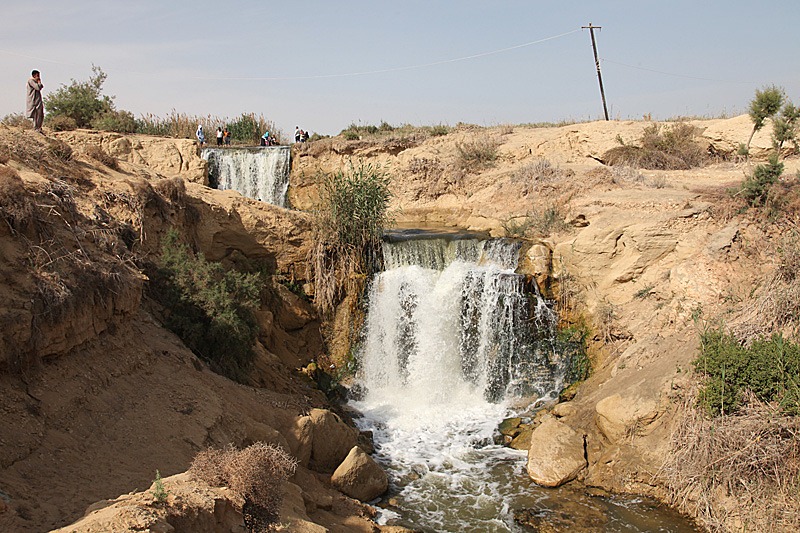
The valley of Wadi El-Rayan, 65 km southwest of Fayoum city, in Egypt, is home to two large artificial lakes created to divert excess agricultural drainage water from Fayoum oasis. It is also home to the country’s only waterfalls.

The Fayoum oasis originally drained into Lake Qarun in the north. But the lake can take only a certain volume of drainage water. Anything over this capacity and the lake level would rise and flood the surrounding land, often doing irreparable damage because of the waters high salt content. This means that the amount of water that can be used in the Fayoum is limited by the region’s maximum drainage capacity. Consequently, until recently water-intensive crops such as rice and reeds could be grown only in very small quantities. Furthermore, no new land could be reclaimed without causing swamping of existing farmland near Lake Qarun. There was a pressing need to find an alternative drainage basin, and the large depression of Wadi El Rayan was found to be suitable.

wadi-el-rayan-waterfalls-6

Photo credit: Roland Unger/Wikimedia

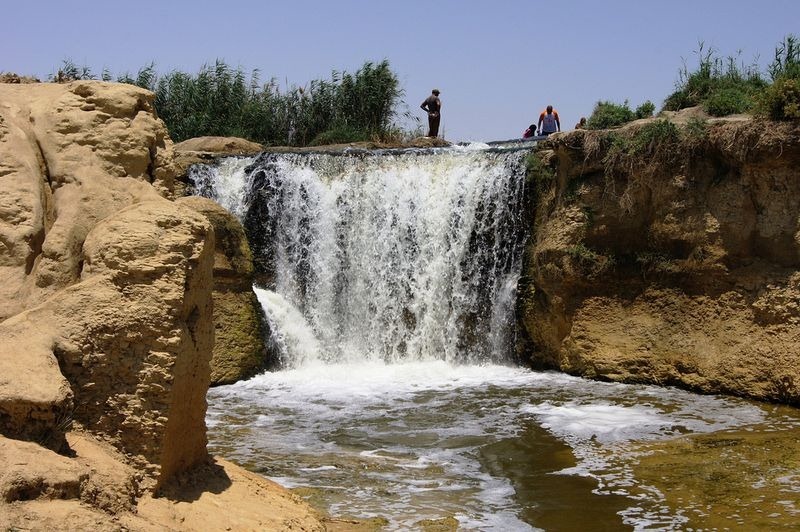
In 1974, a 9-kilometers open channel and an 8-kilometers tunnel were cut through the desert from the western side of the Fayoum depression to the large, dry depression of Wadi El Rayan. Drainage water now flows into Wadi El Rayan forming two large lakes. Water first reaches the northern lake and when it’s overwhelmed, a stream flows towards a deeper part of the depression, where another lake is formed. As the course of the stream was eroded, natural rocks were exposed and waterfalls formed over them.

There are several cascades on the stream, none of them taller than 2 to 4 meters. Yet, they have attracted considerable attention among the local Egyptians, as many have never seen waterfalls before. The waterfalls have also been featured in many Egyptian pop videos and films. The falls, however, will not last for ever as the level of the lower lake is continually rising and the falls will exist only until the expanding surface area allows a rate of evaporation equal to the amount of water flowing into it.

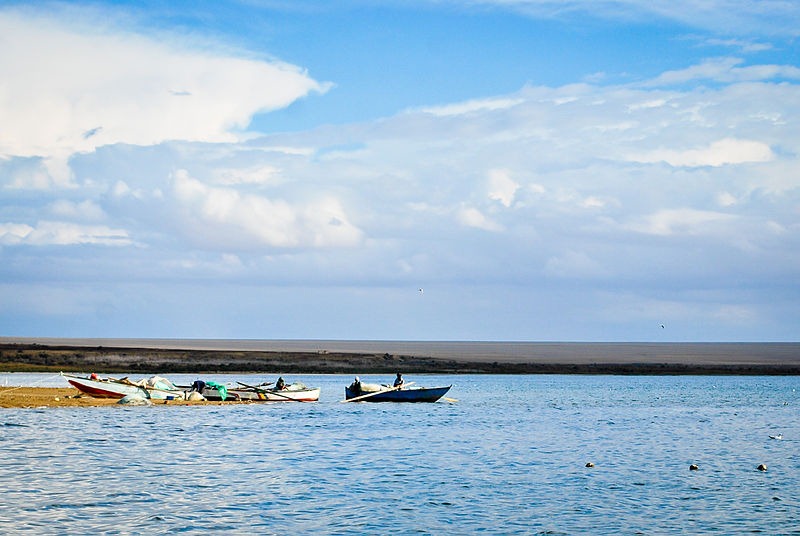
The shorelines of the lakes are densely vegetated making them perfect wintering habitats for migrating birds and breeding spot for many fishes. The area is now a nature reserve and is home to the world’s sole population of Slender-horned Gazelles, as well as 8 other mammal species and 13 species of bird.

wadi-el-rayan-lake

Wadi El-Rayan Lake. Photo credit: Mohammed Moussa/Wikimedia


wadi-el-rayan-waterfalls-3

wadi-el-rayan-waterfalls-1

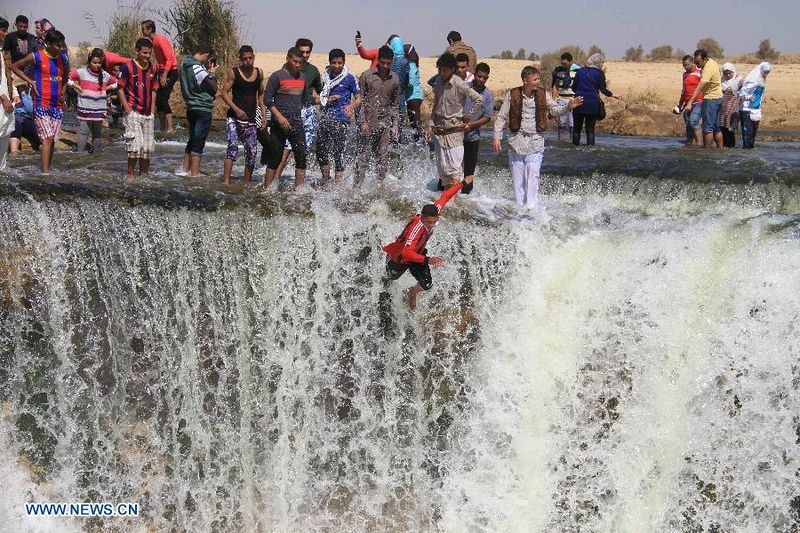
An Egyptian man jumps in the water of Wadi El-Rayan Waterfalls in Fayoum, Egypt, on March 6, 2015. Photo credit: Xinhua/Ahmed Gomaa

Source…..www.amusing planet.com

natarajan

The Incredible Story of Neerja Bhanot – Indian Flight Attendant Who Saved 360 Lives…

On the morning of September 5, 1986, Pan Am Flight 73 landed in Karachi. It had arrived from Mumbai and, had nothing gone wrong, would have departed for Frankfurt and onward to New York City. The flight was carrying, among members of other nationalities, Indians, Germans, Americans, and Pakistanis.

Unfortunately, the flight was hijacked while it was parked on the tarmac at Jinnah International Airport in Karachi.

pan am

Photo for representation purpose only. Source: Wikipedia

Four heavily-armed terrorists, dressed as airport security guards, entered the aircraft while firing shots from an automatic weapon and seized control of the plane.

This is the story of Neerja Bhanot, the senior flight attendant on board, who helped a number of passengers escape. She was murdered while shielding three children from terrorist fire, less than 25 hours before her 23rdbirthday.

After the terrorists boarded the plane, Neerja alerted the cockpit crew, who escaped through an overhead hatch in the cockpit. As the senior-most remaining crew member on board, this left Neerja in charge. One of the terrorists asked the flight crew to collect and hand over the passports of all passengers on board. When Neerja realised that the primary targets of the terrorists were American passengers, she hid their passports – even discarding some of them down the rubbish chute. From a total of 41 American passengers, only 2 were killed.

After holding the passengers and crew members hostage for 17 hours on the runway, the terrorists opened fire. Neerja stayed on the plane to help passengers escape, even though she could have been the first to leave. She was shot while shielding three children from the bullets that were being fired by the terrorists.

Most of us will never find ourselves in a high-pressure situation, facing life or death the way Neerja did. True bravery emerges in the face of fear. We might never know what Neerja was thinking or feeling during those terrible hours of the hijacking, but we do know that she chose to respond to the actions of the terrorists with exceptional grace, courage, and grit. Of the 380 passengers and crew members on Flight 73, 20 were killed.

While many others were injured, they did survive – in no small part due to the actions of a 22-year-old flight attendant who chose compassion over cowardice and performed her duty till the very end.

Neerja Bhanot

source,….Facebook

Neerja Bhanot’s family suffered an unbearable loss when they lost their only daughter.

“Neerja was the ‘laado’ of the family, the youngest and most pampered. My parents had wished for her, and in a news article after her death, my father had mentioned how, when she was born on September 7, 1962, the maternity ward matron here at Chandigarh hospital rang up to inform, it’s a girl. To her surprise, he gave her double thanks, for Neerja was a prayer answered after two sons,”recalls Aneesh, her brother.

As her father remembers her,

“Neerja was a very sensitive, deeply affectionate and an extremely decent person who believed in sharing with her people all her joys but not the jolts. She had well defined principles and there was little room for compromise in that area.”

Despite their irreplaceable loss, her parents, Rama and Harish Bhanot, soldiered on, and even found a fitting way to honour Neerja’s memory. With the insurance money that they received after her death and an equal contribution from Pan Am, they set up the Neerja Bhanot Pan Am Trust. Through the Trust, they present two awards of Rs. 1,50,000 every year – one to an Indian woman who faces social injustice but overcomes it and helps other women in similar situations, and one to honour an airline crew member who acts beyond the call of duty. There could hardly have been a better way to keep Neerja’s memory alive.

For her actions on the day of the hijacking, Neerja Bhanot was posthumously awarded the Ashok Chakra, India’s highest peacetime military decoration for the “most conspicuous bravery or some daring or pre-eminent valour or self-sacrifice”, and the Tamgha-e-Insaniyat, awarded by the Pakistan government for showing incredible kindness. She also posthumously received multiple awards for her courage from the United States government.

Source……..Vandita Kapoor in http://www.the betterindia.com

Natarajan


These Are the 6 Singaporean Satellites Being Launched by ISRO Today…17 Dec 2015…

At 6:00 pm today, Indian Space Research Organisation (ISRO) will launch six Singaporean satellites from the first launch pad at Satish Dhawan Space Centre in Sriharikota, Andhra Pradesh.

The satellites will be put into orbit by India’s Polar Satellite Launch Vehicle, in its thirty-second flight (PSLV-C29).

ISRO Satellite

PSLV-C29 on the First Launch Pad with Vehicle Assembly Building in background

PSLV-C29 will launch the satellites into a 550 km circular orbit inclined at 15 degrees to the equator. They will be launched one after the other to avoid collision, and there will be a distance of about 20 kilometres between them. The satellites being launched include one primary satellite and five co-passenger satellites.

The commercial arm of ISRO, Antrix Corporation Limited, has provided launch services for 51 commercial satellites from 20 countries so far. The six satellites being launched today include the following –

TeLEOS-1:

ISRO Satellite

TeLEOS-1 and Nanosats

This is the primary satellite weighing 400kg. It is the first Singapore commercial earth observation satellite and it is being launched for remote sensing applications. Designed and developed by Singapore Technologies Electronics, the mission life for this satellite is five years.

VELOX-CI:

ISRO Satellite \

Velox-CI and Kent Ridge-1

This is a micro satellite weighing 123kg. It will be used for research in tropical environmental monitoring using radio occultation techniques.

VELOX-II:

This satellite weight 13 kg and is a 6U-CubeSat technology demonstrator with three payloads – the communications, GPS experimental, and fault tolerant payload. A CubeSat is a type of small satellite used for space research.

Athenoxat-1:

ISRO Satellite

PSLV-C29 Heat-shield closed with six satellites integrated to the Launch Vehicle

It is a technology demonstrator nano-satellite, designed and developed by Microspace Rapid Pvt. Ltd in Singapore.

Kent Ridge-1:

This is a micro satellite weighing 78 kg, and it has two primary payloads.

Galassia:

A 2U-Cubesat weighing 3.4 kg, this satellite has two payloads.

“The satellites will be able to produce information at a much higher frequency. This will surely be very important when you use it for disaster monitoring in the region like Southeast Asia,” Project Director of the Satellite Programme at the National University of Singapore (NUS), Professor Goh Cher Hiang, said.

The 59-hour countdown for the PSLV-C29/TeLEOS-1 Mission began at 7:00 am on December 14. This is the eleventh fight of PSLV in ‘core-alone’ configuration. In this configuration, the six strap-on boosters used by standard PSLV model is not used.

All pictures: isro.gov.in

Source….Tanaya Singh in http://www.the better india .com

Natarajan

NASA is accepting astronaut applications, and this quiz will tell you if you qualify….!

If you have a taste for adventure to go where few have gone before, then you might want to sign up to be a NASA astronaut.

On December 14, for the first time in four years, NASA began accepting applications.

“This next group of American space explorers will inspire the Mars generation to reach for new heights, and help us realize the goal of putting boot prints on the Red Planet,” NASA’s Charles Bolden said in a statement.

Do you have what it takes to be the next NASA astronaut? Take this quiz to see what you know:

astronaut selfie photo space nasa

1. How many NASA astronauts have there been throughout history?

A. 167

B. 252

C. 339

D. 588

Answer: C. 339

The first NASA astronaut candidates were selected in 1959 for Project Mercury.

Since then, tens of thousands have applied to NASA’s intense astronaut-training program, but only 339 people have been selected. The newest members of the team were announced in July:

1. US Navy Lt. Cmdr. Josh Cassada
2. US Navy Lt. Cmdr. Victor Glover
3. US Air Force Lt. Col. Tyler “Nick” Hague
4. Christina Hammock
5. US Marine Corps Maj. Nicole Mann
6. US Army Maj. Anne McClain
7. Jessica Meir
8. US Army Maj. Andrew Morgan

2. True or false: All applicants must have a bachelor’s degree to qualify.

A. True

B. False

Answer: A. True

Answer: A. True

Reuters

NASA has a number of basic qualification requirements, and the first is a bachelor’s degree from an accredited institution in at least one of the following fields: engineering, biological science, physical science, or mathematics.

3. Besides a bachelor’s, what else do candidates need?

3. Besides a bachelor's, what else do candidates need?

Apple

A. At least 1,000 hours of pilot-in-command time in a jet aircraft.

B. A doctoral degree in science, engineering, or math.

C. At least three years of teaching K-12 levels in science, engineering, or math.

D. One of the above.

Answer: D. One of the above.

After earning a bachelor’s in one of the four required fields, qualified applicants must complete at least three years of related professional experience. That can include studying an appropriate field in a graduate program, teaching K-12 levels in science, engineering, or math, or completing at least 1,000 hours of piloting a jet aircraft.

By these standards, astrophysicist and famed host of “StarTalk Radio” Neil deGrasse Tyson, who earned a doctorate in astrophysics from Columbia University in 1991, qualifies!

4. Which of the following must candidates have in order to pass NASA’s astronaut physical exam?

4. Which of the following must candidates have in order to pass NASA's astronaut physical exam?

NASA

A. They are no older than 50.

B. They can run a marathon in under 4 hours.

C. They can hold their breath for at least 90 seconds without losing consciousness.

D. They’re between 62 and 75 inches tall.

Answer: D. Astronauts must all be between 62 and 75 inches tall.

Answer: D. Astronauts must all be between 62 and 75 inches tall.

NASA

Every astronaut must pass NASA’s three basic physical requirements, which are:

1. 20/20 vision in each eye (people can get PRK or LASIK surgery to correct their vision to meet the necessary requirements).

2. Blood pressure that does not exceed 140/90 in a sitting position.

3. A standing height of between 62 and 75 inches, or 5.1 and 6.25 feet.

Contrary to popular belief, there are no age limits on becoming a NASA astronaut, but most candidates selected in the past werebetween 26 and 46.

5. Say you’re one of the few candidates to be selected. Where do you go next for your NASA astronaut training?

A. Kennedy Space Center, near Cape Canaveral Air Force Station, in Florida.

B. Lyndon B. Johnson Space Center in Houston, Texas.

C. Jet Propulsion Laboratory in Pasadena, California.

D. Goddard Space Flight Center in Greenbelt, Maryland.

Answer: B. Lyndon B. Johnson Space Center in Houston, Texas.

Astronauts complete a two-year training program at the Lyndon B. Johnson Space Center in Houston, Texas.

Part of the training requires that candidates become scuba-qualified and pass a swimming test to prep them for the underwater extravehicular activity training they perform at the nearby Neutral Buoyancy Laboratory. This giant 6.2-million-gallon pool simulates microgravity environments to get astronauts ready for space walks.

6. True or False: All astronauts must have military experience.

A. True

B. False

Answer: B. False

Contrary to popular belief, you do not need military experience to become an astronaut. But a little experience certainly wouldn’t hurt your chances. As of the 2009 Astronaut Class, 61% of candidates NASA selects came from military service.

7. Which of the following is more important to NASA?

7. Which of the following is more important to NASA?

Thomson Reuters

A. US citizenship.

B. Piloting license.

Answer: A. US citizenship.

Answer: A. US citizenship.

REUTERS/Jonathan Alcorn

To qualify, applicants must be citizens of the US or have a valid US dual-citizenship.

When NASA was selecting candidates for its Mercury program in the late ’50s, it required piloting experience; but today that requirement is no longer in place. If you don’t have military experience and want to be a NASA astronaut, you might want to consider getting your pilot’s license. Many astronauts without a military background have one, according to USA Today.

8. When will NASA begin accepting its next round of astronaut applications?

A. Right now.

B. May 4, 2016.

C. July 4, 2016.

D. They’re always accepting applications.

Answer: A. Right now

NASA is accepting applications for consideration from December 14, 2015, through February 18, 2016. Civilians and military personnel can apply through the Office of Personnel Management’s USA Jobs site at usajobs.gov.

NASA expects to announce its selections by mid-2017.

Source….

http://www.businessinsider.com

Natarajan