Two School Students Help Hundreds of Indian Grandparents Fight Loneliness with Technology !!!

These high school students are introducing technology to senior citizens in an effort to help them overcome loneliness and social isolation – all because of respect and love for their grandparents, who they consider their superheroes.

The 2001 census of India showed that the population of senior citizens in India has crossed 100 million. Today, India is home to one out of every 10 senior citizens in the world. Yet, very few in the country are looking into the problems faced by this ageing section of our society.

An emotional and psychological problem tormenting elders in our country is loneliness.

A student helps a senior citizen learn how to use a computer.

A student helps a senior citizen learn how to use a computer.

This is due to the growing ‘empty nest syndrome.’ Children go away to far-off countries in search of economic betterment. Even if they live within the country, due to the spread of western ideas such as ‘space, privacy, individualism and non-interference,’ nuclear families are becoming the norm even in villages.

Poor social interaction with family and friends, poor social networks, and lack of family support are some of the difficulties faced by senior citizens. At the other extreme is the young generation today, highly dependent on social networking to stay connected with family and friends and build connections. Two high school students from Delhi are helping bridge the gap between the two generations.

Vibhor Rohatgi and Suyesha Dutta were in their 11th grade in Shri Ram School Mouslari, Gurgaon, which follows the International Baccalaureate (IB) board.

Suyesha (on extreme left) and Vibhor (second from right) with their teacher

Suyesha (on extreme left) and Vibhor (second from right) with their teacher

Creativity, activity, service (CAS) are the three essential elements of a CAS project that every student must complete as part of the Diploma Programme (DP) in the IB board internationally. For many students, these projects provide experiences that are profound and fulfilling.

Vibhor and Suyesha decided to take up a CAS project that would prove to be not only life changing for them but also for a much ignored segment of our society –senior citizens.

“When CAS is discussed in school, most students think of helping the underprivileged, the needy or the slum kids. We have this belief that only those who are deprived of money need help. But there are people who have it all but still feel emotionally empty. We wanted to help them – our grandparents,” says Suyesha.

Bridging the generation gap - senior citizens with students.

Bridging the generation gap – senior citizens with students.

Suyesha, who had spent a lot of time with her grandparents till she was in her teens, lost her grandfather three years ago. She saw her grandmother spending most of her days alone after that. So she decided to connect her to technology to help her overcome her loneliness. Once she saw how successful that experiment was, she wanted to gift technology not just to her own grandmother but to as many other grandparents as she could as a tribute to her grandfather.

Suyesha and her friend Vibhor are great fans of the comic superhero Silver Surfer, a humanoid with metallic skin who can travel space with the aid of his surfboard-like craft.  Since this superman is an icon of technology himself, they decided to name their initiative the Silver Surfer Programme.

“The Silver Surfer Programme (SSP), a social initiative started by us, is the epitome of the maxim ‘age is just a number.’ Age is a measure of experience, inefficiently gauged by how many candles one blows out every year. To this plenitude of experiences, we, looking to bring about a social change in society, decided to add one more…the experience known as technology,” says Vibhor

“We called it the Silver Surfer Programme because Silver Surfer is a superhero and we consider our grandparents to be superheroes. His senses enable him to detect objects and energies light years away. Similarly, grandparents have strong intuition and can detect any problem or trouble in their children’s and grandchildren’s lives. He has even proven capable of time travel on occasions, just like our grandparents take us back to their times by narrating stories from their childhood,” adds Suyesha

The Silver Surfer Programme is an effort to better acquaint grandparents with the delights of modern day technology.

DSC02267 (1)

SSP aims to make the lives of grandparents simpler, faster and efficient.  The programme includes two hour modules on three Saturdays every month for the grandparents. The programme, which began in May 2015, includes the following learning sessions:

  • Introduction to the programme and its aim.
  • Introduction to email – how to write an email.
  • Introduction to Facebook and Twitter – how to open and set up an account, send requests, etc.
  • Familiarization with smart phones and tablets and an introduction to WhatsApp – how to set up an account, send and receive messages, etc.
  • Introduction and use of specialist apps, such as, Grofers, Flipkart, BookMyShow, News InShorts/ Times of India, Ola and Meru Cabs, etc.
  • Net banking through HDFC, SBI, etc.
  • Paying utility bills such as electricity, phone bills, etc.

The programme, which started with the help of a few volunteers and their teacher Amrita Sai Marla, became so close to their hearts that they decided to continue it even after the CAS project was over.

The classes were conducted in the computer hall of their school, so they took special permission to continue with the classes. Now, as they have graduated from school, they plan to hand it over to their juniors.

Suyesha and Vibhor do not want to stop getting the blessings of grandparents even after they bid farewell to school. They are now planning to take the initiative forward by going to old age homes and teaching the grandparents who are staying there.

“We raise concerns over environmental degradation or the lack of education of the underprivileged, but seldom have we ever touched upon the most experienced in our society, the grandparents. As we feel that grandparents are the cornerstones of our lives, this is how we’ve decided to do something for them, show them our love and support. We work really hard towards our modules, undertake new challenges and come up with some interesting and essential things for the grandparents to learn, while constantly keeping them engaged. The blessings that the grandparents shower upon us make us feel accomplished and we don’t want to miss a single chance to keep those jubilant smiles on their faces,” says Suyesha

One of the defining moments of the Silver Surfer Programme came when a grandmother from a foreign country came to learn about Facebook from them.

IMG-20150509-WA0000

Grandparents are overjoyed at connecting with old friends through Facebook.

Now in her 70s, this grandmother had not seen her friends ever since she was in her 20s and had to leave her country due to political instability. The prospect of even getting a glimpse of her school friends made her so eager to learn that within minutes Vibhor and Suyesha helped her set up her very own Facebook account. After intensive searching for an hour, they finally found her old friends.

 “Never did a click ever make someone this happy. Overflowing with emotion she was as she got to speak to her friends, her smile radiating light on a cloudy, rainy day. It is for moments such as this that we had started this initiative,” says Vibhor.

“The journey of the Silver Surfer Programme has instilled in me vital life lessons that have helped me develop and grow as a person. For instance, I have learned that learning, in its candid, most humble form, is not bound by time but that it is in fact imperishable. Learning is a well-oiled machine that never stops, a beating heart that gives life. I have learned that there is no ‘right’ age and it is never ‘too late’ to learn,”  adds Vibhor.

Suyesha narrates another happy moment when one of the grandmothers came to her after the class and requested that she teach her how to download songs. Initially, Suyesha was reluctant to do so. She explained to her how it would be an act of piracy. However, the grandmother insisted by saying that it was her favorite song and no one was helping her download it, even though she saw her grandchildren doing it all the time.

“It was an Atif Aslam song, Jiya re Jiya re! I can’t describe the glow in her eyes after it downloaded. She left me with numerous blessings that day,” says Suyesha

The Silver Surfer Programme has now evolved to also start providing the benefits of technology to workers and guards of their school. Their next series of modules is aimed at computer literacy, wherein they will teach the guards and workers everything about the basics of using computers – using the mouse, keyboard, internet, etc.

Source….Manabi Katoch in http://www.the betterindia.com

……About the author: A mechanical engineer, Manabi Katoch has been brought up listening to Tagore’s poems and stories, so she is kind of an emotional person within. She loves writing poems and stories on social and political issues. Few of her poems can be viewed on http://www.poemocean.com and satires on http://www.mindthenews.com. She has worked with Wipro, Frankfinn and Educomp in the past.

Waste to Valuable: Used Flowers in Religious Shrines Are given a New Life by These 2 Friends…

Two friends in Kanpur were shocked by the amount of flowers that are dumped into the Ganges every single day, choking the river with pesticides and chemical fertilisers. They started collecting the flowers from temples and mosques in the city, and turned them into some brilliant eco-friendly products.

Enter a temple, mosque, gurudwara or church in India and the first thing you’ll probably notice is the abundance of flowers at the place of worship. There are flower sellers at the entrance, flowers strewn all over the shrine’s floor, devotees receiving flowers in the form of blessings – there seems to be no limit. Ever wonder what happens to those sacred flowers once we are done with our prayers?

According to many religious beliefs, flowers that are offered during prayers are sacrosanct and cannot be dumped into the garbage once they’ve wilted. This is one of the reasons why people prefer to discard them in rivers, lakes and other water bodies. But not many of us think about the fertilizers and pesticides that might have been used to grow these flowers, which then mix with the water and pollute it.

Ankit Agrawal and Karan Rastogi, two friends from Kanpur, had often thought of this issue. While growing up, the river Ganges had been an important part of their lives and it pained them to see it become increasingly polluted as the years went by.

organic products

Karan and Ankit

“Karan and I have been friends since childhood and some of our friends live abroad as well. Whenever all of us meet in Kanpur, there isn’t much to show them in the city. And when our friends see the river, their first reaction always has to do with how polluted it is. That was the starting point for our idea. Karan used to go to the temple every day and he would see the waste flowers being collected to be dumped in the river. So we thought of doing something to treat these flowers,” says 27-year-old Ankit.

According to him, every year, approximately 80, 00,000 tons of waste flowers are dumped into Indian rivers.

So, Ankit and Karan started thinking of a way to convert these flowers into an eco-friendly business venture. They started research in 2012 and a brilliant idea had taken shape by 2014 after several experiments. In May 2015, they founded Helpusgreen with the aim of utilizing the disposed flowers and turning them into bio-fertilisers and lifestyle products.

The duo picks up flowers from different places of worship every day – approximately 500 kg of them. Since they don’t have a factory, they divide the amount equally between themselves and take the flowers to their respective homes.

The flowers are then mixed with organic cow dung and treated with about 17 natural components like coffee residue, corn cobs, etc. These help increase the nitrogen content in the end-product. After a few days, earthworms are added to the mix. These worms consume the mixture and lead to the formation of vermicompost after 60 days. In this process, earthworms ingest the organic waste and then excrete it in a digested form. The excreta, called worm cast, is a dark, odourless and nutrient rich material that works as a great soil conditioner. Worm casts or vermicompost is a ready-to-use fertilizer.

Karan and Ankit have named this product Mitti and it helps improve soil texture for the better growth of plants.\

organic products

Helpusgreen product range

While 80% of the flowers are used to make vermicompost, the rest are crushed and made into incense sticks andyajna/havan items.

For manufacturing these items, the duo has employed 85 women from different self-help groups in villages around Kanpur, thus providing them with a source of income.

organic products

Women from self-help groups

organic products

“The women take the flower dough home and work for about four hours a day. We don’t use any chemical fragrances to make these products. Everything is natural,” says Ankit.

organic products

Most temples and mosques in Kanpur have management committees that collect the flowers inside the shrines and put them in bins. From here they are sent to be thrown into the river. Helpusgreen collects the flowers directly from the places of worship. According to Ankit, 2400 kg flowers are discarded in Kanpur on a daily basis. But Helpusgreen is only in a position to treat about 500 kg flowers a day, collected from 13 temples and three mosques.

Another great feature of Helpusgreen products is that they use recycled packaging, made from discarded cartons from a liquor factory in Kanpur.

organic products

Additionally, because they know people usually don’t throw away packets that have pictures of gods and goddesses on them, Ankit and Karan pack the havan/yajna items in seed paper that is embedded with tulsi seeds.

The discarded packets will grow into beautiful plants when they come into contact with soil.

organic products

Currently, they are exporting most of their products to Switzerland and Germany. And they are also making them available on e-commerce websites like Amazon, Flipkart, etc.

“We have produced 1.5 lakh kg flower compost till now. My mom was the target customer for us in the beginning. We had decided to keep working on the products till she approved of them. And the best feedback came from her. She loves it,” says Ankit laughing.

While most of us leave it to the gods to take care of the flowers we offer up in places of worship, kudos to Ankit and Karan for turning at least a part of the offerings into such amazing and environment-friendly products.

Visit here to know more about Helpusgreen. You can purchase these products here and here. Contact the founders at hola@helpusgreen.com.

Source……..Tanaya Singh in http://www.the betterindia.com

Natarajan

” What is the Value of Life ….” ?

A man went to God and asked, “What’s the value of life?”

God gave him one stone and said, “Find out the value of this stone, but don’t sell it.”

The man took the stone to an Orange Seller and asked him what its cost would be.

The Orange Seller saw the shiny stone and said, “You can take 12 oranges and give me the stone.”

The man apologized and said that the God has asked him not to sell it.

He went ahead and found a vegetable seller. “What could be the value of this stone?”

he asked the vegetable seller.
The seller saw the shiny stone and said, “Take one sack of potatoes and give me the stone.”

The man again apologized and said he can’t sell it.

Further ahead, he went into a jewellery shop and asked the value of the stone.

The jeweler saw the stone under a lens and said, “I’ll give you 50 Lakhs for this stone.”

When the man shook his head, the jeweler said, “Alright, alright, take 2 crores, but give me the stone.”

The man explained that he can’t sell the stone. Further ahead, the man saw a precious stones shop

and asked the seller the value of this stone.
When the precious stone seller saw the big ruby, he lay down a red cloth and put the ruby on it.
Then he walked in circles around the ruby and bent down and touched his head in front of the ruby.

“From where did you bring this priceless ruby from?” he asked. “Even if I sell the whole world, and

my life, I won’t be able to purchase this priceless stone.

Stunned and confused, the man returned to the God and told him what had happened. “Now tell me

what is the value of life, God?

God said, “The answers you got from the Orange Seller, the Vegetable Seller, the Jeweler and the

Precious Stone’s Seller explain the value of our life… You may be a precious stone, even priceless,
but people may value you based on their level of information, their belief in you, their motive behind
entertaining you, their ambition, and their risk taking ability. But don’t fear, you will surely find someone
who will discern your true value.”

In the eyes of God you are very very precious. Respect yourself. You are Unique. No one can Replace you!

Source…..unknown….input from a friend of mine
Natarajan

This Man Sold Oranges to Build a School in His Village…

An orange seller in Mangaluru built a school for the poor children in his village. Society has repaid the favour by giving him the most beautiful gift.

In the dusty village of New Papdu in Harekala, around 25 km from Mangaluru, lives a saint. For his almost miraculous contribution to society, the people of the land have bestowed the title of ‘Akshara Santa’ or Saint of Letters on Harekala Hajabba.

Growing up as a boy in a very poor family, Hajabba always nurtured the dream of rolling beedis in the city.

However, life took another turn and forced him to sell oranges instead.

The Better India (36)

Photo source: Facebook

“I have never been to school. At a young age, poverty pushed me into taking up a job selling oranges. One day, I encountered two foreigners who wanted to buy a few oranges from me. They started speaking to me in English and asked about the price of the oranges. But I was unable to converse with them and they left. I felt humiliated after this incident and was ashamed that the language barrier made them walk away,” he says.

Not wanting anyone else to go through what he had experienced, his life’s mission suddenly became clear to him. From that day onwards, Hajabba worked towards setting up a school so that the poor children in his village had access to education.

His wife Maimoona would often complain, saying he was giving away money meant for their own three children. Later, she too realised the importance of his cause.

Hajabba’s dream slowly took shape in 1999, in the form of a school attached to a madrasa in his village. When it started, there were only 28 students. However, as the number of students grew, Hajabba knew he would have to shift the school to a bigger facility. So he continued to accumulate every rupee he earned towards building a proper school and ensuring the education of future generations.

In 2004, Hajabba bought 50 cents of land. However, he realised that his savings would not be enough to build a school. So Hajabba started approaching people for money. From politicians to organisations to rich individuals, he went knocking on every door.

“I once went to a very rich person’s house to seek funds for the school. But what happened was that instead of giving me money he set his dogs on me,” Hajabba says.

The unwillingness of some people to support him didn’t come in the way of his dream.

Slowly, Hajabba gathered enough money and constructed a small primary school on the land.

The (1)

Photo source: Facebook

Around this time, the media began to take notice of him too. Hosa Digantha, a Kannada newspaper, was the first to run a story on Hajabba. Soon after that, CNN IBN nominated him for its ‘Real Heroes’ award. Hajabba used his cash prize of Rs. 5 lakh towards building the school.

This was just the beginning.

Soon, recognition began pouring in from every corner. And with the recognition came the donations. Today, the school stands proudly on 1.5 acres of land in the village and has as many as 150 children studying there. From being a primary school, it has now become a secondary school.

“My duty was to only construct the school. I gave it to the government and now the government runs it. It is not only a school for Muslims. Poor children from every religion study in the school,” he says.

Hajabba has truly earned the respect of the people in his village and around the country. Many say they look up to him because the recognition and awards haven’t gone to his head. Nor have they deterred him from his real purpose — he remains humble to date. When the school was constructed, there was a proposal to name it after him. But Hajabba declined, saying he didn’t want to be in the limelight.

Hajabba is often invited to speak at various events. Universities in the region encourage him to share his story in an attempt to inspire students. In 2014, the United Christian Association decided to invite Hajabba to speak at a Christmas programme. To invite Hajabba for the event, Alban Menezes, the founder of the organisation, tried calling him multiple times.

“Finally, his son picked the phone and told me that he was admitted to Yenepoya Hospital in the city and was in critical condition. I rushed to the hospital and this is when the doctors told me there was something troubling Hajabba that was making his health worse,” says Alban.

After a lot of coaxing, Hajabba broke down in front of Alban. He told him that he was worried about not having a proper roof over his head. Hajabba, who had spent all his money for the cause of education, didn’t have any left to repair his dilapidated house.

Alban was deeply saddened by this and decided to construct a house for the man who had done so much for society.

In September 2015, Alban started constructing a house for Hajabba and it was completed in a record four months at a cost of Rs. 15 lakh.

DSC_1115

Photo Credit: H.S. Manjunath

While his organisation was able to raise Rs. 1.5 lakh, Alban chipped in the rest of the money from his own resources.

“I am truly overwhelmed. I am an ordinary man you see. I’m not even worth 15 rupees and these people have actually built a house for me. I have no words to express my gratitude,” says Hajabba.

This 760 sq. ft. house has two bedrooms, a kitchen, and a special enclosure for all of Hajabba’s awards and trophies.

The Better India (38)

Photo source: Facebook

The housewarming ceremony was a special one. This communally-sensitive region witnessed a Hindu priest, a Muslim mullah and a Catholic priest conducting prayers at the ceremony. MP Nalin Kumar Kateel and Karnataka’s Minister for Health and Family Welfare, U.T. Khader, also attended the event.

“The district authorities have been very helpful. I’ve never had a gas stove in my house. The District Commissioner ensured I got a gas connection and a stove. This was sanctioned from some special fund. I feel I’ve been truly blessed,” says Hajabba.

This, however, is not the end of Hajabba’s story. He now plans to construct a Government Pre-University College in his village and has already started working towards the goal. And if his past is any indication, Hajabba will not rest till this dream is fulfilled too.

Source…..Meryl Garcia in www. the betterindia.com

Natarajan

Image of the Day….” Three Stars of Orion …”

Orion and the Chinese New Year

“When the three stars of Orion shine highly at the southern sky after sunset, that means it’s time for the spring festival.”

The three Belt stars of Orion on February 7, 2016 via Jeff Dai and Jingyi Zhang.  Visit Jeff Dai on Facebook.

The three Belt stars of Orion on February 7, 2016 captured by Jeff Dai. Visit Jeff Dai on Facebook.

Jeff Dai and Jingyi Zhang in Chongqing, China submitted this photo and drawing to EarthSky on February 7, 2016, the first day of the Chinese New Year celebration, which is going on this week across Asia. They focused on the three Belt stars in the constellation Orion. They are three medium-bright stars in a short, straight row at the mid-section of the Hunter. Jeff and Jingyi wrote:

As you know, the three lined-up prominent stars of Orion are easily recognized.

The Chinese regarded them as the three gods of fortune, prosperity and longevity. When the three stars shine highly at the southern sky after sunset, that means it’s time for the spring festival.

Here is the view tonight, Happy Chinese New Year!

In Chinese tradition, the 3 belt stars of Orion represent 3 gods.

In Chinese tradition, the 3 belt stars of Orion represent 3 gods. Drawing by Jingyi Zhang.

Bottom line: A photo from China of the three Belt stars of Orion the Hunter and a short discussion of these stars in Chinese tradition … just in time for the Chinese New Year celebration going on this week across Asia.

Source……www.earthsky.org

Natarajan

” Have a Cheerful Day ….” !!!

A beautiful little story about what it really takes to attain true peace of mind. This story seems simple at first, but provokes thought and contemplation with its enlightening message.

This Simple Tale Hides an Ocean of Meaning...


This Simple Tale Hides an Ocean of Meaning...


This Simple Tale Hides an Ocean of Meaning...


This Simple Tale Hides an Ocean of Meaning...


This Simple Tale Hides an Ocean of Meaning...


This Simple Tale Hides an Ocean of Meaning...


This Simple Tale Hides an Ocean of Meaning...


This Simple Tale Hides an Ocean of Meaning...

This Simple Tale Hides an Ocean of Meaning...


This Simple Tale Hides an Ocean of Meaning...

Source……www.ba-bamail.com

natarajan

Joke of the Day……” The Three Kick rule …” !!!

A big city lawyer went duck hunting in rural North Wairarapa.

Eventually he shot down a bird, but it fell into a farmer’s field on the other side of a fence. As the lawyer climbed over it, the elderly farmer drove up on his tractor and asked him what he was doing. The litigator responded, “I shot a duck and it fell into this field, and now I’m going to retrieve it.”

The old farmer replied, “This is my property, and you are not coming over here.”

The indignant lawyer said, “I am one of the best trial attorneys in New Zealand and if you don’t let me get that duck, I’ll sue you and take everything you own.”

The old farmer smiled and said, “Apparently, you don’t know how we settle disputes in North Wairarapa. We settle small disagreements like this with the ‘Three Kick Rule.'”

The lawyer asked, “What is the ‘Three Kick Rule’?”

The Farmer replied, “Well, because the dispute occurred on my land, I get to go first. I kick you three times, and then you kick me three times and so on, back and forth until someone gives up.” The attorney quickly thought about the proposed contest and decided that he could easily take the old codger. He agreed to abide by the local custom.

The old farmer slowly climbed down from the tractor and walked up to the attorney.

His first kick planted the toe of his heavy steel-toed work boot into the lawyer’s groin and dropped him to his knees!

His second kick to the midriff sent the lawyer’s last meal gushing from his mouth.

The lawyer was on all fours when the farmer’s third kick to his rear end, sent him face-first into a fresh cow pie.

The lawyer summoned every bit of his will and remaining strength and very slowly managed to get to his feet. Wiping his face with the arm of his jacket, he said, “Okay, you old fart. Now it’s my turn.”

The old farmer smiled and said, “You know what? Take the duck.”

Source…….www.ba-bamail.com

Natarajan

The Stopping of Niagara Falls in 1969…!!!

Endeavor to change the course of history, has always been a primary motive of human civilization, through several centuries. It has been observed throughout history, that several times people have tried to undertake a feat which brings them in direct face-off with nature. May it be the intent to master the air by inventing airplanes, building mega-structures such as pyramids, or even stopping the flow of one of the world’s largest water resources, “The Niagara Falls”.

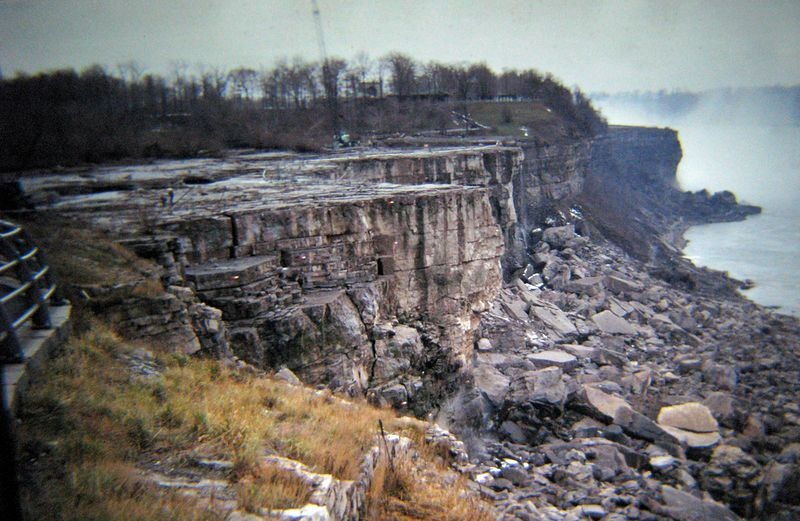
Niagara Falls consists of Horseshoe Falls and the American Falls. Due to several years of rocks falling in, between the year 1931 and 1954, the American Falls faced erosion, which if not prevented would have resulted in the permanent extinction of the American Falls. With resulting public outcry and protests to save the American Falls, the United States Army Corps of Engineers (USACE) – Buffalo district was encumbered with the immense responsibility of dewatering the American Falls for repairs. Taking up this historic challenge, a cofferdam was constructed, that took 3 days after working in two 11-hour shifts, resulting in cutting off of the flow of the Falls from 60,000 gallons per second to one-fourth of its capacity of 15,000 gallons per second.

niagara-falls-turned-off-1969-5

Photo credit: Russ Glasson/Flickr

This gigantic effort, comprising 1,264 truck loads, carrying 27,800 tons of sand and earth, was carried out to fill the cofferdam. Another minor discovery, which emerged from the De-watering Project, was that of a dead-body of a woman, which would never have been possible if the American Falls had been in full-flow. The woman was wearing a gold band, with the tragic inscription ‘forget me not’ on the inside.

Rochester Shale, a type of rock, which started crumbling due to the de-watering project, was a major concern for the geologists who wanted to carry out tests. Pipes totaling 800 feet of length and approximately six inch diameter were laid to moisten the shale.

The motive behind the endeavor to pull off such a huge feat was to conduct tests to prevent further erosion and test the structural integrity of the American Falls. Having planned through all the tests, and having implemented their staggering efforts, USACE estimated that the work will be completed by 1972. A battery of tests consisting of chemical analysis of the rocks, microscopic inspections, and several other tests were conducted accumulating large amounts of engineering, geological, and other data.

After an effort of more than 5 years, the International Joint Commission in 1975 concluded that 385,000 tons of Talus had accumulated at the base of American Falls, and had resulted in reduction of waterfall from 100 feet to 45 feet, while the depth of the Talus ranged from 25 feet to 50 feet.

As per the consensus taken from the public, there was to be no noticeable change in the appearance of American falls. But, it was accepted that there would always be some risk involved in the viewing of falls owing to continued erosion around the Falls.

The important lesson that the effort taught the engineers, and which is also a lesson for all humanity, is that everything has a life span and nothing escapes mortality. May it be flesh and blood humans, or even a stupendous spectacle for humanity such as the Niagara Falls. As is well said, that change is inevitable, and so is the mere existence of everything. It is an important question to be asked that whether something is too big to fall such as the American Falls, or something is too small to rise, like the Talus which over the years caused near extinction of American falls. The dewatering of Niagara Falls in 1969 is abject lesson in the Power of Human effort as compared to the might of Powerful Nature.

niagara-falls-turned-off-1969-1

Photo credit: Russ Glasson/Flickr

niagara-falls-turned-off-1969-6

Photo credit: Russ Glasson/Flickr

niagara-falls-turned-off-1969-7

Photo credit: unknown

niagara-falls-turned-off-1969-8

niagara-falls-turned-off-1969-2

Photo credit: Russ Glasson/Flickr

niagara-falls-turned-off-1969-4

Photo credit: Russ Glasson/Flickr

Source………www.amusingplanet.com

Natarajan

Siachen Miracle – Army Jawan Found Alive, Buried Under 25 Feet of Snow for 6 Days!

Miracles happen! And the Army jawan who was found alive after remaining buried under 25 feet of snow for six days, is a living example of an amazing miracle.

Lance Naik Hanaman Thappa was found in a critical condition after six days of rescue efforts on the Siachen glacier.

siachen2

Source: Twitter

10 Army personnel including a Junior Commissioned Officer (JCO) and nine other ranks of Army’s 19 Madras Regiment were stationed at an altitude of 19,600 feet on the Siachen Glacier in Jammu and Kashmir. On February 3, they were hit by a massive avalanche, and rescue operations have been on since then. The base was located on the Saltoro ridge, close to the Line of Control (LoC) with Pakistan.

On February 4, a Defence Spokesperson had said that the hopes of finding anyone alive were “very remote”. And later, the Indian Army had declared them presumed dead.

After probable locations of the incident were identified by the rescue team with the help of specialised equipment, they had to cut through up to 40 feet of ice at multiple locations. Frequent snow blizzards, extreme freezing temperatures and low visibility made the search operation very difficult.

Army teams have been sifting through huge mass of ice in the hazardous region where temperatures range between minus 42 and minus 25 degrees Celsius.

siachen1

Source: Twitter

“It was a miraculous rescue, all efforts are being made to evacuate Lance Naik Hanaman Thappa to the RR hospital in the morning,” Lt Gen D S Hooda, Northern Army Commander, told PTI.

Five bodies have been recovered so far, and four of them have been identified.

“The teams are working round the clock and observing all precautions since the unstable ice and snow in the region could trigger fresh avalanches. Rescue efforts will continue till all our soldiers are found,” said an Army spokesperson.

On Friday, the Ministry of Defence had released the names of all 10 soldiers who were hit by the avalanche:

1. Subedar Nagesha TT – village Tejur, Hassan district, Karnataka.
2. Havildar Elumalai M – village Dukkam Parai, Vellore district, Tamil Nadu.
3. Lance Havildar S Kumar – village Kumanan Thozhu, Teni district, Tamil Nadu.
4. Lance Naik Sudheesh B – village Monroethuruth, Kollam district, Kerala.
5. Lance Naik Hanamanthappa Koppad – village Betadur, Dharwad district, Karnataka.
6. Sepoy Mahesha PN – village HD Kote, Mysore district, Karnataka.
7. Sepoy Ganesan G – village Chokkathevan Patti, Madurai district, Tamil Nadu.
8. Sepoy Rama Moorthy N – village Gudisatana Palli, Krishna Giri district, Tamil Nadu.
9. Sep Mustaq Ahmed S – village Parnapalle, Kurnool district, Andhra Pradesh.
10. Sepoy Nursing Assistant Suryawanshi SV – village Maskarwadi, Satara district, Maharashtra

The survivor is a resident of Betadur village in Dharwad district of Karnataka.

“We are happy. The entire village is happy and relieved. We were eagerly waiting for some news for past few days. It was difficult to even believe that he was saved. Now, we need everyone to pray for his survival,” his uncle told The News Minute.

Source…….Tanaya Singh in http://www.the betterindia.com

Natarajan

Zika Virus – All You Need to Know…

The ongoing Zika virus outbreak has created fear and uncertainty throughout the world because no-one knows how to contain it or cure it as yet. With that being said, I figured that the best way to protect myself from infection was to inform myself. Here are the five W’s of the Zika virus, and how to protect yourself from contracting it:

Who discovered the Zika virus?

Image Source

Zika was first discovered by scientists in 1947, when a rhesus monkey (pictured) living in Uganda’s Zika forest developed an unknown febrile illness. They were able to isolate a new transmissible agent from the sick monkey, and, in 1952, named it Zika after the forest in which it was discovered.

The first recording of human infection was also made in 1954 after a serological (the study of bodily fluids) survey was conducted on people in Uganda and neighboring Nigeria. Some 50 out of 84 people tested were found to have developed antibodies.

Another study conducted in India around the same time showed that a significant number of the people tested had developed Zika-specific antibodies, indicating the likelihood that the virus has long been present in various human populations.

What is the Zika virus?

The Zika virus is a virus that’s spread by daytime-active mosquitoes that are part of the Aedes genus. They originated in tropical and subtropical zones, however they have now spread around the world. The only place they cannot be found is in Antarctica. Human activity has been in part to blame for the spread of Aedes mosquitoes. An example of this can be seen in how the Asian tiger mosquito made it to the Americas thanks to the used tire trade.

Some 1 in 5 people that are infected with the Zika virus through a mosquito bite actually become ill, and the symptoms they exhibit include fevers, rashes, joint pains, conjunctivitis (redness in the eye), muscle pain and headaches.

The incubation period for the virus is unknown, however it is believed to range from a few days to one week. Its symptoms usually last for the same period. People do not usually get sick enough to go to hospital if infected with the Zika virus, and it is very rare to hear of a death from the virus too.

Zika is related to dengue and yellow fevers, as well as the Japanese encephalitis (inflammation of the brain) and West Nile viruses. It is diagnosed with a specialized blood test, however there is no known cure or vaccine. There have been some media reports of the virus being transmitted sexually, however more evidence is needed to confirm whether this is a cause for widespread concern. Even if it is, the likelihood of this taking place remains very low.

Where did the current Zika virus outbreak start?

While Zika spread through equatorial Africa and Asia between 1951 and 1981, a bona-fide Zika outbreak wasn’t reported until 2007. That took place on the Pacific island of Yap, and thus remained relatively contained.

The current Zika outbreak first began last year in Brazil. Researchers suggested that the virus arrived in the country from French Polynesia sometime during 2014. In May 2015, a dengue-like disease outbreak took hold in northern, northeastern and southeastern Brazil. Many patients were exhibiting flu-like symptoms, followed by rashes and joint pain.

The outbreak reached Colombia by October 2015, before reaching other South American countries, as well as the Caribbean in November and December. At the time of writing, there were also confirmed cases in Central America, the United States, Australia and Europe. In fact, the World Health Organization has said that it expects Zika to spread throughout the entire Americas in the coming weeks.

When should you be concerned about the Zika infection?

Zika is said to have the most severe effects on pregnant women and children, however anyone is vulnerable to infection. If you have visited one of the affected countries and are exhibiting any of the symptoms mentioned in this article, see a doctor as soon as possible. He or she may prescribe blood tests to conduct further investigations should there be suspicion of you having contracted the virus.


Why has Zika become an international health concern?


As aforementioned, the ongoing Zika outbreak commenced in Brazil in May 2015. The main cause for concern over the virus is the fact that there has been a huge spike in births of babies with microcephaly in the affected regions of that country. That is why the virus’ movement is being tracked and reported on all over the world.

Microcephaly is a condition where a baby’s head is much smaller than expected. It occurs because a baby’s brain has not developed properly during pregnancy, or because it stops growing after birth, resulting in a smaller head size. While it can be an isolated birth defect, it can also occur in combination with other major defects, such as developmental delay, intellectual disability and proneness to seizures.

In a nutshell, the World Health Organization is doing what it can to halt Zika’s progress in order to protect unborn children. Currently the biggest fear is that there will be an explosion of microcephaly cases around the world.

How to Protect Yourself From Contracting Zika


– Avoid traveling to countries where the virus has been confirmed.

– If you must, wear long-sleeved shirts and pants.

– Stay somewhere air-conditioned or use windows and door screens to keep any mosquitoes outside.

– Sleep under a mosquito bed net if possible.

– Use insect repellent.

– If you have a child, dress in clothing that covers the arms and legs and use mosquito netting to cover cribs or strollers.

– Treat your clothing with permethrin (a synthetic insecticide), or purchase permethrin-treated items.

–  Use protection if you intend to sleep with someone who has just returned from traveling in a Zika-affected region.

Source……….www.ba-bamail.com

Natarajan