ஹைக்கூ எழுதும் டீக்கடைக்காரர்……

கோவையைச் சேர்ந்தவர் நா.முத்து. டீக் கடைக்காரர். கவிஞர். சாகித்ய அகாதெமி சார்பில், சிறந்த 100 ஹைக்கூ கவிதை தொகுப்புகளை தேர்ந்தெடுத்ததில் இவரது கவிதைத் தொகுப்பும் ஒன்று.

நா.முத்து 8-ஆம் வகுப்பு வரைதான் படித்தார். படிப்பை பாதியிலேயே நிறுத்திவிட்டு தன் அப்பாவுடன் டீக்கடைப் பணியில் சேர்ந்துவிட்டார். ஏன்? படிக்கவில்லை என்று

கேட்டபோது, “”எவ்வளவு புத்தகங்களை வேண்டுமானலும் வாசிப்பேன். ஆனால், மனப்பாடம் செய்து எழுதுவது  எனக்கு சுத்தமாகப் பிடிக்காது. அதனால் தான் படிக்கவில்லை.

ஆனால், படிக்காதது இப்போது வருத்தமாக உள்ளது” என்கிறார்.

“தலைவர் எழுச்சியுரை, உற்சாகம் தந்தார் சுக்குக் காப்பிக்காரர்’

“நேரம் சரியில்லை கடிகாரக் கடை’ என்பது போன்ற நகைச்சுவை ஹைக்கூ கவிதைகளை அள்ளி வீசுகிறார்.

நகைச்சுவை ஹைக்கூக் கவிதைகளை மட்டுமே மையமாக வைத்து எழுதாமல், சமூக நோக்கிலும் பல ஹைக்கூக் கவிதைகளை எழுதியுள்ளார்.

“ஆயிரம் மரங்கள் மரணம்

ஆறுவழிச் சாலை ஜனனம்

அதில் ஆயிரம் வாகனங்கள் பயணம்

ஒவ்வொரு வாகனத்திலும் ஒரு வசனம்

மரம் நடுவோம், மழை பெறுவோம்’

என்கிற கவிதையை கோவை, அவிநாசி சாலையை மையமாக வைத்து எழுதியுள்ளார்.

ஹைக்கூ கவிதையில் ஆர்வம் வரக் காரணம் என்னவென்று கேட்டோம்:

“”நாம் பார்ப்பதெல்லாம் ஹைக்கூ தான். எதைப் பார்த்தாலும் எதாவது சொல்ல வேண்டும் என்கிற முனைப்பு தான் ஹைக்கூ கவிதை எழுதுவதற்கு தூண்டுகோலாக இருந்தது. எனவே, நான் பார்ப்பதை, யோசிப்பதை தெளிவாக சொல்ல வழிவகுத்தது ஹைக்கூ கவிதை தான்.

இதுவரை இரண்டு புத்தகங்கள் எழுதியுள்ளேன். அதில், “இருக்கு’ என்கிற புத்தகம் வெளியிடப்பட்டுள்ளது. தற்போது, சூழல் சார்ந்த கவிதைப் புத்தகம் விரைவில் வெளியிடப்படவுள்ளது. “எடை குறைவாய்’ என்கிற கவிதைத் தொகுப்பை எழுதி வருகிறேன்.

குறும்படங்கள், வீதி நாடகங்கள், கோவை வானொலியில் கவிதைகள் வாசிப்பது, புகைப்படக் கலை, இலக்கியக் கூட்டங்களில் பேசுவது என தற்போது வாழ்க்கை ஓடிக் கொண்டிருக்கிறது.

பாரதியார் கவிதைகள் மிகவும் பிடிக்கும். “உள்ளத்தில் உண்மை ஒளி உண்டாயின் வாக்கினிலே ஒளி உண்டாகும்’ என்பது என் மனதுக்குப் பிடித்த கவிதை. பாரதியின் கவிதைகளைப் படிக்கும்போதே உற்சாகமும், தைரியமும் பிறக்கும். எனவே, அவரது கவிதைகளை அதிகம் வாசிப்பேன்.

“நம் பிறப்பு சாதாரணமானதாக இருக்கலாம் ஆனால், நம் இறப்பு ஒரு சரித்திரமாக மாற வேண்டும்’ என்ற வரிகளுக்கேற்ப எவ்வளவு சாதாரணமானவராக இருந்தாலும் ஒவ்வொருவருக்குள்ளும் ஒரு திறமை இருக்கும். அதைக் கண்டறிந்து செயல்படுத்துவதே அறிவுடைமையாகும் என்பதற்கு சான்று டீக்கடை முத்து.

Source:::::www.dinamani.com

Natarajan


லீ: சிங்கப்பூரின் சிற்பி…….மறக்க முடியாத மாமனிதர் …

சிங்கப்பூர் வரலாற்றில், சிங்கப்பூர் என்ற சொல்லோடு பிரித்துப் பார்க்க முடியாததாக இருந்த இன்னொரு சொல் உதிர்ந்திருக்கிறது: லீ குவான் யூ. சிங்கப்பூரைப் பொறுத்தவரையில் சுதந்திரம் வாங்கித்தந்த காந்தியும் இவரே, சுதந்திரத்துக்குப் பிறகு நாட்டை வளர்ச்சிப் பாதையில் வழிநடத்திய நேருவும் இவரே!

உலக வரைபடத்தில் சின்னஞ் சிறிய புள்ளியாக இருக்கும் சிங்கப்பூரை, இன்று நிர்வாகம், தொழில்நுட்பம், வணிகம் என்று பல துறைகளிலும் உலக நாடுகள் வியக்கும் சாதனை நாடாக மாற்றியமைத்த மாயாஜாலக்காரராகவே உலகத் தலைவர்கள் இவரைப் பார்க்கிறார்கள். பிரிட்டிஷ் ஆட்சியில் இருந்து விடுபட்டு, சிங்கப்பூர் என்ற சுதந்திர நாடு உருவான நாள்தொட்டு, அரை நூற்றாண்டுக்கும் மேலாக லீ குவான் யூவின் மக்கள் செயல் கட்சியே சிங்கப்பூரின் ஆளும் கட்சி. சிங்கப்பூரின் முதல் பிரதமரான லீ, தொடர்ந்து 8 முறை பிரதமராக இருந்தவர். உலகின் மிக நீண்ட காலப் பிரதமர்!

லீயுடன் ஓர் உரையாடல்

உலகம் முழுவதும் லீயைப் பற்றி இரு விதமான பேச்சுகள், மதிப்பீடுகள் உண்டு. அவர் சிங்கப்பூரை வளர்த்தெடுக்க எந்தக் கட்டுப்பாடுகளை ஒரு கருவியாகப் பயன்படுத்தினாரோ, பெரும்பாலும் அதுதான் இந்தப் பேச்சுகள், மதிப்பீடுகளின் மையப்புள்ளி. ஒருமுறை, நான் படித்த சிங்கப்பூர் தேசியக் கல்லூரிக்குச் சிறப்பு விருந்தினராக லீ குவான் யூ வந்திருந்தார். அவருடைய நிகழ்ச்சியின் ஒரு பகுதியாக மாணவர்கள் அவரோடு கலந்துரையாடும் நிகழ்வுக்கு ஏற்பாடு செய்யப்பட்டிருந்தது. லீ – சிங்கப்பூர் இரண்டுக்குமான பல்வேறு யூகங்களுக்குப் பதிலாக அமைந்ததோடு, அவருடைய தனித்துவமான அரசியல் – நிர்வாகப் பார்வையையும் வெளிக்காட்டியது அந்த உரையாடல்.

மாணவர்கள் நிறையக் கேட்டோம், எல்லாவற்றுக்கும் பதில் சொன்னார். அரை நூற்றாண்டுக்கு முந்தைய சிங்கப்பூர் – இன்றைய சிங்கப்பூர் பற்றிக் கேட்டபோது, அப்படியே மவுனத்தில் ஆழ்ந்தார். ஒரு இடைவெளிக்குப் பின் பேசினார்: “50 வருடங்களுக்கு முன் இந்தச் சின்ன தீவில் பிழைப்புக்காக வந்து இறங்கியவர்கள்தான் இன்றைய வளர்ந்து நிற்கும் சிங்கப்பூருக்கான திடமான அஸ்திவாரத்தைப் போட்டவர்கள். எந்தெந்த நாடுகளில் இருந்தோ இங்கு வந்திறங்கி, பத்துக்குப் பத்து சதுர அடியில் எட்டுப் பேர் நெருக்கியடித்துக்கொண்டு கிழிந்த உடைகளும், போஷாக்கு இல்லாத உணவும் கொண்டு உயிர் வளர்த்தவர்கள் கொடுத்த உழைப்புதான் இந்த நாட்டுக்கான உரம். இன்று மழை பெய்யும்போது குடை பிடிக்கும் அவசியம் இல்லாமல் சாலை ஓரம் எங்கும் கூரை வேயப்பட்டிருக்கிறது. உலக அரசாங்கங்கள் பாடம் படிக்கும் நவீன சொகுசுப் பேருந்து போக்குவரத்து வசதியை அனுபவிக்கிறோம். இதற்கெல்லாம், முகம் மறந்து போன அந்தப் பாட்டன்களுக்கும் முப்பாட்டன்களுக்கும் நாம் செலுத்த நன்றி மிச்சம் இருக்கிறது.”

மாறாத வடு

சிங்கப்பூர் மலேசியாவுடன் இணைந்திருக்க வேண்டும் என்று விரும்பியவர் லீ. ஒன்றிணைந்த மலேசியாவின் வர்த்தகத் தலைநகராக சிங்கப்பூர் இருக்க வேண்டும் என்று கனவு கண்டவர்.

மலேசியாவுடன் சிங்கப்பூரை இணைக்க நடவடிக்கைகள் எடுத்தார். ஆனால், மலேசிய அரசாங்கத்துடன் சரியான உடன்படிக்கை ஏற்படாத காரணத்தால், மிகுந்த போராட்டத்துக்குப் பிறகு, கண்கள் கலங்க, தலைகுனிந்து விசும்பியபடி சிங்கப்பூர் -மலேசியப் பிரிவினை அவர் அறிவித்தார். பின்னொரு நாளில், அந்தச் சம்பவத்தை நினைவுகூர்ந்தார். “1965-ல் சிங்கப்பூரை மலேசியாவில் இருந்து பிரிந்த சுதந்திரக் குடியரசாக நான் அறிவித்தேன். நாடு முழுவதும், பலரும் அதைப் பட்டாசுகள் வெடித்தும், இனிப்புகள் பரிமாறியும் கொண்டாடினர். ஆனால், எனக்கோ தூக்கங்கள் இல்லாத இரவுகளாக, மிகுந்த மன உளைச்சலுடனேயே நாட்கள் கழிந்தன. சிங்கப்பூருக்கு இது வாழ்வா, சாவா பிரச்சினை. ஒரு தனி நாடாக இயங்குவதற்குத் தேவையான இயற்கை வளம், மனித வளம் எதுவும் நம்மிடம் கிடையாது. சிங்கப்பூரின் சொத்து, கடல் வணிகத்துக்கு ஏதுவான நமது புவியியல் அமைப்பு மட்டுமே. இருந்தாலும் நமது குறைகள் அனைத்தையும் தகர்த்து, இன்று உயர்ந்த நிலையை நாம் எட்டியிருக்கிறோம். இதற்கான முழு பாராட்டும், நம் மண் மீது நம்பிக்கைகொண்டு இங்கு புலம்பெயர்ந்தவர்களும் அவர்களது அயராத உழைப்புமே.”

தன் தலைமுறையைச் சேர்ந்த ஒவ்வொரு சிங்கப்பூர் வாசியையும் அவர், தங்களை வருத்திக்கொண்டு நாட்டைச் செதுக்கிய தியாகிகளாகவே பார்த்தார்.

ஒழுக்கம் மட்டுமே உயர்வு தரும்

19-ம் நூற்றாண்டின் தொடக்கங்களில், சிங்கப்பூர் பிரிட்டிஷ் கட்டுப்பாட்டில் இயங்கிவந்தது. மற்ற பிரிட்டிஷ் காலனிகளைப் போலவே சிங்கப்பூரும் ஓரளவு வளர்ச்சி கண்டது. இருப்பினும் சொல்லிக்கொள்ளும்படியான உள்கட்டமைப்பு வசதிகள் அந்தக் காலகட்டத்தில் இல்லை. சொல்லப்போனால், அன்றைய சென்னையின் நிலவரத்தில் அரைப் பங்குகூட இல்லை.

சிங்கப்பூர் விடுதலை பெற்று, லீ குவான் யூ ஆட்சிப் பொறுப்பில் அமர்ந்தவுடன், கடுமையான சட்டங்கள் பாய்ந்தன. சாலையில் எச்சில் உமிழ்ந்தால் பிரம்படி; பொதுமக்களுக்குப் பாதிப்பு ஏற்படுத்தும் வகையிலான சட்டவிரோதச் செயல்களில் ஈடுபட்டால் ஜெயில் தண்டனை; போதைப் பொருட்கள் உட்கொண்டாலோ, பகிர்ந்தாலோ மரண தண்டனை – இப்படியான சட்டங்களால் நாடே கிடுகிடுத்துப் போனது. இதனால் பலரது விரோதத்துக்கும் அவப்பெயருக்கும் லீ ஆளாக வேண்டியிருந்தது. இருந்தாலும், அதையெல்லாம் அவர் பெரிதாகப் பொருட் படுத்தவில்லை. “நாட்டின் வளர்ச்சிக்குச் சில தியாகங்களைச் செய்தாக வேண்டும். அது ஆரம்பத்தில் ஒரு கசப்பான கஷாயமாகத்தான் இருக்கும். ஆனால், காலப்போக்கில் அதன் பலன்களை நீங்கள் கட்டாயம் அறுவடை செய்வீர்கள்” என்றார்.

அதுமட்டுமல்லாமல், தெளிவான பொருளாதாரக் கொள்கைகளாலும், முதலீட்டுக் கட்டமைப்புகளாலும் சிங்கப்பூரை என்றென்றைக்கும் அந்நிய முதலீட்டாளர்களை ஈர்க்கும் சொர்க்கமாக மாற்றினார். சமீபத்திய உதாரணம், ஃபேஸ்புக் நிறுவனத்தைத் தோற்றுவித்தவர்களில் ஒருவரான எடுவார்டோ சாவரின், தனது அமெரிக்க குடியுரிமையைத் துறந்துவிட்டு, சிங்கப்பூர்வாசியாகி இருப்பது.

அரசியலுக்குத் தகுதி தேவையில்லையா?

அரசியல் பதவிகளுக்கு நிறைய தகுதிகள் வேண்டும் என்று நினைத்தவர் லீ. “எதன் அடிப்படையில் உங்கள் அரசாங்கத்தின் அமைச்சர்களைத் தேர்ந்தெடுக்கிறீர்கள்?” என்று கேட்டபோது சொன்னார்: “எந்தப் பதவியும் இல்லாமலே திறனுடன் செயல்படுபவர்களை ‘சைக்கோமெட்ரிக் சோதனைகள்’ வழியாக ஆராய்வதுதான் முதல் பணி. அந்தப் பயிற்சியில் அவர்கள் அரசியல் எனும் பெருங்கடலில் நீந்தக்கூடிய திறன் படைத்தவர்கள் என்று தேர்வானால், நாடாளுமன்ற உறுப்பினர் ஆவார்கள். அடுத்த இரண்டு ஆண்டுகளுக்கு அவர்களுக்கு எந்தச் சலுகைகளும், பதவி உயர்வுகளும் அளிக்காமல் தத்தமது தொகுதிகளை அவர்கள் எவ்வாறு பராமரிக்கிறார்கள் என்பதைக் கண்காணிப்போம். முடிவில் அவரவர் திறனுக்கேற்ப அவர்களை இளநிலை அமைச்சர்களாகவோ, அமைச்சராகவோ நியமிக்கிறோம். இத்தனை கடும் சோதனைகளைக் கடந்துவருபவர்கள், பெரும்பாலும் சேவை மனப்பான்மையுடனும், தன்னலம் கருதாச் சமூக அக்கறையுடனும் செயலாற்றக் கூடியவர் களாகவே இருக்கிறார்கள்.”

இப்படித் திறமையான, நேர்மையான அரசியல்வாதியைக் கண்டெடுப்பது, வெறும் முதல்கட்டப் பணி மட்டுமே. அதன் பிறகு, அவர்கள் அதே நேர்வழிப் பாதையில் பயணிக்க வேண்டும் என்றால், அவர்களுக்கு வழங்கப்படும் ஊக்கத்தொகை ஊக்கமூட்டுவதாக இருக்க வேண்டும். “மக்களின் காசுக்கு ஆசைப்படாத அளவுக்கு ஊதியத்தை அரசே அளித்துவிட்டால், அதிகாரத்தில் இருப்பவர்கள் வெளியில் கை நீட்ட மாட்டார்கள்” என்பதும் லீயின் நம்பிக்கை களில் ஒன்று. சிங்கப்பூரின் ஆறு முன்னணித் துறைகளில் அதிக ஊதியம் பெரும் முதல் எட்டுப் பேரின் வருமானம் எவ்வளவோ, அதில் மூன்றில் இரண்டு பங்கு சிங்கப்பூர் அமைச்சர்களின் ஊதியம். லீயின் நம்பிக்கைகளுக்கும் செயல்பாடுகளுக்கும் இடைவெளி இருப்பதில்லை.

வாரிசு அரசியலுக்கும் தகுதி தேவை

“பலம் மிக்க அரசியல் குடும்பத்து வாரிசுகள், சமுதாயத்தில் கட்டாயம் உயர்பதவி வகிக்கலாம். ஆனால், அதில் ஒரு தர்மமும் வேண்டும்” என்று சொல்வார் லீ. அவரது மூத்த மகன் லீ சியன் லூங், புகழ்பெற்ற ஹார்வர்டு பல்கலைக்கழகத்தில் முதுகலைப் பட்டம் பெற்றவர். 13 வருடங்கள் சிங்கப்பூர் ராணுவத்தில் முறையே பயிற்சி பெற்ற லீ சியன் லூங், 1990-ல் துணைப் பிரதமர் ஆனார். 14 வருடங்கள் கழித்து, 2004-ல் பிரதமர் ஆனார்.

இளைய மகன் லீ சியன் யாங், ஸ்டான்பர்ட் பல்கலைக் கழகத்தில் முதுகலைப் பட்டம் பெற்றவர். அவரும் சிங்கப்பூர் ராணுவத்தில் பணியாற்றியவர். பின் அந்நாட்டின் புகழ்பெற்ற தொலைத்தொடர்பு நிறுவனமான சிங்டெல் நிறுவனத்தில் பணியில் சேர்ந்து, பின் அதன் முதன்மை நிறுவனராக உயர்ந்தார். இப்போது சிங்கப்பூர் விமானப் படைத் தலைவர்.

இப்படி லீ குடும்பத்து வாரிசுகள் அரசில் கோலோச்சினாலும், யாரும் அவர்களுடைய தகுதியைக் கேள்விக்குள்ளாக்க முடியாது, இந்திய / தமிழக அரசியலைப் போல ‘வாரிசு முறை’ இவர் விஷயத்தில் சர்ச்சை ஆகவில்லை.

மாற்றம் ஒன்றுதான் மாறாதது

சுமார் 50 ஆண்டுகளாக எதிர்க் கட்சிகளை ஒரு சில தொகுதிகளில் மட்டுமே ஜெயிக்க விட்டுக்கொண்டிருந்த லீ குவான் யூவின் மக்கள் செயல் கட்சி, 2011 தேர்தலில் சறுக்கல் களைச் சந்தித்தது. அந்தத் தேர்தலில் தங்கள் கைவசம் இருந்த முக்கியமான 6 தொகுதிகளை இழந்தது. இதன் தொடர்ச்சியாக, செயற்குழுவைக் கூட்டி, சுயபரிசோதனையில் இறங்கியது லீயின் கட்சி. “இன்றைய இளைஞர்களுக்குத் தங்கள் எதிர்காலம் மீதும், நாட்டின் முன்னேற்றத்திலும் அதிக அக்கறை உள்ளது. இணையம் வழியாக அவர்கள் பதிவிடும் கருத்துக்கள், நாடாளுமன்றம் வரை ஒலிக்க வேண்டும் என்று அவர்கள் நினைக்கின்றனர். உடனுக்குடன் மாற்றத்தை எதிர்பார்க்கும் இந்த நவீன குரல்களுக்குச் செவிசாய்க்கும் சுறுசுறுப்பான அமைச்சர்களையே தங்கள் பிரதிநிதிகளாக அவர்கள் எதிர்பார்க்கிறார்கள். ஒன்று, கால மாற்றத்துக்கு ஏற்றார்போல் நம்மை வடிவமைத்துக்கொள்ள வேண்டும். அல்லது இளைய சமுதாயத்துக்கு வழிவிட்டு, கவுரவமாக நாம் விலகிக்கொள்ள வேண்டும். இதனைக் கருத்தில் கொண்டு, இதுவரை மக்கள் செயல் கட்சியின் அரசியல் ஆலோசகராக இருந்துவரும் நான், அரசியலிலிருந்து நிரந்தரமாக விலகிக்கொள்வதாக அறிவிக்கிறேன்” என்று அறிவித்தார் லீ.

தன்னைப் போன்ற மூத்தவர்கள், இளைஞர்களுக்கு வழிவிட வேண்டிய தருணம் வந்துவிட்டது என்பதைத் தானே முன்னின்று ஏனையோருக்கு உணர்த்தினார்.

கல்லறையிலிருந்து வருவேன்

தன் மீதான விமர்சனங்கள் மீது – கட்டுப்பாடுகள், சுதந்திரத் தலையீடு, கருத்துச் சுதந்திரம், ஏனைய அரசியல் தலைவர்கள் / கட்சிகள் மீதான கட்டுப்பாடு – பற்றியும் லீ பேசியிருக்கிறார். “தேசத் தலைவர் என்று வந்துவிட்டால், மக்களின் பார்வையும், விமர்சனங்களும் நம் மீது எப்போதும் இருந்துகொண்டே இருக்கும். அப்படியான விமர்சனங்களைக் கருத்தில்கொண்டு, ஆட்சிமுறையில் மக்களுக்குத் தேவையான மாற்றங்களைக் கொண்டுவர வேண்டும். என் பார்வையில் கருத்துச் சுதந்திரம் அவசியம். எனினும், அது சரியான அளவுகோலில் உரிய எல்லைக்குள் இருப்பதும் அவசியம்.

சிங்கப்பூரை ஆட்சி செய்பவர் எவராக இருந்தாலும், அவரிடத்தில் இரும்பு போன்ற திடம் இருக்க வேண்டும். ஏதோ, வந்தோம் சென்றோம் என்று விளையாட்டாக ஆட்சி செய்துவிட்டுப் போக இது ஒன்றும் சீட்டாட்டம் இல்லை. சிங்கப்பூரை வளர்க்க நான் என்னுடைய மொத்த ஆயுளையும் அர்ப்பணித்திருக்கிறேன். நான் உயிருடன் இருக்கும் வரையில் என் நாட்டை யாரிடமும் விட்டுக்கொடுக்க மாட்டேன். ஒருவேளை, நாளை நான் இறந்த பிறகும், என் நாட்டுக்கு ஏதாவது ஒரு வகையில் அச்சுறுத்தல் நேர்ந்தால், கல்லறையில் இருந்தும் எழுந்துவருவேன்!”

இலங்கைத் தமிழர்க்கு ஆதரவு!

லீக்கு தமிழர்கள் மீது பெரும் மதிப்பு உண்டு. இலங்கைத் தமிழர் விவகாரத்தில் வெளிப்படையாக இலங்கை அரசைக் கடுமையாக விமர்சித்தவர் அவர்.

“இலங்கை கட்டாயம் ஒரு சந்தோஷமான நாடாக இருக்க வாய்ப்பில்லை. யாழ்ப்பாணத்தில் வாழும் தமிழர்களுக்கு இழைக்கப்படும் அநீதியைப் பார்த்துப் பொறுக்க முடியவில்லை. இலங்கையில் சிங்களர்கள் இருந்த காலம் தொட்டுத் தமிழர்களும் இருந்துவருகின்றனர். அந்த நிலப்பரப்பில் இரு இனத்தவர்களுக்கும் உரிமை உண்டு. ஆனால், திறமையில் தமிழர்களைக் காட்டிலும் பின்தங்கிய சிங்களர்கள் தாழ்வு மனப்பான்மையால் தமிழர்களைக் கொன்றுவருகின்றனர். அதை எதிர்த்து ஈழத் தமிழர்கள் தொடுத்த போர் என்னைப் பொறுத்தவரை நியாயமானதே!

நான் ராஜபக்சவின் சில பிரச்சாரங்களையும், மேடைப் பேச்சுக்களையும் கேட்டிருக்கிறேன். அதை எல்லாம் வைத்துப் பார்க்கும்போது அவர் ஒரு ‘சிங்கள வெறியர்’ என்றுதான் தோன்றுகிறது. வெற்றிக்காக எதையும் துணிந்து செய்யக் கூடியவர் என்று புரிகிறது.

இந்தப் போரில் தமிழர்களின் தோல்வி தற்காலிக மானது. அவர்கள் வெகு நாட்கள் அமைதியாக இருக்கப் போவதில்லை. கூடிய விரைவில் மீண்டு வருவார்கள்” என்று லீ குவான் யூ குறிப்பிட்டிருக்கிறார்.

– ஏ. ஆதித்யன்,

சிங்கப்பூரைச் சேர்ந்த பத்திரிகையாளர் – எழுத்தாளர்,

இந்தோனேசிய http://www.ayobis.com நிறுவனத்தின் முதன்மை நிறுவனர், தொடர்புக்கு : adi1101990@gmail.com 

Source:::: http://www.tamil.thehindu.com

Natarajan

Stockholm Water Prize 2015 for an Indian from Rajasthan ….

India’s waterman Rajendra Singh has been awarded the 2015 Stockholm Water Prize for his consistent and innovative efforts in Rajasthan to save water in rural areas.

The Stockholm Water Prize, founded in 1991 is presented annually by the Stockholm International Water Institute (SIWI) to an individual, organisation or institution for outstanding water-conservation achievements and it carries a cash amount of $150,000 and a specially designed sculpture.

Rajendra Singh interacting with Teri University Students(Photo: Abhinav619)

Rajendra Singh interacting with Teri University Students(Photo: Abhinav619)

Rajendra Singh, who hails from Dollah village of Baghpat district in Uttar Pradesh, shifted to Rajasthan 35 years ago to provide medicines to the old in village areas.

“I used to provide medicines to the old in Rajasthan villages. I also used to help children to go to school but one day an elderly man told me that the people there don’t need medicine or education but water,” he told IANS.

His direction in life changed eversince as he started working on water problems in the villages there. Though he did not have any knowledge of water harvesting or how to get the ground water table recharged, local people helped him learn and he never look back after that in his mission to work on johad or earthen check dams.

These check dams are traditionally used to store rainwater and recharge groundwater, a technique which had been abandoned for decades and revived by Rajendra Singh. With the help of a few local youths he started desilting the Gopalpura johad, lying neglected unused.

When the monsoon arrived, the johad filled up and soon wells which had been dry for years nearby too had water. Villagers pitched in and in the next three years, it made it 15 feet deep.

He had set up Tarun Bharat Sangha in mid-1980s and started padayatra through the villages educating people to rebuild villages’ old check dams. Soon, taking his example, villagers constructed a johad at the source of a dried Arvari River, and along it also built tiny earthen dams, with largest being a 244-meter-long and 7-meter-high concrete dam in the Aravalli hills.

When the number of dams reached 375, the river started to flow again in 1990, after remaining dry for over 60 years.

Later, he turned his attention to Sariska, where mining pits left unfilled led to drought despite constructing johads. He petitioned to the Supreme court, which in turn banned mining in the area and the TBS built 115 earthen and concrete structures within the sanctuary and 600 other structures in the buffer and peripheral zones that paid off and by 1995 Aravri became a perennial river.

In the coming years, rivers like Ruparel, Sarsa, Bhagani and Jahajwali were revived after remaining dry for decades and farming activities could be resumed in hundreds of drought-prone villages in neighbouring districts of Jaipur, Dausa, Sawai Madhopur, Bharatpur and Karauli.

By 2001, his movement had spread over an area of 6,500 km, including also parts of Madhya Pradesh, Gujarat and Andhra Pradesh. It had built 4,500 earthen check dams to collect rainwater in 850 villages of Rajasthan, and he was awarded the Magsaysay Award for Community Leadership for his yeoman service.

In 2005, he was awarded the Jamnalal Bajaj Award. He also played a pivotal role in stopping the controversial Loharinag Pala Hydro Power Project over river Bhagirathi, the headstream of the Ganges River in 2006.

In 2009, he led a pada yatra through Mumbai city along the endangered Mithi river and is currently doing a parikrama along the banks of Godavari river, from Trimbakeshwar to Paithan to educate people to make the river pollution free.

SOURCE:::::www.microfinance monitor.com

Natarajan

Image of the Day…. Vanguard satellite…

One of the Vanguard satellites is checked out at Cape Canaveral, Florida in 1958. Vanguard 1, the world’s first solar-powered satellite, launched on St. Patrick’s Day (March 17) 1958. It was designed to test the launch capabilities of a three-stage launch vehicle and the effects of the environment on a satellite and its systems in Earth orbit. Vanguard 1 was the second U.S. satellite in orbit, following Explorer 1, and remains the oldest artificial object orbiting Earth to this day. Vanguard began as a program at the Naval Research Laboratory in Washington and transferred over to NASA (along with many of its personnel) after the agency was founded by the National Aeronautics and Space Act of 1958.

Image Credit: NASA 

SOURCE::::: http://www.nasa.gov

Natarajan

” ‘Darbha’ grass, a natural preservative “…. ‘தர்ப்பை’ ஒரு சாதாரண புல் அல்ல !!!

A systematic research by SASTRA University researchers

Traditional tropical grass, Darbha, has been identified as an eco-friendly food preservative.

Darbha (Desmotachya bipinnata) is a tropical grass considered a sacred material in Vedic scriptures and is said to purify the offerings during such rituals.

Darbha (Desmotachya bipinnata) is a tropical grass considered a sacred material in Vedic scriptures and is said to purify the offerings during such rituals.

This finding was evolved in a research study undertaken jointly by the Centre for Nanotechnology and Advanced Biomaterials (CeNTAB) and the Centre for Advanced Research in Indian System of Medicine (CARISM) of the SASTRA University, Thanjavur, under the supervision of Dr. P. Meera and Dr. P. Brindha respectively.

Darbha (Desmotachya bipinnata) is a tropical grass considered a sacred material in Vedic scriptures and is said to purify the offerings during such rituals.

At the time of eclipse, people place that grass in food items that could ferment and once the eclipse ends the grass is removed.

A systematic research was conducted by the SASTRA University researchers, in which cow’s curd was chosen as a food item that could ferment easily.

Five other tropical grass species, including lemon grass, Bermuda grass, and bamboo were chosen for comparison based on different levels of antibiotic properties and hydro phobicity.

Electron microscopy of different grasses revealed stunning nano-patterns and hierarchical nano or micro structures in darbha grass while they were absent in other grasses.

On studying the effect of various grasses on the microbial community of the curd, darbha grass alone was found to attract enormous number of bacteria into the hierarchical surface features.

These are the bacteria responsible for fermentation of cow’s curd.

During eclipse, the wavelength and intensity of light radiations available on the earth’s surface is altered. Especially, the blue and ultraviolet radiations, which are known for their natural disinfecting property, are not available in sufficient quantities during eclipse.

This leads to uncontrolled growth of micro-organisms in food products during eclipse and the food products are not suitable for consumption. Darbha was thus used as a natural disinfectant on specific occasions, say researchers at SASTRA University.

Further, the scientists say that darbha could be used as a natural food preservative in place of harmful chemical preservatives and the artificial surfaces mimicking the hierarchical nano patterns on the surface of darbha grass could find applications in health care where sterile conditions were required.

This entire research was funded by the SASTRA University’s Research Fund.

Keywords: SASTRA University researchdarbha researchdarbha grassorganic preservativetraditional tropical grassVedic systems

SOURCE::::::::::L.Renganathan in  www.the hindu.com

Natarajan

Secrets of the Success of Warren Buffett…He Does not Owe His Fortune to Magic !!!

If you’re interested in finance, trying to crack the secret of Warren Buffett’s success is as entertaining as it is maddening — an enticing Rubik’s cube for anyone looking to get rich.

Buffett’s success is so elusive — and so far, unreplicated — that it took a team of Yale academics to determine the Oracle of Omaha does not owe his $73 billion fortune to magic.

“Buffett’s returns appear to be neither luck nor magic,” found a 2013 research paper published on Yale’s website, which boiled down Buffett’s actual secret sauce to “reward for use of leverage combined with a focus on cheap, safe, quality stocks.” (Not-so-secret, really: Buffett admitted to this strategy more than 30 years ago.)

Still, if asked to explain the source of his “alpha,” Buffett is as divided as his devotees — at times shmaltzy (“I found what I love to do very early”), other times coy (“You can’t produce a baby in one month by getting nine women pregnant”) and more often than not, completely blunt: “‘Price is what you pay; value is what you get.’ Whether we’re talking about socks or stocks, I like buying quality merchandise when it is marked down.”

Warren Buffett

Berkshire Hathaway chairman Warren Buffett gestures at the start of a 5km race.

We interviewed some of America’s biggest money experts, and threw them a gauntlet: Tell us the secret to Warren Buffett’s success.

Here’s how they explained the Oracle’s track record.

1. His No. 1 focus is growing his wealth.

According to Brandon Turner, real estate investor and co-host of “BiggerPockets Podcast,” Buffett has a single-track mind — and that’s worked well for him.

“I think Warren Buffett succeeded because he focused 100% on growing wealth above all other things,” Turner said. “He made it a point to continue his education his entire life and stick to sound business principles.”

2. He invests in businesses that aren’t competitive.

“Warren Buffett identifies companies that generally don’t face an enormous amount of competition, and holds them for years — or forever,” said Clark Howard, a consumer expert and host of “The Clark Howard Show.” “His failures have tended to be in businesses that were too competitive.”

3. He doesn’t scare easy.

Andrew Horowitz, CFP, author and host of “The Disciplined Investor,” told us Buffett owes his wealth to one factor: “Time. He has a holding period that appears to be infinite so he does not get spooked by market moves. He also knows that the best time to buy is when everyone else is selling.”

4. He doesn’t let his ego get in the way.

Journalist Emma Johnson, host of “Like a Mother with Emma Johnson,” mentioned Buffett’s famous penchant for value investing — but said his real X-factor was his personality.

“As an investor, Buffett’s success is well-documented — he buys easy-to-understand companies with reasonable management and an intrinsic value. So easy, anyone can understand it,” Johnson said. “But Buffett’s success as a beloved public character is the real magic. We can attribute that to his humble persona: We love him for his habits that include banjo-playing, cheeseburger devotion, and that he has lived in the same, relatively modest house in not-so-glamorous Omaha for 55 years. That he is self-made and earned 99% of his wealth after age 50 inspires us to believe that success is possible for all of us, and his adherence to a modest life of family and charity are great lessons on wealth that apply to us all. He’s both fabulous and accessible, and we love him for it.”

5. He takes advantage of a simple and age-old combination.

Buffett uses a straightforward formula that pays off for anyone who gives it the time, said John Lee Dumas, founder and host of the podcast “Entrepreneur On Fire”: “Compound interest plus patience​.”

6. He sticks to what he knows.

“I don’t know much about Warren Buffett other than I’ve heard that he invests in what he ‘knows‘ and/or has ‘learned,'” said Matt Theriault, host of the podcast “Epic Real Estate Investing.” “In my experience, with the right education and information backing investment decisions, most people would be a success.”

7. He’s aggressively anti-stupid.

According to Stephen Dubner, co-author of the best-selling “Freakonomics” series and host of “Freakonomics Radio,” Buffett has an unerring sense for what is just plain dumb.

“I have no idea how much of his success is due to smarts versus luck and all the additional advantages that are conferred on someone who becomes successful. (Those are important and should never be discounted).” Dubner told us. “But one thing that always impresses me about him is how aggressively anti-stupid he is. It’s not that he’s not willing to take risks; it’s just that he has a great sense of behaviors that are, whether in the moment or in retrospect, plainly stupid — and yet many people are willing to engage in patently stupid behavior because they’ve somehow convinced themselves it’s not stupid.”

8. He tries to be the best at one thing.

Buffett focuses all his energy in one place, according to Laura Adams, a personal finance expert and host of “Money Girl.”

“Buffet’s success seems to come from passion for his work, good mentors early in his career, and striving to be the best at one thing — his consistent knack for identifying undervalued companies to invest in,” she said.

warren buffett most powerful women summit

9. He thinks years in the future.

Most investors are too short-sighted, Chris Hill, host of “Motley Fool Money,” told us.

“While many on Wall Street are thinking about the next quarter, Warren Buffett is thinking about the next five, ten, and twenty years,” he said. “That may seem like a small thing, but it is a radical departure from the short-term mindset that drives so much trading activity. It’s also why Buffett is the greatest investor we will ever see in our lifetimes.”

10. His investments are diversified and long-term.

“He has said it many times: He invests only in things he understands (relying on his common sense, which we all have), he doesn’t put too much of his money into any one investment (called diversification), and his holding period is “forever” (called a long-term approach),” said Ric Edelman, chairman and CEO of Edelman Financial Services, and host of “The Truth About Money with Ric Edelman.” “The best part is that anyone can replicate the strategy used by Warren — and since it made him the world’s most successful investor, we all can become financially successful, too!”

11. He plays the number 1 game for investors.

When Robert Kiyosaki — inveterate investor and founder of “Rich Dad Radio Show” — was young, he learned about business and money by playing Monopoly.

Apparently, the Oracle of Omaha invests like he’s played the game a couple times himself. “He, too, plays the game of Monopoly in real life,” Kiyosaki told us.

12. He’s a ‘go-giver.’

Farnoosh Torabi, financial strategist, author, and host of “So Money with Farnoosh Torabi,” told us Buffett’s truly outstanding factor is his largesse.

“He’s a go-giver,” she said. “He’s incredibly philanthropic and I’ve discovered from countless interviews with some of the most successful people on the planet that being a giving person with your money, time, ideas yields abundance in your life. Warren, consistently ranked as one of the world’s wealthiest individuals, has pledged to give away 99% of his fortune. That’s outstanding.”

SOURCE::::: http://www.businessinsider.com

Natarajan

Message For the Day….” What is Ethical Life …? “

All action (karma) done for the sake of three goals viz. to leverage the Universe for the worship of the Lord, to establish peace and justice in society, and to control and coordinate the functions of the body, is sacrifice. The first is called a holy, sacrificial ritual (yajna); the second, charity(dhana); the third, penance (tapas). All human acts must subserve these three needs, and an ethical life is the foundation for attaining that stage. This ethical life is based upon discrimination between truth and falsehood. Just as the pearl is retained while the shell is  discarded, the essence that is Truth must be accepted and the nonessential rejected. For this, individual exertion and divine grace, both should be present. One should also constantly practice the great lesson that the body and the Atma are separate. This is a highly beneficial exercise. Such discrimination is necessary for secular as well as spiritual life.

Sathya Sai Baba

This Day in Science…. March 14… Birthday Day of Albert Einstein….

March 14, 1879. This is the anniversary of the birth of Albert Einstein, undoubtedly the most famous scientist of the modern era.

Einstein was born in Ulm, Germany, where an uncle – Jakob Einstein, an engineer – introduced him to science and math. At age 17, he enrolled in the Swiss Polytechnic Institute after failing the entrance exam the previous year. He graduated in 1900, and in 1902 he became a junior patent examiner in the Swiss Patent Office in Bern, Switzerland, where he specialized in electrical devices.

The year 1905 came to be known as Einstein’s Miracle Year. He was 26 years old, and in that year he published four papers that reshaped physics.

Albert Einstein in 1904 at age 25.

Photoelectric effect. The first explained what’s called the photoelectric effect – one of the bases for modern-day electronics – with practical applications including television. His paper on the photoelectric effect helped pave the way for quantum mechanics by establishing that light is both a particle and a wave. For this work, Einstein was later awarded a Nobel Prize in physics.

Brownian motion. Another 1905 paper related to Brownian motion. In it, Einstein stated that the seemingly random motion of particles in a fluid (Brownian motion) was a predictable, measurable part of the movement of atoms and molecules. This helped establish the Molecular Kinetic Theory of Heat. That is, if you heat something, the molecules within vibrate. At this same time, Einstein provided definitive confirmation that atoms and molecules actually exist.

Special relativity. Also in 1905, Einstein published his Special Theory of Relativity. Before it, space, time and mass all seemed to be absolutes – the same for everyone. Einstein showed that different people perceive mass, space and time differently, but that these effects don’t show up until you start moving nearly at the speed of light. Then you find, for example, that time on a swiftly moving spaceship slows down, while the mass of the ship increases. According to Einstein, a spaceship traveling at the speed of light would have infinite mass, and a body of infinite mass also has infinite resistance to motion. And that’s why nothing can accelerate to a speed faster than light speed. Because of Einstein’s special relativity, light is now seen as an absolute in a universe of shifting values for space, time and matter.

Mass-energy equivalence. The fourth 1905 paper stated that mass and energy are equivalent. You perhaps know something of this work in Einstein’s famous equation E=mc2. That equation means that energy (E) is equal to mass (m) multiplied by the speed of light (c) squared. Sound simple? It is, in a way. It means that matter and energy are the same thing. It’s also very profound, in part because the speed of light is a huge number. As shown by the equation, a small amount of mass can be converted into a large amount of energy … as in atomic bombs. It’s this same conversion of mass to energy, by the way, that causes stars to shine.

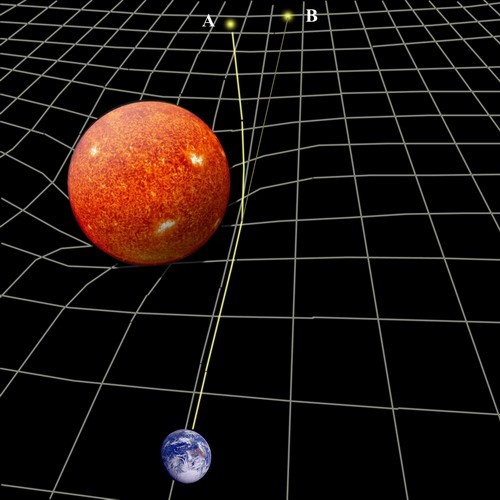
In his General Theory of Relativity, Einstein showed that matter causes space to curve, as in this illustration of starlight being bent by the sun's gravity.

But Einstein did not stop there. As early as 1911, he had predicted that light passing near a large mass, such as a star, would be bent. That idea led to his General Theory of Relativity in 1916. This paper established the modern theory of gravitation and gave us the notion of curved space. Einstein showed, for example, that small masses such as planets form dimples in space-time that hardly affect the path of starlight. But big masses such as stars produce measurably curved space.

The fact that the curved space around our sun was measurable let other scientists prove Einstein’s theory. In 1919, two expeditions organized by Arthur Eddington photographed stars near the sun made visible during a solar eclipse. The displacement of these stars with respect to their true positions on the celestial sphere showed that the sun’s gravity does cause space to curve so that starlight traveling near the sun is bent from its original path. This observation confirmed Einstein’s theory, and made Einstein a household name.

Interestingly, Einstein’s theories contained elements he himself could not accept. In some ways, he was loathe to break too much from the Newtonian/Maxwellian theories upon which his work was built.

He never accepted some of the precepts of quantum mechanics, for example, such as the idea ofindeterminacy. By the late 1920s, quantum mechanics had moved to the forefront of modern physics, yet Einstein never fully accepted many of the new theories. He declared:God does not play dice.

Also, Einstein’s 1916 theory suggested that the universe should be either expanding or contracting. Einstein could not accept that notion, and so in 1917 he introduced a cosmological constant into his theory, which would allow the universe to be stationary. In 1929, however, Edwin Hubble obtained observational evidence that the universe is indeed expanding. Einstein was forced to revise his theory. He called introducing the cosmological constant his greatest blunder.

This part of the Einstein legend illustrates, perhaps, a reason for his global popularity. The great genius could envision mechanisms of the universe in a way many of us have trouble even grasping. His imagination gave him answers to questions most of us would not think to ask.

Yet he remained prone to biases and frailties and thereby thoroughly human … just like the rest of us.

Bottom line: Albert Einstein was born on March 14, 1879. He published his Special Theory of Relativity in 1905 and his General Theory of Relativity in 1916. His work capped off the work of several previous centuries of science … and launched modern physics.

SOURCE:::::www.earthsky.org

Natarajan

Joke of the Day…” Message to Moon…” !!!

I used to be a taxi driver but I had to quit…

I couldn’t stand people talking behind my back.

…………………..

When NASA was preparing for the Apollo Project, it took the astronauts to a Navajo reservation in Arizona for training. One day, a Navajo elder and his son came across the space crew, who were walking among the rocks.

The elder, who spoke only Navajo, asked a question. His son translated for the NASA people:

“What are these guys in the big suits doing?”

One of the astronauts said they were practicing for a trip to the moon. When his son relayed this comment, the Navajo elder got all excited and asked if it would be possible to give the astronauts a message to deliver to the moon.

Recognizing a promotional opportunity when he saw one, a NASA official accompanying the astronauts said, “Why certainly!” and told an underling to get a tape recorder. The Navajo elder’s comments into the microphone were brief. The NASA official asked the son if he would translate what his father had said. The son listened to the recording and laughed uproariously. But he refused to translate.

So the NASA people took the tape to a nearby Navajo village and played it for other members of the tribe. They too laughed long and loudly but also refused to translate the elder’s message to the moon.

Finally, an official government translator was summoned. After he finally stopped laughing, the translator relayed the message:

“Watch out for these guys! They’ve come to steal your land.”….

SOURCE:::::: http://www.joke a day.com

Natarajan