” I survived …So can You …” Says Ankur Mishra !!!

Hailing from a village having no electricity, this techie now runs two start-ups, educates his community, gives TED Talks and is on his third novel. This is Ankur Mishra’s journey.

Ankur Mishra

Ankur Mishra exudes the kind of lucid candour and sincerity that can only be mustered by someone who has lived a life in every season, flavour and shade that India has to offer — for he has walked a thousand miles and chronicled many adventures.

Don’t take him for any other small-town boy with big dreams — for this entrepreneur, social worker, writer, poet and traveller went a step ahead, brought on his finest masonry to also build his road block by block.

Growing up in a village

Ankur grew up in a “pure” small village in Uttar Pradesh, as he likes to put it. “I say ‘pure’, because there was no electricity, and was surrounded by the mountains and a river.

“The school was small and the teachers, harsh. Coming from a very poor family, I almost didn’t get an education, had it not been for the God-given gift of scholarship. Even then, I read English in Class VI for the first time,” he explains.

Some incidents in school left an impression on him.

This catapulted him into action at the raw age of 16, with his ‘baba,’ one of the few members in his family that were literate, by his side.

A headstart

“I had experienced first-hand the impact that the right or wrong teacher could have on a child. Whether it was the moment when I was slapped by a teacher for merely standing up to read the board properly, or the general disinterest that was apparent in so many of the teachers at the village school, our school systems were lacking quality and soul,” he says.

Whilst in Class XII, Ankur felt that his weekends and all that free time could find much better use, so he started an initiative called Unique Educational Group.

He approached several heads of institutions and volunteered to take weekly sessions with students on subjects like Maths and Science. “Maths is my favourite. Kids are very keen to learn counting using different techniques, and I teach them the practical use of mathematics — how they can help their parents in budgeting, time management etc.,” he explains.

Starting out with two village schools, the students’ vigour and eager anticipation of their sessions made them locally famous, and within two years, their weeks had to be split between 17 villages and around 100 schools — something Ankur pulled off completely with his pocket money.

When the time came for Ankur to leave the village behind for his career, the same model was met with indifference from students in cities; but Ankur is keen on setting up in Gurgaon, where he now sips his beloved tea with 10 students weekly, alongside running his early-stage start-up.

First date with a computer

Ankur Mishra

Believe it or not, this seasoned techie laid his claim to the computer only when he entered college for his BTech.

He worked for several MNCs including Microsoft after college as a programmer and developer, but he felt like his ‘tech-geekdom’ had another calling, namely, to help non-techies join the techwagon.

With Digital India especially, Ankur saw great value in helping non-techies “get” the web and do more business using it. Foreantech — ‘a start-up for start-ups,’ became his way of helping start-ups at designing, development and marketing, all at one place. “Today’s start-ups have a big headache of resources, especially, developers and designers.

“I wanted to solve this problem. When a start-up comes to us, their digital worries become ours,”Ankur explains.

The one-year-old company has successfully accomplished about 100 projects with start-ups like Wingo and Baniyagiri, as well as some government assignments.

Love with tech, but flirting with the quill

Scarring experiences from his school days encouraged Ankur to become a storyteller, and he began by publishing an expose on teachers when he was only 16.

The response was amazing and gratifying,according to Ankur, motivating him to write for newspapers and magazines over various social and political issues, until he decided to cast an even wider net, and debut as a novelist. He wrote two books — his first Love Still and l Flirt, his second Kshanik Kahaniyon Ki Ek Virasat,which was better received, and his upcoming one Love at Metro.

He also recently published a collection of Hindi poems.

Ankur started a website called Kavishala.in for poets to have an online mehfil of sorts. Only a month old, 50 poets have already contributed over 100 works to it.

Passing on the torch, and spreading the fire

Brimming with life — experiences of making it as a literate engineer, entrepreneur and multi-lingual writer from a powerless village, Ankur knew he must enlighten those seeking inspiration. “I have never really been afraid of speaking in public platforms,”he notes.

He speaks as a grassroots expert on politics, technology, and society, and has graced the stage at over 25 seminars and events like TedxPatna, Ignite Jaipur, Microsoft Tech Days, UEN Summit Patna etc.

The 25-year-old firework feels that ups and downs are just the way life is. “If I, a predominantly Hindi speaker, can now speak on big stages, write books, blogs and more on such a wide level, anyone can. Alone in an alien city, with barely enough funds to keep me fed, I survived. So can you,”Ankur concludes.

Source……..www.rediff.com

Natarajan

Message for the Day…” Remember that spiritual food will fill your mind and give you eternal Bliss …”

Only a harmonious blend of the secular and spiritual will lend beauty and radiance to life. We should not learn and earn merely to fill our bellies but also to fill our hearts with bliss. The food you eat will fill only your stomach and not the mind, but spiritual food will fill your mind and give you eternal bliss. Hence secular learning and living should be coupled with spirituality. Inculcation of morality is very important in life. Students lead chaste and disciplined lives as long as they live in the hostel, but they lead an altogether different life once they leave the hostel. Your lives should be marked by discipline and morality, whether you live in the hostel or outside. All of your lives should be lived in consonance with the command of your conscience. This rule must remain the same, whether you are being observed or not, whether someone is noticing you or not.

Sathya Sai Baba

Image of the Day…” Busy Traffic at International Space Station …” !!!

Docked Soyuz spacecraft in center of frame with Cygnus cargo craft at left and Progress craft at right with Earth below

Expedition 47 Flight Engineer Tim Peake of the European Space Agency took this photograph on April 6, 2016, as the International Space Station flew over Madagascar, showing three of the five spacecraft currently docked to the station. The station crew awaits the scheduled launch today, April 8, of the third resupply vehicle in three weeks: a SpaceX Dragon cargo spacecraft, which will be the sixth spacecraft docked following its arrival and installation to the Harmony module on Sunday, April 10. Dragon is carrying 6,900 pounds (3,130 kilograms) of science, crew supplies and hardware; the largest payload is theBigelow Expandable Activity Module (BEAM). The BEAM will be attached to the Tranquility module a week after its arrival for a series of habitability tests over two years.

Orbital ATK’s Cygnus cargo craft, visible at the left of this image, was bolted into place on the Earth-facing port of the station’s Unity module on March 26, 2016. Although the SpaceX and Orbital ATK spacecraft have made 12 launches between them, this will be the first time that the two vehicles, contracted by NASA and developed by private industry to resupply the station, are connected to the space station at the same time.

Image Credit: ESA/NASA

Source…….www.nasa.gov
Natarajan

No-fuel Plough Invented by UP Farmer Costs Only Rs 3000, Beats Expensive Bullocks and Tractors…!

A farmer in Banda, Uttar Pradesh, upcycled an old bicycle to make a low cost plough, and then inspired his neighbours to do the same.

50-year-old Ram Prasad hires farm lands following the Bataidari system, or sharecropping, where a landowner gives his land on rent to farmers who plough the land and share the sales with the owner, in Chahnehra village of Banda, about 130 kilometres south of Kanpur.

When the farmlands were facing serious droughts, he had to sell his bullock to feed his family. Without his bullock and less money to maintain tractors and such equipment, times were difficult. Add to that the unpredictable weather: sometimes grave droughts, and sometimes premature rains. When Prasad realised that all these factors only burdened farmers with rising costs and no returns, he was adamant that he had to improvise an economical way to sustain farming.

It took him seven years to experiment with various materials. He finally got a breakthrough by converting an old cycle he found in his backyard, with some pieces of iron, into a plough.

The ploughing machine that he invented would cost only Rs 3000 to 4000.

Compared to the cost of a mini plough, bullocks or tractors, this is a more economical option for farmers.

plough

Representational image

The machine is simple, economical, and easy to assemble. With a single wheel, front and rear handles, and three diggers attached to it, the machine does not require fuel such as diesel or kerosene to operate.

“All it requires is two men,” said Prasad to Times of India, “I have also helped many farmers by converting their old bicycles into a ploughing machine.” He also adds that other than just ploughing, the machine also can be used for weeding and sowing.

Ploughs currently available in the market start at Rs 20,000, and are either manually operated, or mounted on a bullock or a tractor. But the cost only increases with bullocks and tractors. Generally, a pair of bullocks cost Rs 50,000, while a tractor costs as much as Rs 500,000. Along with that, there’s the variable price of fuel or fodder, which creates a dent in their finances.

Prasad’s innovation has caused a significant reduction in production costs. All it needs is a cycle. Plus, there’s no fuel requirement. In situations of droughts and economic crises, such an invention could change the lives of farmers tremendously.

Source….www.the betterindia.com

Natarajan

This Experiment Using a Glass Cover and the Sun Can Generate Water Even in Drought Affected Areas!

In a semi-arid region of Satara district in Maharashtra, there is a plot of lush green land with about 20 fully-grown, beautiful trees – all of which were the part of a very efficient experiment. The seedlings for these trees were fed with water obtained from dry soil, with the help of solar energy.

“I did my PhD in America way back in the late 1970s. And most of my work was around solar distillation of water. I looked at everything that could possibly be done with solar energy at that time and found that if you dig a small hole in the desert, and cover it with plastic, solar energy heats the soil and you can collect a cup of water every day. This was something that remained at the back of my mind for years,” says Dr. Anil Rajvanshi, Director of Nimbkar Agricultural Research Institute (NARI) – a non-profit research and development institute based in Phaltan, Maharashtra.

In 1981, Dr. Rajvanshi returned to India with the aim of using his education to work for the development of rural India, and started establishing the energy and sustainable development work at NARI.

solarenergy5

Dr. Anil Rajvanshi

“I came to this very dry and partially semi-arid region. Sometime in the 1980s, the Government of India conducted a very large-scale tree plantation program. But of the many seeds that were planted, only a few resulted in fully-grown trees. Most of the seeds perished,” he remembers. So, going back to the knowledge he had gained while studying, Dr. Rajvanshi started an experiment to grow trees using water distilled with the help of solar energy, at NARI in 1988.

The basis of the experiment was that soil contains some moisture and roots of plants utilise this water with the help of osmosis – a process in which a solvent (water in this case), passes through a semi permeable membrane from a region of less solute concentration to a region of more concentration. Roots absorb water from the soil through osmosis. But in semi-arid and arid regions, the water is so tightly bound with the soil that seedlings cannot extract it because of less osmotic potential.

This is how the experiment was done:

solarenergy2

Five pits, each of dimensions 0.9m X 0.9m X 0.6m, were dug in a barren land in the NARI campus. These pits were covered with Soil Water Evaporation Stills (SWES) – tilted glass covers connected with water collection bottles placed beside the pits.

When sunlight fell on the pits, it heated up the soil and the water in the soil evaporated, only to be collected in the form of water droplets on the glass covers. These droplets slid into the bottles.

solarenergy3

Three experiments were conducted with these SWES. The water collected in the bottles everyday was given to the seedlings in the morning. In Experiment 1, the water was supplied in equal amounts to some seedlings. In Experiment 2, the water collected from SWES over a period of seven days was supplied to another set of seedlings once a week. And in Experiment 3, the seedlings were rain-fed. The growth of the trees was monitored for diameter, plant height and mortality every three months. And the results were extraordinary.

The survival rate of seedlings fed from SWES was 100% and if one SWES fed 4 plants, an average of 70-80 ml of water was given to each seedling. The growth rate of the trees in Experiment 1 was higher than in Experiment 3.

solarenergy4

According to Dr. Rajvanshi, the production of water from soil in arid regions is an age-old technology and has been used as a strategy for human survival in deserts. However, there is limited data on its daily use, seasonal variation, etc.

“We used to get water from the pits every day and that turned out to be sufficient for the plants. The soil would get heated and the moisture in the soil, which you could not get otherwise, we were able to extract and feed to the plants. The trees were able to grow even in the worst season. Today, we have 15-20 fully grown trees in a place that was once completely barren. They are huge now,” he says.

Dr. Rajvanshi has been working in the field of rural development for the last three decades.

solarenergy1

Born and brought up in Lucknow, he went to the US to pursue higher studies at the University of Florida after his Bachelor’s and Master’s degrees in mechanical engineering from IIT Kanpur. He taught at the University of Florida for over two years and then returned to India

Dr. Rajvanshi feels that with the worsening drought conditions in many regions of Maharashtra, this technique can be used in some form or the other to help people in the region. “If not to grow plants, it can be used to provide sufficient water for people to drink if we conduct a similar experiment at a large scale and think more in that direction,” he concludes.

Source…..Tanaya Singh in http://www.the betterindia.com

Natarajan

Chart: How We See Our Parents From Cradle to Middle Age…!!!

My parents play an important role in my life. I can hardly imagine anyone that would be closer and more important to me than them. Despite this, I often used to take their love and care for granted – until I reached my 30s. When I started to experience what it means to be a parent myself, I came to realize that they are the most precious people in my life. I often wish that I had realized it sooner. I came across this chart, which I believe sums up how many of us see our parents at various ages. Take a look:

Source….www.ba-bamail.com

natarajan

Students at This School Cannot See. But They Can Dance, in a Group, with Perfect Coordination!

At Bengaluru’s Shree Ramana Maharishi Academy for the Blind, visually impaired children learn how to dance.

Rohini, a Class 9 student, has been learning dance from the age of six. Her dance training includes rigorous practise for coordination and flexibility, through a unique touch-and-feel style of teaching. Passionate about Kuchipudi, her ears are attuned to the rhythm of this dance form and its music. Her hands take up their positions automatically and her feet thump loudly. The fact that she can’t see the audience, the stage, or her fellow performers, does not stop her from following her dream of wanting to become a professional dancer.

She is one of the many blind students in Bengaluru who are learning to dance at the Shree Ramana Maharishi Academy for the Blind (SRMAB).

A holistic centre that provides education for the blind, this academy is one of the first of its kind in India to teach dance to visually impaired students.

SRMAB dance

In 1969, T V Srinivasan and his friend Thirumoorthi began SRMAB in a small room with one blind student and many big dreams. “I once visited Tiruvannamalai along with my friend, Thirumoorthi. While meditating we received a distinct vision that we should serve the disabled. This inspired us to start the academy.”

Srinivasan, who was trained in special education at Narendrapur, Kolkata, started the school to ensure those who are blind recognise their own potential and live their lives fully. Almost 200 students are enrolled annually. They are given free lodging and medical facilities.

Since its inception, more than 5000 students have passed Class 10 from the school, with Braille as their language.

Vocational training and extracurricular activities, such as dance, music and sports, are considered essential at SRMAB. “We always motivated the disabled, and encouraged, trained them in various fields like agro-based farming, poultry, vocational training, yoga, dance, table, and more,” says Srinivasan.

In 1973, dance and music were initiated into the school as an extracurricular activity.

But it was only in 1982 that the unique technique of touch and feel teaching was introduced by Gurus Sharadha Natarajan and Ambica Natarajan.

SRMAB

Besides opening up new possibilities for the students, such activities give them confidence and purpose. “Dance helps them feel motivated, empowers them with confidence to meet challenges. They are exposed to different places, people and society, which educates them to live life with dignity and self-esteem,” adds Srinivasan.

Dharmaraju, 29, is an ex-student of SRMAB and has been teaching dance at the academy since 2009. He had joined the school as a student in 1994, at the age of nine. His talent for dance was recognised at the academy right from the beginning. In 1997, he began taking classical dance lessons from Guru Shri K. Narayan.

While it was challenging to follow rhythm and postures owing to his visual impairment, the dedicated efforts by the guru paid off. The same year, in his first stage performance at Chennai, the audience showered him with praise about his precision and grace. That was all the appreciation that he needed. After school, he completed a diploma in dance and performed across the globe. “Among my most cherished moments was my first stage performance abroad in 1999,” he says, “It was in Adelaide, Australia, and I was representing India at a folk festival. A few years later, in 2008, I performed for Akka Sammelan in Chicago, USA. They were both exhilarating performances.”

Today, he teaches students like himself and choreographs classical dance routines for them to perform around the globe.

SRMAB

With Dancemaster Dharmaraju (Left picture, at the centre)

Srinivasan, who was awarded with the Karnataka State Award for Social Worker of the Year 2008, is more than proud of his students.

“As ambassadors of Indian culture and the abilities of people with disabilities, the group has been regularly sponsored to tour UK, USA, Australia, and Italy,” he says. “Tours like these raise awareness on the issues faced by persons with disabilities, while highlighting their abilities in delighting audiences with their spectacular performances.”

But, how do the visually impaired learn dance without watching someone perform? Srinivasan elucidates, “First, the concept is explained to students. The gurus make them understand the bhaavam and they visualise the whole situation before they start learning the dance.” Adds Dharmaraju, “Coordinating the movements in a group is quite challenging and it takes a longer time to learn to perfection.”

SRMAB is involved in several other activities that are all aimed at empowering the visually impaired and their families.

TV Srinivasan SRMAB

For instance, the Community Based Rehabilitation (CBR) programme was started in 1990 in Kanakapura Taluka, and later in Malavalli, Hubli, Ramnagara, and Mandya districts. Severely disabled farmers and their families are provided CBR. Through self-help groups, training and school-based intervention, CBR aims to raise awareness about health, education and economic betterment. It also organises health and nutrition camps.

In 2013, Rohini performed Kuchipudi at the Kanteerava stadium in Bengaluru. The performance bagged a Guinness record, with 1054 dancers, of which 20 were visually challenged. This is only one of the many awards and performances by the students of SRMAB. As Srinivasan puts it, “Through the universal language of art, young, visually impaired dancers send out a strong message: the light, extinguished in their own eyes, is relit in the dance, affirming that there are no people with disabilities, only those who are differently abled.”

Source….Neeti Vijaykumar in http://www.the betterindia.com

natarajan

Message for the Day….”To make proper use of scientific knowledge we must have the wisdom and discrimination.”

Bear in mind that youth is the most precious years in one’s life and should not be wasted or misspent. To let children watch television from 6 to 10 p.m. is to make them forget all that they have learnt at school or college. In addition, they learn many evil things. If TV is used for teaching good things, it can serve a worthy purpose. But that is not the case, younger generation is being ruined by undesirable films and programs. Their minds are being poisoned. It is not a sign of parental love to let children grow in this manner. Even parents should avoid going to cinemas. All crimes and violence we witness today are largely the result of the evil influence of films on young minds. While science and technology may appear, to confer many benefits, they also have many harmful effects. To make proper use of scientific knowledge we must have the wisdom and discrimination.

Sathya Sai Baba

Clingstone: The House on The Rock…!!!

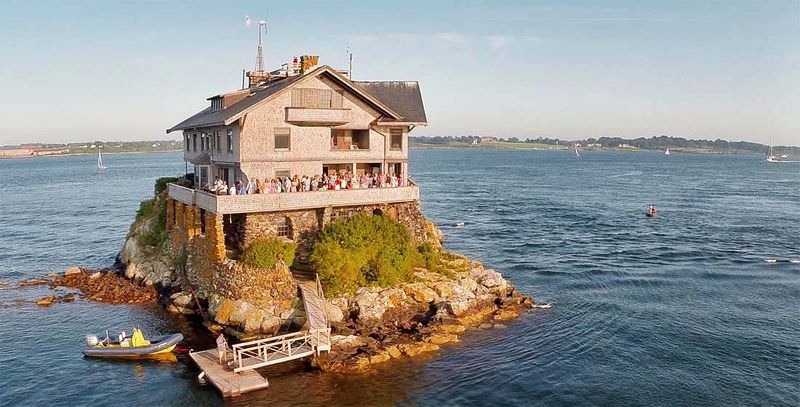
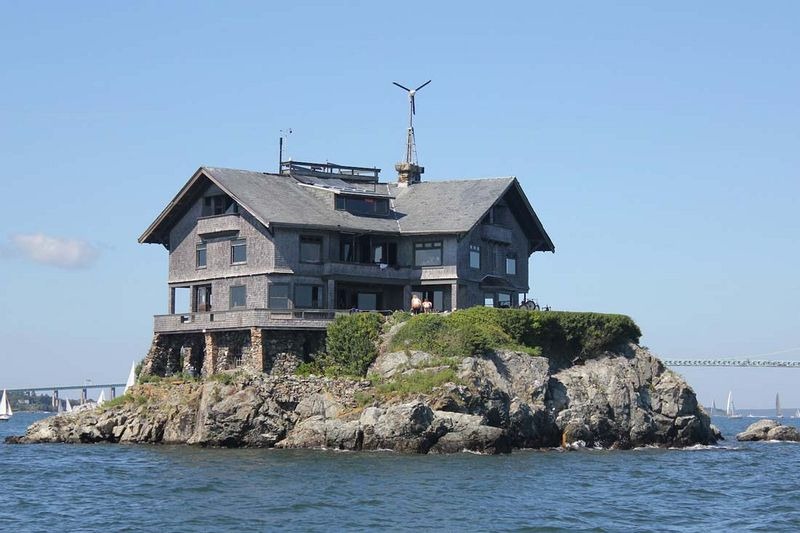
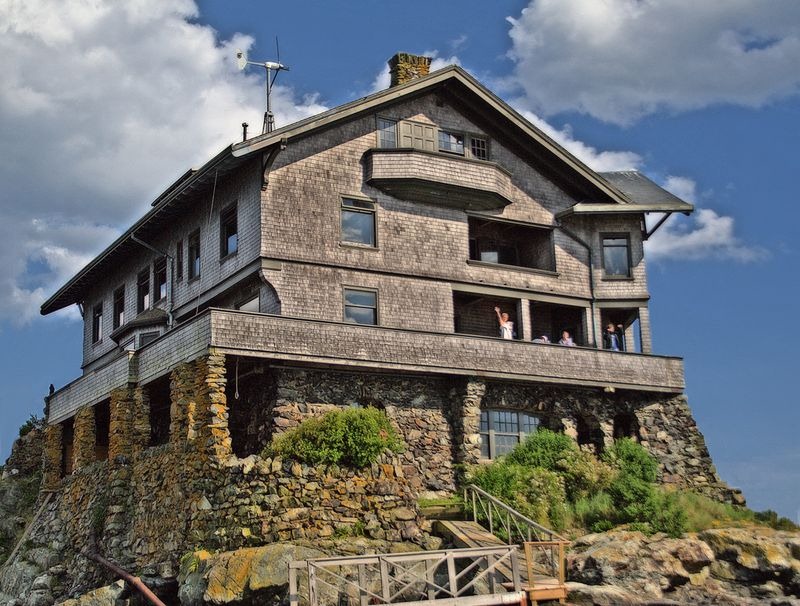
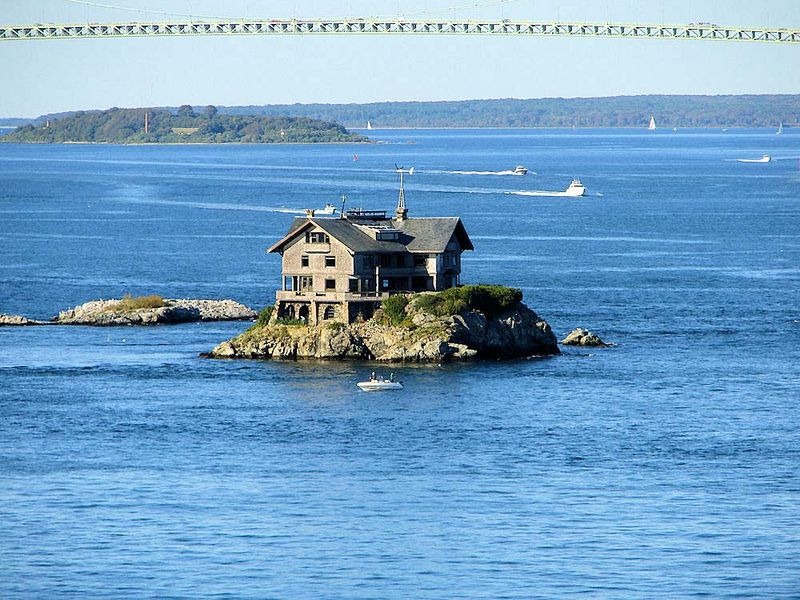
Perched on top of a small, rocky island in Narragansett Bay, near Jamestown, Rhode Island, the United States, is a three-story, cedar shingle mansion built by Philadelphia socialite Joseph Lovering Wharton in 1905. Wharton had built the house as an act of defiance after the government seized his land and summer home that he had in the Fort Wetherill area in south Jamestown, to enlarge the fort at the end of the 1800s. Angered at being ousted from his property, Wharton decided to build a house where no one could bother him, and Clingstone happened. One source claims that the name “Clingstone” was suggested when someone remarked that it was “a peach of a house”. Clingstone is a botanical term for fruits that has a hard stone-like seed inside. Or perhaps, the name is a reference to the way the house clings to the rock.

clingstone-house-6

Photo credit: mansion-homes.com

In spite of its perilious location in the sea, the Clingstone has managed to survive more than a hundred years, weathering countless storms and hurricanes. Originally there was a long stone jetty with gymnasts’ rings and bars, but it was blown away by the Great Hurricane of 1938. The house itself, which sits only 20 feet above sea level, survived with minimal damage. Now Clingstone’s current owner, Henry Wood, a distant cousin of Wharton, regularly goes out to Clingstone with his three grown sons to watch the yearly hurricanes in action.

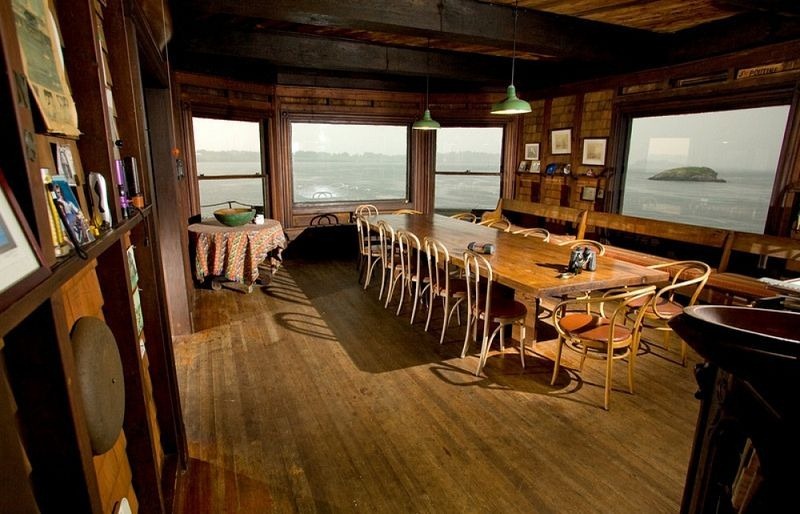
Henry Wood, who is a Boston-based architect, had bought the house in 1961. It had been lying vacant for two decades after the death of Wharton’s widow in 1941. When Wood acquired it, the house was in a shabby condition with all its windows smashed, the floors rotten and covered with pigeon droppings, and the roof mostly gone.

Wood and his sons take pride in their environment-friendly renovations of the house. The house is totally off the power grid. A windmill on the roof provides electricity, while photovoltaic cells charge a bank of batteries in the basement for additional power. Rainwater collected from the roof into a 3,000-gallon cistern provide water for washing and cleaning. Drinking water comes from a sea-water filtration system. Water is heated by solar panels. The house even has a composting toilet. The compost is then used to fertilize the garden.

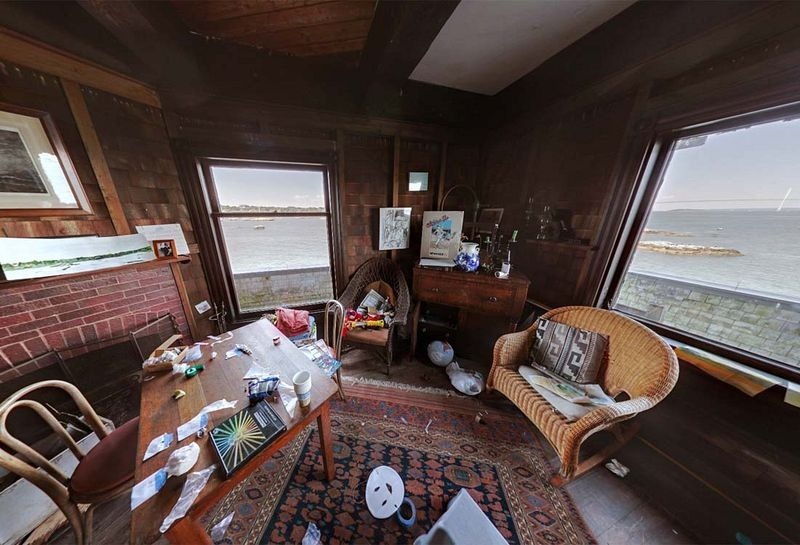
Although refitting the house with green technology has certainly been expensive, Wood has managed to cut corners by acquiring furnishings from thrift shops or yard sales. Windows, light fixtures and doorknobs were scavenged from old buildings that were torn down. The long cypress dining room table was retrieved from the bottom of a cistern.

Today, the house has 23 rooms, including 10 bedrooms and five bathrooms. Visible from the shores, the house is known by locals as “The House on a Rock”.

clingstone-house-5


Photo credit: mansion-homes.com

clingstone-house-22

Photo credit: G.E.Long/Flickr

clingstone-house-10

Photo credit: mansion-homes.com

clingstone-house-21

Photo credit: Eric Jacobs

clingstone-house-1

Photo credit: mansion-homes.com

Source…..www.amusingplanet.com

Natarajan


Cabin Pressure and Oxygen Supply Aboard Commercial Aircraft….

How Cabin Pressure and Oxygen Supplies are Maintained Aboard Commercial Aircraft

Because the economics of having large oxygen tanks aboard airliners simply doesn’t work out (not to mention that the air quality inside the plane would rapidly become unpleasant if fresh air wasn’t constantly supplied, regardless of the oxygen levels), commercial airplanes have a very clever system installed to solve the problem of ultra-low pressure atmosphere at cruising altitudes.

In most modern airliners (the Boeing 787 Dreamliner not withstanding), outside air is “bled off” from the compressor stage of the turbine engines and eventually piped into the passenger areas. However, a bit of processing is needed first as the compressed air is extremely hot (on the order of nearly 400 degrees Fahrenheit

or 200 degrees Celsius) at this stage. Thus, before it enters the passenger compartment, it is first allowed to expand and is run through a heat exchanger and air cycle system to cool it off sufficiently. This system also can work as a heater, with some of the hot air mixed in with the cooled air to regulate cabin temperature.

1280px-Turbofan_operation.svgOnce cooled and filtered, the pressurized air, which now has sufficient oxygen density to keep people happily conscious, is piped into the cabin area, usually at levels around 12 psi (about equivalent to atmospheric pressure at 7,000 feet).  Why 12 psi instead of something like sea-level pressures of about 14.7 psi? 12 psi is sufficient for the majority of passengers while simultaneously reducing the structural strain on the aircraft itself over something like sea level atmospheric pressures.

As for the air already in the cabin, this is vented out through an outflow valve (or multiple valves in larger aircraft), usually located near the rear of the plane. (FunNote: Before smoking was banned on commercial aircraft, the area around this outflow valve was generally stained dark brown from tobacco smoke.)

This outflow valve opens and closes automatically to maintain a steady pressure inside the cabin, while the entire system is ensuring that fresh air is continually being piped into and eventually blown out of the aircraft. In fact, while many complain of airplanes seeming “stuffy,” this system ensures that all the air in the aircraft is being completely replaced on average every 2-3 minutes. Yes, that means that your car, house or office is likely significantly more “stuffy” than a commercial airplane flying at 35,000 feet.

(Note: the Boeing 787 Dreamliner handles cabin pressurization a little differently, using a modernized version of the old, somewhat inefficient, electric compressor system seen on many older aircraft.)

Unfortunately, sometimes planes lose cabin pressure. Whatever the cause, the loss of pressure (usually set at atmospheric pressures past 14,000 ft) will result in oxygen masks deploying. From here, useful consciousness may only last as little as 5-15 seconds, depending on remaining cabin pressure, which is why it’s critical to immediately put your mask on, rather than helping someone else first. You can help them much better when you’re not unconscious or dead.

So how do these airline oxygen masks actually work? It turns out, the economics of having a centralized oxygen tank to provide even emergency oxygen for passengers likewise simply doesn’t add up. Similarly, having tiny individual pressurized oxygen tanks also isn’t feasible. In fact, these masks aren’t hooked up to any tank or air line at all. So how are you able to breathe oxygen through them?
Science.

While designs can vary slightly, in general, when you pull on the device to place it over your face, the tug on the mask’s lanyard releases a spring-loaded mechanism that sets off a small explosive charge. (Yep.) The resulting spark triggers a mixture of lead styphnate and tetracene to generate heat, which will eventually cause a chemical reaction that produces oxygen for your mask. (This is why they tell you to tug on the mask to get the oxygen flowing- you’ve got to set off the explosive charge to get the whole thing going.)

That’s right. What you breathe through the mask didn’t begin as pure oxygen. Rather, the plane is equipped with numerous small chemical oxygen generators (also known as “oxygen candles,” about the size of a small package of tennis balls) which contain a mixture of mostly sodium chlorate (NaClO3), less than 5% barium peroxide (BaO2) and less than 1% potassium perchlorate (KClO4). When these chemicals are heated by the lead styphnate and tetracene, each undergoes a reaction that ultimately results in a fair bit of filtered, life sustaining oxygen running through the tube to you.
Of course, you might also smell a faint burning odor, but this is nothing to be alarmed about; it just assures you that the system is working. In fact, if the plane is actually on fire, the masks usually won’t deploy, so as not to make the fire worse with the extra oxygen.

This brings us to the question of why the plastic bag on the breathing apparatus won’t necessarily inflate as you’re using the device. More than just cosmetic, the bags serve as something of a reservoir for oxygen. If you aren’t taking a breath at all (and have a good seal with the mask tight against your face) the bag keeps the precious, continuously flowing oxygen from escaping into the thin air around you, enabling more of the collected oxygen to be taken in when you do take a breath.  When this is happening, or you are breathing out with the valves on the mask releasing much of the used air, the bag may begin to inflate as oxygen collects. When you breathe in, it will deflate.

So why won’t it always inflate at least a little to show its working? To begin with, you may not have a great seal with the mask on your face, particularly if you have facial hair.  This will allow any produced oxygen (and air you exhale) to more readily escape. (As long as the mask is reasonably secure on your face,

this should still provide you with sufficient oxygen to get by on as long as the plane isn’t flying above 40,000 feet and the pilot does his or her job and gets the plane down below 10,000 feet as rapidly as safely possible.)

Even if you have a good seal, however, the rate at which the oxygen is generated is often not enough to fully inflate the masks’ bag before you take deep, potentially panicky breaths, deflating it. This is simply because the oxygen generation isn’t on-demand (for the passengers anyway), but simply a continuous-flow production of oxygen.

Despite the potentially slow production, the chemical oxygen generators do provide oxygen at a sufficient rate to sustain passengers, generally designed such that peak oxygen production occurs right away (when the plane may be at very high altitude) with the oxygen production rates tailing off over the course of approximately 12-20 minutes before the system burns itself out.

This should be long enough for the pilots to get the plane low enough so that the air pressure is high enough for (relatively) normal atmospheric breathing. And if you’ve ever been lucky enough to be in this sort of situation, you know that those pilots can get the plane from altitudes like 35,000+ feet to safer atmospheric levels alarmingly quickly in an emergency; while it may not be literally true, it at least can seem like roller coasters have nothing on them, which is a good thing in this case.

Source….www.today i foundout.com

natarajan