How to see a solar eclipse at 35,000 ft in the air?…. Here’s the answer!

It’s very rare that a company fulfill its customer’s wish. And that too at about 35,000 feet in the air.

But Alaska Airlines has done that by changing its flight path on Tuesday, so that passengers could enjoy the view of solar eclipse.

IMAGE: Treat your eyes with this breathtaking view. Solar eclipse from Alaska Airlines flight. Photograph: Alaska Airlines/Twitter 

The airliner made this plan a year ago when one of the passengers, Joseph Rao, who is the associate astronomer at the American Museum of Natural History’s Hayden Planetarium, informed it that Alaska Airlines flight 870 from Anchorage to Honolulu would intersect the eclipse’s path.

But there was a catch. The flight’s scheduled departure time was 25 minutes too early to see the eclipse.

After several deliberations the airline decided to adjust the timing to give passengers a chance to witness the grand spectacle.

HERE (external link) is the full video.

IMAGE: Solar eclipse from Alaska Airlines flight. Photograph: Alaska Airlines/Twitter

Source…..www.rediff.com

Natarajan

Qatar Airways to snatch Emirates title of world’s longest commercial flight…!!!

Emirates cannot hold claim to the world’s longest route – a service from their hub in Dubai to Auckland, New Zealand – for much longer. Fellow Gulf carrier, Qatar Airways have announced their service from Doha to Auckland to begin in December.

Qatar Airways to steal Emirates title of world’s longest commercial flight

The world’s longest commercial flight, Emirates’ non-stop service from Dubai to Auckland, may have only begun on 1 March, but it will not be the world’s longest by the end of the year. Qatar Airways has announced their first route to New Zealand, serving Doha to Auckland, to begin service on 3 December.

Qatar will use the Boeing 777 aircraft to serve the route, which was announced by His Excellency Mr. Akbar Al Baker on the opening day of the world’s largest international travel fair, ITB Berlin. In January, Mr. Al Baker had announced the carrier was looking closely at introducing a non-stop service to Auckland as part of extension plans at Bahrain International Airshow.

The service will cover a distance of 14,539 kilometres which will beat out Emirates’ route to Auckland by 339 km. The flight time is believed to be around 18 hours 34 minutes, whereas from Dubai the flight time averages at 17 hours 15 minutes. Emirates was due to add a non-stop service between Dubai and Panama City in February, which was postponed until 31 March 2016. This service would have been the world’s longest in terms of flight time – around 17 hours 35 minutes – but shorter by distance. The route now will not launch until late 2016 or 2017.

The Gulf carrier had intended on launching the Doha-Auckland direct service in June, but held off until the end of the year. His Excellency, Mr. Al Baker said: “We are not going to chicken out, we will definitely fly to Auckland but as a respect to Emirates as they have already launched a direct flight we will wait until the end of the year before we will operate.”

These new services highlight the growing demand of Auckland Airport, and Auckland as a destination. For January 2016, when the airport celebrated 50 years since their official opening, 893,314 international passengers were welcomed. This is the highest number of international passengers ever for a single month, with 43,000 more passengers than December 2015, the previous month with the highest number of international passengers. Compared to January 2015, numbers increased by 9.3 percent.

Auckland Airport were the overall winners of the Routes Asia edition of the Routes 2016 Marketing Awards, which was announced at the event in Manila, Philippines. It is the first time the airport has received the highly regarded accolade, who was also named the winner of the 4-20 million passengers category. The respected panel of judges who chose Auckland Airport was made up of senior members of the airline network planning community.

As overall winners, Auckland Airport are automatically shortlisted for their category at World Routes Awards in Chengdu, China on September 26, 2016.

After receiving the award, Peppy Adi-Purnomo, South East Asia and India Development Manager, Auckland Airport said: “All the work we do is about ‘win win’ and developing a scenario that the business case to airlines work to deliver sustainable air services. We are not interested about short-term success but always look at the long-term and developing a relationship that is right for the airline and also for us at the airport.”

Source….Laura Hamill
Content Executive, Routesonline in www. routesonline.com

Natarajan

Meeting Latha: A woman mechanic fighting stereotypes in Theni …!!!

“I really don’t think there is any job that men alone can do,” says Latha.

Untouched by the pomp and fanfare of the women’s day celebrations elsewhere, Latha is busy looking at the punctured tyre of a bike that has left its owner stranded.

Latha is such an inconspicuous figure under a tamarind tree on the Theni-Periyakulam road that she can be easily missed. She runs her vulcanising shop from under the shade of a tamarind tree.

“More often than not, many people see our equipment first from a distance and come closer. But when they see me handling it all, they pause and sometimes prepare to leave. I tell them I can fix their tyres and do it in no time. After all, I have been doing it for two decades now” she says with an unmistakable pride in her voice.

At 43, Latha is a good mechanic. “I have four brothers and a sister. My father was a mechanic and as a child, I would keenly watch the way he would fix a punctured tyre. But he would never allow me to touch any of it.”

At 20, she got married to a man who ran a small textile shop. Her father had to sell his vulcanising shop to settle the debts of her sister’s wedding. “My brothers refused to take care of my father and I accommodated him in my place. After discussing with my husband, I took his help and with an investment of Rs 13,000 started this shop.”

Until recently, she would take care of the punctured tyres of all vehicles including lorries and cars. “But now due to ill-health, I do only two-wheeler tyres,” Latha says. Students from an Industrial Training Institute nearby often visit her shop to get hands-on experience. “I really don’t think there is any job that men alone can do.”

Though her father never allowed her to touch any of the two wheelers he was working on, he was a role model for Latha. “He treated all of us equally. I never felt I was a daughter and hence inferior. That was not the case with many of my friends. Even when I was young, I had learnt to drive almost all vehicles. With that kind of encouragement, I think any woman can do what a man can – sometimes even what a man can’t. I only wish the government encouraged women more.”

Perhaps the only woman mechanic of Theni district, Latha has a dream: To have a properly constructed shop. “I only have this thatched roof for a shop all these years. I have never been to a government office or approached any politician for help. But I do wish they will help me get a shop. I can even train students if need be”, she says.

For someone who speaks so passionately about the need for women to be independent, Latha had both her daughters married off before they turned 18. “I had little choice. We are living in such a system which does not support independent women. Also I come from a village and you know how it is. My poor health is another reason. I wish it was different though.”

All photographs by Satheesh Lakshmanan

Source…..Satheesh Lakshmanan in http://www.the newsminute.com

Natarajan


The Feng Shui Skyscrapers of Hong Kong….!!!

In Hong Kong, a city with one of the most beautiful skyline, the plan and design of a building is determined as much as by architects and engineers as by feng shui masters. This ancient Chinese philosophy of positioning objects and buildings in harmony with nature to bring about good fortune, is deeply rooted in Hong Kong’s culture. Everything from the orientation of a building, the shape of the building, the position of the entrance and position of furniture within are believed to influence the prosperity of a business or the homeowner. Because of this belief, feng shui practitioners are consulted in almost every new home purchase and office floor plans, and even enormous architectural and engineering projects around this island nation are dictated to a large degree by feng shui. It’s not apparent but examples of feng shui practice are almost everywhere in Hong Kong.

hong-kong-dragon-holes-2

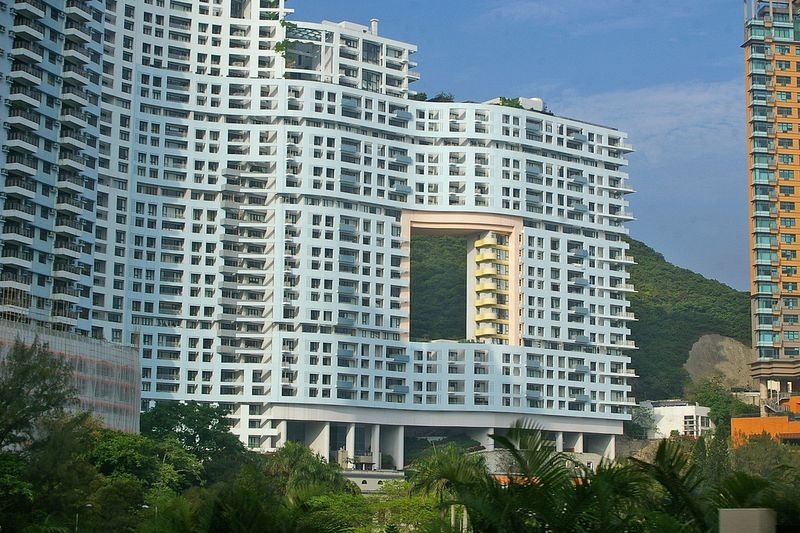
Why do these buildings have holes in the middle? Keep reading for the answer. Photo credit: shottapaul/Flickr

Feng shui was suppressed in mainland China during the Cultural Revolution in the 1960s but has made a dramatic revival in recent years, especially in the superstitious South. Even in modern Central, where feng shui is regarded as superstition, most developers still consult feng shui experts because they figure it’s better to be safe than sorry. Indeed, many corporations set aside a portion of their annual budget for feng shui consultation. Some of the suggestions that feng shui experts offer can be as simple as repositioning the desk of the CEO or placing coins under the carpet. Others can be as expensive as demolishing and reconstructing parts of the building.

When the famous HSBC headquarters with two bronze lions sitting in front were built in the mid-1980s, the escalators were reoriented from their original straight position to an angle with the entrance to prevent evil spirits from flowing straight off the Victoria Harbor and into the office.

feng-shui-hsbc-3

The HSBC building in Hong Kong. Photo credit: Ishak J/Flickr

The Bank of China Tower, on the other hand, neglected good feng shui practices and is now considered so unlucky that it sits empty most of the year. The tower with its many sharp edges is also said to be leaking its negative energy to its surrounding businesses. The owner of the Lippo Centre, which faces one of the building’s edges, went bankrupt and had to sell the building. Similarly, the Government House, which also faces one of the angles of the Bank of China Tower, had its share of troubles.

To prevent such misfortunes from befalling HSBC, the bank had two cannon-like structures installed at the top of their building. These cannons, which are pointed towards the Bank of China building, supposedly protects HSBC from the dreaded Bank of China Tower’s negative energy by deflecting the energy back to its source.

Hong Kong’s growth in recent years has been attributed to good feng shui. Its geographical location with the mountains behind and waters in front is said to be excellent in accordance to feng shui principles. Legend holds that these mountains are home to the dragons that are said to be the bearer of positive and powerful energy. This energy blows through Hong Kong as the dragons make their way from the mountains to the sea to drink and bathe.

This explains why many buildings along the waterline have gaping holes in the middle. These holes provide the dragons an unobstructed path to the water, so that the winds of positive energy continue to flow through the city.

hong-kong-dragon-holes-1

The “dragon hole” of The Repulse Bay building in Hong Kong. Photo credit: Paul Griffin/Flickr

hong-kong-dragon-holes-3

Photo credit: See-ming Lee/Flickr

hong-kong-dragon-holes-5

Photo credit: See-ming Lee/Flickr

Sources: NY Times / Discover Hong Kong / A Passport Affair / Wall Street Journal Blog

Source…….www.amusingplanet.com

Natarajan

This date in science: Yuri Gagarin’s birthday….9th March

He was a Russian Soviet pilot and the first human to travel to space, in 1961. Later, he became one of the world’s true heroes …


“Let’s go! (Poyekhali!)” Image via ESA.

March 9, 2016. Yuri Alekseyevitch Gagarin (1934 – 1968) would have been 82 today. He became the first human ever to travel into space on April 12, 1961, flying into orbit around Earth for 89.1 minutes in Russia’s Vostok 1 spacecraft. He circled the Earth once and flew as high as 200 miles (327 km). The entire mission, from launching to landing lasted 108 minutes.

Yuri was born on a small farm west of Moscow. His father was a bricklayer, a carpenter, and a farmer. His mother was a milkmaid. He was the third in a family of four children.

During the Second World War, the Gagarin family was broken apart as two of Yuri’s older sisters were taken into labor camps by the Nazis. The Gagarins were forced out of their house, and dug a hideout in the ground, where they stayed until the end of the war. After the war, the family moved to Gziatsk.

Gagarin was inspired to become a pilot while still a teenager. When a Russian Yak fighter plane was forced to land in a field near his home, the praise those pilots received left a mark on the young Gagarin. He wanted to be like them.

He studied to become a foundryman (a foundry is a factory that melts metals in special furnaces and pours the molten metal into molds for making products). He was singled out for his skillfulness to further his studies in the Saratov Technical School.

Vostok 1 via Wikimedia Commons.

Vostok 1 via Wikimedia Commons.

There, his dream to become a pilot took root, as during his 4th and last year at Saratov, he had the chance to join a local flying club. He learned to operate a plane, and flew by himself for the first time in 1955.

That same year, he also graduated from school, and was recruited by the Soviet Army.

At the advice of his flying mentor, he joined the Soviet Air Force, and went on studying at the Orenburg School of Aviation. There, he was taught to fly MIGs.

During his studies at Orenburg, he also met his future wife, Valentina Ivanova Goryacheva, who was a nursing student at the time.

In November, 1957, when Gagarin was 23, he graduated from Orenburg with honors and married Valentina. Later, the couple had two girls, Yelena, and Galina.

In 1959, after the Russians succeeded at photographing the far side of the moon for the first time with Luna 3, many – including Yuri – felt it was about time for the first man to be sent to space. He and a few other men were accepted for cosmonaut training in 1960 after a lot of selection.

The selected candidates underwent not only physical training, but also mental and psychological training.

Gagarin was known for his good humour, perseverance, and calm.

On April 12, 1961, the Russians amazed the world by launching Vostok 3KA-3 (Vostok 1) from the Baikonur Cosmodrome with Yuri Gagarin aboard. Vostok means East in Russian.

East for sunrise, and for the rise of the Space Age.

Hear a recording of Yuri Gagarin saying “poyekhali” (“let’s go”) before the launch.

Yuri  Gagarin in Warsaw in 1961.  Image via Wikimedia Commons.

Yuri Gagarin in Warsaw in 1961. Image via Wikimedia Commons.

Gagarin on a visit to Sweden, 1964.  Image via Wikimedia Commons.

Gagarin in Sweden in 1964. Image via Wikimedia Commons.

After coming back from space, Gagarin became an international celebrity. Khrushchev awarded him with the title of Hero of the Soviet Union.

His dream had come true.

Gagarin and his wife began touring the world, where Yuri was decorated for his legendary accomplishment. It’s rumored that Gagarin didn’t handle his fame very well, however.

In 1962, he was appointed as a deputy of the Soviet Union, and he was elected to the Central Committee of the Young Communist League. But Gagarin was not entirely happy. He felt he didn’t train to fly only once. He wanted to fly more, but – according to the stories about him – those around him tried to stop him for fear of losing the great Soviet hero.

In 1963, Gagarin later became deputy training director of the Cosmonaut Training Center outside Moscow. Later, the training center was named for him.

The following year he started extensive training to become a fighter pilot. He died on March 27, 1968, at the age of 34 due to the crash of a MiG – 15UTI that he and colleague Vladimir Seryogin were flying from the Chkalovski Air Base.

Their bodies were collected near the small town of Khirzach, and were cremated. Their ashes are a part of the Kremlin Building in the Red Square, in Moscow.

Yuri's plaque at the Kremlin in Moscow, via Wikimedia Commons.

Yuri’s plaque at the Kremlin in Moscow, via Wikimedia Commons.

Bottom line: Born on March 9, 1934, Yuri Alekseyevitch Gagarin (1934 – 1968) was the first human being ever to travel into space. His historic flight took place on on April 12, 1961, when he orbited Earth for 89.1 minutes in Russia’s Vostok 1 spacecraft.

Source……www.earthsky.org

Natarajan

Celebrating International Women’s Day….

NASA astronauts and JAXA astronaut at work inside International Space Station's Robotics Workstation

In this April 8, 2010 photograph, STS-131 mission specialists Stephanie Wilson of NASA, Naoko Yamazaki of the Japanese Aerospace Exploration Agency (JAXA), Dorothy Metcalf-Lindenburger of NASA, and Expedition 23 flight engineer Tracy Caldwell Dyson (top left) work at the robotics workstation on the International Space Station, in support of transfer operations using the station’s Canadarm2 robotic arm to move cargo from the Multi-Purpose Logistics Module.

The STS-131 mission’s seven-member crew launched aboard space shuttle Discovery on April 5 from NASA’s Kennedy Space Center, joining the six residents of the space station when the shuttle docked on April 7. The merging of the two crews marked the first time four women were in space at the same time.

Image Credit: NASA

Source….www.nasa .gov

Natarajan

Photos of today’s Solar Eclipse….

View larger. | March 9, 2016 total eclipse of the sun by Justin Ng of Singapore.

Justin Ng at Amazing City Beach Resort in Palu, Indonesia captured this photo of the March 9, 2016 total eclipse of the sun. He captured what is one of the most famous of all eclipse phenomena: the legendary diamond ring effect. It happens twice in a total eclipse … in the final moments before totality, and just as totality ends. You can also see a flare from the sun, on its lefthand limb.

A Kannan in Singapore caught the partial phases, too.  He wrote:

A Kannan in Singapore caught the partial phases, too. He wrote: “The partial solar eclipse was observed in Singapore skies this morning covering about 85% of the sun from Earth.”

Source…..www.earthsky.org

Natarajan

The Mysterious Caves of Mustang, Nepal……

The Kingdom of Mustang, bordering the Tibetan plateau, is one of the most remote and isolated region of Nepalese Himalaya. Once an independent Buddhist kingdom, Mustang was annexed by Nepal at the end of the 18th century, but retained its status as a separate principality until the 1950’s when the area was more closely consolidated into Nepal. Because of its sensitive border location, Mustang was off-limits to foreigners until 1992. The relative isolation of the region from the outside world has helped Mustang preserve its ancient culture which is more closely tied to Tibet than to Nepal.

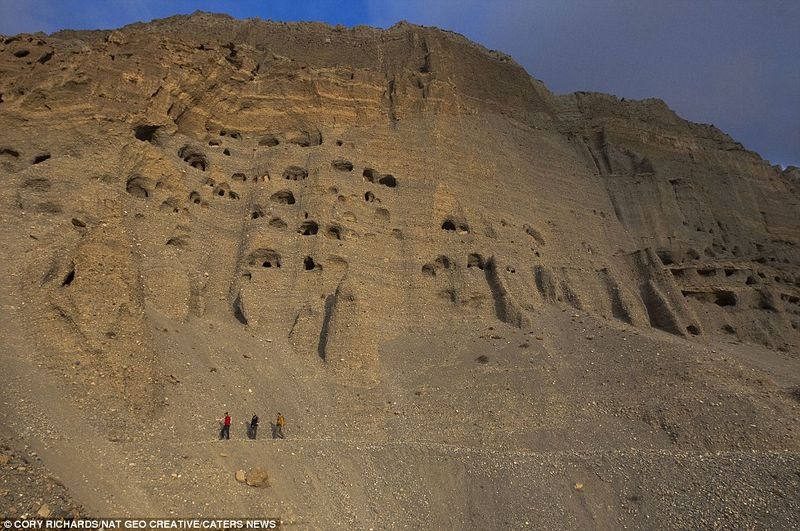
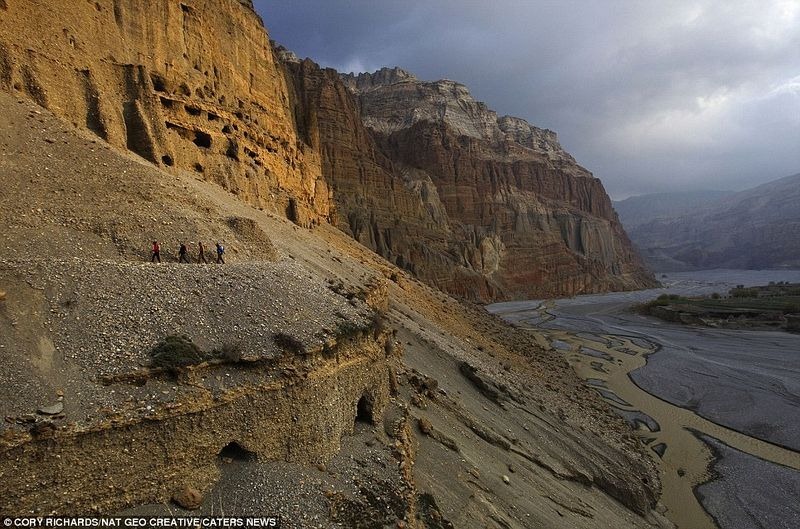
The landscape is also unlike anything that is to be found anywhere else in Nepal —deep gorges carved by the Kali Gandaki River, and strangely sculptured rock formations. The cliffs’ face are pitted with an estimated 10,000 ancient cave dwellings, some of which are perched more than 150 feet above the valley floor. No one knows who dug them, or how people even scaled the near vertical rock face to access them. Some of the caves appear almost impossible to reach even to experienced climbers.

mustang-caves-4

Photo credit: National Geographic

Most of the caves are now empty, but others show signs of domestic habitation —hearths, grain-storage bins, and sleeping spaces. Some caves were apparently used as burial chambers. The several dozen bodies that were found in these caves were all more than 2,000 years old. They lay on wooden beds and decorated with copper jewelry and glass beads.

In other caves, skeletons dating from the 3rd to the 8th centuries, before Buddhism came to Mustang, had cut marks on the bones that may have been inflicted during the practice of sky burial, where the body’s flesh is sliced into small pieces and left to be eaten by vultures. Sky burial is still practiced in many remote regions in the Himalaya.

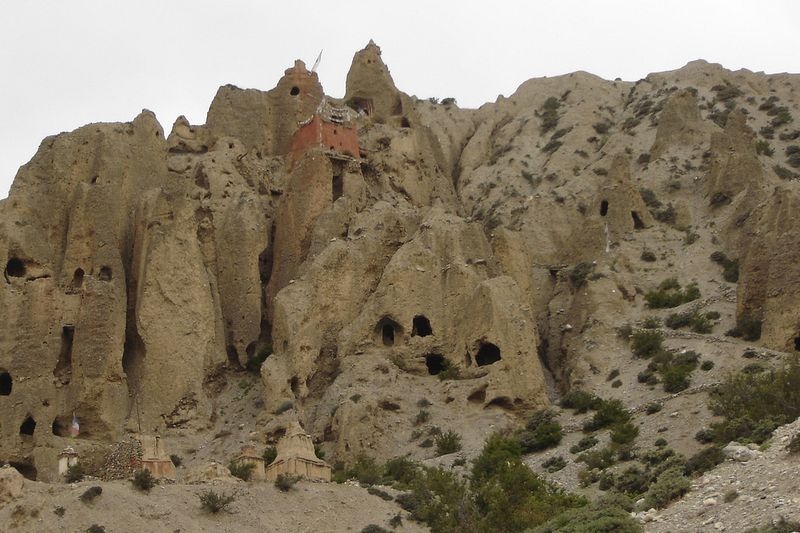
Archeologists believe that the caves in Mustang were used in three general periods. They were first used some 3,000 years ago as burial chambers. Then around 1,000 years ago, they became primarily living quarters, perhaps to escape battles and intruders into the valley. Finally, by the 1400s, most people had moved into traditional villages and the caves became places of meditation. Some of these caves were turned into monasteries such as the Luri Gompa, the Chungsi Cave monastery and the Nyiphuk Cave Monastery, all of which were built around and inside the caves.

Luri Gompa is one of the most famous in Mustang. The monastery is set on a ledge, at least a hundred meter high from the ground, in one of the many natural pillar like sandstone structures. A winding footpath climbs all the way from the bottom of the valley to a single entrance door that leads into two interconnecting chambers. The outer chamber contains a shrine, while the inner chamber —the main treasure of Luri Gompa— is beautifully decorated with a series of paintings depicting Indian Mahasiddhas — saints who were said to have achieved siddhi, or extraordinary powers by meditation. No documentation pertaining to this mysterious gompa or monastery has been found, but the wall paintings appear to be have been made in the 14th century or even earlier.

mustang-caves-1

Photo credit: National Geographic

mustang-caves-3

Photo credit: National Geographic

mustang-caves-5

Photo credit: National Geographic

mustang-caves-6

mustang-caves-7

Photo credit: nepaladvisor.com

mustang-caves-8

Photo credit: David Rengel/Washington Post

luri-gompa-2

Luri Gompa. Photo credit: Bob Witlox/Flickr

luri-gompa-3

luri-gompa-4

Frescos in the ceilings of Luri Gompa. Photo credit: library.brown.edu

Sources: Nat Geo / library.brown.edu / www.oneworldtrekking.com

Source……..www.amusingplanet.com

Natarajan

Breaking stereotypes: ‘We are stronger than we think’ !!!

We had asked you, dear readers, share your experience if you’re a woman who has broken stereotypes.

Here, Vandana Chaudhary shares her story.

Vandana Chaudhary

I am Vandana Chaudhary, 33 years, and presently live in Vizag.

I have always enjoyed sports like badminton and cricket.

I also run marathons occasionally. But cycling, and that too 80 kilometres, is something I never fathomed in the wildest of my dreams.

It all started in August 2013, when I first bought my Firefox (MTB) and enjoyed riding it casually on Dolphin hill (my residence).

In the first few months, I could barely do 4 to 5 km at a stretch, without running out of breath.

Gradually, I improved my timing and was able to do 12 km (with a steep elevation) within six months.

However, I never thought I was good enough to participate in a cycling tour, which had professional cyclists as participants.

In December 2014, the ‘Tour of Eastern Ghats (TEG)’ was organised.

It was time to send in our names and I was still in two minds if I would be able to ride half the distance, let alone complete it.

Nevertheless, with immense encouragement from my husband (Anand V), I decided to give it a shot, with my humble six geared cycle.

Vandana Chaudhary at the start line

On the D-day, while standing at the starting line, I felt terribly intimidated by shiny, sleek Cannondales, Treks and Meridas around.

My heart sunk further, when I saw all of them zooming past me on their 24-geared bikes.

With low spirits already, I decided to continue, slow and steady, with my hubby following me in our black Santro.

Every time I would slow down, he would shout out aloud a word of encouragement like , “C’mon Vandana, you can do it, you are almost there”.

When the group stopped for a quick lunch, I was the last one to reach.

Post lunch, many participants decided to drop out due to exhaustion. That’s when I decided, it is not important to win the race, but it’s important to complete it.

I started with rejuvenated vigour and cycled my way through the fields, mountains and lakes. All this while, Anand trailing me and cheering me.

At one point of time, the organisers asked me to stop and use the towing truck, like others had as it was getting too late.

Sensing my disappointment, Anand stepped up and said, “She will not give up even if it meant riding in pitch dark”.

In the end, I proudly wish to reveal that there were just three of us who completed the entire route, the other two being Naval officers.

That day, for the first time I realised, what a little bit of will power and self belief can achieve

I still feel a sense of pride when I think of how I decided not to give up despite the darkness, pain and exhaustion.

“We are stronger than we think” — I will never stop believing this!

Photographs: Kind courtesy Vandana Chaudhary

Source…….www.rediff.com

Natarajan

India’s Water Warrior Has a Solution for India’s Droughts. The Best Part – We Can Play a Role Too!

Ayyappa Masagi has successfully implemented water conservation projects across states, industries, farms, and homes.

For anyone who is worried about India’s water crisis, Ayyappa Masagi’s solution is simple – conserve. This man – popularly referred to as Water Magician, Water Gandhi, and Water Doctor – firmly believes that by the year 2020 India can manage its water resources well and be a water-efficient country. And if Ayyappa has his way, the country may just end up achieving this goal.

Ayyappa is famous for reversing the fortunes of thousands by getting them to practise rainwater harvesting and water conservation.

masagi1

He has also recharged more borewells and constructed more lakes than probably anyone else in the country.

But he hasn’t always been actively involved in conserving water. In fact, for many years, Ayyappa was an engineer for Larsen and Toubro (L&T), before he started working in this field. Ayyappa was born into a family of poor farmers in Gadag district in Karnataka. And it is his experiences with agriculture that made him study water in his later years.

“In my childhood we faced plenty of water problems. I used to wake up with my mother at 3 am to go and fetch water. This used to happen so often that I took an oath to try and conserve water every day. In fact, throughout my growing years, I thought of ways to conserve water,” he says.

Ayyappa went through many struggles before he could get an education and get employed. His mother sold her gold so he could complete his diploma in mechanical engineering. He worked at BEML, Bengaluru, before joining L&T, where he worked for 23 years.

During his years in L&T, Ayyappa found it hard to resist the call of the earth.

He gave in and purchased six acres of land in a village in Gadag.

masagi4

“In this dry region, I planted crops like rubber and coffee. I wanted to prove that one could grow these crops with whatever rain one gets. Though I was successful in the first two years my crops soon dried up due to a severe drought. The year after that, they were destroyed by floods. Though people mocked me at that point, I didn’t take it to heart. I was determined to find a solution,” he says.

This is how Ayyappa started researching how water, which is abundant at least once a year, can be conserved for the dry season. In his quest for answers, he met with experts like Anna Hazare and Rajendra Singh of Rajasthan.

After a long study, Ayyappa realised that recharging borewells and practising non-irrigational agriculture methods were the answers to the water problems farmers faced.

“I decided to use my farm as my own R&D lab. I implemented these techniques and reaped a good harvest in the two subsequent years, in the face of flood and famine. I was encouraged by the success and started spreading the message about borewell recharging and non-irrigational agricultural techniques. I tested these methods on the farms in my neighbourhood and found they worked there as well. This is what prompted me to reach out to more people,” he says.

Gradually, he quit his job at L&T and decided to work towards making India a water-efficient nation.

“We always blame nature. But that is unfair. It is we who have encouraged uncontrollable development and encroached upon land. Then how can we complain when a place like Chennai receives the rain meant for a year in three days?” asks Ayyappa.

In 2004, Ayyappa received the Ashoka Fellowship for his conservation efforts.

masagi3

A year later, he established the Water Literacy Foundation, in a bid to reach out to more people and spread the message of conservation.

In 2008, Ashoka approached Ayyappa to start a for-profit wing of the Water Literacy Foundation. This is how Rain Water Concepts was launched.

Today, he finds solutions to water problems based on the size of the farm, the availability of resources, and the person’s budget. Ayyappa has orchestrated thousands of conservation projects across 11 states. He has also created over 600 lakes in the country, for which he found mention in the Limca Book of Records.

Ayyappa’s ideas are simple. He considers the earth to be the biggest filter. He captures the water, filters it and then stores it underground. His pit-based rainwater harvesting system is a structure made of boulders, gravel, sand, and mud. When it rains, water trickles through the gravel and sand. It slowly charges the subsoil. This process continues and ensures the soil is always charged with water. This method also prevents water from evaporating.

He also specialises in watershed management, inter-basin water transfer, recycling of water, etc.

masagi2

“Do you know how much water every person wastes while having a bath? This water is not bad water. It can actually be reused,” he says.

Ayyappa not only provides services to individuals but to corporates and other educational institutions as well. He has also managed to create a community of ‘water warriors’ who practise his methods and educate others about them.

“Our country doesn’t need grand plans like river-linking to tackle the problem of water shortage. In fact, that project is an unnecessary expense for the government. If we need to save water, every farmer and ever organisation should plan ahead. And if they do, this country will soon become water-efficient,” he says.

Ayyappa Masagi can be contacted at waterliteracyfoundation@yahoo.com

Source…..Meryil Garcia in http://www.the betterindia.com

Natarajan