How to spot the International Space Station….?

Every so often, the International Space Station (ISS) becomes visible in your night sky. Here’s how you can spot it.

A composite photograph of the International Space Station from Earth. Image Credit: Dave Walker.
A composite photograph of the International Space Station taken from Earth. Image Credit: Dave Walker.
Is it a meteor? Is it a plane? It might be the International Space Station (ISS).Every so often, the ISS becomes visible in the night sky. To us on Earth, it looks like a bright star moving quickly above the horizon. The ISS is so bright, it can even been seen from the center of a city. Then, just as suddenly as it appeared, it disappears. How do you know when you can see the ISS in your night sky?

NASA’s Spot the Station program lets you sign up to receive alerts to let you know when the ISS will be visible from your location – anywhere in the world. You can get alerts via email or text message. Typically, alerts are sent out a few times each month when the station’s orbit is near your location. Visit the Spot the Station website here to sign up, and view a list of upcoming sighting opportunities.

ISS crossing the sky in a long-exposure photograph by Antonín Hušek?.

If you sign up for NASA’s new service, notices will be sent to you only when the ISS will be clearly visible from your location for at least a couple of minutes. If you live north of 51.6 degrees latitude (for example, in Alaska), you will likely have to visit the website to find sighting opportunities because notifications in this region would be rare.

The notices contain information on where to look for the ISS in the night sky. Just note where the sun sets and you can easily find the direction where the station will appear (for example, in the southwest or in the northwest). The height at which the station will appear is given in degrees. Just remember that 90 degrees is directly over your head. Any number less than 90 degrees will mean that the station will appear somewhere between the horizon and the 90 degree mark. The station is so bright that it is really hard to miss if you’re looking in the correct direction. Alternatively, you can stretch out your fist at arm’s length toward the horizon, which is equivalent to about 10 degrees. Then, just use the appropriate number of fist-lengths to find the location marker, e.g., four fist-lengths from the horizon would be equivalent to about 40 degrees.

NASA’s Spot the Station program is great. I’ve seen the station fly over twice now and it’s a pretty amazing experience—gets you thinking about how far our technology has advanced.

The first module of the ISS was launched into space in 1998 and the initial construction of the station took about two years to complete. Human occupation of the station began on November 2, 2000. Since that time, the ISS has been continuously occupied. The ISS serves as both an orbiting laboratory and a port for international spacecraft. The primary partnering countries involved in operating the ISS include the United States, Canada, Europe, Japan and Russia.

The ISS orbits at approximately 220 miles above the Earth and it travels at an average speed of27,724 kilometers (17,227 miles) per hour. The ISS makes multiple orbits around the Earth every day.

Photograph of the International Space Station taken from the space shuttle Endeavour on May 30, 2011. Image Credit: NASA.

Photograph of the International Space Station taken from the space shuttle Endeavour on May 30, 2011. Image Credit: NASA.

Astronauts Robert Curbeam, Jr. and Christer Fuglesang working on the International Space Station. Image Credit: NASA.

Astronauts Robert Curbeam, Jr. and Christer Fuglesang working on the International Space Station. Image Credit: NASA.

Bottom line: Check out the ISS in the night sky the next time it flies over your location. You can sign up to receive alerts with NASA’s Spot the Station program or visit that website to view a list of viewing opportunities.

Source….

Deanna Conners

http://www.earthsky.org

Natarajan

Two Indians Have Designed A Garbage Bin That Will Reward Users With Free WiFi…

Realising the need of the Internet in everyday life, two commerce graduates decided to give free WiFi to people in exchange of a cleaner surrounding with an unique initiative — a ‘WiFi Trash Bin’.

“When somebody dumps trash into a dustbin the bin flashes a unique code, which can be used to gain access to free WiFi, says Prateek Agarwal, one of the two founders of the initiative.

Mumbai-based Agarwal and his partner Raj Desai, a self taught programmer, travelled extensively to countries like Denmark, Finland, Singapore etc and realised that keeping surroundings clean needed apart from a difference in structure, a change in the attitude of people.

“We took a lot of help from countries like Finland, Denmark, Singapore etc and decided to build a system similar to that,” says Prateek Agarwal.

The duo hit upon the idea while visiting the NH7 Weekender a music festival which is spread around a large area and as music festivals go is home to music food drinks and of course a lot of garbage.

” …It took us six hours to find our friends. Since there was no network, we could not reach them through a phone call.

It was the trigger for the idea and we thought why not provide free WiFi to people using hotspots,” says Mr Agarwal.

Keeping the place clean and helping to connect with their friends were the driving force behind their innovative project.

The self-funded experiment with support from operator MTS proved to be a success at the various Weekender Festivals held in Bangalore, Kolkata and Delhi but is not operative at the moment.

The founders say they have received queries from GAIL and talks are in due process.

“We wanted to change the attitude of the people and how things are structured, thus affecting an individual’s behaviour,” says Raj Desai.

The venture, though not operative now aims to satisfy the need of Internet at every step in the modern day world.

“… We want to work more for it,” says Mr Agarwal.

The duo say they tend to setup a network of WiFi bins thus helping to bring about a behaviourial redesign among people.

The venture was recently showcased at “Networked India”, a unique initiative by Ericsson and CNN-IBN that aims to identify and facilitate clutter-breaking innovations in the field of connectivity and mobility.

Source…..www.huffingtonpost.com

Natarajan


” These Chennai Scientists Are Trying To Solve An Impending Agricultural Crisis…”

SALICORNIA BRACHIATA

VEDARANYAM, Tamil Nadu — On a sun-scorched wasteland near India’s southern tip, an unlikely garden filled with spiky shrubs and spindly greens is growing, seemingly against all odds.

The plants are living on saltwater, coping with drought and possibly offering viable farming alternatives for a future in which rising seas have inundated countless coastal farmlands.

Sea rise, one of the consequences of climate change, now threatens millions of poor subsistence farmers across Asia. As ocean water swamps low-lying plots, experts say many could be forced to flee inland.

“It’s hard to imagine how farmers will live,” said Tapas Paul, who as a World Bank official helped channel about $100,000 to help build the small garden a decade ago in a swampy, seaside town dominated by salt flats in southern Tamil Nadu state. “In the places subject to inundation and sea level rise, there are few options.”

A team of Indian scientists is searching for solutions to what they describe as a fast-approaching agricultural crisis. Their neatly plotted rows of naturally salt-tolerant plants, known as halophytes, could be a part of the answer. The scientists from the M.S. Swaminathan Research Foundation are also trying other approaches: tweaking genes and cross-breeding plants by conventional means to discover which might grow and even flourish.

“Sea level rise is inevitable, and we are not prepared,” said Swaminathan, who pioneered high-yield wheat and rice varieties for India in the 1960s. “The biggest problem in India is just the very large population. We can say people can relocate, but where could we even accommodate all those who need to move inland?”

Saltwater for a farmer long meant certain crop failure. Wartime foes sowed enemy fields with salt to ensure social collapse. Natural disasters such as the 2004 Asian tsunami left countless plots unproductive for years.

Asia’s coastal farmers, including millions impoverished in India, now face such problems. Climate change will bring stronger storms and warmer temperatures that expand ocean waters and melt ice caps and glaciers. As a result, seas are set to rise up to 1 meter (3.2 feet) in this century, according to the latest scientific forecasts.

Chellammal, a graceful, 65-year-old farming housewife in the Tamil Nadu village of Tetakudi, knows the nightmare of farming on salt-contaminated land too well.

“I struggled so long to get things to grow, but nothing worked,” said Chellammal, who goes by one name. “Every year just got worse until there was nothing left,” she said, crouched in a bright pink sari by her fields.

The land her family had saved for decades to buy went completely barren about five years ago, after a neighboring village took up shrimp farming when flooding from a nearby ocean canal salted their lands. The shrimp ponds were never lined properly, so their saltwater seeped into surrounding soils.

The farmland lost by Tetakudi’s 200 households now supports little more than a vast expanse of salt-tolerant shrubs called Suaeda maritime along with succulents called Salicornia brachiata, known to locals as “chicken feet.”

To the villagers, the bright green bushes are no better than weeds. Already, 12 families have boarded up their homes and left.

But scientists say suaeda is good for firewood. And salicornia species, which can tolerate nearly twice the salinity of seawater, have enormous potential as a biofuel crop, with seeds containing high concentrations of oil.

The problem, however, lies in realizing profits. For any crop to work on a large scale, inexpensive methods and machinery for harvesting will have to be developed. Then processing plants, production lines and markets would need to be built. As of now, none of that exists.

Chellammal is dubious, but interested.

“If we can make money from what we grow, we’ll try it. Why not?” she said. “Maybe all is not lost.”
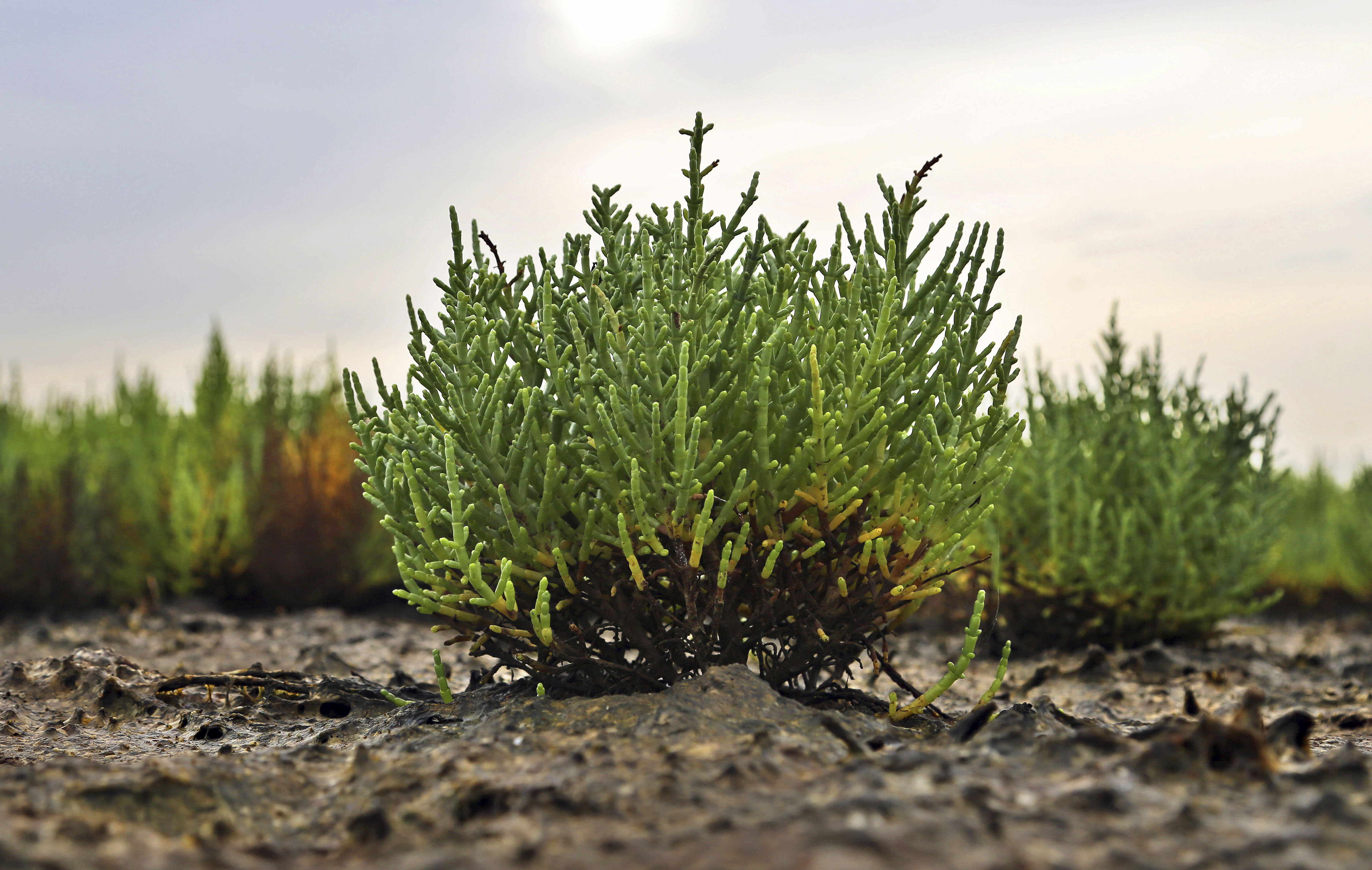
 

salicornia brachiata

In this June 16, 2015 photo, a wild-growing Salicornia brachiata, a halophyte known to locals as ‘€chicken feet’, thrives on fields tainted by saltwater from a neighbouring shrimp farm near Velankanni, India.

The timing for an agricultural crisis due to sea rise couldn’t be worse. India’s poor farmers already struggle with frequent flooding, drought and soils degraded by agrochemical overuse. Those on the coast are also hit by storms, with at least 27 of the 35 deadliest cyclones in history barreling through the Bay of Bengal before slamming into either India or Bangladesh.

India’s freshwater sources are also in peril, with over-tapped groundwater reserves so low the country is expected to have only half the water it needs by 2030. Grain production, meanwhile, has stalled around 260 million tons in recent years, despite global pressure for India to boost yields, eliminate waste and eradicate widespread poverty and malnutrition.

To feed its growing 1.26 billion population, India must increase food production 45 percent by 2050, for which experts say it may need to cultivate more land. Instead, about 1.2 million hectares (3 million acres) of its coastal farmland has been degraded by salt, according to India’s Central Soil Salinity Research Institute.

Inland, India has lost another 5.5 million hectares of arable farmland, out of its nationwide total of 163 million hectares, though India’s soil salinity troubles are exacerbated by industrial salt flats, a growing number of shrimp farms and the depletion of groundwater reserves. The trend will only continue as seawater creeps onto low-lying lands along the 7,500-kilometer (4,700-mile) coast that outlines the country along the Bay of Bengal, Indian Ocean and Arabian Sea.

“Saltwater agriculture is considered a futuristic area. But it really shouldn’t be,” said marine biologist V. Selvam, the M.S. Swaminathan foundation’s mustachioed director of coastal research. “Very soon there won’t be enough land and water to meet our needs.”

And India is not alone. Countries including Egypt, Bangladesh and much of Southeast Asia also face heavy saltwater intrusion and loss of farmland. Already, 62 million hectares, or 20 percent, of the world’s total 300 million hectares of irrigated farmland has been salinized to some extent. Another 50 centimeters (1.6 feet) of sea rise, which is just half of what’s expected by 2100, would swamp up to 1.9 million more hectares, the Intergovernmental Panel on Climate Change has said.

That will undermine the world’s ability to find the additional 120 million hectares of farmland it needs for a staggering 70 percent increase in food production to feed the world by 2050, according to the U.N. Food and Agricultural Organization.

Experts say there will be little choice but to grow some non-food crops along the coasts.

The world’s irrigated acreage could be increased by about 50 percent by reusing saline water and salinized crop fields for halophytes, said University of Arizona environmental sciences professor Edward Glenn.

“As with aquaculture replacing wild fisheries, it is inevitable that halophytes will have their day,” he said.

Sesuvium portulacastrum. Paspalum vaginatum. Prosopis juliflora.

These are just a few of the 350 known species of salt-tolerant plants that are candidates to become crops for the future. Saltwater plants are unlikely to become staple foods, because while often high in nutrients they’re also very salty and so should be eaten in moderation.

Species such as Salicornia europaea, also known as glasswort or samphire, are already sold in European markets as a fancy salad addition or side dish. The bright purple-and-white blossoms of Limonium are a florist’s delight, while another species called Atriplex or saltbush is eaten by sheep.

Supporters note a host of potential uses to make harvests profitable, including firewood, decorative flowers, kitty litter, nutritional supplements, cooking oil and biofuel. Cattle fodder is another possibility, and Indian herders already graze their cattle on thorny shrubbery by the sea.

Despite the potential, saltwater agriculture is still seen as a fringe topic, even after decades of research by universities worldwide along with studies and pilot projects in countries including Mexico, Pakistan, Jordan and Eritrea. The aviation company Boeing is also researching biofuels from saltwater plants.

India’s scientists aren’t waiting for markets to develop. Nor are they relying on just the halophyte garden to offer up new options.

They’re scouring coasts for wild grain species that might naturally tolerate some salinity, and using arduous breeding methods to create new salt-tolerant strains.


The foundation has also developed genetically modified rice using genes from mangrove trees. It says the resulting plant can tolerate salt concentrations of 12-15 grams per liter. Seawater is typically two to three times saltier, but that’s still a major improvement from currently cultivated rice varieties, which can handle only up to 3 grams per liter.

Genetic modification is considered the most difficult approach, because salt tolerance is a trait that involves numerous genes. But the molecular biologist leading the development of GM halophytic rice believes it’s essential.

“Conventional breeding just takes too long, and this problem is urgent,” said Ajay Parida, the foundation’s executive director. His work stalled in 2007 under an effective moratorium on field testing GMOs, but the Indian government is considering shifting its GM testing policy and Parida now expects his trials to start soon.

“We could eventually be cultivating wastelands and places considered entirely unsuitable,” he said. “But it’s only after crisis hits that people realize the magnitude of the problem and start pushing for an answer.”

Source….  |  Katy Daigle….www.huffingtonpost.com

Natarajn


No mission is impossible….Meet Mr. K.R.Pechimuthu of Trichy…

K.R. Pechimuthu with his self-published Thirukkural booklets. Photo: M. Srinath

THE HINDU

K.R. Pechimuthu with his self-published Thirukkural booklets. Photo: M. Srinath

From blood donation to tree-planting, vermicompost and Thirukkural dissemination, retiree K. R. Pechimuthu has espoused each cause with gusto

K.R. Pechimuthu has clearly never thought of retirement as an end. What else would push him (literally) to cycle from his home in Kumaresapuram, on the outskirts of Tiruchi, distributing free booklets of the Thirukkural to primary-level school students?

“Instead of expecting the Government to come and bail us out each time, why cannot we do something ourselves?” he replies with a question.

And so, motivated by the idea of inculcating good values in youngsters, Mr. Pechimuthu and a helper hop on to their bicycles, packed with at least four 25-kilo bundles of booklets at 7 a.m., and visit the schools. Mr. Pechimuthu holds a value-orientation class using the Tamil literary classic as a foundation, for an hour, and encourages children to learn how to recite the poetic lines precisely. To keep them engaged, he offers a prize of Rs. 10 per correct recitation.

“We used to have moral science in our education system earlier, now it’s gone,” says Mr. Pechimuthu. “I use the Thirukkural to unite young children in learning how to venerate their parents and teachers, who are our founts of knowledge.”

It is 17 years since Mr. Pechimuthu stopped working as a mechanical engineer in BHEL, Kailasapuram, and 15 years since he started the Thirukkural project through his Akarur Educational Trust.

Mr. Pechimuthu reckons that at least 10,000 copies are given away every one or two months. He has cycled up to Manachanallur, 15 km from Tiruchi, on this unique mission, eager to use his retirement benefits to fund his dreams.

Father’s lessons

And there has been no dearth in the dreams department either. “People often wonder why I do all this,” he says. “When you grow older, shouldn’t you be getting more careful about your money? But then, no matter how much you earn in this lifetime, are you going to take it all with you when you die? So I thought, ‘let me look for people who need help.’”

Mr. Pechimuthu, born in Mayiladuthurai, and brought up in Devakottai, names his father A. Karupaiyya, a farmer, who worked briefly in Burma before setting up a timber depot in Devakottai, as his chief source of inspiration. “My father was a spiritually-inclined person, and used to recite theThevaram Thiruvasagam (sacred poems written by Saivite saints known as Nayanmars). “I used to be entranced by the recitation, though I couldn’t really understand their full meaning until I was much older,” recalls Mr. Pechimuthu.

“In his advanced years, my father handed over his timber depot to Periyasami, a worker who had joined us at the age of 10, as a symbol of gratitude for his long years of service,” he says. “Besides, as both my brother and I had moved on in our education and career and my sisters had settled into married life, he felt it was the best thing to do. My father’s selfless gesture convinced me to become more socially conscious.”

Social concerns

Mr. Pechimuthu’s social work started with blood donation in 1966, when he was a foreman in BHEL’s design engineering department. He donated blood around 75-80 times until he was 58 years old. He then shifted his attention to raising awareness about eye donation. In the mid-1980s, he got interested in organic farming and vermicompost, and got guidance in the subject from Chennai-based soil biologist Dr. Sultan Ahmed Ismail and Dr. Kalai of Bangalore University.

Popularising the concept through All India Radio broadcasts and workshops for Tamil Nadu Women in Agriculture, Mr. Pechimuthu mastered vermicomposting enough to develop his own study material that was used in many institutions.

Approaching retirement, he decided to set up an industrial training unit for rural youth in Vaiyyampatti block. Its students were also roped into the voluntary tree-planting drive overseen by Mr. Pechimuthu. Some 10,000 neem and laurel saplings (given free by the Agriculture Department), had been planted throughout the block by 1996, with Mr. Pechimuthu paying Rs. 10 per month out of his own funds for the maintenance of each tree planted in a public place. Unable to sustain the institute due to land problems, Mr. Pechimuthu shifted to Kumaresapuram, still keen to be of some use to the youth of the area.

And a new cause soon suggested itself to him. Approached by a tearful mother for aid to pay her child’s school fees, Mr. Pechimuthu wondered why the poor couldn’t have an affordable savings programme that would help them to educate their children.

He decided to act on the advice of his insurance agent friend, and offered to enrol the mother in an endowment assurance scheme where a Rs. 300 premium would ensure a substantial payout at maturity. “I asked her to give half the premium, and I offered to pay the other half,” he says. “By the grace of God, some 568 children have been able to pay their school fees through this policy.” It was while interacting with the students that he realised the need to teach them good manners and ethical awareness through the Thirukkural.

The man who gets up at 4 a.m. to sweep the street outside his home and clean out the open ditches, then accompany his wife on their daily stroll through the neighbourhood and finally gets ready for his school visits, is an inspiring figure. He doesn’t accept (or expect) any kind of financial or ideological sponsorship for his work.

“I don’t want people to praise me, just to absorb the ideals and values I’m putting across,” he concludes.

Mr. K. R. Pechimuthu may be contacted on 9715426463.

Source….Nahla Nainar …www.the hindu.com

Natarajan

How to handle criticism at work….

Feedback is essential for the growth of any professional. But are you equipped to handle it well?

How to handle criticism at work

Dealing with criticism in a positive manner is extremely important.

At some point in your professional life you will be criticised.

It may seem unfair and difficult. But you can use it in a positive manner — as a means to better yourself, or in a negative manner — causing yourself stress, anger and lowered self-esteem.

Below are the ways in which one must handle criticism:

Is it really criticism?

Most people get their defence up the minute they feel somebody is giving them an opinion not necessarily aligned with their own.

It is important to understand if the opinion is criticism or constructive feedback.

Instead of being extra sensitive, it is essential to absorb the person’s outlook and analyse whether it can be incorporated in anyway.

Do not reject any idea by labelling it as criticism.

It might be a stepping stone to bettering yourself.

What is the intent?

You need to evaluate why are you being criticised.

Is it for the betterment of your task quality, behaviour, productivity, or is it simply done to ridicule you?

In case the feedback is in your best interest, utilise the opportunity to learn and outperform your previous efforts.

However, if the person’s intent is to simply pick on you, you must be assertive and stand up for yourself.

Accept that you are not perfect.

‘Nobody is perfect; neither are you.

If you are good, there is scope to become great.

If you are great, there still is scope to become outstanding.

Take feedback with a pinch of salt and do not get offended. Look at it as an opportunity to stretch your boundaries and explore further into your potential.

Do not get offended easily.

Do you find yourself getting hurt, crying at the drop of a hat or stressing out the minute anybody criticises your work?

The solution is not to cut the critics out of your life but to toughen up.

Do not be over sensitive. Listen intently to what the person is saying.

Weigh the significance before dismissing the person.

Is the feedback accurate?

Be completely objective and unbiased in assessing feedback.

Just because it is different from your line of thought, doesn’t necessarily mean that it is wrong.

Think of every piece of feedback/criticism as a means of improving your knowledge, skills, attitude and efficiency.

If it doesn’t help on any of these parameters, brainstorm your ideas with the person before putting your foot down and rejecting it.

Stop making excuses.

Do you display strong displeasure whenever someone is pointing out something to you?

This will lead to conflicting situations with the person or discourage the person from walking up to you and sharing his/her honest and possibly valid feedback next time.

Either way, your relationship will suffer, along with any future probability of getting fresh perspective on self-improvement.

Is the criticism destructive?

If you are sure that the intention behind the criticism is destructive, try to find the hidden motive and communicate with the person.

An open communication serves the purpose majority of the time. Be assertive and yet empathetic when you do so.

Trust yourself and be confident of what you bring on the table. Let the critics not succeed in pulling your morale down.

Remember: If you have received criticism that was delivered in a warm manner only to bring a positive shift in you, take the effort to display your gratitude and appreciation to the person.

Thanking people who give you honest criticism is a sign of maturity.

Lead image used for representational purposes only. Credit: Diego Rodriguez-Vila/Creative Commons

The author is co-founder and head of business development at Work Better Training.

Source….Ruchira Karnik…www.rediff.com

Natarajan

Message for the Day…” Time Wasted is Life Wasted…”

Sathya Sai Baba

You are wasting a lot of time in meaningless pursuits. Time wasted is life wasted. Our ancients never wasted even a minute. They considered God as the embodiment of time and extolled Him thus: Kalaya Namah, Kala Kalaaya Namah, Kalaateetaya Namah, Kalaniyamitaya Namah(Salutations to the Embodiment of Time, to the One who conquered time, to the One who transcends time and to the One who ordains time). Why have you forgotten the truth that time is verily God? You eagerly await a Sunday thinking that you can relax and enjoy. In fact, you should feel sad that you are wasting time without doing any work on a Sunday. You have to utilise your time in a proper way. If you do not have any work, undertake social service. Help your fellowmen. Life becomes meaningful only when you make proper use of time.

First Digital Map of World Ocean Floor….

This is a still shot of the world's first digital map of the seafloor's geology. Image credit: EarthByte Group, School of Geosciences, University of Sydney, Sydney, NSW 2006, Australia National ICT Australia (NICTA), Australian Technology Park, Eveleigh, NSW 2015, Australia

This is a still shot of the world’s first digital map of the seafloor’s geology. Image credit: EarthByte Group, School of Geosciences, University of Sydney, Sydney, NSW 2006, Australia National ICT Australia (NICTA), Australian Technology Park, Eveleigh, NSW 2015, Australia

Map key.

Map key.

Scientists have created a digital map of the global seafloor’s geology. It’s the first time the composition of our planet’s seafloor has been mapped in 40 years; the most recent map was hand drawn in the 1970s.

Published in the latest edition of Geology, the map will help scientists better understand how our oceans have responded, and will respond, to environmental change. It also reveals the deep ocean basins to be much more complex than previously thought. Adriana Dutkiewicz from the University of Sydney is the lead researcher. She said:

In order to understand environmental change in the oceans we need to better understand what is preserved in the geological record in the seabed.

The deep ocean floor is a graveyard with much of it made up of the remains of microscopic sea creatures called phytoplankton, which thrive in sunlit surface waters. The composition of these remains can help decipher how oceans have responded in the past to climate change.

A special group of phytoplankton called diatoms produce about a quarter of the oxygen we breathe and make a bigger contribution to fighting global warming than most plants on land. Their dead remains sink to the bottom of the ocean, locking away their carbon.

The new seafloor geology map demonstrates that diatom accumulations on the seafloor are nearly entirely independent of diatom blooms in surface waters in the Southern Ocean. Professor Dietmar Muller from the University of Sydney, is a study co-author. Muller said:

This disconnect demonstrates that we understand the carbon source, but not the sink.

Some of the most significant changes to the seafloor map are in the oceans surrounding Australia. Dutkiewicz said:

The old map suggests much of the Southern Ocean around Australia is mainly covered by clay blown off the continent, whereas our map shows this area is actually a complex patchwork of microfossil remains. Life in the Southern Ocean is much richer than previously thought.

The scientists analyzed and categorized around 15,000 seafloor samples – taken over half a century on research cruise ships to generate the data for the map. They teamed with the National ICT Australia (NICTA) big data experts to find the best way to use algorithms to turn this multitude of point observations into a continuous digital map. Simon O’Callaghan from NICTA is a study co-author. He said:

Recent images of Pluto’s icy plains are spectacular, but the process of unveiling the hidden geological secrets of the abyssal plains of our own planet was equally full of surprises!

Bottom line: Scientists have created a new digital map of the geology of Earth’s seafloor.

Source….www.earthsky.org

Natarajan

Image of the Day…Balanced Rocks…

Balanced rocks

“Happiness is not a matter of intensity but of balance, order, rhythm and harmony ” – Thomas Merton

Photo by Jeff Berkes Photography

Jeff Berkes provided the quote above along with this photo, which he captured in Rhode island. He wrote:

If you dig this photo or think it could inspire someone, please share and like! Thanks in advance!

Rhode Island, USA
Camera | Nikon D4
Lens | Nikon 17-35mm f/2.8 @ 17mm

Thank you, Jeff!

Visit Jeff Berkes Photography on Facebook

Source…www.earthsky.org
Natarajan

India’s Mars Orbiter sends back stunning 3-D images of the largest known canyon in the solar system

While the rest of India was tasting patriotic waters on the account of the 69th Independence Day, India’s Mars Orbiter Mission, Mangalyaan, sent us pictures which made us proud yet another time.

The Mars Orbiter Mission sent some beautiful images of the largest known canyon from the Red planet – Mars.

These are the images of Valles Marineris,  a largest known canyon complex in the solar system. This picture was taken from a height of nearly 2000 km from Mars colored camera.

A 62 km wide valley named Opir Chasma can be seen bordered by high cliffs.

Mangalyaan reached Mars on September 2014. It was an ecstatic moment for the whole country as ISRO was successful in its maiden attempt. Many countries like the USA, Russia, and Europe have accomplished successful Mars missions.

And what’s more, this is not the first time that an image has been sent. Earlier, they sent images of Martian landmarks – Aurorae Chaos.

It’s a long terrain with irregular blocks.

What this image proved?
It showed signs of fluvial activity which means showing signs of water or similar substances which could have flowed there sometime in the past.

You can see more pictures taken by Mangalyaan here.

Well, there is no doubt that this image proved the mettle of Mangalyaan another time, but it also proved to be a perfect Independence Day present for everyone especially because many studies have been undertaken to know about any signs of life on Mars. May many more pictures come our way!
Built at the cost of just Rs 450 crores, the orbiter still has 39 kilograms of fuel it still has left in the tanks – which could mean a few more years of breathtaking pictures, among other things.

Well done!

News Source: Aparajita Mishra in Hindustan Times…. http://www.storypick.com and  www.scroll.in

Natarajan


“Winners don’t do things differently. They do different things”….

No, I haven’t made a mistake in the title. The age-old saying, ‘Winners don’t do different things. They do things differently,’ made famous by Shiv Khera in his book You Can Win, is, in my opinion, wrong.

I remember it was quoted a lot when the book came out. Every individual can be great. All you need to do is work hard, and ‘work smart’. And every one would nod knowingly at the last clause. So that’s what I did — studied hard, went to a good B-school, got a great job and worked hard (and smart) there.

Unfortunately, that saying doesn’t always apply. And it’s becoming antiquated as ‘technology eats the world’ (to co-opt Marc Andreessen’s pet phrase).

This mentality of doing things smarter now pervades all aspects of our life. But it suffers from one fallacy, which I call ‘focusing on the numerator’.

It’s like a company that focuses only on improving its profit margin. It brings in cutting-edge efficient machines and implements just-in-time production techniques. But with all these productivity improvements, how much could the profit margin increase? From 15 to 20 per cent? To 40 per cent? Is 100 per cent possible?

Even in the best (and quite impossible) scenario, the upside is capped at 100 per cent of revenue. But, what if you focused, instead, on the denominator? What if you looked for ways to achieve a step jump in revenue? Suddenly, there’s far more value to capture, even if you are inefficient.

What you work on matters, and matters far, far more than how hard you work. This is an example of a Power Law, which I’ve written about before. In the early 1900s in England, there were some people who were called ‘knocker-uppers’. Their task was to wake people up every morning. They would walk the streets with a long stick, and tap on windows till people woke up. Many of them worked hard. I’m sure they worked smart too, with well-balanced, aerodynamic and sonorous sticks. Still, they lost their livelihoods in a jiffy when alarm clocks came into the market.

Moral of the story: Do more valuable tasks, instead of doing less valuable tasks efficiently or smartly. Doing something unimportant well does not make it important.

This is how the world is today — it’s the new normal. The companies that win are the ones that innovate 10 times more than their competition and ‘change the game’ and not the ones who innovate incrementally. As Peter Thiel says in his book, don’t move an industry to greater efficiencies (i.e., from 1 to 1.1). Focus instead on moving something from zero to one.

Look at the biggest companies around us — Google (search advertising), Apple (iPhone), Amazon (e-commerce, e-books, etc.). They didn’t just improve search algorithms, build a better phone, or sell books through a simpler distribution chain. They revolutionised their respective industries, not by doing things differently or more efficiently, but by doing different things.

And it’s not just companies: it’s visible in every aspect of life. No longer can you say, ‘Karm kar, phal ki chinta na kar‘ (‘Work hard, don’t worry about the result’), in all honesty. If the recipe is bad, it doesn’t matter how good a cook you are.

This may be bad news. But it’s good news as well. Once you start looking for this ‘focus on the numerator’ behaviour everywhere, you can make more valuable decisions for your company, your products, and with your time.

A few examples of the implications, off the top of my head:

Product Management: Instead of A/B testing and optimising your nth new feature, focus on getting more people to use your product. Andrew Chen puts this well in a recent article.

HR: Instead of trying to getting the best out of your team, learn how to build a better team. [This is more important in technology businesses, and less so in traditional brick-and-mortar companies.]

Health: You can try to manage your cholesterol by eating French fries cooked in refined oil or unsaturated oil or whatever the flavour of the season is. Or, you can just stop eating French fries!

Personal Finance: Focus on earning more, not spending less. A direct corollary of the revenue-profit point I made earlier. It’s ironic, but I’m the prime target for this lesson. I started expense budgeting almost before I could walk. I’ve spent countless hours balancing my expenses, tracking my receipts, and strategising lower spends, when I could have instead focused on doing more valuable things. Which means anything else, basically.

Personal Productivity: Be effective, not efficient, as Tim Ferriss says in The Four Hour Work Week. Do two important things, instead of 10 unimportant ones. A lesson for me as well, as I was firmly in the ‘get more out of your day’ brigade.

TL:DR: In work as in life, we should strive hard by all means. But we must think hard first: is what I’m doing the most valuable thing I could do? Let’s build more important things, instead of optimising our lives away.

Jitha runs a small digital marketing startup in Mumbai. He was a strategy consultant at Monitor Group, before he ‘saw the light’ and decide to struggle instead. He reads voraciously (62 books in 2014!) and likes to write in his free time.

See some of his previous work atjitha.me.

Photograph: Alex Wong/thestocks.in 

 Source…..Jithamithra Thathachariin http://www.rediff.com

Natarajan