Message for the Day…” Offer your heart to God…and gladly undergo transformation under HIS hands…”

Sathya Sai Baba

Offer your entire self, your life Unto Him; then your adoration will transform and transmute you so fast and so completely that you and He can be merged into One. He thinks, feels and acts as you do; you think, feel and act as He does. You will be transformed as a rock is transformed by the sculptor, into an idol, deserving the worship of generations of sincere men. In the process you will have to bear many a hammer stroke, many a chisel-wound, for He is the sculptor. He is but releasing you from petrification! Offer your heart to the Lord, and gladly suffer transformation at His hands. Do not defile time, or the physical sheath, or this life’s chance, using them for paltry ends. Your life is but one long pilgrimage which you entered when you were born, and may not end even when you die. Never forget that. Be pure, alert and humble as pilgrims ought to be.

Operation Sulaimani: A District Collector’s Mind Blowing Initiative to Feed the Hungry in Kozhikode…!!!

The people of Kozhikode are silently funding an initiative that feeds anyone who is hungry for free, with utmost dignity.

“Nalla Manushyar Aanu” – “They are good people.” This is a default comment that you will hear about the people of Kozhikode, Kerala. From its fabled auto drivers who return every penny of change, to its palliative clinic that provides free care for the terminally ill, to simple heart-warming selfless conversations, the tales of Kozhikode’s good hearted people are greatly cherished.

Now here is a reason why you will also chime in with some words of praise – Kozhikode makes sure no one in the city goes hungry! Be it the poorest, the not so poor, be it you or me – the hungry will be served food for free, with utmost dignity.

People in need can collect a free meal coupon from any of the distribution centres and walk into any restaurant in the city – a meal will be served, no questions asked, no explanations sought.

K2

Restaurants in Kozhikode serve meals to the hungry in exchange for free coupons given away by the authorities.

Pic for representation purposes only: kerala.in

“We cannot ask a hungry person to get his hunger attested by a certified gazetted officer! That is why we insisted on the philosophy that ‘no questions will be asked’. If you ask for a food coupon, you will get it, it is as dignified as that,” says District Collector of Kozhikode, Prashant Nair, the chief architect of this project called ‘Operation Sulaimani’, eponymous of Kozhikode’s very own local black tea, served with a dash of lemon and cardamom.

The project was launched by Kozhikode’s District Collector, Prashant Nair, who envisaged this as a community owned and community driven initiative in its entirety. The Collector’s office initiated it and the Kerala State Hotel and Restaurants Association roped in over 125 city restaurants to become a part of this.

But, there are no big sponsors nor do any government funds flow in. The small and big contributions by the citizens are dropped into little boxes with ‘Operation Sulaimani’ inscribed on them.

K4

The volunteer team has placed the boxes across the city, into which nameless donations are made. This money is used to reimburse the meal coupons that are collected at the restaurants. Interestingly, Team Sulaimani does not take a penny from the collected money to meet its administrative costs. This money is meant only to feed the hungry, they insist.

In April 2015, Operation Sulaimani made the free meal coupons available at the Collectorate, Village and Taluk offices. Coupons were also distributed along with newspapers with the intent that people who read newspapers can offer the coupons to those in need. An army of volunteers went around the city to spread the word and distributed the coupons.

Just two days after the launch of Operation Sulaimani, the Collector got a massive one crore donation offer, which he refused. Yes, he refused!

Kozhikode Collector, Prasanth Nair

Kozhikode Collector, Prasanth Nair

The team believe that the spirit of Operation Sulaimani lies in the collective responsibility taken by the people to care for each other rather than an act of benevolence by any individual or organization.

This collective spirit has proved to be indeed powerful by feeding 9000 people in the last one year, not running out of funds, and not showing signs that the city’s good spirit will allow them to run out too.

One of the striking aspects of Operation Sulaimani is the fact that it gets fulfilled within the capabilities of existing systems. No big kitchens to feed the hungry were built and no massive funds were sought in the name of hunger eradication. By leading people to any restaurant in any part of the city, it blended the cause into the everyday function of Kozhikode’s restaurants.

The District Collector adds, “There is no food wastage nor do we have to worry about the safety of the food. If we had chosen to build a large kitchen to supply free food, we would have all these problems. But we just decided to use the existing system and make the best use of it.”

One of the restaurants in the vicinity of the city mental hospital feeds several people who come in with coupons. The restaurant owner says his life has never before felt so blessed.

sulaimani1

Coupons can be exchanged at local restaurants for free meals.

Many restaurant owners like him do not want to take the reimbursements but Team Sulaimani insists that they are paid.

Some people doubt if such a facility will be misused, but the team is not worried about that. Rather, it is finding it challenging to reach more people who are in need. The members found that hunger is not just about the people on the streets, the homeless, it is also discreetly present within our communities. Reaching these people and making them aware that food is the last thing they need to worry about is what the team is obsessed with.

If you noticed, we haven’t got any quotes from any beneficiary of Operation Sulaimani nor put up their photos. Team Sulaimani believes that the dignity of the people should not be infringed on, and we salute that spiri

Source…..Ranjini Sivaswany in http://www.the betterindia.com

Natarajan

The story of the World War II gunner who fell 22,000 feet without a parachute and lived…

Paratroopers make a big deal about jumping out of planes from 800 feet, but U.S. Army Air Force Staff Sgt. Alan Magee fell out of a plane at 22,000 feet without a parachute while the plane was on fire.

And he lived.

ball turret gunner

Magee was a ball turret gunner in a B-17 named “Snap! Crackle! Pop!” after the three mascots for Rice Krispies cereal. That plane, along with others from the 360th Squadron, was sent to bomb German torpedo stores in St. Nazaire, France on Jan. 3, 1943.

During the mission, the plane was shot by anti-aircraft guns and became a ball of flames. Magee climbed into the fuselage to get his chute and bail out, but it had been shredded by the flak. As Magee was trying to figure out a new plan, a second flak burst tore through the aircraft and then a fighter blasted it with machine gun fire.

b17 bomber liberty belle


Magee was knocked unconscious and thrown from the aircraft. When he woke up, he was falling through the air with nothing but a prayer.

Magee told God, “I don’t wish to die because I know nothing of life,” according to reports from the 303rd Bomb Group.

Magee, struggling with a shortage of oxygen and likely in shock from the events of the past few minutes, passed out again and God seemingly answered his prayer. The young noncommissioned officer fell into the town of St. Nazaire and through the glass roof of the train station. He was later found dangling on the steel girders that supported the ceiling.

The glass had slowed his fall and he regained consciousness as German soldiers took him to medical care. Magee’s right leg and ankle were broken, he had 28 wounds from shrapnel and glass, and his right arm was cut nearly the whole way off. He had also suffered numerous internal injuries.

“I owe the German military doctor who treated me a debt of gratitude,” Magee said. “He told me, ‘we are enemies, but I am first a doctor and I will do my best to save your arm.'”

GErman prison camp wwii

French POWs at work at a farm in Westscheid bei Mennighüffen.

Magee was able to keep his arm and eventually made a full recovery. He spent most of the rest of the war as a POW.

In 1995, Magee was invited back to France as part of a ceremony sponsored by French citizens to thank Allied service members for their efforts in the war. Magee was able to see monuments to the crew of Snap! Crackle! Pop!, including the nose art which had been used as a Nazi trophy until after the war when a French man recovered it. It was restored in 1989.

Magee died in 2003.

Read the original article on We Are The Mighty. Copyright 2016. Follow We Are The Mighty on Twitter.

Source….www.businessinsider.com

Natarajan

Joke of the day….” What is the most dangerous food …” !

A doctor was addressing a large audience in Oxford on the subject of modern nutrition.
“The rubbish we put into our stomachs should have killed most of us sitting here, years ago.
Red meat is full of steroids and dye. Soft drinks corrode your stomach lining. Chinese food is loaded with MSG. High trans-fat diets can be disastrous, and none of us realize the long-term harm caused by the germs in our drinking water.


But, there is one thing that is the most dangerous of all and most of us have, or will eat it. Can anyone here tell me what food it is that causes the most grief and suffering for years after eating it?”
After several seconds of quiet,
a 70-year-old man in the front row raised his hand, and softly said:
Wedding Cake?
Source……www.ba-bamail.com
Natarajan

Message for the Day….” It is your duty to follow and practice the twin principles of Truth and Righteousness…”

Sathya Sai Baba

Ravana (the villain in Ramayana) sought wealth and gratification of desire, utterly violating the principle of dharma. He was a scholar par excellence. He had mastered the sixty-four disciplines of learning whereas Rama had mastered only thirty-two. However Rama put them into practice and thereby digested them, whereas Ravana failed to digest them. The indigestion on the part of Ravana arose in the form of desire (kama), which ultimately destroyed him. While Rama was the embodiment of Dharma, Ravana remained as the embodiment of kama. Thus there arose a conflict between righteousness and unrighteousness. Rama transformed Himself into the embodiment of sathya (Truth), since He followed the principle ofdharma. Since Ravana violated dharma, he became the embodiment of asathya (untruth). There is an eternal warfare between righteousness and unrighteousness, truth and untruth. It is your duty to follow and practice the twin principles of truth and righteousness.

Message for the Day….” Lord Rama is the reality in our daily existence…”

Sathya Sai Baba

Consider each brother, sister, comrade, companion, and collaborator of Rama as an example of a person saturated with Righteousness (dharma). In Ramayana, Dasaratha is the representative of the merely physical, with the ten senses. The three qualities (gunas) — serenity, activity, and ignorance (satva, rajasand tamas), are the three queens. The four goals of life, thepurusharthas — righteousness, wealth, fulfilment of desires, and liberation are the four sons. Lakshmana is the intellect; Sugriva is discrimination (viveka); Vali is despair; and Hanuman is the embodiment of courage. The bridge is built over the ocean of delusion. The three Rakshasa chiefs, Ravana, Kumbhakarna, and Vibhishana, are personifications of the active (rajasic), ignorant (tamasic), and pure (sattvic) qualities. Sita is the Awareness of the Universal Divinity (Brahma-jnana), which the individual must acquire and regain while undergoing travails in the crucible of life. Be established in the faith that the Lord (Rama) is the Reality in your daily existence.

Message for the Day….” Lessons we learn from Ramayana ….”

Sathya Sai Baba

Rama is the Indweller in every body. He is the Atma-Rama – the Rama (Source of Bliss) in every individual. His blessings upsurging from that inner spring will confer peace and bliss. He is the very embodiment of righteousness, of all the codes of morality that hold mankind together in love and unity. The story of Rama, ‘Ramayana’, teaches us two lessons: the value of detachment and the need to become aware of the Divine in every being. Faith in God and detachment from objective pursuits are the keys for human liberation. Give up sense objects, and you gain Rama. Mother Sita (Rama’s consort) gave up the luxuries of Ayodhya so she could be with Rama, in the period of exile. When she cast longing eyes on the golden deer and craved for it, she lost the presence of Rama. Renunciation leads to joy; attachment brings about grief. Be in the world, but not of it. Make your heart pure and strong, contemplating the grandeur of the Ramayana.

Message for the Day…..” what is Immortality …” ?

Sathya Sai Baba

My earnest wish is that youth evince keen interest in the moral and spiritual principles of the Ramayana and fully benefit from it. Elders too should mould their lives in consonance with morality and spirituality. Neither wealth nor scholarship can bring you happiness. Only the Love of God confers endless bliss on you. It not only bestows happiness but gives extreme strength as well. You must seek learning that confers immortality. What is Immortality? The removal of immorality is immortality. Human life, which is mortal, is bound to perish one day or the other. Hence we must strive for morality, which is imperishable. This moral splendour is the need of the universe today. It is My earnest wish that our students should cultivate moral splendour and strive for the welfare and upliftment of the Universe, particularly at a time when selfishness and self-interest are so rampant.

Joke of the Day….” They Walked everywhere …” !!!

A teenage boy had just passed his driving test and asked his father when they’d be able to have a discussion about using the car.
His father said he’d make a deal with his son. “You need to bring your grades up from a C to a B-average, study the Bible, and get a haircut. Then we’ll talk about the car.’
The boy thought about that for a moment, decided he’d settle for the offer, and they came to an agreement.
After about six weeks, his father said: “Son, you’ve brought your grades up and I’ve observed that you have been studying the Bible, but I’m disappointed you haven’t cut your hair yet.”
The boy said: “You know, Dad, I’ve been thinking about that, and I’ve noticed in my studies of the Bible that Samson had long hair, John the Baptist had long hair, Moses had long hair – and there’s even strong evidence that Jesus had long hair!”
The dad nods wisely, then leans over and whispers to his son:
Did you also notice they walked everywhere?
Source…..www.ba-bamail.com
Natarajan

Sulabh International Museum of Toilets….!!!

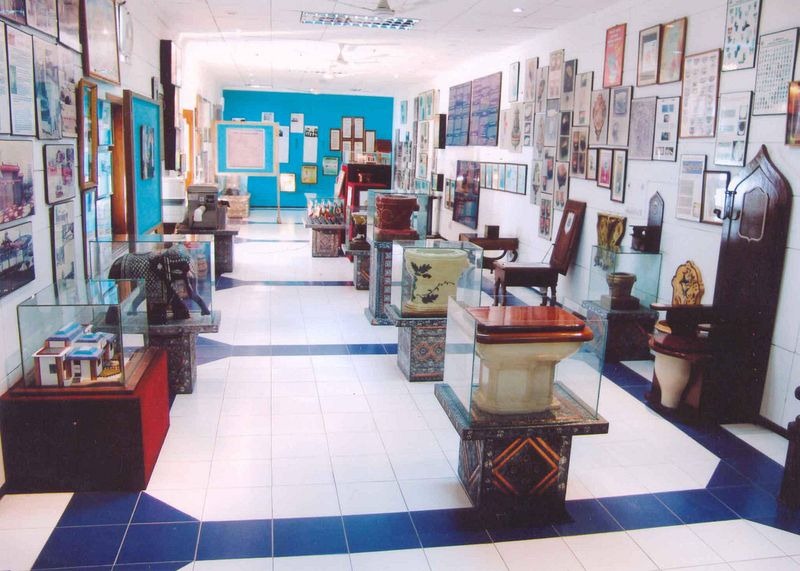
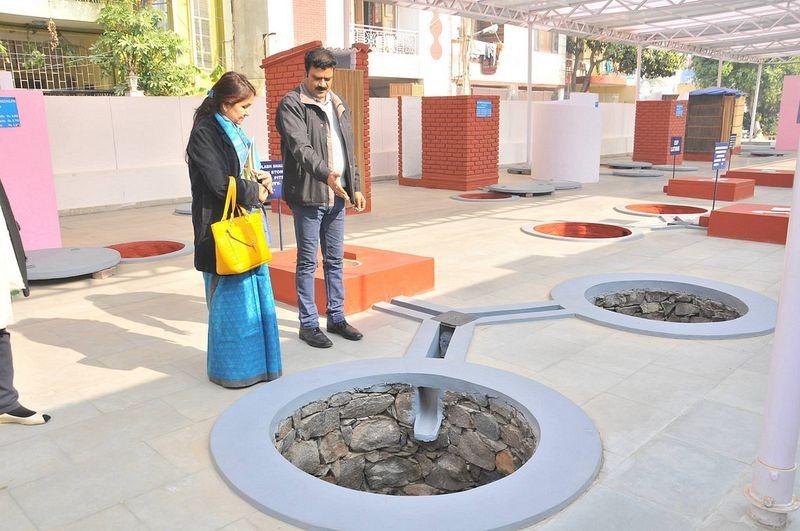
In a quiet courtyard in the suburbs of New Delhi, inside a low-slung concrete building, the assistant curator and guides of Sulabh International Museum of Toilets eagerly awaits for visitors. The museum is small, with just one long room, but it’s possibly the world’s only toilet museum, and it’s location in the Indian capital is all the more important.

Hygiene and sanitation is one of India’s most pressing issues. An astonishing 60% of the country’s 1.2 billion people defecate in the open because they do not have access to safe and private toilets. The numbers were probably worse in 1970 when Dr. Bindeshwar Pathak, a humanitarian and social worker, introduced pay-to-use public toilets in a small village in Patna, Bihar. At first the people laughed at his idea, but now over 15 million people across the country use public toilets constructed by Sulabh International, a non-profit he founded.

sulabh-international-museum-of-toilets-7

Photo credit: http://www.sulabhtoiletmuseum.org

Sulabh International’s mission is to promote safe sanitation habits and provide public toilet facilities throughout India. It builds and maintains hundreds of public toilets in major cities, including those outside tourist attractions such as the Red Fort in Delhi and the Taj Mahal in Agra, as well as towns and villages across the vast nation. With 50,000 volunteers devoted to the cause, Sulabh International is India’s largest nonprofit organization.

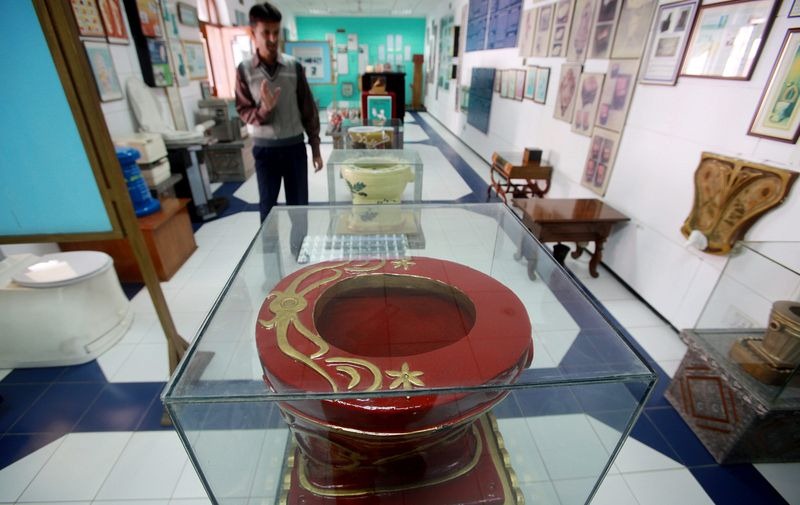
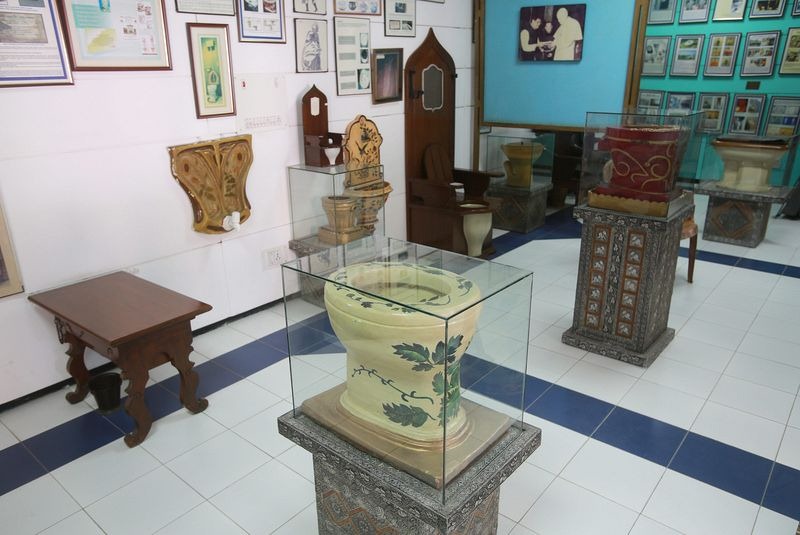
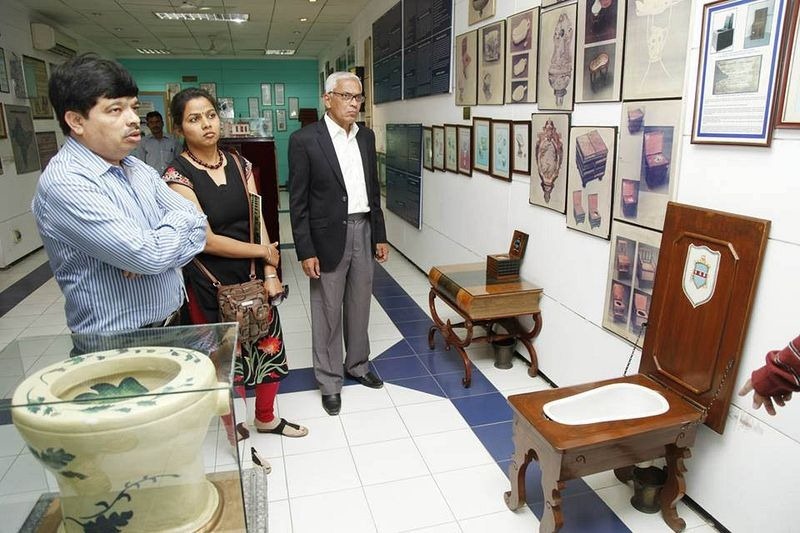
The museum, located in the offices of the organization, traces the history and development of toilet system around the world from the brick commodes of the ancient Harappan settlement near Pakistan, five thousand years ago, through the Middle Ages to the modern day toilet with electrically controlled flush system, through a series of privies, chamber-pots, toilet furniture, bidets and water closets, accompanied by a healthy number of images, drawings, photographs, and graphics. The museum also provides a chronological account of developments relating to technology, toilet related social customs, toilet etiquettes, prevailing sanitary conditions and legislative efforts of the times.

Among its most prized possessions is a flush pot devised in 1596 by Sir John Harrington, a courtier of Queen Elizabeth I, a gem-studded bided of Queen Victoria, table-top toilets from England and a couple of highly decorated commodes from Austria. Some of the toilets of these period were disguised. There is a French one that looks like a stack of books, and an English one which resembles a treasure chest.

Hanging on the walls are display boards with poems, comics, jokes and cartoons related to toilet humor. But one of its most amusing displays is a full-size replica throne from the court of the French King, Louis XIII, with a hidden commode underneath it. The King used it to relive himself while still in court.

The Sulabh International Museum of Toilets was opened in 1992, and since then it has welcomed some 100,000 visitors.

sulabh-international-museum-of-toilets-5

Photo credit: Metro.co.uk

sulabh-international-museum-of-toilets-6

Photo credit: Metro.co.uk

sulabh-international-museum-of-toilets-1

Photo credit: http://www.sulabhtoiletmuseum.org

sulabh-international-museum-of-toilets-2

Photo credit: http://www.sulabhtoiletmuseum.org

Sources: www.sulabhtoiletmuseum.org / Wikipedia / PRI.org

Source….www.amusingplanet.com

Natarajan