How an Artist is Changing Bengaluru Streets, One Pothole at a Time….

How an Artist is Changing Bengaluru Streets, One Pothole at a Time

Baadal Nanjundaswamy’s art work is incredible and delivers results. Image Courtesy: Facebook/Baadal Nanjundaswamy

As Bengaluru preps for the upcoming civic body polls on Saturday, it will be interesting to see how the scary crocodiles and gigantic anacondas that have appeared on the city’s water-logged and pothole-ridden roads recently will affect voters.

The city has been struggling with polluted lakes, garbage crisis, bad roads and crippling traffic management for a while now. Fed up with the state of affairs, local artists took it upon themselves to make sure the problems spoke for themselves, using imagination and art as their tools.

The charge has been led by Baadal Nanjundaswamy who shook up social media and local authorities (into making amends) by creating a life-size crocodile and swamp as an installation to highlight a pothole that hadn’t been fixed for days.

The crocodile did the trick and the pothole was filled. Since then, Mr Nanjundaswamy has been changing the face of Bengaluru pot holes, one brush stroke after another.

From transforming broken dividers into sutli bombs in one place and wrapped gifts in another, to painting huge faces around uncovered man holes, his art work is incredible and delivers results.

Check out some of his work below:

A little Diwali gift – major social media explosion in 3-2-1:

Photo Credit: Facebook/Baadal Nanjundaswamy

Bengaluru’s Secret Santa leaving them colorfully wrapped gifts for Christmas:

Photo Credit: Facebook/Baadal Nanjundaswamy

How about this Valentine’s Day proposal to civic body Bruhat Bengaluru Mahanagara Palike (BBMP)?

Photo Credit: Facebook/Baadal Nanjundaswamy

Or these fearsome faces with gaping mouths?

Photo Credit: Facebook/Baadal Nanjundaswamy

They needed a zebra-crossing, so that’s what they got – a zebra crossing the road:

Photo Credit: Facebook/Baadal Nanjundaswamy

Would you like a game of Hopscotch on one of Bengaluru’s streets? It could be fun but also might be the only thing you do for a while:

Photo Credit: Facebook/Baadal Nanjundaswamy
source…..www.ndtv.com
natarajan

6 Weird Facts About Gravity…

Loren Shriver Credit..NASA

Gravity: You don’t know what you’ve got ’til it’s gone

Here on Earth, we take gravity so for granted that it took an apple falling from a tree to trigger Isaac Newton’s theory of gravitation. But gravity, which draws objects together in proportion to their mass, is about much more than fallen fruit. Read on for some of the strangest facts about this universal force.

girl doing headstand

It’s all in your head

Credit: © Paul Simcock | Dreamstime.com

Gravity may be pretty consistent on Earth, but our perception of it isn’t. According to research published in April 2011 in the journal PLoS ONE, people are better at judging how objects fall when they’re sitting upright versus lying on their sides.

The finding means that our perception of gravity may be less based on visual cues of gravity’s real direction and more rooted in the orientation of the body. The findings may lead to new strategies to help astronauts deal with microgravity in space.


Endeavour landing

Coming down to Earth is tough

Credit: NASA Kennedy Space Center

Speaking of astronauts, their experience has shown that a switch to weightlessness and back can be tough on the body. In the absence of gravity, muscles atrophy and bones likewise lose bone mass. According to NASA, astronauts can lose 1 percent of their bone mass per month in space.

When astronauts come back to Earth, their bodies and minds need time to recover. Blood pressure, which has equalized throughout the body in space, has to return to an Earthly pattern in which the heart must work hard to keep the brain nourished with blood. Occasionally, astronauts struggle with that adjustment. In 2006, astronaut Heidemarie Stefanyshyn-Piper collapsed at a welcome-home ceremony the day after returning from a Space Shuttle mission to the International Space Station.

The mental readjustment can be just as tricky. In 1973, Skylab 2 astronaut Jack Lousma told Time magazine that he’d accidentally smashed a bottle of aftershave in his first days back from a month-long sojourn in space. He’d let go of the bottle in mid-air, forgetting that it would crash to the ground rather than just float there.

null

For weight loss, try Pluto

Credit: nullPluto may no longer be a planet, but it’s still a good bet for lightening up. A 150-pound (68 kilogram) person would weigh no more than 10 pounds (4.5 kg) on the dwarf planet. The planet with the most crushing gravity, on the other hand, is Jupiter, where the same person would weigh more than 354 pounds (160.5 kg).

The planet humans are most likely to visit, Mars, would also leave explorers feeling light-footed. Mars’ gravitational pull is only 38 percent that of Earth’s, meaning a 150-pound person would feel like they weigh about 57 pounds (26 kg).


Hudson Bay, Canada

Gravity is lumpy

Credit: Jacques Descloitres, MODIS Land Rapid Response Team, NASA/GSFCEven on Earth, gravity isn’t entirely even. Because the globe isn’t a perfect sphere, its mass is distributed unevenly. And uneven mass means slightly uneven gravity.

One mysterious gravitational anomaly is in the Hudson Bay of Canada (shown above). This area has lower gravity than other regions, and a 2007 study finds that now-melted glaciers are to blame.

The ice that once cloaked the area during the last ice age has long since melted, but the Earth hasn’t entirely snapped back from the burden. Since gravity over an area is proportional to the mass atop that region, and the glacier’s imprint pushed aside some of the Earth’s mass, gravity is a bit less strong in the ice sheet’s imprint. The slight deformation of the crust explains 25 percent to 45 percent of the unusually low gravity; the rest may be explained by a downward drag caused the motion of magma in Earth’s mantle (the layer just beneath the crust), researchers reported in the journal Science.


Colorized scanning electron micrograph depicting Escherichia coli bacteria, which recent research shows can breed in gravity 400,000 times stronger than that of Earth. Most E. coli strains are harmless, but the one here is O157:H7, which can cause severe

Without gravity, some bugs get tougher

Credit: CDC/Janice Haney Carr

Bad news for space cadets: Some bacteria become nastier in space. A 2007 study published in the journal Proceedings of the National Academy of Sciences found that salmonella, the bacteria that commonlycauses food poisoning, becomes three times more virulent in microgravity. Something about the lack of gravity changed the activity of at least 167 salmonella genes and 73 of its proteins. Mice fed the gravity-free salmonella got sick faster after consuming less of the bacteria.

In other words, Michael Crichton’s “The Andromeda Strain” had it wrong: The danger of infection in space may not come from space bugs. It’s more likely our own bugs grown stronger would strike us.


Spinning black hole

Black holes at the center of galaxies

Credit: April Hobart, NASA, Chandra X-Ray ObservatoryNamed because nothing, not even light, can escape their gravitational clutches, black holes are some of the most destructive objects in the universe. At the center of our galaxy is a massive black hole with the mass of 3 million suns. Scarier thought? It might be “just resting,” according Kyoto University scientist Tatsuya Inui.

The black hole isn’t really a danger to us Earthlings — it’s both far away and it’s remarkably calm. But sometimes it does put on a show: Inui and colleagues reported in 2008 that the black hole sent out a flare of energy 300 years ago. Another study, released in 2007, found that several thousand years ago, a galactic hiccup sent a small amount of matter the size of Mercury falling into the black hole, leading to another outburst.

The black hole, named Sagittarius A*, is dim compared with other black holes.

“This faintness implies that stars and gas rarely get close enough to the black hole to be in any danger,” Frederick Baganoff, a researcher at the Massachusetts Institute of Technology who was involved with the 2007 study, told LiveScience’s sister site SPACE.com. “The huge appetite is there, but it’s not being satisfied.”

Source…www. livescience.com
Natarajan


Gifts Everybody Deserves to Receive…

Everybody loves receiving gifts – For their birthday, for Christmas or randomly. There’s nothing more thrilling, but deep down the real treasured gifts are intangible. These gifts are priceless and everybody deserves receiving them at some point in their lives.

gifts

gifts

gifts

gifts

gifts

gifts

gifts

gifts

Source…www.ba-bamail.com

Natarajan

Message for the Day…” Every Single Unselfish Act is a Righteous Act…”

Sathya Sai Baba

Sacrifice ignorance (ajnana) and ego (ahamkara) at the altar of wisdom (Jnana), and install righteousness(Dharma) therein” – this is the message of the scriptures. Every single unselfish act, which prepares the ground for the merging of the Soul with the Over-Soul, which broadens the vision towards the Divinity immanent everywhere, is a righteous act. Each such act is a tiny stream that swells the river of holiness rushing towards the sea of knowledge of Divinity. Your acts and activities are all rituals in the worship of the Paramatmathat pervades the Universe. Whatever is done in an attitude of dedication and surrender is a component of the Dharma, which leads to Realisation. The strategy of the ancient Bharathiya (Indian) way of life is directed towards the sanctification of every moment and every word, thought and deed as a step towards realising the Divine.

Health Benefits of Guava Fruit…

Guavas are found in the tropics, and invoke images of vacations, summer parties and island life, but this tasty fruit is more than a celebratory food. This fruit is bursting with healthy vitamins and minerals and can be used to treat many serious ailments. You can recognize guavas by their yellow, green or maroon skins and creamy white or pink pulp.

Weight loss and gain

Guava is a winning fruit for its many great benefits. If you’re trying to lose weight, guavas are not a fruit you need to give up. In fact, this snack-sized fruit can satisfy your appetite while adding few calories, low amounts of carbohydrates and no cholesterol to your diet. And, compared to other fruit, adds a low dose of sugar. Guavas also offer a great source of vitamins, proteins, roughage, fibers and minerals. For lean people trying to gain weight, this fruit is also beneficial as it promotes the healthy absorption of nutrients and its substantial nutrients regulate one’s metabolism.

Blood pressure and Diabetes

Guavas are hypoglycemic and rich in fiber, which helps reduce blood pressure. Dietary fibers maintain the blood’s fluidity and prevent it from thickening, which can worsen blood pressure. Foods lacking in fiber (for example refined flour) increase blood pressure because they convert to sugar more quickly. This can help fight or even prevent diabetes. The fiber regulates the sugar being absorbed by the body and the risk of both high spikes and drops in the body’s insulin and glucose levels is reduced.

Diarrhea, dysentery, and gastroenteritis

The abundant astringent (substances that contract body tissue) makeup of raw guava and guava leaves helps loosen the bowels and can reduce the symptoms of diarrhea and gastroenteritis. Being highly alkaline, the guavas act as a disinfectant, removing excess mucus from the intestines and inhibiting microbial growth. For these reasons, guavas can also be used to treat dysentery. The guavas’ plentiful supply of vitamin C, carotenoids and potassium can also boost your digestive system.

Thyroid health

A good substance for regulating the thyroid’s metabolism is copper, which guavas have plenty of. The thyroid glands regulate important hormones and organ system functions, which helps maintain a healthy balance in your body.

Healthy brains

Also present in guavas are high amounts of vitamins B3 and B6. These both have benefits for the health of your brain. B3, which is also called niacin, is known to help increase blood flow and stimulate cognitive function, while B6 helps preserve normal nerve function.

Scurvy

Guava is your best source for vitamin C. In fact it has four times the amount of Vitamin C found in oranges, which are regarded as the go-to food for this vitamin. The concentration of vitamin C can prevent scurvy, a disease caused by a deficiency of this vitamin.

Constipation

The seeds of guavas, either ingested whole or chewed, are excellent laxatives. In addition to the fruits’ substantial amount of dietary fiber, guavas are advantageous for treating constipation. These two sources cleanse your intestines and excretory system and help your body retain water, helping you achieve healthy bowel movements. Frequently snacking on guavas, then, can be beneficial for proper digestion.

Colds and coughs

Drinking the juice of guavas and fresh guava fruit helps in fighting colds and coughs. The astringent quality can lessen mucus, disinfect the respiratory tract, throat, and lungs and reduce microbial activity. The substantial amounts of iron and vitamin C in guavas also help treat viral infections. It’s advised to avoid eating overly ripe guavas when you have a cold or cough as they can actually aggravate them.

Eyesight

The considerable quantities of vitamin A in guavas are extremely beneficial for the health of your vision. This helps slow down macular degeneration, the growth of cataracts and even improve one’s eyesight degradation once it has begun.

Cancer prevention

Guava is also valuable in your diet as a preventative measure against cancerous growths and metastasis. The high levels of an antioxidant called lycopene has been shown to reduce the risk of prostate cancer and inhibit the growth of breast cancer cells. Guava leaf oil is another anti-proliferative extract from the guava plant that has proven effective in reducing cancer growth.

Skincare

Guavas are also fantastic at improving skin texture and keeping your skin looking fresh. Guavas are full of astringents, particularly in fresh fruit and the leaves of the plant. If you rinse your skin with a guava decoction, the fruit can tone and tighten areas of loose skin. Eating the fruit also provides a rich source of vitamins A, B, C, as well as potassium, which are excellent antioxidants and detoxifiers. They can keep your skin glowing, prevent premature aging and wrinkles, and can speed up the healing process of wounds.

Source….www.organicfacts.net and http://www.ba-bamail.com

Natarajan


Dashrath Manjhi Aka Mountain Man’s Story Is The Most Inspiring Thing You’ll Read Today…

Manjhi

Dashrath Manjhi, a poor landless labor moved a mountain in his lifetime, quiet literally! It took him 22 years but Manjhi shortened the travel between the Atri and Wazirganj of Gaya town from 55 km to 15 km. Not many are aware of this man’s greatness but thanks to Bollywood for converting his life story into a film. The film by Ketan Mehta is called Manjhi- The Mountain Man and is slated to release this Friday starring ace actors like Nawazuddin Siddiqui and Radhika Apte in lead roles. The story of a brave man who took the challenge of gifting accessibility to his remote village will inspire you beyond limit.

If you still haven’t heard of the man who fought with a mountain for more than two decades, his real story will move you!

1. Gehlour Ganj, Atri: A 300-foot tall mountain loomed between Atri block of Gaya, Bihar civilization in Wazirganj made commuting a difficult task for the locals

Dashrath Manjhi 1

2. Manjhi, a landless labourer worked in the fields on the other side of the mountain and lived with his wife, Falguni.

Manjhi 2

Manjhi belonged to a cast which was regarded the lowest of the low in a caste-ridden society. They were kept aloof from basic necessities like- water supply, electricity, a school and a medical centre.

3. Like everyday, Manjhi eagerly waited for his beloved wife Falguni who would bring lunch for him.  She did come to him that one eventful day, but her body had bruises and blood all over.

3

The treacherous trek up and around the mountain took hours. This led to frequent accidents and death of locals who lost their lives purely because reaching for medical facilities took hours. The nearest doctor was at Wazirganj, which was more than 70 kilometers over the mountain. Locals of the area cursed the inaccessibility but no one ever bothered to do anything about it. However, one man could wait no longer but that too alerted him after a tragedy. However, one day, Falguni tripped on loose rock, shattering her water pot. Not only she slid down several feet, she injured her leg. Manjhi could not save his wife and then he took a pledge.

4. “Jab Tak todenge nahi, tab tak chodenge nahi”- After losing his wife in 1959, Manjhi took up a challenge against the mountain and sold his goats to buy a hammer, chisel and crowbar.

Manjhi Story

“That mountain had shattered so many pots; claimed lives. I could not bear that it hurt my wife. If it took all my life now, I would carve us a road through the mountain.”- He said.

5. People called him a ‘lunatic’ but that did not deter him from his journey. After a struggle of 22 years (1960-1982), a tiny cleft across a rock wall opened up one day!

Mountain Man

He then went on to widen the cleft. Some several years later, he managed to carve out a passage 360 feet long and 30 feet wide.

Even though he lost his battle of life to cancer in 2007, thanks to Bollywood for converting his life into a film. Even when he was alive, people were totally awed by his will power and determination. Chief Minister Nitish Kumar agreed that once he had stood up and vacated his chair when Manjhi visited him in Janata Durbar in Patna.

Source…..Isha  Sharma… http://www.indiatimes.com

Natarajan

” These Chennai Scientists Are Trying To Solve An Impending Agricultural Crisis…”

SALICORNIA BRACHIATA

VEDARANYAM, Tamil Nadu — On a sun-scorched wasteland near India’s southern tip, an unlikely garden filled with spiky shrubs and spindly greens is growing, seemingly against all odds.

The plants are living on saltwater, coping with drought and possibly offering viable farming alternatives for a future in which rising seas have inundated countless coastal farmlands.

Sea rise, one of the consequences of climate change, now threatens millions of poor subsistence farmers across Asia. As ocean water swamps low-lying plots, experts say many could be forced to flee inland.

“It’s hard to imagine how farmers will live,” said Tapas Paul, who as a World Bank official helped channel about $100,000 to help build the small garden a decade ago in a swampy, seaside town dominated by salt flats in southern Tamil Nadu state. “In the places subject to inundation and sea level rise, there are few options.”

A team of Indian scientists is searching for solutions to what they describe as a fast-approaching agricultural crisis. Their neatly plotted rows of naturally salt-tolerant plants, known as halophytes, could be a part of the answer. The scientists from the M.S. Swaminathan Research Foundation are also trying other approaches: tweaking genes and cross-breeding plants by conventional means to discover which might grow and even flourish.

“Sea level rise is inevitable, and we are not prepared,” said Swaminathan, who pioneered high-yield wheat and rice varieties for India in the 1960s. “The biggest problem in India is just the very large population. We can say people can relocate, but where could we even accommodate all those who need to move inland?”

Saltwater for a farmer long meant certain crop failure. Wartime foes sowed enemy fields with salt to ensure social collapse. Natural disasters such as the 2004 Asian tsunami left countless plots unproductive for years.

Asia’s coastal farmers, including millions impoverished in India, now face such problems. Climate change will bring stronger storms and warmer temperatures that expand ocean waters and melt ice caps and glaciers. As a result, seas are set to rise up to 1 meter (3.2 feet) in this century, according to the latest scientific forecasts.

Chellammal, a graceful, 65-year-old farming housewife in the Tamil Nadu village of Tetakudi, knows the nightmare of farming on salt-contaminated land too well.

“I struggled so long to get things to grow, but nothing worked,” said Chellammal, who goes by one name. “Every year just got worse until there was nothing left,” she said, crouched in a bright pink sari by her fields.

The land her family had saved for decades to buy went completely barren about five years ago, after a neighboring village took up shrimp farming when flooding from a nearby ocean canal salted their lands. The shrimp ponds were never lined properly, so their saltwater seeped into surrounding soils.

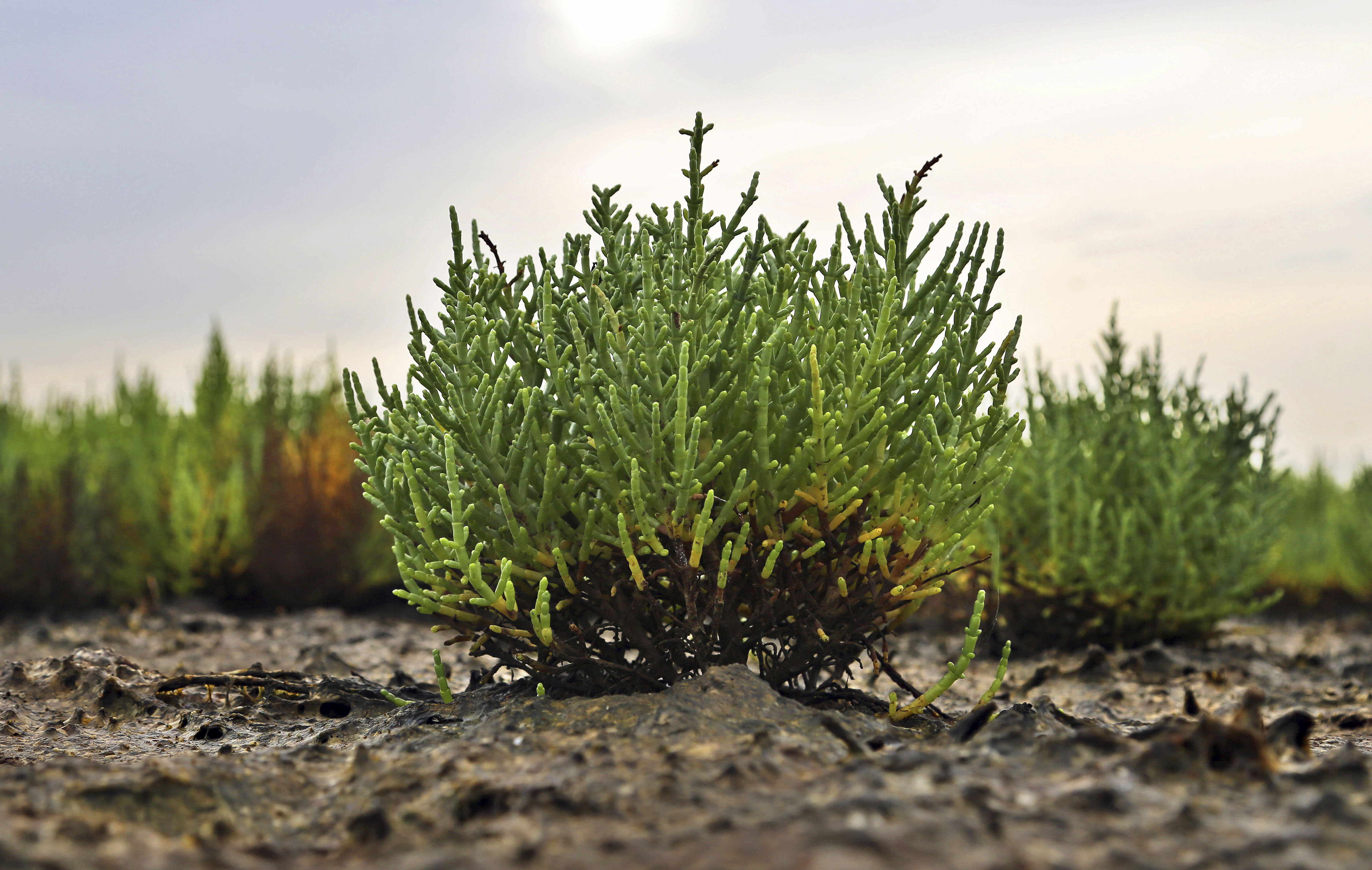
The farmland lost by Tetakudi’s 200 households now supports little more than a vast expanse of salt-tolerant shrubs called Suaeda maritime along with succulents called Salicornia brachiata, known to locals as “chicken feet.”

To the villagers, the bright green bushes are no better than weeds. Already, 12 families have boarded up their homes and left.

But scientists say suaeda is good for firewood. And salicornia species, which can tolerate nearly twice the salinity of seawater, have enormous potential as a biofuel crop, with seeds containing high concentrations of oil.

The problem, however, lies in realizing profits. For any crop to work on a large scale, inexpensive methods and machinery for harvesting will have to be developed. Then processing plants, production lines and markets would need to be built. As of now, none of that exists.

Chellammal is dubious, but interested.

“If we can make money from what we grow, we’ll try it. Why not?” she said. “Maybe all is not lost.”
 

salicornia brachiata

In this June 16, 2015 photo, a wild-growing Salicornia brachiata, a halophyte known to locals as ‘€chicken feet’, thrives on fields tainted by saltwater from a neighbouring shrimp farm near Velankanni, India.

The timing for an agricultural crisis due to sea rise couldn’t be worse. India’s poor farmers already struggle with frequent flooding, drought and soils degraded by agrochemical overuse. Those on the coast are also hit by storms, with at least 27 of the 35 deadliest cyclones in history barreling through the Bay of Bengal before slamming into either India or Bangladesh.

India’s freshwater sources are also in peril, with over-tapped groundwater reserves so low the country is expected to have only half the water it needs by 2030. Grain production, meanwhile, has stalled around 260 million tons in recent years, despite global pressure for India to boost yields, eliminate waste and eradicate widespread poverty and malnutrition.

To feed its growing 1.26 billion population, India must increase food production 45 percent by 2050, for which experts say it may need to cultivate more land. Instead, about 1.2 million hectares (3 million acres) of its coastal farmland has been degraded by salt, according to India’s Central Soil Salinity Research Institute.

Inland, India has lost another 5.5 million hectares of arable farmland, out of its nationwide total of 163 million hectares, though India’s soil salinity troubles are exacerbated by industrial salt flats, a growing number of shrimp farms and the depletion of groundwater reserves. The trend will only continue as seawater creeps onto low-lying lands along the 7,500-kilometer (4,700-mile) coast that outlines the country along the Bay of Bengal, Indian Ocean and Arabian Sea.

“Saltwater agriculture is considered a futuristic area. But it really shouldn’t be,” said marine biologist V. Selvam, the M.S. Swaminathan foundation’s mustachioed director of coastal research. “Very soon there won’t be enough land and water to meet our needs.”

And India is not alone. Countries including Egypt, Bangladesh and much of Southeast Asia also face heavy saltwater intrusion and loss of farmland. Already, 62 million hectares, or 20 percent, of the world’s total 300 million hectares of irrigated farmland has been salinized to some extent. Another 50 centimeters (1.6 feet) of sea rise, which is just half of what’s expected by 2100, would swamp up to 1.9 million more hectares, the Intergovernmental Panel on Climate Change has said.

That will undermine the world’s ability to find the additional 120 million hectares of farmland it needs for a staggering 70 percent increase in food production to feed the world by 2050, according to the U.N. Food and Agricultural Organization.

Experts say there will be little choice but to grow some non-food crops along the coasts.

The world’s irrigated acreage could be increased by about 50 percent by reusing saline water and salinized crop fields for halophytes, said University of Arizona environmental sciences professor Edward Glenn.

“As with aquaculture replacing wild fisheries, it is inevitable that halophytes will have their day,” he said.

Sesuvium portulacastrum. Paspalum vaginatum. Prosopis juliflora.

These are just a few of the 350 known species of salt-tolerant plants that are candidates to become crops for the future. Saltwater plants are unlikely to become staple foods, because while often high in nutrients they’re also very salty and so should be eaten in moderation.

Species such as Salicornia europaea, also known as glasswort or samphire, are already sold in European markets as a fancy salad addition or side dish. The bright purple-and-white blossoms of Limonium are a florist’s delight, while another species called Atriplex or saltbush is eaten by sheep.

Supporters note a host of potential uses to make harvests profitable, including firewood, decorative flowers, kitty litter, nutritional supplements, cooking oil and biofuel. Cattle fodder is another possibility, and Indian herders already graze their cattle on thorny shrubbery by the sea.

Despite the potential, saltwater agriculture is still seen as a fringe topic, even after decades of research by universities worldwide along with studies and pilot projects in countries including Mexico, Pakistan, Jordan and Eritrea. The aviation company Boeing is also researching biofuels from saltwater plants.

India’s scientists aren’t waiting for markets to develop. Nor are they relying on just the halophyte garden to offer up new options.

They’re scouring coasts for wild grain species that might naturally tolerate some salinity, and using arduous breeding methods to create new salt-tolerant strains.


The foundation has also developed genetically modified rice using genes from mangrove trees. It says the resulting plant can tolerate salt concentrations of 12-15 grams per liter. Seawater is typically two to three times saltier, but that’s still a major improvement from currently cultivated rice varieties, which can handle only up to 3 grams per liter.

Genetic modification is considered the most difficult approach, because salt tolerance is a trait that involves numerous genes. But the molecular biologist leading the development of GM halophytic rice believes it’s essential.

“Conventional breeding just takes too long, and this problem is urgent,” said Ajay Parida, the foundation’s executive director. His work stalled in 2007 under an effective moratorium on field testing GMOs, but the Indian government is considering shifting its GM testing policy and Parida now expects his trials to start soon.

“We could eventually be cultivating wastelands and places considered entirely unsuitable,” he said. “But it’s only after crisis hits that people realize the magnitude of the problem and start pushing for an answer.”

Source….  |  Katy Daigle….www.huffingtonpost.com

Natarajn


No mission is impossible….Meet Mr. K.R.Pechimuthu of Trichy…

K.R. Pechimuthu with his self-published Thirukkural booklets. Photo: M. Srinath

THE HINDU

K.R. Pechimuthu with his self-published Thirukkural booklets. Photo: M. Srinath

From blood donation to tree-planting, vermicompost and Thirukkural dissemination, retiree K. R. Pechimuthu has espoused each cause with gusto

K.R. Pechimuthu has clearly never thought of retirement as an end. What else would push him (literally) to cycle from his home in Kumaresapuram, on the outskirts of Tiruchi, distributing free booklets of the Thirukkural to primary-level school students?

“Instead of expecting the Government to come and bail us out each time, why cannot we do something ourselves?” he replies with a question.

And so, motivated by the idea of inculcating good values in youngsters, Mr. Pechimuthu and a helper hop on to their bicycles, packed with at least four 25-kilo bundles of booklets at 7 a.m., and visit the schools. Mr. Pechimuthu holds a value-orientation class using the Tamil literary classic as a foundation, for an hour, and encourages children to learn how to recite the poetic lines precisely. To keep them engaged, he offers a prize of Rs. 10 per correct recitation.

“We used to have moral science in our education system earlier, now it’s gone,” says Mr. Pechimuthu. “I use the Thirukkural to unite young children in learning how to venerate their parents and teachers, who are our founts of knowledge.”

It is 17 years since Mr. Pechimuthu stopped working as a mechanical engineer in BHEL, Kailasapuram, and 15 years since he started the Thirukkural project through his Akarur Educational Trust.

Mr. Pechimuthu reckons that at least 10,000 copies are given away every one or two months. He has cycled up to Manachanallur, 15 km from Tiruchi, on this unique mission, eager to use his retirement benefits to fund his dreams.

Father’s lessons

And there has been no dearth in the dreams department either. “People often wonder why I do all this,” he says. “When you grow older, shouldn’t you be getting more careful about your money? But then, no matter how much you earn in this lifetime, are you going to take it all with you when you die? So I thought, ‘let me look for people who need help.’”

Mr. Pechimuthu, born in Mayiladuthurai, and brought up in Devakottai, names his father A. Karupaiyya, a farmer, who worked briefly in Burma before setting up a timber depot in Devakottai, as his chief source of inspiration. “My father was a spiritually-inclined person, and used to recite theThevaram Thiruvasagam (sacred poems written by Saivite saints known as Nayanmars). “I used to be entranced by the recitation, though I couldn’t really understand their full meaning until I was much older,” recalls Mr. Pechimuthu.

“In his advanced years, my father handed over his timber depot to Periyasami, a worker who had joined us at the age of 10, as a symbol of gratitude for his long years of service,” he says. “Besides, as both my brother and I had moved on in our education and career and my sisters had settled into married life, he felt it was the best thing to do. My father’s selfless gesture convinced me to become more socially conscious.”

Social concerns

Mr. Pechimuthu’s social work started with blood donation in 1966, when he was a foreman in BHEL’s design engineering department. He donated blood around 75-80 times until he was 58 years old. He then shifted his attention to raising awareness about eye donation. In the mid-1980s, he got interested in organic farming and vermicompost, and got guidance in the subject from Chennai-based soil biologist Dr. Sultan Ahmed Ismail and Dr. Kalai of Bangalore University.

Popularising the concept through All India Radio broadcasts and workshops for Tamil Nadu Women in Agriculture, Mr. Pechimuthu mastered vermicomposting enough to develop his own study material that was used in many institutions.

Approaching retirement, he decided to set up an industrial training unit for rural youth in Vaiyyampatti block. Its students were also roped into the voluntary tree-planting drive overseen by Mr. Pechimuthu. Some 10,000 neem and laurel saplings (given free by the Agriculture Department), had been planted throughout the block by 1996, with Mr. Pechimuthu paying Rs. 10 per month out of his own funds for the maintenance of each tree planted in a public place. Unable to sustain the institute due to land problems, Mr. Pechimuthu shifted to Kumaresapuram, still keen to be of some use to the youth of the area.

And a new cause soon suggested itself to him. Approached by a tearful mother for aid to pay her child’s school fees, Mr. Pechimuthu wondered why the poor couldn’t have an affordable savings programme that would help them to educate their children.

He decided to act on the advice of his insurance agent friend, and offered to enrol the mother in an endowment assurance scheme where a Rs. 300 premium would ensure a substantial payout at maturity. “I asked her to give half the premium, and I offered to pay the other half,” he says. “By the grace of God, some 568 children have been able to pay their school fees through this policy.” It was while interacting with the students that he realised the need to teach them good manners and ethical awareness through the Thirukkural.

The man who gets up at 4 a.m. to sweep the street outside his home and clean out the open ditches, then accompany his wife on their daily stroll through the neighbourhood and finally gets ready for his school visits, is an inspiring figure. He doesn’t accept (or expect) any kind of financial or ideological sponsorship for his work.

“I don’t want people to praise me, just to absorb the ideals and values I’m putting across,” he concludes.

Mr. K. R. Pechimuthu may be contacted on 9715426463.

Source….Nahla Nainar …www.the hindu.com

Natarajan

How to handle criticism at work….

Feedback is essential for the growth of any professional. But are you equipped to handle it well?

How to handle criticism at work

Dealing with criticism in a positive manner is extremely important.

At some point in your professional life you will be criticised.

It may seem unfair and difficult. But you can use it in a positive manner — as a means to better yourself, or in a negative manner — causing yourself stress, anger and lowered self-esteem.

Below are the ways in which one must handle criticism:

Is it really criticism?

Most people get their defence up the minute they feel somebody is giving them an opinion not necessarily aligned with their own.

It is important to understand if the opinion is criticism or constructive feedback.

Instead of being extra sensitive, it is essential to absorb the person’s outlook and analyse whether it can be incorporated in anyway.

Do not reject any idea by labelling it as criticism.

It might be a stepping stone to bettering yourself.

What is the intent?

You need to evaluate why are you being criticised.

Is it for the betterment of your task quality, behaviour, productivity, or is it simply done to ridicule you?

In case the feedback is in your best interest, utilise the opportunity to learn and outperform your previous efforts.

However, if the person’s intent is to simply pick on you, you must be assertive and stand up for yourself.

Accept that you are not perfect.

‘Nobody is perfect; neither are you.

If you are good, there is scope to become great.

If you are great, there still is scope to become outstanding.

Take feedback with a pinch of salt and do not get offended. Look at it as an opportunity to stretch your boundaries and explore further into your potential.

Do not get offended easily.

Do you find yourself getting hurt, crying at the drop of a hat or stressing out the minute anybody criticises your work?

The solution is not to cut the critics out of your life but to toughen up.

Do not be over sensitive. Listen intently to what the person is saying.

Weigh the significance before dismissing the person.

Is the feedback accurate?

Be completely objective and unbiased in assessing feedback.

Just because it is different from your line of thought, doesn’t necessarily mean that it is wrong.

Think of every piece of feedback/criticism as a means of improving your knowledge, skills, attitude and efficiency.

If it doesn’t help on any of these parameters, brainstorm your ideas with the person before putting your foot down and rejecting it.

Stop making excuses.

Do you display strong displeasure whenever someone is pointing out something to you?

This will lead to conflicting situations with the person or discourage the person from walking up to you and sharing his/her honest and possibly valid feedback next time.

Either way, your relationship will suffer, along with any future probability of getting fresh perspective on self-improvement.

Is the criticism destructive?

If you are sure that the intention behind the criticism is destructive, try to find the hidden motive and communicate with the person.

An open communication serves the purpose majority of the time. Be assertive and yet empathetic when you do so.

Trust yourself and be confident of what you bring on the table. Let the critics not succeed in pulling your morale down.

Remember: If you have received criticism that was delivered in a warm manner only to bring a positive shift in you, take the effort to display your gratitude and appreciation to the person.

Thanking people who give you honest criticism is a sign of maturity.

Lead image used for representational purposes only. Credit: Diego Rodriguez-Vila/Creative Commons

The author is co-founder and head of business development at Work Better Training.

Source….Ruchira Karnik…www.rediff.com

Natarajan

An Indian diplomat’s gift to the people of the UAE….

Dr Tiju Joseph, an IFS officer who studied medicine, has set up the first public online blood donors registry in the UAE where he is currently posted. He speaks to Shobha Warrier/Rediff.com

Dt Tiju Joseph, Indian diplomat

Dr Tiju Thomas is a diplomat and a doctor by training. He studied medicine in Kottayam, Kerala, before becoming an Indian Foreign Service officer in 1999. Currently, he is posted as the Consul (Economic and Education, Press and Communication) in the United Arab Emirates.

After joining the consulate general in 2012, the doctor in him took him to some of the best hospitals in Dubai as the UAE has been honoured by the World Health Organisation for being among the top five countries in the world with the best blood transfusion services.

One of the hospitals he visited had a very large blood bank.

Doctors at the hospital told the consul about the blood shortage experienced by the hospitals in summer and during Ramadan.

Also, the shortage was more for rare blood groups.

“Blood donation goes down drastically when people fast and also when summer is at its peak. The UAE needs a lot of blood due to various health issues. I am told that more than 40% of the blood goes to thalassemia patients and they need blood regularly; on a fortnightly or monthly basis, Dr Thomas explained.

Thalassemia is a genetic blood disorder.

“The shortage of rare blood groups is because even in blood donation camps, donors with normal blood group are more, compared to rare groups. There is a shortage of such groups all the time which becomes acute during summer and Ramadan,” he added.

When Dr Thomas became aware of this problem and belonging to the rare O negative group himself, he donated blood right at that moment itself. He also promised a solution to the problem.

Back home, he wondered how he as an Indian could help the UAE where Indians are the biggest expat community. He thought of a blood donor registry, which is very common and successful in many cities in India, but a similar online registry was not available in the UAE.

“There are organisations with small groups who regularly donate blood, but the list is available only to them and not to the outside world. There was no way a hospital or a person in need could contact the regular donors. That is why I felt an exhaustive online public blood donor registry was needed which could be accessed by anyone,” Dr Thomas said.

The Consul started the process by first designing a Web site www.blooddonors.ae and then contacting various Indian organisations for their list of donors.

To his surprise, he found that they did not have a proper database of donors. The organisations were given the option to operate pages on the Web site where they could add, delete or correct the information.

They were also given the facility to add photographs of the blood donation drives organised by them.

“It took some time for us to develop all this. Though it was free for all and for a free Web site, being a diplomat, I had to get the necessary permission to go about it.”

On June 14 which is World Donation Day, the first and the biggest blood donor directory in the UAE had a soft launch, and on June 21 — International Yoga Day, Dr Thomas decided to officially launch the Web site.

“16,000 people had assembled to celebrate International Yoga day and we thought that would be the ideal day to launch the Web site too. Yoga is a gift of India to mankind, to the entire world. Similarly, this is a gift of the Indian community to the UAE community.”

Dr Thomas was overwhelmed by public enthusiasm. 110,000 visitors accessed the Web site.

“It is remarkable and I should thank the Indian community here for the response.”

The site has separate options for individuals and groups. Individual donors can go to the Web site and register themselves and there is a page for organisations, associations and large groups that can be contacted to organise instant blood donation drives in case of shortages.

Dr Thomas says 1,650 people have already registered. With the Sikh community group of 2,500 members already joining; the Dubai Kerala Muslim community organising a one week campaign to enrol 1,000 to 1,500 people; the Christian church giving a list of another 1,500 names; Bharatiyam, the friends of India offering to enrol their 1,000 members and also the Indian Schools Association promising to enrol parents and teachers once schools reopen — the response has been heartening.

Dr Thomas hopes to have at least 10,000 names in the registry very soon.

“This is only the beginning. The UAE has an Indian population of around 2.5 million. Though not all can and will donate, we are trying to get the maximum number of people from the age group of 18 to 55 to enrol in the registry. Anybody in need of blood can enter the Website and see the name of the donor, mobile number, gender, blood group and the last date of blood donation. Later on, we plan to add the donor id given by the Dubai blood bank so that anyone can reliably contact the person.”

Other than functioning as a registry, the Web site has many articles on blood and blood donation, both in English and Arabic, and also an audio visual game on how to match various blood groups.

As it was an Indian diplomat who launched such an initiative, it received a lot of media attention. Dr Tiju Thomas says African countries like Ethiopia and Kenya, and other Middle Eastern countries have evinced interest and requested him to replicate such a Web site in those countries.

“I believe this is how we build bridges between various nations and communities,” he says.

While it will be the blood banks at hospitals that would mostly use the registry, Dr Thomas says: “Even if a single person gets a life out of this registry, we will feel the work rewarding. India is very advanced as far as such registries are concerned, but many countries in the world are in need of such an initiative.”

“My dream is to see this is put to use in many countries to save lives. This is a stepping stone to a bone marrow registry and I see many other possibilities in the future.”

Source….Shobha  Warrier in www. rediff.com

Natarajan