Message For the Day…” Yath Bhavam , tath bhavthi…”

Every human being has the evil tendencies of kama (lust), krodha(anger), lobha (greed), etc. in them. The epics teach us to control these real enemies. Hiranyakasipu was a great scientist. He had control over all five elements, but became a victim of his anger. His anger was directed at God and ultimately, he ruined himself. He subjected his son to many trials and tribulations and sought to kill him by throwing him from the hilltop, casting him into the sea, pushing him into a pit of poisonous snakes and making elephants trample on him. Prahlada chanted the name of Narayana ceaselessly, and emerged unscathed and victorious. That is why it is said, Yath bhavam, that bhavathi (As is the feeling, so is the experience). God manifests on the basis of the feelings of the devotee. If you pray to God with purity of heart and love, you will experience Him as such.   

Sathya Sai Baba


“பகவானுக்குத் தெரியாமல் நாம் எதுவும் செய்ய முடியாது …”

குரு சிஷ்ய பாவம்கறது பாரம்பரியமா இந்து மதத்துக்கே உள்ள தனிப் பெருமை. மாதா, பிதாவுக்கு அப்புறம், தெய்வத்தைவிடவும் முன்னதா குருவைத்தான் சொல்லி இருக்கு.
அந்தக் காலத்துல எல்லாம் குருவாக இருக்கறவர் ஒரு ஆக்ஞை இட்டுட்டான்னா அது எவ்வளவு சிரமமானதா இருந்தாலும் செய்யறச்சே கஷ்டங்கள் பலதும் வந்தாலும், கொஞ்சமும் சலிச்சுக்காமலும் தவிர்க்காமலும் சீடர்கள் செய்து முடிச்சுடுவா.
அதேசமயம் அவஸ்யம் இல்லாத எந்தக் காரியத்தையும் அவாளைச் செய்யச் சொல்லமாட்டார் குருநாதர். அப்படிப்பட்ட காலகட்டத்துல நடந்த குருகுல அனுபவம் ஒண்ணை முதல்ல சொல்றேன். அதுக்கும் மகாபெரியவாளுக்கும் என்ன சம்பந்தம்கறதை அடுத்ததா சொல்றேன்.
மூணு இளைஞர்கள் ஒரு குரு குலத்துக்கு வந்தாங்க. குருதேவரை தரிசனம் பண்ணி, தாங்கள் அவர்கிட்டே சீடர்களா சேர்றதுக்காக வந்திருக்கறதா சொன்னாங்க.
இந்தக் காலத்துல பள்ளிக்கூடத்துல சேர்த்துக்கறதுக்கு முன்னால, நேர்முகத் தேர்வு, என்ட்ரன்ஸ் எக்ஸாம் எழுதவைக்கிறது இப்படியெல்லாம் தகுதித்தேர்வு நடத்தறாங்க இல்லையா? அத அந்தக் கால குருகுல முறையில இருந்துதான் வந்தது.
சின்னவயசுலயே குருகுலத்துல சேர்த்து படிப்படியா கத்துக் குடுத்தது ஒருவகை. இன்னொரு வகை நடுத்தர வயசுல குருகுலத்துல சேர்ந்து படிக்கறது. இதுல இரண்டாவது முறையில சீடர்களை சேர்த்துக்கறச்சே அவாளுக்கு என்ன தகுதி இருக்குன்னு தெரிஞ்சுண்டுதான் சேர்த்துக்குவாங்க.
அந்த வழக்கப்படி, தன்கிட்டே பாடம் கத்துக்க வந்த மூணு இளைஞர்களுக்கும் ஒரு தேர்வு வைச்சார், குருநாதர்.
மூணுபேர்கிட்டேயும் ஆளுக்கு ஒரு பறவையைத் தந்தார். “இதை யாரும் பார்க்காத இடத்துல வைச்சு கொன்னுட்டு வந்துடுங்கோ!’ அப்படின்னார்.
இளைஞர்கள் பறவையை எடுத்துண்டு போனாங்க. ரெண்டுபேர் கொஞ்ச நேரத்துலயே வெறும் கையோட திரும்பி வந்துட்டாங்க. மூணாவது இளைஞர் ரொம்பநேரம் கழிச்சு வந்தான். அவன் கொண்டுபோன பறவை அவன் கையிலயே இருந்துது.
குருநாதர் அவங்ககிட்டே நடந்ததை சொல்லச் சொன்னார்.
முதல் இளைஞன் சொன்னான் “நீங்க சொன்னபடியே பண்ணிட்டேன். என் இருப்பிடத்துல ஓர் அறைக்குள்ள போய், கதவை இறுக்க மூடிட்டேன். ஒருத்தரும்… ஏன் சூரிய வெளிச்சம் கூட உள்ளே வரமுடியாதபடி இருண்டுடுத்து. உடனே அங்கேயே வச்சு, அதைக் கொன்னுட்டேன்’.
ரெண்டாவது இளைஞன் அதைக்கேட்டு சிரிச்சான். “நீ குருநாதர் சொன்னதை சரியா புரிஞ்சுக்கலை. யாருமே பார்க்காதபடி பறவையைக் கொல்லச் சொன்னார். ஆனா, நீ அதைக் கொன்ன சமயத்தல அந்தப் பறவை உன்னைப் பார்த்திருக்கும் இல்லையா? அதனால நீ தோத்துட்டே நானும் உன்னை மாதிரிதான் இருட்டு றைக்கு அதை எடுத்துண்டு போனேன். ஆனா அங்கே வைச்சு அதோட கண்ணை ஒரு துணியால கட்டிட்டு வதைச்சுட்டேன். குருநாதர் சொன்னதோட அர்த்தம் புரிஞ்சு செயல்பட்ட என்னைத்தான் அவர் சீடனா ஏத்துப்பர். ஏன்னா, டுத்தவன் அவர் சொன்னதையே கேட்காம பறவையை உயிரோட திருப்பி எடுத்துண்டு வந்திருக்கான். அதனால தகுதித் தேர்வுல ஜெயிச்சது நான்தான்!’
அமைதியாக நின்றிருந்த மூன்றாவது இளைஞனைப் பார்த்தார் குருநாதர், “நீ என்னப்பா சொல்லப்போறே?’ அப்படின்னு கேட்காமலே கேட்ட அவரோட பார்வைக்கு அர்த்தம் புரிஞ்சுண்டு பேச ஆரம்பிச்சான் அவன்.
“சுவாமி, நீங்க சொன்னமாதிரியே பறவையை எடுத்துண்டு போனேன். ஆனா, எங்கே போய் நின்னாலும் கடவுள் எல்லாத்தையும் பார்த்துண்டு இருக்கார்னே, தோணித்து. யாருக்கும் தெரியாம பண்ணணும்னா, அது பகவானுக்கும் தெரியக்கூடாதே? எல்லா இடத்துலயும் நிறைஞ்சிருக்கற, எல்லாத்தையும் பார்த்துண்டு இருக்கற அவருக்குத் தெரியாம எந்த ஒரு காரியத்தையும் பண்றது சாதித்தியமில்லைன்னு தோணித்து. அதோட, உயிர்வதை செய்யறதுல உங்களுக்கு எந்த விருப்பமும் இருக்காது. அதனால் அதை திரும்ப எடுத்துண்டு வரணும்கற அர்த்தத்துலதான் நீங்க அப்படி சொல்லியிருக்கணும்கறதும் புரிஞ்சுது. அதான் பறவையைக் கொண்டு வந்துட்டேன்’
சொல்லி முடிச்ச அவனை, சந்தோஷமா சீடனா ஏத்துண்டு ஆசிர்வதிச்சார் குருநாதர். இந்தக் கதையை எதுக்கு சொன்னேன் தெரியுமா? உலகத்துல நாம எங்க இருந்தாலும் சரி, பகவானுக்குத் தெரியாம ஒரு காரியமும் பண்ண முடியாதுங்கறதை விளக்கத்தான்.
சுவாமிக்கு சமமா போற்றப்படற ஆசார்யாளும் இப்படி எல்லா இடத்துலயும் நிறைஞ்சிருந்து நடக்கற எல்லா விஷயத்தையும் பார்த்துண்டு இருந்தார்ங்கறதை நிரூபிக்கறவிதமா நடந்த சம்பவம் ஒண்ணைதான் நான் இப்போ சொல்லப்போறேன்.
ஒரு சமயம் காஞ்சி மடத்துல பெரியவா, பக்தர்களுக்கு தரிசனம் குடுத்துண்டு இருந்தார். எத்தனை எத்தனையோபேர் எங்கெங்கே இருந்தெல்லாமோ வந்திருந்தா. வரிசை ரொம்ப பெரிசா இருந்தது.
வந்திருந்தவாள்ல அடிக்கடி வர்றவா, எப்போதாவது வர்றவா, புதுசா வர்றவான்னு எல்லா தரப்பும் இருந்தா. அந்தக் கூட்டத்துல சுமார் அறுபது வயசு உள்ள ஒரு பாட்டியும் இருந்தா. நெத்தி நிறைய குங்குமமும் சந்தனமும் இட்டுண்டு , தழையத் தழைய பட்டுக் கட்டிண்டு இருந்தா அந்தப் பாட்டி, பத்தாக்குறைக்க கழுத்துல ருத்ராட்சம், ஸ்படிக மாலைகளையும் போட்டுண்டு இருந்தா.
பார்க்கறவா எல்லாருக்கும் கொஞ்சம் கூடுதலாவே மதிக்கத்தோணும். அப்படி ஒரு தோற்றம் அந்தப் பாட்டிக்கு ரொம்ப பக்தி நிறைஞ்சவா, அவாகூட நாமளும் வர்றதே பாக்யம்னு நினைச்சு சந்தோஷமா வரிசைல வந்தா எல்லாரும்.
ஆச்சு, ஒருவழியா பாட்டியோட முறை வந்துது, மகாபெரியவாளை ரெண்டு கையையும் கூப்பி நமஸ்காரம் பண்ணினா அந்த மூதாட்டி.
ஆசார்யா, ஆசிர்வாதம் செய்யப்போறார்னு நினைச்சதுக்கு மாறா, பக்கத்துல இருந்த சீடனை கூப்பிட்டார் பரமாசார்யா.
“மடத்து உக்ராண அறையில் இருந்து (சமையல்கட்டு) நூறு எலுமிச்சம்பழம் எடுத்துண்டு வா!’ உத்தரவிட்டார்.
அவசர அவசரமாக ஓடினார் அந்தச் சீடர். பாட்டிக்கு ஒண்ணும் புரியலை. சுத்தி இருந்தவாளுக்கோ ஆச்சரியம். “பெரியவா ஒரு எலுமிச்சம் பழம் கொடுத்தாலே அது மகாபிரசாதம். நூறு எலுமிச்சம்பழம் எடுத்துண்டு வரச் சொல்லியிருக்கார்னா, இந்தப் பெரியம்மா ஏதோ பாக்யம் பண்ணி இருக்கணும்னு!’ ஆளாளுக்கு பேசிக்க ஆரம்பிச்சா.
ஒரு கூடையில நூறு எலுமிச்சம் பழத்தை எடுத்துண்டு வேகவேகமா ஓடி வந்தார் சீடர். கூடையை அந்த மூதாட்டி பக்கத்துல வைக்கச் சொன்னார் ஆசார்யா.
“இந்தா இதெல்லாம் உனக்குதான். எடுத்துண்டு போ. நீ செய்யற காரியத்துக்கு உபயோகமா இருக்கும்’
பெரியவா சொல்ல, திருதிருன்னு முழிச்சா அந்த வயதான பெண்மணி. ரொம்ப தயங்கி, “பெரியவா, என்ன சொல்றேள்னு புரியலை. எனக்கு எதுக்கு இத்தனை எலுமிச்சம்பழம்’ கேட்டா.
“அதான் காசுவாங்கிண்டு, குடும்பத்தைக் கெடுக்கறது, உறவை அழிக்கறது, ஏவல் வைக்கறதுன்னெல்லாம் எலுமிச்சம்பழத்துல மாந்திரீக வேலைகளைப் பண்ணிண்டு இருக்கியே… அதுக்கு இது உபயோகப்படும்னுதான் குடுக்கச் சொன்னேன்!’
மகாபெரியவா கொஞ்சம் கோபமான குரல்லயே சொன்னதும்தான் எல்லாருக்கும் அந்த மூதாட்டியோட மறுமுகம் என்னன்னு தெரிஞ்சுது. துஷ்டனை கண்டமாதிரி எல்லாரும் விலகி நின்னா.
சட்டுன்னு பெரியவா கால்ல விழுந்த அந்தப் பாட்டி, “என்னை மன்னிச்சுடுங்கோ… காசுக்க ஆசைப்பட்டு, யாருக்கும் தெரியாதுன்னு நினைச்சு தைரியமா அத்தனை காரியத்தையும் செஞ்சுட்டேன். கூடவே இருந்து எல்லாத்தையும் பார்த்தமாதிரி நீங்க சொன்னது பகவானுக்குத் தெரியாம ஒரு காரியமும் பண்ண முடியாதுங்கறதை எனக்கு உணர்த்திடுத்து. இனிமே எந்தக் கெட்ட காரியமும் கனவுலயும் செய்ய மாட்டேன். என்னை மன்னிச்சுடுங்கோ’ன்னு கதறினா. அவ கண்ணுல இருந்து வழிஞ்ச நீரே அவ பாவத்தைக் கழுவிடும்படிக்கு அழுதா.
கொஞ்ச நேரம் கழிச்சு, “உனக்கு தெரிஞ்ச அபிசார மந்திரத்தை எல்லாம் ஏதாவது ஒரு பசுமாட்டோட காதுல சொல்லிட்டு அதோட தலை முழிகிடு. அதெல்லாம் உனக்கு முழுசா மறந்துடும். போயிட்டு வா. இனிமேலாவது நல்லகாரியம் பண்ணு!’ன்னு சொல்லி அந்தப் பாட்டியை அனுப்பி வைச்சார், பரமாச்சார்யார்.
இப்போ, சொல்லங்கோ மகாபெரியவாளை நடமாடும் தெய்வம்னு எல்லாரும் சொல்றது சத்தியமான வார்த்தைகள்தானே!

– பி. ராமகிருஷ்ணன் in http://www.dinamalar.com….kumudam bhakthi

Natarajan


Image of the Day…. Vanguard satellite…

One of the Vanguard satellites is checked out at Cape Canaveral, Florida in 1958. Vanguard 1, the world’s first solar-powered satellite, launched on St. Patrick’s Day (March 17) 1958. It was designed to test the launch capabilities of a three-stage launch vehicle and the effects of the environment on a satellite and its systems in Earth orbit. Vanguard 1 was the second U.S. satellite in orbit, following Explorer 1, and remains the oldest artificial object orbiting Earth to this day. Vanguard began as a program at the Naval Research Laboratory in Washington and transferred over to NASA (along with many of its personnel) after the agency was founded by the National Aeronautics and Space Act of 1958.

Image Credit: NASA 

SOURCE::::: http://www.nasa.gov

Natarajan

Message For the Day…” Source From which all Authority & Power Originate is ..God…Don’t Forget This…”

People create and develop in themselves an abounding variety of selfish habits and attitudes, causing great discontent for themselves. The impulse for all this comes from the greed for accumulating authority, domination, and power. Greed for things can never be eternal and full; it is just impossible for anyone to be satiated in fulfilling greed. Omnipotence belongs only to the Lord of all(Sarveswara). You may feel elated to become the master of all arts, owner of wealth, possessor of all knowledge, or repository of all the scriptures, but where did these come from? You may claim that you earned this through your own efforts, labour, and toil. But surely, it was given to you by someone some way or other. The source from which all authority and all power originate is the Lord of all. Ignoring that omnipotence, and deluding yourself that the little power you acquired is your own — is indeed is selfishness, conceit and pride(ahamkara).  

Sathya Sai Baba


” Flying into Failure…Airlines that no longer exist…”

Air Australia is one airline that failed.

Air Australia is one airline that failed. Source: News Limited 

THEY are the hugely powerful and glamorous airlines that soared into the hearts of the public only to be plunged into despair and grounded forever.

So what went so horribly wrong

We take a look at five of the most famous cases of carriers that suffered devastating demises and find that financial woes and horrifying plane crashes were among the factors that had a hand in their undoing.

1. Ansett

Founded in 1935, Ansett was Australia’s second-largest airline and ran for more than 65 years. It carried more than 14 million passengers a year and had an annual turnover of more than $3 billion by the time it was placed into administration in 2001.

Unfortunately, Ansett became the nation’s most high-profile aviation failure, and one of the largest corporate collapses ever.

Miss World 1967 Madeleine Hartog-Bel walks out of an Ansett plane. Picture: Bob Nicol

Miss World 1967 Madeleine Hartog-Bel walks out of an Ansett plane. Picture: Bob Nicol Source: News Limited 

In fact, it was bleeding a massive $1.3 million a day, according to its parent company Air New Zealand. The airline’s collapse left about 15,000 people out of work and out of pocket to the tune of $758 million in lost entitlements. Most were eventually paid back, but there were many dark days.

“The Ansett collapse produced enormous pain and hardship to thousands of Australian families,” Mark Korda from administrators KordaMentha told the Herald Sun.

Elizabeth, the Queen Mother, arrives on an Ansett aeroplane circa 1958.

Elizabeth, the Queen Mother, arrives on an Ansett aeroplane circa 1958. Source: News Limited 

KordaMentha stated that: “After a decade of commitment, we effectively completed the administration on 2 September, 2011 … The final dividend paid to former Ansett employees achieved an overall average return of 96 cents in the dollar — a result that surpassed initial stakeholder expectations during the time of the collapse.”

Ansett planes at Sydney Airport.

Ansett planes at Sydney Airport. Source: News Limited  

It was such a desperate time that, in an effort to reimburse the workers, the Federal Government imposed a $10 “Ansett levy” on all plane tickets to raise money.

Tragically, at least 40 Ansett employees committed suicide following its demise, The Australian reported.

2. Air Australia

Unfortunately, Ansett isn’t the only Australian airline to fold in a dramatic fashion. About 4000 passengers were left stranded in 2012 when Air Australia went bustseemingly out of the blue, suddenly grounding flights around its network.

It had pushed itself to the financial brink, literally running out of money to buy fuel.

The Brisbane-based carrier failed with debts of up to $90 million and was liquidated. Up until a few hours before administrators KordaMentha were appointed, tickets were still being sold online. The airline ended up making $36 million from about 100,000 tickets for future travel, which became worthless.

Air Australia is one airline that failed.

Formerly known as Strategic Airlines, the carrier started domestic flights in 2009 before expanding to overseas destinations such as Bali.

3. Pan American World Airways (Pan Am)

One of the world’s most famous airlines, Pan Am was the largest international air carrier in the US for nearly 70 years (1927-91). It was also one of the most innovative, and was a founding member of the global aviation authority, the International Air Transport Association (IATA).

It was a hugely popular airline, bringing glamour to the skies during the good old days of aviation. However, by the 1970s it struggled with major increases in worldwide fuel prices, declining travel, deregulation and an increasing number of competitors.

Then, there was a devastating plane crash that shook the world.

A Pan Am air hostess serves champagne in the first-class cabin.

A Pan Am air hostess serves champagne in the first-class cabin. Source: Getty Images  

According to the The Pan Am Historical Foundation: “The magic era ended with the passing on of Juan Trippe in 1981, and a succession of managements were unable to regain profitability. The rapid rise of world terrorism, culminating in the tragedy of Lockerbie, was the final deathblow.”

A deep gash is seen in the ground next to destroyed houses caused by the crash of Pan Am

A deep gash is seen in the ground next to destroyed houses caused by the crash of Pan Am Flight 103. Source: News Corp Australia  

Pan Am flight 103 from London to New York was destroyed by a bomb in its hold on December 21, 1988, while flying over the Scottish town of Lockerbie. All 243 passengers and 16 crew were killed, as well as 11 people on the ground, making it the deadliest act of terrorism in the UK.

Local residents look at one of the four engines of Pan Am 103.

Local residents look at one of the four engines of Pan Am 103. Source: News Corp Australia   Three years after the tragedy, it was all over for the airline.

A police officer walks past nose of the flight.

A police officer walks past nose of the flight. Source: News Corp Australia 

The Pan Am Historical Foundation states: “All the treasures had been sold, many at bargain-basement prices, yet the deficits remained. The end came on 4 December, 1991. The airline of many firsts, a world leader in technology and innovations, was gone, mourned by many across a world that will not see its like again.”

The story of the airline was turned into a TV show, called Pan Am.

The story of the airline was turned into a TV show, called Pan Am. Source: AP  

4. Swissair

For years, the national airline of Switzerland seemed unbreakable. Founded in 1931, it flew from profit to profit, becoming known as the “Flying Bank” because it was so financially stable and had a reputation for great service.

Throughout the 1980s the airline continued to thrive, and was one of the major carriers in western Europe. But it didn’t last.

A fancy Swissair Convair plane in 1975. Picture: Kecko

A fancy Swissair Convair plane in 1975. Picture: Kecko Source: Flickr 

A disastrous overexpansion program and an unstable economic environment hit the airline hard. By 2001, it was in dire straits. With its entire fleet grounded it was only kept alive by the government. After months of chaos and injections of millions of dollars, it was closed down the following year in a move that shocked the country.

Most of its planes and routes were taken over by a new airline, Swiss International Air Lines (SWISS).

Swissair. Picture: Aero Icarus

5. Trans World Airways (TWA)

One of Pan Am’s main rivals, the US airline TWA also has a long — and mostly glamorous — history spanning 71 years.

In its early days, it flourished under billionaire Howard Hughes and was always on the cutting-edge of aviation technology, USA Today reports. However, poor management in the 1980s hurt the airline, which eventually suffered huge losses.

The situation was worsened by the fact that nobody would lend the airline money with Hughes at the helm.

“We were subject to very stiff interest penalties as a result of Hughes’ involvement,” Jerry Cosley, who held several executive and staff positions with TWA from 1960 to 1985, told the St. Louis Magazine. “He was a genius in many aspects of aviation, but he maintained a very spotty record of financial achievement.”

It faced bankruptcy in 1960, and Hughes gave up control. Things seemed to be OK for a while, until deregulation hit the industry and in the years following, some of its most prized routes were sold off. By 1992 it declared bankruptcy — and again in 1995.

The partially reconstructed shell of the remains of TWA Flight 800 seen in 2013.

The partially reconstructed shell of the remains of TWA Flight 800 seen in 2013. Source: AFP   

Then, disaster struck. In 1996, flight TWA 800 exploded and crashed just minutes after taking off from John F Kennedy Airport, killing all 230 people aboard.

The crash shook the world, and despite it being years ago, there’s still a hunt for answers as to what really happened, with investigators believing it may have been caused by a missile strike.

Five years after the crash, the airline had been sold to American Airlines.

One of the galleys from TWA flight 800.

One of the galleys from TWA flight 800. Source: News Limited 

SOURCE::::: http://www.news.com.au

Natarajan


This Day in Science…. March 14… Birthday Day of Albert Einstein….

March 14, 1879. This is the anniversary of the birth of Albert Einstein, undoubtedly the most famous scientist of the modern era.

Einstein was born in Ulm, Germany, where an uncle – Jakob Einstein, an engineer – introduced him to science and math. At age 17, he enrolled in the Swiss Polytechnic Institute after failing the entrance exam the previous year. He graduated in 1900, and in 1902 he became a junior patent examiner in the Swiss Patent Office in Bern, Switzerland, where he specialized in electrical devices.

The year 1905 came to be known as Einstein’s Miracle Year. He was 26 years old, and in that year he published four papers that reshaped physics.

Albert Einstein in 1904 at age 25.

Photoelectric effect. The first explained what’s called the photoelectric effect – one of the bases for modern-day electronics – with practical applications including television. His paper on the photoelectric effect helped pave the way for quantum mechanics by establishing that light is both a particle and a wave. For this work, Einstein was later awarded a Nobel Prize in physics.

Brownian motion. Another 1905 paper related to Brownian motion. In it, Einstein stated that the seemingly random motion of particles in a fluid (Brownian motion) was a predictable, measurable part of the movement of atoms and molecules. This helped establish the Molecular Kinetic Theory of Heat. That is, if you heat something, the molecules within vibrate. At this same time, Einstein provided definitive confirmation that atoms and molecules actually exist.

Special relativity. Also in 1905, Einstein published his Special Theory of Relativity. Before it, space, time and mass all seemed to be absolutes – the same for everyone. Einstein showed that different people perceive mass, space and time differently, but that these effects don’t show up until you start moving nearly at the speed of light. Then you find, for example, that time on a swiftly moving spaceship slows down, while the mass of the ship increases. According to Einstein, a spaceship traveling at the speed of light would have infinite mass, and a body of infinite mass also has infinite resistance to motion. And that’s why nothing can accelerate to a speed faster than light speed. Because of Einstein’s special relativity, light is now seen as an absolute in a universe of shifting values for space, time and matter.

Mass-energy equivalence. The fourth 1905 paper stated that mass and energy are equivalent. You perhaps know something of this work in Einstein’s famous equation E=mc2. That equation means that energy (E) is equal to mass (m) multiplied by the speed of light (c) squared. Sound simple? It is, in a way. It means that matter and energy are the same thing. It’s also very profound, in part because the speed of light is a huge number. As shown by the equation, a small amount of mass can be converted into a large amount of energy … as in atomic bombs. It’s this same conversion of mass to energy, by the way, that causes stars to shine.

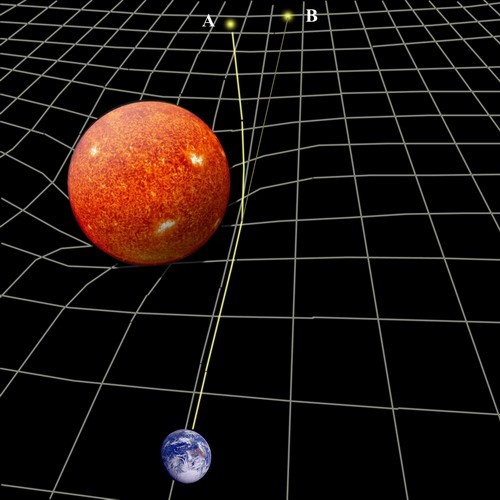
In his General Theory of Relativity, Einstein showed that matter causes space to curve, as in this illustration of starlight being bent by the sun's gravity.

But Einstein did not stop there. As early as 1911, he had predicted that light passing near a large mass, such as a star, would be bent. That idea led to his General Theory of Relativity in 1916. This paper established the modern theory of gravitation and gave us the notion of curved space. Einstein showed, for example, that small masses such as planets form dimples in space-time that hardly affect the path of starlight. But big masses such as stars produce measurably curved space.

The fact that the curved space around our sun was measurable let other scientists prove Einstein’s theory. In 1919, two expeditions organized by Arthur Eddington photographed stars near the sun made visible during a solar eclipse. The displacement of these stars with respect to their true positions on the celestial sphere showed that the sun’s gravity does cause space to curve so that starlight traveling near the sun is bent from its original path. This observation confirmed Einstein’s theory, and made Einstein a household name.

Interestingly, Einstein’s theories contained elements he himself could not accept. In some ways, he was loathe to break too much from the Newtonian/Maxwellian theories upon which his work was built.

He never accepted some of the precepts of quantum mechanics, for example, such as the idea ofindeterminacy. By the late 1920s, quantum mechanics had moved to the forefront of modern physics, yet Einstein never fully accepted many of the new theories. He declared:God does not play dice.

Also, Einstein’s 1916 theory suggested that the universe should be either expanding or contracting. Einstein could not accept that notion, and so in 1917 he introduced a cosmological constant into his theory, which would allow the universe to be stationary. In 1929, however, Edwin Hubble obtained observational evidence that the universe is indeed expanding. Einstein was forced to revise his theory. He called introducing the cosmological constant his greatest blunder.

This part of the Einstein legend illustrates, perhaps, a reason for his global popularity. The great genius could envision mechanisms of the universe in a way many of us have trouble even grasping. His imagination gave him answers to questions most of us would not think to ask.

Yet he remained prone to biases and frailties and thereby thoroughly human … just like the rest of us.

Bottom line: Albert Einstein was born on March 14, 1879. He published his Special Theory of Relativity in 1905 and his General Theory of Relativity in 1916. His work capped off the work of several previous centuries of science … and launched modern physics.

SOURCE:::::www.earthsky.org

Natarajan

This Date in Science…13 March…Discovery Of Uranus…Completely By Accident !!!

March 13, 1781. The 7th planet – Uranus – was discovered on this date, completely by accident. British astronomer William Herschel was performing a survey of all the stars that were of magnitude 8 – in other words, too faint to see with the eye – or brighter. That’s when he noticed an object that moved in front of the star background over time, clearly demonstrating it was closer to us than the distant stars. At first he thought he had found a comet, but later realized this object was a new planet in orbit around our sun – the first discovered since ancient times.

Later, it turned out, astronomers learned they had observed Uranus as far back as 1690. But it was Herschel who first realized the true nature of this distant light in our sky.

William Herschel's famous 40-foot telescope,  constructed between 1785 and 1789 at Observatory House in Slough, England. It was the largest telescope in the world for 50 years.   Image via Wikimedia Commons.

William Herschel’s famous 40-foot telescope, constructed between 1785 and 1789 at Observatory House in Slough, England. It was the largest telescope in the world for 50 years. Image via Wikimedia Commons.

Herschel proposed to name the object Georgium Sidus, after King George III, but those outside of Britain weren’t pleased with the idea. Instead, on the suggestion of astronomer Johann Elert Bode, astronomers decided to follow the convention of naming planets for the ancient gods. Uranus – an ancient sky god, and one of the earliest gods in Greek mythology – was sometimes called Father Sky and was considered to be the son and husband of Gaia, or Mother Earth.

King George III was still pleased, however. As a result of Herschel’s discovery, the king knighted him and appointed him to the position of court astronomer. The pension attached let Herschel quit his day job as a musician and focus his full attention on observing the heavens. He went on to discover several moons around other gas giant planets. He also compiled a catalog of 2,500 celestial objects that’s still in use today.

Voyager 2 gave us our first close-up image of the planet Uranus in 1986.  Its images showed a featureless gas giant world.

Voyager 2 gave us our first close-up image of the planet Uranus in 1986. Its images showed a featureless gas giant world.

In 1977, astronomers using the Kuiper Airborne Observatory made another serendipitous discovery – of rings around the planet Uranus. That discovery made Uranus the second known ringed planet in our solar system.

The closest we humans have come to Uranus was in 1986, when the Voyager 2 spacecraft swung by the planet. At its closest, the spacecraft came within 81,500 kilometers (50,600 miles) of Uranus’s cloudtops on Jan. 24, 1986. Voyager 2 radioed thousands of images and voluminous amounts of other scientific data on the planet, its moons, rings, atmosphere, interior and the magnetic environment surrounding Uranus.

Bottom line: British astronomer William Herschel discovered the planet Uranus – first planet to be discovered since ancient times – on March 13, 1781.

source::::: http://www.earthskynews.org

Natarajan

” A Jumbo Jet Made A Tricky Landing on a Short and Narrow Runway …” Why ?

The aircraft which is known as ‘The City of Canberra’ was cheered and applauded by a crowd of thousands as it made a tricky landing on the short and narrow runway.

FUN FRIDAY: Qantas Lands Jumbo Jet in Small Regional Airport

A Qantas jumbo jet has made history by landing at a regional airport in New South Wales to become the first 747-400 in the world to go on display.

The aircraft which is known as ‘The City of Canberra’ was cheered and applauded by a crowd of thousands as it made a tricky landing on the short and narrow runway.

Illawarra Airport’s runway, which is only 1,800 metres, is less than half the length of Sydney Airport’s runways and at just 30 metres wide, the aircraft’s wingspan of 64 metres caused the two engines to hang over the runway’s edge on landing.

The aircraft was retired to Wollongong after 25 years of service, where it will become a prized addition to the aviation museum based at Illawara Regional Airport.

Qantas’ final 747 flight departed Sydney Airport last weekend, and flew at just 4,000 feet and at a much slower speed for its 15 minute journey to Wollongong.

The Historical Aircraft Restoration Society who will be looking after the jumbo jet has Australia’s biggest collection of historical aircraft including a plane known as ‘Connie’, a Lockheed Super Constellation originally built for the US Air Force.

“It’s a bit sentimental but it’s going to a great home down here and we know it’s going to be looked after by the society volunteers,” Captain Greg Matthews said.

The City of Canberra is the oldest aircraft in the Qantas fleet and holds the record for the longest ever non-stop commercial flight for its trip from London to Sydney in 1989.

In total, the plane has flow 85 million kilometres, which is equivalent to 110 return trips to the moon. Its last commercial flight was in January this year between Johannesburg and Sydney.

SOURCE::::: Poppy Marello in http://www.routesonline.com

Natarajan

Unanswered Questions and Equally Startling Historical Wonders…

India has always been a land of great achievements, people, fables, anecdotes and what not. It goes without saying that it is indeed very difficult to understand and define India in one go. Other than the beauty, culture, rich history, diversity in nature so on and so forth, we have some mindboggling things that made scientist from the west and around the globe question their understanding.

Numerous things in India, including the ones that are mentioned below stand unanswered and beyond doubt startling for the world. Here they are;

1. Karna’s Kavach

Image source

Karna the child of Surya ( Sun god) was born with a shield that protected him from weapons and atrocities of the war. It might be similar to the organic shield like exoskeleton found in tortoise, still extremely solid. Not at all like fake exoskeleton used by people, Karna’s Kavach was mixed with his body. He later gave it to Indra, the father of Arjuna, who was threatened by Karna’s skill, perseverance and strength.

Fact Source


2. Hand Carved Sundials (clock ) at Konark Temple

Image source

This temple is dedicated to the Sun god Surya, and no wonder that it embodies an accurate clock, which dates back to 1250 A.D. The whole sanctuary is a flawlessly adorned chariot mounted on 24 wheels (for day clocks and night clocks), each around 10 feet in measurement and drawn by 7 strong stallions. The 7 steeds speak to the times of the week and the 12 sets of wheels speak to the 12 months of the year.

Fact Source


3. Shiva Lingam at Amarnath Cave

Image source

Arranged in a thin canyon at the elevation of 3,888 meters, the sacred Amarnath cave bears the world renown stalagmite of ice. The well known Amarnath Ice Linga is framed by dropping water through the mountain hole, which grows up vertically to form that Linga. People say that on the Shravan day, Lord Shiva described Amar Katha — the mysteries of the universe — to Goddess Parvati.

Fact Source


4. Fine architecture of Kailasa Temple Ellora Caves

Image source

As a world heritage site, Ellora caves invite plethora of visitors every year, in search of historical anecdotes, however, what lies ahead of that idea is the magnificent design, architecture, structure and individuality of the caves. The entire temple has been carved out of a huge mountain, a technique so unique and hard to accept from that period. It remains one of its kinds in the entire world. Looks like a well contemplated result of a very advanced civilization.

Fact Source


5. Ancient Indian Rope Trick

Image source

Even though, the world claims that nobody has seen the classic version, but what people are talking about is a much simpler version of the trick, which many believe as the amalgamation of numerous tricks at once. This rope trick showcases an erect rope that is sturdy enough to bear the weight of a human.

Fact Source


6. Gyanganj- The Land of Immortals

Image source

In numerous mythologies, mountains are common homes to celestial and godlike creatures. Accordingly, its no shock that the world’s mightiest mountain extend, the Himalayas, is liable to obscure whisperings of secretive creatures hidden away in the remote and inaccessible valleys of the Himalayan mountains. It is said to be an antiquated Indian and Tibetan story of a city-kingdom of complex and everlasting creatures. It is said that Gyanganj is shrewdly covered or actually existing in a totally distinctive plane of reality.

Fact Source


7. Ancient acoustic devices of Golconda Fort

Image source

Clap your fingers and you might be heard a division away. The basic thing anybody entering the Golconda Fort in Hyderabad does is a clap. As soon as you enter through the main entryway into the great patio, you’d clap because the fine architecture allows it to be heard at the other corner of the fort. Furthermore, this clap can be heard high up the slope outside the King’s chamber. When you finish your trek up there, you’d be able to hear other’s clapping on the other end.

Fact Source


8. Vacillating relationship or Ayurveda and Modern Science

Image source

When everything is said and done, we shall see the dwindling bond between the two. Even years of accuracy, perfection, validity and results kept the alliance weakly. Why hasn’t the amazing show of research into Ayurveda brought any explanation for modern medications? Why are these medications unique to cutting edge drug? It is safe to say that it is that Ayurveda takes a shot at confidence alone? Provided that this is true, what is one to make of the a great many “exploratory” studies contending for Ayurvedic medications?

Fact Source


9. Existence of Adam’s Bridge (Rama Setu)

Image source

With a considerable amount of heated debate, people in agreement and the one’s against it; the bridge is 30 kilometers (19 miles) in length and differentiates the Gulf of Mannar (southwest) from the Palk Strait (upper east). The scaffold was initially specified in the old Indian Sanskrit epic Ramayana of Valmiki. It shaped piece of an area connects that joined Sri Lanka to the landmass of Asia amid the last ice age. Hindu devotees hold it as the bridge that Lord Rama and his armed force of gorillas and monkeys assembled to achieve evil spirit ruler Ravana’s Lanka.

Fact Source

Amazed, aren’t you?

SOURCE:::: http://www.storypick.com

Natarajan

Meet The Man Who Posted Himself From London to Perth in a Wooden Box…!!!

When Australian Reg Spiers found himself penniless in London without enough money for a plane ticket home to Adelaide, he decided to post himself back in a wooden box.

Spiers, now 73, lives in Adelaide with his new partner and he remains close friends with the McSorley family

Spiers, now 73, lives in Adelaide with his new partner and two dogs and he remains close friends with the McSorley family.

It was 1964, and the 22-year-old champion javelin thrower was in Britain, desperate to get back to Australia for his daughter’s birthday and to see his wife.

He showed up out of the blue at the East London flat of his close friend – English javelin thrower John McSorley – and presented him with his problem.

Too impatient to work and save up the money for a plane ticket, together Spiers and McSorley hatched a harebrained scheme to build a timber box and send Spiers back to his home country via air freight.


Reg Spiers (left, in the 1960s) posted himself from London to Perth in a wooden box (replica pictured right)

Miraculously he survived the 63-hour journey across three continents inside the 1.52m by 91cm by 76 cm box

Miraculously he survived the 63-hour journey across three continents inside the 1.52m by 91cm by 76 cm box

What followed was a nightmarish 63-hour journey across three continents in which he was delayed in fog for 24 hours, dropped from a forklift and almost suffered dehydration after being left on a scorching tarmac in Bombay, India.

But Spiers survived, and went on to live an extraordinary life in which he travelled the world with his lover, assumed false identities and smuggled narcotics for international drug syndicates.

His sensational life has been documented in a book by McSorley’s wife and son, Julie and Marcus McSorley, titled Out Of The Box: The Highs And Lows Of A Champion Smuggler.

The specifics of Spiers’ crazy plan to post himself from London to Perth were decided over drinks at Twickenham’s Crown pub in October 1964.

The largest box they were allowed to send measured five feet by three feet by two feet six inches (1.52m by 91cm by 76 cm).

They decided they would label the box ‘plastic emulsion’, to be sent from a fake British chemical company to a fake shoe company in Perth.

A ‘Mr Graham’ was listed as the cash-on-delivery recipient – but because no one would ever collect it the money would never be paid and Spiers’ trip would be free.

McSorley built the box inside his flat over a series of late nights, with a number of specifications including side straps and a belt to hold Spiers in place when the box was loaded onto aircraft.

The timber box also opened at both ends, so Spiers could get out and walk around the cargo once the plane was in the air.

Spiers had worked in a cargo shipping section of an airport, so had some inside knowledge about what could be shipped without drawing undue notice from customs and other officials.

He was also incredibly lucky. By the 1960s, the cargo holds of many commercial airliners were pressurised and heated, to protect goods being shipped. This meant Spiers was able to breathe inside the plane while the air outside became too thin as the plane gained altitude, and he did not freeze to death.

Spiers didn’t eat for a week in preparation for his journey, in order to slow his bodily functions down.

He packed a small bag with essential belongings such as his passport, and food and drink including a bottle of fruit juice, two tins of spaghetti, a packet of biscuits, a bar of chocolate and a tube of fruit gums.

On Saturday October 17 1964, McSorley and two friends loaded the box containing Spiers onto a van and drove it to the terminal at Heathrow Airport.

A clerk weighed the box and McSorley handed him his freight forms, before giving the box a quick pat and disappearing into the airport crowd hoping for the best.

Unfortunately for Spiers the journey did not begin well. A thick fog descended on the airport delaying all flights for more than 24 hours.

According to the watch he kept with him it was more than 28 hours before his box was transported to an airplane for the first leg of the trip – a short flight to Paris.

The timber box also opened at both ends, so Spiers could get out and walk around the cargo once the plane was in the air

The timber box also opened at both ends, so Spiers could get out and walk around the cargo once the plane was in the air

Spiers survived the first part of his journey relatively easily – he managed to eat some food and relieve himself in a spare plastic bottle he had brought with him.

The second leg of the journey was from Paris to Bombay.

He was able to get out of the box and move around, but sleeping inside the crate was problematic.

Spiers could only stretch his legs if he was sitting up straight, and could only lie down if his legs were bent.

About 37 hours since he was first dropped off at Heathrow, the plane made its descent into Bombay.

The Indian airport staff that unloaded the aircraft upended his crate as they placed it on the tarmac leaving him dangling upside down from the box’s straps.

He was also precariously balancing a spaghetti can filled with urine, which he had been forced to use after filling the only plastic bottle he packed.

Spiers was left on the scorching tarmac for hours while the Indian ground staff ate their lunch and did other jobs.

He was able to unhook himself from his straps and sit upright in the box, but sunlight streaming through cracks in the wood turned the box into a sauna, and before long he was forced to strip off all his sweat-drenched clothes.

The story was the subject of a media circus after Spiers forgot to contact his friend McSorley back in London to let him know he arrived in Australia safely. Pictured is a cameraman with the box Spiers travelled in


Nearing dehydration, Spiers contemplated turning himself in, wary that the press would ‘have a field day’ if a mysterious naked man emerged from a wooden box on the tarmac in Bombay.

But after a number of hours relief came for Spiers when a vehicle arrived to move his box, driving him out of direct sunlight and onto the aircraft that would take him on the final leg of his journey.

The flight was supposed to travel directly from Bombay to Perth but made a fuel stop in Singapore

It continued on its journey and after 63 hours and almost 21,000 km Spiers arrived exhausted – but miraculously alive – at Perth Airport.

His box was offloaded into a freight shed and he managed to escape when airport workers left to take a smoke break.

He sneaked along a series of warehouses towards the airport terminal, before blending in with a group of passengers disembarking an Ansett plane that had just touched down.

Spiers used his passport to clear immigration and walk out of the airport like a regular traveller.

From Perth he hitchhiked his way across the Nullarbor before meeting a priest who shouted him a train trip to Adelaide.

The story was the subject of a media circus after Spiers forgot to contact his friend McSorley back in London to let him know he arrived in Australia safely.

Panicked, McSorley called a journalist he knew at a British newspaper asking for help to track him down.

The journalist called a correspondent based in Adelaide, and from there the story was picked up by media all over the world – so much so that the airline Spiers had sneaked onto was pressured into allowing Spiers to fly for free.

McSorley’s son Marcus McSorley – who co-wrote the book detailing his extraordinary feat – said the journey was ‘just the beginning’ of Spiers’ sensational life.

‘After the box incident Reg went on to smuggle a different kind of substance,’ Mr McSorley told Daily Mail Australia.

‘He went onto assume three different identities, was wanted in three different continents, he went on the run with his lover and was sentenced to death in Sri Lanka as a Frenchman.

‘The guy’s lived quite a life.’

In 1981 Spiers and his lover – known under the pseudonym ‘Annie’ in the book – were among a syndicate to be arrested and charged in Australia over a plot to smuggle $1.2 million worth of hashish into the country from India.

But while out on bail the couple fled to India.

They lived very much a Bonnie and Clyde lifestyle,’ Mr McSorley said.

‘On the run there they had to make money somehow and Reg was caught again in Bombay in 1983.’

Police in India alleged he and Annie tried to smuggle hashish back to Australia by attaching it to the bottom of a boat.

The couple spent time in separate Bombay prisons, but when they were out on bail they fled the country.

Spiers was arrested for drug smuggling a third time in Sri Lanka in 1984, over a plot to smuggle heroin to Amsterdam. At the time he was travelling using a French passport.

He was sentenced to death, but had his conviction overturned.

In 1987 he was transported back to Adelaide by Australian authorities where he served more than three years in Yatala, Mobilong, and Cadell prisons for the offences he was charged with back in 1981.

In 1994, Annie turned herself into an Australian embassy in Germany and was extradited home.

She was sentenced to six months in jail after a judge found that she committed her crimes due to ‘an infatuation, bordering on obsession,’ for Spiers.

Annie visited him in Adelaide after she was released, but after almost nine years apart the pair did not rekindle their romance.

Spiers and his first wife stayed married for several years after he risked his life to get back to her in the air freight box in 1964, but they separated after having a second daughter.

In 2012, Spiers appeared in court charged with cultivating and trafficking a commercial quantity of cannabis and illegal possession of a revolver.

In 2013, all charges against him were dropped in the Port Adelaide Magistrates Court after prosecutors tendered no evidence.

‘Reg has such charisma and an aura about him whereby he can make anything happen,’ Mr McSorley said.

‘He makes you feel totally alive when you’re around him.

‘Given all he’s done he’s got a lot of great attributes.’

For more details on Spiers’ extraordinary life, read Out Of The Box: The Highs And Lows Of A Champion Smuggler.

Spiers, now 73, lives in Adelaide with his new partner and he remains close friends with the McSorley family

TIMELINE OF REG SPIERS’ EXTRAORDINARY  LIFE

1964: Spiers travels from London to Perth in a wooden air freight box via Paris, Bombay and Singapore.

1981: Spiers is arrested in Australia over a plot to smuggle $1.2 million worth of hashish into the country from India.

He and his ‘lover’ Annie flee the country to India while out on bail.

1983: Spiers is arrested in Bombay and accused of trying to smuggle hashish back to Australia by attaching it to the bottom of a boat.

The couple flee the country again while out on bail.

1984: Spiers is arrested for drug smuggling in Sri Lanka, over a plot to smuggle heroin to Amsterdam. At the time he was travelling using a French passport.

He was sentenced to death, but had his conviction overturned.

1987: Spiers is transported back to Adelaide by Australian authorities. He serves more than three years in Yatala, Mobilong, and Cadell prisons for the offences he was charged with back in 1981.

1994: Annie turns herself into an Australian embassy in Germany and is extradited home.

She serves a six-month prison sentence.

2012: Spiers appears in an Adelaide court charged with cultivating and trafficking a commercial quantity of cannabis and illegal possession of a revolver.

2013: All charges against Spiers are dropped in the Port Adelaide Magistrates Court after prosecutors tender no evidence.

Read more: http://www.dailymail.co.uk/news/article-2987568/The-man-posted-London-Perth-wooden-BOX-went-escape-death-sentence-Sri-Lanka-smuggling-heroin-lives-quiet-life-Adelaide-two-dogs.html#ixzz3TyvBN6tt

SOURCE:::: SARAH MICHAEL in www. dailymail.co.uk

Natarajan