“This Guy is Wheely Brave…Riding Bike Over a 65ft. High Cliff…” !!!

A road bike freestyler risked life and limb while traversing a railing over a 65-ft high cliff for a TV programme that is trying to find the world’s most talented person.

Vittorio Brumotti, who is representing Italy in the interactive talent show, ‘World’s Most Talented’, fought the wind on the seafront during his challenge before safely completing it.

Watched by David Brain, one of the show’s presenters, who filmed the feat on a tablet, the fearless cyclist skilfully jumps onto the top of a wall to begin the stunt

Vittorio Brumotti fought the wind on the seafront during his challenge before safely completing it

Vittorio Brumotti fought the wind on the seafront during his challenge before safely completing it

The extreme cyclist put his life on the line and displayed incredible concentration during the stunt 

The extreme cyclist put his life on the line and displayed incredible concentration during the stunt

Approaching the railing, the road bike freestyler steadies himself and gets into position with a series of small bunny hops.

As Vittorio, 34, cycles along the narrow railing with one leg in the air for balance, footage from his helmet camera shows the drop to the sea to his right and the jagged rocks that stick out from the wall.

 Vittorio Brumotti moved slowly along the railing with one leg in the air for balance

Vittorio Brumotti moved slowly along the railing with one leg in the air for balance

Vittorio Brumotti, from Italy, holds a total of 10 Guinness World Records for his extreme talent

Vittorio Brumotti, from Italy, holds a total of 10 Guinness World Records for his extreme talent

Finally the road bike freestyler reaches the end of the railing and after putting two feet back on the pedals jumps down onto the path safely.

The video concludes with the crowd of observers clapping while David bows and laughs in disbelief at what he has just witnessed.

David said: ‘Going along the edge of a building, that’s not just physical, that’s mental. That blew me away.’

After the stunt Vittorio, a former bike trial world champion, reflected on the dangers involved.

Vittorio Brumotti once climbed the Burj Khalifa, the world's tallest tower, by hopping up the steps on his bike

Beachgoers and a film crew looked on in suspense as the 34-year-old completed the stunt

Beachgoers and a film crew looked on in suspense as the 34-year-old completed the stunt

He said: ‘I think about my mum, because it is important to me to come back to my mum. It’s important to have fear, because without fear, you go down.’

Vittorio holds a total of 10 Guinness World Records for his extreme talent and claims to have always enjoyed riding bikes. He once climbed Dubai’s Burj Khalifa, the world’s tallest tower, by hopping up the stairs on his bicycle.

He said: ‘I started when I was eleven years old, my father and mother bought me the first bike and it was magic, this is my dream.’

SOURCE::::::www.dailymail.co.uk

Natarajan

” What a Little Daredevil…!!!…” Impressive Stunts with Little bit of Photoshop !!!

A Seattle baby can be seen running around the city, perching atop buildings and performing some impressive stunts in a clever photo series created by his doting father.

Seattle-based photographer Brandon Hill conceives and executes the images of his one-year-old son Maddex’s acrobatic adventures, with the help of a little Photoshop, as a part of his ongoing picture series Madd Stunts.

‘This series is all about him blending in with the city, having fun at local tourist spots, and doing stunts,’ Mr Hill told the Huffington Post of the pictures, which capture his adorable son flying behind a speeding moped and hanging from trees.

New skill: One-year-old Maddex can be seen walking across the length of his crib in this photo taken by his photographer father Brandon Hill as a part of his picture series Madd Stunts

New skill: One-year-old Maddex can be seen walking across the length of his crib in this photo taken by his photographer father Brandon Hill as a part of his picture series Madd Stunts.

Over the edge: With the help of a little Photoshop, Mr Hill made it look as though Maddex was perched on top of his play chair

Over the edge: With the help of a little Photoshop, Mr Hill made it look as though Maddex was perched on top of his play chair

The photographer explained that all of photos in the series were taken in Seattle, a city he said that he will always ‘cherish’ because it is where he and his wife had their son.

Maddex can be seen getting into precarious situations at Pike Market, Kerry Park and Seattle’s famous gum wall among other locations and neighborhoods across the city.

He has been photographed doing a handstand on the kitchen counter, tight-rope walking on the ledge of his crib and stuck to a wall littered with gum.

Mr Hill has been working on the project, which celebrated his son’s childhood, for several months.

Held up: Maddex blew a bubble as he hung from Seattle's famous gum wall 

Held up: Maddex blew a bubble as he hung from Seattle’s famous gum wal

Daredevil: The adorable baby was also photographed holding on to a speeding moped

Daredevil: The adorable baby was also photographed holding on to a speeding moped

When he first started, Maddex was unable to walk and had to be probbed up by Mr Hill’s assistant, who would later be edited out of the image.

Mr Hill told Feature Shoot that when Maddex became nine months old he started ‘sharing playful expressions while remaining quiet and still’ during the playful photoshoots.

And the pictures are so good that at least one person thinks that they are actual depictions of Maddex’s amazing feats.

After Mr Hill shared a photo of Maddex ‘balanced’ on top of his baby chair on his Instagram page, one concerned commenter wrote: ‘Is [that] baby really standing like that? Because that is idiot parenting.’

Sheer strength: Maddex used one hand to hang from a tree in the park 

Sheer strength: Maddex used one hand to hang from a tree in the park

Budding gymnast: Maddex used upper body strength to do a handstand on the kitchen counter

Budding gymnast: Maddex used upper body strength to do a handstand on the kitchen counter

Mr Hill jokingly replied: ‘Yep, cause he’s amazing.’

But the exchange didn’t stop there.

When the commenter noted that Maddex’s balancing act was ‘extremely dangerous’, Mr Hill let her in on his secret.

‘Photoshop: endangering children everywhere,’ he wrote.

Admiring the view: He happily hung out on the roof of Seattle's Public Market 

Admiring the view: He happily hung out on the roof of Seattle’s Public Market

Precious moment: Mr Hill cuddled up to his son for this adorable father-son photo 

Precious moment: Mr Hill cuddled up to his son for this adorable father-son photo

SOURCE::::: http://www.dailymail.co.uk

Natarajan

Busiest Flight Routes in the World….Sapporo -Tokyo Sector is on the Top of The List…!!!

Busiest flight routes in the world revealed … with number one carrying SEVEN MILLION passengers a year (and the two cities will surprise you)

  • More than 14 million people travel between Sapporo and Tokyo every year 
  • Six of the world’s 10 busiest routes are found in Asia
  • No cities in Europe or North America managed to crack the list 

More than seven million people travelled on the busiest flight route in the world in 2013 – but the two cities may surprise you.

It wasn’t the short hop between the Brazilian cities of Sao Paulo and Rio de Janeiro or the two-hour journey between Beijing and Shanghai in China.

Surprisingly, it was the 90-minute trek from Sapporo to Tokyo in Japan.

Crowded: The busiest flight route in the world is Sapporo to Tokyo, with the return leg a close second

Crowded: The busiest flight route in the world is Sapporo to Tokyo, with the return leg a close second

Data prepared by FightStats for The Huffington Post shows that 7.4 million passengers travelled from Sapporo to Tokyo on 29,858 flights last year.

The return leg is the world’s second busiest route, transporting 7.3 million passengers on 29,484 flights.

Tokyo has the world’s most populous metropolitan area with more than 35 million residents, while Sapporo, in comparison, is home to just two million people.

An online search displays dozens of daily flights from Sapporo to Tokyo’s Narita and Haneda airports, departing every five to 30 minutes on a number of carriers.

All Nippon Airways is one of the carriers that ferries nearly seven million passengers from Sapporo to Tokyo

All Nippon Airways is one of the carriers that ferries nearly seven million passengers from Sapporo to Tokyo

FlightStats says more than 8.3 million people take to the skies every day on more than 93,000 flights.

The third busiest route in the world in 2013 was Seoul to Jeju in South Korea, while the return flight was the fourth busiest.

Almost seven million people flew each way on about 37,000 flights in 2013.

The Sao Paulo-Rio de Janeiro route rounds out the top five with just over six million travellers. The return flight is the sixth busiest flight.

Six of the world’s 10 busiest routes are in Asia, while the others are located in Brazil and Australia.

Sydney to Melbourne and the return leg are the ninth and 10th busiest routes.

Tokyo was by far the busiest city for airport travel, claiming four spots. The routes between Tokyo and Fukuoka also cracked the list.

No cities in Europe or North America made the top 10.

BUSIEST ROUTES IN THE WORLD

  1. Sapporo-Tokyo (29,585 flights, 7,404,740 passengers
  2. Tokyo-Sapporo, (29,484, 7,376,637)
  3. Seoul-Jeju, South Korea, (37,167, 6,939,204)
  4. Jeju-Seoul, (36,809, 6,872,450)
  5. Sao Paulo-Rio de Janeiro (37,520, 6,094,249)
  6. Rio de Janeiro-Sao Paulo (37,420, 6,085,195)
  7. Tokyo-Fukuoka, Japan (25,214, 5,886,273)
  8. Fukuoka-Tokyo (25,130, 5,872,756)
  9. Sydney-Melbourne (26,534, 4,997,700)
  10. Melbourne-Sydney (26,512, 4,978,161)

Source: FlightStats

The website FlightAware compiled a list of the busiest routes on a single day, using July 30, 2014 as an example.

On that day, the busiest route in the world saw 94 flights travel from Seoul’s Gimpo International Airport to Jeju International Airport.

The busiest route in the US on July 30, 2014 was Los Angeles to San Francisco with a total of 55 flights.

Source:::: http://www.dailymail.co.uk

Natarajan

” Flying into Failure…Airlines that no longer exist…”

Air Australia is one airline that failed.

Air Australia is one airline that failed. Source: News Limited 

THEY are the hugely powerful and glamorous airlines that soared into the hearts of the public only to be plunged into despair and grounded forever.

So what went so horribly wrong

We take a look at five of the most famous cases of carriers that suffered devastating demises and find that financial woes and horrifying plane crashes were among the factors that had a hand in their undoing.

1. Ansett

Founded in 1935, Ansett was Australia’s second-largest airline and ran for more than 65 years. It carried more than 14 million passengers a year and had an annual turnover of more than $3 billion by the time it was placed into administration in 2001.

Unfortunately, Ansett became the nation’s most high-profile aviation failure, and one of the largest corporate collapses ever.

Miss World 1967 Madeleine Hartog-Bel walks out of an Ansett plane. Picture: Bob Nicol

Miss World 1967 Madeleine Hartog-Bel walks out of an Ansett plane. Picture: Bob Nicol Source: News Limited 

In fact, it was bleeding a massive $1.3 million a day, according to its parent company Air New Zealand. The airline’s collapse left about 15,000 people out of work and out of pocket to the tune of $758 million in lost entitlements. Most were eventually paid back, but there were many dark days.

“The Ansett collapse produced enormous pain and hardship to thousands of Australian families,” Mark Korda from administrators KordaMentha told the Herald Sun.

Elizabeth, the Queen Mother, arrives on an Ansett aeroplane circa 1958.

Elizabeth, the Queen Mother, arrives on an Ansett aeroplane circa 1958. Source: News Limited 

KordaMentha stated that: “After a decade of commitment, we effectively completed the administration on 2 September, 2011 … The final dividend paid to former Ansett employees achieved an overall average return of 96 cents in the dollar — a result that surpassed initial stakeholder expectations during the time of the collapse.”

Ansett planes at Sydney Airport.

Ansett planes at Sydney Airport. Source: News Limited  

It was such a desperate time that, in an effort to reimburse the workers, the Federal Government imposed a $10 “Ansett levy” on all plane tickets to raise money.

Tragically, at least 40 Ansett employees committed suicide following its demise, The Australian reported.

2. Air Australia

Unfortunately, Ansett isn’t the only Australian airline to fold in a dramatic fashion. About 4000 passengers were left stranded in 2012 when Air Australia went bustseemingly out of the blue, suddenly grounding flights around its network.

It had pushed itself to the financial brink, literally running out of money to buy fuel.

The Brisbane-based carrier failed with debts of up to $90 million and was liquidated. Up until a few hours before administrators KordaMentha were appointed, tickets were still being sold online. The airline ended up making $36 million from about 100,000 tickets for future travel, which became worthless.

Air Australia is one airline that failed.

Formerly known as Strategic Airlines, the carrier started domestic flights in 2009 before expanding to overseas destinations such as Bali.

3. Pan American World Airways (Pan Am)

One of the world’s most famous airlines, Pan Am was the largest international air carrier in the US for nearly 70 years (1927-91). It was also one of the most innovative, and was a founding member of the global aviation authority, the International Air Transport Association (IATA).

It was a hugely popular airline, bringing glamour to the skies during the good old days of aviation. However, by the 1970s it struggled with major increases in worldwide fuel prices, declining travel, deregulation and an increasing number of competitors.

Then, there was a devastating plane crash that shook the world.

A Pan Am air hostess serves champagne in the first-class cabin.

A Pan Am air hostess serves champagne in the first-class cabin. Source: Getty Images  

According to the The Pan Am Historical Foundation: “The magic era ended with the passing on of Juan Trippe in 1981, and a succession of managements were unable to regain profitability. The rapid rise of world terrorism, culminating in the tragedy of Lockerbie, was the final deathblow.”

A deep gash is seen in the ground next to destroyed houses caused by the crash of Pan Am

A deep gash is seen in the ground next to destroyed houses caused by the crash of Pan Am Flight 103. Source: News Corp Australia  

Pan Am flight 103 from London to New York was destroyed by a bomb in its hold on December 21, 1988, while flying over the Scottish town of Lockerbie. All 243 passengers and 16 crew were killed, as well as 11 people on the ground, making it the deadliest act of terrorism in the UK.

Local residents look at one of the four engines of Pan Am 103.

Local residents look at one of the four engines of Pan Am 103. Source: News Corp Australia   Three years after the tragedy, it was all over for the airline.

A police officer walks past nose of the flight.

A police officer walks past nose of the flight. Source: News Corp Australia 

The Pan Am Historical Foundation states: “All the treasures had been sold, many at bargain-basement prices, yet the deficits remained. The end came on 4 December, 1991. The airline of many firsts, a world leader in technology and innovations, was gone, mourned by many across a world that will not see its like again.”

The story of the airline was turned into a TV show, called Pan Am.

The story of the airline was turned into a TV show, called Pan Am. Source: AP  

4. Swissair

For years, the national airline of Switzerland seemed unbreakable. Founded in 1931, it flew from profit to profit, becoming known as the “Flying Bank” because it was so financially stable and had a reputation for great service.

Throughout the 1980s the airline continued to thrive, and was one of the major carriers in western Europe. But it didn’t last.

A fancy Swissair Convair plane in 1975. Picture: Kecko

A fancy Swissair Convair plane in 1975. Picture: Kecko Source: Flickr 

A disastrous overexpansion program and an unstable economic environment hit the airline hard. By 2001, it was in dire straits. With its entire fleet grounded it was only kept alive by the government. After months of chaos and injections of millions of dollars, it was closed down the following year in a move that shocked the country.

Most of its planes and routes were taken over by a new airline, Swiss International Air Lines (SWISS).

Swissair. Picture: Aero Icarus

5. Trans World Airways (TWA)

One of Pan Am’s main rivals, the US airline TWA also has a long — and mostly glamorous — history spanning 71 years.

In its early days, it flourished under billionaire Howard Hughes and was always on the cutting-edge of aviation technology, USA Today reports. However, poor management in the 1980s hurt the airline, which eventually suffered huge losses.

The situation was worsened by the fact that nobody would lend the airline money with Hughes at the helm.

“We were subject to very stiff interest penalties as a result of Hughes’ involvement,” Jerry Cosley, who held several executive and staff positions with TWA from 1960 to 1985, told the St. Louis Magazine. “He was a genius in many aspects of aviation, but he maintained a very spotty record of financial achievement.”

It faced bankruptcy in 1960, and Hughes gave up control. Things seemed to be OK for a while, until deregulation hit the industry and in the years following, some of its most prized routes were sold off. By 1992 it declared bankruptcy — and again in 1995.

The partially reconstructed shell of the remains of TWA Flight 800 seen in 2013.

The partially reconstructed shell of the remains of TWA Flight 800 seen in 2013. Source: AFP   

Then, disaster struck. In 1996, flight TWA 800 exploded and crashed just minutes after taking off from John F Kennedy Airport, killing all 230 people aboard.

The crash shook the world, and despite it being years ago, there’s still a hunt for answers as to what really happened, with investigators believing it may have been caused by a missile strike.

Five years after the crash, the airline had been sold to American Airlines.

One of the galleys from TWA flight 800.

One of the galleys from TWA flight 800. Source: News Limited 

SOURCE::::: http://www.news.com.au

Natarajan


Hong Kong’s Third Runway Backed by IATA and Cathay Pacific….

The HK$150 billion project has been backed by both Hong Kong flag carrier  Cathay Pacific, and the International Air Transport Association (IATA), with the interpretation that a third runway is necessary in order to see the aviation industry in Hong Kong flourish.  

Hong Kong’s Third Runway Backed by IATA & Cathay Pacific

Hong Kong International Airport (HKIA) is set to begin the construction of a third runway and associated infrastructure.

The HK$150 billion project has been backed by both Hong Kong flag carrier Cathay Pacific, and the International Air Transport Association (IATA), with the interpretation that a third runway is necessary in order to see the aviation industry in Hong Kong flourish.

Construction on the third runway is expected to commence next year, to be completed by 2023, and will help Hong Kong International Airport boost capacity to 100 million passengers and 9 million tons of cargo a year by 2030.

IATA have said that HKIA plays a crucial role as an economic catalyst – Hong Kong is home to some 3,500 regional headquarters and boasts a HK$250 billion tourism industry. The airport serves 63 million passengers and processes 4.4 million tonnes of cargo.

“IATA has long been an advocate of the need for a third runway in Hong Kong. And it is in the interest of everyone in Hong Kong to see the aviation industry flourish. Aviation and aviation-related tourism account for 8.2% of the Hong Kong economy. Increasing HKIA’s capacity to be able to serve 100 million passengers and 9 million tonnes of cargo by 2030 will ensure that the airport continues to be a pillar of Hong Kong’s success—provided the expansion is built, financed  and funded wisely,” said Tony Tyler, IATA’s Director General and CEO in a speech to the Foreign Correspondents Club of Hong Kong.

IATA has outlined a framework which will allow Hong Kong’s new infrastructure to be built without increasing airline charges, without placing a burden on taxpayers, without making it more expensive for travellers, without adding an extra burden to shippers and while increasing competitiveness of the hub’s air transport network.

HKIA is consistently profitable, and IATA’s Tony Tyler has suggested the airport use its advantageous financial situation to fund its expansion by borrowing through commercial loans or bonds.

Flag carrier, Cathay Pacific has supported IATA’s suggestions to fund the project by saying that the third runway can be self-funded through existing income streams, especially as the number of passengers moving through the airport continues to grow.

“Hong Kong International Airport is extremely successful. It is the world’s busiest airport for international freight and the third busiest in terms of international passenger traffic. The Airport Authority enjoys the highest net profit of any airport in the world and benefits from strong cash flows, a healthy balance sheet, and growing income from retail and aeronautical streams,” said Ivan Chu, Cathay Pacific Chief Executive.

Cathay Pacific also believes that, as a public body, the Airport Authority should reinvest its income in the development of the third runway, so that the airport can maintain its premier hub status and continue to make an important economic contribution to Hong Kong.

Hong Kong’s air transport network is under pressure to remain competitive, after its share of the market connecting China to the rest of the world shrank from 20 percent to 17 percent between 2005 and 2013.

Its share on the ASEAN to North America market has remained at 10 percent, whereas the airport’s share on ASEAN to European traffic has contracted to 2.4 percent from 3.3 during the same period.

“There are lots of reasons why these changes are happening. The Middle East airlines are proving to be strong competitors with efficient and affordable hubs being a central piece of their success. And hubs closer to Hong Kong continue to improve their offerings to enhance the competitiveness of their networks,” said Mr Tyler.

SOURCE:::::::: Poppy Marello in http://www.routesonline.com

Natarajan

How to Get Through Life …With a Smile !!!

How To Get Through Life!

Some simple advice on how to get through life with a smile, because as we all know – it’s how we walk the road that determines how much we enjoy it…

Sleep as much as you can….

getting through life

Read books that you enjoy…

getting through life

Show some affection.

getting through life

Change your looks.

getting through life

getting through life

Above all, be happy, 

Regardless of what
 
 
Your challenges may be…
 
getting through life

Have a great life!
 
May your troubles be less,
 
Your blessings more,
 
And may nothing but happiness
 
Come through your door.


Source:::::: http://www.ba-bamail.com

Natarajan


This Day in Science…. March 14… Birthday Day of Albert Einstein….

March 14, 1879. This is the anniversary of the birth of Albert Einstein, undoubtedly the most famous scientist of the modern era.

Einstein was born in Ulm, Germany, where an uncle – Jakob Einstein, an engineer – introduced him to science and math. At age 17, he enrolled in the Swiss Polytechnic Institute after failing the entrance exam the previous year. He graduated in 1900, and in 1902 he became a junior patent examiner in the Swiss Patent Office in Bern, Switzerland, where he specialized in electrical devices.

The year 1905 came to be known as Einstein’s Miracle Year. He was 26 years old, and in that year he published four papers that reshaped physics.

Albert Einstein in 1904 at age 25.

Photoelectric effect. The first explained what’s called the photoelectric effect – one of the bases for modern-day electronics – with practical applications including television. His paper on the photoelectric effect helped pave the way for quantum mechanics by establishing that light is both a particle and a wave. For this work, Einstein was later awarded a Nobel Prize in physics.

Brownian motion. Another 1905 paper related to Brownian motion. In it, Einstein stated that the seemingly random motion of particles in a fluid (Brownian motion) was a predictable, measurable part of the movement of atoms and molecules. This helped establish the Molecular Kinetic Theory of Heat. That is, if you heat something, the molecules within vibrate. At this same time, Einstein provided definitive confirmation that atoms and molecules actually exist.

Special relativity. Also in 1905, Einstein published his Special Theory of Relativity. Before it, space, time and mass all seemed to be absolutes – the same for everyone. Einstein showed that different people perceive mass, space and time differently, but that these effects don’t show up until you start moving nearly at the speed of light. Then you find, for example, that time on a swiftly moving spaceship slows down, while the mass of the ship increases. According to Einstein, a spaceship traveling at the speed of light would have infinite mass, and a body of infinite mass also has infinite resistance to motion. And that’s why nothing can accelerate to a speed faster than light speed. Because of Einstein’s special relativity, light is now seen as an absolute in a universe of shifting values for space, time and matter.

Mass-energy equivalence. The fourth 1905 paper stated that mass and energy are equivalent. You perhaps know something of this work in Einstein’s famous equation E=mc2. That equation means that energy (E) is equal to mass (m) multiplied by the speed of light (c) squared. Sound simple? It is, in a way. It means that matter and energy are the same thing. It’s also very profound, in part because the speed of light is a huge number. As shown by the equation, a small amount of mass can be converted into a large amount of energy … as in atomic bombs. It’s this same conversion of mass to energy, by the way, that causes stars to shine.

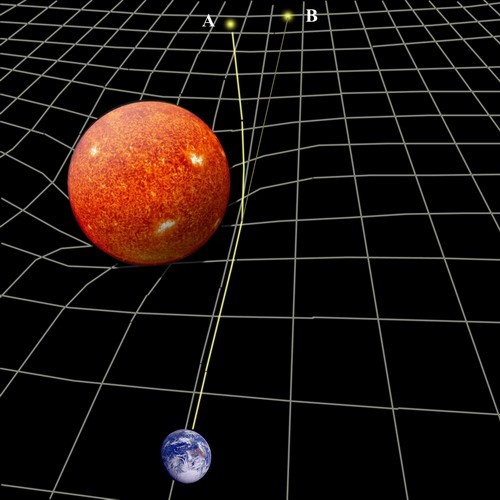
In his General Theory of Relativity, Einstein showed that matter causes space to curve, as in this illustration of starlight being bent by the sun's gravity.

But Einstein did not stop there. As early as 1911, he had predicted that light passing near a large mass, such as a star, would be bent. That idea led to his General Theory of Relativity in 1916. This paper established the modern theory of gravitation and gave us the notion of curved space. Einstein showed, for example, that small masses such as planets form dimples in space-time that hardly affect the path of starlight. But big masses such as stars produce measurably curved space.

The fact that the curved space around our sun was measurable let other scientists prove Einstein’s theory. In 1919, two expeditions organized by Arthur Eddington photographed stars near the sun made visible during a solar eclipse. The displacement of these stars with respect to their true positions on the celestial sphere showed that the sun’s gravity does cause space to curve so that starlight traveling near the sun is bent from its original path. This observation confirmed Einstein’s theory, and made Einstein a household name.

Interestingly, Einstein’s theories contained elements he himself could not accept. In some ways, he was loathe to break too much from the Newtonian/Maxwellian theories upon which his work was built.

He never accepted some of the precepts of quantum mechanics, for example, such as the idea ofindeterminacy. By the late 1920s, quantum mechanics had moved to the forefront of modern physics, yet Einstein never fully accepted many of the new theories. He declared:God does not play dice.

Also, Einstein’s 1916 theory suggested that the universe should be either expanding or contracting. Einstein could not accept that notion, and so in 1917 he introduced a cosmological constant into his theory, which would allow the universe to be stationary. In 1929, however, Edwin Hubble obtained observational evidence that the universe is indeed expanding. Einstein was forced to revise his theory. He called introducing the cosmological constant his greatest blunder.

This part of the Einstein legend illustrates, perhaps, a reason for his global popularity. The great genius could envision mechanisms of the universe in a way many of us have trouble even grasping. His imagination gave him answers to questions most of us would not think to ask.

Yet he remained prone to biases and frailties and thereby thoroughly human … just like the rest of us.

Bottom line: Albert Einstein was born on March 14, 1879. He published his Special Theory of Relativity in 1905 and his General Theory of Relativity in 1916. His work capped off the work of several previous centuries of science … and launched modern physics.

SOURCE:::::www.earthsky.org

Natarajan

Most Beautiful Words in English Language …

English is a remarkable language. It has borrowed from many other languages. It is a language both easy to learn and difficult to truly master. A few weeks ago, an online survey asked tens of thousands of people to suggest what they think are the most beautiful words in the English language. I must say, I think I quite agree with the words that kept showing up. . So here are the 32 English words considered the most beautiful.

SOURCE:::: input from a friend of mine

Natarajan

Image of the Day… ” Return of Expedition 42 to Earth ” …

The Soyuz TMA-14M spacecraft is seen as it lands with International Space Station Expedition 42 commander Barry Wilmore of NASA, Alexander Samokutyaev of the Russian Federal Space Agency (Roscosmos) and Elena Serova of Roscosmos near the town of Zhezkazgan, Kazakhstan. The landing took place on the evening of Wednesday, March 11 in the U.S, and early in the morning on Thursday, March 12, in Kazakhstan.

The three crew members returned to Earth after a 167-day mission on the orbital outpost that included hundreds of scientific experiments and several spacewalks to prepare the orbiting laboratory for future arrivals by U.S. commercial crew spacecraft.

SOURCE:::: http://www.nasa.gov

Natarajan


This Date in Science…13 March…Discovery Of Uranus…Completely By Accident !!!

March 13, 1781. The 7th planet – Uranus – was discovered on this date, completely by accident. British astronomer William Herschel was performing a survey of all the stars that were of magnitude 8 – in other words, too faint to see with the eye – or brighter. That’s when he noticed an object that moved in front of the star background over time, clearly demonstrating it was closer to us than the distant stars. At first he thought he had found a comet, but later realized this object was a new planet in orbit around our sun – the first discovered since ancient times.

Later, it turned out, astronomers learned they had observed Uranus as far back as 1690. But it was Herschel who first realized the true nature of this distant light in our sky.

William Herschel's famous 40-foot telescope,  constructed between 1785 and 1789 at Observatory House in Slough, England. It was the largest telescope in the world for 50 years.   Image via Wikimedia Commons.

William Herschel’s famous 40-foot telescope, constructed between 1785 and 1789 at Observatory House in Slough, England. It was the largest telescope in the world for 50 years. Image via Wikimedia Commons.

Herschel proposed to name the object Georgium Sidus, after King George III, but those outside of Britain weren’t pleased with the idea. Instead, on the suggestion of astronomer Johann Elert Bode, astronomers decided to follow the convention of naming planets for the ancient gods. Uranus – an ancient sky god, and one of the earliest gods in Greek mythology – was sometimes called Father Sky and was considered to be the son and husband of Gaia, or Mother Earth.

King George III was still pleased, however. As a result of Herschel’s discovery, the king knighted him and appointed him to the position of court astronomer. The pension attached let Herschel quit his day job as a musician and focus his full attention on observing the heavens. He went on to discover several moons around other gas giant planets. He also compiled a catalog of 2,500 celestial objects that’s still in use today.

Voyager 2 gave us our first close-up image of the planet Uranus in 1986.  Its images showed a featureless gas giant world.

Voyager 2 gave us our first close-up image of the planet Uranus in 1986. Its images showed a featureless gas giant world.

In 1977, astronomers using the Kuiper Airborne Observatory made another serendipitous discovery – of rings around the planet Uranus. That discovery made Uranus the second known ringed planet in our solar system.

The closest we humans have come to Uranus was in 1986, when the Voyager 2 spacecraft swung by the planet. At its closest, the spacecraft came within 81,500 kilometers (50,600 miles) of Uranus’s cloudtops on Jan. 24, 1986. Voyager 2 radioed thousands of images and voluminous amounts of other scientific data on the planet, its moons, rings, atmosphere, interior and the magnetic environment surrounding Uranus.

Bottom line: British astronomer William Herschel discovered the planet Uranus – first planet to be discovered since ancient times – on March 13, 1781.

source::::: http://www.earthskynews.org

Natarajan