India’s ‘Anaconda’ parody rap against Hindustan Unilever….

Ms Ashraf says she never expected Nicki Minaj to acknowledge her song

Ms Ashraf says she never expected Nicki Minaj to acknowledge her song

Indian activist Sofia Ashraf’s “parody rap video” against consumer goods giant Hindustan Unilever has clocked nearly two million views since it was uploaded on YouTube last week. BBC Monitoring’s Vikas Pandey speaks to the activist about her decision to use singer Nicki Minaj’s hit song Anaconda in her video – and her use of rap as a form of protest.

Corporate giant Hindustan Unilever found itself pitted against an unlikely opponent last week: a YouTube video titled Kodaikanal Won’t, modelled on Nikki Minaj’s hit song Anaconda. The video called out the company for allegedly dumping toxic waste in the soil and the water in Kodaikanal, a city in southern India.

With two million video views and widespread coverage of the rap in both local and international media, the company has in response issued a statement saying that safety is its “number one priority” and that studies showed there had been “no adverse impact” on Kodaikanal’s environment, except in some of the factory premises.

‘Minaj shout out’

Ms Ashraf told the BBC that she decided to create a rap video over the issue because she believed that “social media had the power to add much-needed global voices to the campaign”. But she says she never dreamed that Minaj would actually respond – as she did on Twitter.

“I never expected that. I decided to use her song for [the] parody to ensure that it gets noticed,” she said.

The “shout out” by the pop star ensured media outlets and social media took notice of the song and brought the Kodaikanal issue back into the spotlight.

Activists allege that a thermometer factory belonging to Hindustan Unilever dumped mercury waste, polluting local water supplies and the soil.

Environmental group Greenpeace first reported the alleged violations in 2001. Unilever subsequently shut down its factory and ordered an investigation into the functioning of the unit.

Health workers who conducted a survey of 30 Unilever workers and ex-workers have also alleged that they found many people with “gum and skin allergy-related problems which appeared to be due to exposure to mercury”. Another significant finding, the survey reported, was the high rate of absenteeism and resignations from the job owing to health problems. The report was accepted by the Madras High Court, which has been hearing a petition against Hindustan Unilever by its former workers since 2006.

As the video grew in popularity, the company issued fresh statements over the incident.

A Unilever spokesperson said: “We would never allow our employees to suffer ill-health because of their employment with us and not address it.

“Several independent studies, carried out by experts on mercury-related health complaints, concluded that our former employees were not harmed by working in our factory in Kodaikanal.”

Hindustan Unilever did not dump mercury waste, but “glass scrap containing mercury residue” had been sold to a scrap dealer near the factory, the company said. This was “in breach of our company rules” and the company had removed “both the glass and the underlying soil” to address this.

Studies had showed “no adverse impact on the environment in Kodaikanal, except in some areas of the factory premises”, the statement added. “We are keen to continue work on clearing up the factory site.”

‘Burka rapper’

Kodaikanal Won’t did not happen in a vacuum. Ms Ashraf has composed rap songs for social causes in the past as well.

“Rap is often used as a form of protest. It just feels empowering to use rap for a cause and the success of the Kodaikanal Won’t song just proves that,” she said.

Her foray into rapping began in her early 20s, where she rapped about injustice against Muslims. She was nicknamed the “Burka Rapper” because of her attire and the subject of her performances.

“I was strongly religious. I loved my religion [Islam] and all it entailed. It was beautiful, it defined me and it gave me purpose”, she explained.

The 28-year-old does not wear the burka anymore and says she no longer feels connected to any specific religion. She now finds “purpose” in promoting social causes.

And instead of the burka, she has gone for a traditional South Indian look in her video.

“Some of the clothes I have worn in the video were my own choices but we thought that wearing Indian garments like sari will give the video a distinctive look,” she said.

‘Fight not over’

Ms Ashraf has stressed that the video was “not a solo effort”.

She told the BBC that the dancers, the photographers and activists invested time and energy in making the video free of charge “because they felt strongly for the cause”.

Ms Ashraf says her songs are a result of collaboration with different artists

Ms Ashraf says her songs are a result of collaboration with different artists

Ms Ashraf is thrilled with the success of her video, but stressed that the “fight” is far from over.

“We understand that the shelf life of such social media campaigns is not very long. So we will have to come up with ideas to sustain the momentum we have got from the video,” she said.

Source….www.bbc.com

Natarajan
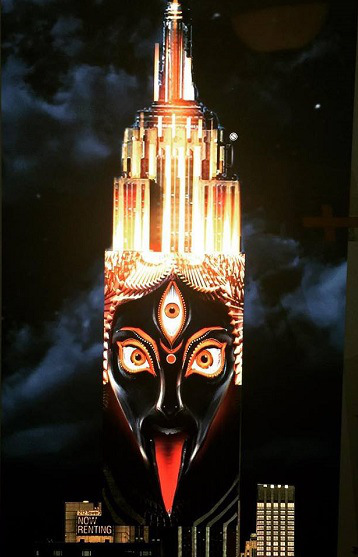
The Epic Moment When Goddess Kali Took Over The Empire State Building In New York…

Goddess Kali is regarded as the Goddess of death but the death of an ego. Of all the forms of Devi, she is considered to be the most compassionate one because she provides moksha or liberation to her children. And now, people in New York would know about Her. Yeah, you read that right.

Goddess Kali was displayed on to the iconic Empire State building in New York which is considered to be the tallest building and also the key piece of NYC skyline.

Empire State building had started a new trend to feature extinct species across the world. But, featuring Goddess Kali was a class apart. Android Jones is the artist who designed the portrait of Kali.

Why Goddess kali? Because She represents the destruction of evil, Android thought it would be a good idea to feature Her. Hence, he opines that She would work as the epitome to fight dangers and pollution.

Recently, the much touted Cecil the lion was also featured there. The death of this lion by an American dentist had caused international outrage. It was broadcast in a picture more than 350 feet tall and 180 feet wide. Other than this, many animals were featured to garner people’s attention and subsequently, create awareness.

Source….Aparajita Mishra in http://www.storypick.com

Natarajan


Interesting Information and Fascinating Facts…

Fascinating Facts

Fascinating Facts

Fascinating Facts

Fascinating Facts

Fascinating Facts

Fascinating Facts

Fascinating Facts

If you like to enrich your general trivia knowledge, or just learn some odd, interesting, and surprising pieces of information, then the above facts should satisfy your hunger for knowledge, and give you some great topics for conversation!

Source…www.ba-bamail.com

Natarajan

Image of the Day… Artichoke in Bloom…

View larger. | Photo by Donna Severson of Plum Wild Photography in Aloha, Oregon.

Donna Severson submitted this photo to EarthSky in July, 2015. She wrote:

My neighbor told me about his artichoke that was about to bloom and wanted me to capture its beauty. Using a ladder, macro lens and nature’s sunlight, I attempted to do so.

Canon 5D M III, Canon 100 M lens

Lightroom – cropped, adjusted exposure, did not touch colors.


Source….www.earthsky.org

Natarajan

Risk of future Nepal-India Earthquake increases….

Aftermath of Nepal earthquake

There is an increased risk of a future major earthquake in an area that straddles the west of Nepal and India, scientists warn.

New data has revealed that the devastating quake that hit Nepal in April did not release all of the stress that had built up underground, and has pushed some of it westwards.

The research is published in the journals Nature Geoscience and Science.

Its authors say more monitoring is now needed in this area.

Prof Jean-Philippe Avouac, from the University of Cambridge, told BBC News: “This is a place that needs attention, and if we had an earthquake today, it would be a disaster because of the density of population not just in western Nepal but also in northern India, in the Gangetic plain.”

The 7.8 magnitude earthquake that struck Nepal earlier this year killed about 9,000 people, and left many thousands more injured and homeless.

It occurred in a geological collision zone, where the Indian tectonic plate pushes north into the Eurasian plate, moving the ground an average of 2cm a year.

Tectonic plate

Over decades, stress built up along a stretch of the fault line, which is called the Main Himalayan Thrust fault, close to Nepal’s capital Kathmandu.

The boundary between the two plates in this area had become locked – stuck together by friction, and so immobile – building up energy that only a major earthquake could release.

However, the quake on 25 April only released part of this pent-up pressure.

“If the earthquake had ruptured all the locked zone all the way to the front of the Himalayas, it would have been a much larger earthquake,” said Prof Avouac.

Instead, the researchers believe that some of this stress has shifted west, to an area stretching from the west of Pokhara in Nepal to the north of Delhi in India.

A major earthquake there is already long overdue: the last happened in 1505 and is estimated to have exceeded M8.5. The researchers say the new stress that has moved there could already be adding to the tension that has been building up over five centuries.

At the moment, we are quite worried about western Nepal,” said Prof Avouac.

Aftermath of Nepal earthquake

The earthquake triggered an avalanche on Everest – but experts say the damage could have been worse

The team says extra monitoring by the research community is now needed, although it is impossible to predict accurately when the natural disaster might strike.

“We don’t want to scare people, but it is important they are aware that they are living in a place where there is a lot of energy available,” Prof Avouac explained.

“A lot of families are building their own houses in Nepal. With minimum care, it is possible to build small buildings that can withstand large earthquakes.”

Commenting on the research, Prof David Rothery from Open University said: “Monitoring techniques have now advanced to the stage where we can work out how a previously ‘locked’ fault has ‘unzipped’ during the couple of minutes that it takes a major earthquake to happen.

“Lives would be saved by drilling school children in western Nepal and the nearby plains of northern India in how to react in the event of an earthquake, and in ensuring that at least school buildings are adequately constructed to survive seismic shaking.”

Data from advanced GPS stations has also revealed that the death toll could have been far higher. These stations track tiny shifts in ground position, at a rate of five measurements every second.

Scientists say the seismic waves travelling underground were a lower frequency than expected, causing the ground to vibrate more gently.

Prof Avouac said: “When I heard about this M7.8 earthquake happening so close to Kathmandu, I was prepared for a death toll in the order of 300,000 or 400,000 people.

“But this earthquake didn’t generate a lot of high frequency waves, which would have been devastating for the small buildings in Kathmandu. They could withstand the earthquake because of the characteristics of the ‘pulse’ – and its relative smoothness.”

Follow Rebecca on Twitter

source…Rebecca Morelle  in http://www.bbc.com

Natarajan

Message for the Day…” Why ‘ bhajan’ is Recommended…” ?

Sathya Sai Baba  Some people may laugh at devotional singing (Bhajans) and call it mere show and exhibition, and recommend instead quiet meditation in the silent recess of the shrine room. But coming out and doing Bhajan in company of others helps in removing egoism; one is not afraid nor ashamed to call out the Name of the Lord. One gets inspired by the devotion of others; the company of people with kindred sentiments helps to foster the tiny seedling from being scorched by the heat of derision. A person will sweep the floor of his room with a broom when nobody is looking on; but to do the same act when people are looking on requires some mastery over the ego. Jayadeva, Gouranga, Meera, Purandaradasa, Thyagaraja and the like sang their hearts out to the Lord and were thrilled at the thought of the Lord, because they had Love for God in such a pure and overpowering form. Selfless love fills your mind with joy and hope.


சிங்கப்பூரின் பொன்விழா….

சிங்கப்பூர் நிகழ்த்திவரும் சாதனைகளும் அதன்முன் உள்ள சவால்களும்.

சிங்கப்பூர் தனி நாடானது ஆகஸ்ட் 9, 1965. ஆனால், யாரும் ஆடவில்லை பள்ளுப் பாடவில்லை. ஆனந்த சுதந்திரம் அடைந்துவிட்டோமென்று கொண்டாடவும் இல்லை. அடுத்த 25 ஆண்டுகளுக்கு சிங்கப்பூரின் பிரதமராக இருக்கப்போகும் லீ குவான் யூ மிகுந்த கலக்கத்திலிருந்தார். இந்த நகரை எப்படி ஒரு தனிநாடாக மாற்றப்போகிறோம் என்று மலைத்துப்போயிருந்தார். மழை நசநசத்துக்கொண்டிருந்தது. எங்கும் புழுக்கம். தனது உணர்ச்சிகளைக் கட்டுப்படுத்த முடியாமல் செய்தியாளர் சந்திப்பை 20 நிமிடங்கள் தள்ளி வைத்தார். சிங்கப்பூர் மலேசியாவுடன் இணைந்திருப்பதையே லீ விரும்பினார். ஆனால், மலேசியா விரும்பவில்லை. அது சிங்கப்பூரை வெளியேற்றியது.

ஓர் இந்தோனேசியத் தலைவர் காழ்ப்போடு குறிப்பிட்டார்: ‘உலக வரைபடத்தில் சிங்கப்பூர் ஒரு சிவப்புப் புள்ளி’ என்று! பரப்பளவு வெறும் 718 ச.கி.மீ. சிங்கப்பூரில் இயற்கை வளங்கள் குறைவு. தண்ணீரே மலேசியாவிலிருந்துதான் வர வேண்டும். அன்று தொழிலும் வணிகமும் சொல்லிக்கொள்ளும்படி இல்லை. மொழியால், இனத்தால், பண்பாட்டால், வேறுபட்ட சீனர்களையும் மலேசியர்களையும் இந்தியர்களையும் உள்ளடக்கிய நாடு. இனக் கலவரம் தொட்டால் பற்றிக்கொள்ளும் நிலையிலிருந்தது. அண்டை நாடுகளான மலேசியாவுடனும் இந்தோனேசியாவுடனும் நல்லுறவு இல்லை. லீ-யின் கவலையில் நியாயமிருந்தது.

ஆடுவோமே பள்ளுப்பாடுவோமே

50 ஆண்டுகள் கழிந்துவிட்டன. இப்போது தேசிய தினத்தின் பொன்விழா கோலாகலமாக நடக்கிறது. வாண வேடிக்கை, கண்காட்சிகள், இசை நிகழ்ச்சிகள்… அரசு ஊழியர்களுக்கு போனஸ், பள்ளிப் பிள்ளைகளுக்கு லீகோ விளையாட்டுப் பெட்டி, ஒவ்வொரு வீட்டுக்கும் நினைவுப் பரிசு. நான்கு நாள் கொண்டாட்டங்களை அறிவித்திருக்கிறார் லீ குவான் யூ-வின் மகனும் இப்போதைய பிரதமருமான லீ சியன் லூங்.

இந்தக் கொண்டாட்டங்களுக்குக் காரணம் இருக்கிறது. இன்று சிங்கப்பூர் உலகின் செல்வந்த நாடுகளின் பட்டியலில் அமெரிக்கா, சுவிட்சர்லாந்து, ஆஸ்திரேலியா போன்ற நாடுகளைப் பின்னுக்குத் தள்ளிவிட்டு, மூன்றாவது இடத்தில் இருக்கிறது. பொதுத் துறைகள் திறமையானவை. வரிகள் குறைவானவை. சேவைகள் தரமானவை.

சிங்கப்பூரும் ஹாங்காங்கும்

ஆய்வாளர்கள் ஹாங்காங்கையும் சிங்கப்பூரையும் எப்போதும் ஒப்பிடுவார்கள். இரண்டு இடங்களிலும் உள்ள துறைமுகங்களும், விமான நிலையங்களும், உள்கட்டமைப்பும் உலகத் தரமானவை. குற்றச் செயல்கள் குறைவானவை. ஊழலற்ற ஆட்சி நடக்கிறது. அதனால், முதலீட்டாளர்கள் படையெடுக்கிறார்கள். ஆனால், சில முக்கியமான புள்ளிகளில் சிங்கப்பூர் வேறுபடுகிறது. ஹாங்காங், மக்கள் சீனக் குடியரசின் கீழ் தன்னாட்சி அதிகாரத்துடன் இயங்குகிறது; பாதுகாப்புக்காக ஒரு சதவீதம்கூடச் செலவழிப்பதில்லை. ஆனால், சிங்கப்பூர் தனது உள்நாட்டு உற்பத்தியில் ஐந்து சதவீதத்துக்கும் மேல் பாதுகாப்புக்காக ஒதுக்குகிறது. 18 வயது நிரம்பிய நிரந்தரக் குடியுரிமை பெற்ற ஆண்கள் அனைவரும் இரண்டு வருட ராணுவப் பயிற்சி பெற வேண்டும். இன்னொரு முக்கிய வேறுபாடு ஹாங்காங் ஜனநாயகத்தில் எதிர்க் குரலுக்கு இடமுண்டு. சிங்கப்பூரில் அது கட்டுப்பாடுகளுக்கு உட்பட்டது.

சிங்கப்பூரின் வெற்றிக்குப் பின்னால் உள்ள காரணிகளில் மூன்றை இங்கே குறிப்பிடலாம். முதலாவதாக வீட்டுவசதி. சிங்கப்பூரில் சேரிகள் இல்லை. 1974-ல் 40% மக்களுக்குச் சொந்த வீடு இருந்தது. இப்போது 80% ஆக உயர்ந்திருக்கிறது. இதற்குக் காரணம் வைப்பு நிதி. நிரந்தரக் குடியுரிமை பெற்ற ஊழியர்கள் தமது ஊதியத்தில் 20%-ஐ வைப்பு நிதியில் செலுத்த வேண்டும். முதலாளிகள் 17% செலுத்துவார்கள். இதை வீடு வாங்கப் பயன்படுத்தலாம். குடியுரிமை உள்ள அனைவரும் வீடு வாங்கிவிடுவது அதனால்தான்.

இரண்டாவதாக, பல் இன மக்களிடையே நிலவும் இணக்கத்தைச் சொல்லலாம். பெரும்பாலான மக்கள் சொந்தக் கூரையின் கீழ் வசிக்கிறார்கள். வேலையில்லாதவர்கள் 2%-க்கும் குறைவு. அடிப்படைத் தேவைகள் நிறைவேறிவிடுவதால் பூசல்கள் இல்லை. 2013 மக்கள்தொகைக் கணக்கெடுப்பின்படி சீனர்கள் 74%, மலேசியர் 13%, இந்தியர்கள் 9%. இந்தியர்களில் 58% தமிழர்கள். மெட்ரோ ரயிலில் ஆங்கிலமும் சீனமும் மலாயும் கேட்கலாம். கூடவே, தேமதுரத் தமிழோசையையும் கேட்கலாம். நான்கும் ஆட்சி மொழிகள். தாய்மொழிக் கல்வி கட்டாயம். தமிழ்ப் பாடநூல்கள் தரமானவை.

சிங்கப்பூர் வெற்றிக்கு இன்னொரு காரணி, வெளியுறவுக் கொள்கை. 1967-ல் துவங்கப்பட்ட தென்கிழக்காசிய நாடுகளின் ஒருங்கிணைப்பான ஆசியானில் சிங்கப்பூர் முன்கை எடுத்துச் செயலாற்றிவருகிறது. இது பிராந்திய ஒத்துழைப்புக்கு உதவுகிறது. இன்று மலேசியாவுடனும் இந்தோனேசியாவுடனும் உறவு சுமுகமாக இருக்கிறது.

சிங்கப்பூரின் சவால்கள்

இந்த இடத்தில் சிங்கப்பூர் எதிர்நோக்கும் சவால்களைப் பற்றியும் பேச வேண்டும். கடந்த 50 ஆண்டுகளாக லீ குவான் யூ-வின் மக்கள் செயல் கட்சிதான் பெருவாரியான வாக்குகளைப் பெற்றுவருகிறது. தூய்மையான, திறமையான ஆட்சி என்பது முக்கியமான காரணம். எதிர்க் கட்சிகள் பலவீனமானவை என்பதும் ஒரு காரணம். கடுமையான தேர்தல் விதிகளும், கட்டுப்பாடுகளுடன் கூடிய பேச்சுச் சுதந்திரமும் நிலவுவதால் எதிர்க் கட்சிகளால் ஒரு சக்தியாக உருவாக முடியவில்லை. 2011 தேர்தல் இதில் சிறிய மாற்றத்தை ஏற்படுத்தியது. இந்தத் தேர்தலிலும் ஆளுங்கட்சி 93% இடங்களைப் பிடித்தது. ஆனால் 60% வாக்குகளையே பெற்றது. கடந்த 50 ஆண்டுகளில் இது மிகக் குறைவானது.

அரசியல் நோக்கர்கள் இந்தப் பின்னடைவுக்குச் சொல்லும் காரணங்களில் பிரதானமானதாகச் சொல்வதைக் கேட்டால், அது விநோதமாகத் தோன்றலாம் – சிங்கப்பூரின் தரமான கல்வி. உலகத் தரமான பல்கலைக்கழகங்களில் நவீன கல்வி கற்ற இளைஞர்களுக்கு அரசின் கடுமையான சட்ட திட்டங்கள் உவப்பாக இல்லை; கூடுதல் சுதந்திரத்தை அவர்கள் எதிர்பார்க்கிறார்கள் என்கிறார்கள். சிங்கப்பூர் அரசு இதை உணர்ந்திருப்பதாகவே தோன்றுகிறது. மாற்றங்களுக்கு அது எப்போதும் தயாராகவே இருந்திருக்கிறது.

கடந்த மார்ச் மாதம் தனது 91-வது வயதில் லீ குவான் யூ காலமானார். மக்கள் மணிக்கணக்கில் வரிசையில் நின்று மரியாதை செலுத்தினார்கள். அவரது மரணம் ஒரு வகையில் சிங்கப்பூர் மக்களிடையே உள்ள இணைப்பை வலுவாக்கியிருக்கிறது என்றார்கள். நாளைய பொன்விழாக் கொண்டாட்டங்கள் அதை மேலும் உறுதிப்படுத்தும்.

– மு. இராமனாதன், ஹாங்காங்கின் பதிவுபெற்ற பொறியாளர், தொடர்புக்கு: mu.ramanathan@gmail.com

ஆகஸ்ட் 9, 2015 சிங்கப்பூரின் 50-வது தேசிய தினம்

Source….www. tamil.thehindu.com

Natarajan

Dhanushkodi….A Ghost Town Hopes to Come Alive…

50 years after a cyclone wiped it out, Dhanushkodi is slowly finding its feet. A tourist attraction precisely for its desolateness, road connectivity could soon transform it. Saisuresh Sivaswamy, who spent a few hours there, comes back enchanted. Photographs: Saisuresh Sivaswamy

As the doughty, packed to the gills Mahindra 4WD vehicle bounces along the tracks left by others of its ilk, along the undulating sand dunes leading up to the seaside, you strain your eyes to see the desolate yet mesmerising sights outside.

It is just sand dunes, as far as the eye can see, in various shapes and grey shades. But on the horizon is a sliver of silver that expands as you weave across towards it, into the glorious sea that is at times green as emerald and suddenly azure as a clear summer sky.

The sand and the sea. Photograph: Saisuresh Sivaswamy/Rediff.com

Just as the waters of Indian Ocean and Bay of Bengal merge here in many hues, Dhanushkodi is where legend, faith and macabre recent history mingle to form a skein of emotions as you gaze across the severe, sere, landscape.

Legend has it that Ram crossed over to Lanka to rescue his wife Sita from Ravan’s clutches from here. This is where he built the Ram Setu, with floating rocks (one of them is under lock and key in a temple in the ghost town), to cross over to Thalaimannar, a few kilometres across the Palk Straits.

Legend further tells that on his successful return he destroyed the bridge with the tip of his arrow on the request of the new king of Lanka, Vibhishan, thus immortalising the town’s name (dhanush + kodi meaning end of a bow).

Political parties may squabble over the legend’s veracity but for the local folk this is all part of history, just as there are spots associated with Ram and his life in distant Ayodhya. On the way from Rameswaram to Dhanushkodi is the Kodhandaramar temple, where Vibhishan is said to have surrendered to Ram and anointed king of Lanka.

The association with Ram, and the proximity to Rameswaram, where the ancient warrior-king is said to have prayed to Lord Siva before embarking on his journey to Lanka, vest the town with divinity.

For most devotees who visit the eponymous Siva temple in the temple town, a visit to Dhanushkodi, around 25 kilometres away, is a must, a bath in the ocean not advised owing to the treacherous waters but still indulged in.

Lore has it too that a pilgrimage to Kasi/Varanasi/Benaras is incomplete without praying at Rameswaram.

The church destroyed in the cyclone 50 years ago. Photograph: Saisuresh Sivaswamy/Rediff.com

But growing up in Tamil Nadu in the 1970s-’80s it is not distant happenings or the power of faith that you remember the town for but a horrid December night from 50 years ago.

When a furious cyclone swept the then bustling town, people, buildings, everything into the all-devouring oceanic maws, the metres-high tidal waves even swallowing up a whole train with all 115 on board.

It was something that stays seared into your memory the way only a nightmare can.

What about the people on the train? What were their last thoughts as their carriages were yanked into the sea by forces beyond comprehension?

What of the townfolk, did anyone survive? What is the place like today?

What’s left of the railway tracks. Photograph: Saisuresh Sivaswamy/Rediff.com

Till the disaster, Dhanushkodi was like any other Indian town. It had a port for traffic to and from Sri Lanka; it had a railway station, a post office, hotels, the usual urban accoutrements you will find in any town of that vintage.

Pamban, the island in Ramnad district which houses Rameswaram and Dhanushkodi, was connected to Mannar in the mainland via a railway line. And regular trains would ply between Madras Egmore and the tip of the island, disgorging and collecting men and materials from the ships from Thalaimannar that would come calling at the port.

Today, all that is left of the town are skeletons of what was, and a splattering of hutments occupied by the fishermen families who continue to live there.

After the December 23-23, 1964, cyclone the town was declared ‘unfit for occupation’ and it doesn’t look like anything has changed on the ground.

The ‘tempos’ that ferry you to and fro Dhanushkodi. Photograph: Saisuresh Sivaswamy/Rediff.com

To get to Dhanushkodi you will have to drive down from Rameswaram, from where a clutch of ‘tempos’, as the ancient Mahindra 4WDs are called, ferry you till land’s end, the south-east corner of Pamban island.

Traffic is regulated, so even if you have a 4WD of your own you will need to register it at the checkpoint at Mukundarayar Chathiram where all tempos, waiting for passengers, are grouped.

Once upon a time there was no regulation and movement was easy. But once Sri Lanka’s Tamil ethnic problem began to intensify, this was where boatloads of Tamil refugees would alight, and as the militancy in the island-nation grew virulent the authorities moved in, clamping down on any illegal entry.

On a clear night, it is said, the lights of Thalaimannar can be seen.

***

The road from Rameswaram goes beyond the barricade at Mukundarayar Chathiram but no vehicles are allowed beyond this point. One can walk all the way on this road, which looks like a good half hour’s trek. There are stalls selling vaazhakkai bajji (coconut fritters), sugarcane juice and such. Fried fish is also sold here, but usually in the evenings, we are told.

This point is, for those who don’t wish to undertake the short but time-consuming drive in decrepit vehicles to land’s end, known poetically as Arichal Munai in Tamil (or, Erosion Point), the walk along the coast will do fine. But if you decide to go all the way, remember, some tempo drivers really pack it in, like ours did, and charge Rs 100 per head, otherwise the norm is Rs 150. They are also open to hiring out their vehicles for smaller groups but on fixed payment, say, around Rs 2000.

If your driver is a voluble man, like ours was, you will get a running commentary of the scenery on the way. ‘There, that was the track there that got blown away.’ ‘Here, you can see the tracks from that night.’ All this is in first person, like he was witness to that traumatic night from 50 years ago.

The mesmerising Arichal Munal or Erosion Point. Photograph: Saisuresh Sivaswamy/Rediff.com

The locale is perfect for film shootings, and as if on cue our man rattles off a list of directors who have shot here, starting from Mani Ratman in Kannathil Mutthamittal and including many others.

Arichal Munai is mesmerising and inviting. There are a few stalls here, selling the usual souvenirs (shells, and more shells, in all shapes and sizes), water, lime juice etc.

The right setting for a chilled beer given that the sun is glaring down at you, you tell yourself, but alas, no luck with the spirits. Although, judging from the odours emanating off a group, where there is a swill, there is a way.

After spending around 30 minutes at the waterfront – really, if you are not swimming, how long can you withstand the afternoon’s scorching sun even if the view is breath-taking?

The tempo trundles to the village some distance away. Which is when the reality of what happened that night 50 years ago hits you.

The church, its roof blown off, silhouette dominant, stands like a silent sentinel over the destroyed homes around, and there’s a small temple next door. A little further is what our driver-guide says was the railway station.

The water tank was next door, what is left of it are the columns, pointing an accusatory finger at the skies.

The water tank near the the railway station. Photograph: Saisuresh Sivaswamy/Rediff.com

There are a few hutments where fisher-folk live, there’s a local school with classes till the eighth standard. Kids try to sell shells to visiting tourists for Rs 10 a pop.

The tourist traffic is constant, through the year except during the rains, and amounts to a few thousands. The numbers are expected to go up exponentially once the sanctioned road from the Mukundarayar Chathiram till Arichal Munai becomes a reality, by next year.

There are earthmovers clearing the way for it, and there’s an air of expectancy among the locals that with connectivity their lives too will improve.

Hotels will come in, so will electricity and regular water supply, schools and hospital… And a ghost town will finally be laid to rest.

Dhanushkodi needs to snap out of it, 50 years is enough time to grieve.

But for now, everyone is grim-faced on gazing at the remainders of what nature’s fury can do, and the return journey is sombre.

Saisuresh Sivaswamy / Rediff.com

Source…..www.rediff.com

Natarajan


Rare Animal Species that Live in Only One Place in the World….

Every animal species has a natural habitat that suits the conditions it was specialized to live in. Some particular species are so specialized that their habitats are limited to only one place in the world, making them extremely rare and a precious hyper-endemic species. If you spot one of these species, you must definitely consider yourself lucky, especially since some of them boast the most bizarre characteristics you’ve ever seen or heard of.
1. Thorny Devil Lizard – Australia

10 Animals That Live in Only One Place in the World

The thorny devil lizard, Moloch horridus, looks dangerous due to the fearsome spikes on its skin, however in reality it is generally harmless. This species has one odd specialization that enables it to drink water through its skin, not by absorption but rather through capillary action. Therefore, if this animal puts its foot in a water puddle, a network of channels in the scales act as tiny straws and carry the water to its mouth.

Source: Steve Shattuck

2. Wilson’s bird-of-paradise – Indonesia

10 Animals That Live in Only One Place in the World

Wilson’s bird of paradise, Cicinnurus respublica, is found on only two tiny islands, Waigeo and Batanta, in the remote collection of islands called Raja Ampat, off West Papua, an Indonesian province of New Guinea. Although it’s hard to find, it’s easy to recognize with its plumage being so vibrant: A turquoise crown, emerald green breast and tail feathers curled round like Captain Hook’s moustache. This animal has a particular way of preparing for a mating display – it creates an arena by obsessively clearing away loose leaves and twigs.

Source: Serhanoksay, Wikimedia Commons

3. Brookesia micra – Madagascar

10 Animals That Live in Only One Place in the World

Brookesia micra is the smallest chameleon in the world, measuring only up to 1.2 inches long when fully grown. They are only found on a tiny rock islet called Nosy, off the northern tip of Madagascar, which was only recently discovered. Here, they live in the cracks of the island’s rocky terrain. They have a limited range of movement, which is said to be explained by their extreme dwarfism.

Source: Frank Glaw, PLOS, Wikimedia Commons

4. Texas blind salamander – Texas

10 Animals That Live in Only One Place in the World

As the name suggests, Texas blind salamander, Eurycea rathbuni, lacks vision because of an unusual absence of eyes. It also hasn’t got any skin pigment, and it’s got frond-like external gills coming out of its neck. Most of the time, you’ll find it roaming in the water-filled caves connected to the Edwards Aquifer in Hays County, Texas, where it lives in absolute darkness. Despite its limited vision, this species makes a very skilled predator of snails and shrimp, which it catches by sensing pressure waves in the water.

Source: Brian Gratwicke, Flickr

5. Papuan jellyfish – Palau

10 Animals That Live in Only One Place in the World

In a marine lake found on one of the islands in the Pacific Island chain of Palau, Eil Malk, an overwhelming population of golden jellyfish can be found. These golden jellies, Mastigias papua etpisoni, have been cut off from their oceanic relatives for millions of years, and as a result, lost much of their sting. They have developed a symbiotic relationship with the algae that live in their tissues, giving them their distinctive golden color. In order to live on these algae, the jellyfish have to make a daily migration across the lake, following the arc of the sun.

Source: Brian Gratwicke 

6. Matschie’s tree kangaroo – Papua New Guinea

10 Animals That Live in Only One Place in the World

The Matschie’s tree kangaroo, Dendrolagus matshiei, may be spotted munching leaves in the treetops of the cloud forests in Huon Peninsula, Papua New Guinea. This magnificent animal actually spends most of its life doing this. It’s got brown fur and golden paws, belly and tail, and like other kangaroos, a pouch for carrying and nursing its joeys.

Source: Richard Ashurst
7. Golfo Dulce Poison Dart Frog – Costa Rica

10 Animals That Live in Only One Place in the World

Costa Rica’s Osa Peninsula has to be the most biologically diverse spot in the country, home to nearly half of the country’s flora and fauna. Amongst all the creatures is the striking Golfo Dulce poison dart frog, Phyllobates vittatus, which is distinguished by the unique red stripes along the sides of its body, contrasting strongly against the black color of its back. This frog’s skin holds a powerful neurotoxin that can be seriously poisonous, possibly even causing seizures and paralysis.

Source: Thor Hakonsen

8. Gelada – Ethiopia

10 Animals That Live in Only One Place in the World

This particular monkey species, the Gelada, Theropithecus gelada, is endemic to the highlands of Ethiopia, where it can be found sitting in fields chewing on grass. Its baboon-like features and the red bare-skin triangles found on the chests of both males and females give this beautiful species its identity. At night, the Geladas climb cliff faces in search for the right ledges to sleep on.

Source: Christoph Lorse


9. Pink Land Iguana – Galapagos Islands

10 Animals That Live in Only One Place in the World

One of the rarest species found on the Galapagos Islands is the pink land iguana, Conolophus marthae, which lives in a stretch of 25 square kilometers on top of the Wolf Volcano on Isabela Island. It is said that this species has split from other land iguanas for over 6 million years. Unfortunately, researchers claim that the small numbers of this unique iguana renders them seriously threatened.

Source: Galapagos National Park Directorate

10. Pebble Toad – Venezuela

10 Animals That Live in Only One Place in the World

The highlands of Venezuela, where the flat-topped mountains (tepuis) form isolated islands in the clouds, is home to the tiny, rough-textured Pebble Toad, Oreophrynella nigra. This toad species has one bizarre defense mechanism it uses when being attacked by a predator (such as the tarantula) – it shapes its body into a ball and rolls downhill, bouncing away from danger like a loose stone.

Source: Gérard Vigo, Wikimedia Commons

Source…www.ba-bamail.com

Natarajan


Message for the Day…” Be Thankful to God for the Chance given to You to Serve Others…”

Sathya Sai Baba

Every village and town today is sick with animosities and petty quarrels. Even though many attempts have been made during the past years to better the lot of the common people, results have been far below expectations and expense. This is because of the absence of three requisites essential for all advancement: Dhairyam, Utsaham and Aanandam(courage, enthusiasm and joy). Nature has sufficient beauty to instill awe and wonder, to impart courage, to inspire enthusiasm and fill you with joy! It is a type of falsevairagyam (non-attachment) to close one’s eye to all the beauty, plenty, mercy that you receive from Mother Nature, and to run around in sorrow, bewailing your lot. Be thankful to the Lord for the chance given to you to serve others and yourselves, to witness His Glory and Grace, and look upon all as brothers and sisters.The virtues of the people are the treasures of the State; the remembrance of the name of the Lord is the root of all virtues.