Message for the Day…”You cannot achieve liberation by merely going to sacred places, or seeing, touching and conversing with great souls. You must put in your full and complete effort to follow the instructions and their directions.”

Source….http://media.radiosai.org

When you go to a temple, you see the idol, and very soon, your thoughts are with your footwear you left outside at the gate! This simple thought reveals the depth of concentration you have achieved. Unless you take care of every single aspect, you cannot experience the benefits from your spiritual practices (sadhana)! A water-filled-pot with one, a few or many holes is useless for carrying or storing water, isn’t it? Hence, you cannot achieve liberation by merely going to sacred places, or seeing, touching and conversing with great souls. You must put in your full and complete effort to follow the instructions and their directions. Following the path of Radha, Meera, Gouranga and Thukaram, you must feel an inseparable affinity with the Lord, as inseparable as the sea and the wave. Remember, you are really of the same essence, the same taste, the same quality as the sea, though you have the name and form of the wave.

Alexander Graham Bell’s Tetrahedral Kites…


Alexander Graham Bell is best remembered for inventing the telephone, but the great Scottish inventor’s interests weren’t limited to just one field. Aside from his priceless contributions in the field of acoustics and telegraphy, Bell is also credited with the invention of the metal detector, the audiometer (an instrument used to detect hearing problems), and a device to locate icebergs. Bell and his associates investigated the possibility of impressing a magnetic field on a physical device as a means of recording sound—the basic principle behind tape recorder and hard disc—but could not develop a workable prototype. Bell also had a great passion for aeronautics.

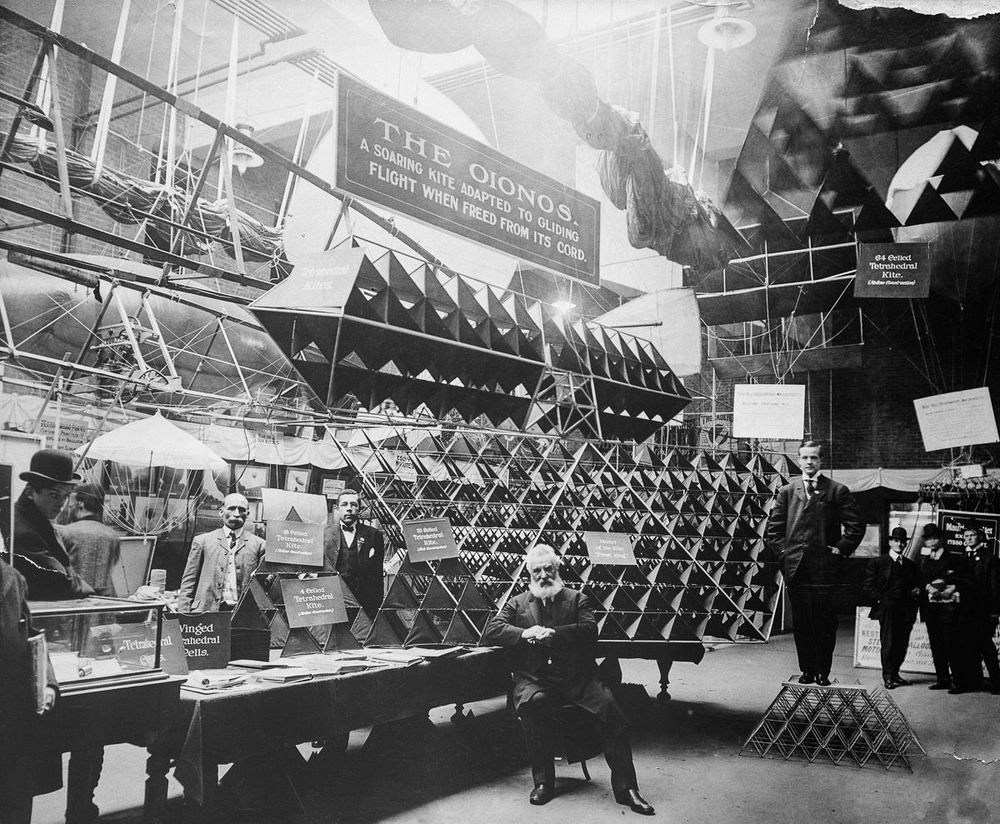
Bell became obsessed with flight and began studying the possibility of building a kite large and stable enough to carry a man. His first innovation was the box kite, which he built by joining the sides of several triangular kites together to create a box-like structure. Bell realized that by sharing joints and spars, he was able to greatly increase the surface area of his kites with little increase in weight. Then he combined several box-like cells to create large pyramidal structure with three triangular sides and a triangular base. This geometric form, known as a tetrahedral, is one of nature’s most stable structures. Although it looks pretty complicated, tetrahedral kites are very easy to fly.

Bell believed that the future of flight lied in kites and not in airplanes, which the Wright brothers had demonstrated. He was convinced that his tetrahedral cell structure was more stable than the Wright brothers’ machine.

In 1907, Bell collected a group of a young men interested in aviation and established the Aerial Experimental Association (AEA), whose purpose was to build a practical powered airplane. The same year, the AEA built the largest tetrahedral kite, named the Cygnet, meaning “little swan” in French. It was composed of over 3,393 cells, was 40 feet long and weighed 91 kg. It successfully flew carrying a human passenger 168 feet above water when towed behind a steamship. Unfortunately, it crashed and tore to pieces on landing.

In the meantime, Bell’s own colleagues—the other members of the AEA— became more interested in producing conventional aircraft, and subsequently a series of airplanes were designed. One of these planes, named the “June Bug”, won the Scientific American Trophy in an exhibition in 1908. Its pilot, Glenn Curtiss, who would later  establish a large and successful aeronautical manufacturing company, flew 5,360 feet in just under 2 minutes. By the end of that year, the AEA flew over 150 flights without mishap.

The AEA was financed entirely by Alexander Graham Bell’s wife, Mabel Bell. When the funds ran out, the association was disbanded. In less than two years of its existence, the AEA made many innovative contribution to airplane design such as cockpit enclosures and tail rudders. One of Bell’s invention was the aileron, that is now a standard component on all aircraft.

Despite the gradual disinterest in kites and the growing success of the American brothers’ airplanes, Bell made two more massive tetrahedral kites, named Cygnet II, and III, but neither one was successful. His Cygnet III with a 70-horsepower motor was reported to have flown only one foot. Bell eventually abandoned his experiments in 1912.

1904. Bell poses with some of his tetrahedral kites.

Source….Kaushik in http://www.amusingplanet.com

Natarajan

Message for the Day…”You should recognise the truth that your life should consist of making the journey from the position of ‘I’ to the position of ‘We’. If all the time you simply stay in the place of ‘I’, you will remain where you are.”

Source: http://media.radiosai.org

Broadening your heart and making it bigger and bigger, you should make it as big as God Himself. A balloon, in its initial stage, is tiny. If you go on blowing air into it, it becomes bigger and bigger and later explodes. Though beginning with the ideas of ‘I’ and ‘mine’, if you ultimately move on to the place that, “all are mine and all are one”, gradually you will become broader in your vision, and then you burst and merge into God who is omnipresent. You should recognise the truth that your life should consist of making the journey from the position of ‘I’ to the position of ‘We’. If all the time you simply stay in the place of ‘I’, you will remain where you are. This creation is like the bridge which connects man with God. ‘I’ is one hill. ‘God’ is another hill. The bridge between the two is the aspect of creation. If you break and destroy the bridge, you can never reach the destination. I am hoping that you plunge into society and do service, and thereby use the bridge to reach God.

வாரம் ஒரு கவிதை….” காந்திக்கு ஒரு கடிதம் “


காந்திக்கு ஒரு கடிதம்
———————-
விடுதலை பெற்று தந்தாய் என் தாய்
நாட்டுக்கு …உன்னையே விலையாகவும்
கொடுத்தாய் மத பேதம் இல்லா புதிய
பாரதம் ஒன்று படைக்க !
ஆனால் …
விடுதலை பெற்ற என் தேசம் இன்னும்
புது விடியலை தேடுதே …அது ஏன் ?
மதவாத அரசியலில் ஆதாயம் தேடுதே
ஒரு பெரும் கூட்டம் !
அது ஏன் ?
மூலைக்கு மூலை உன் சிலை
வைத்து காந்தி ஒரு பொம்மைதான் எங்கள்
அரசியல் விளையாட்டுக்கு என்று சொல்லாமல்
சொல்லுது ஒரு கூட்டம் !
காந்தியா …அது  யார் என்று கேக்குது
இன்னொரு கூட்டம் …காந்தி உன்னையே
மறந்த கூட்டம் காந்தீயக் கொள்கை கிடைக்குமா
ஒரு விலைக்கு என்று அலைவதும் உண்மை இன்று !
வேற்றுமையில் ஒற்றுமை என்பது வெறும் பேச்சு
மட்டுமா ?  ஒளிமயமான வலுவான பாரதம்
பிறப்பது எப்போது ?  என் தேசம் புது விடியல்
காண்பது எப்போது ?
சிலையாய் இருக்கும் காந்தி நீ இப்போது
எடுக்க வேண்டும் மீண்டும் ஒரு பிறவி !
காந்தி சிலைகள் எல்லாம்  உயிர் பெற்று
பல நூறு புதிய காந்திகளாய் என் மண்ணில்
பிறக்க வேண்டும் இப்போதே !
என் மண்ணின் விடுதலைக்கு ஒரே ஒரு
காந்தி நீ இருந்தாய்.. இன்று
இந்த  மண்ணின் புது விடியலுக்கு  பல  நூறு
காந்தி வேண்டுமே  அய்யா !
மறுக்காமல் நீ பிறப்பாயா அய்யா மீண்டும்
என் மண்ணில் ? ஒரு புதிய பாரதமும்
மலர்ந்து ஒளிருமா என் கண் முன்னால் ?
My kavithai as published in http://www.dinamani.com on 8th Oct 2017
Natarajan

Message for the Day…”Offer the flower of non-violence (ahimsa) to God. We regard ahimsa to mean not to cause harm and hurt to other living beings. The true meaning of ‘Ahimsa’ is to not cause hurt and harm through thoughts, words or deeds”

Source: http://media.radiosai.org/

Offer the flower of non-violence (ahimsa) to God. We regard ahimsa to mean not to cause harm and hurt to other living beings. The true meaning of ‘Ahimsa’ is to not cause hurt and harm through thoughts, words or deeds. The control of your sense organs is another flower that must be offered to God. Our senses run without any control. If running horses are not controlled, they pose a danger. God has created each organ of the human body for a specific purpose. It is only when we use these sensory organs along the right path for which they have been created will we be entitled to God’s grace. Our inner strength will decrease rapidly with agitation or unnecessary sorrow; body also suffers illness due to mental agitations and distractions. One ages very quickly through excitement and sorrow. The reason for your not preserving this sacred instrument in sound condition is lack of control over these sensory organs. Hence the second flower of sensory control should be used for worshipping God.

Moscow’s Bagel House…

In the early 1970s, Russian architect Evgeny Stamo and engineer Alexander Markelov came up with plans for an unusual house in the capital city Moscow. The house was to be shaped like a ring, about 150 meters across, enclosing a large inner courtyard with playgrounds and green spaces. The building was to have over nine hundred apartments, and all the necessary services and facilities, including shops, a pharmacy, a laundry room, a studio, post office, and so on. When completed in 1972, the authorities were so impressed that plans for more such house across Moscow were drawn up.

At that time, the Summer Olympic Games of 1980, which was to be hosted by the Soviet Union, was approaching, and the city decided to build five similar ring-shaped houses to symbolize the event. However, by the time the second ring house went up in 1979, on Dovzhenko street, the project was already shelved. The Soviet Union was on the brink of an economic collapse, and the buildings, it was realized, were too expensive to maintain. They are also bulky and inconvenient.

Besides, the proposed location of the buildings were spaced too far apart to provide any meaningful association with the five Olympic rings. Even if it did, a pedestrian could never see the rings from the street level or appreciate the composition.

Today, both buildings are still used as apartments. Each building has nine floors and over twenty entrances. Some say that finding the right entrance and locating the correct apartment is extremely difficult.

Locals affectionately call them the “bagel house”.

Source….kaushik in http://www.amusingplanet.com

natarajan

The Fascinating History of the Iconic Mysore Sandal Soap…

A soap that has held a special place in the hearts of Indians for more than a century, Mysore Sandal Soap’s legacy is intricately interwoven with Karnataka’s history and heritage.

There is something beautifully Indian about the fragrance of sandalwood. Sweet, warm, rich and woody, it is a scent that is deeply interwoven with the nation’s history and heritage. This is, perhaps, one of the many reasons why the Mysore Sandal Soap has held a special place in the hearts of Indians for more than a century.

Here’s the fascinating story behind India’s most-loved sandal soap.

One hundred and one years ago, in May 1916, Krishna Raja Wodiyar IV (the then Maharaja of Mysore) and Mokshagundam Visvesvaraya (the then Diwan of Mysore), set up the Government Sandalwood Oil factory at Mysore for sandalwood oil extraction.

The primary goal of the project was to utilise the excess stocks of the fragrant wood that had piled up after World War I halted the export of sandalwood from the kingdom of Mysore (the largest producer of sandalwood in the world at the time).

Two years later, the Maharaja was gifted a rare set of sandalwood oil soaps. This gave him the idea of producing similar soaps for the masses which he immediately shared with his bright Diwan. In total agreement about the need for industrial development in the state, the enterprising duo (who would go on to plan many projects whose benefits are still being reaped) immediately got to work.

A stickler for perfection, Visveswaraya wanted to produce a good quality soap that would also be affordable for the public. He invited technical experts from Bombay (now Mumbai) and made arrangements for soap making experiments on the premises of the Indian Institute of Science (IISc). Interestingly, the IISc had been set up in 1911 due to the efforts of another legendary Diwan of Mysore, K Sheshadri Iyer!

From the talent involved in the research happening at IISc, he identified a bright, young industrial chemist called Sosale Garalapuri Shastry and sent him to England to fine tune his knowledge about making soap. Affectionately remembered by many as Soap Shastry, the hardworking scientist would go on to play a key role in making Visveswaraya’s dream a reality.

After acquiring the required knowledge, Shastry quickly returned to Mysore where the Maharaja and his Diwan were waiting anxiously. He standardized the procedure of incorporating pure sandalwood oil in soaps after which the government soap factory was established near K R Circle in Bengaluru.

The same year, another oil extraction factory was set up at Mysore to ensure a steady supply of sandalwood oil to the soap making unit. In 1944, another unit was established in Shivamoga. Once the soap hit the market, it quickly became popular with the public, not just within the princely state but across the country.

However, Shastry was not done yet. He also created a perfume from distilled sandalwood oil. Next, he decided to give the Mysore Sandal Soap a unique shape and innovative packaging. In those days, soaps would normally be rectangular in shape and packed in thin, glossy and brightly coloured paper. To help it stand out from the rest, he gave the soap an oval shape before working on a culturally significant packaging.

Cognizant of the Indian love of jewels, Shastry designed a rectangular box resembling a jewellery case— with floral prints and carefully chosen colours. At the centre of the design was the unusual logo he chose for the company, Sharaba (a mythical creature from local folklore with the head of an elephant and the body of a lion. A symbol of courage as well as wisdom, the scientist wanted it to symbolise the state’s rich heritage.

The message ‘Srigandhada Tavarininda’ (that translates to ‘from the maternal home of sandalwood’) was printed on every Mysore Sandal Soapbox. The aromatic soap itself was wrapped in delicate white paper, similar to the ones used by jewellery shops to pack jewels.

This was followed by a systematic and well-planned advertising campaign with cities across the country carrying vibrant signboards in neon colours. Pictures of the soapbox were noticeable everywhere, from tram tickets to matchboxes. Even a camel procession was held to advertise the soap in Karachi!

The out-of-the-box campaign led to rich results. The soap’s demand in India and abroad touched new heights, with even royal families of foreign nations ordering it for themselves. Another important turning point for the company was when, in 1980, it was merged with the oil extraction units (in Mysuru and Shivamoga) and incorporated into one company called Karnataka Soaps and Detergent Limited (KSDL).

However, in the early 1990s, the state-run firm did face a rough patch due to multinational competition, declining demand and lack of coordination between sales and production departments. As losses started rising, it was given a rehabilitation package by BIFR (Board for Industrial & Financial Reconstruction) and KSDL grabbed the lifeline with both hands.

The company streamlined its way of functioning and soon it had started showing profits again. Thanks to rising profits year after year, it had soon wiped out all its losses and repaid its entire debt to BIFR by 2003. The company also successfully diversified into other soaps, incense sticks, essential oils, hand washes, talcum powder etc.

Nonetheless, the Mysore Sandal Soap remains the company’s flagship product, the only soap in the world made from 100% pure sandalwood oil (along with other natural essential oils such as patchouli, vetiver, orange, geranium and palm rose). Due to tremendous brand recall and loyalty associated with the soap, it also bags a prized position on the shopping lists of visiting NRIs.

In 2006, the iconic was awarded a Geographical Indicator (GI) tag — that means anyone can make and market a sandalwood soap but only KSDL can rightfully claim it to be a ‘Mysore Sandalwood’ soap.

Thanks to this near-monopolistic presence in the market for sandalwood bathing soaps, KSDL has also become one of Karnataka’s few public sector enterprises that turns consistent profits. In fact, the company registered its highest gross sales turnover (of ₹476 crore) in 2015-16.

Such is the legacy of sandalwood and this earthy, oval-shaped soap in the state that even Karnataka’s thriving film industry calls itself Sandalwood!

Today, there are a multitude of branded soaps in the market but Mysore Sandal Soap continues to hold a distinctive place among all of them. Its production figures continue to rise, even as the availability of sandalwood is on the decline.

To counter this, KSDL has been running a ‘Grow More Sandalwood’ programme for farmers, that provides affordable sandalwood saplings along with a buy-back guarantee.Working in partnership with the forest department, it is also working to ensure that for every sandalwood removed for extraction, a sandalwood sapling is planted to replace it.

The story of Mysore Sandal Soap and its enduring appeal is an inspiration not just for Indian PSUs but for the entire FMCG sector. Here’s hoping that its future is aromatic as its history!

Source….www.the betterindia.com

Natarajan


Joke of the Day…”Let my chauffeur answer this…” !!!


When Albert Einstein was making the rounds of the speaker’s circuit, he usually found himself eagerly longing to get back to his laboratory work. One night as they were driving to yet another dinner, Einstein mentioned to his chauffeur (a man who somewhat resembled Einstein in looks & manner) that he was tired of speech-making.

“I have an idea, boss,” his chauffeur said. “I’ve heard you give this speech so many times, I’ll bet I could give it for you.”

Einstein laughed loudly and said, “Why not? Let’s do it!”

When they arrived at the dinner, Einstein donned the chauffeur’s cap and jacket and sat in the back of the room. The chauffeur gave a beautiful rendition of Einstein’s speech and even answered a few questions expertly.

Then a supremely pompous professor asked an extremely esoteric question about antimatter formation, digressing here and there to let everyone in the audience know that he was nobody’s fool.

Without missing a beat, the chauffeur fixed the professor with a steely stare and said, “Sir, the answer to that question is so simple that I will let my chauffeur, who is sitting in the back, answer it for me.” 

Source…..www.ba-bamail.com

Natarajan

Message for the Day…”The toughest fibre is anger; it is indeed the stickiest dirt! When you get angry, you forget everything and quickly descend to the lowest depth. You lose all discrimination during the agitation. Be Aware! Cultivate virtues assiduously. Virtue is your life-breath, character is the backbone.”

Source…..http://media.radiosai.org/

In temples or homes, you may have seen people breaking coconuts to offer to God. If you try to break the nut just as it fell from the tree, will it break? No! The fibrous outer cover must be removed to first expose the shell. The fibre protects the shell and lets it grow, preventing blows from the environment. Liberation results from breaking the mind filled with vagaries and wishes. But how can you break it when the fibrous armour of sensual desires encompasses it? So, carefully and persistently, remove them and dedicate your mind to God! Smash it open in His presence. At that very moment, you are set free! The toughest fibre is anger; it is indeed the stickiest dirt! When you get angry, you forget everything and quickly descend to the lowest depth. You lose all discrimination during the agitation. Be Aware! Cultivate virtues assiduously. Virtue is your life-breath, character is the backbone.

A Garden In A Sinkhole…

The region in the southeast of South Australia, near Mount Gambier, is littered with many volcanic and karst features such as volcanic craters, lakes, limestone caves, water-filled caves and sinkholes. One particular sinkhole, located just off Jubilee Highway East, is particularly worth visiting. What was once a typical limestone cave formed by the corrosion of limestone rocks by seawater, and the subsequent collapse of the chamber’s roof, has been transformed into a beautiful garden.

The Sunken Garden in the Umpherston Sinkhole was built by James Umpherston in the 1880s, after he purchased the property about twenty years prior. Being retired, Umpherson wanted to create a place where the people of Mount Gambier could come to relax and escape the heat of summer. He carved a path in the side of the rock and erected a set of wooden steps so people could descend into the sinkhole and to his sunken garden, where he planted all sorts of ferns, shrubs and flowers. The sinkhole even had a small lake within where visitors could take boat rides.

The garden became an immediate success and very popular among the residents of Mount Gambier. After James Umpherston died in 1900, his garden fell into disrepair, and it was only about forty years ago that the garden was rescued from a rubbish dump that it had become. The garden was restored by the employees of the South Australian Woods and Forests Department in 1976. They removed the rubbish and cleared the weeds, and planted hydrangeas and other species along the terraces.

Once again, the garden has become a popular recreation spot. In 1995, the garden was added to the South Australian Heritage Register.

Source….kaushik in http://www.amusingplanet.com

Natarajan