How an 11 Year old Girl got to Name the Planet Pluto … !!!

An 11-year-old British girl is responsible naming the planet Pluto, the once ninth planet of our solar system, after her grandfather read about the dwarf planet’s discovery at the family breakfast table.

pluto

The girl, Venetia Burney, recalled the event in an interview with NASA in 2006,

Venetia_Burney

“I think it was on March the 14th, 1930 and I was having breakfast with my mother and my grandfather. And my grandfather read out at breakfast the great news and said he wondered what it would be called. And for some reason, I after a short pause, said, “Why not call it Pluto?” I did know, I was fairly familiar with Greek and Roman legends from various children’s books that I had read, and of course I did know about the solar system and the names the other planets have. And so I suppose I just thought that this was a name that hadn’t’t been used. And there it was. The rest was entirely my grandfather’s work.”

Burney’s grandfather, Falconer Madan, the ex-head librarian at the Bodleian at Oxford, was so pleased by his granddaughter’s proposed name that he suggested it to Herbert Hall Turner, a retired astronomer who held the title of Astronomer Royal.

Turner immediately wired the idea to American astronomers at Lowell Observatory. The planet was officially named a in May 1930.


Despite many rumors that Burney named the planet Pluto after the Greek god of the underworld or that the first two letter “PL” are in honor of Percival Lowell, the founder of Lowell Observatory, Burney seems to have named the planet Pluto because it sounded good to her. “I just thought it was a name that hadn’t been used so far, and might be an obvious one to have,” Burney told NASA.

There was also a rumor that the planet was named after Pluto the dog because both, the cartoon and the planet, came out in 1930. However, Pluto the dog was originally named Rover in 1930. It wasn’t until 1931 that the beloved cartoon dog took the name Pluto, meaning that the dog took the name of the planet.
This article originally appeared at Modern Notion. Copyright 2015. Follow Modern Notion on Twitter
Read more: http://modernnotion.com/little-girl-named-pluto/#ixzz3SELJkgOQ

SOURCE::::

http://www.businessinsider.com

Natarajan

3 Indian Airports Among the World’s Best….

Three airports from India have bagged the Airports Council International’s Airport Service Quality Awards.

Photograph, courtesy: Ramesh NG/Wikimedia Commons

The Indira Gandhi International Airport has been ranked as the best airport in the world in the 25-40 million passengers per annum category.

The survey rates each airport’s performance in 34 key service areas under eight major categories including access, check-in, security, airport facilities, food and beverage providers.

Seoul’s Incheon airport is ranked as the world’s best airport in the above 40 million passengers’ category.

Two Indian airports won the award in the 25-40 million passengers’ category, while one bagged the third place in the 5-15 million category…

Take a look at the world’s best airports…

Photograph, courtesy: Krokodyl/ Wikimedia Commons

Indira Gandhi International Airport, New Delhi

Rank: 1

Indira Gandhi International Airport is the busiest airport in India.

The airport is managed by Delhi International Airport Limited (DIAL), a joint venture between the AAI and GMR Group-led consortium.

“The journey was never easy especially after holding the No 2 mark for last three years. We can now justifiably claim to be the world’s best,” Prabhakara Rao, chief executive, DIAL said in a statement.

With the new Terminal 3, the Delhi international airport has become South Asia’s largest aviation hub.

Photograph, courtesy: Kaichinshih/Wikimedia Commons

Taipei Taoyuan, Taiwan

Rank: 2

One of five airports in the country, Taipei Taoyuan is the largest airport in Taiwan.

Last year also, it bagged the world’s second best airport award from ACI.

“Airports are more than simply points of departure and arrival. At the end of the day, good business acumen comes down to a simple equation: better service, improved traffic and a healthier bottom line,” said Angela Gittens, Director General, ACI World.

Photograph, courtesy: Chongqing Jiangbei International Airport

Chongqing Jiangbei International Airport, China

Rank: 3

One of the busiest airports in the world, Chongqing Jiangbei International Airport has been regularly winning award for its best services.

Photograph, courtesy: Baycrest/ Wikimedia Commons

Shanghai Hongqiao International Airport, China

Rank: 4 

Shanghai Hongqiao International Airport is a hub for China Eastern Airlines, Shanghai Airlines, Juneyao Airlines and Spring Airlines.

It is one of the busiest airports in China.

Photograph: Rajesh Karkera/Rediff.com

Chhatrapati Shivaji International Airport, Mumbai

Rank: 5

It is the second busiest airport in India, after Delhi airport.

The airport has five operating terminals spread over an operational area of 8 square kilometers.

A world class terminal T2 was recently opened last year for international operations at the Mumbai airport.

The airport is run by Mumbai International Airport Limited (MIAL), a joint venture between the AAI and GVK group-led consortium.

Rajiv Gandhi International Airport, Hyderabad

The Rajiv Gandhi International Airport (RGIA) in Hyderabad has bagged the third position in the 5-15 million passengers per annum category.

The Hyderabad airport was ranked as the best airport in 2009 and 2010, third-best in 2011, and second-best in 2012.

Natarajan


Have you Heard about these Aircraft Designs … ?

The 20th century saw an amazing array of new vehicles – from cars to ships to submarines and airplanes. Some of these designs are still used today, their basic premise being so dead on. However, some designs were less than ideal, and what follows are the aircraft designs that just weren’t as good as the rest, but are still fascinating to see. Enjoy this collection of strangely designed planes.

weird planes

weird planes

weird planes

weird planes

weird planes

weird planes

weird planes

weird planes

weird planes

weird planes

weird planes

weird planes

weird planes

weird planes

weird planes

weird planes

weird planes

weird planes

weird planes

weird planes

weird planes

weird planes

weird planes

weird planes

weird planes

weird planes

weird planes

weird planes

SOURCE:::: http://www.ba-bamail.com

Natarajan

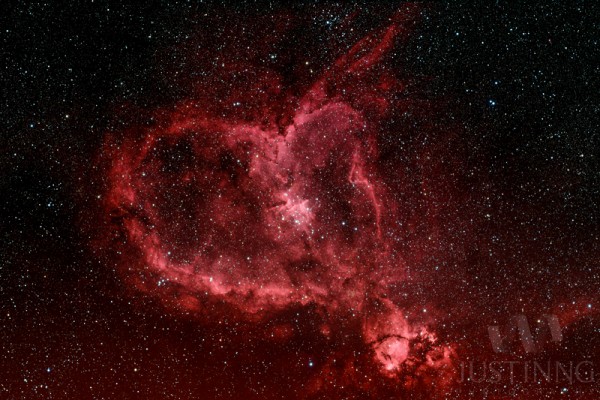
Image of the Day… Heart Nebula For Valentine’s Day… !!!

Heart Nebula

It’s 7,500 light years away, in the Perseus Arm of our Milky Way galaxy, in the direction to the constellation Cassiopeia the Queen.

IC1805 aka the Heart Nebula via Justin Ng.  See it larger at his website.

Our friend Justin Ng sent in this photo of IC 1805 – otherwise known as the Heart Nebula – on this Valentine’s Day 2015. It’s an emission nebula with glowing gas and darker dust lanes, located some 7,500 light years away, in the Perseus Arm of our Milky Way galaxy, in the direction to the constellation Cassiopeia the Queen.

Thank you, Justin Ng!

To all who celebrate it, happy Valentine’s Day 2015!

SOURCE:::: http://www.earthskynews.org

Natarajan

This Date …Feb 13…. .. BirthDay of Chuck Yeager… The 1st Pilot to Break the Sound Barrier…

February 13, 1923. Chuck Yeager, the first pilot to break the sound barrier, was born in Myra, West Virginia on this date in 1923.

Yaeger enlisted in the Army Air Corps in September 1941, at the age of 18. He fought in World War II before being assigned to fly high-performance aircraft at Edwards Air Force Base in 1947.

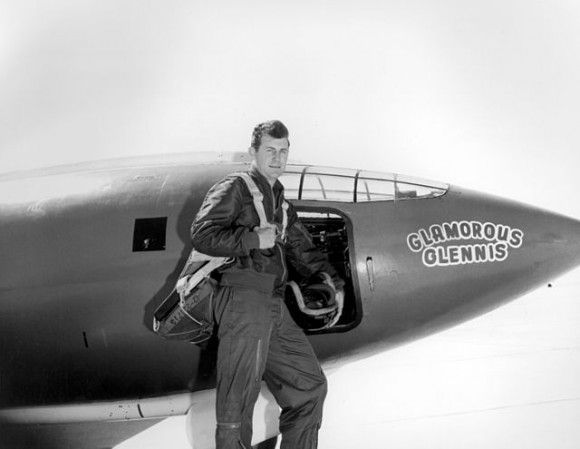
On October 14, 1947, Yeager piloted a plane called Glamorous Glennis to Mach 1.06, just over the speed of sound.

Dubbed the fastest man alive, he also won the prestigious Collier Trophy in aviation even as he continued setting speed records.

The plane in which he broke the sound barrier is on display at the Smithsonian National Air and Space Museum in Washington, D.C.

Yeager’s adventures were popularized in a 1980s satirical book and movie, both called The Right Stuff.

He currently lives California.

Yeager in front of the Bell X-1, which, as with all of the aircraft assigned to him, he named Glamorous Glennis after his wife.  Image via Wikimedia Commons.

Bottom line: On February 13, 1923, Chuck Yeager, the first pilot to break the sound barrier, was born in Myra, West Virginia.

SOURCE:::: http://www.esrthskynews.org

Natarajan

This Date in Science….Feb 11 2010……When a Spacecraft Destroyed a Sundog…

February 11, 2010. On this date – the coolest space launch ever for us sky fans! I ran into this image and video yesterday via a post on Google+. I was interested when I saw a quote from the person who runs the world’s absolute best website for sky optics, Les Cowley of the website Atmospheric Optics. It turns out this story has been around a few years, but I liked it and thought you might, too. It began with the launch five years ago of NASA’s Solar Dynamics Observatory (SDO), one of several observatories that keep an eye on our sun. It seems that when SDO lifted off from Cape Canaveral on February 11, 2010, on its mission to observe the sun, it first destroyed a sundog in Earth’s atmosphere – in the process bringing to light the new form of ice halo – and teaching those who love and study sky optics new things about how shock waves interact with clouds.

The video above shows SDO’s 2010 launch via an Atlas V rocket. Watch it now, and turn up the volume to hear people cheer when the spacecraft’s passage through the atmosphere destroyed the sundog – which is a bright spot in the sky, formed by refraction of sunlight through plate-shaped ice crystals, which drift down from the sky like leaves fluttering from trees. If you have to, watch it twice to see the luminous column of white light that appears next to the Atlas V.

Les Cowley explained in this 2011 post at Science@NASA:

When the rocket penetrated the cirrus, shock waves rippled through the cloud and destroyed the alignment of the ice crystals. This extinguished the sundog.

The sundog’s destruction was understood. The events that followed were not. Cowley said:

A luminous column of white light appeared next to the Atlas V and followed the rocket up into the sky. We’d never seen anything like it.

Cowley and colleague Robert Greenler at first couldn’t explain this column of light. Then they realized that the plate-shaped ice crystals were organized by the shock wave from the Atlas V. Cowley explained:

The crystals are tilted between 8 and 12 degrees. Then they gyrate so that the main crystal axis describes a conical motion. Toy tops and gyroscopes do it. The earth does it once every 26000 years. The motion is ordered and precise.

Love it!

View larger. | Optics experts in the U.K. have discovered a new form of ice halo.  Image Credit: NASA/Goddard/Anne Koslosky View larger. | When the Solar Dynamic Observatory (bright streak in lower right quadrant of photo) lifted off from Cape Canaveral on February 11, 2010, its launch enabled optics experts to discover a new form of ice halo. Image via NASA/Goddard/Anne Koslosky

Bottom line: When NASA’s Solar Dynamics Observatory (SD0) lifted off from Cape Canaveral on February 11, 2010, on its mission to observe the sun, it first destroyed a sundog in Earth’s atmosphere – in the process bringing to light the new form of ice halo – and teaching those who love and study sky optics new things about how shock waves interact with clouds.

Via Science@NASA website

SOURCE:::: http://www.earthskynews.org

Natarajan

” This Russian was Mystified by How Americans act on Planes …” !!!

Aeroplane tropical sunset

It’s easy to mistake certain social customs of Americans that might suggest strong personal connections where none are intended. For example, Americans are more likely than those from many cultures to smile at strangers and to engage in personal discussions with people they hardly know. Others may interpret this “friendliness” as an offer of friendship. Later, when the Americans don’t follow through on their unintended offer, those other cultures often accuse them of being “fake” or “hypocritical.”

Igor Agapova, a Russian colleague of mine, tells this story about his first trip to the United States:

I sat down next to a stranger on the aeroplane for a nine-hour flight to New York. This American began asking me very personal questions: did I have any children, was it my first trip to the U.S., what was I leaving behind in Russia? And he began to also share very personal information about himself. He showed me pictures of his children, told me he was a bass player, and talked about how difficult his frequent travelling was for his wife, who was with his newborn child right now in Florida.

In response, Agapova started to do something that was unnatural for him and unusual in Russian culture — he shared his personal story quite openly with this friendly stranger thinking they had built an unusually deep friendship in a short period of time. The sequel was quite disappointing:

I thought that after this type of connection, we would be friends for a very long time. When the aeroplane landed, imagine my surprise when, as I reached for a piece of paper in order to write down my phone number, my new friend stood up and with a friendly wave of his hand said, “Nice to meet you! Have a great trip!” And that was it. I never saw him again. I felt he had purposely tricked me into opening up when he had no intention of following through on the relationship he had instigated.

The difference between American and Russian cultures here can be described as peach and coconut models of personal interaction.

In peach cultures like the United States or Brazil, to name a couple, people tend to be friendly (“soft”) with others they have just met. They smile frequently at strangers, move quickly to first- name usage, share information about themselves, and ask personal questions of those they hardly know. But after a little friendly interaction with a peach person, you may suddenly get to the hardshell of the pit where the peach protects his real self. In these cultures, friendliness does not equal friendship.

In coconut cultures such as France, Germany, or Russia, people are more closed (like the tough shell of a coconut) with those they don’t have friendships with. They rarely smile at strangers, ask casual acquaintances personal questions, or offer personal information to those they don’t know intimately. It takes a while to get through the initial hard shell, but as you do, people will become gradually warmer and friendlier. While relationships are built up slowly, they tend to last longer.

SOURCE:::: ERIN MEYER,  in www. businessinsider.com.au

Natarajan

Image of the Day….A Fantastic View From ISS.. ” !!!

European Space Agency astronaut Samantha Cristoforetti took this photograph from the International Space Station and posted it to social media on Jan. 30, 2015. Cristoforetti wrote, “A spectacular flyover of the Gulf of Aden and the Horn of Africa. #HelloEarth”

Image Credit: NASA/ESA/Samantha Cristoforetti 

SOURCE:::: www. nasa.gov.

Natarajan

Why We Do Not Feel the Earth Spin …?

Why can’t we feel Earth’s spin?

We can’t feel Earth’s rotation or spin because we’re all moving with it, at the same constant speed.

Earth spins on its axis once in every 24-hour day. At Earth’s equator, the speed of Earth’s spin is about 1,000 miles per hour (1,600 kph). The day-night has carried you around in a grand circle under the stars every day of your life, and yet you don’t feel Earth spinning. Why not? It’s because you and everything else – including Earth’s oceans and atmosphere – are spinning along with the Earth at the same constant speed.

Think about riding in a car or flying in a plane. As long as the ride is going smoothly, you can almost convince yourself you’re not moving. A jumbo jet flies at about 500 miles per hour (about 800 km per hour), or about half as fast as the Earth spins at its equator. But, while you’re riding on that jet, if you close your eyes, you don’t feel like you’re moving at all. And when the flight attendant comes by and pours coffee into your cup, the coffee doesn’t fly to the back of the plane. That’s because the coffee, the cup and you are all moving at the same rate as the plane.

Now think about what would happen if the car or plane wasn’t moving at a constant rate, but instead speeding up and slowing down. Then, when the flight attendant poured your coffee … look out!

If you're drinking coffee in a steadily moving car or airplane, no problem.  But if the car or plane speeds up or slows down, your coffee sloshes and maybe spills.  Likewise, as long as Earth spins steadily, we can't feel it move.  Image by H.C. Mayer and R. Krechetnikov, via Science.

If you’re drinking coffee in a steadily moving car or airplane, no problem. But if the car or plane speeds up or slows down, your coffee sloshes and maybe spills. Likewise, as long as Earth spins steadily, we can’t feel it move. Image by H.C. Mayer and R. Krechetnikov, via Science.
Likewise, Earth is moving at a fixed rate, and we’re all moving along with it, and that’s why we don’t feel Earth’s spin. If Earth’s spin were suddenly to speed up or slow down, you would definitely feel it.

The constant spin of the Earth had our ancestors pretty confused about the true nature of the cosmos. They noticed that the stars, and the sun and the moon, all appeared to move above the Earth. Because they couldn’t feel Earth move, they logically interpreted this observation to mean that Earth was stationary and “the heavens” moved above us.

With the notable exception of the early Greek scientist Aristarchus, who first proposed a heliocentric (sun-centered) model of the universe hundreds of years B.C.E., the world’s great thinkers upheld the geocentric (Earth-centered) idea of the cosmos for many centuries.

It wasn’t until the 16th Century that the heliocentric model of Copernicus began to be discussed and understood. While not without errors, Copernicus’ model eventually convinced the world that Earth spun on its axis beneath the stars … and also moved in orbit around the sun.

Sky wheeling around Polaris, the North Star.

Sky wheeling around Polaris, the North Star.
A time exposure of the northern sky, revealing the apparent motion of all the stars around Polaris. In fact, this apparent motion is due to Earth’s spin. Image via Shutterstock
Bottom line: Why don’t we feel Earth rotating, or spinning, on its axis? It’s because Earth spins steadily – and moves at a constant rate in orbit around the sun – carrying you as a passenger right along with it.

SOURCE::::www.earthskynews.org

Natarajan


Image of the Day… Full Moon and Jupiter on 3 rd and 4th Feb 2015….

The moon and Jupiter on February 3 - over Atlantic Beach, Florida - posted to EarthSky Facebook by Eve Baker.

The moon and Jupiter on February 3 – over Atlantic Beach, Florida – posted to EarthSky Facebook by Eve Baker.

What a sight … the full moon coupled up with Jupiter on the night of February 3-4, 2015.

EarthSky Facebook friend Duke Marsh caught the February 3 moon and Jupiter from New Albany, Indiana.  Thanks, Duke.

EarthSky Facebook friend Duke Marsh caught the February 3 moon and Jupiter from New Albany, Indiana.

SOURCE:::: http://www.earthskynews.org

Natarajan