Indian Airports Hold Top 6 Positions in South Asia Aviation Market…

Here we look closely at the airports of South Asia and highlight the region’s top performers. 

DATA: What are the Fastest Growing Airports in South Asia?

Ahead of this year’s Routes Asia forum, Routesonline is providing a snapshot on the leading airlines and airports and most used aircraft types across the region.  Here we look closely at the airports serving South Asia and highlight the region’s top performers.

Scheduled Air Capacity From South Asia (2005 – 2014)

Our analysis of published schedules for the past ten years shows that air capacity within and from South Asia has risen from 69,033,731 available seats in 2005 to 158,760,706 available seats in 2014.  This represents a growth of 130.0 per cent across the period, an average annual increase of 14.4 per cent.  In the past year capacity increased 7.3 per cent.

Year Available Capacity
2005 69033731
2006 88368144
2007 109348747
2008 118056955
2009 117414226
2010 125066419
2011 143163209
2012 143648290
2013 148024633
2014 158760706

Top Ten Airports in the South Asian Market (2014) ….

Delhi (DEL)    Mumbai (BOM)      Bangalore (BLR      Chennai (MAA)      Kolkata (CCU)   Hyderabad (HYD)     Colombo (CMB)        Dhaka (DAC)       Cochin (COK

Indian airports hold the top six positions in the listing of largest facilities for air travel within and from South Asia, highlighting the key role new entrants into the local market and infrastructure growth at airports in the country will have on the future of aviation in this region.

The big metropolis hubs of Indira Gandhi International Airport in Delhi and Chhatrapati Shivaji International Airport in Mumbai lead the way with 16.8 per cent and 15.3 per cent shares of capacity within and from South Asia in 2014, respectively. With a faster rate of growth Delhi’s gateway has strengthened its prominence in the region with its share of available seats rising 0.3 percentage points between 2013 and 2014 following a 9.0 per cent rise in departure capacity.

The Indian airports hold seven of the top ten largest airports in South Asia with Kempegowda International Airport in Bangalore (6.2 per cent share); Chennai International Airport (6.1 per cent share); Netaji Subhas Chandra Bose International Airport in Kolkata (4.9 per cent share); Rajiv Gandhi International Airport in Hyderabad (4.5 per cent share) and Cochin International Airport (2.6 per cent share), the others.

The largest non-Indian airport in South Asia by departure capacity in 2014 was Bandaranaike International Airport, serving the Sri Lankan capital city of Colombo, which was ranked seventh with a 3.3 per cent share. The other non-Indian airports in the top ten were: Dhaka’s Shahjalal International Airport in Bangladesh (2.8 per cent share) and Karachi’s Jinnah International Airport in Pakistan (2.6 per cent share).

Fastest Growing Airports in the South Asian Market (2010-2014)

Looking at capacity data in the region across a five year period, it is Rajiv Gandhi International Airport in the Indian city of Hyderabad that has grown by the biggest margin with capacity up 68.6 per cent from 2010. The modern facility was opened in March 2008 as a replacement for the city’s former airport at Begumpet and is viewed upon as one of the most efficient facilities across the Asian market, regularly appearing highly in customer surveys.

The performance at Hyderabad over the last five years only just exceeded that of two other Indian airports. Pune Airport grew capacity 65.9 per cent between 2010 and 2014, while at Lucknow’s Chaudhary Charan Singh International Airport departure seats increased 60.6 per cent, despite capacity falling last year.

Outside of the dominant Indian market, Ibrahim Nasir International Airport, the main international airport in the Maldives, was the fastest growing airport in South Asia with departure capacity up 56.4 per cent over the past five years. Bandaranaike International Airport in Colombo, Sri Lanka also saw a notable 45.3 per cent capacity rise between 2010 and 2014, highlighting its emergence as a regional hub for the oneworld alliance and resurgence of tourism to the country.

SOURCE::::: www .routesonline.com

natarajan


Message For the Day…” Core of Truth Will Never Change…”

When the moon is just a little arc in the sky and one desires to see it, a person indicates it by pointing a finger towards it. Or, when one desires to look at a particular star, a person says, “There, just above that branch of this tree.” The moon is far away, and the star is much farther. At the moment it could be seen just above the branch, but that is only a temporary location. Soon, the location changes. The finger can no longer be correct, for the star or moon moves across the sky. But the genuine characteristic never undergoes change. The form may suffer change; the name may change; times may change; and the space it occupies may change. But the core of Truth will not change. That core is denoted as existence, luminescence, and attractiveness(asthi, bhathi, priyam) in Vedantic texts. The above three together are the nature of God. On these as the basis, forms are constructed by the mind, and names for the forms follow.

Sathya Sai Baba

Hong Kong’s Third Runway Backed by IATA and Cathay Pacific….

The HK$150 billion project has been backed by both Hong Kong flag carrier  Cathay Pacific, and the International Air Transport Association (IATA), with the interpretation that a third runway is necessary in order to see the aviation industry in Hong Kong flourish.  

Hong Kong’s Third Runway Backed by IATA & Cathay Pacific

Hong Kong International Airport (HKIA) is set to begin the construction of a third runway and associated infrastructure.

The HK$150 billion project has been backed by both Hong Kong flag carrier Cathay Pacific, and the International Air Transport Association (IATA), with the interpretation that a third runway is necessary in order to see the aviation industry in Hong Kong flourish.

Construction on the third runway is expected to commence next year, to be completed by 2023, and will help Hong Kong International Airport boost capacity to 100 million passengers and 9 million tons of cargo a year by 2030.

IATA have said that HKIA plays a crucial role as an economic catalyst – Hong Kong is home to some 3,500 regional headquarters and boasts a HK$250 billion tourism industry. The airport serves 63 million passengers and processes 4.4 million tonnes of cargo.

“IATA has long been an advocate of the need for a third runway in Hong Kong. And it is in the interest of everyone in Hong Kong to see the aviation industry flourish. Aviation and aviation-related tourism account for 8.2% of the Hong Kong economy. Increasing HKIA’s capacity to be able to serve 100 million passengers and 9 million tonnes of cargo by 2030 will ensure that the airport continues to be a pillar of Hong Kong’s success—provided the expansion is built, financed  and funded wisely,” said Tony Tyler, IATA’s Director General and CEO in a speech to the Foreign Correspondents Club of Hong Kong.

IATA has outlined a framework which will allow Hong Kong’s new infrastructure to be built without increasing airline charges, without placing a burden on taxpayers, without making it more expensive for travellers, without adding an extra burden to shippers and while increasing competitiveness of the hub’s air transport network.

HKIA is consistently profitable, and IATA’s Tony Tyler has suggested the airport use its advantageous financial situation to fund its expansion by borrowing through commercial loans or bonds.

Flag carrier, Cathay Pacific has supported IATA’s suggestions to fund the project by saying that the third runway can be self-funded through existing income streams, especially as the number of passengers moving through the airport continues to grow.

“Hong Kong International Airport is extremely successful. It is the world’s busiest airport for international freight and the third busiest in terms of international passenger traffic. The Airport Authority enjoys the highest net profit of any airport in the world and benefits from strong cash flows, a healthy balance sheet, and growing income from retail and aeronautical streams,” said Ivan Chu, Cathay Pacific Chief Executive.

Cathay Pacific also believes that, as a public body, the Airport Authority should reinvest its income in the development of the third runway, so that the airport can maintain its premier hub status and continue to make an important economic contribution to Hong Kong.

Hong Kong’s air transport network is under pressure to remain competitive, after its share of the market connecting China to the rest of the world shrank from 20 percent to 17 percent between 2005 and 2013.

Its share on the ASEAN to North America market has remained at 10 percent, whereas the airport’s share on ASEAN to European traffic has contracted to 2.4 percent from 3.3 during the same period.

“There are lots of reasons why these changes are happening. The Middle East airlines are proving to be strong competitors with efficient and affordable hubs being a central piece of their success. And hubs closer to Hong Kong continue to improve their offerings to enhance the competitiveness of their networks,” said Mr Tyler.

SOURCE:::::::: Poppy Marello in http://www.routesonline.com

Natarajan

” How to Flatten Your Belly …” ?

How To Make Sassy Water to Flatten Your Belly

What is Sassy Water? And, will it really help you lose up to seven pounds and five inches in an insanely short time? According to the flat belly diets published in Prevention Magazine and The Daily Mail, the answer is yes. Lemon water has long been touted as a great way to cleanse your body, and help you lose weight. The addition of few new ingredients apparently boosts that weight loss power. Although, you’ll have to look up the diet on your own, the recipe is simple and healthy.

lemon


Difficulty: Easy

Instructions

1. First, you’ll need 3 1/2 to 4 quarts of water in a pitcher. Use filtered  water to make sure it is pure.

2. Thoroughly wash one lemon. Slice it very thin, and add it to the water.   You don’t need to squeeze the juice out, just drop the slices in.

3. Peel and thinly slice one cucumber, and add to the water. Add 12 fresh, clean mint leaves.

4. Next, you will need one teaspoon of finely grated ginger. Make sure it is fresh ginger, not the dried powder from your spice rack. Add the ginger to the water. Give it a quick stir, cover and place in the refrigerator over night. Drink it chilled throughout the following day.

5. Make a fresh batch every day for four days. Repeat as needed for great results.

Good luck!  

SOURCE:::::::www.ba-bamail.com

Natarajan

Message For the Day….” What is Ethical Life …? “

All action (karma) done for the sake of three goals viz. to leverage the Universe for the worship of the Lord, to establish peace and justice in society, and to control and coordinate the functions of the body, is sacrifice. The first is called a holy, sacrificial ritual (yajna); the second, charity(dhana); the third, penance (tapas). All human acts must subserve these three needs, and an ethical life is the foundation for attaining that stage. This ethical life is based upon discrimination between truth and falsehood. Just as the pearl is retained while the shell is  discarded, the essence that is Truth must be accepted and the nonessential rejected. For this, individual exertion and divine grace, both should be present. One should also constantly practice the great lesson that the body and the Atma are separate. This is a highly beneficial exercise. Such discrimination is necessary for secular as well as spiritual life.

Sathya Sai Baba

How to Get Through Life …With a Smile !!!

How To Get Through Life!

Some simple advice on how to get through life with a smile, because as we all know – it’s how we walk the road that determines how much we enjoy it…

Sleep as much as you can….

getting through life

Read books that you enjoy…

getting through life

Show some affection.

getting through life

Change your looks.

getting through life

getting through life

Above all, be happy, 

Regardless of what
 
 
Your challenges may be…
 
getting through life

Have a great life!
 
May your troubles be less,
 
Your blessings more,
 
And may nothing but happiness
 
Come through your door.


Source:::::: http://www.ba-bamail.com

Natarajan


This Day in Science…. March 14… Birthday Day of Albert Einstein….

March 14, 1879. This is the anniversary of the birth of Albert Einstein, undoubtedly the most famous scientist of the modern era.

Einstein was born in Ulm, Germany, where an uncle – Jakob Einstein, an engineer – introduced him to science and math. At age 17, he enrolled in the Swiss Polytechnic Institute after failing the entrance exam the previous year. He graduated in 1900, and in 1902 he became a junior patent examiner in the Swiss Patent Office in Bern, Switzerland, where he specialized in electrical devices.

The year 1905 came to be known as Einstein’s Miracle Year. He was 26 years old, and in that year he published four papers that reshaped physics.

Albert Einstein in 1904 at age 25.

Photoelectric effect. The first explained what’s called the photoelectric effect – one of the bases for modern-day electronics – with practical applications including television. His paper on the photoelectric effect helped pave the way for quantum mechanics by establishing that light is both a particle and a wave. For this work, Einstein was later awarded a Nobel Prize in physics.

Brownian motion. Another 1905 paper related to Brownian motion. In it, Einstein stated that the seemingly random motion of particles in a fluid (Brownian motion) was a predictable, measurable part of the movement of atoms and molecules. This helped establish the Molecular Kinetic Theory of Heat. That is, if you heat something, the molecules within vibrate. At this same time, Einstein provided definitive confirmation that atoms and molecules actually exist.

Special relativity. Also in 1905, Einstein published his Special Theory of Relativity. Before it, space, time and mass all seemed to be absolutes – the same for everyone. Einstein showed that different people perceive mass, space and time differently, but that these effects don’t show up until you start moving nearly at the speed of light. Then you find, for example, that time on a swiftly moving spaceship slows down, while the mass of the ship increases. According to Einstein, a spaceship traveling at the speed of light would have infinite mass, and a body of infinite mass also has infinite resistance to motion. And that’s why nothing can accelerate to a speed faster than light speed. Because of Einstein’s special relativity, light is now seen as an absolute in a universe of shifting values for space, time and matter.

Mass-energy equivalence. The fourth 1905 paper stated that mass and energy are equivalent. You perhaps know something of this work in Einstein’s famous equation E=mc2. That equation means that energy (E) is equal to mass (m) multiplied by the speed of light (c) squared. Sound simple? It is, in a way. It means that matter and energy are the same thing. It’s also very profound, in part because the speed of light is a huge number. As shown by the equation, a small amount of mass can be converted into a large amount of energy … as in atomic bombs. It’s this same conversion of mass to energy, by the way, that causes stars to shine.

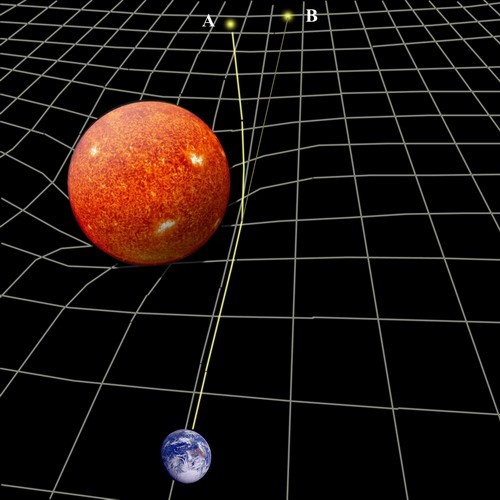
In his General Theory of Relativity, Einstein showed that matter causes space to curve, as in this illustration of starlight being bent by the sun's gravity.

But Einstein did not stop there. As early as 1911, he had predicted that light passing near a large mass, such as a star, would be bent. That idea led to his General Theory of Relativity in 1916. This paper established the modern theory of gravitation and gave us the notion of curved space. Einstein showed, for example, that small masses such as planets form dimples in space-time that hardly affect the path of starlight. But big masses such as stars produce measurably curved space.

The fact that the curved space around our sun was measurable let other scientists prove Einstein’s theory. In 1919, two expeditions organized by Arthur Eddington photographed stars near the sun made visible during a solar eclipse. The displacement of these stars with respect to their true positions on the celestial sphere showed that the sun’s gravity does cause space to curve so that starlight traveling near the sun is bent from its original path. This observation confirmed Einstein’s theory, and made Einstein a household name.

Interestingly, Einstein’s theories contained elements he himself could not accept. In some ways, he was loathe to break too much from the Newtonian/Maxwellian theories upon which his work was built.

He never accepted some of the precepts of quantum mechanics, for example, such as the idea ofindeterminacy. By the late 1920s, quantum mechanics had moved to the forefront of modern physics, yet Einstein never fully accepted many of the new theories. He declared:God does not play dice.

Also, Einstein’s 1916 theory suggested that the universe should be either expanding or contracting. Einstein could not accept that notion, and so in 1917 he introduced a cosmological constant into his theory, which would allow the universe to be stationary. In 1929, however, Edwin Hubble obtained observational evidence that the universe is indeed expanding. Einstein was forced to revise his theory. He called introducing the cosmological constant his greatest blunder.

This part of the Einstein legend illustrates, perhaps, a reason for his global popularity. The great genius could envision mechanisms of the universe in a way many of us have trouble even grasping. His imagination gave him answers to questions most of us would not think to ask.

Yet he remained prone to biases and frailties and thereby thoroughly human … just like the rest of us.

Bottom line: Albert Einstein was born on March 14, 1879. He published his Special Theory of Relativity in 1905 and his General Theory of Relativity in 1916. His work capped off the work of several previous centuries of science … and launched modern physics.

SOURCE:::::www.earthsky.org

Natarajan

Mother Child Photo Shots For Mothers’ Day….

From lions and tigers, to penguins and giraffes, every baby needs its mother.

And to celebrate the run-up to Mother’s Day on Sunday, an animal photographer has revealed his favourite moments of mum-child bonding in the wild.

With two decades of leading trips to exotic places, photographer and guide Paul Goldstein has been lucky enough to witness some gorgeous moments of bonding between mothers and youngsters.

A walrus mother and calf enjoying the sunshine in Spitsbergen, Norway

A walrus mother and calf enjoying the sunshine in Spitsbergen, Norway

A cub enjoys himself as his lion mother licks him clean in Kenya

A cub enjoys himself as his lion mother licks him clean in Kenya

A calf holds on to its mother's tail as the elephants take a stroll around Masai Mara in Kenya

A calf holds on to its mother’s tail as the elephants take a stroll around Masai Mara in Kenya

He has chosen some of his favourite photographs from journeys to places as far afield as the Masai Mara and Spitsbergen in northern Norway.

Highlights include a newborn giraffe walking within 15 minutes of birth, a polar bear mother and cubs sitting on sea ice, and a comical image of an Emperor penguin chick seemingly waving its arms at its mother.

A campaigner for animal rights, Mr Goldstein fund-raises for tigers and other persecuted species as well as writing.

He also owns four safari camps in Kenya and is a tour operator who guides all over the world, Paul feels very strongly that photographs should never be manipulated by photographers.

‘Ethics are a big deal in all facets of photography,’ he said.

‘I like to see what someone has taken not what they have manufactured, show me a bold flawed photograph than a safe record shot any day.’

He has chosen some of his favourite photographs from journeys to places as far afield as the Masai Mara and Spitsbergen in northern Norway.

Highlights include a newborn giraffe walking within 15 minutes of birth, a polar bear mother and cubs sitting on sea ice, and a comical image of an Emperor penguin chick seemingly waving its arms at its mother.

A campaigner for animal rights, Mr Goldstein fund-raises for tigers and other persecuted species as well as writing.

He also owns four safari camps in Kenya and is a tour operator who guides all over the world, Paul feels very strongly that photographs should never be manipulated by photographers.

‘Ethics are a big deal in all facets of photography,’ he said.

‘I like to see what someone has taken not what they have manufactured, show me a bold flawed photograph than a safe record shot any day.’

This little penguin, pictured above, flaps his arms wide to get his mother's attention
This little penguin, pictured above, flaps his arms wide to get his mother’s attention

A leopard mum shows her teenage cub who is boss in Masai Mara, Kenya

Mr Goldstein’s photo captures a newborn giraffe taking its first steps 15 minutes after it was born

An Adelie penguin with a 10 minute old chick, Paulet Island, Antarctica, Eastern Peninsular

An Adelie penguin with a 10 minute old chick, Paulet Island, Antarctica, Eastern Peninsular

A Cheetah cub tried to get its mother's attention, pictured in Masai Mara, Kenya

A Cheetah cub tried to get its mother’s attention, pictured in Masai Mara, Kenya

A polar bear mum leads her cubs through the icy sea in Spitsbergen, Norway

 A black backed jackal pups plays with his mother, above, pictured in Masai Mara, Kenya

A black backed jackal pups plays with his mother, above, pictured in Masai Mara, Kenya

A lioness carries her five-week-old cub gently in her jaws, in Masai Mara, Kenya

A lioness carries her five-week-old cub gently in her jaws, in Masai Mara, Kenya

A Polar bear and her cubs, above, sunabathe on an iceberg in Spitsbergen, Norway

A Polar bear and her cubs, above, sunabathe on an iceberg in Spitsbergen, Norway

A five-week old lion cub play fights with its mother in Masai Mara, Kenya

A five-week old lion cub play fights with its mother in Masai Mara, Kenya
Three elephants, including a mother, her baby and young elephant in Masai Mara, Kenya

SOURCE:::::::   http://www.dailymail.com.uk

Natarajan

Riddles For the Weekend….

Riddle Time: 12 Challenging Brainteasers

Get ready to put on your thinking cap. It’s time to rack your brain with these 12 riddles. 
1. I am only useful when I’m full, yet I am always full of holes. What am I?


A sieve (used for straining food like pasta).

2. Fill in the blanks with four, four-letter words that all share the same first three letters.

Samuel the secretive Scotsman was dressed to ____ in his twill woven ____. Little did they know he had a ____ of marijuana stashed away as he innocently warmed his hands by the Scotch ____.


Kill, kilt, kilo, kiln

3. What is special about the number 854,917,632?


It is the numbers from one to nine in alphabetical order.

4. It stalks the countryside, with ears that cannot hear. What is it?


Corn

5. A word with horizontal symmetry is one whose letters are a mirror image of themselves. If you drew a horizontal line across the word and folded it over, it would overlap on itself. Examples: EXCEEDED and ICEBOX. What is the longest word with horizontal symmetry?


CHECKBOOK

6. I travel a lot and meet both the rich and the poor, but nobody knows where I am going next. I’m invisible but you can see what I do. Who or what am I?


The wind.

7. King Ferdinand has no immediate living relatives and decides to hold a contest to find a worthy successor for when he dies. He gives a seed to every contestant and explains that the person with the healthiest and most beautiful plant will win the throne.

When the final day of the contest arrives, the king finds hundreds of plants of all shapes and sizes. However, he ignores them and awards the throne to a girl holding a pot with only moist dirt. Why did she win?


King Ferdinand was a kind and trusting man and wanted to be sure he found an honest heir. He gave small pebbles to all the contestants, claiming they were seeds. Therefore, any contestant with a plant had switched their “seed” in order to win. Everyone but the girl had been dishonest.

8. What can go up a drainpipe down but not down a drainpipe up?


An umbrella.

9. What word could be added to all of these words?

  • apple
  • cone
  • lake
  • tree
  • ridge
  • nuts


Pine.

10. What goes up and down but doesn’t move?


A staircase.

11. Brandon was walking around at the carnival. A man called out from a booth and said, “If I can write your exact weight on this piece of paper, you have to pay me $50. If I can’t do it, I’ll pay you $50.”

Brandon checked the booth for a scale but saw nothing. He agreed. Since your weight can fluctuate by a pound or two, he decided that no matter what number the man wrote, he would just say he weighed a pound more or less. In the end, the man in the booth won the $50. How did he do it?


The man in the booth wrote the words, “Your exact weight” on the piece of paper.

 
12. You can have it, and be at it, but it never lasts forever. What is it?


Peace

H/T: riddlesbrainteasers.com

SOURCE:::: http://www.ba-bamail.com

Natarajan

Image of the Day… ” Return of Expedition 42 to Earth ” …

The Soyuz TMA-14M spacecraft is seen as it lands with International Space Station Expedition 42 commander Barry Wilmore of NASA, Alexander Samokutyaev of the Russian Federal Space Agency (Roscosmos) and Elena Serova of Roscosmos near the town of Zhezkazgan, Kazakhstan. The landing took place on the evening of Wednesday, March 11 in the U.S, and early in the morning on Thursday, March 12, in Kazakhstan.

The three crew members returned to Earth after a 167-day mission on the orbital outpost that included hundreds of scientific experiments and several spacewalks to prepare the orbiting laboratory for future arrivals by U.S. commercial crew spacecraft.

SOURCE:::: http://www.nasa.gov

Natarajan