The Vilayil Veedu family is the only family entrusted to make the ‘Onavillu’ that is offered to the deity at Sri Padmanabhaswamy Temple.
For the Vilayil Veedu family at Karamana it is a busy time of the year. The family of traditional craftsmen is the only family entrusted to make the ‘Onavillu’, a ceremonial bow that is offered to the deity at Sri Padmanabhaswamy Temple here as part of the annual rituals during the Onam festival season.
Their house wears a festive look, as all the five male members of the family, including a 12-year-old, immerse themselves in the task of crafting these colourful bows.
“In these bows, we paint all the avatars of Vishnu. 12 of them are offered in the temple as a part of the ritual. Nowadays, even more, numbers are being offered at the temple. They consider it holy and keep it in their pooja rooms as well,” Binukumar, one of the craftsmen from the family, told TNM.
The bow is a broad piece of wood, tapering on both sides, on which miniature paintings of the Ananthasayanam, Dasavatharam, Sreerama Pattabhishekam and the Sreekrishnaleela are portrayed.
Earlier the ‘villus’ were 3.5-4.5 feet long and 4-6 inches wide. But, now the family have introduced 1.5 feet long small bows that can be used by everyone.
The making of the Onavillu is an age-old tradition that has continued over the years from the 16th century. The family members observe a 41-day penance prior to the commencement of the work.
“We have to be pure while we make this. We are vegetarians and follow certain other norms while making it. There are certain mantras to be chanted while carving and drawing each Onavillu,” he added.
Earlier the making would take place only during the Onam season but now with people buying for their home, the craftsmen work throughout the year.
The red tassels used to adorn the ‘villu’, which is known as ‘Kunjalam’, are made by the convicts of the Central Jail at Poojappura here.
Last week the jail authorities handed over this year’s required ‘Kunjalam’ to the Vilayil family.
“Kunjalam making was started decades ago by the jail inmates. There is a weaving unit in the jail. The Kunjalam was prepared under the guidance of the instructor. We make it as per the order given by the temple,” S Santhosh, Poojappura jail superintendent told TNM.
He also says that even the prisoners observe penance before and while weaving the Kunjalam.
“They don’t take any non-vegetarian food, make themselves clean before starting the work and also do certain prayers,” he added.
Binukumar said that at prison these ‘Kunjalams’ are made by the inmates irrespective of caste or religion. “People belonging to all religion are involved in the making of Kunjalam. Surprisingly they all observe the penance so that the Onavillu’s holiness is not lost,” he added.
The ‘villus’ are first offered to the family deity at the Valiya Veedu for three days. They are then taken to Sri Padmanabhaswamy Temple on Thiru Onam day and displayed at the Natakasala before being offered to the deity.
Edited by Kannaki Deika
Source….Haritha John in http://www.thenewsminute.com
Photos : Sreekesh Raveendran Nair
Today I found out about a man who fairly accurately estimated the circumference of the Earth well over 2,000 years ago: Eratosthenes of Cyrene.
Born around 276 B.C. in Cyrene, Libya, Eratosthenes soon became one of the most famous mathematicians of his time. He is best known for making the first recorded measurement of the Earth’s circumference, which was also remarkably accurate. (And, yes, people at that point had known for some time that the world wasn’t flat, contrary to popular belief.)
Eratosthenes was able to accomplish this in part because of his education in Athens. There, he became known for his achievements in many different fields, including poetry, astronomy, and scientific writing. His activities became so talked about, in fact, that Ptolemy III of Egypt decided to invite him to Alexandria to tutor his son. Later, he would become the head librarian of the Library of Alexandria.
The mathematician must have been thrilled to have this opportunity. The Library of Alexandria was a hub of learning at the time, attracting scholars from across the known world. Eratosthenes was able to rub shoulders with the likes of Archimedes while continuing his own learning.
It was probably in the Library of Alexandria that he read about a curious event that took place in Syene (now Aswan, Egypt) at the summer solstice. Syene sat to the south of Alexandria. At high noon, the sun would shine directly overhead and there would be no shadows stemming from the columns. However, Eratosthenes realized that at the same moment in Alexandria, columns clearly did have shadows. Being a good mathematician, he decided to use this knowledge to do a few calculations to figure out the circumference of the Earth.
To do this, Eratosthenes measured the shadow of an obelisk on June 21 at noon. He discovered that the sun was about 7°14’ from being directly overhead. He realized that, because the Earth is curved, the greater the curve, the longer the shadows would be.
Based on his observations, he hypothesized that Syene must lie 7°14’ along a curve from Alexandria. Furthermore, he knew that a circle contained 360°, which meant that his calculation—7°14’—was roughly one fiftieth of a circle. Therefore, Eratosthenes thought, if he multiplied the distance between Syene and Alexandria by 50, he would have the circumference of the Earth.
The missing information was simply how far away Syene was from Alexandria. He measured the distance in stadia. There isn’t an exact modern day conversion to stadia, and it isn’t perfectly clear which version of the stadia Eratosthenes was using, but regardless, from what is known, his estimation was remarkably accurate.
There are two theories as to how Eratosthenes figured out the distance: first, that he hired a man to walk there and count the steps. Second, that he heard a camel could travel 100 stadia a day, and it took a camel about 50 days to travel to Syene. Whatever the case, he estimated the distance between Syene and Alexandria was 5,000 stadia. If that was the case, then using his formula, the earth was 250,000 stadiaaround.
Due to the uncertain distance that stadia represents (and particularly which stadia he was using), historians believe that Eratosthenes’ conclusion was between .5% and 17% off the mark. Even if the latter case was true, it was astoundingly accurate given the limited technology he was dealing with at the time. But many scholars think it likely that he was using the Egyptian stadia (157.5 m), being in Egypt at the time. This would make his estimate only about 1% too small.
There had been previous attempts at discovering the Earth’s circumference (which don’t count as “first recorded” because their methods didn’t survive, though we have references to them) which resulted in a 400,000 stadia figure, 150,000 more than Eratosthenes’—obviously far from accurate.
While finding the approximate circumference of the Earth was probably Eratosthenes’ largest contribution to scholarship at the time, it was by no means the only one. Eratosthenes is also credited with coming up with a way to map out the known world by drawing lines north-south and east-west—early latitude and longitude lines. However, these lines were irregular and often drawn through known places, meaning they weren’t entirely accurate. Nevertheless, it provided a precursor for maps we know today.
He is also remembered for the Sieve of Eratosthenes, a simple algorithm that makes it easy to find all prime numbers up to a certain limit. Though none of Eratosthenes’ personal work on the sieve survives, he was credited with the creation of the algorithm by Nicomedes in his Introduction to Arithmetic.
Not only that, but Eratosthenes estimated the distance to both the sun and the moon, and measured the tilt of the Earth’s axis all with amazing accuracy.
He also wrote the poem Hermes, correctly sketched the route of the Nile, and even gave a more-or-less accurate account of why the Nile flooded, something that had baffled scholars for centuries. He worked on a calendar that included leap years and he also estimated and corrected the dates of various historical events beginning with the Siege of Troy.
Despite these accomplishments and many more like them, Eratosthenes was often nicknamed “Beta.” Beta is the second letter in the Greek alphabet and referred to Eratosthenes being second-best in everything he did.
Eratosthenes died around 194 B.C. and is thought to have starved himself to death. It is believed that he started going blind in his later years and, unable to continue his work, he simply stopped eating.
Bonus Fact:
Source…www.todayifoundout.com
Natarajan
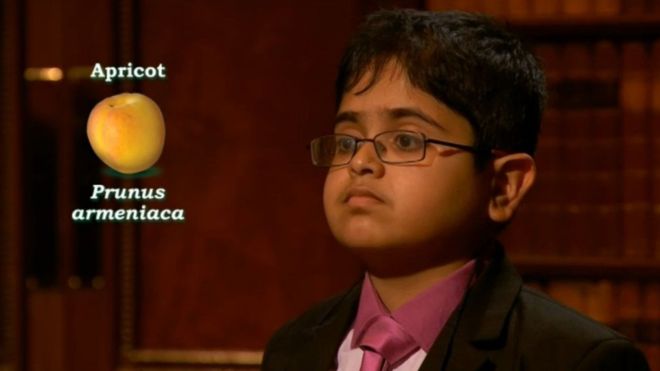
Do you know the scientific name for apricot?
We didn’t think so.
But a 12-year-old boy Rahul from Barnet in North London does. A contestant on the latest series of Child Genius, the Indian-origin boy became an overnight sensation after correctly answering every question he was asked on the show, including the scientific name for apricot.
The British reality competition series has children aged 8 to 12 battling against one another in intelligence tests.
He has an IQ of 162, which qualifies him to become a member of Mensa, the largest and oldest high IQ society in the world, reports BBC.
He received full marks in a spelling test, and scored higher than any contestant in a timed memory round. Competing for the ‘Child Genius’ title, Rahul already thinks he’s a genius. “I always want to do the best, and I’ll do that no matter what the cost. I think I’m a genius. I’m good at mental maths, general knowledge and I find it quite easy to memorise stuff,” he told BBC.
Social media was flooded with appreciation from the viewers of the show, with one of them calling Rahul his “new favourite person.”
Rahul’s father, IT manager Minesh, says he’s no less than Einstein. “As a comparison Rahul is as clever as Albert Einstein or Stephen Hawking,” he said.
The finale of the show will be held over the weekend where they will crown UK’s ‘child genius’.
Source….Deepika Bharadwaj in http://www.the betterindia,com
Natarajan
Currently based in Mumbai, the young aviator had always dreamed of becoming a pilot and did so at the age of 19
“Since my childhood, I wanted to be a pilot. Other children used to make fun of me for this. Kids, at that time, were pushed to pursue engineering or become a doctor but not a pilot,” Anny told to HT.
Coming from an army background, one would think Anny must have had it easy. While she had rock-solid support from her parents, dissent often cropped up in form of family friends and relatives.
“Luckily, my parents never forced their choice on me. They were supportive and progressive in their thinking. My mother always used to encourage me. However, my relatives and my family friends were against my decision to become a pilot. Also, at that time, being a pilot was not considered as a profession for woman,” she said.
After her father took voluntary retirement, the family moved to Vijayawada, where Anny did her schooling. Hailing from a modest background, their family had their share of financial shortcomings. “Since I grew up in Vijayawada, I could write and read English but speaking English was a major challenge that I had to overcome,” Anny said.
Post her school education, the 17-year-old Anny made it to Indira Gandhi Rashtriya Uran Akademi (IGRUA), one of the premier flying schools in the country.
The cultural change from a small town to a big city was overwhelming for me. I had difficulty adjusting and speaking English. People used to mock me for my poor English and that hurt me a lot. At times, I had even thought of going back. However, backed with my parents’ support, I worked hard enough to win a scholarship,” she added.
Completing her training by the time she was 19, Anny bagged a job with Air India and since then, there has been no looking back. Post her training, she kickstarted her flying carrier with Boeing 737.
“When I turned 21, I was sent to London for further training. It was then when I started to fly Boeing 777. Since then, my life has changed. It’s been a great experience so far. I’ve got the opportunity to travel to various countries. My journey so far has taught me a lot,” Anny added.
When the going gets tough, the tough get going!
Source….LekshmiPriya .S in http://www.betterindia.com
Natarajan