Chart: How We See Our Parents From Cradle to Middle Age…!!!

My parents play an important role in my life. I can hardly imagine anyone that would be closer and more important to me than them. Despite this, I often used to take their love and care for granted – until I reached my 30s. When I started to experience what it means to be a parent myself, I came to realize that they are the most precious people in my life. I often wish that I had realized it sooner. I came across this chart, which I believe sums up how many of us see our parents at various ages. Take a look:

Source….www.ba-bamail.com

natarajan

“I’d Given up on Returning to India After 18 Years Abroad. But This Year Something Changed.”

From dreaming about returning to India one day after she had to shift to the US with her family, to reaching a stage where she could no longer find that cherished connection with her country, to falling in love with it all over again – this is the story of Jessica Sinha and how Kolkata showed her a different India.

I was 10 when I moved to the U.S. and have lived abroad for over 18 years now. Leaving was the most difficult thing for me to do every time I visited India in the first eight years of moving to the U.S. I would bite my lip hoping the pain would hold back the tears. My last memory of India would be of the last song that played on the radio before we arrived at Indira Gandhi International Airport. Each year I vowed – I’ll be back someday, I’ll live here eventually. With no plans of when, where, and how, I continued to dream about it.

But after those first eight years, it never felt the same again. My relatives grew distant. Their excitement on seeing us dwindled every year. I found myself struggling with the basic things – showering, going to the bathroom, shopping, getting to places on my own, taking the bus, etc. Even my Indian looks and perfect Hindi couldn’t help hide the fact that I had no clue about anything in India. I was just a guest to my relatives now – a guest who visited once a year.

I grew up and started feeling unsafe in my country, cringing every time I read another news article about another rape case. Every trip from then on was the same. We would arrive in Delhi, go home, stay home. Then we would take the car and driver, visit relatives and family friends, and come back home again. We went to the mall once in a while, but the charm of India that I was delighted about once…it remained only in my heart. Everything and everyone I connected with, seemed to have almost never existed and my dream of moving to India started fading, right in front of my eyes.

This month I went back to India, Kolkata this time, with my Bengali husband for our first India trip after marriage. And something changed in the 14 days I spent there. A fire that I thought was long put out, sparked again. I saw a different country:

kolkata3

Mornings here begin with the sweet cooing of the Koyal. This city wakes up later than many others, but by 7-8 am, I can hear elderly neighbours chattering, gargling, or fighting a cough. The kitchen stoves come alive and the scraping of metal palta against the kadais marks the beginning of a new day. The smell of mouth-watering spices slowly fills the corridors of the building and escapes into the alleys.

Someone blows a long note on the conch shell over the sound of bells and muffles of Bengali prayers.

kolkata1

I walk up to the roof and get a glimpse of the sun. The buildings, painted yellow or light blue or pink sometimes, bear brown-black streaks from past rains. Some rooftops have bent clotheslines holding long saris that flow in the cool morning breeze. Somehow, the unfolded sari speaks to me. It floats freely like a kite, but is held safely by the clothesline.

With the distant sound of koyals, I sweep into a daydream where every single day in India feels as this moment does.

kolkata2

Back inside the flat, my mother-in-law brings out tea for the three of us, herself, my husband, and I; and we all decide to sit in the balcony. The balconies, windows, doors, any openings into the flat, are all protected by grills. There is something about the grills that’s uniquely classic and nostalgic. I think back to my childhood in Delhi – every night the community watchman would walk around the block, blowing his whistle loud and clear as he ran his baton across the park fence.

I look out into the streets and though it is mostly empty at this time, I know that the morning has already begun in many homes. Every balcony is a window into a different life. I look across to the building on the right and find an elderly man sitting in his balcony with a cup of chai and his parrot. In another window there’s a woman pulling down the dry clothes from the clothesline, hung the day before.

A sip of my tea. I wonder if my mother-in-law sees what I see. On days when she’s feeling hot, tired, and wants to take a break, does she look out like I do? Does she see the different lives as I do? And in those quiet tranquil moments when she does, does the world outside beckon to her? Does she see the ever turning wheels of time in Kolkata? Does she savour the endless festivities of every day? Even if a dispirited heart was to look out this balcony, it would find peace in knowing that it is not alone.

I’m not sure how the rest of India has fared since 1997, but Kolkata seems to be stalled in a time and place, which I dreamed about in my thoughts. It remains culturally rich and enticing. There is no confused blend of the western influences and eastern culture. I heard no heart-wrenching stories, saw no soul-searching individuals. I saw no street corners engulfed in conversations of unfulfilled ambitions. I saw hope in a newly-wed couple’s humble home, gratification in the everyday affairs, modesty of character, and a satisfaction with life as it is.

– Jessica Sinha

Source…..www.the betterindia.com

Natarajan

படித்து ரசித்தது …”ஓட்டை கம்பளி …”!!!

ஒரு கட்டுரையில், கி.வா.ஜ., எழுதியது:

கவிதை, சங்கீதம் மற்றும் நாடகம் போன்ற கலைகள் எதுவானாலும், ரசிகர்கள் இருந்தால் தான், கலைஞர்கள் மகிழ்ந்து, மேலும் தம் திறமையை காட்டுவர். கலைஞர் உள்ளம் வெறும் பணத்துக்கோ, கொடைக்கோ மகிழாது.
மாடு தன் காதை மட்டும் ஆட்டுவதைப் போன்று ஆட்டுவது, கோகர்ண வித்தை; யானை தன் காது நுனியை மட்டும் ஆட்டும்; அதைப் போன்று செய்வது கஜகர்ண வித்தை. ஒரு வித்தையாடி, இந்த வித்தைகளை எல்லாம் செய்வதுடன், மாடு மாதிரி குரல் எழுப்புவான்; யானை மாதிரி பிளிறுவான். பலவகை விலங்குகளைப் போல நடிப்பான்.
ஒருநாள், ஓர் வித்தைகாட்டி, அரசன் ஒருவனின் சபைக்கு வந்து, தன் வித்தைகளை காட்டத் துவங்கினான்; எல்லாரும் பார்த்து மகிழ்ந்தனர். ஒவ்வொரு வித்தை முடிந்தவுடன், அதற்கேற்ப பரிசை அளித்து வந்தான் அரசன். இந்நிலையில், பார்வையாளர் கூட்டத்தில், பசு மேய்க்கும் இடையன் ஒருவன், கோலை ஊன்றி, ஓட்டை கம்பளியை தலைமேல் போட்டு, வித்தைகளை கவனித்தவாறு இருந்தான்.
பசுமாடு மாதிரி நடிக்க துவங்கினான் கலைஞன். வால் போன்ற ஒன்றை, பின்னால் செருகி, அதை ஆட்டினான்; காதை தனியே ஆட்டினான். வேடிக்கை பார்த்த இடையன், வித்தைக்காரன் அருகில் வந்து என்னவோ செய்தான். அடுத்த நிமிடம், தான் போர்த்தியிருந்த ஓட்டை கம்பளியை, அவன் மேல் போட்டு விட்டுப் போய் விட்டான்.
வித்தைகள் எல்லாம் முடிந்தன. வித்தைக்காரன் முதலில் அந்தக் கம்பளியை எடுத்து மடித்து, கண்ணில் ஒற்றி, பெட்டிக்குள் வைத்தான். அதை பார்த்த அரசனுக்கு கோபம் வந்து, ‘என்னை நீ அவமதித்து விட்டாய்…. இடையன் போட்ட கம்பளிக்கு கொடுத்த மரியாதையை, நான் வழங்கிய பரிசுகளுக்கு கொடுக்கவில்லையே… அந்த ஓட்டை கம்பளி உனக்கு பெரிதாக போய் விட்டதா…’ என்று கேட்டான்.
‘அரசே… அந்த கம்பளி கொடுத்தவர், எதை பார்த்து ரசித்தார், தெரியுமா?’ என்றான் வித்தைக்காரன்.
‘நீ மாடு மாதிரி நடந்ததையும், காதை ஆட்டினதையும் பார்த்திருப்பான்; அவனுக்கு மாடு தானே தெரியும்…’ என்றான் அரசன்.
வித்தைக்காரன் நிதானமாக, ‘அரசே… அவர் என் நடிப்பில் ஒரு நுட்பத்தை கண்டு மகிழ்ந்தார். நான் மாடாக நடித்த போது, ஒரு சிறு பருக்கை கல்லை எடுத்து, என் மேல் போட்டார். அந்த இடத்தை மட்டும், நான் சுழித்துக் காட்டினேன். அதன் அருமையை உணர்ந்து, அந்த கம்பளியை அளித்தார். ஓட்டம் அறிந்து வழங்கியதால், அதை பெரிதாக கருதுகிறேன்…’ என்றான்.

Source….www.dinamalar.com

Natarajan

படித்து நெகிழ்ந்தது …” மே /பா காமராஜர் தலைவர் சத்திய மூர்த்தி பவன் “

எட்டயாபுரம், பா.நா.கணபதி எழுதிய, ‘நினைவுகள்’ நூலிலிருந்து:

ஒரு முதிய காங்கிரஸ் தியாகி, சென்னை அரசு மருத்துவமனையில் சிகிச்சைக்காக சேரும்போது, தன் பெயருடன், மே/பா. காமராஜர், தலைவர், சத்தியமூர்த்திபவன், சென்னை என, பதிவேட்டில் எழுதி கொள்ளும்படி கூறினார்.
ஒருநாள், அம்முதியவர் திடீரென்று இறந்து விட்டார். அவர் தந்த முகவரிப்படி காமராஜருக்கு தகவல் தரப்பட்டது. அதைக் கேட்டு அதிர்ந்து போனார் காமராஜர். ஏன் என்றால், இறந்தவர் யார் என்றே அவருக்கு தெரியாது.
‘இறந்தவர் காங்கிரஸ் தியாகி; என் முகவரியை தந்திருக்கிறார். அவருக்கு என்னிடம் அவ்வளவு நம்பிக்கை! தியாகியின் இறுதி சடங்கை நல்ல முறையில் செய்ய வேண்டும்…’ என்ற கடமையுணர்வு அவரது உள்ளத்தில் மேலிட்டது.
மருத்துவமனை சென்று, இறந்தவரின் உடலை பெற்று, நல்லடக்கம் செய்யும்படி, செயலர் வி.எஸ். வெங்கட்ராமனிடம் தெரிவித்தார். அன்று, தன் வழக்கமான நிகழ்ச்சிகளை ரத்து செய்தவர், செயலற்றவராக, ஈஸி சேரில் சாய்ந்து விட்டார்.
சடலம், மூலகொத்தளம் சென்றடைந்து, எரியூட்டும் சமயம் அங்கு சென்ற காமராஜர், ‘இந்த தியாகி யாரோ… வீடு, வாசல், மனைவி, மக்கள் எல்லாவற்றையும் துறந்து, காங்கிரசில் சேர்ந்து பல அவஸ்தைகள் பட்டும் கூட, அக்கட்சியிடம் நம்பிக்கை இழக்காத இவர், மரணம் அடையும் முன், காங்., அலுவலக விலாசமே தந்துள்ளார். இவருக்கு நாம் எல்லாருமே கொள்ளி போடுவோம்…’ என்று, நா தழுதழுக்க கூறிய வார்த்தைகள், அனைவரையும் கண்ணீர் விட செய்தன.
ஒரு எளிய தியாகிக்காக, தியாக சீலரான காமராஜர் சிந்திய கண்ணீர், தூய்மையான அன்பின் வெளிப்பாடாக விளங்கியது.

Source….www.dinamalar.com

Natarajan


படித்து ரசித்தது …”ஆசிரியர் , மாணவர் …ஒரு உதாரணம் …”!

‘பெரியோர்கள் வாழ்விலே’ நூலிலிருந்து: கல்வி வள்ளல் அழகப்ப செட்டியார், ஒருமுறை கேரளாவுக்கு செல்லும் போது, வழியில், கோவையில், சர்.ஆர்.கே. சண்முகம் செட்டியார் இல்லத்தில் தங்கினார். அப்போது, தன் தமிழ் ஆசிரியரான பலராம ஐயர், அவ்வூரில் வாழ்ந்து வரும் தகவலை அறிந்தார்.
உடனே, ஆசிரியரை சந்திக்க விரும்பி, கைப்பட கடிதம் எழுதி, தன் ஊழியரிடம் கொடுத்து, அவரை அழைத்து வரச் சொல்லி, தன் காரை அவர் இல்லத்திற்கு அனுப்பி வைத்தார்.
கடிதத்தை வாங்கி படித்த ஆசிரியர், உடனே பதில் கடிதம் தந்தார். அதில், தன் மாணவன் இன்று நல்ல நிலையில் இருப்பதற்கு தன் மகிழ்ச்சியையும், வாழ்த்தையும் தெரிவித்து, மூன்று காரணங்களால், அவரை சந்திக்க வருவது, சாத்தியமில்லை என்று குறிப்பிட்டிருந்தார். அது, ‘முதலாவதாக, நான் வயோதிகன்; நீ இளைஞன். இரண்டாவதாக, நான் ஆசிரியன்; நீ மாணவன். மூன்றாவதாக, நான் வறியவன்; நீ செல்வந்தன். எனவே, நான் வந்து உன்னை பார்ப்பது பெருமையல்ல…’ என்ற, பொருள்பட ஆசிரியரின் கடிதம் இருந்தது.
அதைப் பார்த்ததும், பதறி, ஆசிரியரை பார்க்க, தானே அவர் இல்லத்திற்கு புறப்பட்டார் அழகப்ப செட்டியார்.
பூ மற்றும் பழங்கள் வாங்கி சென்ற அழகப்பர், கையில் தயாராக வைத்திருந்த மாலையை ஆசிரியருக்கு அணிவித்து வணங்கி, ‘இங்கிதம் அறியாமல், தங்களை அழைத்து வருமாறு கூறி விட்டேன்…’ என்று வருத்தம் தெரிவித்தார். ஆசிரியரும் மனம் நெகிழ்ந்து, தன் மாணவரோடு மனம் விட்டு அளவளாவினார்.
அழகப்பர் விடை பெறும்போது, ஒரு வெள்ளி தட்டில், 100 ரூபாய் கட்டுகளை வைத்து, அதை ஏற்று கொள்ளுமாறு ஆசிரியர் முன் சமர்ப்பித்தார்.
ஆசிரியரோ, புன்சிரிப்பை உதிர்த்து, ‘உன் அன்புக்கு மிக்க மகிழ்ச்சி; ஆனால், இந்த பணத்தால், பலனடையும் வயதை தாண்டி விட்டேன். எனவே, என்னை வற்புறுத்தாமல் நீயே இதை எடுத்துக் கொள்…’ என்றார்.
ஆசிரியருக்கு அவரும், மாணவருக்கு இவரும் உதாரணம்!

Source…….www.dinamalar.com

Natarajan

Joke of the Day… ” What did you teach ? ” !!!!

I was sitting in the waiting room for my first appointment with a new dentist. I noticed his DDS diploma on the wall, which bore his full name.


Suddenly, I remembered a tall, handsome, dark-haired boy with the same name had been in my high school class, some 30-odd years ago.

Could he be the same guy that I had a secret crush on way back then? Upon seeing him, however, I quickly discarded any such thought. This balding, gray-haired man was way too old to have been my classmate.

After he examined my teeth, I asked him if he had attended Northmont high school.

“Yes. Yes, I did. I’m a thunderbolt,” he said gleaming with pride.

“When did you graduate?” I asked.

He answered, “in 1975. Why do you ask?”

“You were in my class!”, I exclaimed.

He looked at me closely, then, the ugly, old, bald, wrinkle-faced, fat, gray-haired, decrepit fool asked, “What did you teach?”!!!!


Source…….www.ba-bamail.com

Natarajan

Origins of currencies: from jagged edges to flowers……

A fistful of dollars

The dollar is one of the most common currencies in the world used by the US, Australia, Canada, Fiji, New Zealand, and Singapore to name a few. The origin of the dollar, also the Slovenian tolar, is from a coin called the Joachimsthaler, shortened to Thaler (or daler in early Flemish or Low German), named after the valley in which the silver it was made from was mined, the Joachimsthal, literally ‘Joachim’s valley’. The term began to be used in other languages, especially Dutch, and was later applied to the most widely used coin in the American colonies. In 1792, it was adopted as the name of the US monetary unit.

All that glitters is not gold

Many countries use the dinar, which comes from the Latin denarius, an ancient Roman silver coin: Jordanian dinar, Algerian dinar, Serbian dinar, and Kuwaiti dinar among others. The Indian and Pakistani rupee derives from the Sanskrit rupya meaning ‘wrought silver’,which is also the origin of the Indonesian rupiah.

The South African rand is named after the Witwatersrand, the area  around Johannesburg known for its gold deposits, while Poland uses the zloty which means ‘golden’ in Polish. The Hungarian forint comes from the Italian fiorino, originally the name of a gold coin from Florence, Italy with a flower (Italian fiore) stamped on it. The British coin the florin (used until 1971) has the same origin.

Serrated edges on coins became popular when coins were made of precious metals like gold and silver because the ridges made it harder for people to scrape off metal and devalue the coins. The Malaysian ringgit is from the Malay for ‘jagged’ and refers to the serrated edges of the Spanish silver dollars used as currency in Malaysia before the ringgit was introduced.

Doing the rounds

Chinese yuan 元, Japanese yen 円, and Korean won 원, all originate from the Chinese character 圓 meaning ‘round’  or ‘round coin’. Although in English, we speak about the Hong Kong dollar or the New Taiwan dollar, in Chinese these are referred to as yuán 圓. Likewise, in Chinese, ‘dollar’ is translated as ‘yuan’, so the US dollar or měiyuán 美元 is literally ‘American yuan’ in Chinese.

Royal crown

Many Scandinavian countries use currency whose name is ultimately derived from the Latincorona meaning ‘crown’: Swedish krona, Norwegian krone, Danish krone, Icelandic krónaas well as the Estonian kroon (now replaced by the Euro) and the Czech koruna. The Spanish real, a former currency of Spain derived from the Latin regalis meaning ‘royal’ which is the origin of a number of Middle Eastern currencies such as the Omani and Iranianrial, and the Qatari, Saudi, and Yemeni riyal.

A weighty subject

Although the Germans and the Finns use the Euro now, their former currencies the Germanmark and the Finnish markka, both have their origin in units of weight. While the Spanishpeso meaning ‘weight’ in Spanish, is also no longer used in Spain, it lives on as the currency of Mexico, Argentina, the Philippines, Chile, Uruguay, the Dominican Republic, Cuba, and Colombia. The Russian ruble or рубль, also used in Belarus, was originally a measure of weight used for silver. The British pound (or pound sterling) comes from the Latin pondus ‘weight’ (sterling probably originally from Middle English meaning ‘little star’ because there was a star on early Norman coins). The Italian and Turkish lira also have their origins in units of weight from the Latin libra meaning ‘pound’.

Source…..www.blog.oxforddictionaries.com

Natarajan

That Time an Olympic Rower Stopped to Let Some Ducks Swim By and Still Won the Gold Medal…

Born in Sydney Australia in 1905, Henry Robert Pearce, better known as Bobby Pearce, dominated the world of competitive rowing throughout the 1920s and 1930s and was extremely popular with fans of the sport due to a combination of the ease with which he seemed to best opponents and his affable personality. Perhaps the greatest example of both of these things in action was the time Pearce stopped mid-race to allow a duck and her ducklings to pass in front of him and still won.

This particular anecdote from Pearce’s life occurred at the 1928 Summer Olympics in Amsterdam during the quarter final of the single sculls event in the Sloten canal. For anyone unfamiliar, the single sculls is essentially a race between individual opponents along a body of water and it has been a staple of the Olympic program since 1896.

Prior to taking part in the quarter final event at the 1928 Olympics, Pearce had already made quite a splash with locals by beating his previous two opponents by nearly 30 seconds each, winning his first event with such a comfortable lead that, according to a contemporary report from the Sydney Morning Herald, he pulled up before the finish line to wait for his opponent to catch up a little.

Pearce’s opponent on the fateful duck match quarter final was a Frenchman called Vincent Saurin, a powerful rower who during his career would win nine national titles and medal at three European championships. Despite his opponent’s pedigree, Pearce was able to effortlessly pull away and secure himself a near half-minute lead before the half way mark of the 2000 metre race.

In an interview with historian Henry Roxborough in 1976, Pearce recounted what happened next.

“I heard wild roars from the crowd along the bank of the canal. I could see some spectators vigorously pointing to something behind me, in my path. I peeked over one shoulder and saw something I didn’t like, for a family of ducks in single file was swimming slowly from shore to shore. It’s funny now, but it wasn’t at the time for I had to lean on my oars and wait for a clear course…”

“Had to lean on my oars…” isn’t quite accurate.  He could have simply plowed through them, but chose to pull up. While all this was happening, Saurin made up the lead Pearce had secured and, showing far less concern for the welfare of the ducks than Pearce had, capitalised on his opponents’ unlikely stint as a duck crossing guard and blew past him, stealing himself a five length lead before Pearce started rowing again.

Remarkably, in the final 1,000 metres of the race, not only did Pearce catch up to the Frenchman, but he was able to once again get far enough ahead to secure an almost 30 second lead by the finish line. In the end, Pearce finished the race with a time of 7:42.8 vs. Saurin’s 8:11.8.

This, in of itself would be impressive, but it should also be noted that not only was Pearce able to beat Saurin by nearly half a minute after coming to a complete stop in the middle of the race, but in that race he also finished with the fastest time of any of the eight competitors that round.

We should also probably mention that this was during the elimination portion of the competition meaning Pearce had risked his chance of winning an Olympic medal for his country in his first Olympics to let the ducks pass.

Unsurprisingly, Pearce ultimately won the gold medal for that event, beating out the previously undefeated American Kenneth Myers with a new world record for the 2,000 metre event with a time of 7:11.0. This record stood for an astounding 44 years, finally beaten in 1972 by Yuri Malishev of the Soviet Union.

As for the formerly undefeated Myers, his time in that face-off was a nearly equally remarkable 7:20.8, which would have been a new world record, beating the old by almost 15 seconds, if not for Pearce’s time.

(For reference, today the world record is currently held by Mahé Drysdale of New Zealand with a time of 6:33.35, which he set in Poland in 2009.  As for the Olympic record, it was recently set in 2012 in London by Tim Maeyens of Belgium with a time of 6:42.52 in the first heat. However, the gold medal in that Olympics went to Drysdale with a time of 6:57.82 seconds in the final.)

Despite his incredible talent, as Pearce was barred from competing for money if he wished to continue competing in the Olympics, he struggled to make ends meet for much of his early life, even being unemployed during the early 1930s, scraping a living by collecting scrap paper at the Sydney Showgrounds. His fortunes turned around, however, when he met Scottish whisky magnate Lord Dewar, who happily offered Pearce a job selling his whisky as his official Canadian representative, prompting Pearce to move to Canada, where he lived the rest of his life.

Despite the move, Pearce continued to compete for Australia in the 1932 Olympics, in which he defended his title, winning the gold by narrowly beating out American William Miller by a mere 1.1 seconds in the final.  While that was a close finish, it should be noted that the nearest competitors behind those two finished a whopping 30 seconds back.

Shortly after the 1932 Olympics concluded, Pearce decided to turn pro, barring him from future Olympics, but at least allowing him to earn some money at his greatest skill while his body was still up to it.

Pearce’s professional career was decidedly uneventful… by which we mean he won every event he took part in and none of his races involved ducks. He eventually retired undefeated as an adult in 1938. That same year, he even managed to win a title defense race in Toronto just a few days after his wife unexpectedly died. In fact, while we know he must have lost several matches before his first competitive victory at 14 years old, the only definitive record we could find of Pearce ever losing a sculling match was his first one when he was six years old, which was a 16 year old and under youth competition.  He finished second in that race.
After retiring from the sport, Pearce tried his hand at being a professional wrestler before joining the Canadian war effort during WW2 as part of the Naval reserves. He served in the navy until 1956, retiring as a lieutenant commander. He subsequently spent the rest of his life selling whisky on behalf of Lord Dewar in Canada, later dying of a heart attack at the age of 70 in 1976

Source………..www.today i foundout.com

Natarajan

This date in science: Yuri Gagarin’s birthday….9th March

He was a Russian Soviet pilot and the first human to travel to space, in 1961. Later, he became one of the world’s true heroes …


“Let’s go! (Poyekhali!)” Image via ESA.

March 9, 2016. Yuri Alekseyevitch Gagarin (1934 – 1968) would have been 82 today. He became the first human ever to travel into space on April 12, 1961, flying into orbit around Earth for 89.1 minutes in Russia’s Vostok 1 spacecraft. He circled the Earth once and flew as high as 200 miles (327 km). The entire mission, from launching to landing lasted 108 minutes.

Yuri was born on a small farm west of Moscow. His father was a bricklayer, a carpenter, and a farmer. His mother was a milkmaid. He was the third in a family of four children.

During the Second World War, the Gagarin family was broken apart as two of Yuri’s older sisters were taken into labor camps by the Nazis. The Gagarins were forced out of their house, and dug a hideout in the ground, where they stayed until the end of the war. After the war, the family moved to Gziatsk.

Gagarin was inspired to become a pilot while still a teenager. When a Russian Yak fighter plane was forced to land in a field near his home, the praise those pilots received left a mark on the young Gagarin. He wanted to be like them.

He studied to become a foundryman (a foundry is a factory that melts metals in special furnaces and pours the molten metal into molds for making products). He was singled out for his skillfulness to further his studies in the Saratov Technical School.

Vostok 1 via Wikimedia Commons.

Vostok 1 via Wikimedia Commons.

There, his dream to become a pilot took root, as during his 4th and last year at Saratov, he had the chance to join a local flying club. He learned to operate a plane, and flew by himself for the first time in 1955.

That same year, he also graduated from school, and was recruited by the Soviet Army.

At the advice of his flying mentor, he joined the Soviet Air Force, and went on studying at the Orenburg School of Aviation. There, he was taught to fly MIGs.

During his studies at Orenburg, he also met his future wife, Valentina Ivanova Goryacheva, who was a nursing student at the time.

In November, 1957, when Gagarin was 23, he graduated from Orenburg with honors and married Valentina. Later, the couple had two girls, Yelena, and Galina.

In 1959, after the Russians succeeded at photographing the far side of the moon for the first time with Luna 3, many – including Yuri – felt it was about time for the first man to be sent to space. He and a few other men were accepted for cosmonaut training in 1960 after a lot of selection.

The selected candidates underwent not only physical training, but also mental and psychological training.

Gagarin was known for his good humour, perseverance, and calm.

On April 12, 1961, the Russians amazed the world by launching Vostok 3KA-3 (Vostok 1) from the Baikonur Cosmodrome with Yuri Gagarin aboard. Vostok means East in Russian.

East for sunrise, and for the rise of the Space Age.

Hear a recording of Yuri Gagarin saying “poyekhali” (“let’s go”) before the launch.

Yuri  Gagarin in Warsaw in 1961.  Image via Wikimedia Commons.

Yuri Gagarin in Warsaw in 1961. Image via Wikimedia Commons.

Gagarin on a visit to Sweden, 1964.  Image via Wikimedia Commons.

Gagarin in Sweden in 1964. Image via Wikimedia Commons.

After coming back from space, Gagarin became an international celebrity. Khrushchev awarded him with the title of Hero of the Soviet Union.

His dream had come true.

Gagarin and his wife began touring the world, where Yuri was decorated for his legendary accomplishment. It’s rumored that Gagarin didn’t handle his fame very well, however.

In 1962, he was appointed as a deputy of the Soviet Union, and he was elected to the Central Committee of the Young Communist League. But Gagarin was not entirely happy. He felt he didn’t train to fly only once. He wanted to fly more, but – according to the stories about him – those around him tried to stop him for fear of losing the great Soviet hero.

In 1963, Gagarin later became deputy training director of the Cosmonaut Training Center outside Moscow. Later, the training center was named for him.

The following year he started extensive training to become a fighter pilot. He died on March 27, 1968, at the age of 34 due to the crash of a MiG – 15UTI that he and colleague Vladimir Seryogin were flying from the Chkalovski Air Base.

Their bodies were collected near the small town of Khirzach, and were cremated. Their ashes are a part of the Kremlin Building in the Red Square, in Moscow.

Yuri's plaque at the Kremlin in Moscow, via Wikimedia Commons.

Yuri’s plaque at the Kremlin in Moscow, via Wikimedia Commons.

Bottom line: Born on March 9, 1934, Yuri Alekseyevitch Gagarin (1934 – 1968) was the first human being ever to travel into space. His historic flight took place on on April 12, 1961, when he orbited Earth for 89.1 minutes in Russia’s Vostok 1 spacecraft.

Source……www.earthsky.org

Natarajan

The Mysterious Caves of Mustang, Nepal……

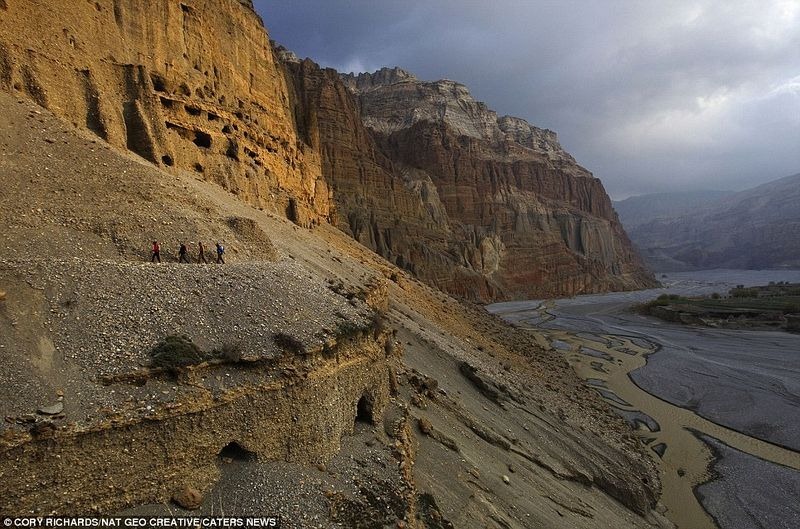
The Kingdom of Mustang, bordering the Tibetan plateau, is one of the most remote and isolated region of Nepalese Himalaya. Once an independent Buddhist kingdom, Mustang was annexed by Nepal at the end of the 18th century, but retained its status as a separate principality until the 1950’s when the area was more closely consolidated into Nepal. Because of its sensitive border location, Mustang was off-limits to foreigners until 1992. The relative isolation of the region from the outside world has helped Mustang preserve its ancient culture which is more closely tied to Tibet than to Nepal.

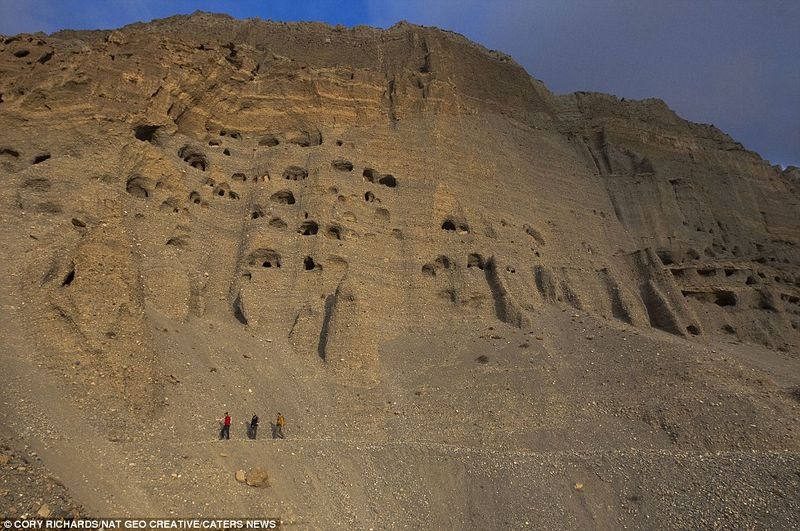
The landscape is also unlike anything that is to be found anywhere else in Nepal —deep gorges carved by the Kali Gandaki River, and strangely sculptured rock formations. The cliffs’ face are pitted with an estimated 10,000 ancient cave dwellings, some of which are perched more than 150 feet above the valley floor. No one knows who dug them, or how people even scaled the near vertical rock face to access them. Some of the caves appear almost impossible to reach even to experienced climbers.

mustang-caves-4

Photo credit: National Geographic

Most of the caves are now empty, but others show signs of domestic habitation —hearths, grain-storage bins, and sleeping spaces. Some caves were apparently used as burial chambers. The several dozen bodies that were found in these caves were all more than 2,000 years old. They lay on wooden beds and decorated with copper jewelry and glass beads.

In other caves, skeletons dating from the 3rd to the 8th centuries, before Buddhism came to Mustang, had cut marks on the bones that may have been inflicted during the practice of sky burial, where the body’s flesh is sliced into small pieces and left to be eaten by vultures. Sky burial is still practiced in many remote regions in the Himalaya.

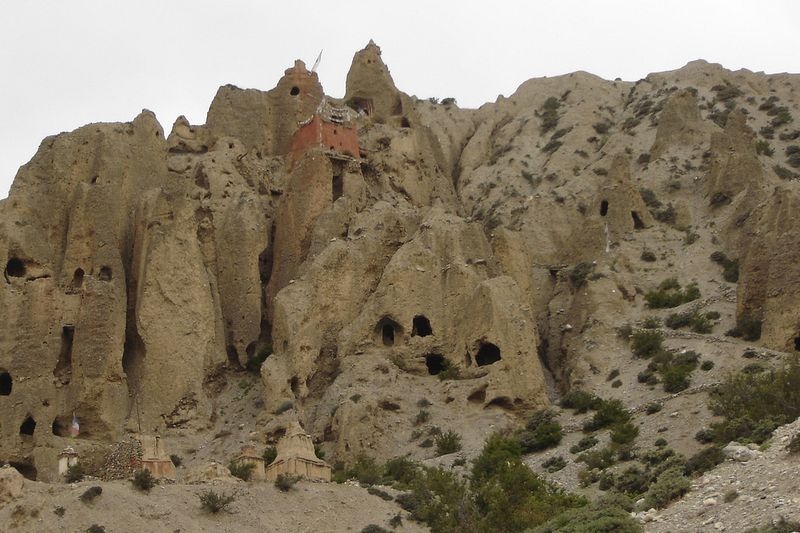
Archeologists believe that the caves in Mustang were used in three general periods. They were first used some 3,000 years ago as burial chambers. Then around 1,000 years ago, they became primarily living quarters, perhaps to escape battles and intruders into the valley. Finally, by the 1400s, most people had moved into traditional villages and the caves became places of meditation. Some of these caves were turned into monasteries such as the Luri Gompa, the Chungsi Cave monastery and the Nyiphuk Cave Monastery, all of which were built around and inside the caves.

Luri Gompa is one of the most famous in Mustang. The monastery is set on a ledge, at least a hundred meter high from the ground, in one of the many natural pillar like sandstone structures. A winding footpath climbs all the way from the bottom of the valley to a single entrance door that leads into two interconnecting chambers. The outer chamber contains a shrine, while the inner chamber —the main treasure of Luri Gompa— is beautifully decorated with a series of paintings depicting Indian Mahasiddhas — saints who were said to have achieved siddhi, or extraordinary powers by meditation. No documentation pertaining to this mysterious gompa or monastery has been found, but the wall paintings appear to be have been made in the 14th century or even earlier.

mustang-caves-1

Photo credit: National Geographic

mustang-caves-3

Photo credit: National Geographic

mustang-caves-5

Photo credit: National Geographic

mustang-caves-6

mustang-caves-7

Photo credit: nepaladvisor.com

mustang-caves-8

Photo credit: David Rengel/Washington Post

luri-gompa-2

Luri Gompa. Photo credit: Bob Witlox/Flickr

luri-gompa-3

luri-gompa-4

Frescos in the ceilings of Luri Gompa. Photo credit: library.brown.edu

Sources: Nat Geo / library.brown.edu / www.oneworldtrekking.com

Source……..www.amusingplanet.com

Natarajan