The Hindi-Speaking Aussie who loves India …

Charles ‘Biharilal’ Thomson, is an Australian who speaks fluent Hindi learnt on the streets, trains and buses of India’s hinterland.
Biharilal tells Rediff.com‘s Archana Masih how India has bewitched him.


Photograph: Kind courtesy Charles Thomson/Facebook

Biharilal Thomson is a white Australian who speaks Hindi better than many Indians.

The first time he saw a non-white person was as a 10 year old. His mother had invited an Indian yogi from Bihar into their home in Australia and asked her son to share his room with the sadhu for a few weeks.

“I had only seen white Australians till then, not even native Aboriginals — and here was an Indian in a langoti in my room!” he exclaims in good humour, sitting in a film producer’s home in suburban Mumbai, wearing a kurta-pajama and a yellow stole.

In the two hour conversation, he only speaks Hindi, a language he learnt in the streets, trains and buses of Bihar where he had arrived at age 13 in December 1974.

He loved his new home on the banks of the Ganga so much that he did not return to Australia for the next 11 years. Accounts of his experiences in India’s rural underbelly in the 1970s-1980s, include encounters with dacoits on horseback on at least two railway journeys.

“I saw real sadhus, I saw real dacoits — and I thought I had reached an amazing place,” says Biharilal with a grin. His life experiences, he says are so unbelievable that he sometimes thinks it is like a film.

It also reveals an India of another time — one that was simpler, wilder, unfamiliar and distant from what it is today.

“India was friendly with the Soviet Union, and I came across Indians who were desperate to emigrate to the USA, Canada or UK — not to the USSR.”

“The other thing that was common was cycles. Only the DM (district magistrate) and SP (superintendent of police) had cars — and in the trains people sometimes travelled with their own cooks!”

After going back to Australia in 1985, he returned to formally work in India in 2011.

India has seen a giant leap ahead since, and he has spent nearly 16 years here, but one question posed to him that hasn’t changed over the years is — “Why did you come to India?”

“This is what I am routinely asked, especially by the youth. They ask ‘Why have you come here when we want to settle abroad?’,” says Biharilal, who applied for Indian citizenship in 2014 and hopes to hold an Indian passport soon.

“The other thing I am amazed with is this craze for English. Even if I speak to those who know Hindi in Hindi, they reply in English!”

“Why?”

His fluency in Hindi has fetched him invites to Hindi events by the Indian high commission in Australia, to symposia at Savitribai Phule Pune university and Delhi’s Hansraj College. He has anchored a few film festivals and done some acting roles.

It has also brought him an FM radio show that he hopes to receive a confirmation for by April.

“In independent India it will be the first time that an angrez will do a radio show in Hindi,” he says enthusiastically.

Not wanting to be boxed into roles of the typical gora speaking tooti-phooti Hindi, he refers to the accomplished actor Tom Alter.

“He is an asli Hindustani, I’m nakli, but because earlier directors made him speak broken Hindi like an angrez, people thought he was English.”

“People didn’t know he was Indian, a Padma Shri, who spoke fluent Hindi and Urdu.”

Biharilal works at Josh Talks, a media company that invites guests to share inspirational stories. His focus is on all regional languages and tier-2 cities.

He has also done a few acting roles in Hindi and Marathi television serials, and recently appeared in an airline commercial for Scoot, a budget airline owned by Singapore Airlines.

There are quirky benefits to a white man speaking Hindi too — like the number of wedding invitations he receives. Many wedding organisers in the Delhi area send him invitations only to have a foreigner on display!

“I get so many invitations for chief guest. In the marriage season, I’ll be booked,” he laughs.

“People want a gora who speaks Hindi to show at their weddings.”

The move from Australia to India may have been a continental shift, but for Charles ‘Biharilal’ Thompson, it was like coming home.

It was a life introduced to him by his mother, a ballerina and an early convert to yoga, who came to learn at the Bihar School of Yoga in Munger in 1972.

“At that time only 1% of the world travelled by aeroplane,” says Biharilal, who is often recognised as ‘Biharilal Autowale Babu’ after a show on Zee TV where he covered the 2017 Delhi municipal election in a colourful autorickshaw.

He also covered the UP assembly election last year for WION, Zee’s English news channel.

“We used to fly to the Gold Coast to visit my grandparents every year. I made my father promise that he would send me to India instead, if I stood 1st or 2nd in school.”

He stood 2nd and travelled to Calcutta, he says, taking a train to Jamalpur and then a bus to Munger.

“I was shocked to see the poverty in Calcutta, but hearing ‘garam chai‘ by tea vendors in the train was like music,” he remembers.

Eight weeks later, his father returned to take him home.

“I told him I wanted to stay for one more year,” he says over a cup of tea.

“But I stayed for 11.”

blob:https://ishare.rediff.com/d8239350-f845-46f6-86e1-762bd67d53b5

He has now spent 16 years in India — first at the Bihar School of Yoga in Munger, then working in a financial tech start up Eko India, and currently in the entertainment industry.

At the famed yoga school in Munger, he says he learnt yoga and managed the library. He helped in the institute’s office work which would take him to Patna and Delhi.

It was on one these travels that he found himself in the middle of a dacoity.

He had bought a third class ticket and boarded a train from Jamalpur to Patna in Bihar. The TT saw his ticket and upgraded him to first class. Along the way, dacoits came riding alongside the train, detached the first class compartment and started looting passengers.

When they reached his coupe, he held out his hands, and said, “Ruko, ruko! (stop, stop!)”

The dacoits stopped.

“I was a young boy and did not know very good Hindi at that time, so I just managed to ask a dacoit if he had any videshifriend?”

The dacoit said ‘No’ and Biharilal told him that he would be his friend.

“He smiled and did not take anything from me.”

Caught in another dacoity on a railway platform — this time on a dark railway platform surrounded by crop fields — his saffron clothes came to his rescue.

“When they came to me, I just sprang up and started chanting Bum, Bum Bole-Bum, Bum Bole and they said, ‘Yeh toh Ganga jal wala aadmi hai‘ and let me go,” he chuckles.

India was very different then, he says. Yoga institutes were very austere and drew only the most committed.

He remembers the first function he organised which had a generator as backup for electricity failure. When the lights went off and the generator was switched on — the crowd left the sammelan and rushed to get a first glimpse of a generator at the back.

At fifty-seven, Biharilal has seen the arc of India’s history from Indira Gandhi’s Emergency to her assassination to the post liberalisation. He has travelled widely, even taken his mother to the Kumbh Mela.

In between, he returned to Australia and ran a Thai vegetarian restaurant but kept coming back to India.

“I started coming back in the late 80s, but visas were very difficult. Till the Modi Sarkar came, getting a visa to India was not easy. Sushma Swaraj is doing a good job,” he says.

In 2009, a startup started by Biharis, Eko India, offered him a job and he moved to India.

But it was a chance encounter with an Indian student at a Sydney swimming pool that opened the door to acting.

Shashank Ketkar, now a popular television actor, had got talking to him by the pool hearing his Hindi and came to eat at his Thai restaurant.

Few years later, Biharilal would visit him on the sets of his show whenever he was in Mumbai. His kurta-pajama style of dressing and fluency in Hindi caught the eyes of the director and led to small roles. He also got to play an angrez in a Marathi film Shashank Ketkar was acting in.

“I went to Kohlapur and shot a scene where I was seated on a horse in 40 degrees heat. I loved it. I thought I had become Shah Rukh Khan!”

He has also acted in a Hindi suspense thriller that will release this year.

Every day, he receives a large number of messages on Facebook and makes it a point to at least say ‘Ram, Ram’ or ‘Namaste’ to them.

“I feel the whole of Hindustan is made for me. Yeh kamal ka desh hai, yaha aapko sab kuch mil jayega (this is a great country, there is nothing you can’t find here),” he says, adjusting the famous Australian Akubra hat he is wearing and steps into the hot Mumbai sun.

Archana Masih / Rediff.com

Source…..www.rediff.com

Natarajan

Australians Rescued A Giant Spider. The Rest Of The World Wonders Why….?

AUSTRALIA:  For the past day, people around the world at least the ones who can get past a certain spider video without screaming “kill it with fire!” have been engaged in a rigorous debate about whether Andrea Gofton is one of the most compassionate Australians on her continent, or simply insane.

This month, her community has endured its worst flooding in almost a decade nearly 20 inches since March 1

Australians Rescued A Giant Spider. The Rest Of The World Wonders Why.

Homes and roads are flooded; students on a field trip to Echo Creek Adventure Park got more creek and more adventure than they were expecting; and towns have been declared a “disaster area.” Still, all things considered, the waterlogged population has escaped mostly unscathed.

At least the humans. It is a tough time to be an air-breathing animal in northeast Australia. Dens and burrows are flooded. Food sources are underwater and water-adept predators, particularly crocodiles, sharks and snakes, are riding newly-created waterways in search of unsuspecting prey.

But Gofton’s ethical dilemma came in the form of a not-so-tiny spider found clinging precariously to a tree branch: A giant Australian tarantula called the bird-eating spider.

It is, of course, almost instinctual for humans to want to save animals, even when they don’t do a particularly good job of it.

But there are some things about the spider that Gofton encountered that people need to know before deciding to reject the offer from #TeamKillItWithFire.

It is huge: The spider can grow to be the size of a man’s hand, a two-inch body with six-inch legs. That is bigger than some chihuahuas.

It has giant, venomous fangs. The tarantula’s fangs are nearly half an inch long, about a sixth the size of its body. The Queensland Museum says the tarantulas “can be quite aggressive if mishandled” and that the bite is “quickly fatal to dogs and cats,” but rarely causes serious illness in humans.

It has a deadly, if inaccurate nickname.Scientists have pointed out that the name “bird-eating” spider is, technically, a misnomer. The giant Australian tarantula only occasionally eats birds. Instead, it feasts on lizards, frogs and other spiders, a correction that is not at all reassuring.

It is standing right behind you. Okay. That one is technically a lie, but not as much as you think.

It hisses. Although some have said it’s more of a bark. Either way, the sound is nature’s way of saying “Don’t save me from this raging river, Andrea.”

But some people don’t listen.

Gofton and her friend Andrew Giliberto encountered the arachnid outside a SPAR Supermarket in the town of Halifax. The creature’s legs were intertwined over a flimsy branch, which was the only thing stopping it from being swept away by the water below, according to 9News Australia.

One of the Aussies filmed, while another put a hand close to the spider, apparently to see if it would latch on. It didn’t. So they snapped the branch that it was on and carried it to a nearby avocado tree, where they set it free.

They’ve spent the subsequent 24 hours going back and forth with ardent supporters of spider-cide, arguing that their actions were heartwarming, not horrendous.

Clearly, critics argued, Gofton had not gotten the message that giant spiders are notour friends.

“Nope nope, just nope,” one woman wrote on a post about the spider-save on a community Facebook group about the floods. “The tree has gotta be burnt, with a flame thrower.”

A short time later, Gofton replied: “I’m glad there are decent people out there, the negativity about an animal is beyond ridiculous.”

Of course the spider is the one who’s having the last laugh (hiss? bark?). It’s now safely weathering out what remains of the storm in the avocado tree outside the neighborhood supermarket.

That means some unsuspecting shopper may be in for a surprise, especially if the rescued spider is female.

Another fun fact about the giant Australian tarantula: Females can lay 50 eggs at a time.

Source…….www.ndtv.com

Natarajan


Hyderabad Girl Scripts History, Wins India’s First Gymnastics Medal in World Cup…!

The Gymnastics World Cup 2018 in Melbourne will go down in history as India got its first ever bronze medal in the women’s vault event.

The feat was achieved by Aruna Reddy, who finished after Slovenia’s Tjasa Kysslef and Australia’s Emily Whitehead, with a score of 13.649. A total of 16 countries were part of the World Cup series event this year.

The 22-year old dedicated her stupendous win to her late father, B Narayana Reddy, who had been instrumental for his daughter’s entry into the field.                     

Aruna with her Bronze medal. Source: Facebook.

Realising that Aruna had the agility and build for a gymnast, Narayana had her enrolled at the Lal Bahadur Shastri stadium in Hyderabad at the age of five.

“I owe everything to him, and if he had been alive and seen me on the podium today, he would have been so happy. He was there in my days of struggle, but couldn’t watch me win,” said an emotional Aruna to The Indian Express.

The Hyderabadi lass, who is a former black belt and Karate trainer, had initially trained under the guidance of coaches Swarnalatha and Ravinder. Later, Swarnalatha’s husband Giriraj took over as Aruna’s mentor after realising her immense potential and was her instructor until his untimely death in 2008.

Then, coach Brij Kishore took Aruna under his wing, and it is under his guidance that the budding gymnast blossomed and went on to clinch many medals at three National Games she had participated in, with the first one being in 2005.

In 2014, Aruna had aroused some hope for Indian gymnasts when she secured the 14th position at the qualification round of Vault apparatus at the Commonwealth Games along with a ninth place finish at the Asian Games.

Aruna came back to the fore when she had finished sixth in Vault during the 2017 Asian Championships.

The young athlete is determined to give her finest performance in the upcoming international events.

“The sad thing about this sport is that once you cross the age of 23-24, it becomes difficult to perform because the body doesn’t remain as flexible. A gymnast’s career is short. That’s why I want to make the most out of things before I turn 23,” she told Deccan Chronicle.

Aruna is also part of the Indian gymnastics contingent for the 2018 Commonwealth Games which will be held in Gold Coast, Australia.

We congratulate the young woman on her extraordinary win and wish her luck in all her future endeavours.

Source….www.the betterindia.com

natarajan


World’s busiest air route is right here in India!…

In 2017 only the Jeju-Seoul Gimpo route (with over 64,991 flights) and Melbourne-Sydney (54,519 departures and arrivals) were busier than Mumbai-Delhi.

It is the third-busiest air route in the world, with as many as 47,500 departures and landings last year.

Yet despite reaching this position, the Mumbai-Delhi route could face serious challenges in sustaining or improving it this year.

The reason? Hardly any additional capacity is now available at Mumbai airport to deploy more flights on this route.

But with the demand growing by 10-12 per cent annually, and with no possibility of adding more flights, flyers will soon face a hike in air fares this year.

According to OAG, an air travel intelligence firm based in the UK, the Mumbai-Delhi air route was the third-busiest in the world last year, with an average of 130 flights between the two cities every day.

In 2016, India was number six in the pecking order of the busiest routes, and this calculation was based on the capacity deployed on the route one way.

In 2017 only the Jeju-Seoul Gimpo route (with over 64,991 flights) and Melbourne-Sydney (54,519 departures and arrivals) were busier than Mumbai-Delhi.

Airlines say the route makes up about 10 per cent of their capacity and revenues, making it by far the biggest market.

And, at an average passenger load factor on this route of 80-90 per cent, this is a lucrative route, on which the demand is growing.

It also reflects the skew that these two markets have in the aviation business in the country as it constitutes more than 35 per cent of the domestic traffic.

Over 10,000 passengers depart every day from Mumbai for Delhi and vice versa and 70 per cent of them are corporate travellers, and this makes the situation even worse as they travel only during the peak hours (6am-8am and 5pm to 7pm).

That is why IndiGo and Jet Airways, each of which has 17 departures from Mumbai, top the list, followed by Air India (11), Vistara (10), GoAir (7), and SpiceJet (4). Yet the writing is on the wall. While most airlines are pushing for more capacity on the route, none is available.

Says a senior executive of a leading airline: “If slots are available, we can achieve a growth rate of 10-12 per cent on this route every year.

“But as slots are not available, the only possibility is to deploy bigger planes. But everyone does not have that flexibility, especially the LCCs. What you will see is fare increases”.

Last year, for instance, only Vistara and IndiGo were given additional slots on the route.

According to estimates of the Centre for Asia Pacific Aviation, the airport, which has a maximum capacity of 50-52 million per annum, is handling 46-50 departures an hour, which pretty close to the global best of around 55.

Currently the airport handles over 45 million passengers a year.

The agency says that the airport would reach its full capacity either by FY18 and surely by 2019, which makes the development of the new airport in Navi Mumbai so important.

Source…www.rediff.com

Natarajan

India”s Most unusual Post Offices….Our Country Celebrates National Postal Day today…

E-mails may have overshadowed the concept of snail mail, yet post offices still hold a special place in the Indian way of life. Having long had a presence in local communities, they have served as exchange posts for news, gossip and much more.

As the country celebrates the National Postal Day today, here’s a look at three of India’s most unusual post offices.

Send a postcard from any of these unique spots, and you are sure to score some travel bragging rights!

1. The Post Office at Hikkim


Perched at 15,500 ft above sea level in Himachal Pradesh’s strikingly beautiful Spiti Valley, the hamlet of Hikkim is reputedly home to the world’s highest post office.

A small hut with whitewashed walls and a red postbox hanging outside, the quaint post office is 23 km from the town of Kaza and has been functioning since November 5, 1983. With no internet and patchy cell phone signal, the facility is the only conduit to the world for Hikkim’s residents.

This inconspicuous little post office is single-handedly managed by Rinchen Chhering, who has been the branch postmaster for over 20 years. He was chosen for the post when he was just 22 because he could run fast and owned a bicycle!

Every day, two runners take turns hiking to Kaza on foot to deliver mail that is then taken by bus to Reckong Peo, onward to Shimla, further by train to Kalka, from where it is taken to Delhi and sent to its final destination. In winter, everything in the valley freezes – the rivers, the lakes, the mountains. As the snow cover cuts off Hikkim from the rest of the world, the village’s post office also shuts down for six months.

2. The Post Office at Antarctica

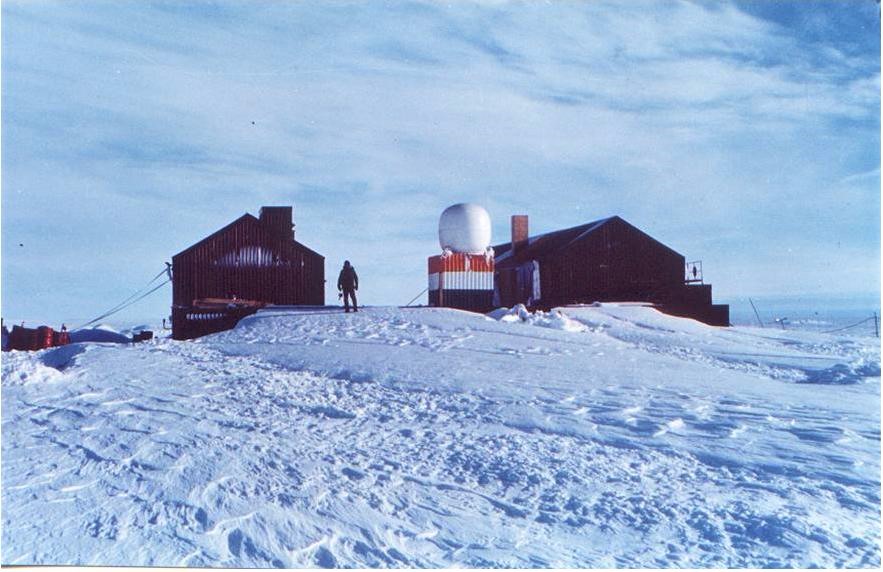
Dakshin Gangotri Station                                                                                                                                                           


Located in Dakshin Gangotri, India’s first scientific base in Antarctica, this post office first became operational on February 24, 1984, after it was established during the third Indian expedition to the frigid ‘White Continent.’ It was a part of the base’s multi-support systems that also included including ice-melting plants, laboratories, storage and recreational facilities.

The Dakshin Gangotri PO was brought under the Department of Post at Goa on January 26, 1988. Scientist G. Sudhakar Rao, who went to Antarctica as a member of the Seventh Indian Scientific Expedition in 1987, was appointed as its first honorary postmaster. Interestingly, in its first year of establishment, nearly 10000 letters were posted and cancelled at this post office.

However, in 1990, Dakshin Gangotri PO in Antarctica was decommissioned after it got half buried in ice. The post office was then shifted to the new permanent research base, Maitri.

Over the years, the unusual spot has become a favourite stop-off for tourists from cruise ships who came to explore the frozen continent and learn about its unique ecosystem. They send out postcards and letters that take between two and six weeks to reach their destinations via Hobart (in Australia).

3. The Post Office on Dal Lake


Built on an intricately carved houseboat, the Srinagar’s Floating Post Office claims to be the only one of its kind in the world. Here you can avail all regular postal services while being afloat on the Dal Lake. A heritage post office that has existed since colonial times, it was called Nehru Park post office before it was renamed by the then chief postmaster John Samuel in 2011.

After a pretty little philately museum and souvenir shop were added to it, the Floating Post Office was formally relaunched in August 2011. Interestingly, the seal used on everything posted from the this is unique, and tourist-friendly post office bears a special design — of a boatman rowing a shikara on the Dal Lake — along with the date and address.

While enthusiastic tourists row to the post office every day to send postcards back home, for the locals, the post office is more than an object of fascination. The islets in Dal Lake are home to over 50000 people (farmers, labourers, artisans and shikaraowners) for whom this state-run facility is the nearest source of postal and banking services.

Source…SanchariPal in http://www.thebetterindia.com

Natarajan


A Garden In A Sinkhole…

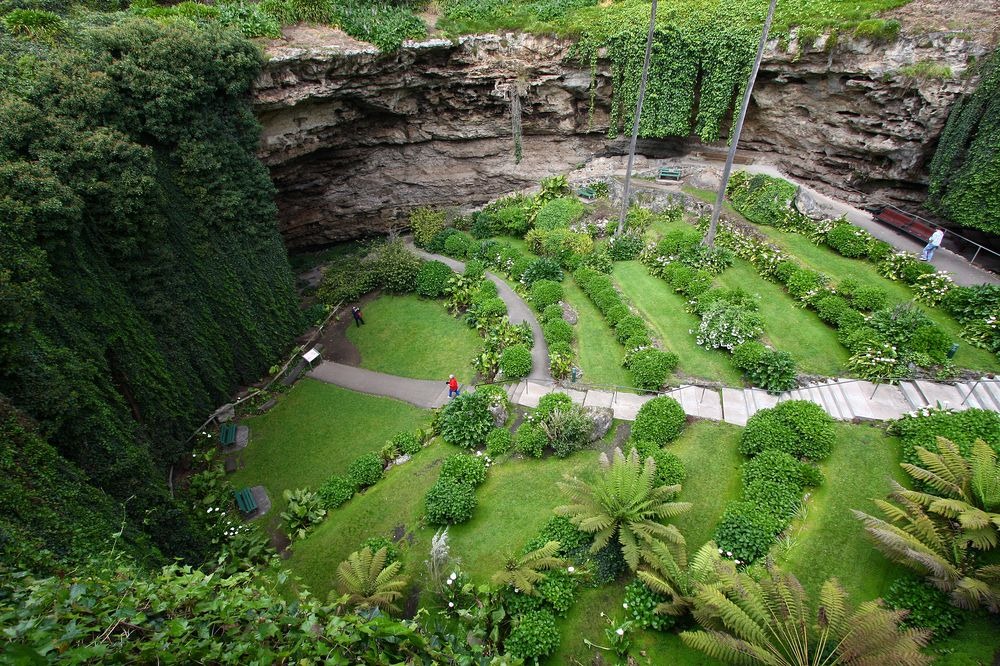
The region in the southeast of South Australia, near Mount Gambier, is littered with many volcanic and karst features such as volcanic craters, lakes, limestone caves, water-filled caves and sinkholes. One particular sinkhole, located just off Jubilee Highway East, is particularly worth visiting. What was once a typical limestone cave formed by the corrosion of limestone rocks by seawater, and the subsequent collapse of the chamber’s roof, has been transformed into a beautiful garden.

The Sunken Garden in the Umpherston Sinkhole was built by James Umpherston in the 1880s, after he purchased the property about twenty years prior. Being retired, Umpherson wanted to create a place where the people of Mount Gambier could come to relax and escape the heat of summer. He carved a path in the side of the rock and erected a set of wooden steps so people could descend into the sinkhole and to his sunken garden, where he planted all sorts of ferns, shrubs and flowers. The sinkhole even had a small lake within where visitors could take boat rides.

The garden became an immediate success and very popular among the residents of Mount Gambier. After James Umpherston died in 1900, his garden fell into disrepair, and it was only about forty years ago that the garden was rescued from a rubbish dump that it had become. The garden was restored by the employees of the South Australian Woods and Forests Department in 1976. They removed the rubbish and cleared the weeds, and planted hydrangeas and other species along the terraces.

Once again, the garden has become a popular recreation spot. In 1995, the garden was added to the South Australian Heritage Register.

Source….kaushik in http://www.amusingplanet.com

Natarajan

Hiding in plain sight; Rangoli, Kolam designs and what they mean…


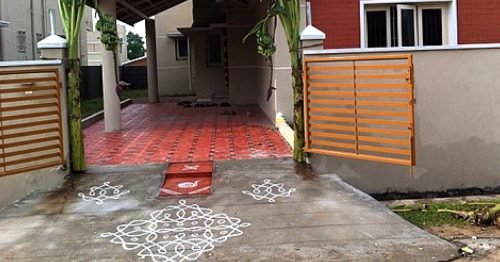
Every day, my mother religiously performed a ritual. Rain or shine, she never skipped this ritual even for a day. Every day, she drew enchanting kolam patterns using rice flour.

On special occasions, the white kolam designs were made with wet rice flour paste accompanied by thick strips of earth colored borders made with red sand mixed with water.

My mother is proud of her kolam design skills. She is not alone. It seems no self-respecting South Indian woman will tolerate anyone questioning her ability to conjure up kolam designs at will.

Millions of women from different communities in South India practice this art form every day.

For over 38 years, I considered Kolam to be just another ritual among the long list of rituals Indian women seem to follow. However, when I decided to dig deeper to understand the significance of kolam designs, I was surprised at what I discovered.

The threshold is a key concept in Tamilian culture. Even historical Tamil literature such as the Sangam literature (Tamil literature in the period spanning 300BC to 300 CE) is divided into the akam (inner field) and the puram (outer field).

That’s not all.

In one of Nammalvar’s (the fifth among the 12 Alwar saints who espoused Vaishnavism) hymns, the God in the poem is the God of the threshold. Of course, every newly married bride formally becomes a part of the household when she steps overs the threshold.

Should we then conclude that kolam designs are a celebration of the threshold?

Different interpretations of the significance of kolam designs

Here are a few explanations I came across in my quest to unearth the real significance of the kolam ritual.

The most common understanding has been that the idea of using rice flour is to provide food to ants, insects and small birds.

If that is the case, what’s stopping men from participating in this noble deed?

While I did not find an answer, a common sense reasoning is that women have traditionally carried the burden of maintaining the home and the kolam ritual automatically became a part of the woman’s domain.

That’s also a reason why my mother and my aunts believe that women see it as a key ritual that helps them improve their concentration and patience, two key components needed to run a household!

Here is another interpretation recorded in Lance Nelson’s study of Kolam.

“Bhumi Devi [earth goddess] is our mother. She is everyone’s source of existence. Nothing would exist without her. The entire world depends on her for sustenance and life. So, we draw the kolam first to remind ourselves of her. All day we walk on Bhumi Devi. All night we sleep on her. We spit on her. We poke her. We burden her. We do everything on her. We expect her to bear us and all the activities we do on her with endless patience. That is why we do the kolam.”

According to Devdutt Pattnaik, author and mythologist –

“A downward pointing triangle represented woman; an upward pointing triangle represented man. A circle represented nature while a square represented culture. A lotus represented the womb. A pentagram represented Venus and the five elements.”

Kolams connects the dots in more than one way.

Cultural practices are common across the length and breadth of India. They also transcend regions.

The concept of Kolam is definitely not unique to Tamil speaking community in India. For example, in the Telugu language, it is called ‘Muggulu’, and it’s known as ‘Rangoli’ in the Kannada language.

But the idea of drawing patterns on the ground transcends India and can be found in other cultures as well!

Anil Menon, a computer scientist, and a speculative novelist has compiled findings from his research on similar practices among cultures separated by oceans. Here are some tidbits from Menon’s work.

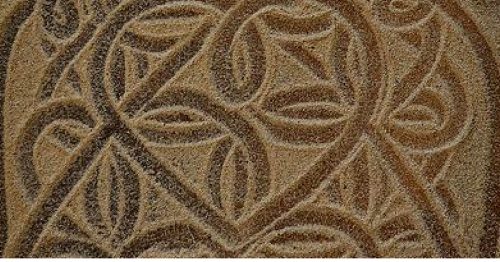
British anthropologist, John Layard, found that the patterns drawn on the sand by the tribal population of Malekula (an island that’s a part of The Republic of Vanuatu, situated 1000 miles east of Australia) are similar to the kolam patterns popular in Tamil Nadu!

Here is the proof.


There is also a possibility that kolam designs were an early form of pictorial language!

Dr Gift Siromani, through his path-breaking work, has proved that it is possible to create any kolam pattern using a combination of strokes.

Rituals and cultural practices are to be cherished

I did not think much of the kolam designs my mom drew every day. But a sudden spark of curiosity led me to unexpected findings and the joy of discovering human beings are connected to each other in more ways than we can imagine.

Physical boundaries, cultural differences, and racial definitions are just imaginary barriers we have erected over a period of time. Our lives are always connected just like the dots of the kolam my mom draws.

SOURCE….Srinivas Krishnaswamy in http://www.the betterindia.com

Natarajan

Image of the Day… Amazing Photo of Super Moon on 14th Nov 2016 !!!


The lights around the moon are street lights and there is a tree in front of the moon like veins on moon….!!!

Photo Credit  by Senthil Natarajan , Brisbane , Australia

Photograph taken by him on the night of Super Moon Day …14 Nov 2016

Source…Facebook post of Senthil Natarajan

Natarajan


15094496_10154788090699630_1663026486696801254_n