” Hear the Thud Of Philae While Landing on Comet ” !!!

Today, German scientists released a two-second recording of the sound the Rosetta mission’s Philae lander made when it touched down on comet 67P/Churyumov-Gerasimenko’s icy surface. Philae landed on the comet, which is about 311 million miles (500 million kilometers) from Earth, last week (November 12, 2014).


The sound comes from sensors embedded in Philae’s three legs. The recording is part of SESAME, the Surface Electric Sounding and Acoustic Monitoring Experiment. Because its harpoons didn’t fire, Philae actually ended up bouncing twice and landing three times. This is a recording of the first bounce.

Scientists from the German Aerospace Center, DLR, which is responsible for SESAME, areanalyzing the sound of the landing for clues about the comet’s surface.

After nearly 57 hours on Comet 67P/Churyumov–Gerasimenko, the Philae lander had completed its main science mission on November 15, 2014, when its batteries failed and the lander went silent. Read more.

Philae's bounce across the surface of its comet, as captured by the Rosetta mothership.  Image via ESA/Rosetta/MPS for OSIRIS Team MPS/UPD/LAM/IAA/SSO/INTA/UPM/DASP/IDA

Philae’s bounce across the surface of its comet, as captured by the Rosetta mothership. Image via ESA/Rosetta/MPS for OSIRIS Team MPS/UPD/LAM/IAA/SSO/INTA/UPM/DASP/IDA

SOURCE::::www.earthsky.org

Natarajan

Joke of the Day… ” Is your Uncle an Electrician … ? ” !!!

A brilliant young boy was applying for a job with the railways. The interviewer asked him: “Do you know how to use the equipment?” “Yes”, the boy replied. “Then what would you do if you realized that 2 trains, one from this station and one from the next were going to crash because they were on the same track?” The young applicant thought and replied “I’d press the button to change the points without hesitation.” “What if the button was frozen and wouldn’t work?” “I’d run outside and pull the lever to change the points manually” “And if the lever was broken?” “I’d get on the phone to the next station and tell them to change the points,” he replied. “And if the phone was broken and needed an electrician to fix it?” The boy thought about that one. “I’d run into town and get my uncle” “Is your uncle an electrician?”

“No, but he’s never seen a train crash before!” 

SOURCE::::joke a day.com

Natarajan

Message For the Day…” Spiritual Education is the Need of the Hour …”

Modern education is mere bookish knowledge, confined to what is contained in the texts. Today many are pursuing such secular education only (i.e., value neutral). Secular education alone is not enough. It must be supplemented with spiritual education. Spiritual education has its effect on one’s heart, and is called Educare. Educare means bringing out the latent Divinity, that is hidden in the heart of human beings and establishing it as an ideal to the whole world. Through Educare, you must develop the principle of love and students must follow the path of truth. True education is that which is suffused with truth and love. Secular education is for making a living, whereas spiritual education is for reaching the goal of life. It is the duty of students as well as educators to harmonize the secular education with spiritual education. This is the prime necessity today. 

Sathya Sai Baba

” Fax Machine was Invented in 1843 … ” !!!

Today, we mostly think of the fax machine as an outdated piece of technology. While there are still some uses for it in an office-setting, technological advances are sending the fax machines to the same pasture as pagers, land-line telephones, and disposable cameras. Even if this is the last we hear of the beeps and bops that echo as an incoming fax is transmitted, the fax machine had a very long life – an amazing 171 years to be exact. Yes, the fax machine was invented in 1843, before the Model-T was even a dream, before the telephone was invented, and even before the American Civil War broke out.

Alexander Bain, a Scotsman clockmaker living in London, was already a decently well-known inventor by the time he got to inventing the world’s first facsimile (meaning in Latin to “make alike”) – or fax – machine. In 1841, he had invented an electric clock by electrifying a pendulum (rather than using springs or weights), while submitting patents for several other useful inventions like improved control systems for railways, automated music machines, and devices to measure how fast a ship was going.

On May 27, 1843, he applied for a patent for a “chemical telegram” and “”improvements in producing and regulating electric currents and improvements in timepieces, and in electric printing, and signal telegraphs,” in which “a copy of any other surface composed of conducting and non-conducting materials can be taken by these means.”

His new invention used the newly popularized telegraph (the electrical telegraph, which was patented by Samuel Morse in 1837) as its base and then added electromagnetic pendulums (like his clock) that would scan the image and puncture a chemically treated paper with lines and tics, which would then be interpreted by a telegraph operator.

Bain’s initial version of the fax machine essentially was a written telegraph and this wasn’t lost upon Samuel Morse. Morse and Bain became embroiled in a patent dispute that eventually was ruled in Morse’s favor. Journalists of the time wondered out loud that since the dispute was taken up in US courts and Morse was American, that the ruling had a bias. In fact, one even went as far as to jokingly state that Bain should never bring his children to America because if he did, Morse would surely claim them as his own too.

Bain submitted another patent for the chemical telegram in 1846 with improvements to his invention that included sketching out and sending facsimile images. It used the same premise as before, but now the paper was treated with a mixture of ammonium nitrate and potassium ferrocyanide, so when electrified, the paper turned blue. (See: Why Blueprints are Blue.) Again, Morse blocked the patent. Within a few years, Bain would further improve his machine, resulting in a version capable of copying approximately 325 written words per minute, about 8 times what Morse’ telegraph system could do. However, by this time, other inventors were getting into the facsimile game with even better designs and Bain’s career was basically over. He would die in poverty in 1877.

This brings us to Frederick Bakewell who received a patent for his improved “image telegraph,” which essentially replaced the pendulums with synchronized rotating cylinders. He was able to send the first certified “telefax” with actual words and images. He demonstrated it at the Great Exhibition in London in 1851, but it wasn’t met with much enthusiasm due to the very long time it took to copy and transmit. Plus, as with Bain’s system, it suffered from synchronization problems.

Italian physicist Giovanni Caselli focused his work on making sure the cylinders stayed synchronized. He succeeded with his invention, the pantelegraph, which used a regulating clock signal to keep both ends in perfect synchronization. With Caselli’s device, first, a message or image would be written in non-conductive ink on a piece of tin. The thin tin sheet would then be scanned by an electrified transmitting stylus, attached to telegraph wires, going back and forth across the sheet. When the stylus encountered the non-conductive ink, rather than the tin, electrical conduction stopped. A very similar apparatus was placed on the receiving end, except this had chemically-treated paper and an electrified stylus (similar to what Bain had done), which would contact the paper where the conduction stopped on the sending side, creating an exact replica of the message. Thanks to his advancements in synchronization, Caselli had created the first reliable fax machine.

Caselli was so confident in it, he demonstrated it for the French Emperor Napoleon III in 1860. The Emperor was astounded with what he saw – the signature of well-known French composer Gioacchino Rossini transmitted over a 140 kilometer long telegraph line between Paris and Amiens. To ensure its viability, the Emperor asked for another test. So, Caselli sent a message between Paris and Marseille, which had 800 kilometers separating them. It worked. Napoleon III accepted the pantelegraph for use by law across France. A year later, Russian Tsar Nicholas I used the pantelegraph to send messages between his palaces in Moscow and Saint Petersburg. Unfortunately, the French-Prussian war of 1870 caused many telegraph poles to come down across both countries and forced the pantelegraph to cease operations. But the technology was here to stay.

Improvements continued on the image-creating telegraph with Bernhard Meyer using a drum to double the speed of the previous pantelegraph. In 1888, Ohio-born Elisha Gray received a patent for the telautograph, a unit that had horizontal and vertical bars that further quickened the pace. Foster Richie created the telewriter, which could be operated on the newly-built telephone lines that stretched across America, allowing for both speech and copies simultaneously.

The first wireless fax was sent, using radio-waves, in 1924. Richard Ranger worked for the Radio Corporation of America (RCA) when he sent an image of President Calvin Coolidge on November 29, 1924 across radio-waves. Also all the way back in 1924, the first color fax was sent by Herbert Ives of the American Telephone and Telegraph Company (AT&T).

Despite reliable fax machines (even wireless and color) being around for quite some time, it wouldn’t be until 1964 when fax machines were widely used commercially. Xerox, a Rochester, New York based company, developed the “Long Distance Xerography” which connected copiers in offices via telephone lines. It would take a few years, but Xerox fax machines soon were the mode de jour to send and receive documents. And the rest, as they say, is history.

SOURCE:::: http://www.todayifoundout.com

Natarajan

Things We all Did as Indian Kids …!!!

Read on to know what we all did as Indian kids.

1. Rolled on the playground, got dirty in the mud

1st-Get-dirty-in-mud

Cuz mitti mein nai khela toh kya khela.


2. Played hopscotch, chupa chupi

2nd-play-hopscotch


3. We had no prom nights but we had some awesome times dancing in sarvajanik Ganpati and Durga pooja utsav

3rd-sarvajanik-dance


4. Played galli cricket

4th-galli-cricket

Cuz galli was our cricket stadium


5. Watched Shaktiman with all the neighborhood kids on Sundays

5th-Shaktiman

and hoped to become Shaktiman as a grown up or meet him some day.


6. Saw Aahat and almost peed in our pants, but saw it anyway

6th-Aahat


7. Made paper balls and played cricket during recess hours in school

7th-paper-balls


8. Ate baraf ka gola on the last day of the school to welcome summer holidays

8th-baraf-ka-gola


9. Played popular pop songs like Made in India and Dooba Dooba rehta hoon loudly

9th-Pop-songs


10. Fixed our chappal by tucking in the strap with the help of a twig; every time we played outdoor games

10th-chappal


11. Saw “Jalebbiiii” ad and instantly demanded for hot and delicious jalebi

11th-jalebi-add

Image source


12. Katti toh katti barah baje batti tu kha matti mein khau ice cream

12th-katti

Say this as soon as you’re angry or annoyed with your friend. And no there was nothing like pinky promise, the above sign meant katti.


13. Rasna rozana utsav was your favorite ad and drink, especially during summer vacation

13th-rasna-rozana-utsav


14. Got excited when the door bell rang so you could open the door like Sweety from Hum Paanch

14th-Hum-Paanch


15. Put those brown covers just a day before the first day of school

15th-brown-cover

To let the feeling sink in. Yes school is starting tomorrow.


16. When electricity went off after sunset, gather around with friends and enjoy the dark time with ghost stories or chupa chupi

16th-playing-in-the-dark

These are the things we all did as Indian kids and man how we loved every single minute of it.
Cheers to those times :)

SOURCE:::: http://www.storypick.com

Natarajan

What is the Lake-Effect Snow ?

Image Credit: pmarkham


What is lake-effect snow? If you live on the downwind side of a large lake, you’re probably all too familiar with this weather phenomenon. It happens when cold winter air moves over a relatively warm body of water. What you get are small-scale but intense snowstorms. A powerful lake-effect snow storm hit the Buffalo, New York area this week, and is continuing through Friday, November 21, 2014. See pictures and read more about the effects of the November 2014 lake-effect snow storm.

This article,  is  based on a 2011 interview with Tom Niziol, longtime meteorologist-in-charge of the National Weather Service in Buffalo, New York and who joined the Weather Channel in early 2012. He told EarthSky that accurate forecsting of lake-effect snow is a challenge cause:

[Lake-effect snow] occurs on such a small scale, almost on the scale of a summertime thunderstorm. One portion of a neighborhood or city might be under heavy snow, where a few miles away you may be under sunny skies.


Photo credit: Square Foot Staffing
He said Buffalo, New York on the eastern shore of Lake Erie, is notorious for its lake-effect snowstorms. Niziol said cold air moving in from Canada triggers the snowfall.

As that air moves across the warm water of the Great Lakes, heat and moisture from the lake rises up into that air mass. That moisture eventually condenses out into snowflakes. And when we get to the downwind shores, we end up with lake-effect snow.

Niziol said similar snowstorms happen around the globe. The coasts of the United Kingdom, France, Japan, and Korea, for example, get what’s called ocean-effect snow, from cold air moving across warm seas.

So at a whole range of latitudes in the Northern Hemisphere, right around the globe, we see the same activity.

Niziol gave an earlier example of how dramatic lake effect snow can be.

In early December, 2010, in the western New York area around the city of Buffalo, one of these snow bands set up off Lake Erie. The band was about 8-10 miles wide. The northern portion of Buffalo had green grass throughout most of this event. The southern portion of Buffalo, however, only about 10-12 miles away, picked up 40 inches of snowfall.

He said that lake-effect snow can begin in early fall and continue throughout the winter months.

Early in the fall, we see the same type of activity – cold air moving across a warm body of water – but it’s actually warm enough that we see lake effect rainshowers occur. As we get into November to early December, the air is cold enough to turn that into snow.

But if the lake freezes over, it can bring a halt to these seasonal snowstorms.

Lake Erie is a very shallow lake. In January it develops a significant amount of ice cover. The ice cover acts as a cap, in a simple way, to limit the amount of heat and moisture that can come through that ice and then modify that air mass.

Niziol said that the most important thing for people who experience lake effect snow to know is how to be prepared for an unexpected snowstorm.

Be prepared for winter weather conditions. Have extra clothes in your car, make sure your cellphone is charged, have a shovel in the car, some water, granola bars, extra food as well. Because you never know when you leave the house, even if you have a forecast with you, what it will be like when you drive through one of these snow bands.

Lake-effect snow belts may include portions of the Upper Peninsula of Michigan, northern and western portions of the Lower Peninsula of Michigan, northern Indiana, northeastern Ohio, northwestern Pennsylvania and western New York state.

Bottom line: Lake-effect snow happens when cold winter air moves over a relatively warm body of water. What you get are small-scale but intense snowstorms.

SOURCE::::www.earthsky.org

Natarajan

Mosquito Repelling Plants For Home ….

 Mosquito-Repelling Plants You Can Grow at Home

Mosquitoes are a serious nuisance; from that terrible buzz near your ear when you’re trying to sleep, to the itchy, swollen bumps they leave after biting you. If you didn’t know, it’s only the females of the specie who bite us. Male mosquitos prefer to feed on nectar, generally avoiding humans.

Mosquitos can also be a health-risk – they can transmit diseases through their bite (including Malaria, Yellow Fever, West-Nile Fever, and more). In-fact, mosquitos are responsible for more human deaths than all wars, combined.

You can buy gadgets and products that repel these nasty bugs, but they’re all temporary and can be irritating or dangerous. Instead, you can grow certain plants that repel mosquitos naturally:
Lemon Verbena: This lovely plant has a light citrus scent and can be added to tea for both flavor and it’s calming effect on the digestive system. You can plant it in the ground or in a deep pot and let it scare away those nasty bugs. Make sure it has a good supply of water and sunlight. Mosquito Repellants
Cloves: Cloves are the flower buds of the Syzygium aromaticum plant. You can plant it around the yard to enjoy its mosquito-repelling properties, as well as use the cloves to spice up food. Mosquito Repellants
Mint: Most common as an added flavor for tea, mint also has powerful mosquito-repelling properties. All species of mint are useful repellants. Mint needs sunlight and plenty of water to grow. You can plant it in your garden or in pots. If you choose to put it in your garden, be aware that it likes to spread, and can sometimes take over and kill weaker plants. Mosquito Repellants
Rosemary: A favorite herb for savory dishes, it’s also a potent repellent. Plant it in your garden or in deep planters and let this lovely bush grow and take care of your mosquito problem. Mosquito Repellants
Lemon Thyme: A natural mosquito repellent, lemon thyme is also a great herb for seasoning dishes. Plant it in pots to get lovely little plants around the house, or in your garden to control mosquito population. Mosquito Repellants
Lavender: The scent of lavender is often a favorite for many people, and it’s commonly used in aromatherapy for its soothing properties. For mosquitos, however, it’s a very strong repellent. Plant them in your garden or in pots in your house and enjoy the scent of the beautiful purple flowers. Mosquito Repellants
Floss Flower: These lovely tiny flowers are superb at repelling mosquitos. Make sure you only grow them in a pot, as they tend to overgrow in the soil and take over the entire garden. Make sure they’re out of reach of children and animals, as they can be toxic. Mosquito Repellants
Pitcher Plant: These carnivorous plants grow natural pitchers, filled with appealing-scented nectar to lure bugs in. Once the bugs get inside the pitcher, they can’t get out again and are digested by the plant. Plant them in planters by window sill and enjoy their mosquito-capturing properties. Mosquito Repellants


Cadaga Tree: (AKA  “Cadagi”, oreucalyptus torelliana) – These beautiful trees are natural barriers for mosquitos, who hate their scent. Plant a few of these in your garden and let nature free you of those pesky biters.                                 Mosquito Repellants


SOURCE::::ba-ba mail site

Natarajan

” A Cycle Beats Ferrari…Reaches Over 330kmph !!!”

The cycle that you see in the video is definitely not an ordinary cycle, but a rocket-powered one. The cycle is fuelled by a mix of hydrogen peroxide and compressed air. On November 7, 2014, Francois Gissy reached the speed of 207mph on the cycle developed by his friend Arnold Neracher at a racing circuit in France. With the new record, Gissy broke his previous best of 177.13mph.

Makers of this rocket-powered cycle will now be working on a new bicycle to beat their own record in 2015.

Cycle Beats Ferrari; Reaches Over 330kmph


You must have seen so many drag races, where results turned out to be unexpected (a more powerful car losing to a lesser one), but none of those would have been half as exciting as this one. That is because of the fact that this race was not between two sportscars or supercars, but it was a cycle that took on a Ferrari.

Built by Arnold Neracher, the cycle shown above achieved a top-speed of mind-boggling 331Km/h in just 4.8 seconds! Yes you read it right, a cycle that goes faster than some of the most powerful cars out there in the market. The car it took on was a Ferrari F430 Scuderia, and within micro seconds, the cycle left the car way behind.

SOURCE:::: You Tube and auto.ndtv.com

Natarajan


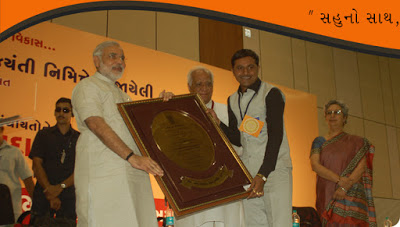
How One Man….Himanshu Patel…Transformed a Gujarat Village …!!!

Punsari village, barely 100 km from Ahmedabad, could be a textbook case of development. Closed-circuit cameras, water purifying plants, air-conditioned schools, Wi-Fi, biometric machines – the village has it all. And all of it was done in a matter of eight years, at a cost of a mere Rs. 16 crore.

The man behind the transformation is its young sarpanch – 31-year-old Himanshu Patel. A graduate from North Gujarat University, Mr Patel had won the panchayat polls in 2006, at the age of 23.

Back then, the village didn’t even have proper roads, power or water. The panchayat funds were in deficit. Mr Patel found though money come aplenty, it was the utilisation that’s at fault.

Over the next eight years, together with the district administration, he stitched up funds from under various heads – the District Planning Commission, Backward Regional Grant Fund, 12th Finance Commission, and those under Self Help Group Yojnas – and began the development of the village.

The results are obvious. Recently, a team from the Central ministries of rural and urban development had come to study the “Punsari model”.

But the young sarpanch is already onto his next projects – a unit producing electricity out of plastic waste and e-rickshaws for garbage collection. “The state government has already sanctioned Rs. 52 lakh,” he said.

Understanding the importance of education, Mr Patel has earmarked a chunk for the village school. From 300 students in 2006, the number has now doubled to over 600. The classrooms are not just air-conditioned but also have computers and projectors.

“We have managed to attract more children,” said teacher Narendra Jhala.  Vidya Patel, a student of Class 7, thinks learning is fun. “The audio visual presentations make it easier to remember our lessons,” she said.

Interestingly, Mr Patel has not asked for a penny from the MLA fund, and over the last eight years, the village has just got Rs. 1 lakh from the MP fund.

“We didn’t feel the need, since there is enough from various budgetary grants of the state and Centre. If you utilise it properly, you can work wonders,” said Mr Patel.

“The village has demonstrated how understanding various schemes available and leveraging them properly can bring about a qualitative change,” said Himmatnagar collector Banchha Nidhi Pani.

SOURCE::::www.ndtv.com and nidhi-bansal.blogspot.in

Natarajan