Image of the Day…. Vanguard satellite…

One of the Vanguard satellites is checked out at Cape Canaveral, Florida in 1958. Vanguard 1, the world’s first solar-powered satellite, launched on St. Patrick’s Day (March 17) 1958. It was designed to test the launch capabilities of a three-stage launch vehicle and the effects of the environment on a satellite and its systems in Earth orbit. Vanguard 1 was the second U.S. satellite in orbit, following Explorer 1, and remains the oldest artificial object orbiting Earth to this day. Vanguard began as a program at the Naval Research Laboratory in Washington and transferred over to NASA (along with many of its personnel) after the agency was founded by the National Aeronautics and Space Act of 1958.

Image Credit: NASA 

SOURCE::::: http://www.nasa.gov

Natarajan

” ‘Darbha’ grass, a natural preservative “…. ‘தர்ப்பை’ ஒரு சாதாரண புல் அல்ல !!!

A systematic research by SASTRA University researchers

Traditional tropical grass, Darbha, has been identified as an eco-friendly food preservative.

Darbha (Desmotachya bipinnata) is a tropical grass considered a sacred material in Vedic scriptures and is said to purify the offerings during such rituals.

Darbha (Desmotachya bipinnata) is a tropical grass considered a sacred material in Vedic scriptures and is said to purify the offerings during such rituals.

This finding was evolved in a research study undertaken jointly by the Centre for Nanotechnology and Advanced Biomaterials (CeNTAB) and the Centre for Advanced Research in Indian System of Medicine (CARISM) of the SASTRA University, Thanjavur, under the supervision of Dr. P. Meera and Dr. P. Brindha respectively.

Darbha (Desmotachya bipinnata) is a tropical grass considered a sacred material in Vedic scriptures and is said to purify the offerings during such rituals.

At the time of eclipse, people place that grass in food items that could ferment and once the eclipse ends the grass is removed.

A systematic research was conducted by the SASTRA University researchers, in which cow’s curd was chosen as a food item that could ferment easily.

Five other tropical grass species, including lemon grass, Bermuda grass, and bamboo were chosen for comparison based on different levels of antibiotic properties and hydro phobicity.

Electron microscopy of different grasses revealed stunning nano-patterns and hierarchical nano or micro structures in darbha grass while they were absent in other grasses.

On studying the effect of various grasses on the microbial community of the curd, darbha grass alone was found to attract enormous number of bacteria into the hierarchical surface features.

These are the bacteria responsible for fermentation of cow’s curd.

During eclipse, the wavelength and intensity of light radiations available on the earth’s surface is altered. Especially, the blue and ultraviolet radiations, which are known for their natural disinfecting property, are not available in sufficient quantities during eclipse.

This leads to uncontrolled growth of micro-organisms in food products during eclipse and the food products are not suitable for consumption. Darbha was thus used as a natural disinfectant on specific occasions, say researchers at SASTRA University.

Further, the scientists say that darbha could be used as a natural food preservative in place of harmful chemical preservatives and the artificial surfaces mimicking the hierarchical nano patterns on the surface of darbha grass could find applications in health care where sterile conditions were required.

This entire research was funded by the SASTRA University’s Research Fund.

Keywords: SASTRA University researchdarbha researchdarbha grassorganic preservativetraditional tropical grassVedic systems

SOURCE::::::::::L.Renganathan in  www.the hindu.com

Natarajan

“This Guy is Wheely Brave…Riding Bike Over a 65ft. High Cliff…” !!!

A road bike freestyler risked life and limb while traversing a railing over a 65-ft high cliff for a TV programme that is trying to find the world’s most talented person.

Vittorio Brumotti, who is representing Italy in the interactive talent show, ‘World’s Most Talented’, fought the wind on the seafront during his challenge before safely completing it.

Watched by David Brain, one of the show’s presenters, who filmed the feat on a tablet, the fearless cyclist skilfully jumps onto the top of a wall to begin the stunt

Vittorio Brumotti fought the wind on the seafront during his challenge before safely completing it

Vittorio Brumotti fought the wind on the seafront during his challenge before safely completing it

The extreme cyclist put his life on the line and displayed incredible concentration during the stunt 

The extreme cyclist put his life on the line and displayed incredible concentration during the stunt

Approaching the railing, the road bike freestyler steadies himself and gets into position with a series of small bunny hops.

As Vittorio, 34, cycles along the narrow railing with one leg in the air for balance, footage from his helmet camera shows the drop to the sea to his right and the jagged rocks that stick out from the wall.

 Vittorio Brumotti moved slowly along the railing with one leg in the air for balance

Vittorio Brumotti moved slowly along the railing with one leg in the air for balance

Vittorio Brumotti, from Italy, holds a total of 10 Guinness World Records for his extreme talent

Vittorio Brumotti, from Italy, holds a total of 10 Guinness World Records for his extreme talent

Finally the road bike freestyler reaches the end of the railing and after putting two feet back on the pedals jumps down onto the path safely.

The video concludes with the crowd of observers clapping while David bows and laughs in disbelief at what he has just witnessed.

David said: ‘Going along the edge of a building, that’s not just physical, that’s mental. That blew me away.’

After the stunt Vittorio, a former bike trial world champion, reflected on the dangers involved.

Vittorio Brumotti once climbed the Burj Khalifa, the world's tallest tower, by hopping up the steps on his bike

Beachgoers and a film crew looked on in suspense as the 34-year-old completed the stunt

Beachgoers and a film crew looked on in suspense as the 34-year-old completed the stunt

He said: ‘I think about my mum, because it is important to me to come back to my mum. It’s important to have fear, because without fear, you go down.’

Vittorio holds a total of 10 Guinness World Records for his extreme talent and claims to have always enjoyed riding bikes. He once climbed Dubai’s Burj Khalifa, the world’s tallest tower, by hopping up the stairs on his bicycle.

He said: ‘I started when I was eleven years old, my father and mother bought me the first bike and it was magic, this is my dream.’

SOURCE::::::www.dailymail.co.uk

Natarajan

Secrets of the Success of Warren Buffett…He Does not Owe His Fortune to Magic !!!

If you’re interested in finance, trying to crack the secret of Warren Buffett’s success is as entertaining as it is maddening — an enticing Rubik’s cube for anyone looking to get rich.

Buffett’s success is so elusive — and so far, unreplicated — that it took a team of Yale academics to determine the Oracle of Omaha does not owe his $73 billion fortune to magic.

“Buffett’s returns appear to be neither luck nor magic,” found a 2013 research paper published on Yale’s website, which boiled down Buffett’s actual secret sauce to “reward for use of leverage combined with a focus on cheap, safe, quality stocks.” (Not-so-secret, really: Buffett admitted to this strategy more than 30 years ago.)

Still, if asked to explain the source of his “alpha,” Buffett is as divided as his devotees — at times shmaltzy (“I found what I love to do very early”), other times coy (“You can’t produce a baby in one month by getting nine women pregnant”) and more often than not, completely blunt: “‘Price is what you pay; value is what you get.’ Whether we’re talking about socks or stocks, I like buying quality merchandise when it is marked down.”

Warren Buffett

Berkshire Hathaway chairman Warren Buffett gestures at the start of a 5km race.

We interviewed some of America’s biggest money experts, and threw them a gauntlet: Tell us the secret to Warren Buffett’s success.

Here’s how they explained the Oracle’s track record.

1. His No. 1 focus is growing his wealth.

According to Brandon Turner, real estate investor and co-host of “BiggerPockets Podcast,” Buffett has a single-track mind — and that’s worked well for him.

“I think Warren Buffett succeeded because he focused 100% on growing wealth above all other things,” Turner said. “He made it a point to continue his education his entire life and stick to sound business principles.”

2. He invests in businesses that aren’t competitive.

“Warren Buffett identifies companies that generally don’t face an enormous amount of competition, and holds them for years — or forever,” said Clark Howard, a consumer expert and host of “The Clark Howard Show.” “His failures have tended to be in businesses that were too competitive.”

3. He doesn’t scare easy.

Andrew Horowitz, CFP, author and host of “The Disciplined Investor,” told us Buffett owes his wealth to one factor: “Time. He has a holding period that appears to be infinite so he does not get spooked by market moves. He also knows that the best time to buy is when everyone else is selling.”

4. He doesn’t let his ego get in the way.

Journalist Emma Johnson, host of “Like a Mother with Emma Johnson,” mentioned Buffett’s famous penchant for value investing — but said his real X-factor was his personality.

“As an investor, Buffett’s success is well-documented — he buys easy-to-understand companies with reasonable management and an intrinsic value. So easy, anyone can understand it,” Johnson said. “But Buffett’s success as a beloved public character is the real magic. We can attribute that to his humble persona: We love him for his habits that include banjo-playing, cheeseburger devotion, and that he has lived in the same, relatively modest house in not-so-glamorous Omaha for 55 years. That he is self-made and earned 99% of his wealth after age 50 inspires us to believe that success is possible for all of us, and his adherence to a modest life of family and charity are great lessons on wealth that apply to us all. He’s both fabulous and accessible, and we love him for it.”

5. He takes advantage of a simple and age-old combination.

Buffett uses a straightforward formula that pays off for anyone who gives it the time, said John Lee Dumas, founder and host of the podcast “Entrepreneur On Fire”: “Compound interest plus patience​.”

6. He sticks to what he knows.

“I don’t know much about Warren Buffett other than I’ve heard that he invests in what he ‘knows‘ and/or has ‘learned,'” said Matt Theriault, host of the podcast “Epic Real Estate Investing.” “In my experience, with the right education and information backing investment decisions, most people would be a success.”

7. He’s aggressively anti-stupid.

According to Stephen Dubner, co-author of the best-selling “Freakonomics” series and host of “Freakonomics Radio,” Buffett has an unerring sense for what is just plain dumb.

“I have no idea how much of his success is due to smarts versus luck and all the additional advantages that are conferred on someone who becomes successful. (Those are important and should never be discounted).” Dubner told us. “But one thing that always impresses me about him is how aggressively anti-stupid he is. It’s not that he’s not willing to take risks; it’s just that he has a great sense of behaviors that are, whether in the moment or in retrospect, plainly stupid — and yet many people are willing to engage in patently stupid behavior because they’ve somehow convinced themselves it’s not stupid.”

8. He tries to be the best at one thing.

Buffett focuses all his energy in one place, according to Laura Adams, a personal finance expert and host of “Money Girl.”

“Buffet’s success seems to come from passion for his work, good mentors early in his career, and striving to be the best at one thing — his consistent knack for identifying undervalued companies to invest in,” she said.

warren buffett most powerful women summit

9. He thinks years in the future.

Most investors are too short-sighted, Chris Hill, host of “Motley Fool Money,” told us.

“While many on Wall Street are thinking about the next quarter, Warren Buffett is thinking about the next five, ten, and twenty years,” he said. “That may seem like a small thing, but it is a radical departure from the short-term mindset that drives so much trading activity. It’s also why Buffett is the greatest investor we will ever see in our lifetimes.”

10. His investments are diversified and long-term.

“He has said it many times: He invests only in things he understands (relying on his common sense, which we all have), he doesn’t put too much of his money into any one investment (called diversification), and his holding period is “forever” (called a long-term approach),” said Ric Edelman, chairman and CEO of Edelman Financial Services, and host of “The Truth About Money with Ric Edelman.” “The best part is that anyone can replicate the strategy used by Warren — and since it made him the world’s most successful investor, we all can become financially successful, too!”

11. He plays the number 1 game for investors.

When Robert Kiyosaki — inveterate investor and founder of “Rich Dad Radio Show” — was young, he learned about business and money by playing Monopoly.

Apparently, the Oracle of Omaha invests like he’s played the game a couple times himself. “He, too, plays the game of Monopoly in real life,” Kiyosaki told us.

12. He’s a ‘go-giver.’

Farnoosh Torabi, financial strategist, author, and host of “So Money with Farnoosh Torabi,” told us Buffett’s truly outstanding factor is his largesse.

“He’s a go-giver,” she said. “He’s incredibly philanthropic and I’ve discovered from countless interviews with some of the most successful people on the planet that being a giving person with your money, time, ideas yields abundance in your life. Warren, consistently ranked as one of the world’s wealthiest individuals, has pledged to give away 99% of his fortune. That’s outstanding.”

SOURCE::::: http://www.businessinsider.com

Natarajan

Hong Kong’s Third Runway Backed by IATA and Cathay Pacific….

The HK$150 billion project has been backed by both Hong Kong flag carrier  Cathay Pacific, and the International Air Transport Association (IATA), with the interpretation that a third runway is necessary in order to see the aviation industry in Hong Kong flourish.  

Hong Kong’s Third Runway Backed by IATA & Cathay Pacific

Hong Kong International Airport (HKIA) is set to begin the construction of a third runway and associated infrastructure.

The HK$150 billion project has been backed by both Hong Kong flag carrier Cathay Pacific, and the International Air Transport Association (IATA), with the interpretation that a third runway is necessary in order to see the aviation industry in Hong Kong flourish.

Construction on the third runway is expected to commence next year, to be completed by 2023, and will help Hong Kong International Airport boost capacity to 100 million passengers and 9 million tons of cargo a year by 2030.

IATA have said that HKIA plays a crucial role as an economic catalyst – Hong Kong is home to some 3,500 regional headquarters and boasts a HK$250 billion tourism industry. The airport serves 63 million passengers and processes 4.4 million tonnes of cargo.

“IATA has long been an advocate of the need for a third runway in Hong Kong. And it is in the interest of everyone in Hong Kong to see the aviation industry flourish. Aviation and aviation-related tourism account for 8.2% of the Hong Kong economy. Increasing HKIA’s capacity to be able to serve 100 million passengers and 9 million tonnes of cargo by 2030 will ensure that the airport continues to be a pillar of Hong Kong’s success—provided the expansion is built, financed  and funded wisely,” said Tony Tyler, IATA’s Director General and CEO in a speech to the Foreign Correspondents Club of Hong Kong.

IATA has outlined a framework which will allow Hong Kong’s new infrastructure to be built without increasing airline charges, without placing a burden on taxpayers, without making it more expensive for travellers, without adding an extra burden to shippers and while increasing competitiveness of the hub’s air transport network.

HKIA is consistently profitable, and IATA’s Tony Tyler has suggested the airport use its advantageous financial situation to fund its expansion by borrowing through commercial loans or bonds.

Flag carrier, Cathay Pacific has supported IATA’s suggestions to fund the project by saying that the third runway can be self-funded through existing income streams, especially as the number of passengers moving through the airport continues to grow.

“Hong Kong International Airport is extremely successful. It is the world’s busiest airport for international freight and the third busiest in terms of international passenger traffic. The Airport Authority enjoys the highest net profit of any airport in the world and benefits from strong cash flows, a healthy balance sheet, and growing income from retail and aeronautical streams,” said Ivan Chu, Cathay Pacific Chief Executive.

Cathay Pacific also believes that, as a public body, the Airport Authority should reinvest its income in the development of the third runway, so that the airport can maintain its premier hub status and continue to make an important economic contribution to Hong Kong.

Hong Kong’s air transport network is under pressure to remain competitive, after its share of the market connecting China to the rest of the world shrank from 20 percent to 17 percent between 2005 and 2013.

Its share on the ASEAN to North America market has remained at 10 percent, whereas the airport’s share on ASEAN to European traffic has contracted to 2.4 percent from 3.3 during the same period.

“There are lots of reasons why these changes are happening. The Middle East airlines are proving to be strong competitors with efficient and affordable hubs being a central piece of their success. And hubs closer to Hong Kong continue to improve their offerings to enhance the competitiveness of their networks,” said Mr Tyler.

SOURCE:::::::: Poppy Marello in http://www.routesonline.com

Natarajan

Message For the Day….” What is Ethical Life …? “

All action (karma) done for the sake of three goals viz. to leverage the Universe for the worship of the Lord, to establish peace and justice in society, and to control and coordinate the functions of the body, is sacrifice. The first is called a holy, sacrificial ritual (yajna); the second, charity(dhana); the third, penance (tapas). All human acts must subserve these three needs, and an ethical life is the foundation for attaining that stage. This ethical life is based upon discrimination between truth and falsehood. Just as the pearl is retained while the shell is  discarded, the essence that is Truth must be accepted and the nonessential rejected. For this, individual exertion and divine grace, both should be present. One should also constantly practice the great lesson that the body and the Atma are separate. This is a highly beneficial exercise. Such discrimination is necessary for secular as well as spiritual life.

Sathya Sai Baba

This Day in Science…. March 14… Birthday Day of Albert Einstein….

March 14, 1879. This is the anniversary of the birth of Albert Einstein, undoubtedly the most famous scientist of the modern era.

Einstein was born in Ulm, Germany, where an uncle – Jakob Einstein, an engineer – introduced him to science and math. At age 17, he enrolled in the Swiss Polytechnic Institute after failing the entrance exam the previous year. He graduated in 1900, and in 1902 he became a junior patent examiner in the Swiss Patent Office in Bern, Switzerland, where he specialized in electrical devices.

The year 1905 came to be known as Einstein’s Miracle Year. He was 26 years old, and in that year he published four papers that reshaped physics.

Albert Einstein in 1904 at age 25.

Photoelectric effect. The first explained what’s called the photoelectric effect – one of the bases for modern-day electronics – with practical applications including television. His paper on the photoelectric effect helped pave the way for quantum mechanics by establishing that light is both a particle and a wave. For this work, Einstein was later awarded a Nobel Prize in physics.

Brownian motion. Another 1905 paper related to Brownian motion. In it, Einstein stated that the seemingly random motion of particles in a fluid (Brownian motion) was a predictable, measurable part of the movement of atoms and molecules. This helped establish the Molecular Kinetic Theory of Heat. That is, if you heat something, the molecules within vibrate. At this same time, Einstein provided definitive confirmation that atoms and molecules actually exist.

Special relativity. Also in 1905, Einstein published his Special Theory of Relativity. Before it, space, time and mass all seemed to be absolutes – the same for everyone. Einstein showed that different people perceive mass, space and time differently, but that these effects don’t show up until you start moving nearly at the speed of light. Then you find, for example, that time on a swiftly moving spaceship slows down, while the mass of the ship increases. According to Einstein, a spaceship traveling at the speed of light would have infinite mass, and a body of infinite mass also has infinite resistance to motion. And that’s why nothing can accelerate to a speed faster than light speed. Because of Einstein’s special relativity, light is now seen as an absolute in a universe of shifting values for space, time and matter.

Mass-energy equivalence. The fourth 1905 paper stated that mass and energy are equivalent. You perhaps know something of this work in Einstein’s famous equation E=mc2. That equation means that energy (E) is equal to mass (m) multiplied by the speed of light (c) squared. Sound simple? It is, in a way. It means that matter and energy are the same thing. It’s also very profound, in part because the speed of light is a huge number. As shown by the equation, a small amount of mass can be converted into a large amount of energy … as in atomic bombs. It’s this same conversion of mass to energy, by the way, that causes stars to shine.

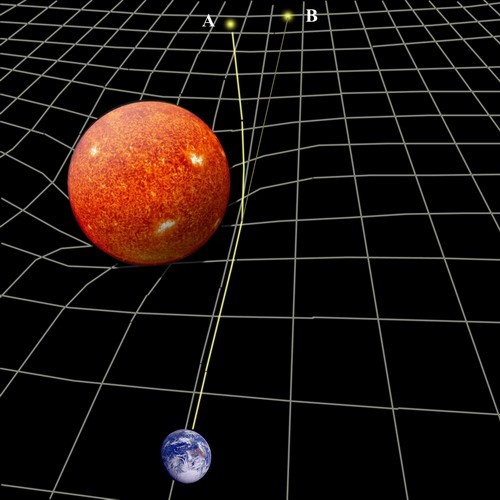
In his General Theory of Relativity, Einstein showed that matter causes space to curve, as in this illustration of starlight being bent by the sun's gravity.

But Einstein did not stop there. As early as 1911, he had predicted that light passing near a large mass, such as a star, would be bent. That idea led to his General Theory of Relativity in 1916. This paper established the modern theory of gravitation and gave us the notion of curved space. Einstein showed, for example, that small masses such as planets form dimples in space-time that hardly affect the path of starlight. But big masses such as stars produce measurably curved space.

The fact that the curved space around our sun was measurable let other scientists prove Einstein’s theory. In 1919, two expeditions organized by Arthur Eddington photographed stars near the sun made visible during a solar eclipse. The displacement of these stars with respect to their true positions on the celestial sphere showed that the sun’s gravity does cause space to curve so that starlight traveling near the sun is bent from its original path. This observation confirmed Einstein’s theory, and made Einstein a household name.

Interestingly, Einstein’s theories contained elements he himself could not accept. In some ways, he was loathe to break too much from the Newtonian/Maxwellian theories upon which his work was built.

He never accepted some of the precepts of quantum mechanics, for example, such as the idea ofindeterminacy. By the late 1920s, quantum mechanics had moved to the forefront of modern physics, yet Einstein never fully accepted many of the new theories. He declared:God does not play dice.

Also, Einstein’s 1916 theory suggested that the universe should be either expanding or contracting. Einstein could not accept that notion, and so in 1917 he introduced a cosmological constant into his theory, which would allow the universe to be stationary. In 1929, however, Edwin Hubble obtained observational evidence that the universe is indeed expanding. Einstein was forced to revise his theory. He called introducing the cosmological constant his greatest blunder.

This part of the Einstein legend illustrates, perhaps, a reason for his global popularity. The great genius could envision mechanisms of the universe in a way many of us have trouble even grasping. His imagination gave him answers to questions most of us would not think to ask.

Yet he remained prone to biases and frailties and thereby thoroughly human … just like the rest of us.

Bottom line: Albert Einstein was born on March 14, 1879. He published his Special Theory of Relativity in 1905 and his General Theory of Relativity in 1916. His work capped off the work of several previous centuries of science … and launched modern physics.

SOURCE:::::www.earthsky.org

Natarajan

Joke of the Day…” Message to Moon…” !!!

I used to be a taxi driver but I had to quit…

I couldn’t stand people talking behind my back.

…………………..

When NASA was preparing for the Apollo Project, it took the astronauts to a Navajo reservation in Arizona for training. One day, a Navajo elder and his son came across the space crew, who were walking among the rocks.

The elder, who spoke only Navajo, asked a question. His son translated for the NASA people:

“What are these guys in the big suits doing?”

One of the astronauts said they were practicing for a trip to the moon. When his son relayed this comment, the Navajo elder got all excited and asked if it would be possible to give the astronauts a message to deliver to the moon.

Recognizing a promotional opportunity when he saw one, a NASA official accompanying the astronauts said, “Why certainly!” and told an underling to get a tape recorder. The Navajo elder’s comments into the microphone were brief. The NASA official asked the son if he would translate what his father had said. The son listened to the recording and laughed uproariously. But he refused to translate.

So the NASA people took the tape to a nearby Navajo village and played it for other members of the tribe. They too laughed long and loudly but also refused to translate the elder’s message to the moon.

Finally, an official government translator was summoned. After he finally stopped laughing, the translator relayed the message:

“Watch out for these guys! They’ve come to steal your land.”….

SOURCE:::::: http://www.joke a day.com

Natarajan

Riddles For the Weekend….

Riddle Time: 12 Challenging Brainteasers

Get ready to put on your thinking cap. It’s time to rack your brain with these 12 riddles. 
1. I am only useful when I’m full, yet I am always full of holes. What am I?


A sieve (used for straining food like pasta).

2. Fill in the blanks with four, four-letter words that all share the same first three letters.

Samuel the secretive Scotsman was dressed to ____ in his twill woven ____. Little did they know he had a ____ of marijuana stashed away as he innocently warmed his hands by the Scotch ____.


Kill, kilt, kilo, kiln

3. What is special about the number 854,917,632?


It is the numbers from one to nine in alphabetical order.

4. It stalks the countryside, with ears that cannot hear. What is it?


Corn

5. A word with horizontal symmetry is one whose letters are a mirror image of themselves. If you drew a horizontal line across the word and folded it over, it would overlap on itself. Examples: EXCEEDED and ICEBOX. What is the longest word with horizontal symmetry?


CHECKBOOK

6. I travel a lot and meet both the rich and the poor, but nobody knows where I am going next. I’m invisible but you can see what I do. Who or what am I?


The wind.

7. King Ferdinand has no immediate living relatives and decides to hold a contest to find a worthy successor for when he dies. He gives a seed to every contestant and explains that the person with the healthiest and most beautiful plant will win the throne.

When the final day of the contest arrives, the king finds hundreds of plants of all shapes and sizes. However, he ignores them and awards the throne to a girl holding a pot with only moist dirt. Why did she win?


King Ferdinand was a kind and trusting man and wanted to be sure he found an honest heir. He gave small pebbles to all the contestants, claiming they were seeds. Therefore, any contestant with a plant had switched their “seed” in order to win. Everyone but the girl had been dishonest.

8. What can go up a drainpipe down but not down a drainpipe up?


An umbrella.

9. What word could be added to all of these words?

  • apple
  • cone
  • lake
  • tree
  • ridge
  • nuts


Pine.

10. What goes up and down but doesn’t move?


A staircase.

11. Brandon was walking around at the carnival. A man called out from a booth and said, “If I can write your exact weight on this piece of paper, you have to pay me $50. If I can’t do it, I’ll pay you $50.”

Brandon checked the booth for a scale but saw nothing. He agreed. Since your weight can fluctuate by a pound or two, he decided that no matter what number the man wrote, he would just say he weighed a pound more or less. In the end, the man in the booth won the $50. How did he do it?


The man in the booth wrote the words, “Your exact weight” on the piece of paper.

 
12. You can have it, and be at it, but it never lasts forever. What is it?


Peace

H/T: riddlesbrainteasers.com

SOURCE:::: http://www.ba-bamail.com

Natarajan

Image of the Day… ” Return of Expedition 42 to Earth ” …

The Soyuz TMA-14M spacecraft is seen as it lands with International Space Station Expedition 42 commander Barry Wilmore of NASA, Alexander Samokutyaev of the Russian Federal Space Agency (Roscosmos) and Elena Serova of Roscosmos near the town of Zhezkazgan, Kazakhstan. The landing took place on the evening of Wednesday, March 11 in the U.S, and early in the morning on Thursday, March 12, in Kazakhstan.

The three crew members returned to Earth after a 167-day mission on the orbital outpost that included hundreds of scientific experiments and several spacewalks to prepare the orbiting laboratory for future arrivals by U.S. commercial crew spacecraft.

SOURCE:::: http://www.nasa.gov

Natarajan