Hyderabad Girl Scripts History, Wins India’s First Gymnastics Medal in World Cup…!

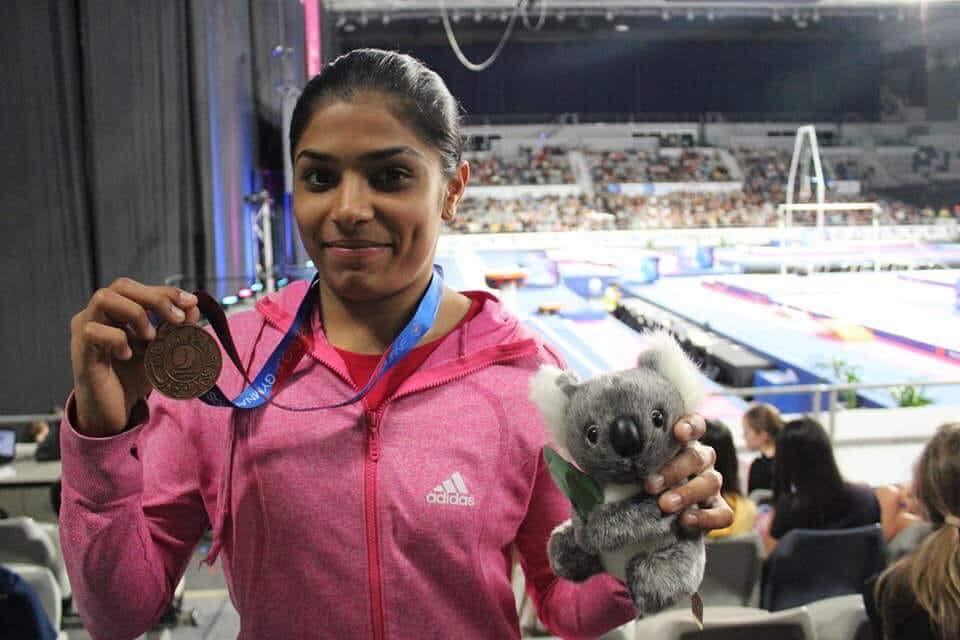
The Gymnastics World Cup 2018 in Melbourne will go down in history as India got its first ever bronze medal in the women’s vault event.

The feat was achieved by Aruna Reddy, who finished after Slovenia’s Tjasa Kysslef and Australia’s Emily Whitehead, with a score of 13.649. A total of 16 countries were part of the World Cup series event this year.

The 22-year old dedicated her stupendous win to her late father, B Narayana Reddy, who had been instrumental for his daughter’s entry into the field.                     

Aruna with her Bronze medal. Source: Facebook.

Realising that Aruna had the agility and build for a gymnast, Narayana had her enrolled at the Lal Bahadur Shastri stadium in Hyderabad at the age of five.

“I owe everything to him, and if he had been alive and seen me on the podium today, he would have been so happy. He was there in my days of struggle, but couldn’t watch me win,” said an emotional Aruna to The Indian Express.

The Hyderabadi lass, who is a former black belt and Karate trainer, had initially trained under the guidance of coaches Swarnalatha and Ravinder. Later, Swarnalatha’s husband Giriraj took over as Aruna’s mentor after realising her immense potential and was her instructor until his untimely death in 2008.

Then, coach Brij Kishore took Aruna under his wing, and it is under his guidance that the budding gymnast blossomed and went on to clinch many medals at three National Games she had participated in, with the first one being in 2005.

In 2014, Aruna had aroused some hope for Indian gymnasts when she secured the 14th position at the qualification round of Vault apparatus at the Commonwealth Games along with a ninth place finish at the Asian Games.

Aruna came back to the fore when she had finished sixth in Vault during the 2017 Asian Championships.

The young athlete is determined to give her finest performance in the upcoming international events.

“The sad thing about this sport is that once you cross the age of 23-24, it becomes difficult to perform because the body doesn’t remain as flexible. A gymnast’s career is short. That’s why I want to make the most out of things before I turn 23,” she told Deccan Chronicle.

Aruna is also part of the Indian gymnastics contingent for the 2018 Commonwealth Games which will be held in Gold Coast, Australia.

We congratulate the young woman on her extraordinary win and wish her luck in all her future endeavours.

Source….www.the betterindia.com

natarajan


THE ANCIENT STONE IN LONDON THAT IS SUPPOSED TO BE IMPORTANT BUT NO ONE REMEMBERS WHY…!!!

Sitting in the heart of London since long before anyone can remember, theories regarding the London Stone range from Roman ruin, to Druidic icon to a talisman of good fortune.

Although many point to John Stow’s Survey of London(1598), where he sets the 10th century as the first mention of the stone in print (he claims he found a mention of the stone in a document from the 900s AD), others feel more comfortable citing a list of Canterbury Cathedral’s properties from somewhere around the turn of the 12th centuries, where it lists Eadwaker æt lundene stane.

Regardless, by medieval times, the London Stone was a fixture in the city, so much so that residents even incorporated it into their names, such as Ailwin of London Stone. Clearly important, by the 15th century the landmark was seen as a symbol for London, and perhaps England; this helps explain why, when Jack Cade led a rebellion against Henry VI in 1450, he reportedly struck the London Stone with his sword in claiming the city for himself, as immortalized by Shakespeare in King Henry VI, Part II, Act IV, Scene VI.

In the 16th century, one popular theory for the stone’s origins was that it had been used by the Roman’s during their occupation (approximately 43 AD – 410 AD) as a millarium or central milestone from which all distances were measured. Charles Dickens even cited this explanation in his Dictionary of London (1879).

During the 18th century, some were speculating that the stone was used in worship by the Druids, although there is no evidence to support it.

In the 19th century, as interest in spiritualism became more widespread, some theorized that the London Stone was a Palladium or talisman dating back to Roman times and Britain’s legendary founder. It was during this time that the now well-known saying appeared: “So long as the Stone of Brutus is safe, so long shall London flourish.”

By the 20th century, serious archaeologists began digging into the London Stone’s origins, and some found that it is situated at the center, or at the gate, of where a large Roman structure, sometimes identified as a Governor’s palace or pretorium, had been.

Today, those who believe in ley lines, straight “lines” that connect sites of historical or geographical significance, claim that the London Stone is transected by several of these lines, while others have posited that the stone was set in the center of the old Roman city, in homage to Jupiter.


Source….www.today i foundout.com

Natarajan


வாரம் ஒரு கவிதை… ” எங்கும் எதிலும் “

எங்கும் எதிலும்
————–

photo-1485546246426-74dc88dec4d9

எங்கள் வங்கியில் எங்கும் எந்த ஊரிலும்
எந்த கிளையிலும் நீங்க உங்க பணம்
பெறலாம் ..பணம் கட்டலாம் என்று
சொன்னது என் வங்கி …மகிழ்ந்தேன் நான் !
வங்கிக்கு செல்லும் வீண் சங்கடம் எதுக்கு
உனக்கு…. உன் வங்கி கணக்கு விவரம்
இப்போ உன் மடிக் கணினியிலும் கைபேசியிலும்
சொன்னது மீண்டும் என் வங்கி !
வங்கியே என் கையில் இப்போது ..எங்கும் எப்போதும் !
பணம் எடுக்க ATM …எங்கும் எதிலும் எப்போதும் !
விண்ணில் பறந்தேன் நான் …மண்ணில் இல்லை
என் கால் !
எங்கும் எதிலும் எப்போதும் பண பரிமாற்றம் !
உங்க வங்கிக்கு நீங்க வரவே தேவை இல்லை
உங்க வங்கி கணக்கு இப்போ உங்க கையில்
என்றும் சொன்ன என் வங்கி இருக்குதா
அதே இடத்தில் என் பணத்துடன் ?
இன்று சென்று பார்க்க வேண்டும் நான் !
எங்கும் எதிலும் நானாவது கவனமாக
இருக்க வேண்டாமா ? என் வங்கியில்
இருப்பது என் பணம் அய்யா !
Natarajan
in http://www.dinamani.com dated 25th Feb 2018

At 103, This Karnataka Man is one of the oldest Drivers on the Country”s streets Today …

Willy’s, Morris Minor, Fiat, Austin, Ferguson, Mercedes Benz, Chevrolet, Volkswagen – these are just among the few brands 103-year-old CSR Michael D’Souza has driven.

A veteran of World War II, Michael has been driving for the last 85 years.

But giving up his car keys is simply not an option for him. “I enjoy driving and never got tired of it. I will continue to drive till the lord sends me his vehicle,” he smiles.

A native of Ooty, Michael was born to Charlson and Mary D’Souza on October 16th, 1914. Michael’s first tryst with a vehicle was at the age of 18, when he and his 13 siblings drove around Ooty in his father’s truck.

“The licence issued then was a page-long and it was applicable for all vehicles. Unlike today, there was no such thing as a licence based on vehicle category,” he says.

In 1932, he was enlisted in the British Army for 10 years and during his service he travelled to different parts of the country.

“However, due to the loss of my original military documents during transit in Visakhapatnam, my post-service benefits were denied to me. Though I appealed to my superiors for several years, I gave up realising it was a lost cause,” he says.

Meanwhile, Michael married Eliza, and the couple moved to the erstwhile Madras Presidency. Though they had no children, it was a happy marriage, he says, and they regarded the children of his elder brother as their own.

A few years later, Michael joined the Public Works Department (PWD) in Mysore and later he was transferred to Mangalore. At PWD, Michael had the chance to drive the general purpose vehicle, affectionately called ‘Jeep’ (GP). He also was given the opportunity to drive a truck, tractors and even road rollers.

“It was quite an experience, since the department barely had qualified man-power to operate such heavy-duty machines. I was asked to drive everything and I took the opportunity to make the most of it,” he laughs.

In fact, several roads in Mysore, Udupi and Mangalore were first asphalted and sealed when he drove the road roller over them.

In 1982, he retired from service, but the couple stayed on in Mangalore.

Michael got his first license in 1959, and he has renewed it constantly since then.

“On my last visit, the RTO inspector said in jest that should I make it for my next renewal in 2019, then he will award me the permit driving for a lifetime,” Michael smiles.

Considering he has driven so many vehicles, which one does he prefer?

“The GP,” he says, without missing a beat. “It does not skid and in unstable territory you can also shift to a lower gear and drive.”

He has only driven a two-wheeler once. “I got so dizzy, I stopped immediately. I am only cut out to driver vehicles with four wheels or more,” he says.

Except for a brief period in 1993 when he had a cataract surgery, Michael has never stopped driving. At the ripe age of 103, his medical records show that he is incredibly fit for his age and shows no signs of age-related ailments.

His secret, he says, is his diet, which comprises rice, curd, chapathi and bread. Although, up until a couple of years ago, he used to consume meat frequently, lately he has reduced his intake of non-vegetarian food.

“As our age progresses, I believe we should not strain our stomachs. Therefore, nowadays I eat meat only rarely,” he says.

He is also incredibly active – no matter the number of floors, he always takes the stairs.

After Eliza passed away in 2013 – at the age of 83 – Michael’s routine changed. He now wakes up at 4 am every morning to tend to his garden and feed his cat, dog and birds. “Earlier, I used to even have a goat, a chicken and a duck. My wife was very irritated with the tortoise I had, so I had to give him up,” he says.

Always dressed in a formal shirt, pants and a golfer’s hat, Michael still works – he now drives for a local banker and his family. The one concession he does make for his age is that he now avoids going on long drives and driving late in the night.

What does Michael think of drivers today? “Terrible!” he shakes his head. “People just don’t follow lane discipline any more. It’s horrible the way autorickshaws and two-wheelers switch lanes these days. One of the main reasons I don’t drive in the evening is how people thoughtlessly switch on their high beams even on well-lit roads. It can easily lead to an untoward incident.”

In his 85 years behind the wheel, Michael says he has been fined only once for not wearing a seatbelt. “Three months ago, when I was fined, I went to the station to pay the fine. The inspector took the receipt, laughed when he saw my age and the fact I was being fined for the first time, and said he will pay the fine on my behalf and let me go,” smiles Michael.

Ironically, Michael does not own a car, although the centenarian does not regret it. “As long as I am allowed to drive a car, I don’t have any qualms about it,” he says.

Content provided by Story Infinity (Subs and Scribes Media Ventures LLP).

Source….Harsha Raj Gatty in https://www.thenewsminute.com/

Natarajan


He is 100 and She is 99…Meet the Kerala Couple celebrating 82 years of Marriage …

The Kottayam-based couple studied in the same school and later went on to marry.


Ask Madhavan Nair and Meenakshi Amma for how long they have been married, and 99-year-old Meenakshi Amma creases her forehead, as if lost in deep thought. Sitting beside her, 100-year-old Madhavan Nair does not need much prodding to remember the year they got married – Malayalam calendar year 1111.

Meenakshi Amma nods in agreement.  “See, he still remembers it so clearly!” she says, breaking into laughter.

(Malayalam calendar year 1111 is the year 1936. According to Malayalam calendar, 2018 is the year 1193.)

The duo celebrated 82 years of their marriage in December 2017 and the milestone also coincided with Madhavan Nair’s 100th birthday.

In their house near Pallikkathode in Kerala’s Kottayam district, Madhavan Nair – who used to be an active member of the Congress party – and his wife Meenakshi Amma, continue to live their “happily ever after” to this day.

When TNM visited the couple, Madhavan Nair and Meenakshi Amma shared their eight decades-long love story. Although the duo first met in school at the age of 8, little did they know that the coming years would bring them together. After a few years of studying in the same class, both Madhavan Nair and Meenakshi Amma moved to different schools.

Together in youth and old age

Having known each other since a very young age, Madhavan Nair and Meenakshi Amma have retold their wedding story many a time to their children, explaining how theirs had been an arranged marriage and not a love marriage. The couple have five children together, all of whom stay in Kottayam.

“It is true that we knew each other from school. We had seen each other, but hadn’t spoken much. What do school kids have to talk to each other at that age? Years later, our families decided to get us married. So that’s how it happened,” Madhavan Nair says.

Asked about the wedding, Madhavan Nair’s recollection is matter-of-fact: “It was a simple ceremony, no pomp and show like today’s weddings. The wedding took place at her (Meenakshi Amma) house. I tied the thaali around her neck, gave her the pudava (saree) and there was a meal afterwards. That’s how simple the wedding was.”

After a moment’s pause, Madhavan Nair continues: “During our times, nobody got married in temples like now, and young people never eloped! The weddings used to happen at the brides’ house.”

When asked whether they feel the weight of 82 long years, the two of them smile. This writer was charmed to see Madhavan Nair’s toothless grin while Meenakshi Amma guffawed loudly, displaying her perfectly aligned teeth.

The years where Madhavan Nair was involved in party and social work had not been easy on his family, he admits. The odd working hours and the long absence from home did not exactly bode well for a harmonious family life. But Meenakshi Amma is in no mood to send her husband on a guilt trip.

“People would come to get him. He would go with them and share whatever knowledge he had. It never bothered me, since I knew he was going on work and not for anything else. He would return home after work for sure,” Meenakshi Amma says.

However, Madhavan Nair has for long withdrawn from his years of active social life, and now spends most of his time at home. While minor health issues do trouble Meenakshi Amma, Madhavan Nair likes to dismiss age-related woes.

Despite having to rely on a walking stick, the 100-year-old is young at heart.

“I walk around the house and the yard at times. With this walking stick, I can walk as far as I can. But I am not so young any more, I have no teeth left and I don’t think I look good with this toothless grin!” Madhavan Nair says.

Visuals by Lenin CV

Source….Megha Varier in https://www.thenewsminute.com

Natarajan

When your parents agree to watch your children, this is a convenient arrangement in every respect, but in order for it to work best for all parties, it is important to have some basic rules so that your parents don’t feel like substitute parents or like they are “working for you.” If you stop asking for their help and start demanding it, if you want them to follow all your rules, and if you involve your partner in arguments between you and your parents, you should reconsider your behavior and read the following tips for maintaining a relationship with grandparents who care for their grandkids.

1. Don’t take your parents for granted

Within our family unit, we tend to forget that those around us are people with needs and limitations of their own, just like us. This is even truer when our parents become caregivers to our children. Although grandchildren sometimes seem to be a source of happiness and enjoyable pastime for your parents, remember that they have other interests. Don’t assume that your parents are always available for you or want to help all the time. Ask for help and don’t demand it, and know when you should hold back and not burden them, even considering their age limitations.

If your parents took care of your children all week, you might want to reconsider asking them to babysit Saturday night. Despite the grinding routine, it must be remembered that our parents also need their own free time, a listening ear and someone who would like to spend time with them talking about things that concern them. Look for shared time with your parents where you can recharge them with energy and build up your relationship.

2. Be a little laxer on your rules

Every parent has rules and methods when raising their children; some don’t want their children to watch television, some don’t want them eating candy, and some schedule tutors immediately after the kids come home from school. Whatever your rules are, when your children are under your parents care for a long time, you may need to be a bit more flexible with your rules.

Keep in mind that your parents can’t meet all your conditions and expectations and might even choose to break your rules, whether it’s because that’s what they’re used to, or maybe because they want to spoil and treat their grandkids. As long as your parents do not do something that compromises your child’s physical and mental well-being, think your rules over, and decide which one you can be more flexible with, and which ones you aren’t budging on.

3. Offer payment for special expenses

Even if in most cases your parents won’t ask for compensation for taking care of your children, remember that they have additional expenses on the days they take care of and spend time with your little ones. If grandparents take the grandchildren for a meal at a restaurant, for a day at the mall, or to the zoo, the experience usually involves quite a bit of an expense. Offer to pay them back, or even leave some money with them beforehand. Even if the offer is rejected by your parents, be sure to offer them money from time to time to show them that their help isn’t expected or taken for granted.

4. Say thank you and buy them a gift

Your parents don’t take care of their grandchildren in order to receive a gift. They do so for a variety of reasons related to helping you and just loving and wanting to spend time with their family. Despite all this, all of us, old and young, need recognition and reinforcement. Thank your parents and don’t take their help for granted, even if they’re guilty of doing so themselves. Buy them a nice gift and write a thank you card to remind them of your appreciation of their dedication and help. In order to repay your parents in another way, try to help them in areas where they have difficulty as in small renovations or house maintenance.

5. Don’t involve your partner in arguments with your parents

It is natural and common for you to have occasional disagreements with your parents about issues related to the care and education of your kids, and it’s even recommended that you have an open conversation with them about the issues that concern you, but be sure to do so without involving your partner. Your parents may feel uncomfortable or even attacked, in the presence of a more distant person like your spouse, even if they like and get along with them. If you can’t overcome the problem alone, you can lean on your partner for support, but first, try to talk to your parents privately and remember that they have only good intentions for you and their grandchildren.

6. Encourage your child to respect your parents

Do you come across situations where your children are cheeky to your parents? Do they demand instead of ask, treat your parents with contempt and perhaps maybe even curse them out? Just before you scold them, ask yourself whether your children are just copying the nature of the relationship they have seen between you and your parents. Remember that personal example is the main way children learn about relationships.

Beyond setting a personal example, make sure to praise and thank your parents in front of your children; you can tell them for example how Grandpa once managed to fix the car during a family trip or how Grandma sewed you the most beautiful costume in school. Beyond that, it is important that you teach your child how to deal respectably with arguments and disagreements in general, and with their grandparents in particular.

7. Clean up after yourself

After a whole day in the company of children, everyone’s house looks completely different – toys everywhere, puzzles scattered all over the floor, half-eaten candy and dirty dishes all over the place. It may be that in your home this doesn’t really bother you, but when your children spend time with your parents, it isn’t fair to leave their home messy. Make sure that the kids clean up the mess they made, and do it yourself if your child is too young to do It themselves.

8. Make your home accessible to parents

Technology has become a part of our lives whether we like it or not. Even those who are deterred by innovations have to adapt to a new era and can even finally discover that they like the new possibilities. Many of our parents have a smartphone and a Facebook account and get along very well.

However, it is worth remembering that each device and software has its own complex operating system. When your parents come to your home to watch your children, let them feel comfortable and give them access to all the tools you have in your home. Be sure to explain to your parents how to operate all electronic devices putting special emphasis on the TV, computer, microwave and other appliances that they will most likely want to use.

9. Don’t have your parents cook and clean

You may never have asked your parents to fold your laundry or cook dinner. They just see a pile of clothes on the sofa in the living room and fold it on their own. But what starts out as a small initiative can become an abysmal routine in which most household chores, including cleaning, cooking, children’s showers and even homework help, are done by your parents. In some cases, your parents also drive your kids to afterschool activities.

You may think that your parents are just doing these things to kill time, but no one actually wants to do these menial tasks, especially considering that your parents have to clean up their own home. Just let your parents know that that isn’t something they have to do, and to just enjoy the time with their grandchildren.

Once your kids get older and you no longer need your parents to watch them, they’ll be teenagers managing their own schedules. In order to maintain the relationship between them and keep it deep, mutual and ongoing, make sure that it isn’t based solely on supervision and fulfillment of tasks.

Encourage your children to get off their phones and talk to their grandparents, take an interest in them, discover more of their life story and family heritage. On the other hand, encourage your parents to play with their grandchildren and open up to them not only as grandparents but as human beings. You will find that even when your children grow up and get older, they’ll still want to visit their grandparents and the bond between them will accompany them for the rest of their lives.

Source….www.ba-ba mail.com
Natarajan

Will Chennai be able to save a 300 year old Plaque connecting it to its Armenian Past …?

The plaque is the last living relic of the Marmalong, the first ever bridge built over the Adyar river in 1726 by Armenian trader Coja Petrus Uscan.


If you take a walk across the busy roads of Saidapet in Chennai, chances are that you would cross what is perhaps one of the oldest living relics that connects the city to its Armenian past.

To the uninitiated, it may look like an unremarkable slab of stone on a pale green crumbling wall. However, this ordinary looking slab of stone is in fact a 300-year-old plaque that belonged on the pillars of one of oldest bridges in the city.

Marmalong Bridge, the first ever bridge across the Adyar river, was commissioned in 1726 by Coja Petrus Uscan, an immensely wealthy Armenian trader. Uscan, who had decided to settle in Madras after coming to the city in 1724, paid 30,000 pagodas from his own money to build the bridge and another 1,500 pagodas for its upkeep.

“Uscan was immensely respected and perhaps was even one of the only non-British allowed to stay in Fort St George or the White town. A devout believer in St Thomas, Uscan wanted more people to visit the Saint Thomas Mount, and therefore removed the two impediments – the river and the lack of steps – by building the bridge as well as 160 steps to the mount. This was the initial purpose of the bridge. But all that soon changed as the Marmalong Bridge became crucial to the expansion of the city, especially towards the South,” says Chennai-based novelist and historian Venkatesh Ramakrishnan.

Mount Road came after the bridge


 Mount Road, around which the city developed, came 60 years after the Marmalong bridge.

Named after Mambalam, one of the villages near the Adyar, the Marmalong Bridge perhaps laid the foundation stone for the city as it led to the emergence of the Mount Road, around which Chennai developed.

“It was only natural that a road followed after a bridge was built. The British built the Mount Road in the 1800s, around which the city grew. So, in a sense, the bridge led to the city’s birth and is very close to its heart,” Venkatesh adds.

However, the Marmalong only lives in our memories today. Where the arched bridge of Uscan once stood, a concrete replacement called the Maraimalai Adigal Bridge now exists. There are no traces of this Adyar-Armenian connect but for the last living relic – the plaque commemorating Uscan’s construction of the bridge.

With inscriptions in three ancient languages – Persian, Armenian and Latin, the Uscan plaque was established in memory of the great nation of Armenia and is a tribute to the people who helped build the city.

“The Armenian inscriptions are on the lower portion of the plaque. It can’t be read because the writing has faded with time and neglect,” according to Venkatesh.

Crusade to preserve the plaque


The neglected plaque stands near the Saidapet Metro construction site. 

Displaced from its original site, the plaque faces the perils of urbanisation and is further threatened by the metro rail work that is underway.

Years of neglect and development in the area has buried the stone in layers of debris. In fact, the bottom of the stone has disappeared under the ground as the road levels have been rising every year due to re-carpeting, Venkatesh laments.

With the construction of the Saidapet Metro station underway, historians who are fighting to save the plague urge the CMRL to give the stone a place of honor in the metro station.

Highlighting the importance of preserving such relics, Venkatesh says, “The Armenians have contributed immensely to this city. I believe it is important to preserve all traces to this link. It is really unfortunate that while the Uscan stone stands neglected, another plaque at the Fourbeck Bridge is preserved by the Architectural Society of India,” he said.

A dedicated group of Chennai historians have launched a Facebook page “Retrieve Uscan Stone” to draw attention to the issue and save the plaque.

“The Saidapet Metro work is too close to the plaque. We have been urging the officials to move the relic to a better place, may be a museum or a memorial site. We just don’t want to lose a precious piece of the city’s history,” Venkatesh says hopefully.

Source….https://www.thenewsminute.com

Natarajan


5 People Who Survived the Unimaginable…

We are all going to die – ideally from old age and in our sleep, less ideally from the Universe concocting a terrible, inescapable, and painful end just for us. Fortunately, there’s no such thing as a totally inescapable scenario. Once every now and then, a person finds themselves face-to-face with Death and decides to yank the robes from under his feet and make a quick getaway. Below you’ll find the stories of five such people.

1. A Paraglider Naps Her Way across the Upper Atmosphere

In February 2007, German paraglider Ewa Wisnerska was sucked into an unexpected thunderstorm in Australia. As testimony to that storm’s intense hatred of flying people, a Chinese paraglider had been pulled into that exact same storm earlier that day. His lifeless body was found 50 miles away.

Not content with just the one victim, the storm nabbed Ewa mid-flight and dragged her high into the air. At 3,000 feet, her exposed skin was frostbitten. Her glasses, like the rest of her clothing, were covered in ice so thick that she couldn’t even make out her own glider – which the violent weather kept collapsing, so she had to constantly battle to keep her glider in working condition.

At 20,000 feet, the air temperature was down to -58 degrees Fahrenheit, and ice had encased her entire body. The lack of oxygen also caused her to pass out. You really wouldn’t expect to wake up from a nap like that.

The previous record altitude for a paraglider was 24,000 feet. Geese fly at 27,000 feet and so did Ewa, briefly, on her way to 29,035 feet – which is the exact height of the summit of Mount Everest. At this point, the storm was getting frustrated that she was still alive, so it lifted her up to 30,000 feet just to see if she could survive the cruising height of a passenger jet, without the jet. She could.

At 32,000 feet, the storm gave up and she began to descend. At 23,000 feet, she woke up and realized that she had no way to brake or steer (due to her frozen hands), so she rode out the storm and hoped that she’d eventually land safely. Which she did, 40 miles from her starting point.

Apart from some bruising and frostbite damage, she was perfectly fine. This is probably because she was unconscious for most of the flight. Your heart rate slows when you’re out cold, and this would have played a huge part in her survival.

2. Jacob Miller Sleeps Off Headshots

The Battle of Chikamagua in Tennessee during the Civil War was the second heaviest Union defeat after Gettysburg, with around 36,000 casualties. One of these casualties was Jacob Miller, who was shot between the eyes on September 19, 1863.

Miller’s Union allies thought he was dead so they left him behind. The Confederate army thought the same and walked right over him as they pushed forward. They didn’t know that Miller had the ability to sleep off a headshot.

When he woke up with a new hole in his head, he realized that he was now at the back of the Confederate line. So, using his gun as a crutch, he waddled along parallel to the fighting until he could pass back over to the Union side. Since his uniform was drenched in blood, the Confederates didn’t recognize him as an enemy.

After making it back to friendly turf, the surgeons refused to remove the bullet as they told him he was going to die anyway. In fact, the Union troops were about to retreat again, and the doctors deemed Miller too sick to move, so it looked like he was going to be left behind again.

Miller was having none of this and started retreating with them. His face was now so swollen that he had to manually lift his eyelids to see where he was going. He kept retreating with the Union troops, with no intention of stopping and dying. Eventually, he was picked up by an ambulance wagon.

Nine months after the incident, doctors finally got around to removing the shot from his head. The bullet hole never closed, and although Miller would go on to live a long life, he spent the next thirty years sweating bullets, as pieces of the shot would occasionally make their way out of his wound.

3. A Man Elbows His Way Out of a Watery Grave

In early 2017, Jake Garrow was plowing the snow from an ice road in Ontario, Canada, when his skid loader hit an unexpected thin patch and plunged into the frozen waters, taking Garrow with it.

For the majority of us, sinking 100 feet to the bottom of a freezing lake is a terrible way to go, but Garrow is not most of us. As he sank, he looked around for the cord release that would pop the back window open. Unfortunately, he couldn’t find it. So rather than fumble around futilely, while water rushed into his cab, Garrow smashed the back window using his elbow.

Now he was free from his skid loader, but he still had to swim 100 feet through pitch-black, ice-covered water and hope that he could find the hole that he fell through. Miraculously, he managed it, and emerged from the ice with little more than a perforated eardrum.

However, his ordeal wasn’t over yet. Garrow had to walk a mile to the main road in soaking wet clothes with a wind chill of -22 degrees Fahrenheit, and then stand at the side of the road freezing because not a single motorist stopped for him.

He only managed to get a ride to the hospital because a familiar contractor happened to drive by. To add to his plight, Garrow was contacted by the Ministry of Environment and was told to get his skid loader out of their lake by June.

4. Everything That Could Go Wrong With a Spaceship Landing Did

In 1969, at the height of the space race, Russian Cosmonaut Boris Volynov was flying a solo re-entry into Earth’s atmosphere on Soyuz 5. He was returning after having just dropped off two colleagues on another ship, and unfortunately, designated driver gigs are as awful in space as they are on Earth. During re-entry, the equipment module on Soyuz 5 failed to detach, which messed up the balance of the spacecraft and caused it to turn around.

This was a major problem, as the heat of bursting through Earth’s atmosphere was expected to burn away a good three inches of the special ablator coating in the thicker side of the vessel, which had a good six inches of it. Unfortunately, Volynov was now flying back into Earth backward, and the side of his ship facing the flames was just a mere inch thick.

To add to this, his body was also being submitted to nine times the gravitation force of Earth, making all attempts to fix the dire situation border-line impossible. At this point, ground control was already busy passing around a hat to collect money for his family. Volynov was facing certain death until he suddenly noticed something: The malfunctioning part of the ship that had failed to detach was also getting sheared off by intense heat. Summoning all his strength, he managed to maneuver the Soyuz 5 to its correct position in the nick of time.

Problem solved! Well, not exactly. He had new problems to contend with. The ships parachute had taken damage and could only partially deploy. To add to this, the rockets designed to soften the landing had also failed completely. Soyuz 5 hit the ground like a meteor. Volynov survived this too, but he was thrown around the cabin and broke a number of teeth.

He now had another problem to contend with. He had landed in the Ural Mountains, far away from his intended landing spot in Kazakhstan. The weather outside was -36 degrees Fahrenheit. If he stayed put, he’d be long dead before anyone rescued him.

When the rescue team arrived hours later, they found an empty Soyuz 5. However, they followed a set of footprints, peppered with blood and bits of teeth, and found Volynov warming himself in a peasant hut, which he had managed to locate by following a distant column of smoke.

5. Scientists Witness a Volcanic Eruption… From Inside the Volcano!

In January 1993, a group of scientists from 15 different countries gathered in Colombia to assess the danger of the 9,000 foot Galeras Volcano, which has irrupted irregularly for centuries. The volcanologists thought it would be fairly safe as it had last erupted six months earlier, and no seismic activity indicated that it would do so again. Therefore, 16 people ventured into its cone to gather samples and valuable information.

To its credit, the volcano waited until the most dramatic moment to launch its attack. An hour earlier, and all the scientists would have perished as they stood right at the inner crater. An hour later, and they would have been at a relatively safe distance. But no, Galeras waited until they had just stopped work for the day, and still had a sporting (yet slim) chance of escaping. Then, and only then, did the ground start to rumble. The volcano erupted and sent a 90-story cloud of ash, smoke, and gas into the air.

Three scientists were hit with a blast of heat so hot that it reduced them to ash. Six were bombarded and crushed to death by scalding rocks. When the dust settled, nine scientists had been killed, and those who were still alive were seriously injured.

Dr. Stanley Williams, the leader of the group, was standing right by the crater’s rim when the eruption came. He managed to avoid the blast of heat, but was still assaulted by a maelstrom of white-hot boulders. A rock struck him in the head, instantly shattering his skull and sending bone fragments deep into his brain. He managed to stumble away, only to have his legs savaged by another rock bombardment.

That might have been the end for him, if it wasn’t for two of his colleagues, Marta Calvache and Patty Mothes. Both had inexplicably decided to climb toward the volcanic eruption to look for any survivors. They managed to locate Williams and drag him to safety.

Source….www.ba-bamail.com

Natarajan