The Rock Garden of Chandigarh….

It took years of planning and millions of Rupees to design one of India’s first planned cities, but Chandigarh’s biggest tourist attraction was not on the master plan of Swiss-French architect Le Corbusier. It was the product of creative imagination and fifty years of labor by a humble government official Nek Chand.

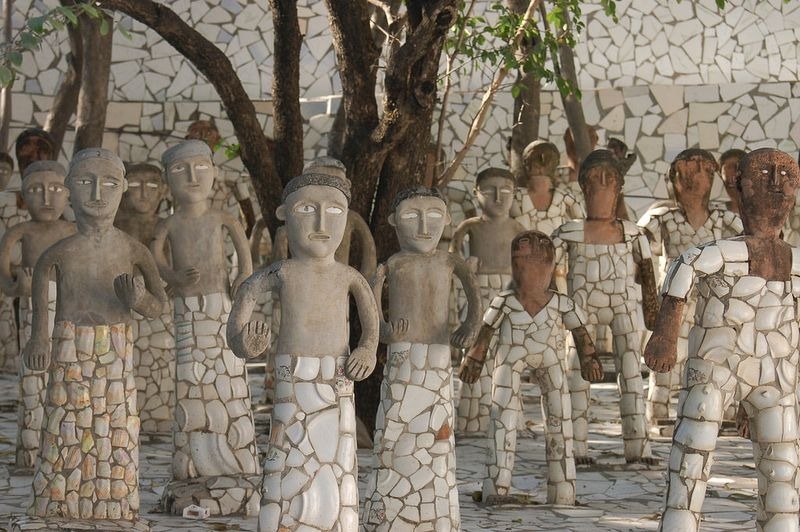
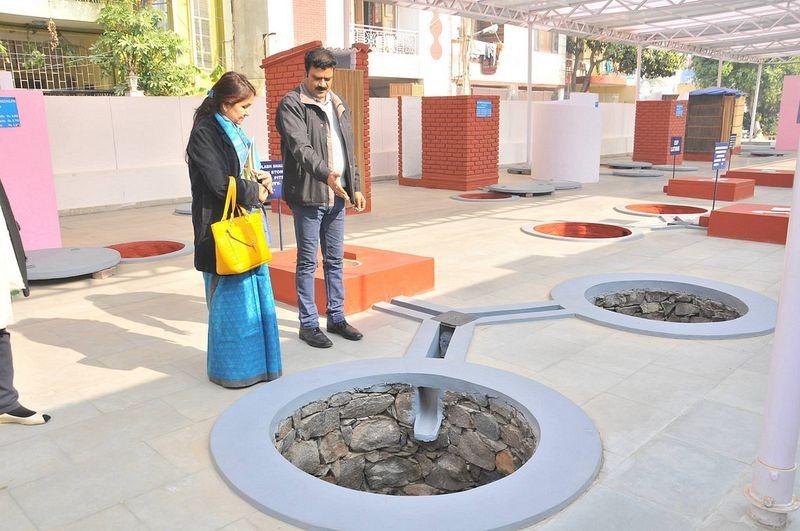
Nek Chand was a road inspector in the Engineering Department of Chandigarh Capital Project, in 1957, the year he started working on his secret sculptural project. Nek Chand would cycle to a gorge near Sukhna Lake, at the foothills of Shivalik hills, that was used as dumping ground for urban and industrial waste, and spend hours collecting discarded pieces of broken pottery, bottles, auto parts, plumbing materials, street lights, electrical fittings, broken sanitary ware and so on. He would carry the pieces to a nearby PWD (Public Works Department) warehouse and fashion them into artistic forms resembling humans and animals.

rock-garden-chandigarh-106

Photo credit: Kirk Kittell/Flickr

Nek Chand worked at night because he was afraid of being discovered. For eighteen years, he kept it this site a secret. By the time it was discovered, it had grown into a 12-acre complex of interlinked courtyards, each filled with hundreds of pottery-covered concrete sculptures of dancers, musicians, and animals. The Rock Garden, as it is called now, mesmerizes everyone who sees it. Today it is spread over an area of 40 acres, and is completely built out of trash.

At one point, soon after its discovery, the authorities wanted to demolish the park because Nek Chand didn’t have permission to build it, but the public intervened. In 1976 the park was officially inaugurated as a public space. Nek Chand was given a salary, a title (“Sub-Divisional Engineer, Rock Garden”), and 50 laborers so that he could concentrate full-time on his work.

In recognition of his work, Nek Chand was awarded the Padma Shri, the fourth highest civilian award in India. The Rock Garden also appeared on an Indian stamp in 1983.

rock-garden-chandigarh-22


Photo credit: Ian Brown/Flickr

rock-garden-chandigarh-32


Photo credit: Carlos Zambrano/Flickr


Photo credit: Ramnath Bhat/Flickr

Sources: Wikipedia / citcochandigarh.com / The Wire


Bartered, Gifted, Stolen, But Never Sold, the Elusive Kohinoor Diamond is Still Making History…!!!

Entrenched in history, having been passed down by some of the greatest rulers of massive empires in the Indian subcontinent, the Kohinoor diamond is the most desirable, priceless stone.

It’s a clear stone the size of a ping pong ball and it fits in the palm of the hand. But the Kohinoor Diamond is priceless, with a deep history engraved in its essence. The stone has seen bloodshed, violence, greed, wonder, deception and wars. It has seen men go mad with power, it has seen men fall from grace. It has seen the thirst, the hunger and the dreams that make humans essentially human. The stone has been brought down through the ages, changing hands and making history on its way.

The assertion of ownership over the stone is still an elusive decision. India, Pakistan and Afghanistan all want the stone back, claiming ownership, while Britain vehemently refuses to part with their most prized possession. As theIndian government claims to bring back to stone ‘amicably’, here’s a look at why this legendary, brilliant cut 106-carat stone is so remarkable and desirable.

From India to Present-day Uzbekistan to England

kohinoor

The Kohinoor Diamond on the royal crown

Source: Wikimedia Commons

According to legends, in the 13th century, the diamond was found in Guntur, in Andhra Pradesh. The first known record of the possession of the diamond was with the Kakatiya Dynasty in South India, and then with the Rajas of Malwa. When the Delhi Sultanate took over the South of India in 1300s, Alauddin Khilji held the stone in his palace.

In 1339, it was taken to Samarkand (present day Uzbekistan), which was its home for the next 500 years. Sultan Ibrahim Lodi gifted it to Babur. After three generations, it was passed on to Shah Jahan. Then his son Aurangzeb took over and imprisoned him, and guarded the stone with his life. It was passed on to Bahadur Shah I and later to his great grandson, Muhammad Shah. Being a weak ruler, the stone was taken from Muhammad by Nader Shah. In 1747, he was assassinated, and his general, Ahmad Shah Durrani, passed on the stone to his grandson, Shah Shuja Durrani.

Durrani took the stone to India, and gifted it to the founder of the Sikh Empire, Ranjit Singh in 1813, in return for help to take down the Afghani throne. Emporer Ranjit Singh had instructed the stone to be part of Jagannath Temple in Puri after his death in his will. But when the East India Company and the British Empire took over the Sikh Empire in 1849, the stone was confiscated, and stored at a treasury in Lahore. Finally, it was taken to the Queen in 1850. Today, it is part of the Crown Jewels, placed in the Tower of London in the UK

The Curse of the Mountain of Light

In Persian, Koh-i-Noor means the mountain of light. However, the name didn’t come about till the stone reached Nader Shah in the mid-1700s. Legend has it that in 1306, someone wrote that the stone was cursed. According to the curse, any man who owns the stone is likely to own all the riches and power of the world, but also suffer great misfortunes. Only a god or a woman can carry or wear the stone with no ill consequences.

A New, Lighter Cut

kohinoor

The size of the stone before 1852

Source: Kohinoordiamond.org

When the stone was discovered, it was allegedly 793 carats, uncut. By the time it reached the British Empire in 1849, the stone weighed 186 carats. The Queen ordered the stone to be cut in 1852, as it wasn’t as brilliant and beautifully shaped when compared to other cut diamonds in their possession at the Crystal Palace. The stone was cut into an oval shape, and weighed 42% lighter at 105.602 carats.

The Priceless Gem

In the 1500s, Babur had declared that the Kohinoor was worth half the world’s total production costs in a day. However, there’s no certain way of determining the price of the stone. It has changed hands through history mainly because it was bartered, gifted or stolen. Compared to other stones in the world that weigh somewhere close, like the 100-carat flawless diamond sold by Sotheby’s at an auction in 2015, it should cost around $22-30 million (Rs 146 crores). But considering that the stone has been possessed by many of the greatest legends in Indian and world history, the premium for it could be priceless.

The Tug of War

kohinoor

Source: Wikimedia Commons, Kohinoordiamond.org

When India got its independence in 1947, it asked for the stone back, believing it was supposed to be in India. Even after consequent requests in 1953 and 2000, the British government refused, citing that it was nearly impossible to decide who the stone belonged to, given its various owners throughout history. In 1976, Pakistan laid claim to the stone, but was refused by then-Prime Minister of the UK, James Callaghan, claiming that in a treaty with the Maharaja of Lahore in 1849, the stone was ordered to be transferred to the British Crown. Afghanistan too claimed that the stone should be returned to them.

In 2010, Prime Minister David Cameron said, in a quote that’s now popular, “If you say yes to one you suddenly find the British Museum would be empty. I am afraid to say, it is going to have to stay put.”

It might be a while before a concrete decision has been made about the ownership of the diamond. Until then, it’ll take you a ticket to London to appreciate this beauty, steeped in historical legends!

Source…..Neeti VijiayKumar in http://www.the better india .com

Natarajan

Operation Sulaimani: A District Collector’s Mind Blowing Initiative to Feed the Hungry in Kozhikode…!!!

The people of Kozhikode are silently funding an initiative that feeds anyone who is hungry for free, with utmost dignity.

“Nalla Manushyar Aanu” – “They are good people.” This is a default comment that you will hear about the people of Kozhikode, Kerala. From its fabled auto drivers who return every penny of change, to its palliative clinic that provides free care for the terminally ill, to simple heart-warming selfless conversations, the tales of Kozhikode’s good hearted people are greatly cherished.

Now here is a reason why you will also chime in with some words of praise – Kozhikode makes sure no one in the city goes hungry! Be it the poorest, the not so poor, be it you or me – the hungry will be served food for free, with utmost dignity.

People in need can collect a free meal coupon from any of the distribution centres and walk into any restaurant in the city – a meal will be served, no questions asked, no explanations sought.

K2

Restaurants in Kozhikode serve meals to the hungry in exchange for free coupons given away by the authorities.

Pic for representation purposes only: kerala.in

“We cannot ask a hungry person to get his hunger attested by a certified gazetted officer! That is why we insisted on the philosophy that ‘no questions will be asked’. If you ask for a food coupon, you will get it, it is as dignified as that,” says District Collector of Kozhikode, Prashant Nair, the chief architect of this project called ‘Operation Sulaimani’, eponymous of Kozhikode’s very own local black tea, served with a dash of lemon and cardamom.

The project was launched by Kozhikode’s District Collector, Prashant Nair, who envisaged this as a community owned and community driven initiative in its entirety. The Collector’s office initiated it and the Kerala State Hotel and Restaurants Association roped in over 125 city restaurants to become a part of this.

But, there are no big sponsors nor do any government funds flow in. The small and big contributions by the citizens are dropped into little boxes with ‘Operation Sulaimani’ inscribed on them.

K4

The volunteer team has placed the boxes across the city, into which nameless donations are made. This money is used to reimburse the meal coupons that are collected at the restaurants. Interestingly, Team Sulaimani does not take a penny from the collected money to meet its administrative costs. This money is meant only to feed the hungry, they insist.

In April 2015, Operation Sulaimani made the free meal coupons available at the Collectorate, Village and Taluk offices. Coupons were also distributed along with newspapers with the intent that people who read newspapers can offer the coupons to those in need. An army of volunteers went around the city to spread the word and distributed the coupons.

Just two days after the launch of Operation Sulaimani, the Collector got a massive one crore donation offer, which he refused. Yes, he refused!

Kozhikode Collector, Prasanth Nair

Kozhikode Collector, Prasanth Nair

The team believe that the spirit of Operation Sulaimani lies in the collective responsibility taken by the people to care for each other rather than an act of benevolence by any individual or organization.

This collective spirit has proved to be indeed powerful by feeding 9000 people in the last one year, not running out of funds, and not showing signs that the city’s good spirit will allow them to run out too.

One of the striking aspects of Operation Sulaimani is the fact that it gets fulfilled within the capabilities of existing systems. No big kitchens to feed the hungry were built and no massive funds were sought in the name of hunger eradication. By leading people to any restaurant in any part of the city, it blended the cause into the everyday function of Kozhikode’s restaurants.

The District Collector adds, “There is no food wastage nor do we have to worry about the safety of the food. If we had chosen to build a large kitchen to supply free food, we would have all these problems. But we just decided to use the existing system and make the best use of it.”

One of the restaurants in the vicinity of the city mental hospital feeds several people who come in with coupons. The restaurant owner says his life has never before felt so blessed.

sulaimani1

Coupons can be exchanged at local restaurants for free meals.

Many restaurant owners like him do not want to take the reimbursements but Team Sulaimani insists that they are paid.

Some people doubt if such a facility will be misused, but the team is not worried about that. Rather, it is finding it challenging to reach more people who are in need. The members found that hunger is not just about the people on the streets, the homeless, it is also discreetly present within our communities. Reaching these people and making them aware that food is the last thing they need to worry about is what the team is obsessed with.

If you noticed, we haven’t got any quotes from any beneficiary of Operation Sulaimani nor put up their photos. Team Sulaimani believes that the dignity of the people should not be infringed on, and we salute that spiri

Source…..Ranjini Sivaswany in http://www.the betterindia.com

Natarajan

Lord Rama….Fact or Fiction ….?

By Sri Nandanandana das (Stephen Knapp)

As of late, in the year 2007, the idea of whether Lord Rama exists or not has been called into question, by no less than some of the politicians in India. So it is a wonder how such persons can be accepted as leaders of the people of India who should be concerned with preserving and protecting the culture of the country. Obviously, they are neither concerned nor aware of the depths of information that can be found in support of the traditions for which India is especially known. Or, they are really attempting to dismantle or destroy the authority of the timeless nature of the civilization of the country.

In regard to Lord Rama, the point about ancient history is that the farther you go back in time, the fewer references you can use that actually refer to the incident in history. There may be many commentaries, but few quotations to the actual events.

However, when it comes to the Ramayana and the history of Lord Rama, there have been numerous authors who have accepted the Ramayana as a history of ancient events. For example, the first Governor General of India, Sri Rajaji, wrote on the Ramayana and called it a history, as also did the English Indologist Sir William Jones. Various other western authors have made a study of the culture and history of the Ramayana, such as Philip Lutgendorf in his book Rama’s Story in Shiva’s City, California University; Joe Burkhalter Flueckiger and Laurie Sears in The Boundaries of Traditional Ramayana and Mahabharata Performances in South and Southeast Asia, University of Michigan, Ann Arbor; W. L. Smith on Ramayan Traditions in Eastern India, University of Stockholm, and others.

There are also numerous places that are indicated as the locations where various events happened in reference to the pastimes of Lord Rama and Sita. Thus, they are accepted as historical sites. I have personally visited many of these places, such as Ramesvaram, Nasik, Hampi, and others where there are particular locations and sites that are related to the events that took place in the life and adventures of Lord Rama. Many people accept these sites as the locations for the events described in the Ramayana. So how can this be unless there are not some reality behind it?

However, why is there not more archaeological evidence that points towards Rama’s existence? Because such an effort has not been made in India and systematic excavations have never been carried out, says historian Nandita Krishnan. She says that to doubt the existence of Rama is to doubt all literature. There is little archaeological or epigraphic evidence for either Jesus Christ or Prophet Mohammed, who are known only from the Bible and Koran respectively. Does it mean they did not exist? If Rama performs miracles such as liberating Ahalya, the Biblical story of Jesus walking on water or the Koranic tale of Mohammed flying to heaven on a horse are equally miraculous. Such stories reinforce divinity.

She also describes in summary what areas the events of Lord Rama’s life took place. She explains: “The Ramayana is geographically very correct. Every site on Rama’s route is still identifiable and has continuing traditions or temples to commemorate Rama’s visit. Around 1000 BC or earlier, no writer had the means to travel around the country inventing a story, fitting it into local folklore and building temples for greater credibility.

“In 1975 the Archaeological Survey of India (ASI) unearthed fourteen pillar bases of kasauti stone with Hindu motifs near the mosque at Ayodhya; reports of the excavations are available with the ASI. Rama was born in Ayodhya and married in Mithila, now in Nepal. Not far from Mithila is Sitamarhi, where Sita was found in a furrow, still revered as the Janaki kund constructed by her father Janaka. Rama and Sita left Mithila for Ayodhya via Lumbini. In 249 BC, Ashoka erected a pillar in Lumbini with an inscription referring to the visits by both Rama and Buddha to Lumbini. Ashoka was much nearer in time to Rama and would be well aware of his facts.

“Rama, Lakshmana and Sita left Ayodhya and went to Sringaverapura – modern Sringverpur in Uttar Pradesh – where they crossed the River Ganga. They lived on Chitrakoot hill where Bharata and Shatrughna met them and the brothers performed the last rites for their father. Thereafter, the three wandered through Dandakaranya in Central India, described as a land of Rakshasas, obviously tribes inimical to the brothers’ habitation of their land. Tribals are still found in these forests. The trio reached Nasik, on the River Godavari, which throbs with sites and events of Rama’s sojourn, such as Tapovan where they lived, Ramkund where Rama and Sita used to bathe, Lakshmankund, Lakshmana’s bathing area, and several caves in the area associated with their lives in the forest.

“Rama then moved to Panchavati near Bhadrachalam (AP), where Ravana abducted Sita. The dying Jatayu told them of the abduction, so they left in search of Sita. Kishkinda, near Hampi, where Rama first met Sugriva and Hanuman, is a major Ramayana site, where every rock and river is associated with Rama. Anjanadri, near Hospet, was the birthplace of Hanuman (Anjaneya); Sugriva lived in Rishyamukha on the banks of the Pampa (Tungabhadra); Sabari probably also lived in a hermitage there. Rama and the Vanara army left Kishkinda to reach Rameshwaram, where the Vanaras built a bridge to Lanka from Dhanushkodi on Rameshwaram Island to Talaimannar in Sri Lanka. While parts of the bridge – known as Adam’s Bridge – are still visible, NASA’s satellite has photographed an underwater man-made bridge of shoals in the Palk Straits, connecting Dhanushkodi and Talaimannar. On his return from Sri Lanka, Rama worshiped Shiva at Rameshwaram, where Sita prepared a Linga out of sand. It is still one of the most sacred sites of Hinduism.

“Sri Lanka also has relics of the Ramayana. There are several caves, such as Ravana Ella Falls, where Ravana is believed to have hidden Sita to prevent Rama from finding her. The Sitai Amman Temple at Numara Eliya is situated near the ashokavana where Ravana once kept her prisoner.

“All the places visited by Rama still retain memories of his visit, as if it happened yesterday. Time, in India, is relative. Some places have commemorative temples; others commemorate the visit in local folklore. But all agree that Rama was going from or to Ayodhya. Why doubt connections when literature, archaeology and local tradition meet? Why doubt the connection between Adam’s Bridge and Rama, when nobody else in Indian history has claimed its construction? Why doubt that Rama traveled through Dandakaranya or Kishkinda, where local non-Vedic tribes still narrate tales of Rama? Why doubt that he was born in and ruled over Ayodhya?

“Rama’s memory lives on because of his extraordinary life and his reign, which was obviously a period of great peace and prosperity, making Ramarajya a reference point. People only remember the very good or the very bad. Leftist historians have chosen to rubbish archaeology, literature and local tradition.”

Nandita Krishnan also adds that “Nobody believed that Homer’s Iliad was a true story till Troy was discovered after extensive archaeology. Unfortunately, the sites of the Ramayana and Mahabharata have now been built over many times and it may never be possible to excavate extensively either at Ayodhya or Mathura.”

To further verify this aspect of the history of Lord Rama, Pushkar Bhatnagar concludes that geographical evidence for the epics is abundant. There still exist many places like Rameshwaram, Kishkindha, Kurukshetra, Hastinapura, etc. where the visits of Rama and Krishna are a basic part of local folklore.

Lack of archaeological evidence is no excuse for denying the existence of history, sums up Bhatnagar. “If the buildings of that time over 7000 years ago do not exist today, can we just infer that civilizations and personalities of that time also did not exist?”

In literature, we have the Ramayana and other texts such as the Puranas which also relate and verify the history and existence of Lord Rama. People from many other regions of the world have also accepted the Ramayana as worthy of attention, devotion, and historical evidence. For example, we can see the affects of the Ramayana tradition in many countries who have adapted their own form of the Ramayana and worship of Lord Rama, especially in the countries of Southeast Asia. These include Burma (Myanmar), Cambodia (Capuchia), Thailand, Indonesia, Malaysia, the Philippines and Vietnam. Other areas can also be found where the influence of the history of Lord Rama is in affect, such as the continent of Africa was once known as Kushadvipa for having been ruled by Kush, one of Lord Rama’s sons.

The other fact is that many millions of people feel the reciprocation from Lord Rama whenever they engage in devotion to Him, or read the Ramayana, or hear the Ramayana in a katha, or watch a television show or movie about Him, or go to one of the temples dedicated to Him. This cannot be denied or neglected. Just because we have insensitive politicians who cannot perceive this reciprocation does not mean that we all are so spiritually undeveloped. This dedication and reciprocation has spread throughout the world.

There have also been astronomers who have identified the approximate time of the Ramayana by the descriptions of the stars and constellations as given in the Ramayana, or even in the Bhagavata Purana and other texts. Pushkar Bhatnagar, author of the book Dating the Era of Lord Rama, claims that there is a significant amount of information available to prove that Rama was a historical personality. He says, “Valmiki, who wrote the Ramayana, was a contemporary of Rama. While narrating the events of the epic, he has mentioned the position of the planets at several places.” He explains that by using recent planetary software, it has been possible to verify that these planetary positions actually took place precisely as specified in the Ramayana. These were not just stray events, but the entire sequence of the planetary positions as described by Valmiki at various stages of Rama’s life can be verified today as having taken place.

Bhatnagar goes on to explain: “This information is significant, since these configurations do not repeat for lakhs of years and cannot be manipulated or imagined so accurately, without the help of sophisticated software. The inference that one can draw is that someone was present there to witness the actual happening of these configurations, which got recorded in the story of Rama.”

Bhatnagar provides the following quote from the Ramayana: “Rama was born on the Navami tithi of Shukla Paksha of Chaitra masa (9th day of the increasing phase of the moon in the lunar month of Chaitra). At that time, the nakshatra was Punarvasu, and Sun, Mars, Saturn, Jupiter and Venus were in Aries, Capricorn, Libra, Cancer and Pisces respectively. Lagna was Cancer and Jupiter & Moon were shining together. — Ramayana 1.18.8,9

The conditions can be summarized as follows, according to Bhatnagar:
1. Sun in Aries
2. Saturn in Libra
3. Jupiter in Cancer
4. Venus in Pisces
5. Mars in Capricorn
6. Lunar month of Chaitra
7. 9th day after New Moon (Navami Tithi, Shukla Paksh)
8. Moon near Punarvasu Nakshatra (Pollux star in Gemini constellation)
9. Cancer as Lagna (Cancer constellation rising in the east)
10. Jupiter above the horizon

According to the Planetarium software, it provides the following date: Sri Rama Navami – 10th January 5114 BCE – Birth Day of Rama, Observation at 12.30 p.m.

Bhatnagar continues: “By using a powerful planetarium software, I found that the planetary positions mentioned in Ramayana for the date of birth of Lord Ram had occurred in the sky at around 12.30 p.m. of 10th January 5114 BC. It was the ninth day of the Shukla Paksh of Chaitra month too. Moving forward, after 25 years of the birth of Lord Ram, the position of planets in the sky tallies with their description in Ramayana. Again, on the amavasya (new moon) of the 10th month of the 13th year of exile the solar eclipse had indeed occurred and the particular arrangement of planets in the sky was visible. ( Date comes to 7th October, 5077 BC). Even the occurrence of subsequent two eclipses also tally with the respective description in Valmiki Ramayana. (Date of Hanuman’s meeting Sita at Lanka was 12th September, 5076 BC). In this manner the entire sequence of the planetary positions gets verified and all the dates can be precisely determined.”

Although this provides verification of the existence for Lord Rama according to calculations as given in the Ramayana, some people feel the timing for the day and year of His birth may be different than what the planetarium software indicates. For example, Vedic astrologer Nartaka Gopala devi dasi points out that “Regarding the calculation of Lord Rama’s birth as 10th of January 5114 BCE – Birth Day of Rama, Observation at 12.30 PM, there are 2 reasons why this cannot be correct. His rising sign, or lagna, is Cancer. That places Aries in the tenth house, and He has the Sun in Aries. The placement of the Sun in any birth chart will tell the time of day of the birth. Sun in the tenth house means birth at noontime (approx. 11 AM to 2 PM). There are no exceptions to this. (Lord Krishna appeared at midnight, the Sun is in Leo, 4th house for Taurus rising. Birth at 6 PM means 7th house Sun. Birth at sunrise means 1st house Sun.) Also, in Lord Rama’s chart the Sun is in Aries, and the dates for Sun in Aries are fixed, which means the same each year on April 14th to May 13th. So how did the January 10 date come up? These two Jyotish corrections are common sense that any Vedic astrologer would immediately see.” So there may be a difference in what the planetarium software suggests. This also corroborates why we who follow the Vedic calendar celebrate Lord Rama’s appearance in April-May each year. So the traditional date appears accurate.

Furthermore, some people feel that the appearance of Lord Rama took place many thousands or even millions of years earlier, in the Treta-yuga. For example, the Bhagavata Purana clearly states that Lord Rama became king during Treta yuga (Bhag. 9.10.51). We have been in Kali-yuga for 5000 years. Before this was Dvapara-yuga which lasts 864,000 years. Before that was Treta-yuga, which lasts over 1,200,000 years. Thus, according to this, the existence of Lord Rama had to have been many thousands of years ago. And if Lord Rama appeared in one of the previous Treta-yugas, it would certainly indicate that Lord Rama appeared several million years ago. And this is exactly what is corroborated in the Vayu Purana.

In the Vayu Purana (70.47-48) [published by Motilal Banarsidass] there is a description of the length of Ravana’s life. It explains that when Ravana’s merit of penance began to decline, he met Lord Rama, the son of Dasarath, in a battle wherein Ravana and his followers were killed in the 24th Tretayuga. The Roman transliteration of the verse is:

tretayuge chaturvinshe ravanastapasah kshayat
ramam dasharathim prapya saganah kshayamiyavan

There are 1000 Treta-yugas in one day of Brahma, and it is calculated that we are presently in the 28th cycle of the four yugas (called divya-yugas, which is a cycle of the four yugas, Satya-yuga, Treta-yuga, Dvapara-yuga, and then Kali-yuga) of Vaivasvata Manu, who is the seventh Manu in the series of 14 Manu rulers who exist in one kalpa or day of Brahma. Each Manu is considered to live for 71 such divya-yuga cycles. So, without getting too complicated about things, from the 24th Treta-yuga to the present age of this Kali-yuga, there is obviously a difference of millions of years when Lord Rama manifested here on earth. Of course, few people may believe this unless they are already familiar with the vast lengths of time that the Vedic literature deals with.

Nonetheless, maybe there is further reason why we should accept that Lord Rama appeared millions of years ago. In the Valmiki Ramayana, Sundara-Kanda (or Book 5), Chapter 4, verse 27, [Gita Press, Gorakhpur, India] it explains that when Hanuman first approached Ravana’s palace, he saw the doorways surrounded by horses and chariots, palanquins and aerial cars, beautiful horses and elephants, nay, with four-tusked elephants decked with jewels resembling masses of white clouds.

Elsewhere in the Valmiki Ramayana, Sundara-Kanda (or Book 5), Chapter 27, verses12, an ogress named Trijata has a dream of Lord Rama, which she describes to the other demoniac ogresses upon awakening. In that dream she sees Rama, scion of Raghu, united again with Sita. Sri Rama was mounted on a huge elephant, closely resembling a hill, with four tusks.

The question is how could there be a mention of the elephants with four tusks unless Valmiki and the people of his era were familiar with such creatures? A quick search on the Encarta Encyclopedia will let us know that these four-tusked elephants were known as Mastodontoidea, which are said to have evolved around 38 million years ago and became extinct about 15 million years ago when the shaggy and two tusked Mastodons increased in population. Now there’s something to think about, eh? So this would mean that the specific planetary configuration that is described in the Ramayana, and is verified by Pushkar Bhatnagar, may have indeed happened, but at a time millions of years prior to merely 10,000 years ago.

In this way, as we go through the evidence, we can see how Lord Rama was an actual historic personality, as described in the Ramayana and in other Puranic texts. Nonetheless, there will always be those for whom no matter what you present for verification, it will not be enough. Some just won’t believe it. Some will, some won’t, so what, let’s move on. But many in the world already accept the authority of the Ramayana and other Vedic texts for the verification of the existence of Lord Rama.

Jaya Sri Rama!

Source…….www.dandavats.com

Natarajan

Sulabh International Museum of Toilets….!!!

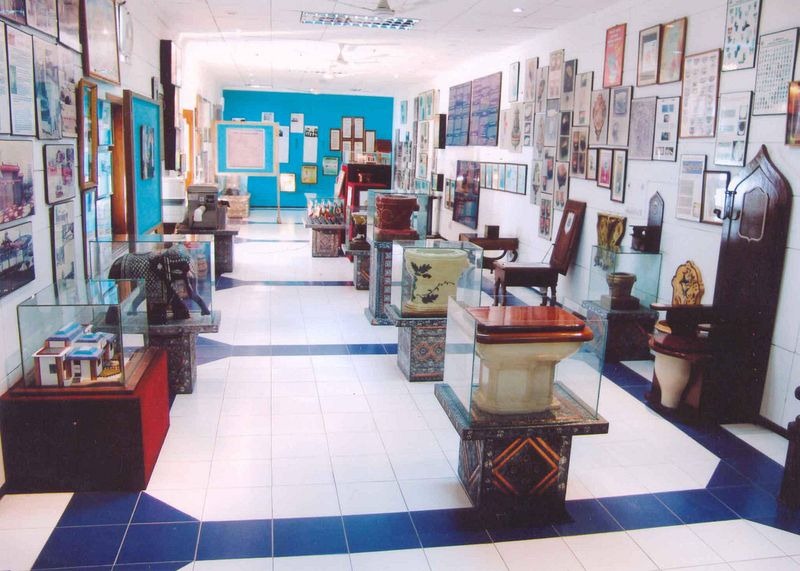
In a quiet courtyard in the suburbs of New Delhi, inside a low-slung concrete building, the assistant curator and guides of Sulabh International Museum of Toilets eagerly awaits for visitors. The museum is small, with just one long room, but it’s possibly the world’s only toilet museum, and it’s location in the Indian capital is all the more important.

Hygiene and sanitation is one of India’s most pressing issues. An astonishing 60% of the country’s 1.2 billion people defecate in the open because they do not have access to safe and private toilets. The numbers were probably worse in 1970 when Dr. Bindeshwar Pathak, a humanitarian and social worker, introduced pay-to-use public toilets in a small village in Patna, Bihar. At first the people laughed at his idea, but now over 15 million people across the country use public toilets constructed by Sulabh International, a non-profit he founded.

sulabh-international-museum-of-toilets-7

Photo credit: http://www.sulabhtoiletmuseum.org

Sulabh International’s mission is to promote safe sanitation habits and provide public toilet facilities throughout India. It builds and maintains hundreds of public toilets in major cities, including those outside tourist attractions such as the Red Fort in Delhi and the Taj Mahal in Agra, as well as towns and villages across the vast nation. With 50,000 volunteers devoted to the cause, Sulabh International is India’s largest nonprofit organization.

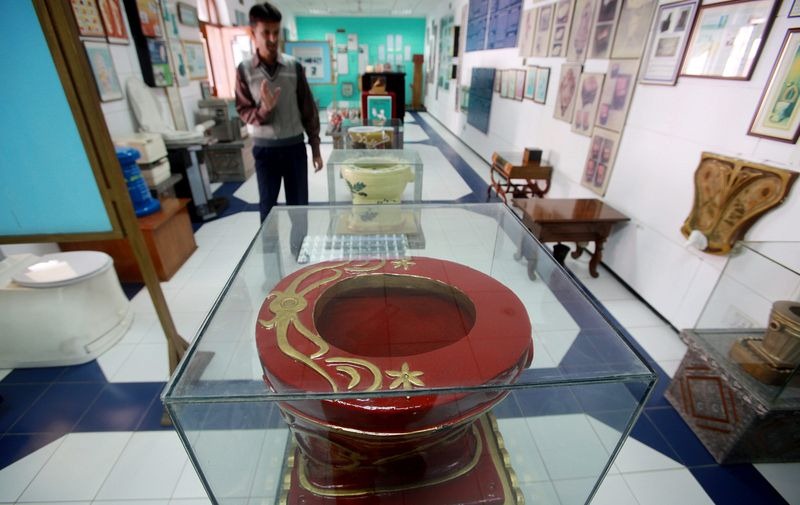
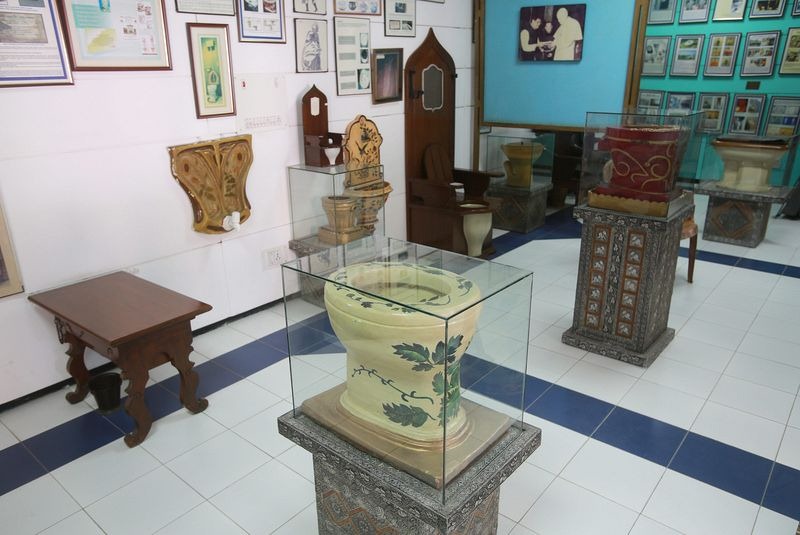
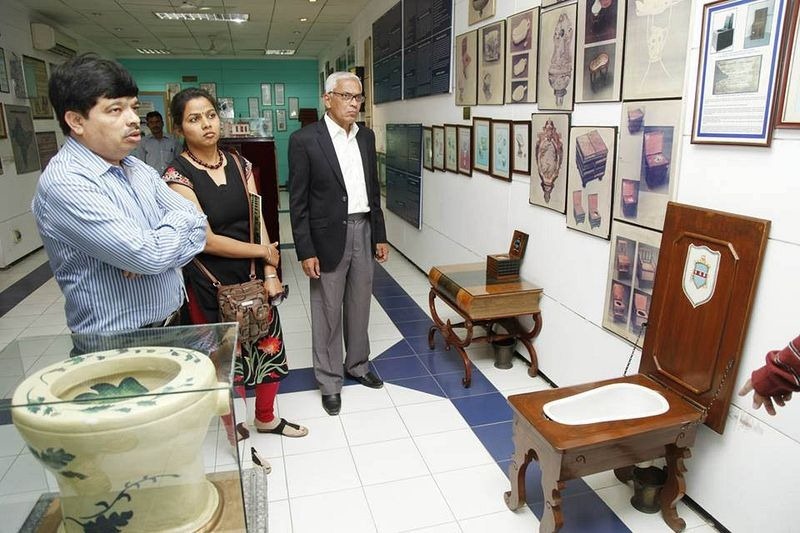
The museum, located in the offices of the organization, traces the history and development of toilet system around the world from the brick commodes of the ancient Harappan settlement near Pakistan, five thousand years ago, through the Middle Ages to the modern day toilet with electrically controlled flush system, through a series of privies, chamber-pots, toilet furniture, bidets and water closets, accompanied by a healthy number of images, drawings, photographs, and graphics. The museum also provides a chronological account of developments relating to technology, toilet related social customs, toilet etiquettes, prevailing sanitary conditions and legislative efforts of the times.

Among its most prized possessions is a flush pot devised in 1596 by Sir John Harrington, a courtier of Queen Elizabeth I, a gem-studded bided of Queen Victoria, table-top toilets from England and a couple of highly decorated commodes from Austria. Some of the toilets of these period were disguised. There is a French one that looks like a stack of books, and an English one which resembles a treasure chest.

Hanging on the walls are display boards with poems, comics, jokes and cartoons related to toilet humor. But one of its most amusing displays is a full-size replica throne from the court of the French King, Louis XIII, with a hidden commode underneath it. The King used it to relive himself while still in court.

The Sulabh International Museum of Toilets was opened in 1992, and since then it has welcomed some 100,000 visitors.

sulabh-international-museum-of-toilets-5

Photo credit: Metro.co.uk

sulabh-international-museum-of-toilets-6

Photo credit: Metro.co.uk

sulabh-international-museum-of-toilets-1

Photo credit: http://www.sulabhtoiletmuseum.org

sulabh-international-museum-of-toilets-2

Photo credit: http://www.sulabhtoiletmuseum.org

Sources: www.sulabhtoiletmuseum.org / Wikipedia / PRI.org

Source….www.amusingplanet.com

Natarajan

Message for the Day…” Lord Rama’s name cleanses all evil and transforms the sinner…”

Sathya Sai Baba

The name Rama is the essence of scriptures (Vedas); Lord Rama’s story is an ocean of milk, pure and potent. Ramayana, the epic describing Lord Rama’s incarnation is a sacred text, reverently recited by the scholar as well as the ignorant, the millionaire as well as the pauper. Lord Rama’s name cleanses all evil and transforms the sinner; it reveals the charming form represented by the name. Ramayana must be read not as a record of a human career but as a narrative of the advent and activities of an incarnation of God (Avatar). You must endeavor with determination to realise through your own experience the ideals revealed in that narrative. God is all-knowing, all-pervasive, and all-powerful. The words He utters while embodied in the human form, the acts He deigns to indulge in during His earthly sojourn — these are inscrutable and extraordinarily significant. The precious springs of His message ease the path of deliverance for humanity.

Meet the 86-Year-Old Who Has Helped 6 Lakh Patients Get Medical Treatment They Could Not Afford…

Starting with a small donation of Rs 10, this man has collected over Rs 10 crores to help 6 lakh patients who cannot afford to pay for their medical treatment. Read the story of Naginbhai Shah, an 86-year-old man who still works with the dedication of a 20-year-old to bring relief and hope to the lives of thousands in Ahmedabad.

“Everyone lives. But to live while doing something for other people is what matters the most. I get complete satisfaction, loads of blessings and a lot of happiness. This is my meditation,” says 86-year-old Naginbhai Shah about his work.

Naginbhai is the founder of Dardionu Rahat Fund, an organization based in Ahmedabad, Gujarat. He has taken up the responsibility of helping patients who cannot afford medical treatment in hospitals – those who have no money to pay for their medicines, check-ups, surgeries, etc.

The Fund was born in 1964 with a small donation of Rs. 10 and, since then, Naginbhai and his group of volunteers have collected over Rs. 10 crores! They have helped with the treatment of more than 6 lakh patients.

Naginbhai Shah donation for patients

Naginbhai (centre) with patients and volunteers

“My son was about three years old when he fell sick and had to be admitted to the hospital. I was a middle class man back then and was searching for a job. I didn’t have the money required for his treatment,” recalls Naginbhai about the time when he first became motivated to do something for the underprivileged.

He had his asthmatic son admitted to the hospital for treatment and went to an old friend to borrow some money. On returning with a sum of Rs. 25, Naginbhai encountered a woman who had come from a nearby village. She was there with her eight year old son and was weeping when Naginbhai met her.

“I asked her why she was crying. After some hesitation she told me that her child needed an operation and the doctor had informed her that the total expenditure would be Rs. 25. She had come with only Rs. 10 from her village. And now, she was left with just Rs. 6. I don’t know what came over me but without thinking for a second I immediately gave her the Rs. 25 that I had borrowed,” he says.

Naginbhai had to go out and borrow some money for his son once again but he was happy that the child he helped recovered after the operation.

Naginbhai Shah donation for patients

Providing for the needy

“My son recovered too. And after some time I got a job as well. After that, I started believing that my job and my son’s health were all the result of the blessings of that woman,” he adds.

It was sometime around then that an idea began to take shape within him. “What if I came to the hospital for half an hour each day and helped one or two people with whatever money I could arrange?” he thought. The year was 1964. Naginbhai discussed the idea with some friends. He was amazed when he asked if they would be willing to help with Rs. 10 — they gave him Rs. 51 instead. “I was surprised. I was asking for small amounts and people were giving a lot more,” says Naginbhai.

And that’s how it all started. Naginbhai would regularly ride his bicycle to the hospital near his home, identify the people who needed help and take care of all their medical expenses with the money he had collected from his friends.

Naginbhai Shah donation for patients

Naginbhai giving medicines to patients

Today, after about half a decade, this generous man is still dedicated to his service. He has a team of five volunteers and they go out every evening at 5 pm to Sheth V. S. General Hospital, Jivraj Mehta Hospital, and some other hospitals in Ahmedabad. In the general wards of these hospitals, they move from one bed to another, talking to the patients there. They chat with them to find out where they are from, their professions, how much money they make, etc.

In this manner, they are able to identify those who need their help the most.

Naginbhai Shah donation for patients

A beneficiary

“We ‘adopt’ these people and help them with everything they need — be it an MRI, a CT Scan, some medicines, an operation, or anything else. But we make sure that the patient does not go home untreated.” The small team raises money by speaking to people across the city — friends, acquaintances, family, strangers – anyone who can help them with funds. “Sometimes, when we reach the hospital, we find the doctors, staff and some patients waiting for us. The doctors ask those who cannot afford treatment to wait till we come,” says Naginbhai.

“We know what we do is just a drop in the ocean. We cannot go out and help every poor person who cannot pay his/her medical bills. But we have decided that whoever we help, we will help completely and won’t leave that person’s treatment half way. The money involved could be Rs. 10,000 or Rs. 50,000, or more. But once we tell a person we will help, we don’t back out,” he adds.

Naginbhai lives with his son who is working in Ahmedabad. He is extremely frugal with his expenses.

His team works with him for free and there are three trustees who help him take care of the finances of the Fund.

Naginbhai Shah donation for patients

My family does not support me a lot. But I have stopped expecting anything from them. The people support me. Donors send in money blindly. Last year, I collected Rs. 1.55 crores and spent Rs 1.48 crores on the patients. No money is spent on administration.”

His team also provides patients with fruits, hearing aids, artificial limbs, etc. It is mostly by word of mouth that donors reach Naginbhai. One such donor is Suresh Ruparel. He’s been associated with Naginbhai for the last five years.

“Once I visited a hospital and asked if I could donate money for someone and how I could find a genuine case. The hospital staff told me about Naginbhai. Actually, my mother died in that hospital and I could not reach in time. That’s why I really wanted to help someone there. Naginbhai maintains a very good relationship with all regular donors. I keep aside a portion of my salary for him every month,” he says.

Naginbhai sure has the blessings of the woman he first helped with Rs. 25. And many more now. We wish this 86-year-old a long life and many more years of dedicated service.

Source….Tanaya Singh in http://www.the betterindia.com

Natarajan

” I survived …So can You …” Says Ankur Mishra !!!

Hailing from a village having no electricity, this techie now runs two start-ups, educates his community, gives TED Talks and is on his third novel. This is Ankur Mishra’s journey.

Ankur Mishra

Ankur Mishra exudes the kind of lucid candour and sincerity that can only be mustered by someone who has lived a life in every season, flavour and shade that India has to offer — for he has walked a thousand miles and chronicled many adventures.

Don’t take him for any other small-town boy with big dreams — for this entrepreneur, social worker, writer, poet and traveller went a step ahead, brought on his finest masonry to also build his road block by block.

Growing up in a village

Ankur grew up in a “pure” small village in Uttar Pradesh, as he likes to put it. “I say ‘pure’, because there was no electricity, and was surrounded by the mountains and a river.

“The school was small and the teachers, harsh. Coming from a very poor family, I almost didn’t get an education, had it not been for the God-given gift of scholarship. Even then, I read English in Class VI for the first time,” he explains.

Some incidents in school left an impression on him.

This catapulted him into action at the raw age of 16, with his ‘baba,’ one of the few members in his family that were literate, by his side.

A headstart

“I had experienced first-hand the impact that the right or wrong teacher could have on a child. Whether it was the moment when I was slapped by a teacher for merely standing up to read the board properly, or the general disinterest that was apparent in so many of the teachers at the village school, our school systems were lacking quality and soul,” he says.

Whilst in Class XII, Ankur felt that his weekends and all that free time could find much better use, so he started an initiative called Unique Educational Group.

He approached several heads of institutions and volunteered to take weekly sessions with students on subjects like Maths and Science. “Maths is my favourite. Kids are very keen to learn counting using different techniques, and I teach them the practical use of mathematics — how they can help their parents in budgeting, time management etc.,” he explains.

Starting out with two village schools, the students’ vigour and eager anticipation of their sessions made them locally famous, and within two years, their weeks had to be split between 17 villages and around 100 schools — something Ankur pulled off completely with his pocket money.

When the time came for Ankur to leave the village behind for his career, the same model was met with indifference from students in cities; but Ankur is keen on setting up in Gurgaon, where he now sips his beloved tea with 10 students weekly, alongside running his early-stage start-up.

First date with a computer

Ankur Mishra

Believe it or not, this seasoned techie laid his claim to the computer only when he entered college for his BTech.

He worked for several MNCs including Microsoft after college as a programmer and developer, but he felt like his ‘tech-geekdom’ had another calling, namely, to help non-techies join the techwagon.

With Digital India especially, Ankur saw great value in helping non-techies “get” the web and do more business using it. Foreantech — ‘a start-up for start-ups,’ became his way of helping start-ups at designing, development and marketing, all at one place. “Today’s start-ups have a big headache of resources, especially, developers and designers.

“I wanted to solve this problem. When a start-up comes to us, their digital worries become ours,”Ankur explains.

The one-year-old company has successfully accomplished about 100 projects with start-ups like Wingo and Baniyagiri, as well as some government assignments.

Love with tech, but flirting with the quill

Scarring experiences from his school days encouraged Ankur to become a storyteller, and he began by publishing an expose on teachers when he was only 16.

The response was amazing and gratifying,according to Ankur, motivating him to write for newspapers and magazines over various social and political issues, until he decided to cast an even wider net, and debut as a novelist. He wrote two books — his first Love Still and l Flirt, his second Kshanik Kahaniyon Ki Ek Virasat,which was better received, and his upcoming one Love at Metro.

He also recently published a collection of Hindi poems.

Ankur started a website called Kavishala.in for poets to have an online mehfil of sorts. Only a month old, 50 poets have already contributed over 100 works to it.

Passing on the torch, and spreading the fire

Brimming with life — experiences of making it as a literate engineer, entrepreneur and multi-lingual writer from a powerless village, Ankur knew he must enlighten those seeking inspiration. “I have never really been afraid of speaking in public platforms,”he notes.

He speaks as a grassroots expert on politics, technology, and society, and has graced the stage at over 25 seminars and events like TedxPatna, Ignite Jaipur, Microsoft Tech Days, UEN Summit Patna etc.

The 25-year-old firework feels that ups and downs are just the way life is. “If I, a predominantly Hindi speaker, can now speak on big stages, write books, blogs and more on such a wide level, anyone can. Alone in an alien city, with barely enough funds to keep me fed, I survived. So can you,”Ankur concludes.

Source……..www.rediff.com

Natarajan

No-fuel Plough Invented by UP Farmer Costs Only Rs 3000, Beats Expensive Bullocks and Tractors…!

A farmer in Banda, Uttar Pradesh, upcycled an old bicycle to make a low cost plough, and then inspired his neighbours to do the same.

50-year-old Ram Prasad hires farm lands following the Bataidari system, or sharecropping, where a landowner gives his land on rent to farmers who plough the land and share the sales with the owner, in Chahnehra village of Banda, about 130 kilometres south of Kanpur.

When the farmlands were facing serious droughts, he had to sell his bullock to feed his family. Without his bullock and less money to maintain tractors and such equipment, times were difficult. Add to that the unpredictable weather: sometimes grave droughts, and sometimes premature rains. When Prasad realised that all these factors only burdened farmers with rising costs and no returns, he was adamant that he had to improvise an economical way to sustain farming.

It took him seven years to experiment with various materials. He finally got a breakthrough by converting an old cycle he found in his backyard, with some pieces of iron, into a plough.

The ploughing machine that he invented would cost only Rs 3000 to 4000.

Compared to the cost of a mini plough, bullocks or tractors, this is a more economical option for farmers.

plough

Representational image

The machine is simple, economical, and easy to assemble. With a single wheel, front and rear handles, and three diggers attached to it, the machine does not require fuel such as diesel or kerosene to operate.

“All it requires is two men,” said Prasad to Times of India, “I have also helped many farmers by converting their old bicycles into a ploughing machine.” He also adds that other than just ploughing, the machine also can be used for weeding and sowing.

Ploughs currently available in the market start at Rs 20,000, and are either manually operated, or mounted on a bullock or a tractor. But the cost only increases with bullocks and tractors. Generally, a pair of bullocks cost Rs 50,000, while a tractor costs as much as Rs 500,000. Along with that, there’s the variable price of fuel or fodder, which creates a dent in their finances.

Prasad’s innovation has caused a significant reduction in production costs. All it needs is a cycle. Plus, there’s no fuel requirement. In situations of droughts and economic crises, such an invention could change the lives of farmers tremendously.

Source….www.the betterindia.com

Natarajan

This Experiment Using a Glass Cover and the Sun Can Generate Water Even in Drought Affected Areas!

In a semi-arid region of Satara district in Maharashtra, there is a plot of lush green land with about 20 fully-grown, beautiful trees – all of which were the part of a very efficient experiment. The seedlings for these trees were fed with water obtained from dry soil, with the help of solar energy.

“I did my PhD in America way back in the late 1970s. And most of my work was around solar distillation of water. I looked at everything that could possibly be done with solar energy at that time and found that if you dig a small hole in the desert, and cover it with plastic, solar energy heats the soil and you can collect a cup of water every day. This was something that remained at the back of my mind for years,” says Dr. Anil Rajvanshi, Director of Nimbkar Agricultural Research Institute (NARI) – a non-profit research and development institute based in Phaltan, Maharashtra.

In 1981, Dr. Rajvanshi returned to India with the aim of using his education to work for the development of rural India, and started establishing the energy and sustainable development work at NARI.

solarenergy5

Dr. Anil Rajvanshi

“I came to this very dry and partially semi-arid region. Sometime in the 1980s, the Government of India conducted a very large-scale tree plantation program. But of the many seeds that were planted, only a few resulted in fully-grown trees. Most of the seeds perished,” he remembers. So, going back to the knowledge he had gained while studying, Dr. Rajvanshi started an experiment to grow trees using water distilled with the help of solar energy, at NARI in 1988.

The basis of the experiment was that soil contains some moisture and roots of plants utilise this water with the help of osmosis – a process in which a solvent (water in this case), passes through a semi permeable membrane from a region of less solute concentration to a region of more concentration. Roots absorb water from the soil through osmosis. But in semi-arid and arid regions, the water is so tightly bound with the soil that seedlings cannot extract it because of less osmotic potential.

This is how the experiment was done:

solarenergy2

Five pits, each of dimensions 0.9m X 0.9m X 0.6m, were dug in a barren land in the NARI campus. These pits were covered with Soil Water Evaporation Stills (SWES) – tilted glass covers connected with water collection bottles placed beside the pits.

When sunlight fell on the pits, it heated up the soil and the water in the soil evaporated, only to be collected in the form of water droplets on the glass covers. These droplets slid into the bottles.

solarenergy3

Three experiments were conducted with these SWES. The water collected in the bottles everyday was given to the seedlings in the morning. In Experiment 1, the water was supplied in equal amounts to some seedlings. In Experiment 2, the water collected from SWES over a period of seven days was supplied to another set of seedlings once a week. And in Experiment 3, the seedlings were rain-fed. The growth of the trees was monitored for diameter, plant height and mortality every three months. And the results were extraordinary.

The survival rate of seedlings fed from SWES was 100% and if one SWES fed 4 plants, an average of 70-80 ml of water was given to each seedling. The growth rate of the trees in Experiment 1 was higher than in Experiment 3.

solarenergy4

According to Dr. Rajvanshi, the production of water from soil in arid regions is an age-old technology and has been used as a strategy for human survival in deserts. However, there is limited data on its daily use, seasonal variation, etc.

“We used to get water from the pits every day and that turned out to be sufficient for the plants. The soil would get heated and the moisture in the soil, which you could not get otherwise, we were able to extract and feed to the plants. The trees were able to grow even in the worst season. Today, we have 15-20 fully grown trees in a place that was once completely barren. They are huge now,” he says.

Dr. Rajvanshi has been working in the field of rural development for the last three decades.

solarenergy1

Born and brought up in Lucknow, he went to the US to pursue higher studies at the University of Florida after his Bachelor’s and Master’s degrees in mechanical engineering from IIT Kanpur. He taught at the University of Florida for over two years and then returned to India

Dr. Rajvanshi feels that with the worsening drought conditions in many regions of Maharashtra, this technique can be used in some form or the other to help people in the region. “If not to grow plants, it can be used to provide sufficient water for people to drink if we conduct a similar experiment at a large scale and think more in that direction,” he concludes.

Source…..Tanaya Singh in http://www.the betterindia.com

Natarajan