How a Class 7 Indian-Origin Girl in Texas Raised Rs. 13 Lakh to Distribute Free LED Bulbs in Delhi…?


This Class 7 student in the US raised funds to buy and distribute LED bulbs for free to poor people in India. This is the story of her determination to do something concrete for the future of the planet.

meera2

“Small things can make a difference – provided all of us do our part. I am asking you to join me in the effort of replacing 77 crore incandescent bulbs in India with energy efficient LED bulbs. This will go a long way in reducing energy consumption and carbon emission along with the electricity bills of those who can least afford these bulbs. For the sake of India and for the sake of this planet, let’s all change our future, one bulb at a time.” – This is 13-year-old Meera Vashisht’s message to children of her age around the world.

An Indian-origin girl who was born and raised in the US and lives in Sugar Land, Texas, Meera will soon be in Delhi to distribute LED bulbs for free to those who cannot afford them.

Meera’s interest in the project came about when she was researching a project in school. She stumbled across a news article about the LED revolution in India. The Indian government is in the process of replacing 77 crore incandescent bulbs with LED bulbs, as a part of the Unnat Jyoti by Affordable LEDs for All (UJALA) scheme. She was intrigued to learn that simply changing a bulb at home can not only change the lives of people by offering increased energy savings, but reduce our carbon footprint as well.

Under the UJALA scheme, the Indian government is distributing LED bulbs across 16 states, in the price range of Rs. 75-95.

“But even at these subsidised rates, people belonging to the poorest sections of society would find it difficult to afford these bulbs,” Meera concluded.

“This was my moment of reckoning. After all those days when I had thought of doing something for India but didn’t know what to do, I suddenly discovered something that I could actually do and make a difference,” she wrote in an essay.

Meera’s first thought was to save her allowance money and send it to India as her contribution to the UJALA scheme. But that wouldn’t be enough she realized, so she thought of something else: “Let’s distribute the bulbs for free!” Her parents encouraged her to develop the idea further and it was then that she came up with the idea of a fundraiser.

She picked up a telephone directory and started writing letters to random people in the US, asking for help in making LED bulbs available to those who need them the most in India.

The challenge here was – why would anyone in the US want to fund something that was going on in India? But Meera was willing to take on this challenge. She told us – ‘The planet is one. We all share this planet. Whatever happens in India affects everyone. So let me try and draft this letter,’” says her mother Sunanda Vashisht, who works as a writer and columnist.

To everybody’s surprise, the first cheque arrived for Meera in just a few days, and the money kept coming in after that. Meera sent 500 letters and collected $ 2,000 (approximately Rs. 1,40,000) over the span of a year.

“In my letter, I explained why an LED revolution in India can save the whole planet and why we all should participate and contribute. I explained that a simple action of switching a light bulb in India could help achieve the goal of providing 24/7 electricity across the country. What most of us don’t understand is that electricity is empowerment. In rural areas it helps kids study after dusk, it helps ease the workload of people, it improves agricultural output, it helps set up small scale industries and connects remote areas with the world at large via the Internet and smartphones. This is empowerment in its truest sense and real democracy in action,” she wrote.

Now Meera had to find a way to reach those people who would need these bulbs the most. Sunanda contacted India’s Ministry of Power, informing them about Meera’s desire to visit and contribute to their mission, and the authorities were more than willing to help.

Sunanda and Meera will reach Delhi in the first week of July, and the Ministry will help them identify the underprivileged families that need these bulbs.

Meera’s father is an engineer and her family’s ancestral home is in Punjab. “We have family in India and we keep going back to visit them all the time. We are inculcating affection for India in Meera. She always says that she wants to work for people there,” says Sunanda. Through this distribution drive, Meera also wants to create awareness about the use of LED bulbs among people who might think that giving Rs. 75 for a bulb is a waste of money.

The teenager also stays connected to her roots through music and dance. She learns Hindustani classical vocal music and has been learning Bharat Natyam since she was four years old. Her grandfather’s passion for environmental causes has inspired Meera to work for the environment as well.

“He is an avid lover of nature, an artist, and an environmentalist. He is very considerate and compassionate. From him I have learnt to respect all life…I am so glad to be finally able to now come to India and make a contribution to the cause of cleaning the environment in a tangible way. I couldn’t be happier,” she says.

Here’s hoping this young environment enthusiast finds success in all her endeavours towards making the planet greener and more compassionate towards the less fortunate.


You can contact Sunanda by writing to her at sunanda_vashisht@yahoo.com.

Source….TanayaSingh in www. the betterindia .com

Natarajan

” Give and Take ” Principle in our Life….A Moral Story !


af80adc2-4280-41d5-8c5d-f40715a844a6

‘Give-Receive’ – The Abundance Principle


Once a man got lost in a desert. The water in his flask had run out two days ago, and he was on his last legs. He knew that if he didn’t get some water soon, he would surely die. The man saw a small hut ahead of him. He thought it would be a mirage or may be a hallucination, but having no other option, he moved toward it. As he got closer, he realized it was quite real. So he dragged his tired body to the door with the last of his strength.

   The hut was not occupied and seemed like it had been abandoned for quite some time. The man entered into it, hoping against hope that he might find water inside.

   His heart skipped a beat when he saw what was in the hut – a water hand pump…… It had a pipe going down through the floor, perhaps tapping a source of water deep under-ground. He began working the hand pump, but no water came out. He kept at it and still nothing happened. Finally he gave up from exhaustion and frustration. He threw up his hands in despair. It looked as if he was going to die after all.

   Then the man noticed a bottle in one corner of the hut. It was filled with water and corked up to prevent evaporation.He uncorked the bottle and was about to gulp down the sweet life-giving water, when he noticed a piece of paper attached to it. Handwriting on the paper read :

    “Use this water to start the pump. Don’t forget to fill the bottle when you’re done.”

   He had a dilemma. He could follow the instruction and pour the water into the pump, or he could ignore it and just drink the water. What to do? If he let the water go into the pump, what assurance did he have that it would work? What if the pump malfunctioned? What if the pipe had a leak? What if the underground reservoir had long dried up?

   But then… may be the instruction was correct. Should he risk it? If it turned out to be false, he would be throwing away the last water he would ever see. Hands trembling, he poured the water into the pump. Then he closed his eyes, said a prayer, and started working the pump.

    He heard a gurgling sound, and then water came gushing out, more than he could possibly use. He luxuriated in the cool and refreshing stream. He was going to live!

   After drinking his fill and feeling much better, he looked around the hut. He found a pencil and a map of the region. The map showed that he was still far away from civilization, but at least now he knew where he was and which direction to go. He filled his flask for the journey ahead. He also filled the bottle and put the cork back in. Before leaving the hut, he added his own writing below the instruction:

        “Believe me, it works!”

This story is all about life.  The Morals It teaches us that ‘We must GIVE  before We can RECEIVE Abundantly’. 


More importantly, it also teaches that ‘FAITH  plays an important role in GIVING’. 


The man did not know if his action would be rewarded, but he proceeded regardless. Without knowing what to expect, he made a Leap of Faith.


   Water in this story represents the Good things in Life something that brings a smile to your face. It can be Intangible Knowledge or it can represent Money, Love, Family, Friendship, Happiness, Respect, or any number of other things you Value. Whatever it is that you would like to get out of life, that’s water. The water pump represents the Workings of the Karmic Mechanism. 


‘Give it some Water to Work with, and it will RETURN far more than you put in.’

Source…..unknown….Input from a friend of mine

Natarajan

Lessons one can learn from Negative thoughts….!


We all experience negative thoughts at times. Unfortunately, our social and environmental conditioning can lead us to treating them as things to be fought against, avoided, or a sign of our weakness. As a result, the negative thoughts are often coupled with anger towards ourselves. These negative thoughts can keep us “stuck in our own heads”, and hinder us from moving forward with our lives in a positive manner. With that being said, there’s much to learn from these so-called negative thoughts. They can teach us some very important lessons, and it is our fear of negativity itself that keeps us from learning these lessons. Next time your mind wanders into negative thinking, don’t try to suppress such thoughts. Instead, use them as a ladder to haul yourself back up. Here are the seven most important lessons you can learn from negative thoughts:

1. If you’re lost, negativity can be your compass

Being angry at yourself in times of crisis can cause you to become lost in a sea of thoughts, and even forget how you got to this state in the first place, thus preventing you from avoiding it next time. Instead, try using your negative thoughts as a compass – think of why you became angry in the first place to try and find the source of your frustration, as well as remind you where you want to be. You can guide your search with questions such as:

  • When did I become angry with myself?
  • Has this sort of thing happened in the past?
  • Were my reactions to this situation different last time?
  • If I acted differently, was I more or less frustrated?

Another way of using negative thoughts as a compass is by mapping out your fears or the obstacles in the way of you feeling better. Try asking yourself:

  • Am I mad at myself because there’s something I could have done differently?
  • If so, can I avoid this type of obstacle next time?
  • Are there other ways to approach this problem?
  • What can I do differently next time?

2. Falling into familiar holes doesn’t become less painful

Imagine walking down the street and suddenly falling into a hole. The first time it happens, you’ll be mad at the city for its negligence. The second time, you’ll be mad because it still hasn’t fixed the problem despite the risk. The third time, you’ll be mad at yourself because you didn’t remember that there’s a hole there. Why did you fall into that hole time after time? Most likely it’s because you weren’t looking where you were heading, and were too busy blaming others, thus avoiding your own responsibility.

The best way to deal with such “holes” in your life is in stages – by covering the hole if you can, finding a way around the hole while it’s still there, or looking forward to avoid falling into that hole (or others) in the future. Instead of blaming others for your predicament, take responsibility for what you can do differently, and do it.

3. Your best friend is you

Negativity turns you into your own judge, jury, and executioner. As proof, we still remember certain mistakes we made in the past that others have already forgotten. However, we tend to ignore the most important lesson that each negative thought carries with it – just as we are our own harshest judges, we are also our own best friends.

Instead of running in circles, finding yourself guilty time and time again, try looking at the problem impartially, as if a friend is telling you about their problem and asking you for your opinion. What your advice be? Is it really a problem that cannot be overcome? When you look at an issue from the sideline, you can often find a solution more easily. If you keep practicing this lesson, you’ll find it easier to connect with yourself, and stop judging yourself so harshly.

4. No one knows everything

Many of our negative thoughts originate from the false assumption that they are indisputable facts. We can be sure that there is only one reason for our failings, or that people act a certain way because of one specific reason. These assumptions can be completely wrong, making them into the feet we use to trip ourselves over when dealing with future problems.

If we think that a colleague has no time for us because they don’t like us, we won’t be able to communicate with them positively in the future, even if their reason was that they were busy, or weren’t feeling well when we approached them. Such an incident can lead us to analyze our relationship with others incorrectly, as well as causing us to make the same mistakes time and time again in future. In quite the same way, being rejected when applying for a job can make us think we’re not talented enough when that position may have been made redundant for a variety of reasons.

Try reminding yourself that in any negative situation, some things that you’re not aware of and are beyond your control may have taken place. Remember that nobody is omniscient, and that’s perfectly fine.

5. If you think you’re drowning in negativity, you’re probably wrong

Do you think that everything bad that happens to you is the result of personal malice, and that bad things keep happening to you all the time? It may be time to stop for a moment and remind yourself that the worst thing that is happening is what you’re doing to yourself. Every negative thought provides us with two options – to fall into despair, or to learn and grow. Sadly, most of us choose the first option.

In order to help yourself see the situation from a broader perspective, assign every negative thought a couple of new friends – factual proof, and a different interpretation. Factual proof forms the basis of assessing your situation (for example, if a friend is mad at you, what are we basing our understanding of that anger on?), at the same time, even if you’re sure that your interpretation is correct, train yourself to come up with an alternative, logical interpretation of the situation. It might just be the right interpretation after all.

6. Some positive thoughts are disguised as negative ones

Not all thoughts that begin in a negative tone are necessarily negative themselves. It may surprise you, but if you think about it, you’ll find out that it is indeed the case. You may be imagining the worst possible scenario about something that may happen to someone you hold dear, but this thought is actually a positive thought, originating from a place of love and care for that person.

Try and express as many negative thoughts in a positive way and you may find out that people who originally reacted to these thoughts in a negative way now react to them differently after they understand the source of your fears or anger.

7. To move forward, stop collecting trash

After you’ve sifted through your negative thoughts and learned as much as you can from them, you can divide them into negative thoughts that can help you, and those that are nothing but “trash”. In other words, don’t let the trashy thoughts take up space in your head – they’ll only slow you down and make you feel unhappy.

No one likes to live in a house that is filled with trash, and the same goes for you and your mental space. Instead of punishing yourself by preoccupying yourself with these unnecessary thoughts, which exact a heavy toll on your mental state, try disposing of them as soon as you can. If a negative thought pops up, treat it as a memo to clear your mind up and make room for positivity instead.

Source…www.ba-bamail.com

Natarajan


Message for the Day…”Conquer your Mind and be at Peace…”


SI_20160607If you conquer your mind, you will attain peace. If you attain peace, you will look at all things with an equal mind. Good and bad, respect and disrespect, likes and dislikes are all aspects of one and the same thing – Brahman (Divinity). If you are able to get divine grace, everything will flow smoothly. If you are far away from divine grace, evil planets will begin to influence you. Sage Viswamitra pleased Brahma through his intense austerities. Lord Brahma removed the clouds of doubts that were hiding the intrinsic strength present in Sage Viswamitra. Lord Brahma taught Viswamitra to recognise the divine presence everywhere and told him to sing about Lord’s grace and His presence. The divine aspect is not something which is separate and distinct. God is omnipresent; it is not a matter with some specific features, it is spirit (parartha) and not matter or object (padartha). God is, and is present everywhere.

” ஒட்டிய பழமும் …ஒட்டாத பழமும் …” Mahaperiava ‘s Tips for getting Good Orange !

Experiences with Maha Periyava: Ottiya Pazhamum Ottadha Pazhamum (The fruit that sticks and the fruit that does not)

album1_22

Many years have passed since this happened. Still it remains unfading green in my heart and guides me until today.

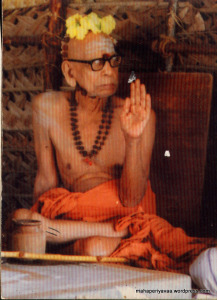
My marriage was held in the year 1958. My husband was serving as a Captain in the Army. Since, even after some years there was no putra bhagyam (fortune of a child) for me, my mother took me to have darshan of Shri Kanchi Kamakoti Pithadhipati Shri Chandrashekarendra Saraswati Maha Swamigal.

It was evening time. Shri Kanchi Maha Swamigal was doing japam (litany) sitting in his mena (palanquin). Some time passed by, and then Sri Maha Periyava looked at us with boundless compassion. My mother conveyed my grievance to Sri Maha Periyava. Taking an orange fruit from a plate nearby, Sri Maha Periyava kept meditating, closing His two eyes that were in blossom like lotus flowers, and rolling that fruit over those two eyes.

After sometime, He blossomed his eyes, gave that fruit to me and said, “You take this.”

With great happiness I took that fruit and went home.

Years rolled by. My husband was serving as a Major in charge of guarding the borders. When he came home during his vacation, we both went to Shri Kanchi Matham to have darshan of Shri Maha Swamigal.

It was evening time. Coming out of his room, the God of Compassion welcomed us with vatsalyam (paternal love), looked at me with limitless kindness and said, “Vaama Kuzhandhe! (Come, child! Come inside!)” He took us inside and told us to sit down.

Looking at my husband he asked, “You are serving in the Army, right?” and my husband replied, “Yes, I am in Siliguri.” Periyava asked him, “Can you get oranges there? Can you send me a basket of them?” “Yes”, replied my husband.

Sri Kanchi Maha Periyava looked at me and said, “There are two varieties of the orange fruit. Do you know?”

“I don’t know”, I said.

Periyava explained, “There are two kinds of oranges, one where the fruit sticks to the inner rind, the other, (he gestured with his hand as if He held a fruit and shook it near his ear), like this, rattles, with the fruit not touching the rind. It is this fruit that is tastier and sweeter than the kind that sticks to the rind. Always keep this in mind.”

He had given me a fruit earlier. Years later, He spoke to me about ‘the fruit that does not stick’ to its rind and gave me an insight into a very great truth. He taught me that one must live like ‘the fruit that does not stick’, unattached and unaffected by life. By calling me with the words, “Come, my child”, He made me His child. After I have myself become His child, where is the need of a child for me?


Author: Smt.Lalitha Raman, Sainikpuri
Source: Maha Periyaval – Darisana Anubhavangal Vol.2, Pages 120-122

Source….Facebook input

Natarajan

வாரம் ஒரு கவிதை… ” புறக்கணிப்பு ” !!!

stock-photo-beautiful-yellow-sunflower-petals-closeup-1975445

Man lives 555 days without a Heart …

1465822719821

While waiting for a human heart transplant, Stan Larkin lived 555 days without the organ at all.

To passers-by, the 25-year-old Ypsilanti, Michigan, resident appeared to be a typical young adult. He enjoyed taking his three toddlers to the park and hanging out with his younger brother, Dominique.
What wasn’t obvious was that a gray backpack Larkin carried was what kept him alive. Inside that bag was the power source for an artificial heart pumping in his chest.
Larkin’s real heart was removed from his body in November 2014. It was replaced with a device that allowed Larkin to stay home instead of in a hospital while waiting to receive a transplant.
It finally arrived this year, in May. Now, Larkin is recovering from his procedure at the University of Michigan Frankel Cardiovascular Center. He is scheduled to return home as early as next week.
“Most people would be scared to go so long with [an artificial heart], but I just want to tell them that you have to go through the fear, because it helps you,” Larkin said. “I’m going home so fast after the transplant because it helped me stay healthy before the transplant.”
At any given time, there are about 4,000 patients nationwide waiting for human heart transplants, according to the U.S. Organ Procurement and Transplantation Network.
Some patients with end-stage heart failure may wait months or even years before a suitable donor heart becomes available, said Dr. Billy Cohn, a cardiovascular surgeon and director of the Center for Technology and Innovation at the Texas Heart Institute.
“Many of these patients have hearts that are so weak, the kidneys, liver and other critical organs will fail while they are waiting,” said Cohn, who was not involved in Larkin’s care. “Many of these patients would die without some form of support,” such as an artificial heart.

‘A machine was going to be my heart’

Larkin didn’t realize that his heart was suffering until nine years ago, when he collapsed without warning while playing in a basketball game. It turned out that Larkin had a genetic form of heart disease called familial cardiomyopathy. His brother, Dominique, 24, was soon found to have it, too.
The condition occurs when heart muscle stretches and enlarges the open area of at least one heart chamber, inhibiting the organ from pumping blood efficiently.
The type of cardiomyopathy seen in Stan and Dominique, called arrhythmogenic dysplasia, causes arrhythmias and failure on both sides of the heart, said Dr. Jonathan Haft, a cardiac surgeon at the University of Michigan who operated on the brothers.
“It’s an awful condition to have,” Haft said. “But the technology available and the technology that is evolving in the field of heart failure is very exciting. … The total artificial heart falls into that category.”
Both brothers eventually progressed to heart failure and cardiogenic shock, and they were equipped with artificial heart devices in late 2014. Dominique stayed in the hospital with his device for six weeks before receiving a human heart transplant.
But Larkin, who was thriving with the device, was the perfect candidate to live outside the hospital, Haft said.
“I was shocked when the doctors started telling me that I could live without a heart in my body and that a machine was going to be my heart. Just think about it — a machine,” Larkin said.

‘It feels like a real heart’

It’s not the first time a patient has lived for a long time with an artificial heart, but Larkin became the first patient in Michigan to go home with the portable device.
The SynCardia temporary artificial heart in Larkin’s chest replaced his failing heart, including its chambers and four valves. Two tubes, exiting the left side of Stan’s body beneath the ribcage, connected the artificial heart to a 13-pound machine called the Freedom Driver.
 
The driver, which was carried in a backpack, not only powered the artificial heart, it delivered pumps of compressed air into the heart’s ventricles, allowing blood to be pumped through the body.
“Stan was very active and did an immaculate job taking care of himself and taking care of the equipment used to keep him alive,” Haft said.
With his life-saving backpack in tow, Larkin played pick-up games of basketball, enjoyed time with his children and rode in the car with his friends.
“It’s just like a real heart,” Larkin said. “It’s just in a bag with tubes coming out of you, but other than that, it feels like a real heart. … It felt just like a backpack with books in it, like if you were going to school.”
Voncile McCrae, Larkin’s mother, often helped him change the bandages covering the holes in his body where the tubes emerged.
We had to be careful so that he wouldn’t get an infection,” McCrae said, chuckling about how she had been scared to touch the tubes and handle the Freedom Driver machine. “Now, I’m a pro.”

‘An amazing brother’

The technology that, temporarily, was a part of Larkin’s body shows just how advanced artificial heart devices have become since the world’s first self-contained artificial heart was implanted in a patient in 2001, said Dr. Laman Gray, Jewish Hospital chair in cardiovascular surgery at the University of Louisville.
Gray was one of the celebrated surgeons who performed that first artificial heart procedure. He has closely followed developments in the fields of cardiac surgery, such as Larkin’s case.
“I think there’s good science here, and there have been really great advancements in this area,” Gray said. “We’re making great progress, and people are living normal lives. There’s definitely a place for total artificial hearts and a need for them.”
Dominique said he and his brother are grateful that their needs were met — and that they survived.
“I have an amazing brother,” Dominique said. “He has been here with me since the beginning and has never let me down. … I’m blessed to have him in my life.”
Source…..By Jacqueline Howard, CNN ….www.stumbleupon.com
Natarajan

படித்து மெய் சிலிர்த்தது ….!


“இன்று மாலை காஞ்சிபுரம் மகா பெரியவா பிருந்தாவனம் சென்றிருந்தேன். அற்புதமான தரிசனம் (இரவு ஆரத்திக்குப் பின் எடுக்கப்பட்ட படத்தை இணைத்துள்ளேன்). மகா பெரியவா சரணம்.
கடந்த 5.6.2016 ஞாயிறன்று கோவைப்புதூர் பிராமண சேவா சங்கத்தின் சார்பாக அங்குள்ள சுந்தர விநாயகர் ஆலயத்தில் ‘ஷீர்டி பாபா மகிமை’ என்ற தலைப்பில் சொற்பொழிவு நிகழ்த்தினேன்.
எனது நிகழ்ச்சிகள் குறித்து முகநூலிலும், மெயிலிலும் முன்கூட்டியே பதிவிடுவது வழக்கம். அந்தந்த ஏரியாவில் உள்ள பக்தர்கள் கலந்து கொள்வதற்கு வசதியாக இருக்கும் என்பதால் இப்படி. சமீப நாட்களில் முக்கியமான எனது சொற்பொழிவு விவரங்களை வாட்ஸப்பில் சில குரூப்களிலும் நானே பதிவிடுவது வழக்கம்.
அதுபோல் ஒரு வாட்ஸப் குரூப்பில் கோவை நிகழ்ச்சிகள் குறித்துப் பதிவிட்டேன். அதில் ‘ஷீர்டி பாபா மகிமை’ குறித்து நான் சொற்பொழிவு நிகழ்த்தப் போவது குறித்து அதே குரூப்பில் ஒரு அன்பர் தனது கண்டனத்தைத் குரல் வாயிலாகவே பதிவு செய்திருந்தார். அதன் சாராம்சம் – ‘மகா பெரியவா மகிமை பற்றிப் பேசி வரும் தாங்கள் ஷீர்டி பாபா பற்றி பேசுவது சரியல்ல. இதை ஏற்றுக் கொள்ள முடியவில்லை. கண்டனத்துக்குரியது’ என்பது போல் பதிவு செய்திருந்தார்.
நான் இதைக் கேட்டு விட்டு, எல்லாம் மகா பெரியவா லீலையே என்று விட்டு விட்டேன். காரணம் – ஷீர்டி பாபா பற்றிப் பேசுவது இது முதல் முறை அல்ல. மயிலாப்பூர் ஷீர்டி சாய்பாபா ஆலயத்தில் பாபா பற்றிப் பேசி இருக்கிறேன். பொதிகை ‘குரு மகிமை’ நிகழ்ச்சியில் அவ்வப்போது பாபா பற்றிப் பேசியும் வருகிறேன். எனவே, இவரது கருத்துக்கு முக்கியத்துவம் கொடுக்காமல் விட்டு விட்டேன். என்றாலும், அவர் ஏன் இப்படிப் பேசினார் என்று எனக்குள் ஒரு கேள்வி அவ்வப்போது எழுந்து கொண்டே இருந்தது.
இன்று பெரியவா பிருந்தாவனத்தில் அவரது சந்நிதிக்கு நேர் எதிரில் நான் அமர்ந்திருக்கும்போது இதற்கு பதில் கிடைத்தது, சிலிர்க்க வைத்த ஓர் அனுபவம்.
காஞ்சிபுரத்தில் வசிக்கும் பாரதி என்ற பெண் மகா பெரியவாளின் அத்யந்த பக்தை. இவர் ஒரு மாற்றுத் திறனாளி. என்றாலும், சிரமத்தைப் பற்றிச் சற்றும் பொருட்படுத்தாமல் வீல் சேரில் மடத்துக்கு வந்து விடுவார்.
அவர் இன்று பெரியவா சந்நிதிக்கு எதிரே அமர்ந்திருந்தார். பக்கத்தில் நான் அமர்ந்திருந்தேன். அப்போது, ‘‘உங்ககிட்ட ஒரு விஷயம் சொல்லணும். இங்கே சின்ன காஞ்சிபுரத்துல அமுதானு என் ஃப்ரெண்டு இருக்கா. அவகிட்ட பெரியவா ஒரு அற்புதம் பண்ணி இருக்கா. தோ, அவளே வந்து சொல்லுவா. இங்கேதான் பிரதட்சிணம் பண்ணிண்டிருக்கா’’ என்று ஆரம்பித்தார் பாரதி.
அடுத்த ஒரு சில நிமிடங்களில், பிரதட்சிணத்தைப் பாதியில் நிறுத்தி விட்டு வந்த அமுதாவும் அருகே அமர்ந்தார். அமுதாவே ஆரம்பித்தார். ‘‘எனக்கு மகா பெரியவாதான் எல்லாம். எங்க வீட்டுல தினமும் பூப்பறிச்சு மகா பெரியவா உள்ளிட்ட எல்லா சாமிங்களுக்கும் வைப்பேன். சமீபத்துல ஒருத்தர் என்கிட்ட ஷீர்டி சாய்பாபா விக்கிரகம் ஒன்றைக் கொடுத்தார். அதையும் வீட்டு பூஜையறையில வெச்சிருந்தேன். ஏனோ தெரியலை… அதற்கு பூ வெச்சதில்லை. ஆனா, பிரார்த்திப்பேன்.
திடீர்னு ஒரு நாள் பெரியவாளே என்கிட்ட ‘தினமும் ஷீர்டி பாபாவுக்கும் பூ வை. அவரும் நானும் வேறில்லை’ சொல்றதைப் போல் இருந்திச்சு. ஷாக் ஆகி அடுத்த நாள் முதல் ஷீர்டி பாபாவுக்கும் பூ வெச்சு பிரார்த்தனை பண்றேன்’’ என்றார்.
வாட்ஸப் குரூப்பில் அந்த அன்பர் கேட்டதற்கான பதிலை, இதைவிட வேறு எப்படித் தெளிவாக மகா பெரியவாளால் தர முடியும்?!
என்னைப் பொறுத்தவரை – மகான்களுக்குள் பேதமே இல்லை. என்னைப் பொறுத்தவரை ஆதி சங்கரரும் ஒன்றுதான். ராமானுஜரும் ஒன்றுதான். காவாங்கரை கண்ணப்ப ஸ்வாமிகளும் ஒன்றுதான். என்றைக்குமே நான் பேதம் பார்த்ததில்லை.
மகா பெரியவா சரணம்.
அன்புடன் .
சுவாமிநாதன்  “
Source…. Input from My friend Shri Swaminathan , Chennai thro his mail to me today.
Natarajan

” மு ” என்றால் முகுந்தன் …”ரு ” என்றால் ருத்ரன் …”கா ” என்றால் பிரம்மா …!!!

namavali006

முருகா ” என்றால் என்ன ” புண்ணியம் ” கிடைக்கும்….
‘மு’ என்றால் ” முகுந்தன்
‘ரு’ என்றால் ” ருத்ரன் ”
‘கா’ என்றால் ” பிரம்மா ”
இதனால் “முருகா ” என்ற நாமத்தைச் சொன்னால் மூன்று பெருங்கடவுள்களின் பெயர்களைச் சொன்ன புண்ணியம் கிடைக்கும்.
இது மட்டுமல்ல.
“முகுந்தன் ” தமது மார்பில் மகாலட்சுமியை வைத்துக் கொண்டிருக்கிறார்.
“ருத்ரன் ” எனும் சிவபெருமான் உமையவளுக்கு உடலில் ஒரு பாகத்தையே கொடுத்திருக்கிறார்.
“பிரம்மா ” தமது மனைவியான சரசுவதியை நாக்கில் வைத்திருக்கிறார்.
இதனால் ” முருகா ” என்றால் ஆறு பேர்களைத் தொழுத புண்ணியம் கிடைக்கிறது.
இதனால்தான் முருகா என்பவை நாமங்கள் என்றார் அருணகிரிநாதர்.
முருகா!முருகா!முருகா!முருகா!முருகா
Source….Input from a friend of mine
natarajan

Message for the Day…” Whenever you face obstacles in Life , you should treat it as stepping stones for your success…”


All the pains and difficulties that you get will ultimately turn out as a means to give you happiness and pleasure. Even a diamond of high quality does not get its value unless we cut the facets on it. Pure gold will not be turned into a beautiful ornament unless it is repeatedly put into fire and moulded. Whenever you experience pains, trials, obstacles and tribulations, you should recognise them as paths for obtaining ultimate happiness. So we should be prepared to accept pain. To seek pleasure alone and not to welcome pain is not right. Pleasure comes out of pain. We should recognise that all pain will ultimately end in pleasure.SI_20160607