குழந்தைகளே! மற்ற நாடுகளின் சுதந்திரத்தை நாம மதிக்கிறோம். நாமும் சுதந்திரமாக இருக்க விரும்புறோம். நாம சுதந்திரமா இல்லைன்னா, நம்மள யாராவது மதிப்பார்களா?
நாட்டின் பாதுகாப்பை மனதில் வைத்து வேலை செய்த முன்னோடிகளான விஞ்ஞானிகளோடு வேலை செய்கிற அதிர்ஷ்டம் எனக்குக் கிடைத்தது. இந்தியாவோட ராக்கெட்டுகளை வானத்தில் ஏவுகிற இஸ்ரோ நிறுவனத்தில் 20 ஆண்டுகளுக்கு நான் வேலை பார்த்தேன். இந்தியாவோட முதல் ராக்கெட்டை ஏவுகிற திட்டத்தின் இயக்குநரா நான் இருந்தேன். அப்போதுதான் முதலாவது செயற்கைக்கோள் ரோகிணி வெற்றிகரமாக வானத்தில் ஏவப்பட்டது.
அதுக்கப்புறம் நாட்டின் பாதுகாப்புக்கு அவசியமான ஏவுகணைகளை உருவாக்கும் பணியில் சேர்ந்தேன். இந்தியா இப்போ வளரும் நாடு அல்ல, வளர்ந்த நாடு என்று உலகத்துக்கு நிரூபிப்பது போல இருந்தன அந்தப் பணிகள். அப்போதுதான் ‘நான் ஒரு இந்தியன்’ என்ற பெருமிதம் எனக்கு அதிகமானது.
அப்போது நாங்கள் மிகவும் லேசான ஒரு கார்பன் பொருளைக் கண்டுபிடித்தோம். ஒருநாள் நிஜாம் இன்ஸ்டிடியூட் ஆஃப் மெடிகல் சயின்ஸ் நிறுவனத்திலிருந்து ஒரு டாக்டர் என்னைப் பார்க்க வந்திருந்தார். எலும்பு அறுவை சிகிச்சை நிபுணர் அவர். எனது ஆய்வகத்திலிருந்த லேசான பொருளை அந்த டாக்டர் தூக்கிப் பார்த்தார். அதன் பிறகு அவரது மருத்துவமனைக்கு என்னை அழைத்துப்போனார்.
அங்கே சின்னஞ் சிறுமிகளும் சிறுவர்களும்கூட நோயாளிகளாக இருந்தார்கள். அவர்கள் தங்களது உடலில் மூன்று கிலோவுக்கு அதிகமான எடைகொண்ட ‘காலிபர்’ எனும் கருவிகளைக் கால்களில் தாங்கியபடி இருந்தார்கள். அவற்றை நாங்கள் 300 கிராம் எடையுள்ளதாக மாற்றினோம். அதைப் போட்டுக்கொண்டு கஷ்டமில்லாமல் சுலபமாக நடந்தார்கள். அந்தக் குழந்தைகளால் அதை நம்பவே முடியவில்லை. அவர்களுடைய அம்மா, அப்பா மகிழ்ச்சியாக இருந்தார்கள். எனக்கும் மகிழ்ச்சியாக இருந்தது.
நம் தேசம் ஒரு மகத்தான தேசம். நமது சாதனைகளையும் ஆற்றல்களையும் நாம்தானே அங்கீரிக்க வேண்டும். அற்புதமான சாதனைச் செய்திகள் நம்மிடம் உள்ளன. பால் வளத்தில் நாம்தான் உலகில் முதல் இடம். தொலைதூர உணர்வு கொண்ட செயற்கைக்கோள்களை உருவாக்குவதில் நாமே முதல் இடம். கோதுமை, அரிசி உற்பத்தியில் இரண்டாம் இடம்.
ஒரு முறை இஸ்ரேல் நாட்டில் பேப்பர் படித்தேன். பாலைவனத்தை ஐந்தாண்டுகளில் சோலையாக்கிய ஒரு சாதனை மனிதன் பற்றிய செய்தி இருந்தது. உள்ளேதான் சண்டைகள், சச்சரவுகள் பற்றிய செய்திகள் இருந்தன. ஆனால், இந்தியாவில் தலைகீழாக உள்ளது.
பதினான்கு வயதுச் சிறுமி ஒருத்தியிடம் ‘உன் குறிக்கோள் என்ன?’ என்று கேட்டேன். ‘வளர்ச்சியடைந்த இந்தியாவில் வாழ விரும்புகிறேன்’ என்று சொன்னாள்.
நமது நாட்டைப் பற்றி பல புகார்கள் கூறுவார்கள். ஆனால், அப்படி புகார் கூறுபவர்கள்கூட வெளிநாடுகளுக்கு சென்றால் மிகவும் கட்டுப்பாடாக நடந்துகொள்வார்கள். அசுத்தப்படுத்த மாட்டார்கள். அதேமாதிரி உள்நாட்டில் நடந்துகொண்டால் என்ன?
யாரோ வந்து நாட்டின் பிரச்சினைகளை எல்லாம் தீர்த்து வைப்பார்களா? நாமே நமது பிரச்சினைகளைத் தீர்த்துக்கொள்ள ஆரம்பித்தால் என்ன? நன்றாக யோசித்துப் பாருங்களேன்!
(மறைந்த முன்னாள் குடியரசுத் தலைவர் அப்துல் கலாம் ஹைதராபாத் பள்ளிக் குழந்தைகள் மத்தியில் பேசியது)
இந்தியாவின் முதல் பெண் ஐபிஎஸ் அதிகாரி கிரண் பேடி என்று தெரியும். இந்தியக் குடிமைப் பணிகள் தேர்வு என்று அழைக்கப்படும் ஐசிஎஸ் தேர்வில் முதன்முதலாக வெற்றிபெற்ற பெண் யார் தெரியுமா? அவர்தான் சி.பி. முத்தம்மா.
கர்நாடகாவின் குடகு மாவட்டத்தின் விராஜ்பேட் நகரில் 1924-ல் பிறந்தவர் முத்தம்மா. தனது 9-வது வயதில், தனது தந்தையைப் பறிகொடுத்தார். எனினும், வைராக்கியம் கொண்ட அவரது தாய், தனது நான்கு குழந்தைகளையும் நன்கு படிக்க வைத்தார். மடிகேரி புனித ஜோசப் பெண்கள் பள்ளியில் பள்ளிப்படிப்பை முடித்த முத்தம்மா, சென்னை பெண்கள் கிறிஸ்தவக் கல்லூரியில் பட்டப்படிப்பை மேற்கொண்டார். மூன்று தங்கப் பதக்கங்களுடன் படிப்பை முடித்த அவர், சென்னை பிரெசிடென்சி கல்லூரியில் ஆங்கில இலக்கியத்தில் முதுகலைப் பட்டப் படிப்பை முடித்தார்.
1949-ல் ஐசிஎஸ் தேர்வில் வென்ற பின்னர், வெளியுறவுத் துறையில் சேர்ந்தார். ஆண் அதிகாரிகளின் ஆதிக்க மனப்பான்மைக்கு எதிராகப் போராடினார். சவால்களை வெல்வதைப் பழக்கமாகக்கொண்டிருந்த முத்தம்மா, பெண்களுக்கு எதிராக இருந்த அரசு விதிகளை எதிர்த்து நீதிமன்றத்தை அணுகினார். அந்த வழக்கை விசாரித்த வி.ஆர். கிருஷ்ணய்யர் தலைமையிலான மூன்று நீதிபதிகளைக் கொண்ட அமர்வு, அவருக்குச் சாதகமாகத் தீர்ப்பு வழங்கியது. இந்தியப் பெண்கள் வரலாற்றில் மிக முக்கியமான தீர்ப்பு அது. பின்னர், ஐரோப்பா, ஆசியா, ஆப்பிரிக்கா ஆகிய மூன்று கண்டங்களின் பல்வேறு நாடுகளில் இந்திய வெளியுறவுத் துறையில் பணியாற்றினார். 1970-ல் ஹங்கேரிக்கான இந்தியத் தூதர் பதவி அவருக்கு வழங்கப்பட்டது. 1982-ல் ஓய்வுபெற்ற முத்தம்மா, பல்வேறு விஷயங்களைப் பற்றிய கட்டுரைகளை எழுதினார். 2009 அக்டோபர் 14-ல் காலமானார்.
Dharma is the moral path, which is the light; the light is bliss (ananda). Scriptures convey that Dharma is the essence of spiritual wisdom (jnana). Dharma is characterized by sacredness, peace, truth, and fortitude. Dharma is yoga (union); it is truth (sathya). Its attributes are justice, sense control, sense of honour, love, dignity, goodness, meditation, sympathy, and nonviolence. It leads you onto universal love and unity. It is the highest discipline and the most profitable. All this ‘unfoldment’ began with Dharma;this is stabilized by truth (sathya). Truth is inseparable fromdharma. Truth is the law of the universe, which makes the sun and moon revolve in their orbits. Dharma is the course, the path, the law. Wherever there is adherence to morality, there you can see the law of Truth (sathya-dharma) in action. In the Bhagavata too, it is said, “Where there is Dharma, there is Krishna; where there are both Dharma and Krishna, there is victory.”
Calling our parents anything other than mom, dad or one of the many variations thereof is an almost alien concept to many (and in some cultures is considered downright rude). So why is it we refer to our parents in this way? Where did it come from and perhaps, more curiously, is there any culture that forgoes this seemingly universal nickname custom for parental figures?
The words can be traced back to the 1500s for “dad” and the 1800s for “mom”. As with so many etymologies, where these words were first uttered and by whom is a mystery. Even the Oxford English Dictionary has admitted that they have “no evidence” on where the word “dad” originated. The word “mom”, on the other hand, is a slightly different story and it’s widely believed that the word was born from the much older word “mamma” which itself can be traced back to the 1500s in English. This, in turn, can be traced back to Latin where “mamma” meant “breast” or “teat”. From this word, we also got the word “mammalia” and later “mammal” to describe animals that suckle their young.
This brings us to the amazing part- a word extremely similar to “mom” occurs in almost every language on Earth. We don’t mean that there is a word for “mom” in every language; we mean that the word for “mom” is shockingly similar across nearly all of the most commonly spoken languages on Earth.
For example, if you wanted to address your mother in Dutch you’d say “moeder”, if you were to travel to Germany on the other hand you’d call her “mutter” while over in Italy you’d refer to her as, “madre”. Now we know what you’re thinking, those are all European languages. So let’s mix things up a bit and list the words for mom or mother in some more, shall we say, “exotic” languages, from an English speaker’s point of view, and see if you start to notice a pattern:
Chinese: Mãma
Hindi: Mam
Afrikaans: Ma
Ancient Egyptian: Mut
Swahili: Mama
As you can clearly see from this list, there’s a very peculiar trend with “mom” in various languages in that it’s nearly universally pronounced with an “m” sound. If you’re still not convinced or think that we’re perhaps cherry picking examples, here’s a pretty exhaustive list of ways to say “mother” in a number of languages for you to peruse at your leisure. With a few exceptions, our favorite of which is the Mapunzugun “Ñuke”, you’ll note that they pretty much all employ an “m” and often a “ma” sound.
As for the word “dad”, while there is certainly more variation in the ways to address your man-mum in foreign languages, similar trends can be observed. For example, the word “Papa” is present in several languages including Russian, Hindi, Spanish and English, while slight variations on it appear in German (Papi), Icelandic (Pabbi), Swedish (Pappa) and a number of other languages across the globe. Likewise in Turkish, Greek, Swahili, Malay and several other languages the word for dad is “Baba” or a variation of it.
The current working theory to explain this fascinating phenomenon is that the words parents use to refer to themselves are derived from the babblings of their child during its “baby-talk” phase. It has been observed that babies, regardless of where in the world they’re born, naturally learn to make the same few sounds as they begin to learn to speak. It has also been noted that during the babbling stage, babies will create what is known as “protowords” by combining nonsensical combinations of consonants and vowels.
The really interesting part about these protowords is that they’re consistent across different cultures for reasons that aren’t quite clear. The words babies make in this early babbling stage tend to use the softer contestants like B, P and M, often leading to the creation of otherwise non-words like baba, papa and mama by the child in question.
It’s further theorised that as these are often the first sounds babies are able to make consistently, parents came to use them to refer to themselves, which explains why words like “mama”, “papa,” “dada”, “tata” and “baba” are present in so many languages as a way of addressing one’s parents. It’s usually less complex to say than the parent’s real names and works as a substitute that ultimately sticks.
As to why the “ma” sound in derivations like “mamma” came to be assigned to women instead of men, it is generally thought that it derived from the sound babies make while suckling or feeding. It’s noted that the only sound a baby can really make while its mouth is full of his or her mother’s life giving bosom is a “slight nasal murmur” or a repeated “m” sound. Further, when the baby is hungry and sees the object of its foodie desires, it is not uncommon for the baby to, as linguist Roman Jakobson put it, “reproduced [it] as an anticipatory signal”. While no one can prove this is how “mom” and its predecessor “mamma” came about, it would at the least explain why there is an almost universal trend of the word for mother in varying languages utilising the “m”, and often “ma” sound.
There is no such precise theory for why the word “dad” was specifically chosen (presumably from “dada”), but this lack of a good reason to assign “dada” to male parents over other variations like “papa”, “tata”, “baba”, etc. is perhaps why there is such variation on this one in terms of which repeated consonant is used to go along with the a’s in a given culture.
So is there any culture in which this nicknaming practise isn’t observed? There are certainly examples of cultures that don’t adhere to the idea of a nuclear family, but as far as applying similar types of nicknames to parental figures, not really… At least as far as we could find and we’re usually very good at this sort of thing and spent more hours than we care to admit trying to find the obligatory exception. But if you happen to be an anthropologist or just someone who knows different and you know of an exception where children don’t commonly give their parental figures (whether truly their biological parents or not) some sort of nickname, please do let us know. We came up empty on it, which makes us a little uncomfortable as there seemingly always is at least one exception somewhere for just about any issue. Is this an exception to the rule that there is always an exception? It would seem so.
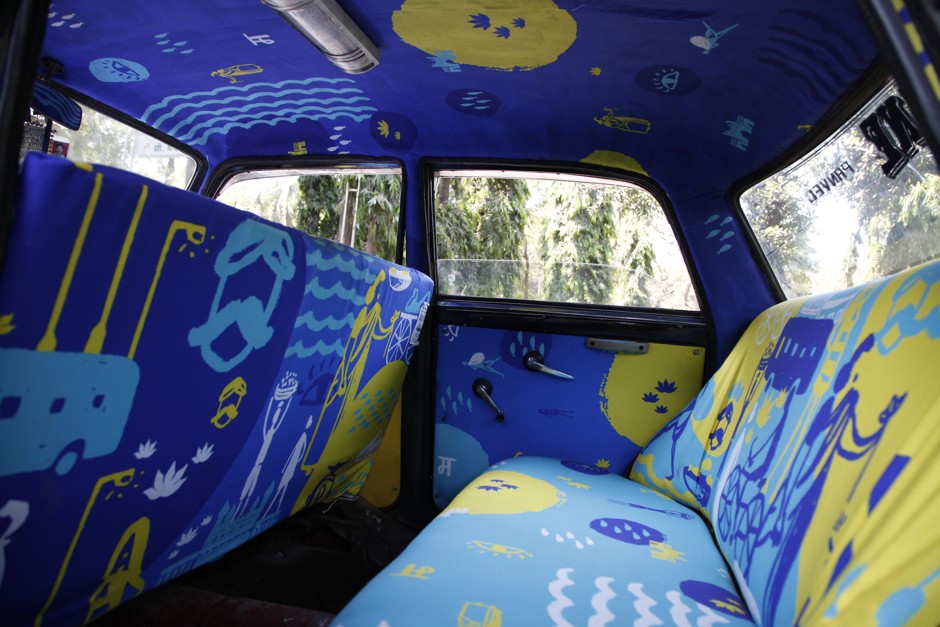
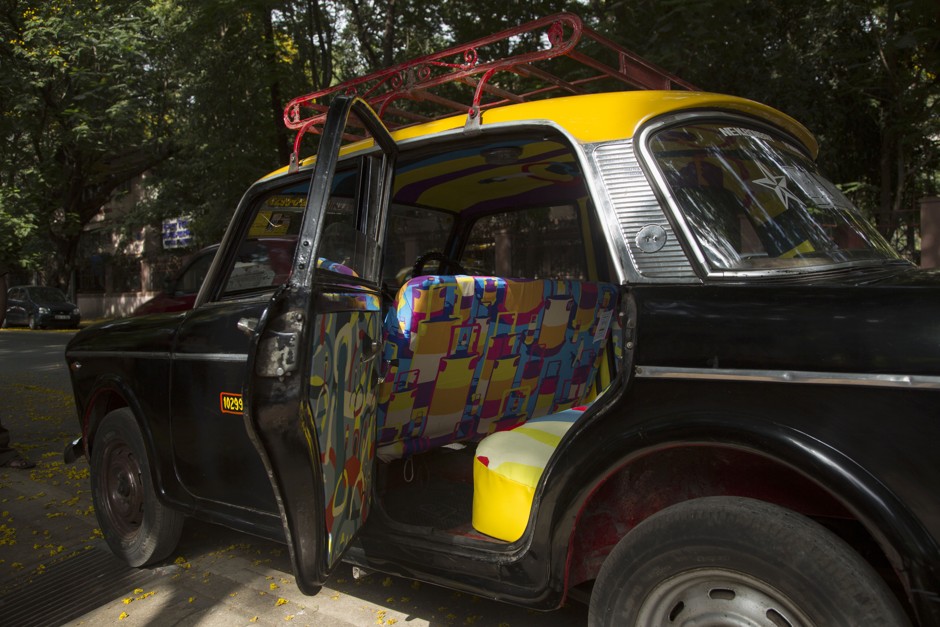
The Taxi Fabric project gives local designers a new vehicle to show off their work.
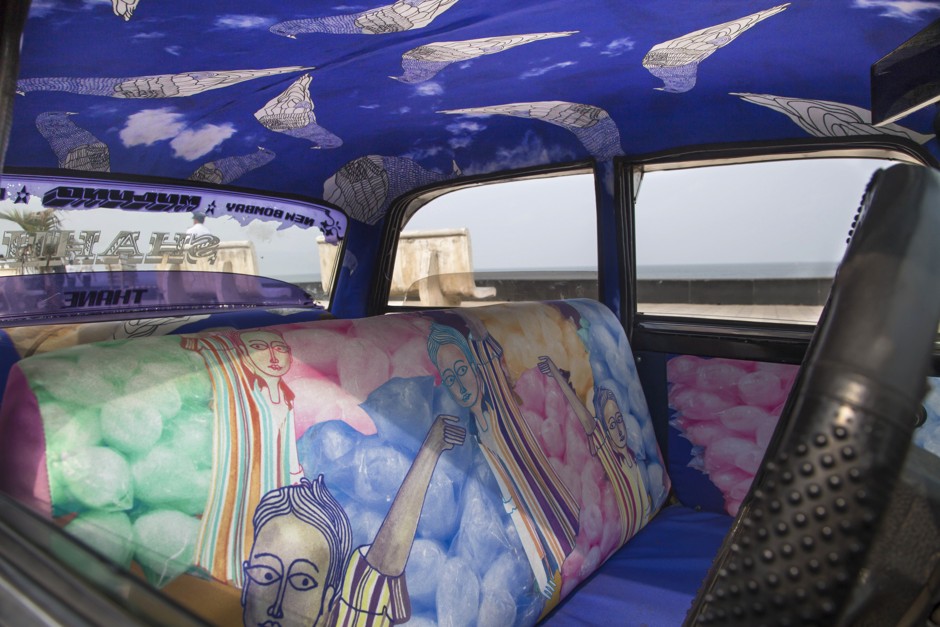
The bright pink interior of this taxi, by artist Pranita Kocharekar, reflects the diversity of Mumbai.(Taxi Fabric)
When you hop into a taxi, there isn’t usually much to look at except out the window. But one graphic designer wants to change that by turning cabs in Mumbai into canvasses for emerging artists.
Sanket Avlani is the founder of Taxi Fabric, a project that has already turned seven of the city’s 50,000-plus taxicabs into works of arts. The interior of each taxi, from the ceiling and doors to the seats, has been specially designed by local Mumbai designers, and the designs themselves are inspired by India’s most populous city.
Take the latest taxi to get Taxi Fabric’s special treatment—the design, by 25-year-old typographer and designer Pavithra Dikshit, features jasmine flowers, peppers, and lemons against an eye-popping green background. Called “Urban Garden,” it’s Dikshit’s way of paying homage to Mumbai’s disappearing green space.
“As a fast-growing metropolis, it has building and buildings coming up in every space,” says Dikshit. “The green color is shrinking, so I wanted my taxi to show to all the green things around you.”
Other designs were inspired the daily life of a Mumbaikar—the different people you meet on the streets, from businessmen to children to vegetable vendors; and the personal stories of the cab drivers themselves.
Mumbai has a relatively small design community and an even smaller appreciation for the profession, says Avlani, who grew up in Mumbai and now works in London. “The design world is very small there, and most of the designers know each other,” he says. “If you wish to study design in India, not many people would understand or encourage it as much as they would in Europe or the United States.”
His hope is that the project will help spark conversation about the designs between taxi drivers and passengers. For Avlani, the iconic black-and-yellow taxis are the perfect medium because they’re everywhere.
”It’s so easy for people taking those taxis to react to those designs if the stories they tell are those that they recognize,” Avlani says. “If even the driver gets excited about it, it’s a win-win for everybody.”
As funding continues to trickle in from Taxi Fabric’s Kickstarter campaign, which runs until August 10, Avlani and his team hope to give at least 20 more cabs a special makeover by the end of the year.
Young designers and students who want to participate can submit a portfolioto the Taxi Fabric team, who will then select artists to work with. “We gauge if the designer can handle a project like this and if they can bring something new, and if the have their own style,” he says. Once accepted, artists will work with the team and, in some cases, cab drivers who want to be part of the program, to come up with a unique design.
The concept itself isn’t entirely new. It’s common for taxi drivers in Mumbai to customized their cars with colorful seat covers, eye-popping window decorations, lights, and little trinkets on the dashboard. “The taxi is like a desk at work. They spend their whole day in it so for them, it has to look interesting,”says Dikshit. “They don’t think that it attracts extra customers or anything, but it makes themselves feel good about spending [time] in it daily.”
But the bright pink, vibrant blue, and lively green colors that Taxi Fabric designers bring to cabs are a big step up from what drivers typically choose for their interior. Many drivers, Dikshit says, just go with fabric that’s already available at textile markets. “They’re very dull in color, like brown and maroon,” she says. “That’s how it’s always been, and nobody has the time to think about, ‘What if [the seat] is yellow?’”
Boring fabric doesn’t generate conversation, which Dikshit sees as a missed opportunity. “The drivers have their own stories, and they’re happy to discuss everything from politics to religion to traffic, to who they are as people,” she says. “You can almost consider them an extended part of the city landscape.”
Designed by Tasneem Amiruddin, this taxi art design reflects the daily life of a Mumbaikar. (Taxi Fabric)
A design by Taxi Fabric creator Sanket Avlani pays homage to “dawaballas,” who deliver hundreds of thousands of hot lunches across the city every day. (Taxi Fabric)
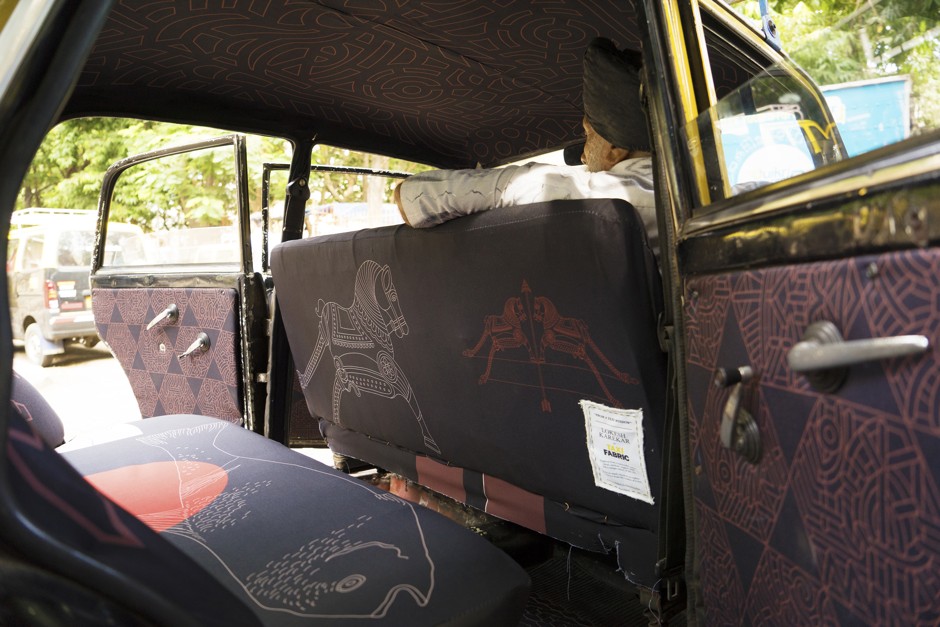
Artist Lokesh Karekar went for a minimalist design inspired by the 1980s. (Taxi Fabric)
Guarav Ogale wanted his design to reflect the life of the taxi’s driver. (Taxi Fabric)
People resort to gurus to receive mantras (mystically powerful formulae to be recited by them for their spiritual uplift); others seek medicine men and holy monks to get yantras (esoteric talismans to ward off evil forces); some others learn thanthras (secret rites for attaining superhuman powers) from scholars (pandits). But all of this is wasteful effort. One should accept the body as the thanthra, one’s own breath as the mantra and the heart as the yantra. There is no need to seek them outside oneself. When all words emanating from you are sweet, your breath becomes Rig Veda. When you restrict what you listen to and prefer only sweet speech, all that you hear becomes Sama gana(rendition of Sama Veda). When you do only sweet deeds, all that you do is Yajur homa (ritualistic sacrifice). Then you will be performing every day the Veda Purusha Yajna, the yajna which propitiates the noblest and highest Vedic Spirit!
Abasaheb Gaikwad won three gold medals at the Australian Master Games in discus throw, hammer throw and shot put events. Here’s how he reached this stage of success.
35-year-old Abasaheb Gaikwad, a bus conductor from Shetjale village in Sangli, Maharashtra, has made India proud by winning three gold medals at the Australian Master Games, which were held in Adelaide.
Abasaheb broke his own records from the past, and bagged three gold medals in different games – discus throw, hammer throw and shot put.
He had participated in the 30-35 age group category, and won by beating players from at least seven countries.
But success for Abasaheb did not come in one day. He prepared for the the games while working full time, and training himself without any coach. He has been able to reach this stage because of a lot of hard work, dedication, and the help of many people associated with him.
As the cost of the tour is very high, his employers at Maharashtra State Regional Transport Corporation (MSRTC), friends, family members and well-wishers, pitched in and helped him in gathering funds. Back home, when he was preparing for the games, his senior officials from MSRTC shifted him to internal duty and used to send him to trips only when they were close to the depot, so he could make time for practice. Because of the lack of sports facilities in Sangli, his friends also helped him during practice sessions.
“Before embarking on the trip Down Under, I had to go through a qualifying round in Mumbai, where I performed outstandingly and got chosen for the tour…My friends and colleagues helped me a lot, both in terms of gathering funds and preparing for the tournament. The cost of the tour is huge. Everyone collected a sum of Rs 2.5 lakh” he told The Pune Mirror.
Australian Masters Games is a biennial, multi-sport event. It covers more than 50 sports, and sportsmen aged over 30 years are allowed to participate from across the world. The 15th Australian Masters Games took place from October 3-10, 2015.
After participating in many district, state and national level championships, this self-taught athlete had also won two gold medals in javelin and discus throw at the Torino International Masters Games, held in Turin, Italy, in 2013.
Siddharth GJ is a motivational speaker, a father, a Certified Documentary Credit Specialist, and a friend of the late President APJ Abdul Kalam. He also has cerebral palsy. Siddharth’s journey has been, expectedly, full of challenges, but is nothing short of inspirational given all that he has achieved because of his determination and strong will.
How often does it happen that the President of India calls you his friend? That he can spot you in a crowd of thousands of people and talks about you in his many motivational speeches. This may be a dream for most of us but for Siddharth GJ it was a proud moment when the late President referred to him as a friend.
Siddharth has cerebral palsy. But he never let this come in the way of his succeeding at whatever he set his mind to. He excelled academically, found an intellectually challenging job, and also became a motivational speaker delivering over a hundred talks.
Kalam and Siddharth shared a great bond after their first meeting at Chennai airport. –
President Kalam read an article on Siddharth on an online portal that talked about Siddharth’s medical condition and how he overcame all the challenges to succeed in his life. Impressed by Siddharth’s resolve and perseverance, the President wrote to him and expressed a desire to meet him. They finally met at Chennai airport in December 2005.
“I still remember the day. It was December 2, 2005. My life changed after that. I made him a small presentation on issues faced by people with disabilities. He even talked about that at a conference, which gave me huge recognition. I will never forget my meeting with him. I was mesmerized by his presence,” Siddharth recalls.
President Kalam was so bowled over by Siddharth’s work that he talked about him at the inaugural speech of the First International and the Ninth Annual Conference of the Indian Academy of Cerebral Palsy.
Their bond grew stronger and they kept in touch and met a few more times. Siddharth recalls another incident when he had gone to attend a talk by President Kalam in Chennai. The President recognised his ‘friend’ from the stage and broke protocol to come and meet Siddharth in the crowd.
“I loved meeting him because he did not make me feel that I was different. He treated me like a regular person. Often, people confuse cerebral palsy with mental illness. Which is so untrue because it is just a condition where the body and mind do not coordinate with each other. This affects the body posture and the way I behave. It has nothing to do with my intelligence,” says Siddharth.
Siddharth had jaundice when he was just three months old. His parents, who were simple villagers, did not realize the seriousness of the disease. The delay in treatment left Siddharth with the condition which makes him ‘different’ from others.
Siddharth (R) has always found a happier way to fight challenges
“The news shattered everyone in the family but they were so supportive. They never let me feel that I was any less. They would treat me exactly the way they would treat my sister. If she got a scolding, so would I,” he recalls.
The couple knew that Siddharth might not be as well co-ordinated as other kids of his age but he was as intelligent as any ‘normal’ child.
“It was not until I turned eight that I stepped into a school. Then, gradually, teachers saw my capabilities and gave me double promotions. I excelled in my studies and cleared my 12th exam with 90 percent marks in spite of having a scribe who barely knew English. I had to work very hard to explain to him what I wanted to convey. I could not score more because my scribe was not allowed to do the practical exam and draw diagrams,” says Siddharth.
He then finished his Master’s in Economics and excelled in that as well. He was now eager to enter a new world where he could work and become financially independent.
But this was just the start of the struggle Siddharth had to face because he encountered challenges and rejections at every step.
Many companies dismissed his job applications in spite of his incredible academic background. “They thought I would not be able to perform well under pressure. They just judged my abilities without even testing me. I was hurt and disappointed,” says Siddharth.
The rejections continued for several years and then a positive change came into his life when he got his first job in 2005 with ABN AMRO Central Enterprises Services Pvt. Ltd., as an officer trainee in the bank’s document checking section.
“That moment I felt that all my tears and hard work have paid off. All the pain and struggle were a thing of the past and I was full of new energy, hope and passion. I was proud because I got a job due to my capabilities and on my terms,” he recalls.
But this wasn’t the end of his journey. It was, rather, a new beginning. His life took a complete turn when he became a Tedx speaker in Chennai and, since then, he has never looked back.
“I spoke in front of an audience of over 250 people and they gave me a standing ovation. It felt so great to share my experiences and, since then, I have been giving many motivational talks at various platforms and inspiring people to live a more positive life,” he says.
He currently works with IndusInd Bank Ltd., as manager. In fact, he is the first person in the country with cerebral palsy to be a Certified Documentary Credit Specialist. –
A Certified Documentary Credit Specialist is a professional who demonstrates a high level of practical knowledge and understanding of the complex issues associated with documentary credit practice, which is a set of rules on the issuance and use of letters of credit (a document from a bank guaranteeing that a seller will receive payment in full as long as certain delivery conditions have been met).
He met a beautiful girl and says he experienced “love at first sight.” He is happily married to her and has a toddler boy. “I see myself in my son. He runs around the house and I live my childhood through him as I could not do so,” he says.
“I can’t thank my mother and my sister enough for their support. Sometimes, after continuous rejection, I would be very rude to them but they always supported me and showed me the right path. They would go out of their way to make me feel loved and accepted. The day when I came out of denial, I became a calmer person and pursued my life in a better way,” he says.
Siddharth’s story is one of struggle but also of love and support from the family helping him defeat hardships. He has not just overcome hurdles in his own life but is also, with his inspirational talks, helping others with disabilities live a more positive life today.
The same person is king to his subjects, son to his parents, enemy to his enemies, husband to his wife, and father to his son. He plays many roles. Yet, if you ask him who he is, he would be wrong if he gave any of these relationships as his distinctive mark, for these marks pertain to physical relationship or activities. They denote physical kinships or professional relationships; they are names attached to temporary statuses. Nor can he reply that he is the head, the feet, the hands, etc., for they are but the limbs of the physical form. He is more real than all the limbs, and is infact beyond all names and forms which are falsities that hide the basic Brahman; he is known as ‘I’. Reflect over that entity well and discover who that ‘I’ really is. When it is so hard to analyse and understand your own entity, how can you pronounce judgement on other entities with any definiteness?
photo credit: Chandra X-ray Observatory awaiting deployment from the Space Shuttle Columbia. NASA
In celebration of American Archive Month, NASA has released six mind-blowing images from the Chandra archive.
The Chandra X-ray Observatory was launched and deployed from Space Shuttle Columbia on July 23, 1999. Since then, it has collected data on thousands of cosmic objects such as pulsars, supernovae, interstellar gas clouds, and galaxies. NASA hopes that by releasing these images to the public and scientific community, it will inspire new perspectives and serve as inspiration for future exploration.
The images can take hours, and in some instances days, to capture. They are imaged using a combination of light waves, X-rays, and radio waves.
Below is W44, also known as G34.7-0.4, which is an expanding supernova remnant that is interacting with the dense cosmic material surrounding it.
Image credit: X-ray: NASA/CXC/Univ. of Georgia/R.Shelton & NASA/CXC/GSFC/R.Petre; Infrared: NASA/JPL-Caltech
Next is SN 1987A, the brightest and nearest supernova to Earth in the last century. This image shows the result of the supernova explosion, which occurs when a star runs out of fuel and then hurls layers of itself out into space.
Image credit: X-ray: NASA/CXC/PUS/E.Helder et al; Optical: NASA/STScI
Below is Kesteven 79, another remnant of a supernova explosion. This one, however, occurred thousands of years ago.
Image credit: NASA/CXC/SAO/F.Seward et al, Optical: DSS
Next is MS 0735.6+7421, a galaxy cluster where one of the most powerful eruptions ever observed by humanity was seen.
Image credit: NASA/CXC/Univ. of Waterloo/A.Vantyghem et al; Optical: NASA/STScI; Radio: NRAO/VLA
Here, we see the galaxy cluster 3C295. The pink area is superheated gas and the yellow regions are individual galaxies. Galaxy clusters like this contain huge amounts of dark matter, which hold the hot gas (pink) and galaxies (yellow) together.
Image credit: X-ray: NASA/CXC/Cambridge/S.Allen et al; Optical: NASA/STScI
Last but not least is the “Guitar Nebula,” containing a pulsar officially called B2224+65. This pulsar is traveling at an extremely high speed of approximately 800 kilometers (500 miles) per second.
Image credit: X-ray: NASA/CXC/UMass/S.Johnson et al, Optical: NASA/STScI & Palomar Observatory 5-m Hale Telescope
Check out NASA’s website for more details on each image.




 Take off with Natarajan