Meet the Cute Little Sleeping Beauties … !!!

s there anything cuter than a sleeping newborn baby? Yes. Ten of them!

Baby photographer Sandi Ford has shared some images from her recent photo shoots to celebrate the arrival of spring and Mother’s Day.

In the heart-warming collection of pictures the babies are captured snoozing peacefully on super soft rugs and blankets.

Sandi runs her company Bumps, Babes and Beyond Photography from a studio in Ealing, West London, where she adds dainty accessories to the dozing newborns she shoots, some of whom are just a few days old.

Baby photographer Sandi Ford has shared some images from her recent photo shoots to celebrate the arrival of spring and Mother's Day

In the heart-warming collection of pictures the babies are captured snoozing peacefully on super soft rugs and blankets

In the heart-warming collection of pictures the babies are captured snoozing peacefully on super soft rugs and blankets

The photographer is a fan of natural light and says she likes to focus on the little details, fragility and tenderness of a newborn baby and encourage parents to use props and personal or sentimental items to provide a unique and personal touch to the pictures.

Sandi has three young children herself which she says helps her know how to get giggles from older children and how to soothe and relax a new arrival.

As well as newborns Sandi, whose work has appeared in Vogue and on Netmums.com, loves maternity shoots saying: ‘Pregnancy is such an amazing time in a woman’s life and we love to celebrate your beautiful body!’

See more of her work at www.bumpsbabesandbeyond.com

Sandi runs her company Bumps, Babes and Beyond Photography from a studio in Ealing, West London

The photographer adds dainty accessories like this floral headband to the dozing newborns she shoots

Many of her subjects are just a few days old and so spend a lot of their time sleeping

Sandi uses both natural and studio light and says she likes to focus on the little details, fragility and tenderness of a newborn baby

She says having three young children herself helps her know how to get giggles from older children and how to soothe and relax a new arrival

She encourages parents to use props and personal or sentimental items to provide a unique and personal touch to the pictures

Sandi's work has appeared in Vogue and on Netmums.com

SOURCE::::: TONI JONES FOR MAILONLINE  in http://www.dailymail.uk.com

Natarajan


Pamban Bridge… A Fascinating One !!!


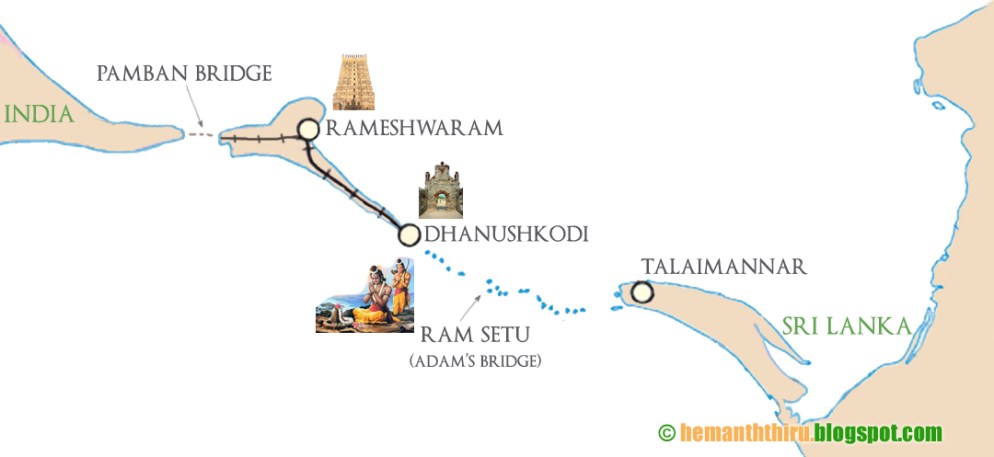
Pamban Bridge (named after the place at one end) lies between Indian main land
and Rameswaram island. It was the longest sea bridge for almost a century in India
(built in 1914) until Worli – Bandra sea bridge was built in Mumbai a few years ago.
Now it is the second.

Besides this, it is also a cantilever bridge that opens up in the middle to allow
ships to pass by like the Tower Bridge in London.

It was damaged in a cyclone in 1964 and was restored in just 46 days by E Sreedharan
the father of Delhi Metro.That cyclone had however damaged the link from Pamban to
Dhanuskodi town that vanished in the cyclone, thereby cutting the rail link between India
and Sri Lanka. Along with it went away the name Boat Mail for Madras – Dhanuskodi train.
Boat mail ? yes, because from Dhanuskodi, the passengers used to take a ferry to
Thalaimannar in Sri Lanka and continued their onward train journey all the way to Colombo.
Since the Madras train connected to a boat at the end of the journey, it was called
Boat Mail. This train was also known as Indo Ceylon Express in very early days.
https://i0.wp.com/static.panoramio.com/photos/large/41963310.jpg
https://i0.wp.com/i1.trekearth.com/photos/18313/img_2671.jpg
https://i0.wp.com/www.ramnad.tn.nic.in/images/Final_Scissors%20Bridge%20001.jpg
SOURCE:::: iNPUT FROM A FRIEND OF MINE
Natarajan

Magical Flight Of Starling Murmuration… Watch the Startling Video Clip… !!!

Watching a Starling Murmuration in Flight Is Simply Magical….

A flock of starlings is called a murmuration. These flocks may include other species of starlings and sometimes species from other families. This sociality is particularly evident in the their roosting behaviour; in the non-breeding season some roosts can number in the thousands of birds. They will travel many miles to get to their food, and all stay together for the warmth and safety of a large groups. Their movements are so precise, so coordinated, that the group of thousands seems like a single entity, moving this way and that. It’s a sight to see for all nature lovers, and one of the many miracles of life.

At dusk on a winter evening in southern England a flock of 200,000 European starlings congregate to soar in breathtaking formations before roosting for the night. These incredible displays of aerial precision and biological engineering are captured in this memorable sequence from FLIGHT: THE GENIUS OF BIRDS.

SOURCE::::www.you tube.com

Natarajan

Image of the Day…Frozen Sea Waves…. !!!

View larger. | Slushy waves on a Nantucket beach, February 20, 2015.  Photo by Jonathan Nimerfrosh.

View larger. | Slushy waves on a Nantucket beach, February 20, 2015. See the complete collection here. Photos byJonathan Nimerfroh.

Sure, the ocean freezes. But this photo of partly frozen waves – caught by photographer and surfer Jonathan Nimerfroh – fascinated even the experts

As you well know if you live there, the eastern United States has been in a deep freeze throughout February, 2015. Wave after wave of ice and snowstorms have hit the region, and NASA says that hundreds (maybe thousands) of records have been set for daily low temperatures. Now, from a photographer and surfer in Nantucket, Jonathan Nimerfroh, we have this amazing photo from February 20, 2015 of an ocean wave, just before it freezes solid. He calls it a slurpee wave.

The New York Times has a great article about this photo and these slow-moving waves of slush. Jonathan’s photo has also been on the Weather Channel and other places (I first saw it on Facebook; thanks, Beverly Spicer!). Nimerfroh told the New York Times:

I just noticed a really bizarre horizon. The snow was up to my knees, getting to the water. I saw these crazy half-frozen waves. Usually on a summer day you can hear the waves crashing, but it was absolutely silent. It was like I had earplugs in my ears.

Enjoying EarthSky so far? Sign up for our free daily newsletter today!

Of course, the ocean does freeze. Salty sea water has a lower freezing point than the ice in your home freezer, not 32 degrees F but instead about 28.4 degrees F. And it was colder than that on that day in Nantucket, somewhere around 10 degrees F. Still, these waves are something very special, and even experts commented that they had not seen them before. Helen Fricker, a glaciologist at the Scripps Institution of Oceanography in La Jolla, California, who studies the dynamics of ice flows in Antarctica, told the New York Times that a full scientific explanation was “outside her expertise.” Erin Pettit, a glaciologist at the University of Alaska, Fairbanks, added that waves in Alaska tend to break up sea ice and said:

I have never seen frozen waves like this.

Nimerfroh said he returned the following day to the same beach. That day it was a few degrees colder still and the water had completely frozen. He said:

Nothing was moving. There were no waves anymore.

Shop the complete collection of Nantucket Slurpee Wave photos at Jonathan Nimerfroh’s website.

Bottom line: Wave caught in the act of freezing at a Nantucket beach, February 2015, by Jonathan Nimerfroh.

SOURCE::: http://www.earthskynews.org

Natarajan


One Year on, This Chennai Family Waits for MH 370 Passenger… Whole World Still Looking For Clues…


Chandrika Sharma(L)was one of the 239 people on board the ill-fated MH370 flight that disappeared while on its way to Beijing on March 8, 2014. In this photograph, she is seen with her daughter Meghna and husband Narendran.

KS Narendran, Chandrika Sharma’s husband, is a shattered man. His wife was one of the 239 people on board the ill-fated MH370 flight that disappeared while on its way to Beijing, one year ago on March 8, 2014.

Sharma had taken the flight on her way to Ulan Bator to participate in a Food and Agriculture Organisation conference to represent the NGO she worked for. Narendran, a management consultant, is a quiet man and has since chosen to keep to himself.

A colleague of Sharma at the NGO she worked at, International Collective in Support of Fishworkers (ICSF), said Narendran did not want to be disturbed. “Till date he has not received any death certificate,” the colleague added

https://i0.wp.com/www.hindustantimes.com/Images/popup/2015/3/08-03-pg21a.jpg

The couple’s only daughter is studying in a Delhi college and is currently preparing for her annual examinations.

On Friday, Narendran was present at a workshop organised by the NGO where Sharma’s co-workers and government officials paid tribute and spoke about her commitment to the cause and dedicated service to the people.

A stoic Narendran looked on as speaker after speaker narrated their own experiences at the NGO and shared their thoughts about Chandrika Sharma.  The ICSF in its website homepage has a section titled “Waiting for Chandrika Sharma”.

If the massive undersea search for Malaysia Airlines Flight 370 turns up nothing by the end of May, the three countries leading the effort will go “back to the drawing board,” Malaysia’s transport minister said on Saturday.

Liow Tiong Lai told a small group of foreign reporters on the eve of the anniversary of the plane’s disappearance that he remains cautiously optimistic the Boeing 777 is in the area of the southern Indian Ocean where the search is ongoing.

Despite the exhaustive search for the plane, which disappeared last March 8 during a flight from Kuala Lumpur to Beijing, no trace of the jet has been found. Malaysia’s government on January 29 formally declared the incident an accident and said all 239 people on board were presumed dead.

“By the end of May, if we still can’t find the plane, then we will have to go back to the drawing board,” Liow said.

Asked if Malaysia might stop the search if there are no new leads by the end of May, when bad weather usually sets in, Liow said it was “too early to pre-empt anything now,” and that the government would continue to rely on the group of experts leading the hunt.

“We stand guided by the expert team,” he said.

“I am cautiously optimistic it should be in this area,” he said, adding that “we need directions, we need plans, we need to review all the data that we have.”

Ships looking for debris from the plane on the ocean floor off the coast of western Australia have so far scoured 44 percent of the 60,000-square-kilometer (23,166-square-mile) area the search has been focused on, Liow said. In the latest report he received Friday, he said the search team had identified 10 hard objects that still need to be analysed.

Such findings, which often include trash and cargo containers from passing ships, have been common during the search, and so far no trace of wreckage has been located.

Liow said that Australia, Malaysia and China would meet next month to discuss the next steps in the search. Most of the plane’s passengers were Chinese.

Australian transport minister Warren Truss said last week that if the plane isn’t found by May, one option is to expand the hunt beyond the current search zone to a wider surrounding area.

Australian Prime Minister Tony Abbott said on Thursday, “I can’t promise that the search will go on at this intensity forever,” but added that “we will continue our very best efforts to resolve this mystery and provide some answers.”

Liow said an interim report on the investigation – a requirement under international civil aviation regulations – would be presented to the Malaysian government on Saturday and released to the public on Sunday. He didn’t comment on it.

But he outlined measures his government has already undertaken, including plans to upgrade radar systems to cope with bigger traffic volume and a new tracking system on Malaysia Airlines flights that sends aircraft data every 15 minutes, instead of the previous 30 to 40 minutes.

Liow said the government has allocated 700 million ringgit ($190 million) for the improved radar.

He said that the radar upgrade had been in the works even before Flight 370 disappeared. The plane dropped off civilian radar when its transponder and other equipment were switched off shortly after takeoff from Kuala Lumpur, but was tracked for some time by Malaysia’s military radar as it headed south across the country toward the Indian Ocean.

SOURCE:::: http://www.hindustantimes.com

Natarajan

” This All Women Team Took a Road Trip To INSPIRE other Women …” Also Spreading the Message of Women Empowerment…

A group of seven women embarked on a road trip in January 2015

In January 2015, a group of women travelled 5000 kilometres in India over eight cities in 28 days to spread the message of women’s empowerment and safety while on the road.

This is the first hand experience of the journey from Vidula who led the initiative. Read on!    I had always wanted to drive a car along the coast of the Indian Peninsula.

The maps were the first thing I worked on. Mahindra agreed to sponsor the Scorpio Adventure 4×4 vehicle.

Eventually, we had a real team of seven women raring to go.

The budget was Rs 1500 per head per day for food, fuel and accommodation.

We attended a first aid workshop with Anish Menon from Pune while Mahindra conducted a car maintenance workshop for us where we learned how to change the stepney.

The event was flagged off on the January 4, 2015.

On days one and two, we witnessed the beautiful Konkan coast, blue skies, lovely people and delectable food.

As the roads were badly maintained we ended up driving nine hours on these two days.

We decided then to stick to the national highways.

That sort of eased the pressure and we were able to stop by and see some places.

Malvan was the next stop where we swam in the sea at night.

Day three was Agonda in Goa!

Food was the highlight — delicious pancakes and chicken cafereal, a famous Goan dish.

We interviewed Belinda Mueller, who is a psychiatrist by profession and a long distance cyclist.

One of the girls got a haircut at a local barber shop and she let go of all her long lovely curls.

The Karnataka stretch was pretty, lined with rivers, bridges, seas, coconut trees, tiny villages and fields.

We stopped for some gajras (flower necklaces) that we wore on our hands and necks.

We stopped at a local shack.

There was an amma who was really keen to speak to us but didn’t know our language and we didn’t know hers.

Very affectionately she served us everything.

She smiled and laughed at everything we said.

We then went to Mirjan Fort which is a 16th century fort, built during the reign of Adil Shah.

Enroute, we stopped at Murudeshwar where the big Shiva statue was the highlight.

Back in the car, we read out loud some poetry by Pablo Neruda, and had some good laughs recording the poetry session.

In Udupi, we tried every local dish that we could get our hands on.

In Kerala, whenever we called the hotels for directions, all we would get was, “Please give the phone to the driver.”

They assumed that the driver would always be the stereotypical male.

After telling them that we women were driving ourselves, they meekly gave us directions.

In Kozhikode, for breakfast, the lady of the homestay made us some local puttu that we had with bananas.

Kochi biennale was going on and we got to see some art at a café.

The following day we stayed at the Kovalam beach.

It was much quieter after sunset, and spent the evening talking at a restaurant.

It was time for a rest day when one of the girls decided to go bald and felt liberated.

Kanyakumari was at the tip of the peninsula. The roads were far better on the east coast than the west.

The following day, on our way to Rameshwaram, we saw some beautiful sunflower fields.

Another day gone by and we saw ourselves make our way to Velankanni, which turned out to be a pretty little, clean town.

Next, we left for Puducherry. Enroute was Tranqeubar.

We stopped for a snack at the ‘Bungalow on the beach’.

There is an old Dutch fortress from the 1600s that stands on the shore.

We partied in Puducherry.

Two of the girls had emergencies back home and had to leave the trip midway.

It was down to two of us for the next couple of days.

We decided to continue nevertheless as we were going to pick up the last participant of the drive.

Close to Sullurupeta is the Pulicat lake and bird sanctuary which is the second largest brackish water lake in India.

We saw in the distance pink flamingoes, the exotic side of nature.

We drove from Nellore to Vijayawada to pick up our final companion and interview Mythri.

We reached Kakinada and then Vishakapatnam where the submarine museum was shut for renovation because a cyclone called HudHud had devastated it.

In Odisha, the first halt was at Gopalpur, a small village we had never heard of.

We then made our way to Puri.

We interviewed Claire Prest, the Co-founder of Grass Route Journeys.

We saw the Jagannath Puri temple where non-Hindus were not allowed, the women ululated, the men threw their hands up in the air with cries of joy and the deity was colourful and beautiful.

We hired a boat on Chilika Lake and saw some exotic birds. We visited the Konark Temple which is magnificent.

We also went to Raghurajpur where everyone from different families worked towards a common cause — art.

Chandipur beach which was our last stop in Odisha is also called the vanishing beach because twice in a day water recedes for 3 kms as this is an elevated beach. It was beautiful and there weren’t too many people on the beach.

We handed over the car to Mahindra in Kolkata and the road trip had come to an end.

We spent three days here, walking around and clicking random street pictures.

We visited the 100-year-old, India Coffee House and saw the Rabindranath Tagore museum in old Kolkata.

We interviewed musician Anushree Gupta in Kolkata.

The whole drive was about women’s empowerment.

It is about putting thoughts into action.

We were more careful and cautious on the east coast than the west.

Each one of us had a bottle of pepper spray.

Women are not expected to drive.

Belinda Mueller, the first Goan woman, whom we interviewed said, “Don’t let fear restrict you. But don’t do anything silly and stupid.”

The whole drive was about staying safe and common sense is what it took us to stay safe.

Men have to be more accepting of women. We wanted to be the seeds of change.

We had done that!

Source:::::  Vidula in http://www.rediff.com

Natarajan


Image For The Day…. Dwarf Planet Ceres as Seen From Dawn Spacecraft Of NASA…

NASA’s Dawn spacecraft has become the first mission to achieve orbit around a dwarf planet. The spacecraft was approximately 38,000 miles (61,000) kilometers from Ceres when it was captured by the dwarf planet’s gravity at about 4:39 a.m. PST (7:39 a.m. EST) Friday, March 6.

This image of Ceres was taken by the Dawn spacecraft on March 1, just a few days before the mission achieved orbit around the previously unexplored world. The image shows Ceres as a crescent, mostly in shadow because the spacecraft’s trajectory put it on a side of Ceres that faces away from the sun until mid-April. When Dawn emerges from Ceres’ dark side, it will deliver ever-sharper images as it spirals to lower orbits around the planet.

The image was obtained at a distance of about 30,000 miles (about 48,000 kilometers) at a sun-Ceres-spacecraft angle, or phase angle, of 123 degrees. Image scale on Ceres is 1.9 miles (2.9 kilometers) per pixel. Ceres has an average diameter of about 590 miles (950 kilometers).

Dawn’s mission is managed by NASA’s Jet Propulsion Laboratory, Pasadena, California, for NASA’s Science Mission Directorate in Washington. Dawn is a project of the directorate’s Discovery Program, managed by NASA’s Marshall Space Flight Center in Huntsville, Alabama. The University of California, Los Angeles, is responsible for overall Dawn mission science. Orbital ATK Inc., in Dulles, Virginia, designed and built the spacecraft. The German Aerospace Center, the Max Planck Institute for Solar System Research, the Italian Space Agency and the Italian National Astrophysical Institute are international partners on the mission team. For a complete list of acknowledgments, http://dawn.jpl.nasa.gov/mission.

Image Credit: NASA/JPL-Caltech/UCLA/MPS/DLR/IDA 

SOURCE:::: http://www.nasa.gov

Natarajan

Arunima Sinha ….On the Top of the World…. Hats off To This Brave Lady …

http://inktalks.com

You Might Have watched a plenty of Motivational and Inspirational Videos and Talks …

But this Talk by Arunima Sinha  on her goal and experience is totally on a different platform.

My request to you  is to watch this video  and Listen to her talk … Also share this Video Talk with your Kids and friends …You need not listen to any Gurus …both Religious and Management… after listening to her.

HATS OF TO THIS COURAGEOUS LADY …

Natarajan

 
In April 2011, Arunima Sinha, a national level volleyball player, was thrown out of a running train by robbers who were after her gold chain. Her left leg crushed by the passing trains had to be amputated. This did not stop her from dreaming the impossible, on May 21st, 2013, Arunima summited Mount Everest. Watch as she takes us along on her journey in this passionate talk.

Please Note: This talk is available with English subtitles. Please enable YouTube Captions if the subtitles are not appearing.

ABOUT INK: INKtalks are personal narratives that get straight to the heart of issues in 18 minutes or less. We are committed to capturing and sharing breakthrough ideas, inspiring stories and surprising perspectives–for free!

Watch an INKtalk and meet the people who are designing the future–now.

Connect with us:
http://inktalks.com
http://facebook.com/inktalks
http://twitter.com/inktalks

ABOUT ARUNIMA SINHA:
Arunima is a former national level volleyball player who was thrown off a moving train in 2011. In order to save her life, the doctors had to amputate part of her left leg. In light of this event, Arunima became inspired by Yuvarj Singh, an international cricket player who successfully won his battle with cancer. As such, she was determined to climb Mount Everest. In 2013, Arunima became the first female amputee (and the first Indian amputee) to make the climb.

Arunima then went on to be the first female amputee to climb Mt. Kilamanjaro in Africa and Mt. Elbrus in Europe. She has been honoured with numerous awards and recognitions. Currently she is busy planning to open a sports academy for underprivileged and physically disabled children.

SOURCE::::: http://www.You Tube.com and ink talks.com

Natarajan

Himalayas From 20000 Feet ….A Video Clip …


The Himalayas From 20,000 Feet

It isn’t easy to film at 20,000 feet, but the aerial cinema experts at Teton Gravity Research have outdone themselves in this video of the world’s highest mountains.

This first ultra HD footage of the Himalayas is shot from above 20,000 ft. with the GSS C520 system, the most advanced gyro-stabilized camera system in the world.

It was shot from a helicopter with a crew flying from Kathmandu at 4,600 ft. up to 24,000 ft. on supplemental oxygen. The images of Mt. Everest, Ama Dablam, and Lhotse are so clear and sharp it’s like nothing we’ve ever seen.

SOURCE:::: http://www.you tube .com and http://www.yougottobekidding.wordpress.com

Natarajan