Image For the Day… Astronaut Buzz Aldrin in the Apollo 11 Lunar Module !!!

 Astronaut Buzz Aldrin in the Apollo 11 Lunar Module

This July 20, 1969 photograph of the interior view of the Apollo 11 Lunar Module shows astronaut Edwin E. “Buzz” Aldrin, Jr. during the lunar landing mission. The picture was taken by astronaut Neil A. Armstrong, commander, prior to the landing.

Buzz Aldrin was born in Montclair, New Jersey, on Jan. 20, 1930. Aldrin became an astronaut during the selection of the third group by NASA in October 1963. On Nov. 11, 1966 he orbited aboard the Gemini XII spacecraft, a 4-day 59-revolution flight that successfully ended the Gemini program. During Project Gemini, Aldrin became one of the key figures working on the problem of rendezvous of spacecraft in Earth or lunar orbit, and docking them together for spaceflight. Aldrin was chosen as a member of the three-person Apollo 11 crew that landed on the moon on July 20, 1969, fulfilling the mandate of President John F. Kennedy to send Americans to the moon before the end of the decade. Aldrin was the second American to set foot on the lunar surface.

Image Credit: NASA 

SOURCE::::: http://www.nasa.gov

Natarajan

Jan 22 2015


Image of the Day…Largest Picture Ever Taken … !!!


Did you see the largest picture ever taken, released on January 5? The picture has a staggering 1.5 billion pixels, so you’d need 600 HD television screens to display it. It shows the neighboring Andromeda galaxy, closest spiral galaxy to our Milky Way. Now daveachuk on YouTube has created this wonderful fly-through video, showing detail in the gigantic Andromeda pic. Enjoy feeling small! And remember … each one of those white dots? Each one is a sun, much like the sun that powers all life on Earth.

Enjoy the video! And be sure to watch until the end!

The NASA/ESA Hubble Space Telescope captured the full image, which is made up of 411 Hubble images, takes you through a 100 million stars and travels over more than 40,000 light years. Our thanks to Alex Grossman on G+ for sharing! As he said:

Wow. Just wow.

Bottom line: Fly-through video of the largest image ever taken, of the Andromeda galaxy, nearest spiral galaxy to our Milky Way. Prepare to feel small!

SOURCE:::: www. earthskynews.org and You Tube

Natarajan

Jan 22 2015


World”s Most Spectacular New Airports …

Changi airport, Singapore (opening 2018)

Architect Moshe Safdie – who designed the iconic Habitat 67 housing complex in Montreal – began construction on a new development at Singapore’s Changi airport in December 2014. Featuring a ‘Forest Valley’, ‘Jewel Gardens’ and a 130ft-high (40m) waterfall called a ‘Rain Vortex’, it looks more like the Land of Oz than an air hub; trees, palms and ferns are enclosed within a 134,000sq m glass dome. Scheduled for completion in 2018, the Jewel complex will be linked by pedestrian bridges to existing terminals, offering space for shops and restaurants alongside the foliage. Safdie has said that the project is “the prototype of a new kind of urban place”. (Safdie Architects)


Mexico City international airport, Mexico (opening 2018)

In September 2014, British architecture firm Foster and Partners won a competition to design what will be one of the world’s largest airports when it is completed in 2018. Working with Mexican firm Fernando Romero Enterprise, Foster and Partners unveiled plans for a 555,000 sq m terminal enclosed within a lightweight shell. The new international airport for Mexico City has been designed to accommodate increasing passenger numbers and has echoes of Foster’s plans for the world’s first private spaceport in New Mexico. The structure is pre-fabricated, allowing for rapid construction without scaffolding. The new building will harness the sun’s energy as well as collecting rainwater and maintaining interior temperatures using natural ventilation. (Foster and Partners/Fernando Romero Enterprise)


Mumbai’s Chhatrapati Shivaji international airport, India (opened 2014)

Designed to reference the feathers in a peacock’s tail – and mirror traditional Indian open-air pavilions – the concrete canopy on this new terminal is part of a wider trend to reflect local architecture within airports. This addition to Mumbai airport was opened in February 2014 and is the vision of US firm SOM, whose website says that “just as the terminal celebrates a new global, high-tech identity for Mumbai, the structure is imbued with responses to the local setting, history, and culture”. (Robert Polidori/SOM)


Shenzhen Bao’an international airport, China (opened end of 2013)

Covered with a honeycomb pattern and a whopping 1.5km (0.9 miles) long, the new terminal at Shenzhen Bao’an was designed to evoke the shape of a manta ray, according to its architects Studio Fuksas. The architects rather poetically describe it as “a fish that breathes and changes its own shape, undergoes variations, turns into a bird to celebrate the emotion and fantasy of a flight”. The design continues into the interiors, its hexagonal skylights allowing natural light in with a dappled effect. (Archivio Fuksas)


Chongqing Jiangbei international airport, China (opening 2015)

Architects ADPI continue the trend towards green space in airports in their plans for a new terminal at Chongqing Jiangbei. With two wings referencing Chongqing’s two rivers, the structure is set within a park: once completed, the terminal will be able to handle 55m passengers a year, ranking the airport among the world’s 15 largest. (ADPI)


Pulkovo International Airport, Russia (opened 2014)

Designed by Grimshaw architects to work with the extremes of climate in St Petersburg, the new terminal at Pulkovo airport features monumental folded ceilings clad in metal panels that recall the gilded spires of churches in the city. A series of linked zones is intended to reflect St Petersburg’s landscape of islands and bridges. Opening in February 2014, the building has a large flat roof with folded structures beneath that distribute weight away from the middle to offer support during heavy snowfall. Once construction on a second and final phase of the project is completed in 2015, the airport will cater for 17m passengers a year. (Grimshaw)


Istanbul New Airport, Turkey (opening 2019)

Grimshaw is also in charge of a team designing a new six-runway airport in Istanbul which aims to accommodate 90m passengers a year once it opens in 2019, before increasing its capacity to 150m after completion. Featuring a vaulted canopy, the airport’s Terminal One will cover a site of nearly 100 hectares (0.4 sq miles) – the architects say it will become the “world’s largest airport terminal under one roof” once finished. “We were inspired by the local use of colours and patterns, the quality of light and how it penetrates buildings, as well as by traditional architecture such as the Süleymaniye Mosque,” claims Tomas Stokke, the director of Haptic, which is collaborating with Grimshaw and Nordic Office of Architecture on the project. (Grimshaw/Nordic Office of Architecture/Haptic) 


Mount Fuji Shizuoka airport, Japan

Pritzker Prize-winner Shigeru Ban is designing a terminal for the airport at the base of Mount Fuji. Inspired by the tea plantations surrounding the mountain, his plans include green barrel vaults. Inside, natural light is diffused by a roof canopy made out of twisted laminated wood – latticing being a signature style of the Japanese architect. (Shigeru Ban)

SOURCE::::


Amazing Paintings…Something Different !!!

The Unreal Paintings of Robert Gonsalves

Canadian artist Robert Gonsalves creates beautiful paintings. However, his paintings go a step further than beautiful, they each play with the border between reality and the surreal. his work has also been influenced by Salvador Dali and Rene Magritte, who he had the pleasure of meeting.
A quick glance at one of his paintings will never do, because there is always more than one image on the canvas, depending on how you look at it. This is among my favorite types of creative art, the kind that unfolds in both meaning and beauty.
rob gonsalves surreal

rob gonsalves surreal

rob gonsalves surreal

rob gonsalves surreal

rob gonsalves surreal

rob gonsalves surreal

rob gonsalves surreal

rob gonsalves surreal

rob gonsalves surreal

rob gonsalves surreal

SOURCE:::: http://www.ba-bamail.com

Natarajan

Jan 21 2015

Image of the Day…” Sunset Over The Atlantic…”

Dramatic sunset over the Atlantic, seen near Rio

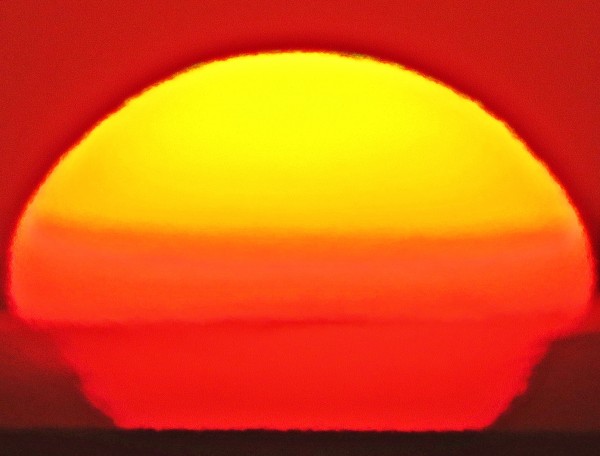
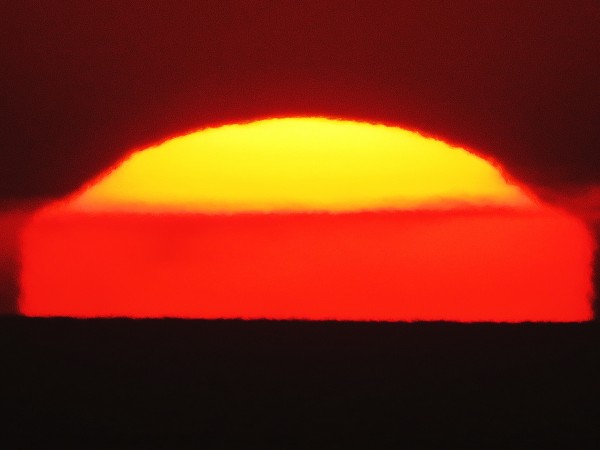
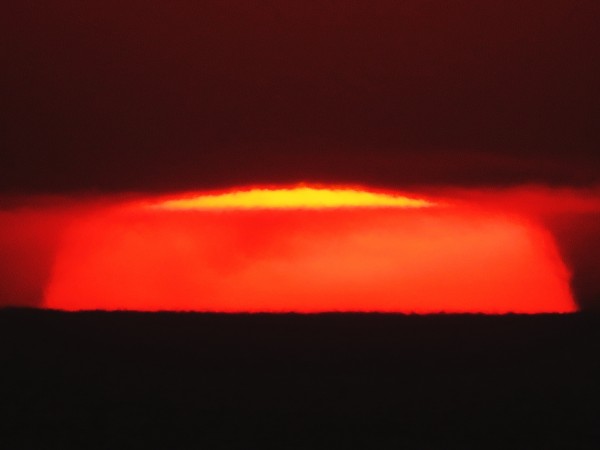
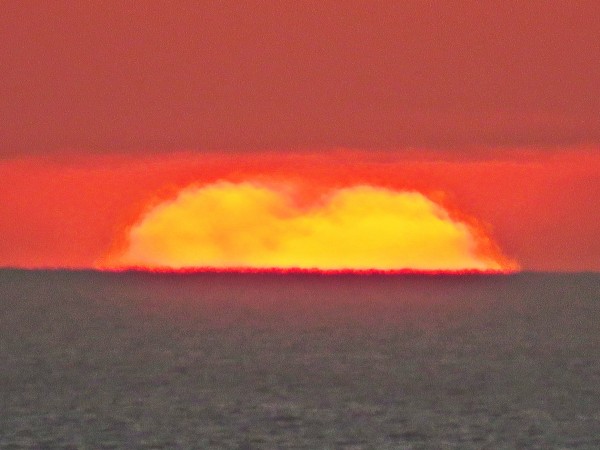
Cool air on the sea surface strongly refracted the setting sun, seen Saturday night from a small town near Rio de Janeiro, Brazil. Cool series of images!

January 17 sunset by Helio de Carvalho Vital.  Shot 1 of 6.

Helio de Carvalho Vital wrote:

That the strong refraction next to the horizon flattens the image of the setting sun is no surprise to anyone. But what if the sun suddenly becomes shaped like a mushroom? Saturday evening [January 17, 2015], I took some photos of the sun setting over the Atlantic Ocean from Saquarema, a small city 100 km east of downtown Rio de Janeiro.

The local air temperature was 34°C but the seawater was only 21°C. Thus a layer of cooler air formed on the surface of the sea.

As sunlight crossed that layer to reach my camera, it underwent a complex series of refractions and reflections that severely distorted the image of the sun, making it acquire very unusual shapes.

A Canon Powershot SX60 HS was used for all the shots, taken at 21:39-41 UTC.

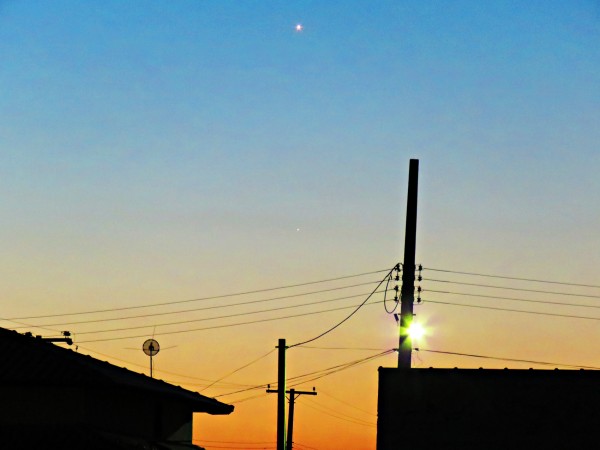
After sunset that same evening, Venus and Mercury appeared!

January 17 sunset by Helio de Carvalho Vital.  Shot 2 of 6.

January 17 sunset by Helio de Carvalho Vital.  Shot 3 of 6.

January 17, 2015 sunset by Helio de Carvalho Vital.  Shot 4 of 6.

January 17, 2015 sunset by Helio de Carvalho Vital.  Shot 5 of 6.

After sunset on January 17, as the sky began to darken, Venus and Mercury popped into view in the western sky.  Photo by Helio de Carvalho Vital.

Bottom line: Series of images of Saturday night’s amazing sunset, seen over the Atlantic from a small town near Rio de Janeiro, Brazil.

SOURCE::: http://www.earthskynews.org

Natarajan

Jan 21 2015

How Mumbai Once Lived !!!….

Mumbai may pace to a frenetic beat, but the metropolis has hidden corners where life moves more leisurely.

Satish Bodas/Rediff.com visits the city’s BDD chawls where neighbours live like one big family.

If you want to see what life was like a few decades ago, I’d suggest a visit to Mumbai’s 92-year-old Bombay Development Directorate’s chawls.

Families manage in tiny rooms and neighbours, unlike what happens in much of Mumbai, are very much a part of each other’s lives. The chawls’s residents still share their joys, sorrows and festivals with each other.

BDD is a little oasis in the heart of Mumbai — where a bustling lifestyle and tall skyscrapers pause to watch a slower, more measured Time that exists in a few old stone buildings.

But the residents — mainly Hindus and Buddhists — say it is time for change. Their families have expanded and living in such tiny spaces, plagued by leakage problems, is no longer easy.

Many youngsters have moved out; the older generation waits behind, hoping that redevelopment will take place, yet not completely ready to let go of a life they are so familiar with.

In my eyes, it is one of the last bastions guarding a simple, old-fashioned way of life.

The BDD chawl building built in 1925

The structures of the BDD chawls were built between 1922 and 1925.

The 1922 structure with a new coat of paint

When space is short, windows provide a convenient area for storage.

Kashinath Annaa kakade a resident since 1948

Kashinath Anna Kakade, who is 95 years old, has created a special calendar.

If you tell him the date of your birth, he will tell you on which day you were born.

He makes it a point to read the newspaper regularly and enjoys drinking a glass of milk every day.

Mr Kakade has been staying here since 1948 and feels that life today is much more comfortable than it was in his youth.

“Then,” he says, “we had to go down to fetch water, but now the BMC (Brihammumbai Municipal Corporation) water comes directly to my house.”

An iron staircase going to the roof

This old ladder leads to the terrace. Only one person can use it at a time.

As you can see, the ravages of age have begun to show in this old stone structure.

Gas and kerosene stove used by the joint families residing here

The families living here rely on gas cylinders and kerosene stoves to cook their daily meals.

As you can see, water continues to be a major issue. Look at all the vessels used to store the precious liquid.

Each room is home a family and is self-contained; it includes the bathroom and the kitchen.

The toilets, of course, are communal and are located outside the house.

Each floor houses 20 families in 20 rooms.

There are six toilets on each floor — three for men and three for women.

Washing clothes outside the ground floor premises

This family on the ground floor, like many others in the chawl, uses the extra space outside their house to wash and dry their clothes.

If you look at the photograph carefully, you will see the little door (behind the lady in maroon) they have made under the window for a quick entry and exit.

BDD Chawl

Sadly, the rear areas of the BDD buildings are used as chicken coops-cum-garbage dumps.

BDD Chawl

Facing the chawls is a huge open area where children skip out to play… a rarity in Mumbai.

BDD Chawl

Most of the residents, except those who stay in buildings reserved as residential quarters for the police (known locally as Police Line Buildings), have extended their rooms to get extra space.

Take a look at this picture and you’ll know what I mean.

BDD Chawl

You don’t need to live in fancy buildings to have a gymnasium on the premises. Here’s a look at the gym at BDD chawl.

BDD Chawl

Skyscrapers, with their alluring promise of a more modern lifestyle, tower nearby.

BDD Chawl

Every floor is connected through a long passage, with houses on both sides. These passage, as you can see, become an extension of the houses.

BDD Chawl

Finally, here’s a glimpse of how the old replaces the new — the old wooden staircase of the chawl has been renovated using tiles and marble.

Satish Bodas/Rediff.com

Natarajan
Jan 20 2015

Vyjayanthimala Bali ….Dancing @ the Age of 80 !!!


A Bollywood and Bharatanatyam legend, smt. Vijayahthimala Bali (b. 1936) at Bharatiya Vidya Bhavan, in Mylapore, December 2013.
http://en.wikipedia.org/wiki/Vyjayant…


SOURCE::: http://www.You Tube.com

Natarajan

Jan 20 2015

” 320 Pound Woman … How She will Look Like ” !!!

Amazing!

The question is, What does a 320 pound woman look like? 


Now, before you scroll down to look at her pictures, get a mental image of what you think a woman who weighs 320 looks like…


Got it?


Ready?


Amazing!001
 
 
Amazing!002

Not exactly what you were expecting is it??!!


The tallest and best proportioned woman in the world lives in Holland .

She is 7’4′ and weighs 320

What a relief! Now we ALL know we aren’t overweight; we’re just too short! 

SOURCE:::: http://www.fundstuffpeoplesendme.wordpress.com

Natarajan

Jan 20 2015

” Dosa …. Dosa …. Dosa … “


Dosa
is a fermented crepe or pancake made from rice batter and black lentils. It is a staple dish in the South Indian states of Tamil Nadu, Kerala, Andhra Pradesh and Karnataka. It is also popular in other parts of India, as well as other countries like Sri Lanka, Malaysia and Singapore.

Here are 20 dosas that everyone must try:

1. Sweet Banana Wheat Dosa

A tasty sweet treat, especially for children. Serve it with sliced bananas and warm chocolate syrup.


2. Mysore Masala Dosa

Commonly known as Masala Dosa, it is Karnataka’s speciality.  The filling is prepared with soft mashed potatoes and curry leaves. It’s the first choice when you want to enjoy South Indian food.


3. Paper Dosa

Who doesn’t remember munching on this paper thin crispy dosa  dipped in hot sambar and coconut chutney. As kids, it was our all-time favourite.


4. Ali Pota Dosa

Soft and spongy, the name of the dosa literally means ‘scooping into’, when translated from Tamil. It is prepared like Soft dosa, but with different proportions. Serve it with tamarind or puli chutney to bring out the acidic flavours.


5. Oats Masala Dosa

Here comes a tasty South Indian treat for the health conscious people. It is not only fiber rich, but also diabetic friendly. Top it with some chaat masala to give your taste buds a kick.


6. Neer Dosa

Neer dosa, literally means ‘water dosa‘, comes from the unique region of Dakshin Kannada.  It is prepared with watery rice batter and tastes best with jaggery and coconut chutney.


7. Kovil Prasadam Dosa

It is made in a unique way and served in South Indian temples as prasadam to the Gods. The recipe for the dosa calls for ginger and sonti and it tastes best with ginger chutney.


8. Davangere Benne Dosa

The dosa traces its origins from the city of Davangere in Karnataka. Benne means butter and so, this mouthwatering dish is made with fresh homemade butter.


9. Godhambu Dosa

Craving for a dosa but don’t have much time? Try this instant wheat dosa recipe. It doesn’t need much fermentation and can be cooked in a few minutes. This simple and nutritional dosa is a perfect choice for your evening snack.


10. Rava Masala

Prepared with suji, you can make it plain or spice it up with mashed potatoes, chopped onions, curry leaves and red chillies. The thin texture of the batter gives it a netted and crispy appearance.


11. Ragi Dosa

A health-friendly dosa, it is slightly brown in colour and has a netted texture just like Rava dosa. Ragi, being very rich in calcium, is a perfect choice for vegans and vegetarians. You can enjoy it plain or with potato fillings and coconut chutney.


12. Kaal Dosa

Unlike other dosasKaal dosa is a bit thick and very soft. One of the famous South Indian breakfast dishes, it is served with Kara chutney. 


13. Uppu Huli Dosa

A very popular dish in Mangalore and Udupi, the batter is prepared with tamarind and red chillies, giving it a reddish texture. This dosa is a combination of sweet, sour and spicy flavours.


14. Navratan Dosa

Just like it’s name, the dosa takes a royal place in the family of dosas. The dish is prepared with vegetables, fruits and nuts. It is an appetizing yet healthy treat when served hot with corianderchutney and sambar.


15. Egg Dosa

An innovative dosa, it is a doppelganger of our favourite half-fried egg. The thin and crispy layer of a plain dosa makes it taste even more heavenly and luscious.


16. Open Masala Dosa

As the name suggests, the masala is arranged on top of the dosa. It is slightly thicker than plain dosaand can be enjoyed with Sambar and tomato chutney.


17. Steamed Dosa

Also known as Set dosa, it is a very healthy dish prepared without oil. Very easy to make, Steameddosa has a very soft texture and can be enjoyed plain with coriander and tamarind chutney or with mashed potatoes prepared with chillies, curry leaves and onions.


18. Pesarattu Dosa

Prepared with Moong Dal, it is a popular breakfast dish in Andhra Pradesh and it is also known as MLA Pesarattu dosa. The moong daal makes it wholesome and filling. This crispy dosa tastes delightful with some Upama and coconut chutney.


19. Brown Rice Dosa

Full of nutrition, this dosa is the best for every weight watcher. When served with tomato and coconutchutney, this cholesterol-free dosa will not disappoint you.


20. Avocado Dosa

The filling of this dosa is made of avocado and onions. Avacados are called Benne Hannu in Kannada  and the dosa is a famous dish in Bangalore hotels. You can enjoy this piping hot dosa withSambar and chutney.

SOURCE:::: http://www.scoopwhoop.com

Natarajan

Jan 19 2015


Do you have any more yummy 
dosas to add to this list?