திருவிளையாடல்’ திரைப்படத்தில் வந்த சிவனையும் தருமியை நம்மால் மறக்கமுடியாது. அதற்குக் காரணம் சிவாஜியும் நாகேஷும்தான். தங்களது தெறிப்பான நடிப்பில் தமிழ் ரசிகர்களை திக்குமுக்காடச் செய்தவர்கள் அவர்கள்.
நாம் நினைத்துக் கொண்டிருக்கிறோம், தருமி கதை வந்தது திருவிளையாடல் படத்தில்தான் என்று. உண்மையில், அதற்கும் பல ஆண்டுகள் முன்பே ஒரு திரைப்படத்தில் இக்காட்சி வந்துவிட்டது என்பது தெரியுமா?
தருமி, நக்கீரனுடனான சிவனின் திருவிளையாடலை தமிழ் சினிமா முன்னமே கண்டிருக்கிறது என்பது மட்டுமல்ல; அதிலும் சிவாஜி கலக்கியிருக்கிறார் என்பதுதான் ஆச்சரியம்.
இங்கு வீடியோவில் இடம்பெற்றுள்ள ‘நான் பெற்ற செல்வம்’ என்ற பழைய திரைப்படத்தில் வரும் இந்த ஒரு காட்சியில் நீங்கள் காணப்போவது ஒன்றல்ல… இரண்டு ஆச்சரியங்கள்!
For those lucky enough to ride in a first class cabin, a 20-hour flight is actually something to look forward to.
AirlineRatings.com, which rates airlines on the level of comfort and safety they provide to passengers, recently ranked the top 10 airlines with the best first class cabins.
From multi-room suites to double beds covered in plush linens, here’s a look inside the cushiest first class cabins in the world.
Emirates
Emirates
Business class cabins on Emirates have privacy doors, personal mini bars, and ambient lighting for maximum relaxation. Each seat converts to a fully flat mattress.
On longer flights, take advantage of the onboard shower spa stocked with Bvlgari toiletries, or stretch your legs and grab a drink in the first and business class lounge.
Etihad Airways
Etihad
On Etihad Airways, cabins feature Poltrona Frau leather seats, ambient lighting, personal wardrobes, and a chilled drinks cabinet. Guests looking for the ultimate experience in luxury can stay in The Residence — an upper deck cabin on the A380 airbus that has a living room, separate double bedroom, ensuite shower room, personal butler, and chef.
Japan Airlines
Japan Airlines (JAL)
Each wood grain and leather cabin on Japan Airlines‘ 777 is designed with custom airweave bedding, a retractable privacy partition, and a 23-inch personal TV screen. Meals are prepared by chefs like Seiji Yamamoto, known for his three-Michelin star restaurant, Ryugin, in Tokyo.
Lufthansa
Lufthansa
Lufthansa’s first class suites include ergonomically shaped seats, lie-flat beds with a mattress topper, pillow, and duvet, and in-flight entertainment in up to eight languages. The wine list is curated by sommelier Markus Del Monego and caviar is served.
Singapore Airlines
Singapore Airlines
The seats on Singapore Airlines are 35 inches wide, with a bed length of 82 inches and curved side panels for privacy. Passengers are treated to pajamas and bedroom slippers as they relax in the ambient mood lighting. Each seat has a vanity corner with a mirror so you can freshen up before you disembark.
Qantas
International first class suites on Australia’s Qantas airline are designed with lie-flat beds measuring 6.5 feet long. The mattress is made of plush sheepskin and the seat and leg rest are adjustable. There’s even an ottoman so you can have a guest in your cabin.
Dining options include an eight-course tasting menu or an à la carte menu designed by Chef Neil Perry, with selections from Quantas’ award-winning wine list.
SWISS
SWISS
Swiss International Air Lines’ first class armchairs are available on long-haul flights and can be turned into a lounge armchair, a table for two, or a 6.5 foot bed with a mattress and privacy walls.
Passengers are given pajamas by Zimmerli of Switzerland and toiletry bags that contain socks, eye masks, toothbrushes, toothpaste, earplugs, and skincare products by La Prairie.
Korean Air
Korean Air
Korean Air’s first class cabins offer a variety of seating options. The Kosmo Suite 2.0 includes a sliding door that’s see-through on the inside, a 9.4-inch partition, and a 79-inch seat. Kosmo Suite seats are 26.5 inches wide and have adjustable back support, a footrest, and one-touch controls to change positions.
There’s also a Kosmo Sleeper with a 78-inch lie-flat bed and a Sleeper Ottoman with a
180-degree lie-flat bed on B777-300, A330-300, and A330-200 aircrafts.
Seats come with personal LCD screens, individual reading lamps, and free noise-cancelling headphones.
All Nippon Airways
All Nippon Airways
ANA (All Nippon Airways) offers first class passengers a cabin with comfortable seating, a large adjustable dining table, and an adjustable cocktail table. What sets this cabin apart is its storage. There’s a mini closet for your jacket and shoes, a space underneath the ottoman for baggage, and multiple compartments for smaller items.
Seats have two LED personal lights, international telephones with personal satellites to make calls in privacy, a ‘do not disturb’ light, USB port, and 23-inch LCD wide-screen monitor.
Thai Airways
Guests flying Royal First Class on Thai Airways are greeted with chilled Champagne and caviar. The Airbus A380s and newly remodeled Boeing 747s feature semi-private suites that are almost eight feet long. Seats are either 23 or 27 inches wide on the 747 and Airbus A380, respectively.
Chairs convert to 180-degree lie-flat beds, in-flight entertainment systems boast 23-inch flat screes with over 300 programs, and passengers can relax with a full-body massage at the Royal First Lounge of Bankgkok’s Suvarnabhumi Airport before their flight.
If every home in Bengaluru cooked 5 additional meals, would it ensure that the hungry don’t go to bed on an empty stomach? Here’s a community initiative that’s going to find out.
“This Dusshera, my aim is to try and ease Bangalore’s hunger problem.” So begins Mahita Fernandez’ post on the Facebook group Feed Your Neighbour.
The idea for the initiative, Feed Your Neighbour (FYN), came to Mahita in the wee hours of a night when she woke up hungry.
She says, “I woke up with a rumbling stomach around 3 am and felt thankful that I had food to eat. I then thought about the thousands in Bengaluru who are probably hungry and have nothing to eat. The very next morning, I put down the idea on paper and created the group to reach out to people.”
The Facebook group has since been joined by over 1,300 people.
Through the FYN initiative, Mahita aims to mobilise the community to cook and share food with the homeless and hungry in Bengaluru. The initiative, which will run from October 12-22, 2015, hopes to rally a minimum of 2,000 people who are willing to cook five extra meals each day. The food will then be distributed to the needy. This would also mean that across the eleven-day period, the initiative will have ensured that 1 lakh people do not go to bed on an empty stomach.
How does Feed Your Neighbour work?
While the FYN initiative primarily aims to do its part to ease Bengaluru’s hunger problem, it also hopes to build a sense of community among Bengalureans by giving them an opportunity to make a difference to the lives of those in need, via a ripple effect.
The initiative is simple – those interested in participating are required to cook a minimum of five meals which they will have to drop off at a particular point in their neighbourhood.
From here, volunteers will pick up the food and deliver them to the homeless and hungry.
Picture for representation only. Credit: vahrehvah.com
Mahita says that so far, around 900 people have agreed to provide food, and 75 others have signed up as volunteers to distribute the food. She is also looking for more volunteers to identify distribution points, and actually pick up and drop off the food. In addition, she is also looking for coordinators who can help with liaising with the volunteers, verifying the distribution points, etc. More details on this can be found here.
For those interested in being a part of the FYN initiative, here’s how you can get on board.
• Drop an SMS to +91 99723 24458 or a mail to feedyourneighbour@gmail.com with your name, locality, mobile number, email ID and what you would like to volunteer as.
• Those volunteering to cook are expected to cook a minimum of five packs of any rice-based dish like pulav, bisi bele bath, lemon rice, etc.
• Packing material will be provided so that quantities are standardised.
• The packed food will need to be dropped off at a designated point by 7 pm each day.
• From here, volunteers will distribute the food to the needy in various parts of the city.
Those people who are neither able to cook nor volunteer their time, but wish to be a part of the FYN initiative, can do so by donating money or by spreading the word. The funds collected will be used to purchase packing material, hire transportation for the pickup and distribution of food, etc. Mahita adds that if there is any excess money remaining after October 22, she will continue to distribute food to the needy till the money runs out.
How will the logistics be managed?
Picture for representation only. Credit: Terry Feuerborn/pixabay.com
In addition to mobilising the community to cook, Mahita is also currently working with volunteers to identify areas where the food can be distributed. Most of the food that is collected from a particular neighbourhood, will be distributed in that neighbourhood itself.
Mahita clarifies, “There are some areas like MG road and Lavelle road from where people want to donate food. However, these areas do not have a proliferation of the homeless. We’re planning to distribute the food collected from such areas, elsewhere.”
She also adds that while most of the food will be distributed to people on the streets, homes for the destitute, beggars’ homes, slums etc. are also being looked at. She mentions how one of the volunteers suggested a colony of Metro workers in South Bengaluru as one of the distribution points.
Ask Mahita why she has targeted dinner time, and she responds, “Most volunteers are likely to be busy during the day with their jobs and home chores. And considering we are rolling this out during Dussehra, pujas even. Also, many of the people who we are distributing the food to are possibly employed, whether they are daily wage labourers or beggars. Dinner time is probably the most convenient for both our volunteers, and the people who we are looking to help out.”
Food to be packed in eco-friendly material
Picture for representation only. Credit: Terry Feuerborn/Flickr
Mahita says that as far as possible, people are being handed eco-friendly material to pack the food.
“We are looking at giving out the food in boxes made from cardboard or other recyclable material,” she says. “However, there are some darshinis who have also agreed to send food. We can inform them, but we don’t really have control over what kind of packing material they will use.”
In addition, at the time of distributing the food, volunteers are being asked to inform the people who come to collect the food to dispose of the waste responsibly. Mahita hopes that educating them about this aspect will also sensitise them about proper waste management in the long run.
Mahita also believes that it is unlikely that there will be excess food. She says, “No matter how many people volunteer, the number of people who can do with a good meal will always be more. So we will ensure that the food reaches as many people as possible.”
She also expects that the number of people who come to collect the food is bound to increase over the ten days, as word gets out. Should this happen, she is in talks with caterers and darshinis who can help supply the additional food at subsidised costs.
To know more about the Feed Your Neighbour initiative and be a part of it, click here.
Written by Ganga Madappa for Women’s Feature Service (WFS) and republished here in arrangement with Citizen Matters. The story was originally published here. (c) Oorvani Foundation/Open Media Initiative. –
குழந்தைகளே! மற்ற நாடுகளின் சுதந்திரத்தை நாம மதிக்கிறோம். நாமும் சுதந்திரமாக இருக்க விரும்புறோம். நாம சுதந்திரமா இல்லைன்னா, நம்மள யாராவது மதிப்பார்களா?
நாட்டின் பாதுகாப்பை மனதில் வைத்து வேலை செய்த முன்னோடிகளான விஞ்ஞானிகளோடு வேலை செய்கிற அதிர்ஷ்டம் எனக்குக் கிடைத்தது. இந்தியாவோட ராக்கெட்டுகளை வானத்தில் ஏவுகிற இஸ்ரோ நிறுவனத்தில் 20 ஆண்டுகளுக்கு நான் வேலை பார்த்தேன். இந்தியாவோட முதல் ராக்கெட்டை ஏவுகிற திட்டத்தின் இயக்குநரா நான் இருந்தேன். அப்போதுதான் முதலாவது செயற்கைக்கோள் ரோகிணி வெற்றிகரமாக வானத்தில் ஏவப்பட்டது.
அதுக்கப்புறம் நாட்டின் பாதுகாப்புக்கு அவசியமான ஏவுகணைகளை உருவாக்கும் பணியில் சேர்ந்தேன். இந்தியா இப்போ வளரும் நாடு அல்ல, வளர்ந்த நாடு என்று உலகத்துக்கு நிரூபிப்பது போல இருந்தன அந்தப் பணிகள். அப்போதுதான் ‘நான் ஒரு இந்தியன்’ என்ற பெருமிதம் எனக்கு அதிகமானது.
அப்போது நாங்கள் மிகவும் லேசான ஒரு கார்பன் பொருளைக் கண்டுபிடித்தோம். ஒருநாள் நிஜாம் இன்ஸ்டிடியூட் ஆஃப் மெடிகல் சயின்ஸ் நிறுவனத்திலிருந்து ஒரு டாக்டர் என்னைப் பார்க்க வந்திருந்தார். எலும்பு அறுவை சிகிச்சை நிபுணர் அவர். எனது ஆய்வகத்திலிருந்த லேசான பொருளை அந்த டாக்டர் தூக்கிப் பார்த்தார். அதன் பிறகு அவரது மருத்துவமனைக்கு என்னை அழைத்துப்போனார்.
அங்கே சின்னஞ் சிறுமிகளும் சிறுவர்களும்கூட நோயாளிகளாக இருந்தார்கள். அவர்கள் தங்களது உடலில் மூன்று கிலோவுக்கு அதிகமான எடைகொண்ட ‘காலிபர்’ எனும் கருவிகளைக் கால்களில் தாங்கியபடி இருந்தார்கள். அவற்றை நாங்கள் 300 கிராம் எடையுள்ளதாக மாற்றினோம். அதைப் போட்டுக்கொண்டு கஷ்டமில்லாமல் சுலபமாக நடந்தார்கள். அந்தக் குழந்தைகளால் அதை நம்பவே முடியவில்லை. அவர்களுடைய அம்மா, அப்பா மகிழ்ச்சியாக இருந்தார்கள். எனக்கும் மகிழ்ச்சியாக இருந்தது.
நம் தேசம் ஒரு மகத்தான தேசம். நமது சாதனைகளையும் ஆற்றல்களையும் நாம்தானே அங்கீரிக்க வேண்டும். அற்புதமான சாதனைச் செய்திகள் நம்மிடம் உள்ளன. பால் வளத்தில் நாம்தான் உலகில் முதல் இடம். தொலைதூர உணர்வு கொண்ட செயற்கைக்கோள்களை உருவாக்குவதில் நாமே முதல் இடம். கோதுமை, அரிசி உற்பத்தியில் இரண்டாம் இடம்.
ஒரு முறை இஸ்ரேல் நாட்டில் பேப்பர் படித்தேன். பாலைவனத்தை ஐந்தாண்டுகளில் சோலையாக்கிய ஒரு சாதனை மனிதன் பற்றிய செய்தி இருந்தது. உள்ளேதான் சண்டைகள், சச்சரவுகள் பற்றிய செய்திகள் இருந்தன. ஆனால், இந்தியாவில் தலைகீழாக உள்ளது.
பதினான்கு வயதுச் சிறுமி ஒருத்தியிடம் ‘உன் குறிக்கோள் என்ன?’ என்று கேட்டேன். ‘வளர்ச்சியடைந்த இந்தியாவில் வாழ விரும்புகிறேன்’ என்று சொன்னாள்.
நமது நாட்டைப் பற்றி பல புகார்கள் கூறுவார்கள். ஆனால், அப்படி புகார் கூறுபவர்கள்கூட வெளிநாடுகளுக்கு சென்றால் மிகவும் கட்டுப்பாடாக நடந்துகொள்வார்கள். அசுத்தப்படுத்த மாட்டார்கள். அதேமாதிரி உள்நாட்டில் நடந்துகொண்டால் என்ன?
யாரோ வந்து நாட்டின் பிரச்சினைகளை எல்லாம் தீர்த்து வைப்பார்களா? நாமே நமது பிரச்சினைகளைத் தீர்த்துக்கொள்ள ஆரம்பித்தால் என்ன? நன்றாக யோசித்துப் பாருங்களேன்!
(மறைந்த முன்னாள் குடியரசுத் தலைவர் அப்துல் கலாம் ஹைதராபாத் பள்ளிக் குழந்தைகள் மத்தியில் பேசியது)
Alaska Airlines Space Bins will give passengers almost 50 percent more space overhead for carry-on bags. Within two years, nearly half of Alaska Airlines’ fleet will be fitted with the larger bins, the airline said. (Boeing)
Is the end of scrambling for overhead bin space near?
Boeing revealed new overhead bins on its Boeing 737s that will give passengers almost 50 percent more space for carry-on luggage.
Alaska Airlines is one of the first major airlines outfitted with Boeing’s bigger and wider bins, it dubbed Space Bins, which will fit six bags instead of four.
In order to do that, it’s sacrificing about 2 inches of head space, says Boeing.
But the move could mean savings for passengers who spent $3.5 billion last year on fees to check their bags–and are trying to find ways around check bag fees, which average around $25 per bag.
On Alaska’s 737-800, the expanded bin space will increase the number of bags that can fit overhead from 118 to 178 — a difference of 60 more standard sized bags.
“Alaska is relentlessly focused on making the travel experience better,” Sangita Woerner, Alaska Airlines vice president of marketing said in a release. “We’ve been on a mission to improve our cabin experience for several years and Space Bins are part of a $150 million investment we’ve made to make flying more comfortable and enjoyable.”
Within two years, nearly half of Alaska Airlines’ fleet will be fitted with the larger bins, the airline said. Delta will also have Space Bin 737s in early 2016 and United has also committed to the bins.
But that doesn’t mean you can bring on a bigger bag— the size limitations for carry-ons on Alaska will stay in place.
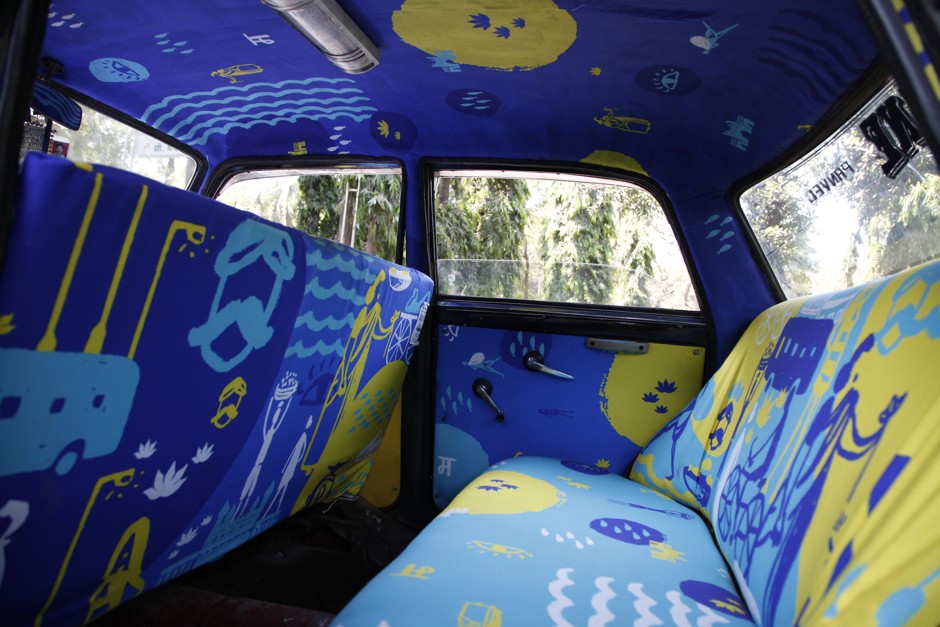
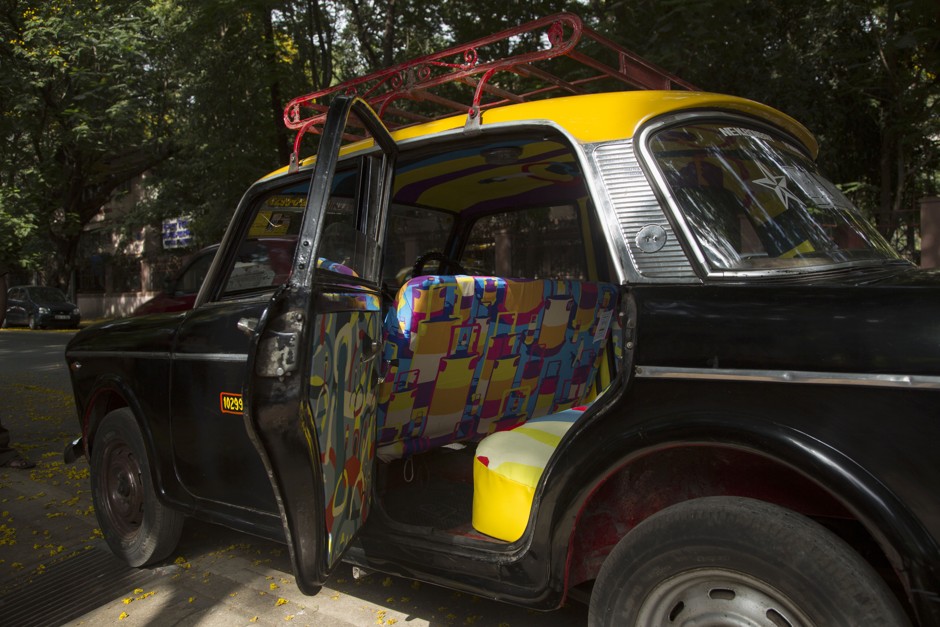
The Taxi Fabric project gives local designers a new vehicle to show off their work.
The bright pink interior of this taxi, by artist Pranita Kocharekar, reflects the diversity of Mumbai.(Taxi Fabric)
When you hop into a taxi, there isn’t usually much to look at except out the window. But one graphic designer wants to change that by turning cabs in Mumbai into canvasses for emerging artists.
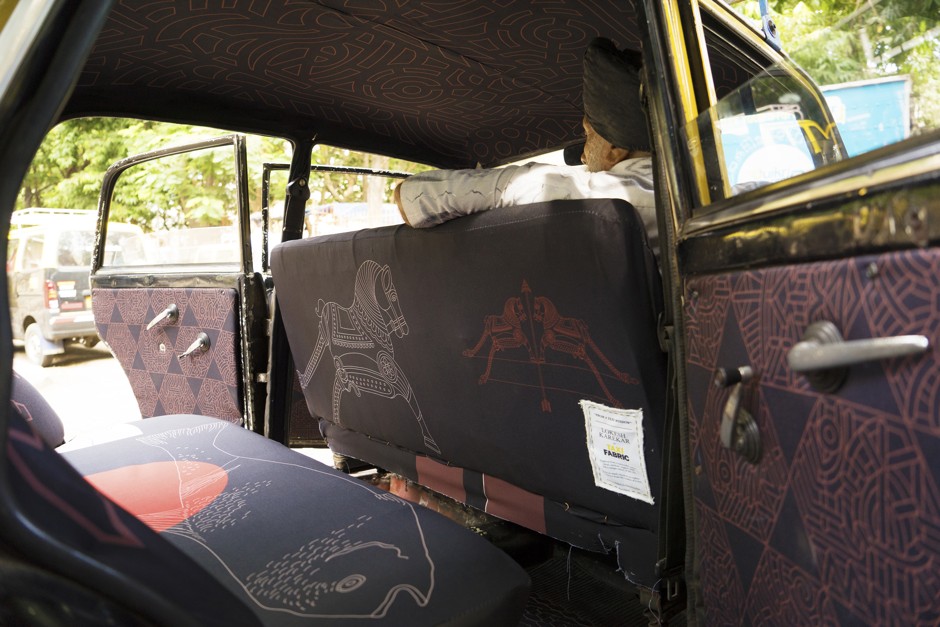
Sanket Avlani is the founder of Taxi Fabric, a project that has already turned seven of the city’s 50,000-plus taxicabs into works of arts. The interior of each taxi, from the ceiling and doors to the seats, has been specially designed by local Mumbai designers, and the designs themselves are inspired by India’s most populous city.
Take the latest taxi to get Taxi Fabric’s special treatment—the design, by 25-year-old typographer and designer Pavithra Dikshit, features jasmine flowers, peppers, and lemons against an eye-popping green background. Called “Urban Garden,” it’s Dikshit’s way of paying homage to Mumbai’s disappearing green space.
“As a fast-growing metropolis, it has building and buildings coming up in every space,” says Dikshit. “The green color is shrinking, so I wanted my taxi to show to all the green things around you.”
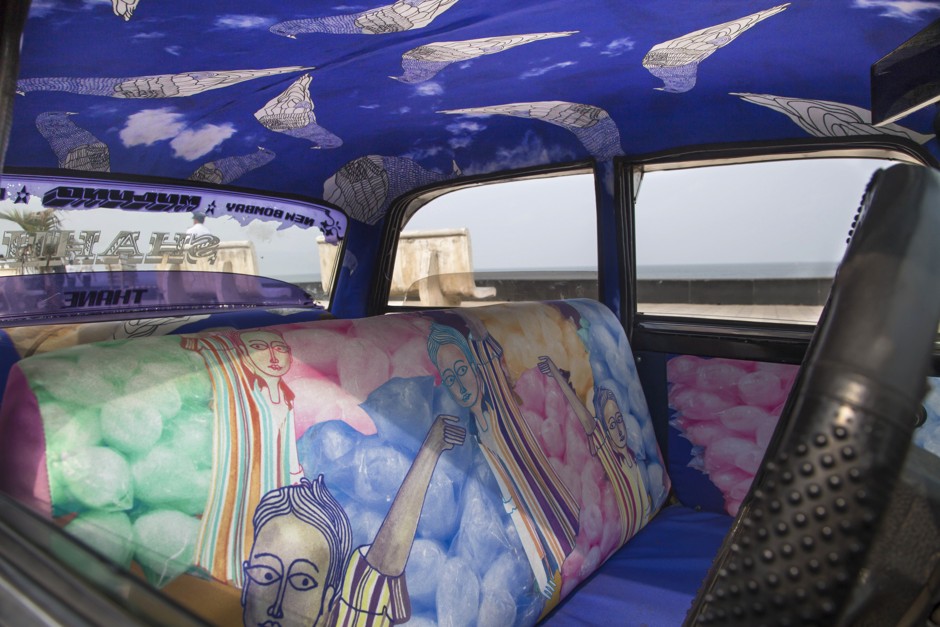
Other designs were inspired the daily life of a Mumbaikar—the different people you meet on the streets, from businessmen to children to vegetable vendors; and the personal stories of the cab drivers themselves.
Mumbai has a relatively small design community and an even smaller appreciation for the profession, says Avlani, who grew up in Mumbai and now works in London. “The design world is very small there, and most of the designers know each other,” he says. “If you wish to study design in India, not many people would understand or encourage it as much as they would in Europe or the United States.”
His hope is that the project will help spark conversation about the designs between taxi drivers and passengers. For Avlani, the iconic black-and-yellow taxis are the perfect medium because they’re everywhere.
”It’s so easy for people taking those taxis to react to those designs if the stories they tell are those that they recognize,” Avlani says. “If even the driver gets excited about it, it’s a win-win for everybody.”
As funding continues to trickle in from Taxi Fabric’s Kickstarter campaign, which runs until August 10, Avlani and his team hope to give at least 20 more cabs a special makeover by the end of the year.
Young designers and students who want to participate can submit a portfolioto the Taxi Fabric team, who will then select artists to work with. “We gauge if the designer can handle a project like this and if they can bring something new, and if the have their own style,” he says. Once accepted, artists will work with the team and, in some cases, cab drivers who want to be part of the program, to come up with a unique design.
The concept itself isn’t entirely new. It’s common for taxi drivers in Mumbai to customized their cars with colorful seat covers, eye-popping window decorations, lights, and little trinkets on the dashboard. “The taxi is like a desk at work. They spend their whole day in it so for them, it has to look interesting,”says Dikshit. “They don’t think that it attracts extra customers or anything, but it makes themselves feel good about spending [time] in it daily.”
But the bright pink, vibrant blue, and lively green colors that Taxi Fabric designers bring to cabs are a big step up from what drivers typically choose for their interior. Many drivers, Dikshit says, just go with fabric that’s already available at textile markets. “They’re very dull in color, like brown and maroon,” she says. “That’s how it’s always been, and nobody has the time to think about, ‘What if [the seat] is yellow?’”
Boring fabric doesn’t generate conversation, which Dikshit sees as a missed opportunity. “The drivers have their own stories, and they’re happy to discuss everything from politics to religion to traffic, to who they are as people,” she says. “You can almost consider them an extended part of the city landscape.”
Designed by Tasneem Amiruddin, this taxi art design reflects the daily life of a Mumbaikar. (Taxi Fabric)
A design by Taxi Fabric creator Sanket Avlani pays homage to “dawaballas,” who deliver hundreds of thousands of hot lunches across the city every day. (Taxi Fabric)
Artist Lokesh Karekar went for a minimalist design inspired by the 1980s. (Taxi Fabric)
Guarav Ogale wanted his design to reflect the life of the taxi’s driver. (Taxi Fabric)
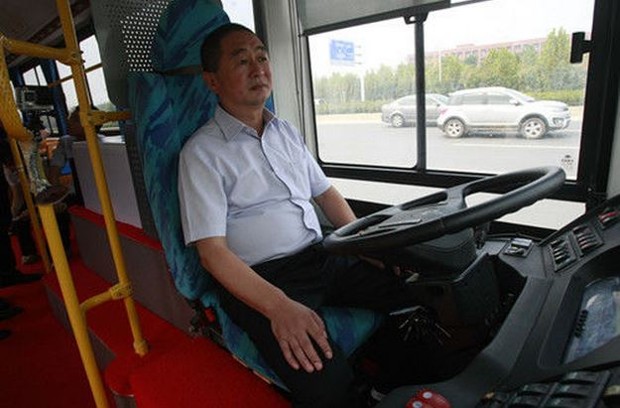
Look again. The dude behind the wheel is stretching his arms up like he’s dunking on someone—perhaps the execs at Google and Apple, as this thing is the “world’s first driverless bus,” according to manufacturer Yutong.
While tech companies in America have focused on personal automated cars, China has gone big with what could be the beginning of mass, unmanned bus transit. The spacious vehicle, unveiled at the end of August after three years of development, recently managed a 20-mile trip through the crowded city of Zhengzhou without crashing into other motorists or bursting into flames. That same driver stayed behind the wheel, true, but maybe as technology progresses he’ll be replaced with a Johnny-Cab robot.
The bus maneuvers with the help of cameras, laser radars, and a master controller that tells it to go faster and stop at signals. Yutong says in a press release it masterfully handled the road during one of its test drives:
With a distance of 32.6 km, the intercity road from Zhengzhou to Kaifeng has 26 traffic lights in total. Despite this and busy traffic, Yutong driverless bus successfully completed a series of highly complex driving acts, such as automatic lane change, overtake, and responding traffic lights. Without any human assistance, the bus arrived at its destination with its highest speed reaching 68 km/h (42 mph). According to some experts, the much improved active safety standard is the biggest advantage of unmanned vehicles as they are very likely to eliminate all kinds of traffic accidents.
The manufacturer also says the bus has an efficient driving style—one “that can only be attained by years of experience of an attentive and careful driver”—that will reduce energy waste and thus make the ride environmentally friendly. The company plans to put it through more tests, including running it on race lanes, before proceeding with real-world applications.
A reporting crew with RTtook a spin on the bus last week. Have a look at the view from the front seat:
Strange, puffy, dense clouds are descending on the streets of Bangalore, India’s technology capital. While whimsical-looking, they are actually puffs of a toxic foam inundating the city.
Documentary photographer Debasish Ghosh has captured images of the clouds floating around the city and overrunning the roads. The foam comes from Bellandur, a 1.4-square-mile lake that for years has been polluted by chemical and sewage waste. Every time it rains, the lake rises and wind lifts the froth up and carries it into the city.
A pedestrian walks among clouds of toxic foam in Bangalore, India.
The toxic foam gets in the way of pedestrians and cars, creating awful traffic jams. It carries a stench so strong that it burns the nose. And if it comes into contact with your skin, you’ll get an itchy rash.
“It causes a nuisance,” Ghosh says.
Making matters worse, the froth is flammable. In May and June, the entire lake caught fire, leaving a 56-year-old man who was standing on a bridge above the lake with a ruptured cornea.
The froth has come every summer for more more than a decade now, but Ghosh says that this year is particularly bad. He’s been documenting the pollution since May, making sure to immediately clean his arms, hands, and face any time he gets too close.
Debasish Ghosh When it rains, the froth rises up and gets carried into the city by winds.
Officials try to “hose” down the lake, using water to keep the foam from rising.
Residents in the area have filed numerous complaints to the city, according to Ghosh, but the government has done little to remedy the situation. Ghosh says since his photos were firstpublished by the BBC, the government has paid a bit more attention, but still not enough. For now, city officials try to keep the foam down whenever it rains by pumping water into the lake. “What happens is the water [mixes with] the foam at a high speed, and it disintegrates and doesn’t rise up,” says Ghosh. “That’s how they are controlling it at this point in time, so it doesn’t fall on people.”
Actually cleaning up Bellandur and other polluted lakes won’t be easy. Once known for being the home of nearly a thousand lakes, Bangalore has become known as the “land of a thousand sewage tanks,” instead. Today, after years of urbanization, only about 150 lakes still exist, according to the Deccan Herald.The rest are either used as garbage dumps or, when they dry up, filled in and put up for grabs.
“There’s so much pollution that it will take lots of time and lots of investment to bring this lake back to normal,” he says. “To what it was maybe two decades ago, when people say there would still be migratory birds in there.”
Abasaheb Gaikwad won three gold medals at the Australian Master Games in discus throw, hammer throw and shot put events. Here’s how he reached this stage of success.
35-year-old Abasaheb Gaikwad, a bus conductor from Shetjale village in Sangli, Maharashtra, has made India proud by winning three gold medals at the Australian Master Games, which were held in Adelaide.
Abasaheb broke his own records from the past, and bagged three gold medals in different games – discus throw, hammer throw and shot put.
He had participated in the 30-35 age group category, and won by beating players from at least seven countries.
But success for Abasaheb did not come in one day. He prepared for the the games while working full time, and training himself without any coach. He has been able to reach this stage because of a lot of hard work, dedication, and the help of many people associated with him.
As the cost of the tour is very high, his employers at Maharashtra State Regional Transport Corporation (MSRTC), friends, family members and well-wishers, pitched in and helped him in gathering funds. Back home, when he was preparing for the games, his senior officials from MSRTC shifted him to internal duty and used to send him to trips only when they were close to the depot, so he could make time for practice. Because of the lack of sports facilities in Sangli, his friends also helped him during practice sessions.
“Before embarking on the trip Down Under, I had to go through a qualifying round in Mumbai, where I performed outstandingly and got chosen for the tour…My friends and colleagues helped me a lot, both in terms of gathering funds and preparing for the tournament. The cost of the tour is huge. Everyone collected a sum of Rs 2.5 lakh” he told The Pune Mirror.
Australian Masters Games is a biennial, multi-sport event. It covers more than 50 sports, and sportsmen aged over 30 years are allowed to participate from across the world. The 15th Australian Masters Games took place from October 3-10, 2015.
After participating in many district, state and national level championships, this self-taught athlete had also won two gold medals in javelin and discus throw at the Torino International Masters Games, held in Turin, Italy, in 2013.
Siddharth GJ is a motivational speaker, a father, a Certified Documentary Credit Specialist, and a friend of the late President APJ Abdul Kalam. He also has cerebral palsy. Siddharth’s journey has been, expectedly, full of challenges, but is nothing short of inspirational given all that he has achieved because of his determination and strong will.
How often does it happen that the President of India calls you his friend? That he can spot you in a crowd of thousands of people and talks about you in his many motivational speeches. This may be a dream for most of us but for Siddharth GJ it was a proud moment when the late President referred to him as a friend.
Siddharth has cerebral palsy. But he never let this come in the way of his succeeding at whatever he set his mind to. He excelled academically, found an intellectually challenging job, and also became a motivational speaker delivering over a hundred talks.
Kalam and Siddharth shared a great bond after their first meeting at Chennai airport. –
President Kalam read an article on Siddharth on an online portal that talked about Siddharth’s medical condition and how he overcame all the challenges to succeed in his life. Impressed by Siddharth’s resolve and perseverance, the President wrote to him and expressed a desire to meet him. They finally met at Chennai airport in December 2005.
“I still remember the day. It was December 2, 2005. My life changed after that. I made him a small presentation on issues faced by people with disabilities. He even talked about that at a conference, which gave me huge recognition. I will never forget my meeting with him. I was mesmerized by his presence,” Siddharth recalls.
President Kalam was so bowled over by Siddharth’s work that he talked about him at the inaugural speech of the First International and the Ninth Annual Conference of the Indian Academy of Cerebral Palsy.
Their bond grew stronger and they kept in touch and met a few more times. Siddharth recalls another incident when he had gone to attend a talk by President Kalam in Chennai. The President recognised his ‘friend’ from the stage and broke protocol to come and meet Siddharth in the crowd.
“I loved meeting him because he did not make me feel that I was different. He treated me like a regular person. Often, people confuse cerebral palsy with mental illness. Which is so untrue because it is just a condition where the body and mind do not coordinate with each other. This affects the body posture and the way I behave. It has nothing to do with my intelligence,” says Siddharth.
Siddharth had jaundice when he was just three months old. His parents, who were simple villagers, did not realize the seriousness of the disease. The delay in treatment left Siddharth with the condition which makes him ‘different’ from others.
Siddharth (R) has always found a happier way to fight challenges
“The news shattered everyone in the family but they were so supportive. They never let me feel that I was any less. They would treat me exactly the way they would treat my sister. If she got a scolding, so would I,” he recalls.
The couple knew that Siddharth might not be as well co-ordinated as other kids of his age but he was as intelligent as any ‘normal’ child.
“It was not until I turned eight that I stepped into a school. Then, gradually, teachers saw my capabilities and gave me double promotions. I excelled in my studies and cleared my 12th exam with 90 percent marks in spite of having a scribe who barely knew English. I had to work very hard to explain to him what I wanted to convey. I could not score more because my scribe was not allowed to do the practical exam and draw diagrams,” says Siddharth.
He then finished his Master’s in Economics and excelled in that as well. He was now eager to enter a new world where he could work and become financially independent.
But this was just the start of the struggle Siddharth had to face because he encountered challenges and rejections at every step.
Many companies dismissed his job applications in spite of his incredible academic background. “They thought I would not be able to perform well under pressure. They just judged my abilities without even testing me. I was hurt and disappointed,” says Siddharth.
The rejections continued for several years and then a positive change came into his life when he got his first job in 2005 with ABN AMRO Central Enterprises Services Pvt. Ltd., as an officer trainee in the bank’s document checking section.
“That moment I felt that all my tears and hard work have paid off. All the pain and struggle were a thing of the past and I was full of new energy, hope and passion. I was proud because I got a job due to my capabilities and on my terms,” he recalls.
But this wasn’t the end of his journey. It was, rather, a new beginning. His life took a complete turn when he became a Tedx speaker in Chennai and, since then, he has never looked back.
“I spoke in front of an audience of over 250 people and they gave me a standing ovation. It felt so great to share my experiences and, since then, I have been giving many motivational talks at various platforms and inspiring people to live a more positive life,” he says.
He currently works with IndusInd Bank Ltd., as manager. In fact, he is the first person in the country with cerebral palsy to be a Certified Documentary Credit Specialist. –
A Certified Documentary Credit Specialist is a professional who demonstrates a high level of practical knowledge and understanding of the complex issues associated with documentary credit practice, which is a set of rules on the issuance and use of letters of credit (a document from a bank guaranteeing that a seller will receive payment in full as long as certain delivery conditions have been met).
He met a beautiful girl and says he experienced “love at first sight.” He is happily married to her and has a toddler boy. “I see myself in my son. He runs around the house and I live my childhood through him as I could not do so,” he says.
“I can’t thank my mother and my sister enough for their support. Sometimes, after continuous rejection, I would be very rude to them but they always supported me and showed me the right path. They would go out of their way to make me feel loved and accepted. The day when I came out of denial, I became a calmer person and pursued my life in a better way,” he says.
Siddharth’s story is one of struggle but also of love and support from the family helping him defeat hardships. He has not just overcome hurdles in his own life but is also, with his inspirational talks, helping others with disabilities live a more positive life today.





 Take off with Natarajan