Why this 50-yr-old makes India proud….?

Read on to learn how Raju Dabhade created history…

Raju Dhabade

Do you know this man?

No? Even I didn’t, till I met him.

Now that I have, I will never forget him.

He is a man who makes India proud.

No, he is not a celebrity or a sportsperson who has won medals for the country.

Fifty-year-old Raju Dabhade is the creator of the game of roll ball that will see its third World Championship in December, 2015, in Pune.

The first Roll Ball World Championship, held in 2011 in Pune, was won by Denmark; India was the first runner up.

The second World Cup, which India won, took place in Kenya in 2013.

“Roll ball is so named because it is a fast-paced game where the players use skates and the ball is always rolling, says Dabhade, who is also the general secretary of the International Roll Ball Federation.

Roll ball is a combination of basketball, handball, throwball and skating that requires balance, speed, accuracy and teamwork.

It is played between two teams; the objective is to score the maximum number of goals within a stipulated time.

So how did someone who, as young a boy, made ends meet doing odd jobs like working in a tea stall and delivering newspapers door-to-door end up inventing an international sport?

We asked Dabhade himself:

Raju Dabhade

How did roll ball begin?

As a Physical Training teacher in Pune’s MES Bal Shiksha English Medium School, I used to train and take players from different games for interschool competitions.

During the matches, I was always curious about the origin of these sports.

So I researched about them in detail — I used books from our school library and the internet.

I found out how different types of sports such as basketball, judo, hockey, football, etc, started, their history, playing techniques and strategies, different types of balls, etc.

Then, I began to wonder if it was possible to create a new game and started working on it.

Once in 2002, while teaching skating to students, a ball from the basketball court came bouncing over and I saw a student on skates bouncing the ball back to the players.

That’s how the idea of roll ball began.

It took one year to finally create the game with proper rules and techniques.

Raju Dabhade at the International Roll Ball Federation in Japan

How did roll ball get international recognition?

I took the idea of roll ball to the school’s then principal, Dr Sunitha Bhagwat.

She was very encouraging and talked to the students’ parents about it. I also contacted people I knew.

In February 2003, the official demonstration of the game was organised before the Sports Authority of India.

They liked it a lot and guided us on how to get the game recognised by the government.

We started working on the procedure and I personally went many times to New Delhi for this purpose.

After roll ball was recognised by the Indian government, we obtained a copyright certificate from the USA in March 2003.

Thereafter, first we contacted people in India and held matches here.

Once roll ball got national recognition, we started contacting the neighbouring countries and so on.

Dr Bhagwat adds: “PT teachers usually fall into a routine and are least motivated about getting involved in activities that are not within that routine or interacting with students. But Raju was different. He was an honest person who was good with people and went out of his way to help others.

“Initially, parents of his students funded expenses like transportation that were required for the game’s development.

“He had no financial or social support and lacked communication skills. Yet still, he never came to me with a problem.

“He would say that this is what he had found and needed to see how it works. Hence, I allowed him to use the school grounds for roll ball practices.

“All the support that he has is due to sheer goodwill.”

Raju Dabhade training students for Roll Ball

Can you tell us about your early days?

We were a financially poor family.

I was 15 when I lost my father. So I started earning early through odd jobs like working in a tea stall and door to door newspaper delivery.

I completed my education through night school and finally found a job as a PT teacher at BSEM school.

It has been 15 years since I stared working here and I am indebted to its people for having believed in me at the first go.

I am grateful to that newspaper delivery job which helped me feed my struggling family.

I now have a newspaper agency where I provide employment to poor boys.

You won the national level skating championship at school. How did that happen?

I wanted to learn skating but did not have enough money as my income went towards supporting my family.

Somehow, I managed to save some money and bought the basic skates with iron wheels.

I polished them well and covered them with rubber.

I learned skating on my own.

Later, a friend gave me a pair of good quality skates and I put my soul in practising with them.

I competed at the national level between 1980 and 1985. Then I got a job and couldn’t continue.

It will be the third world cup for roll ball. The game’s reach is surpassing the resources available to manage it. How has this been handled now and initially?

I am lucky. Behind the immense moral and financial support of the school management, friends and parents of students is perhaps the reputation I have earned over the years.

I was a punctual, fair and dedicated teacher, who was a mentor-cum-friend to students.

Fortunately, I have a very supportive wife.

My family never questions me about my whereabouts.

That is their faith in me, perhaps because I’ve never indulged in any wrong doing.

People like local businessmen and associations have also helped after seeing the matches.

Recently, we put up a sports stall in Russia.

As we couldn’t afford LCDs, I took the television set from my home and attached a pen drive to it.

We continuously played match videos and had many people stop by our stall.

What are your success mantras and advice to young Indians?

Work hard and don’t give up till you succeed.

Keep calm and be positive.

Pursue your passion and own your work.

Do something different and innovative.

Everyone gets the opportunity to succeed. Don’t miss it.

Make your nation proud.

Photographs: Kind courtesy Raju Dabhade

Payal Khare Bhatnagar    source….www.rediff.com

Natarajan

Believe it or Not…No Casualties in these Air crashes….

When one thinks of airplane disasters, one relates them to tragedy, loss and devastation.

However, German photographer Dietmar Eckell finds ‘miracles in aviation history’ at the abandoned sites of wrecks that have resulted in no casualties.

Happy End’ is a photo-project of 15 airplanes that had forced landings but all on board survived and were rescued from the remote locations. The planes remain abandoned in nowhere for the last 10-70 years.

He writes, “It’s part of  my long term project ‘restwert’ (German for residual value) to document abandoned objects with fascinating backgrounds like cold war relicts, Olympic sites, flooded churches, railroad tracks, never finished nuclear reactors, overgrown adventure parks etc.”

Douglas Skytrain C-47, Yukon, Canada

In February 1950, a Douglas Skytrain C-47 plane accidentally crashed into the ridge and 10 passengers on board miraculously survived in the cold weather. Photograph: Dietmar Eckell

The pilot made it down to a nearby highway to get help rescuing the other nine survivors.Photograph: Dietmar Eckell

The photographer spent two hours at the crash site taking various shots of the wreckage. Speaking of his experience, Eckell says, “I still cannot imagine how they survived in February 1950 with temperatures in the -40s up there.” Photograph: Dietmar Eckell

Carvair, Alaska

In June 1997, Carvair took off from Venetie, United States of America. The aircraft was climbing when the engine on the left wing began to run rough. Soon, a fire broke out, causing the engine to fall off the wing. The captain was forced to carry out an emergency landing on a sand and gravel bar in the ChandalarRiver. Photograph: Dietmar Eckell

Fairchild C-82, Alaska

A twin-engine Fairchild C-82, carrying cargo, experienced troubled and had to crash-land in January 1965 in the Tundra forest, cutting down many trees. The three crewmembers survived by building a huge fire from the surrounding pines, which proved their salvation when a spotter plane saw its glow 3 days later. Photograph: Dietmar Eckell

Cessna T-50, Alaska

This Cessna T-50, also known as the “Bamboo Bomber,” crash-landed in Alaska after it ran out of fuel in the 1960s. Photograph: Dietmar Eckell


Cessna 310, Australia

A Cessna 310 in repose in Western Australia after it crashed in 1993. Eckell captured this image after a 1,500 kilometre drive. Photograph: Dietmar Eckell

B-24 Liberator, Papua New Guinea

This massive B-24 bomber crash-landed in Papua New Guinea swamp in October 1943 after running low on fuel after a bombing mission. The crew successfully parachuted to the ground, and the two pilots were unhurt in the crash landing.

Douglas C-53, Australia

The Douglas Skytrooper was forced to land in February 1942 after the pilot missed the airport and ran out of fuel. This cluttered transport wreck is the last shoot — to date — of the Happy End project. Photograph: Dietmar Eckell

Grumman hu-16 Albatross, Mexico

This Grumman Albatross crashed on a beach about 70 km south of Puerto Escondido, Mexico. The locals told Eckell that the plane was used by drug traffickers. Eckell discovered the wreck in 2010, six years after the crash. The imminent storm gave him precisely the backdrop he wanted. Photograph: Dietmar Eckell


Avro Shackleton, Western Sahara

Two engines of this plane suddenly failed, sending it down to the desert sand in 1994. Surviving this crash in such an inhospitable environment was an astonishing feat for the 19 passengers and crew. He remembers his attempt to reach the plane as dangerous. “After a 30-hour car ride from Morocco to Mauritania and a 26-hour ride on an ore train, I got to a mining town and there had to convince the local Polisario leader to take me over the border to the Western Sahara. I had the plane’s GPS location and we drove cross country to avoid getting caught by the Mauritanian military. Photograph: Dietmar Eckell

Curtiss C-46 Commando, Manitoba, Canada

This Curtiss Commando made a heroic emergency landing in the hills of Manitoba, Canada. All 3 people aboard survived. The Commando was often used as transport aircraft in World War II; command crews nicknamed the C-46 the ‘flying coffin’. Eckell explains that although this wreck is relatively easy to hike to, it involves an extra threat: It’s in polar bear country. Photograph: Dietmar Eckell

Douglas C-47 R4D-8, Iceland

In November 1973, this US Navy transport plane crashed after encountering severe weather conditions and icing near Vik, Iceland. All 7 passengers and crew members made it to safety.Photograph: Dietmar Eckell

Vought F4U Corsair, Hawaii

A Vought F4U Corsair ended up in Hawaii waters a few years after World War II.  cal diving school operators helped Eckell to find the small fighter plane and told him the pilot escaped.Photograph: Dietmar Eckell


Bristol 170, Canada

This Bristol Type 170 broke through the frozen lake on landing, fracturing the wing, and has been there ever since 1956. Eckell tracked it down with the GPS coordinates and persuaded a local Cessna pilot to fly him out to it. Photograph: Dietmar Eckell

Check out Dietmar Eckell’s Facebook page

Source….www.rediff.com

Natarajan

Two Indians Make it to the FORBES List of Top 20 Billionaires of 2015….

Indians are making their country proud everywhere. While 5 Bollywood actors made it to 35 highest-paid actors list released by Forbes yesterday, 2 Indians have made it to the list of Tech Billionaires of 2015.

Here’s the entire list:

20. Klaus Tschira – Rs. 54,844 Crores

  •     Net worth- $ 8.6 billion
  •     Co-founder of SAP

19. Hiroshi Mikitani – Rs. 55,482 Crores

  •     Net worth – $ 8.7 billion
  •     Chairman & CEO of Japan’s biggest E-retailer, Rakuten


18. Eric Schmidt – Rs. 58,026 Crores

  •    Net worth – $ 9.1 billion
  •    Executive chairman Google


17. Hasso Plattner – Rs. 58,026 Crores

  •    Net worth – $9.1 billion
  •    Co-founded SAP (Systems, Applications, Products)


16. Lei Jun – Rs. 84,179 Crores

  •    Net worth – $13. 2 billion
  •    Founder of Xiaomi


15. Shiv Nadar – Rs. 94,372 Crores

  •    Net worth – $14. 8 billion
  •    Co-founder of HCL

shiv-nadar-1

14. Robin Li – Rs. 97,571 Crores

  •    Net worth – $15.3 billion
  •    CEO of China’s largest online search company Baidu


13. Ma Huateng a.k.a. Pony Ma – Rs. 102,661 Crores

  • Net worth – $16.1 billion
  • Chinese Internet firm – Tencent


12. Paul Allen – Rs. 111,571 Crores

  •    Net worth – $17. 5 billion
  •    Co-founder of Microsoft Corporation

11. Azim Premji – Rs. 121,788 Crores

  • Net worth – $19.1 billion
  • Founder of Wipro

Azim-Premji-1


10. Michael Dell – Rs. 122,443 Crores

  • Net worth – $19.2 billion
  • Founder of Dell


9. Lauren Powell Jobs – Rs. 124,356 Crores

  • Net worth – $19.5  billion
  • Founder of Emerson Collective


8. Steve Ballmer – Rs. 137,126 Crores

  • Net worth – $21.5
  • Owner of Los Angeles Clippers, an American basketball team

7. Jack Ma – Rs. 144,763 Crores

  • Net worth – $22.7 billion
  • Founder of Alibaba Group


6. Sergey Brin – Rs. 186,215 Crores

  • Net worth – $29.2 billion
  • Co-founder of Google and runs Google X


5. Larry Page – Rs. 189,404 Crores

  • Net worth – $29.7 billion
  • CEO of Google

4. Mark Zuckerberg – Rs. 212,969 Crores

  • Net worth – $33.4 billion
  • Founder & CEO of Facebook


3. Jeff Bezos – Rs. 221,896 Crores

  • Net worth – $34. 8 billion
  • CEO of Amazon


2. Larry Ellison – Rs. 346,235 Crores

  • Net worth – $54.3 billion
  • Ex-CEO of Oracle Corporation


1. Bill Gates – Rs. 459,161 Crores

  • Net worth – $72 billion
  • Founder of Microsoft Corporation he has been on the top of the list for 16 times out of last 21

They are the richest in the tech field in the world. Now please don’t look at your bank balance and cry.


Source….www.storypick.com  and  www.forbes.com

Natarajan


India”s Pride….Indians come home with 173 medals at Special Olympics….

Ishant Tudeja, a 13-year old boy with intellectual disabilities bagged a gold and silver medal in roller skating at the Special Olympics World Games. (Parveen Kumar/HT Photo)

The 275-member strong Indian contingent made the country proud by pocketing 173 medals at the Special Olympic World Summer Games 2015 in Los Angeles.

The athletes, who competed under the banner of Special Olympics Bharat, bagged 47 gold medals, 54 silver and 72 bronze pieces 14 disciplines during the nine-day event that ended August 2.

The country was most successful in athletics where Indians collected a total of 47 medals which included three gold medals in various categories of the 100-metre race. They also clinched the soft ball gold on debut.

Prime Minister Narendra Modi congratulated the Indian contingent for its great outing in the American city.

“Achievements of Indian contingent at @LA2015 @SpecialOlympics are truly gladdening. They are India’s pride,” Modi wrote on his Twitter page.

“The @LA2015 @SpecialOlympics were a triumph of determination, hardwork & sportsman spirit. Congratulations to all athletes who participated,” he tweeted.

Mukta Narain Thind, Special Olympics Bharat’s national director (organisation development), said it was an improvement from last year.

“They shine every time, and they have shone this year too. We are pleased with the performance, the medal tally has improved. They have bagged 173 from 150 something last time around, so we are extremely proud of what they have achieved,” Mukta told IANS.

“Next is the winter Olympics in Austria in 2017 which will be our main focus. The athletes will start training from October this year,” she said.

India had won 156 medals – 56 gold, 48 silver and 52 bronze – in the last edition of the games held in Athens, Greece.


Facts about Special Olympics:

  • Special Olympics is the World’s largest multi-sport event which is held for athletes with disabilities
  • Special Olympics was founded in 1968 by Eunice Kennedy Shriver
  • In 1988, International Olympics Committee recognised Special Olympics
  • The 2015 Special Olympics event in Los Angeles had the largest gathering in the World after 1984
  • This year, the Games were held from July 25, 2015 to August 2, 2015
  • The 2015 Special Olympics World Summer Games were officially opened by Michelle Obama. Stevie Wonder was also featured in the opening

Source….www.hindustantimes.com and http://www.indiatoday.intoday.in

Natarajan

World-class airports offering perks so good you’ll actually want a flight delay….!!!

Singapore’s Changi airport has a swimming pool to float away the time. Picture: Alamy

Singapore’s Changi airport has a swimming pool to float away the time. Picture: Alamy Source: Alamy

BELIEVE it or not, flight delays can actually be a blessing in disguise, especially if you’re stuck at one of these airports.

From golf courses to wave pools and a game of croquet, these airports are truly destinations in themselves. These are six of the world’s best airport terminals.

Incheon International Airport, South Korea

Earlier this year, this airport was hailed the world’s cleanest by Skytrax, a UK-based consultancy that reviews airports.

When you’re not taking advantage of the free showers in the hotel-style bathrooms, you can also enjoy a museum, golf course, casino and ice-skating rink. No one would notice if they scraped the “airport” off the sign and changed it to “resort.”

Changi International Airport, Singapore

It almost seems silly to fly out of this airport — because how many destinations can hold a candle to its awesome attractions?

The hands-down coolest thing? A Hobbit Hole inside the Naturally New Zealand exhibit — holla! It’s a hobbit village as depicted in “The Lord of the Rings,” built by some of the same film crew. (OK, the installation ended in April, but something equally cool is bound to replace it.)

Not to be outdone, the Social Tree claims some bragging rights. It’s surrounded by eight interactive booths made from 32-inch televisions with touch screens. You can take photos to send to yourself, to store in the system, or to display on its massive wall.

Fancy a dip before your flight? No problem — pre- and post-flight swims are available at Changi’s rooftop pool. For some serenity, check out the koi ponds and 500,000 plants throughout five indoor gardens, which require maintenance from 11 fulltime horticulturists.

Munich International Airport

Sometimes you need to take the edge off before a flight — and this airport has you covered in the hippest way possible: It has its own microbrewery. There’s also an in-house art gallery.

And if you get sick of waiting for your flight, there’s always the Audi car showroom above Terminal 1, in case your destination is within driving distance.

But Munich’s sweetest amenity has to be the newly opened wave pool, where surfers can enjoy stationary shredding.

London Heathrow Airport

Often considered the crossroads of the world, there’s very little Heathrow doesn’t have — including a Harrods outpost.

When retail therapy doesn’t cut it, there’s always the Molton Brown Travel Spa in British Airways Terminals 1 and 4, where you can grab a quickie hydrotherapy shower. The therapeutic technique increases your circulation, thanks to all that (water) jet action.

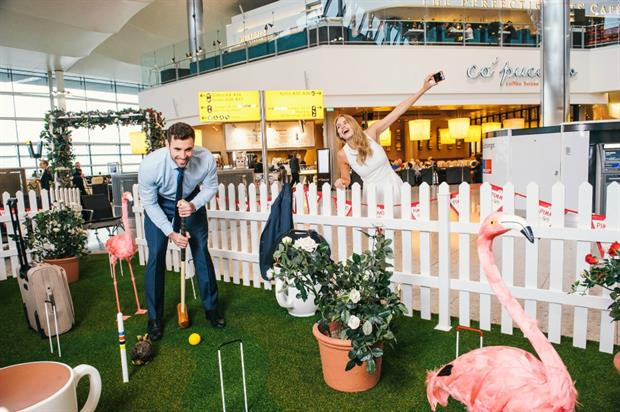
And don’t forget to enjoy croquet on a mini court.

Embedded image permalink

Amsterdam Schiphol Airport

If you’re still on a high from all that Amsterdam has to offer, and forgot to pick up souvenirs for your loved ones, don’t despair: This airport has Dutch diamond purveyor Gassan, offering cut and polished bling with all the proper certifications. Freaked out by the price on your receipt? Then check out the meditation centre.


Queen Alia International Airport, Zizya, Jordan

Sure, it’s been known to heat up in Jordan in summertime, but the airport — whose terminals are shaped like desert palm leaves — has taken care of that. In an eco-friendly move, it uses actual rainwater for the indoor garden, cooling everything down in the process.

Embedded image permalink

Source…..www.news.com.au

Natarajan

In Pictures….Hiroshima on 6 Aug 1945…

Hiroshima mushroom cloud after the first atomic bomb was dropped by a US Air Force B-29

The first atomic bomb was dropped by a United States aircraft on the Japanese city of Hiroshima on 6 August 1945.

Photo from the US Army Signal Corps showing the devastation left after the first atomic bomb was dropped on Hiroshima. No precise date given for the photo which was taken some time not long after the explosion.

US President Harry S Truman, who announced the news from the cruiser USS Augusta in the mid-Atlantic, said the device was more than 2,000 times more powerful than the largest conventional bomb previously used.

The atomic bombing of Hiroshima - Aerial view after the bomb

The Hiroshima bomb, known as “Little Boy”, contained the equivalent of between 12 and 15,000 tons of TNT and devastated an area of 13 square kilometres (five square miles).

The Boeing B-29 Superfortress Enola Gay landing on the Marianas Island after the atomic bombing mission on Hiroshima, Japan.

The bomb was dropped at 0815 local time from an American B-29 Superfortress, known as Enola Gay, seen here returning to the Marianas Island.

Firestorms after the explosion of the atom bomb in August 1945, Hiroshima, Japan

The plane’s crew say they saw a column of smoke rising and intense fires springing up.

Devastation at Hiroshima, after the atomic bomb was dropped. The building on the right was preserved as the Hiroshima Peace Memorial, Atomic Bomb Dome or Genbaku Dome, 1 September 1945.

More than 60% of the buildings in the city were destroyed.

The patient's skin is burned in a pattern corresponding to the dark portions of a kimono worn at the time of the explosion

No-one is sure how many died on that first day. Estimates start at 70,000 but later estimates suggest the final toll was far higher, about 140,000, of Hiroshima’s 350,000 population. This person’s skin was burned in a pattern corresponding to the dark portions of a kimono worn at the time of the explosion.

Hiroshima bombing - The landscape after the bombing

The US President said the atomic bomb heralded the “harnessing of the basic power of the universe”. It also marked a victory over the Germans in the race to be first to develop a weapon using atomic energy.

The Roman Catholic Church of Urakami standing over the burn-razed cityscape of Nagasaki, southern Japan, after the second atomic bomb ever used in warfare was dropped by the US over the Japanese industrial centre.

Another atomic bomb dropped three days later over the Japanese city of Nagasaki killed at least 74,000 people by the end of year.

A Photograph of a Soldier at Hiroshima after the Blast in Japan, August 1945.

The bombings brought about an abrupt end to the war in Asia – but critics said Japan had already been on the brink of surrender. The two atomic bombs, with the Soviet declaration of war against Japan on 8 August 1945, finally left the Japanese no choice. Japan surrendered to the Allies on 14 August 1945.

Source….www.bbc.com

Natarajan

” Why Do we Need to be in Mad Rush all the time …”?

In an Independence Day Special series, Rediff.com celebrates India through the lives of her people.

Today: Ashok Kumar Mondol, who drives the tram, a timeless Kolkata classic. Kolkata is the only city in India where you can ride a tram.

A Tram in Kolkata

Zindagi ek safar hai suhana/Yahan kal kya ho kisne jaana.”

I have been driving a tram in Kolkata for 32 years. The most picturesque parts of the route that I take are around Esplanade and the areas surrounding Fort William and Kolkata Maidan.

There is greenery all around and when it rains the entire area looks magical. On a rainy day, I feel like jumping out of this tram car. I feel like singing and dancing and getting drenched. But I can’t. My task is but to ferry the passengers to their desired destinations.

Every time I pass the Maidan, I fall in love with this city all over again.

The greenery enroute

My father was a Calcutta Tramways Company conductor. In his times, the pay scale at CTC was poor and he had a tough time taking care of our family of five.

After studying till Class 8, I was forced to leave school and share the burden of household responsibility.

I was good in studies and wanted to clear the Class 12 examination at least. But Baba desperately needed another earning member in the family. He needed to marry two of my sisters off.

I started trying for jobs. It wasn’t easy. Then a friend of my father said the CTC was hiring.

I applied and got selected. It has been a long bond of more than three decades. Loyalty with CTC runs in my family.

I lost my mother a few years back, my family now comprises my father, wife and two sons. We have a house in the southern suburb of Sonarpur.

My eldest son holds a master’s degree and works in a private company while the younger one is doing his graduation.
As I have served the state government for so many years, I don’t have much faith in private companies. Hence, I have asked my eldest son to apply for jobs in the CTC. It is obvious that with his qualification, he won’t be a tram driver like me!

Ashok Kumar Mondol, Tram Drive

A tram driver’s life isn’t easy. Though a tram doesn’t pollute, emissions from other vehicles that ply on the roads clog my lungs and at times it seems as if I can’t breathe. There are too many cars and buses on the roads now.

On returning home from work the first thing I do is take a long, leisurely, bath. There is so much dirt on the roads.

I talk to my wife and Baba over lunch and the three of us catch a short nap in the afternoon.

As my younger son goes to college, we get to see each other mostly in the evenings. I drive the tram from the CTC office till Esplanade every day.

I can’t understand why other Indian states don’t opt for trams. They are the most environment-friendly mode of transport. It is slow, but then why do we need to be in a mad rush all the time?

A tram car is hassle-free and most easy to control. Accidents rarely happen here.

In my long career, I faced an emergency only once when the tram I was driving got derailed because of a sudden electrical wire break, injuring a couple of people. But apart from that, the running has been pretty smooth.

Earlier, a traffic jam could never delay a tram. But now, traffic congestion is a major issue for us. Vehicles from every corner block the roads and also the tram tracks. Often an hour-long journey takes more than two hours.
Travel by a tram is a great stress buster. It is sure to soothe one’s nerves and I often see the rich getting into my tram with the chauffeurs of their cars following their masters.

Conditioned air inside costly cars can’t hold a candle to fresh natural air.

Celebrities generally avoid public transport, but once I had seen actor Chiranjit (Dipak Chakraborty, now a Trinamool Congress member of the legislative assembly) in my tram car. It was a red letter day for me.

I had taken his autograph and he had smiled at me.

My day starts at 5 in the morning and ends at 1 pm. I report for work around 6 am and wind up around 12.30 pm.

On reaching the depot, I sign the register and set out on my daily journey from Tollygunge to Esplanade.

On a light day or on weekends, I manage 3, even 4 trips whereas on a heavy weekday or during rains I manage 2 trips at the most.

I get short breaks in between trips and have breakfast at the CTC depot canteen.

I travel from home to the nearest metro rail station by an autorickshaw and then reach the Tollygunge Metro Station (recently rechristened Mahanayak Uttam Kumar Metro Station by West Bengal Chief Minister Mamata Banerjee). I follow the same route on the way back.

As the CTC depot is situated right opposite the metro station, travelling is really convenient. It takes me 30, 40 minutes to travel one way.
In recent times, CTC has revised its pay scales to a large extent and my gross salary now stands at Rs 30,000 a month. It is not huge, but enough to cater to the needs of a middle-class family like ours.

Besides, my elder one is also contributing these days and we don’t have anything to complain.

There was a time when CTC salaries were irregular. But not any more. Now, things are looking up.

A Tram passes by a fruit vender in Kolkata

Music was my passion from childhood and Ma had got me admitted to Bani Chakra (a well-known music school).

I learnt my music lessons quickly and was referred to as a shining star.

My parents thought a career in music would put me on the wrong track of life and my name was struck off Bani Chakra’ roster soon after.

India is a fascinating country. I am so proud to be born here.

I feel the country can be a superpower only if our political leaders stop looking at us, the people, as ballot papers.

We elect them, but the moment they ascend the throne of power, they start disowning us. This attitude has to change.

But it is also unfair to put the blame on the political leaders all the time. We, the citizens, too have some responsibility to make India a better place.

Why should we bribe to get our job done? Why should we evade taxes? Why should we be mean and divisive?

Isn’t it our responsibility to keep our motherland clean?

Golpo korte korte doshta bajiye fellum didi, cholun ebar jaoa jaak (We lost track of time chatting, let’s go, didi)!

After Indrani Roy/Rediff.com spoke to Mr Mondol at the CTC depot in Kolkata, she rode the tram with him.

He took her around a wet canopy of trees in the city’s famed sprawling Maidan, the Victoria Memorial, Fort William and unending Mayo Road — showing her own city to her in a way she had never seen before.

Mr Mondol is a very gifted singer

The minimum tram fare is Rs 5 and the maximum Rs 6. A ride in the heritage tram costs Rs 10.

Photographs/Video: Abhiroop Dey Sarkar.

Indrani Roy / Rediff.com

Source….www.rediff.com

Natarajan

” These Baby animals fit in your Hand …” !!!

Animals That Fit Into Your Hand

Life would be so much happier if you carried a little, sleeping squirrel around your hand all day.


Animals That Fit Into Your Hand

No wonder rabbits breed so rapidly, their young are so adorable!

Animals That Fit Into Your Hand

Tiny little ears? Check! Chubby cheeks? Check! Fluffy fur? Check. This littlehamster is ticking a lot of cuteness boxes.


Animals That Fit Into Your Hand

This baby chipmunk is perfectly pocket-sized!

Animals That Fit Into Your Hand

We couldn’t really do a list of baby animals without including an adorable kitten!

Animals That Fit Into Your Hand

This turtle is thinking: ‘I might be cute but pet me too much and I am going back into my shell!’

Animals That Fit Into Your Hand

This tiny duckling has already perfected the art of posing for the camera – ‘I will show them my good side and shoot them a cheeky smile’!

Animals That Fit Into Your Hand

Might as well pet these baby leopards while they fit in the hand because in a few years they will make sure you have no hand left if you do the same!

Animals That Fit Into Your Hand

What’s cuter than a big, cuddly black and white panda?  A tiny, white baby panda; that’s what.

Animals That Fit Into Your Hand

If you ever wondered why koalas are often referred to as ‘bears’ even though they are technically marsupials, this little guy is good evidence.  As cute as a teddy bear!

Source….www.ba-bamail.com

Natarajan

Isro to put US satellite in space for the first time….

Many may find it a crowning glory, but Indian Space Research Organization (Isro) scientists think it’s just an acknowledgement long due. The US, which imposed sanctions on India, will take India’s help to launch one of its satellites soon.

Isro has a track record of launching satellites for 19 countries including space-faring nations, but this is the first time the US would be using an Indian vehicle, the Polar Satellite Launch Vehicle, to put one of its satellite in orbit.

“US will be the 20th country to sign up for a commercial launch by India,” said Isro chairman A S Kiran Kumar, on the sidelines of the 5th convocation of AMET University. “It’s the cost-effective technology we have.”

India has so far launched 45 satellites for 19 nations. Kiran Kumar said another 28 foreign satellites will be launched in the next two years. “The need of the hour is to increase our capacity,” he said.

ISRO, at present, is gearing up for the launch of GSLV-Mark-II, probably around August 27. “The 2.1-tonne capacity GSLV-Mark-II will be carrying a communication satellite,” he said. “By March 2016, we will launch seven satellites.”

Isro, meanwhile, has put to long-duration test its indigenously developed cryogenic engine for GSLV-Mark-III, which can carry satellites weighing up to four tonnes. “We will launch it by December 2016,” Kumar said. India’s big missions including the proposed manned mission rests on the shoulders of GSLV-MIII.

Having successfully launched a Mars mission, India is planning a mission to Venus. Isro is also on the lookout for a launch pad outside Sriharikota, in Kulasekharapattinam in southern Tamil Nadu.

Source….www.timesofindia.indiatimes.com

Natarajan