India Celebrates 69th Independence Day….

Patriotic fervour swept the nation on Saturday as it celebrated its 69th Independence Day, with chief ministers announcing development initiatives, flagging the challenges ahead and pledging to take their states forward on the path of peace and progress.  

The celebrations marked by unfurling of tricolour, colourful parades and other events in the state capitals passed off peacefully.

A view of the 69th Independence Day function at the historic Red Fort in New Delhi.Photograph: PTI

BSF soldier wave the Tricolour as they mark the occasion of Independence Day at the Attari Border in Wagah. Photograph: PTI

Female cops take part in the Independence Day celebrations at the Bakshi stadium in Srinagar. The functions in Jammu and Kashmir were held in the heavy presence of security personnel. Photograph: Umar Ganie/Rediff.com 

The mobile phone services remained suspended till the ceremonies were over in the valley. Photograph: Umar Ganie/Rediff.com

The Indian Army hosted the Chinese PLA to a Special Border Personnel Meeting at Chushul in Eastern Ladakh. Photograph: PROArmy

Participants holding the Tricolour conduct stunts on a motorbike during Independence Day celebrations in Guwahati. Photograph: Rediff.com

Students of Swaminarayan Gurukul holds tricolour to mark the celebrations of 69th Independence Day in Ahmedabad. Photograph: PTI

Wearing their patriotism on their sleeve, in this case, their body. Boys with the Tricolour painted on their bodies take out a procession in Bhubhaneshwar. Photograph: PTI

Bihar Chief Minister Nitish Kumar inspecting the parade during 69th Independence Day celebration at Gandhi Maidan. Photograph: PTI

Uttar Pradesh Chief Minister Akhilesh Yadav salutes after unfurling the national flag during the 69th Independence Day function at Vidhan Sabha in Lucknow. Photograph: Nand Kumar/PTI

School children celebrate after being rewarded for their dance performance during India’s Independence Day celebrations in Chandigarh. Photograph: Ajay Verma/Reuters

Village children show their patriotic spirit near Balurghat. Photograph: PTI Photo

The future of India, its kids. This photograph was taken at a school in Mumbai. Photograph: Shashank Parade/PTI Photo

This human chain at a college in Coimbatore, Tamil Nadu comprised of 6,900 students, creating a record of sorts. Photograph: PTI Photo

School children perform during Independence Day celebrations at Guru Nanak Stadium in Amritsar, Punjab. Photograph: PTI Photo

India’s vibrant culture on display at the Bakhshi Stadium in Srinagar. Photograph: PTI Photo

Schoolchildren dressed in tricolour patterns listen to the prime minister speak at Red Fort in New Delhi. Photograph: PIB Photo 


Source…….www.rediff.com

Natarajan

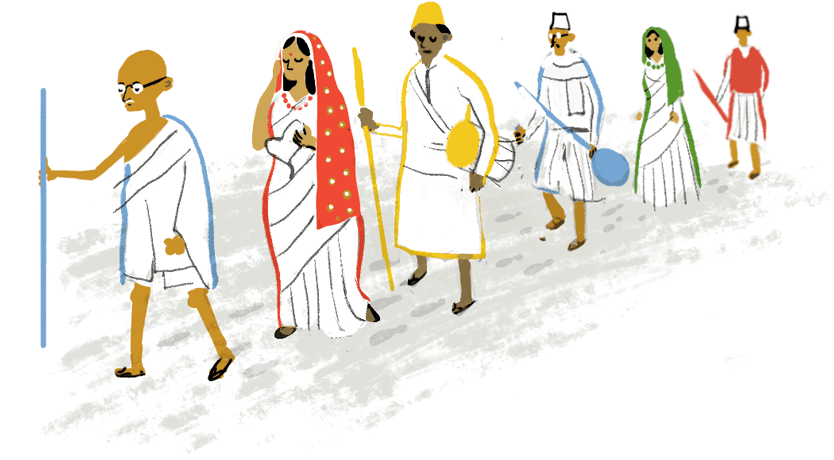
Google Doodle Celebrates India’s Independence Day…

Illustration on Google India shows Gandhi leading the Dandi March of 1930

In honor of the 69th Anniversary of India’s Independence on Aug. 15,Google India’s Doodle features Mahatma Gandhi leading the Dandi March of 1930.

India Independence Day 2015

The scene depicts a significant moment in India’s push for freedom from the rule of the British Raj and the beginning of the Civil Disobedience Movement. Seventy-eight Congress volunteers participated in the 240-mile march in protest of unfair salt laws.

Leon Hong illustrated the Doodle for Google users in India as they celebrate the Indian Independence Act of 1947 on Saturday.


Source…Julia Zorthian   http://www.times.com

Natarajan

” My Dream is to Fly the 747 Oneday…” Says Capt. Indu Nair…

In our Special Independence Day series, Rediff.com looks at India through the lives of her people.

Today: Captain Indu Nair, who joined a private airline after her tenure as a pilot in the Indian Air Force ended five years ago. From the second batch of women pilots in the IAF, she flew during the Kargil conflict.

As a commercial airline pilot, one of her best experiences, she says, is taking off with an all woman crew!

Captain Indu Nair

The complete coverage

It is no longer unusual for passengers to have a lady pilot fly them to their destinations. I have been a pilot for 20 years and it has been a lovely journey. My dream, however, is to fly the Boeing 747!

India has many women pilots now. There are days when both the pilots in the cockpit and the cabin crew — are all women. It is a superb feeling to have an all women crew.

I served the Indian Air Force as a pilot for 15 years and became a commercial pilot when my career ended since I was on a short service commission.

There was a time in school I wanted to be an air hostess, but my sister superior counseled me against it. I then started looking at the civil services but was always fascinated by the uniform and that’s how I joined the IAF.

I was among the earliest batch of women officers. A male bastion till then, I think it took longer for the male officers to adapt to us that us to them.

At the time of the Kargil conflict, two of us women officers were called by our senior officer and told that while the male officers would fly for the Kargil operation, the two of us would be assigned ground duties.

We came out of his office and went back in again to tell him that we are trained pilots like the men and we can do the same. We were told that it would be hard, we would have to sleep in the airplane, use common toilets as the men and be in difficult terrain. We told him we were ready and we were giving flying duties during the Kargil conflict.

We flew in ammunition and supplies; on the way back we carried the bodies of our martyred soldiers.

Ferrying the bodies of young men who had died defending our country was one of the toughest things I have done.

It was tragic. It left me numb.

Captain Indu Nair

Indu Nair was from the second batch of lady pilots to join the Indian Air Force. Photograph: Kind courtesy, Indu Nair.

When I was in the Indian Air Force, I flew the AN-32 — a rugged but forgiving Russian aircraft. You needed physical strength to operate the AN-32.

I now fly the ATR, a delicate machine.

Before a take-off, I take a walk about of the airplane and do the external checks. I often pat my aircraft and in my mind tell her to take us to our destination safely.

Safety is of paramount importance. As captain of the aircraft, I am responsible for the safety of the passengers and the aircraft.

I have seen sunrise and sunset, up in the sky, from the windows of my cockpit. I was telling my copilot just the other day how privileged we are to see nature in all its glory.

We have also seen how fickle nature can be, and how bad weather disrupts flying schedules. In all these years of flying, I have realised that a pilot has to respect the weather and follow the flying manual to a T.

I remember once on a flight, passengers got into an argument with the cabin crew when the flight was diverted because of poor visibility. They kept saying that if they can see the air strip from the window, why couldn’t the pilot!

When we landed at the airport we were diverted to, the first officer and me as the captain, had to explain to the irate passengers that if the air traffic control tells us that we cannot land, we just cannot!

Captain Indu Nair

An AN-32, the Russian-made aircraft she flew in the IAF. Photograph: Kind courtesy, Indu Nair.

My usual schedule is 6 days of flying, followed by two days of rest.

I have to report at the dispatch room at the airport before the flight. We get written regulations; a medical and breath analyser test is done.

In the cockpit, I am in charge as the captain. The first officer and me discuss the flight, make the necessary announcements and steer the aircraft to the destination.

After a flight, we complete the necessary paperwork, go back to the dispatch room and then leave for home.

What I sometimes miss is having a regular 9 to 5 schedule, but such is the nature of my profession that this is not possible.

Captain Indu Nair

IMAGE: Her last sortie as a wing commander in the IAF. Photograph: Kind courtesy Indu Nair.

My children are used to seeing mummy as a pilot and my older child is showing some interest in following in my footsteps. Once I am home, I cook, spend time with the family and get early to bed. On my days off, I catch up on household affairs — I like going and buying vegetables.

My husband laughs that I am better in the cockpit than in the driving seat of a car — but driving on city roads is no longer a pleasant experience.

The thing that I don’t enjoy too much about being away as a pilot is eating hotel food over days. How much airline and hotel food can you eat, after all!

So often, passengers on my regular routes have told me that once they hear I am in the cockpit, they know it would be smooth landing.

Women pilots are not an unusual sight and people, especially, girls look at us with pride.

More and more women every year are taking the commerical pilot’s license. And over the year, women have proved to be efficient pilots. It is there for everyone to see.

Out of 5,100 pilots in India, 600 are women, according to the ministry of civil aviation.

A pilot with Jet Airways for the last five years, Captain Indu Nair will join another domestic airline next week. She lives in Mumbai with her husband, a former Indian Air Force officer, and two daughters.

She spoke to Archana Masih/Rediff.com

Source….www.rediff.com

natarajan

This Independence Day, The Tiranga Has a Message for Every Indian…

This Independence Day, The Tiranga Has a Message for Every Indian

Image Courtesy: Screengrab taken from YouTube video uploaded by BeingIndian

I was born in 1947 made out of hand-spun cotton on a charkha , dyed in the three colours of courage, peace and the earth. I symbolize Independence…”

As India prepares to celebrate its 69th Independence Day on August 15, this powerful video has a poignant message for every Indian — ‘Freedom is the absolute truth… and in truth there is valour…’

Put beautifully in words by Priyan Redican and expressed by six dancers in Bhatnatyam and Mohini Attam,  five mminute video  tries to explain the meaning of freedom and why we should not take it for granted

India is just a  country,
mere lines on a map,
and I’m just a flag,
a simple piece of cloth,
We’re nothing but mere ideas,
reflections of your passions,
we’re nothing but you fighting for freedom anew…

Watch the video and let the powerful words inspire you.

Source….www.you tube.com  and http://www.ndtv.com

Natarajan


Lessons from Sundar Pichai’s rise: Meritocracy, not mediocrity, is way forward….

The elevation of Sundar Pichai to CEO of tech giant Google marks a triumph for four ideas we in India are uncomfortable with: giving meritocracy its due, allowing people to rise regardless of age, valuing diversity, and inviting talented immigrants to work for the country.

Stuck as we are to politically-driven social justice systems where quotas and reservations dominate the agendas of political parties and have become an end in themselves, we have paid inadequate attention to meritocracy. Any society that places such a low value on getting the right talent into the right job and giving him or her opportunities for growth will pay a huge price on several fronts – innovation being one of them.

Mediocrity, whether in government or in corporations or in academics, can provide only incremental gains for society. Multi-bagger gains come from promoting meritocracy.

It should thus come as no surprise that India has invented almost nothing since the humble “lota” of centuries ago, even while Indian techies dominate Silicon Valley’s startup culture, accounting for 15 percent of the total. Our belief in “jugaad” may be useful when resources are scarce, but “make-do” is a poor substitute for “make something new.”

Support for meritocracy, effective mentoring, and an ability to discriminate in favour of talent (as opposed to just seniority and age) is vital for innovation.

Consider Sundar Pichai (the name is actually a shortened version of his original name Sundararajan Pichai). He joined Google in 2004, and in 11 years he is holding the top job at age 43. It is difficult to visualise any Indian company giving this kind of opportunity to a talented foreigner. To be sure, we do have the occasional foreign talent heading Indian companies (the Tata group has some examples in this area), but the cases are few and far between as most Indian companies tend to be family-dominated or narrowly based in terms of their talent pool. And the talent we get from abroad is usually past its prime.

Sundar Pichai Reuters

Even Infosys, our home-grown tech pioneer in offshoring, fell into the trap of giving the founders first right of refusal to the CEO’s job till bad performance and a changing operating environment finally forced them to get new blood in the form of a Vishal Sikka last year.

A Satya Nadella would have been languishing at some middle-level position in an Indian tech company if he had sought to make his career here, but at 46 he made it to the top at Microsoft as CEO in early 2014, a successor to Steve Ballmer.

Sundar Pichai was also not made by accident. Before he became CEO, he worked closely with CEO Larry Page, and played major roles in creating the Google Toolbar, the browser Chrome, and in managing the growth of Android, the world’s largest mobile phone operating system. Page did not hand over his job to Pichai because he liked the guy. He watched Pichai’s progress from close quarters, and after handing him one assignment after another, decided that he was the man to take over his own job. Page wrote in his Google blog yesterday (10 August): “I have been spending quite a bit of time with Sundar, helping him and the company in any way I can, and I will of course continue to do that. Google itself is also making all sorts of new products, and I know Sundar will always be focused on innovation – continuing to stretch boundaries. I know he deeply cares that we can continue to make big strides on our core mission to organise the world’s information.”

Note the degree of supervision and support Page gave Pichai. He also wrote this about Pichai: “Sundar has been saying the things I would have said (and sometimes better!) for quite some time now, and I’ve been tremendously enjoying our work together. He has really stepped up since October of last year, when he took on product and engineering responsibility for our Internet businesses. Sergey (Brin) and I have been super excited about his progress and dedication to the company. And it is clear to us and our board that it is time for Sundar to be CEO of Google. I feel very fortunate to have someone as talented as he is to run the slightly slimmed down Google and this frees up time for me to continue to scale our aspirations.”

Now, why wouldn’t a Pichai kill for such a strong vote of confidence, support and faith from the bosses of Google?

Unfortunately, the Indian DNA is about losing talent. India produces tech talent by the thousand, but still loses them by the hundred (if not the thousand) to Ivy League schools or tech companies in Silicon Valley. This is because we are unwilling or unable to give our talent the kind of support and mentoring, not to speak of challenge and opportunity, they need.

The recent incident, where IIT Roorkee had to expel 72 students for failing to make the grade, is instructive. Most students who get into IITs are, by definition, hard and talented workers. They would have spent years in coaching classes and worked hard to crack the IIT-JEE exams. The question is: why then would 72 of them fail to make the grade?

Answer: we fail to give them the support they actually need – or not enough of it – after they get into the institution. As this Indian Express story points out, “90 percent of the IIT-Roorkee students who were expelled were from reserved categories (SC, ST and OBC) and scored average to high ranks in their respective categories in the 2014 IIT-JEE (Advanced). Once on campus, however, several factors pull them back, prominent among them a lack of fluency in English.”

Consider the sheer loss of talent we face if students have to be turfed out not for lack of engineering talent, but lack of proficiency in English.

The problem is not the quotas themselves, but the assumption that quotas by themselves are enough. In fact, excessive dependence on quotas to deliver social justice does damage by, first, marking such students out as somehow untalented, and then ensuring their failure by not giving them the support they need to cope with the rigours of an IIT academic session. We have conveniently forgotten that quotas have to be supplemented by effective mentoring and help by mentors. Without this, quotas will become self-defeating and divisive. (Some IITs do this effectively, but not all).

One can be sure that the same thing is happening in other areas of reservations and quotas, where the successes are vastly outnumbered by failures due to the lack of mentoring, including in our government.

Quotas are useful only if they succeed in reducing the need for quotas, not if they end up perpetuating and extending it by promoting mediocrity and a sense of victimhood among the beneficiaries.

We need to learn how to do things right from the elevation of Pichai, a first-generation immigrant to the US who rose to the top because their system favours meritocracy even while encouraging affirmative action and social diversity in institutions and corporations.

For now, though, we should see Pichai’s and Nadella’s rise as slaps in the face of our mediocrity-driven culture.

Source……R.Jagannathan ….www.firstpost.com

Natarajan

Why this 50-yr-old makes India proud….?

Read on to learn how Raju Dabhade created history…

Raju Dhabade

Do you know this man?

No? Even I didn’t, till I met him.

Now that I have, I will never forget him.

He is a man who makes India proud.

No, he is not a celebrity or a sportsperson who has won medals for the country.

Fifty-year-old Raju Dabhade is the creator of the game of roll ball that will see its third World Championship in December, 2015, in Pune.

The first Roll Ball World Championship, held in 2011 in Pune, was won by Denmark; India was the first runner up.

The second World Cup, which India won, took place in Kenya in 2013.

“Roll ball is so named because it is a fast-paced game where the players use skates and the ball is always rolling, says Dabhade, who is also the general secretary of the International Roll Ball Federation.

Roll ball is a combination of basketball, handball, throwball and skating that requires balance, speed, accuracy and teamwork.

It is played between two teams; the objective is to score the maximum number of goals within a stipulated time.

So how did someone who, as young a boy, made ends meet doing odd jobs like working in a tea stall and delivering newspapers door-to-door end up inventing an international sport?

We asked Dabhade himself:

Raju Dabhade

How did roll ball begin?

As a Physical Training teacher in Pune’s MES Bal Shiksha English Medium School, I used to train and take players from different games for interschool competitions.

During the matches, I was always curious about the origin of these sports.

So I researched about them in detail — I used books from our school library and the internet.

I found out how different types of sports such as basketball, judo, hockey, football, etc, started, their history, playing techniques and strategies, different types of balls, etc.

Then, I began to wonder if it was possible to create a new game and started working on it.

Once in 2002, while teaching skating to students, a ball from the basketball court came bouncing over and I saw a student on skates bouncing the ball back to the players.

That’s how the idea of roll ball began.

It took one year to finally create the game with proper rules and techniques.

Raju Dabhade at the International Roll Ball Federation in Japan

How did roll ball get international recognition?

I took the idea of roll ball to the school’s then principal, Dr Sunitha Bhagwat.

She was very encouraging and talked to the students’ parents about it. I also contacted people I knew.

In February 2003, the official demonstration of the game was organised before the Sports Authority of India.

They liked it a lot and guided us on how to get the game recognised by the government.

We started working on the procedure and I personally went many times to New Delhi for this purpose.

After roll ball was recognised by the Indian government, we obtained a copyright certificate from the USA in March 2003.

Thereafter, first we contacted people in India and held matches here.

Once roll ball got national recognition, we started contacting the neighbouring countries and so on.

Dr Bhagwat adds: “PT teachers usually fall into a routine and are least motivated about getting involved in activities that are not within that routine or interacting with students. But Raju was different. He was an honest person who was good with people and went out of his way to help others.

“Initially, parents of his students funded expenses like transportation that were required for the game’s development.

“He had no financial or social support and lacked communication skills. Yet still, he never came to me with a problem.

“He would say that this is what he had found and needed to see how it works. Hence, I allowed him to use the school grounds for roll ball practices.

“All the support that he has is due to sheer goodwill.”

Raju Dabhade training students for Roll Ball

Can you tell us about your early days?

We were a financially poor family.

I was 15 when I lost my father. So I started earning early through odd jobs like working in a tea stall and door to door newspaper delivery.

I completed my education through night school and finally found a job as a PT teacher at BSEM school.

It has been 15 years since I stared working here and I am indebted to its people for having believed in me at the first go.

I am grateful to that newspaper delivery job which helped me feed my struggling family.

I now have a newspaper agency where I provide employment to poor boys.

You won the national level skating championship at school. How did that happen?

I wanted to learn skating but did not have enough money as my income went towards supporting my family.

Somehow, I managed to save some money and bought the basic skates with iron wheels.

I polished them well and covered them with rubber.

I learned skating on my own.

Later, a friend gave me a pair of good quality skates and I put my soul in practising with them.

I competed at the national level between 1980 and 1985. Then I got a job and couldn’t continue.

It will be the third world cup for roll ball. The game’s reach is surpassing the resources available to manage it. How has this been handled now and initially?

I am lucky. Behind the immense moral and financial support of the school management, friends and parents of students is perhaps the reputation I have earned over the years.

I was a punctual, fair and dedicated teacher, who was a mentor-cum-friend to students.

Fortunately, I have a very supportive wife.

My family never questions me about my whereabouts.

That is their faith in me, perhaps because I’ve never indulged in any wrong doing.

People like local businessmen and associations have also helped after seeing the matches.

Recently, we put up a sports stall in Russia.

As we couldn’t afford LCDs, I took the television set from my home and attached a pen drive to it.

We continuously played match videos and had many people stop by our stall.

What are your success mantras and advice to young Indians?

Work hard and don’t give up till you succeed.

Keep calm and be positive.

Pursue your passion and own your work.

Do something different and innovative.

Everyone gets the opportunity to succeed. Don’t miss it.

Make your nation proud.

Photographs: Kind courtesy Raju Dabhade

Payal Khare Bhatnagar    source….www.rediff.com

Natarajan

Isro to put US satellite in space for the first time….

Many may find it a crowning glory, but Indian Space Research Organization (Isro) scientists think it’s just an acknowledgement long due. The US, which imposed sanctions on India, will take India’s help to launch one of its satellites soon.

Isro has a track record of launching satellites for 19 countries including space-faring nations, but this is the first time the US would be using an Indian vehicle, the Polar Satellite Launch Vehicle, to put one of its satellite in orbit.

“US will be the 20th country to sign up for a commercial launch by India,” said Isro chairman A S Kiran Kumar, on the sidelines of the 5th convocation of AMET University. “It’s the cost-effective technology we have.”

India has so far launched 45 satellites for 19 nations. Kiran Kumar said another 28 foreign satellites will be launched in the next two years. “The need of the hour is to increase our capacity,” he said.

ISRO, at present, is gearing up for the launch of GSLV-Mark-II, probably around August 27. “The 2.1-tonne capacity GSLV-Mark-II will be carrying a communication satellite,” he said. “By March 2016, we will launch seven satellites.”

Isro, meanwhile, has put to long-duration test its indigenously developed cryogenic engine for GSLV-Mark-III, which can carry satellites weighing up to four tonnes. “We will launch it by December 2016,” Kumar said. India’s big missions including the proposed manned mission rests on the shoulders of GSLV-MIII.

Having successfully launched a Mars mission, India is planning a mission to Venus. Isro is also on the lookout for a launch pad outside Sriharikota, in Kulasekharapattinam in southern Tamil Nadu.

Source….www.timesofindia.indiatimes.com

Natarajan

Rare Photographs of Dr. Abdul Kalam ….From The Archives of Indian Express…

abdul kalam, abdul kalam rare photos, abdul kalam photos, photos abdul kalam, apj abdul kalam, apj abdul kalam photos, photos abdul kalam, abdul kalam photo, photos kalam, kalam photos, latest photos, photos 27 July abdul kalam

The journey of A P J Abdul Kalam as a space scientist began in early 1960s at Thumba, a coastal village near here, which housed India’s first rocket launcher, Thumba Equatorial Rocket Launcher.

I K Gujral congratulating former President Dr. APJ Abdul Kalam after he was conferred with the Bharat Ratna at Rashtrapati Bhawan in New Delhi. (Source: Express photo by Virendra Singh) –


abdul kalam, abdul kalam rare photos, abdul kalam photos, photos abdul kalam, apj abdul kalam, apj abdul kalam photos, photos abdul kalam, abdul kalam photo, photos kalam, kalam photos, latest photos, photos 27 July abdul kalam

One of the little known facts about former President A P J Abdul Kalam is that he has a medical invention to his name — a coronary stent built with missile composites that dramatically brought down the cost of heart stents from Rs 55,000 to Rs 10,000 in the mid-1990s.

Former president Dr APJ Kalam deliver lecture on Homi Bhabha Birth Centenary Commemoration TIFR Foundation Day at Colaba. (Source: Express Photo by Ganesh Shirsekar) –


abdul kalam, abdul kalam rare photos, abdul kalam photos, photos abdul kalam, apj abdul kalam, apj abdul kalam photos, photos abdul kalam, abdul kalam photo, photos kalam, kalam photos, latest photos, photos 27 July abdul kalam

Dr. Abdul Kalam, who received several prestigious awards including Bharat Ratna, played a crucial role when India tested its nuclear weapons at Pokhran in 1998 when the Vajpayee government was in power.

Former prime minister Atal Bihari Vajpayee, George Fernandes, Pramod Mahajan, Bhairon singh Shekhawat and other senior sceintist and army officals at the site of 1998 Pokharan nuclear missile launch. (Source: Express photo by Ravi Batra) –

abdul kalam, abdul kalam rare photos, abdul kalam photos, photos abdul kalam, apj abdul kalam, apj abdul kalam photos, photos abdul kalam, abdul kalam photo, photos kalam, kalam photos, latest photos, photos 27 July abdul kalam

Dr. APJ Abdul Kalam felicitated 100-year-old body builder from Kolkata Manohar Aich during the celebration of Shanmukhananda Hall Diamond Jubilee. (Source: Express photo by Prashant Nadka) –

abdul kalam, abdul kalam rare photos, abdul kalam photos, photos abdul kalam, apj abdul kalam, apj abdul kalam photos, photos abdul kalam, abdul kalam photo, photos kalam, kalam photos, latest photos, photos 27 July abdul kalam

“At Rashtrapati Bhawan I found a letter from our first President, Rajendra Prasad to Nobel laureate Sir C V Raman in 1954 asking him to come to Rashtrapati Bhawan to accept the Bharat Ratna. Anyone would have jumped at the offer. Then I read Sir CV Raman’s reply to the invitation. It said, “Dear Mr President, I thank you for giving me such a great honour, but I have a problem. I am guiding a scholar and he is submitting his thesis in December-January. I have to sign the thesis and won’t be able to accept the invitation, ” Dr. Kalam said at Idea Exchange. (Source: Express archive) –

abdul kalam, abdul kalam rare photos, abdul kalam photos, photos abdul kalam, apj abdul kalam, apj abdul kalam photos, photos abdul kalam, abdul kalam photo, photos kalam, kalam photos, latest photos, photos 27 July abdul kalam

Dr. APJ Abdul Kalam being sworn-in as the 11th President of India by the then Chief Justice of India B N Kirpal at the central hall of Parliament in New Delhi. (Source: PTI file photo) –


abdul kalam, abdul kalam rare photos, abdul kalam photos, photos abdul kalam, apj abdul kalam, apj abdul kalam photos, photos abdul kalam, abdul kalam photo, photos kalam, kalam photos, latest photos, photos 27 July abdul kalam

Former President A P J Abdul Kalam intervenes in the debate after presenting the second Ramnath Goenka Excellence in Journalism awards on Monday night. On stage (from left): moderators Rajdeep Sardesai of CNN-IBN and Barkha Dutt of NDTV; panelists Shobhana Bhartia of The Hindustan Times, N Ram of The Hindu, Ravi Dhariwal of Bennett, Coleman (publishers of The Times of India), Pankaj Pachauri of NDTV India and Shekhar Gupta of The Indian Express. (Source: Express archive) –

abdul kalam, abdul kalam rare photos, abdul kalam photos, photos abdul kalam, apj abdul kalam, apj abdul kalam photos, photos abdul kalam, abdul kalam photo, photos kalam, kalam photos, latest photos, photos 27 July abdul kalam

During the Ramnath Goenka Awards, Dr. Kalam had broken protocol and sat on the dais to interact with the journalists present at the ceremony. (Source: Express archive) –

abdul kalam, abdul kalam rare photos, abdul kalam photos, photos abdul kalam, apj abdul kalam, apj abdul kalam photos, photos abdul kalam, abdul kalam photo, photos kalam, kalam photos, latest photos, photos 27 July abdul kalam

Dr. APJ Abdul Kalam in Sukhoi-30 MKI. (Source: Express photo by Ravindra Joshi)

APJ Abdul Kalam's rare photos from Indian Express archive

Dr. Abdul Kalam at his residence at 10 Rajaji Marg in New Delhi. (Source: Express photo by Oinam Anand) –

See more at: http://indianexpress.com/photos/photo-archives/apj-abdul-kalams-rare-photos-from-indian-express-archive/15/#sthash.0VnQg57H.dpuf


Source….www.indianexpress.com

Natarajan

” Britain Must Pay Reparations to India….”

British troops in Calcutta, with rifles at the ready, clearing a street after Hindus and Muslims used firearms against each other. (Pho

British troops in Kolkata after a religious clash


At the end of May, the Oxford Union held a debate on the motion “This house believes Britain owes reparations to her former colonies”. Speakers included former Conservative MP Sir Richard Ottaway, Indian politician and writer Shashi Tharoor and British historian John Mackenzie. Shashi Tharoor’sargument in support of the motion, went viral in India after he tweeted it out from his personal account. The argument has found favour among Indians, where the subject of colonial exploitation remains a sore topic. Here he gives a summary of his views:

Indian economy

At the beginning of the 18th Century, India’s share of the world economy was 23%, as large as all of Europe put together. By the time the British departed India, it had dropped to less than 4%.

The reason was simple: India was governed for the benefit of Britain. Britain’s rise for 200 years was financed by its depredations in India.

By the end of the 19th Century, India was Britain’s biggest cash-cow, the world’s biggest purchaser of British exports and the source of highly paid employment for British civil servants – all at India’s own expense. We literally paid for our own oppression.

Grey line

De-industrialisation of India

Britain’s Industrial Revolution was built on the de-industrialisation of India – the destruction of Indian textiles and their replacement by manufacturing in England, using Indian raw material and exporting the finished products back to India and the rest of the world.

The handloom weavers of Bengal had produced and exported some of the world’s most desirable fabrics, especially cheap but fine muslins, some light as “woven air”.

Britain’s response was to cut off the thumbs of Bengali weavers, break their looms and impose duties and tariffs on Indian cloth, while flooding India and the world with cheaper fabric from the new satanic steam mills of Britain.

Weavers became beggars, manufacturing collapsed; the population of Dhaka, which was once the great centre of muslin production, fell by 90%.

So instead of a great exporter of finished products, India became an importer of British ones, while its share of world exports fell from 27% to 2%.

‘Clive of India’

Robert Clive, Baron Clive of Plassey, (1725 - 1774), British soldier and governor of Bengal, circa 1755.

Lord Clive was an enigmatic figure in the history of the British Empire

Colonialists like Robert Clive bought their “rotten boroughs” in England with the proceeds of their loot in India (loot, by the way, was a Hindi word they took into their dictionaries as well as their habits), while publicly marvelling at their own self-restraint in not stealing even more than they did.

And the British had the gall to call him “Clive of India”, as if he belonged to the country, when all he really did was to ensure that much of the country belonged to him.

Bengal famine

As Britain ruthlessly exploited India, between 15 and 29 million Indians died tragically unnecessary deaths from starvation.

Famine victims in Bengal, November 1943

Four million Bengalis died in the Great Bengal Famine of 1943

The last large-scale famine to take place in India was under British rule; none has taken place since, since free democracies don’t let their people starve to death.

Some four million Bengalis died in the Great Bengal Famine of 1943 after Winston Churchill deliberately ordered the diversion of food from starving Indian civilians to well-supplied British soldiers and European stockpiles.

“The starvation of anyway underfed Bengalis is less serious than that of sturdy Greeks,” he argued.

When officers of conscience pointed out in a telegram to the prime minister the scale of the tragedy caused by his decisions, Mr Churchill’s only response was to ask peevishly “Why hasn’t Gandhi died yet?”

Myth of ‘enlightened despotism’

British imperialism had long justified itself with the pretence that it was enlightened despotism, conducted for the benefit of the governed. Mr Churchill’s inhumane conduct in 1943 gave the lie to this myth.

An Indian man takes a photograph of a painting depicting the Jallianwala Bagh massacre in Amritsar on April 12, 2011

Hundreds of people at a public meeting were shot dead by British troops at the Jallianwala Bagh

But it had been battered for two centuries already: British imperialism had triumphed not just by conquest and deception on a grand scale, but by blowing rebels to bits from the mouths of cannons, massacring unarmed protesters at Jallianwala Bagh and upholding iniquity through institutionalised racism.

No Indian in the colonial era was ever allowed to feel British; he was always a subject, never a citizen.

Indian railways


7th April 1951: A locomotive constructed for the Indian Government Railways by the North British Locomotive Company of Glasgow, on show at the Festival of Britain on London's South Bank.

The railways were intended to help the British get around’

The construction of the Indian Railways is often pointed to as a benefit of British rule, ignoring the obvious fact that many countries have built railways without having to be colonised to do so.

Nor were the railways laid to serve the Indian public. They were intended to help the British get around, and above all to carry Indian raw materials to the ports to be shipped to Britain.

The movement of people was incidental except when it served colonial interests; no effort was made to ensure that supply matched demand for mass transport.

In fact the Indian Railways were a big British colonial scam.

British shareholders made absurd amounts of money by investing in the railways, where the government guaranteed extravagant returns on capital, paid for by Indian taxes.

Thanks to British rapacity, a mile of Indian railways cost double that of a mile in Canada and Australia.

It was a splendid racket for the British, who made all the profits, controlled the technology and supplied all the equipment, which meant once again that the benefits went out of India.

It was a scheme described at the time as “private enterprise at public risk”. Private British enterprise, public Indian risk.

Grey line

British aid

In recent years, even as the reparations debate has been growing louder, British politicians have in fact been wondering whether countries like India should even receive basic economic aid at the expense of the British taxpayer.

To begin with, the aid received is 0.4%, which is less than half of 1% of India’s GDP.

British aid, which is far from the amounts a reparation debate would throw up, is only a fraction of India’s fertiliser subsidy to farmers, which may be an appropriate metaphor for this argument.

Britons may see our love of cricket or the English language, or even parliamentary democracy, conjuring up memories of the Raj as in television series like Indian Summers, with Simla, and garden parties, and gentile Indians.

For many Indians, however, it is a history of loot, massacres, bloodshed, of the banishing of the last Mughal emperor on a bullock cart to Burma.

Grey line

Indian soldiers in world wars

More than two million Indian soldiers participated in World War Two

More than two million Indian soldiers participated in World War Two

India contributed more soldiers to British forces fighting the First World War than Australia, Canada, New Zealand and South Africa combined.

Despite suffering recession, poverty and an influenza epidemic, India’s contributions in cash and materiel amount to £8bn ($12bn) in today’s money.

Two and a half million Indians also fought for British forces in the Second World War, by the end of which £1.25bn of Britain’s total £3bn war debt was owed to India, which was merely the tip of the iceberg that was colonial exploitation.

It still hasn’t been paid.

Return the Koh-i-Noor diamond’

he Queen Elizabeth The Queen Mothers priceless crown, containing the famous Koh-i-noor diamond, rests on her coffin on a Gun Carriage pulled by the Royal Horse Artillery to Westminster Hall.

Maybe Britain could kindly return the Koh-i-Noor diamond’

What’s important is not the quantum of reparations that Britain should pay, but the principle of atonement.

Two hundred years of injustice cannot be compensated for with any specific amount.

I, for one, would be happy to accept a symbolic pound a year for the next two hundred years, as a token of apology.

And maybe Britain could kindly return the Koh-i-Noor diamond to the country it was taken from!

Source…..www.bbc.com

Natarajan
” Indian PM ‘thrills’ with yoga event… “

Modi doing yoga

Prime Minister Narendra Modi surprised participants by joining in with the yoga exercises

The Indian Prime Minister, Narendra Modi’s participation in the first ever International Yoga Day in the capital, Delhi, added the surprise element to what was expected to be like any other staid government function, writes the BBC’s Geeta Pandey in Delhi.

On the carefully compiled guest list were bureaucrats, diplomats, schoolchildren and soldiers; and on the agenda were speeches and a 35-minute “module of yoga poses”.

Officials and ministers had repeatedly told us that Mr Modi would attend the event and give a speech, but he would not take part in yoga because “he’s a very private person”.

But to everyone’s surprise, after a short speech, Mr Modi walked down from the stage to the Rajpath or the King’s Avenue – a wide boulevard in the centre of the city that had been turned into a massive exercise ground for the day – rolled out his aquamarine mat and joined the tens of thousands practising yoga

null

Authorities say 35,000 people participated in the event

null

Sunday’s event was held on the stately Rajpath – the King’s Avenue

He contorted his body into different poses, did stretches and bends and breathing exercises with the 35,000 participants. At one point, he wandered off into the crowd to inspect how others were doing, before returning to rejoin the session.

The live commentary informed the participants about the benefits of striking each pose – one, it said, helped with spondylitis, another eased back pain.

Mr Modi’s impromptu yoga session was applauded by the other participants.

Sonia Tomar, who is training to be a policewoman, said she was “stunned” and “thrilled” when the prime minister “sat down next to us to do yoga”.

Hours before the event began, the participants had taken their places on colourful mats on Rajpath.

A group of girls said they had been asked to report to school at 21:00 India time [15:30GMT] on Saturday night and had stayed there till morning.

null

School girl Nikita Thakur (centre) said she was happy yoga was receiving global attention

Just after 4am, they were bussed to the sprawling lawns of India Gate for the event and not one of them said they were tired.

There were a lot of happy excited faces, some were laughing and chatting, some were practising their yoga moves.

“I have been doing yoga for the last six years,” said 14-year-old Nikita Thakur. “No-one had paid so much attention to yoga before. I am glad it’s getting global attention now,” she added.

“We enjoy yoga, it’s great fun,” said 12-year-old Anjali Arya.

The children said they had been training daily for a month and a half for the yoga day.

null

At one point, Mr Modi went into the crowd to inspect how others were doing

Mr Modi, a yoga enthusiast who says he practises the ancient Indian art daily for an hour, had lobbied the United Nations for the yoga day.

The government is hoping the event will set a new Guinness World Record for the largest yoga class at a single venue – the current record is held by 29,973 students who practised yoga in the central Indian city of Gwalior.

On Sunday morning, Mr Modi told the participants that yoga was “more than physical fitness” and “a way of training the human mind to begin a new era of peace and harmony”.

null

Shabnam Saifi was among thousands of Muslims who participated in the yoga day event

In the days before the yoga day celebrations, there had been murmurs of protest from some Muslim organisations that since yoga has its origins in Hinduism, practising it is against the monotheism preached by Islam and that Mr Modi’s government is trying to promote its Hindu agenda.

On Sunday, however, thousands of Muslims participated in the yoga day event.

Shabnam Saifi was within touching distance of Mr Modi as he rolled out his mat.

“I’m a Muslim woman but I do yoga every day. I don’t think it is against my religion. When I do Surya Namaskar [Sun Salutation], I feel really good,” she says.

“I think yoga is a great cultural practice and it’s good for the health and integrity of people around the world. Why fight over silly things?”

Source….www.bbc.com

Natarajan