Busiest Flight Routes in the World….Sapporo -Tokyo Sector is on the Top of The List…!!!

Busiest flight routes in the world revealed … with number one carrying SEVEN MILLION passengers a year (and the two cities will surprise you)

  • More than 14 million people travel between Sapporo and Tokyo every year 
  • Six of the world’s 10 busiest routes are found in Asia
  • No cities in Europe or North America managed to crack the list 

More than seven million people travelled on the busiest flight route in the world in 2013 – but the two cities may surprise you.

It wasn’t the short hop between the Brazilian cities of Sao Paulo and Rio de Janeiro or the two-hour journey between Beijing and Shanghai in China.

Surprisingly, it was the 90-minute trek from Sapporo to Tokyo in Japan.

Crowded: The busiest flight route in the world is Sapporo to Tokyo, with the return leg a close second

Crowded: The busiest flight route in the world is Sapporo to Tokyo, with the return leg a close second

Data prepared by FightStats for The Huffington Post shows that 7.4 million passengers travelled from Sapporo to Tokyo on 29,858 flights last year.

The return leg is the world’s second busiest route, transporting 7.3 million passengers on 29,484 flights.

Tokyo has the world’s most populous metropolitan area with more than 35 million residents, while Sapporo, in comparison, is home to just two million people.

An online search displays dozens of daily flights from Sapporo to Tokyo’s Narita and Haneda airports, departing every five to 30 minutes on a number of carriers.

All Nippon Airways is one of the carriers that ferries nearly seven million passengers from Sapporo to Tokyo

All Nippon Airways is one of the carriers that ferries nearly seven million passengers from Sapporo to Tokyo

FlightStats says more than 8.3 million people take to the skies every day on more than 93,000 flights.

The third busiest route in the world in 2013 was Seoul to Jeju in South Korea, while the return flight was the fourth busiest.

Almost seven million people flew each way on about 37,000 flights in 2013.

The Sao Paulo-Rio de Janeiro route rounds out the top five with just over six million travellers. The return flight is the sixth busiest flight.

Six of the world’s 10 busiest routes are in Asia, while the others are located in Brazil and Australia.

Sydney to Melbourne and the return leg are the ninth and 10th busiest routes.

Tokyo was by far the busiest city for airport travel, claiming four spots. The routes between Tokyo and Fukuoka also cracked the list.

No cities in Europe or North America made the top 10.

BUSIEST ROUTES IN THE WORLD

  1. Sapporo-Tokyo (29,585 flights, 7,404,740 passengers
  2. Tokyo-Sapporo, (29,484, 7,376,637)
  3. Seoul-Jeju, South Korea, (37,167, 6,939,204)
  4. Jeju-Seoul, (36,809, 6,872,450)
  5. Sao Paulo-Rio de Janeiro (37,520, 6,094,249)
  6. Rio de Janeiro-Sao Paulo (37,420, 6,085,195)
  7. Tokyo-Fukuoka, Japan (25,214, 5,886,273)
  8. Fukuoka-Tokyo (25,130, 5,872,756)
  9. Sydney-Melbourne (26,534, 4,997,700)
  10. Melbourne-Sydney (26,512, 4,978,161)

Source: FlightStats

The website FlightAware compiled a list of the busiest routes on a single day, using July 30, 2014 as an example.

On that day, the busiest route in the world saw 94 flights travel from Seoul’s Gimpo International Airport to Jeju International Airport.

The busiest route in the US on July 30, 2014 was Los Angeles to San Francisco with a total of 55 flights.

Source:::: http://www.dailymail.co.uk

Natarajan

Message For the Day…” Core of Truth Will Never Change…”

When the moon is just a little arc in the sky and one desires to see it, a person indicates it by pointing a finger towards it. Or, when one desires to look at a particular star, a person says, “There, just above that branch of this tree.” The moon is far away, and the star is much farther. At the moment it could be seen just above the branch, but that is only a temporary location. Soon, the location changes. The finger can no longer be correct, for the star or moon moves across the sky. But the genuine characteristic never undergoes change. The form may suffer change; the name may change; times may change; and the space it occupies may change. But the core of Truth will not change. That core is denoted as existence, luminescence, and attractiveness(asthi, bhathi, priyam) in Vedantic texts. The above three together are the nature of God. On these as the basis, forms are constructed by the mind, and names for the forms follow.

Sathya Sai Baba

” How to Flatten Your Belly …” ?

How To Make Sassy Water to Flatten Your Belly

What is Sassy Water? And, will it really help you lose up to seven pounds and five inches in an insanely short time? According to the flat belly diets published in Prevention Magazine and The Daily Mail, the answer is yes. Lemon water has long been touted as a great way to cleanse your body, and help you lose weight. The addition of few new ingredients apparently boosts that weight loss power. Although, you’ll have to look up the diet on your own, the recipe is simple and healthy.

lemon


Difficulty: Easy

Instructions

1. First, you’ll need 3 1/2 to 4 quarts of water in a pitcher. Use filtered  water to make sure it is pure.

2. Thoroughly wash one lemon. Slice it very thin, and add it to the water.   You don’t need to squeeze the juice out, just drop the slices in.

3. Peel and thinly slice one cucumber, and add to the water. Add 12 fresh, clean mint leaves.

4. Next, you will need one teaspoon of finely grated ginger. Make sure it is fresh ginger, not the dried powder from your spice rack. Add the ginger to the water. Give it a quick stir, cover and place in the refrigerator over night. Drink it chilled throughout the following day.

5. Make a fresh batch every day for four days. Repeat as needed for great results.

Good luck!  

SOURCE:::::::www.ba-bamail.com

Natarajan

Message For the Day….” What is Ethical Life …? “

All action (karma) done for the sake of three goals viz. to leverage the Universe for the worship of the Lord, to establish peace and justice in society, and to control and coordinate the functions of the body, is sacrifice. The first is called a holy, sacrificial ritual (yajna); the second, charity(dhana); the third, penance (tapas). All human acts must subserve these three needs, and an ethical life is the foundation for attaining that stage. This ethical life is based upon discrimination between truth and falsehood. Just as the pearl is retained while the shell is  discarded, the essence that is Truth must be accepted and the nonessential rejected. For this, individual exertion and divine grace, both should be present. One should also constantly practice the great lesson that the body and the Atma are separate. This is a highly beneficial exercise. Such discrimination is necessary for secular as well as spiritual life.

Sathya Sai Baba

How to Get Through Life …With a Smile !!!

How To Get Through Life!

Some simple advice on how to get through life with a smile, because as we all know – it’s how we walk the road that determines how much we enjoy it…

Sleep as much as you can….

getting through life

Read books that you enjoy…

getting through life

Show some affection.

getting through life

Change your looks.

getting through life

getting through life

Above all, be happy, 

Regardless of what
 
 
Your challenges may be…
 
getting through life

Have a great life!
 
May your troubles be less,
 
Your blessings more,
 
And may nothing but happiness
 
Come through your door.


Source:::::: http://www.ba-bamail.com

Natarajan


This Day in Science…. March 14… Birthday Day of Albert Einstein….

March 14, 1879. This is the anniversary of the birth of Albert Einstein, undoubtedly the most famous scientist of the modern era.

Einstein was born in Ulm, Germany, where an uncle – Jakob Einstein, an engineer – introduced him to science and math. At age 17, he enrolled in the Swiss Polytechnic Institute after failing the entrance exam the previous year. He graduated in 1900, and in 1902 he became a junior patent examiner in the Swiss Patent Office in Bern, Switzerland, where he specialized in electrical devices.

The year 1905 came to be known as Einstein’s Miracle Year. He was 26 years old, and in that year he published four papers that reshaped physics.

Albert Einstein in 1904 at age 25.

Photoelectric effect. The first explained what’s called the photoelectric effect – one of the bases for modern-day electronics – with practical applications including television. His paper on the photoelectric effect helped pave the way for quantum mechanics by establishing that light is both a particle and a wave. For this work, Einstein was later awarded a Nobel Prize in physics.

Brownian motion. Another 1905 paper related to Brownian motion. In it, Einstein stated that the seemingly random motion of particles in a fluid (Brownian motion) was a predictable, measurable part of the movement of atoms and molecules. This helped establish the Molecular Kinetic Theory of Heat. That is, if you heat something, the molecules within vibrate. At this same time, Einstein provided definitive confirmation that atoms and molecules actually exist.

Special relativity. Also in 1905, Einstein published his Special Theory of Relativity. Before it, space, time and mass all seemed to be absolutes – the same for everyone. Einstein showed that different people perceive mass, space and time differently, but that these effects don’t show up until you start moving nearly at the speed of light. Then you find, for example, that time on a swiftly moving spaceship slows down, while the mass of the ship increases. According to Einstein, a spaceship traveling at the speed of light would have infinite mass, and a body of infinite mass also has infinite resistance to motion. And that’s why nothing can accelerate to a speed faster than light speed. Because of Einstein’s special relativity, light is now seen as an absolute in a universe of shifting values for space, time and matter.

Mass-energy equivalence. The fourth 1905 paper stated that mass and energy are equivalent. You perhaps know something of this work in Einstein’s famous equation E=mc2. That equation means that energy (E) is equal to mass (m) multiplied by the speed of light (c) squared. Sound simple? It is, in a way. It means that matter and energy are the same thing. It’s also very profound, in part because the speed of light is a huge number. As shown by the equation, a small amount of mass can be converted into a large amount of energy … as in atomic bombs. It’s this same conversion of mass to energy, by the way, that causes stars to shine.

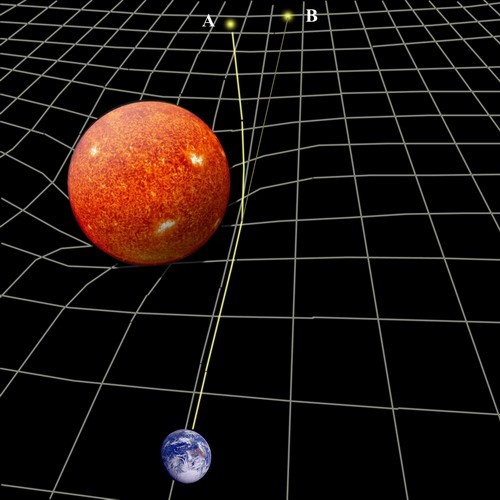
In his General Theory of Relativity, Einstein showed that matter causes space to curve, as in this illustration of starlight being bent by the sun's gravity.

But Einstein did not stop there. As early as 1911, he had predicted that light passing near a large mass, such as a star, would be bent. That idea led to his General Theory of Relativity in 1916. This paper established the modern theory of gravitation and gave us the notion of curved space. Einstein showed, for example, that small masses such as planets form dimples in space-time that hardly affect the path of starlight. But big masses such as stars produce measurably curved space.

The fact that the curved space around our sun was measurable let other scientists prove Einstein’s theory. In 1919, two expeditions organized by Arthur Eddington photographed stars near the sun made visible during a solar eclipse. The displacement of these stars with respect to their true positions on the celestial sphere showed that the sun’s gravity does cause space to curve so that starlight traveling near the sun is bent from its original path. This observation confirmed Einstein’s theory, and made Einstein a household name.

Interestingly, Einstein’s theories contained elements he himself could not accept. In some ways, he was loathe to break too much from the Newtonian/Maxwellian theories upon which his work was built.

He never accepted some of the precepts of quantum mechanics, for example, such as the idea ofindeterminacy. By the late 1920s, quantum mechanics had moved to the forefront of modern physics, yet Einstein never fully accepted many of the new theories. He declared:God does not play dice.

Also, Einstein’s 1916 theory suggested that the universe should be either expanding or contracting. Einstein could not accept that notion, and so in 1917 he introduced a cosmological constant into his theory, which would allow the universe to be stationary. In 1929, however, Edwin Hubble obtained observational evidence that the universe is indeed expanding. Einstein was forced to revise his theory. He called introducing the cosmological constant his greatest blunder.

This part of the Einstein legend illustrates, perhaps, a reason for his global popularity. The great genius could envision mechanisms of the universe in a way many of us have trouble even grasping. His imagination gave him answers to questions most of us would not think to ask.

Yet he remained prone to biases and frailties and thereby thoroughly human … just like the rest of us.

Bottom line: Albert Einstein was born on March 14, 1879. He published his Special Theory of Relativity in 1905 and his General Theory of Relativity in 1916. His work capped off the work of several previous centuries of science … and launched modern physics.

SOURCE:::::www.earthsky.org

Natarajan

Mother Child Photo Shots For Mothers’ Day….

From lions and tigers, to penguins and giraffes, every baby needs its mother.

And to celebrate the run-up to Mother’s Day on Sunday, an animal photographer has revealed his favourite moments of mum-child bonding in the wild.

With two decades of leading trips to exotic places, photographer and guide Paul Goldstein has been lucky enough to witness some gorgeous moments of bonding between mothers and youngsters.

A walrus mother and calf enjoying the sunshine in Spitsbergen, Norway

A walrus mother and calf enjoying the sunshine in Spitsbergen, Norway

A cub enjoys himself as his lion mother licks him clean in Kenya

A cub enjoys himself as his lion mother licks him clean in Kenya

A calf holds on to its mother's tail as the elephants take a stroll around Masai Mara in Kenya

A calf holds on to its mother’s tail as the elephants take a stroll around Masai Mara in Kenya

He has chosen some of his favourite photographs from journeys to places as far afield as the Masai Mara and Spitsbergen in northern Norway.

Highlights include a newborn giraffe walking within 15 minutes of birth, a polar bear mother and cubs sitting on sea ice, and a comical image of an Emperor penguin chick seemingly waving its arms at its mother.

A campaigner for animal rights, Mr Goldstein fund-raises for tigers and other persecuted species as well as writing.

He also owns four safari camps in Kenya and is a tour operator who guides all over the world, Paul feels very strongly that photographs should never be manipulated by photographers.

‘Ethics are a big deal in all facets of photography,’ he said.

‘I like to see what someone has taken not what they have manufactured, show me a bold flawed photograph than a safe record shot any day.’

He has chosen some of his favourite photographs from journeys to places as far afield as the Masai Mara and Spitsbergen in northern Norway.

Highlights include a newborn giraffe walking within 15 minutes of birth, a polar bear mother and cubs sitting on sea ice, and a comical image of an Emperor penguin chick seemingly waving its arms at its mother.

A campaigner for animal rights, Mr Goldstein fund-raises for tigers and other persecuted species as well as writing.

He also owns four safari camps in Kenya and is a tour operator who guides all over the world, Paul feels very strongly that photographs should never be manipulated by photographers.

‘Ethics are a big deal in all facets of photography,’ he said.

‘I like to see what someone has taken not what they have manufactured, show me a bold flawed photograph than a safe record shot any day.’

This little penguin, pictured above, flaps his arms wide to get his mother's attention
This little penguin, pictured above, flaps his arms wide to get his mother’s attention

A leopard mum shows her teenage cub who is boss in Masai Mara, Kenya

Mr Goldstein’s photo captures a newborn giraffe taking its first steps 15 minutes after it was born

An Adelie penguin with a 10 minute old chick, Paulet Island, Antarctica, Eastern Peninsular

An Adelie penguin with a 10 minute old chick, Paulet Island, Antarctica, Eastern Peninsular

A Cheetah cub tried to get its mother's attention, pictured in Masai Mara, Kenya

A Cheetah cub tried to get its mother’s attention, pictured in Masai Mara, Kenya

A polar bear mum leads her cubs through the icy sea in Spitsbergen, Norway

 A black backed jackal pups plays with his mother, above, pictured in Masai Mara, Kenya

A black backed jackal pups plays with his mother, above, pictured in Masai Mara, Kenya

A lioness carries her five-week-old cub gently in her jaws, in Masai Mara, Kenya

A lioness carries her five-week-old cub gently in her jaws, in Masai Mara, Kenya

A Polar bear and her cubs, above, sunabathe on an iceberg in Spitsbergen, Norway

A Polar bear and her cubs, above, sunabathe on an iceberg in Spitsbergen, Norway

A five-week old lion cub play fights with its mother in Masai Mara, Kenya

A five-week old lion cub play fights with its mother in Masai Mara, Kenya
Three elephants, including a mother, her baby and young elephant in Masai Mara, Kenya

SOURCE:::::::   http://www.dailymail.com.uk

Natarajan

Image of the Day… ” Return of Expedition 42 to Earth ” …

The Soyuz TMA-14M spacecraft is seen as it lands with International Space Station Expedition 42 commander Barry Wilmore of NASA, Alexander Samokutyaev of the Russian Federal Space Agency (Roscosmos) and Elena Serova of Roscosmos near the town of Zhezkazgan, Kazakhstan. The landing took place on the evening of Wednesday, March 11 in the U.S, and early in the morning on Thursday, March 12, in Kazakhstan.

The three crew members returned to Earth after a 167-day mission on the orbital outpost that included hundreds of scientific experiments and several spacewalks to prepare the orbiting laboratory for future arrivals by U.S. commercial crew spacecraft.

SOURCE:::: http://www.nasa.gov

Natarajan


This Date in Science…13 March…Discovery Of Uranus…Completely By Accident !!!

March 13, 1781. The 7th planet – Uranus – was discovered on this date, completely by accident. British astronomer William Herschel was performing a survey of all the stars that were of magnitude 8 – in other words, too faint to see with the eye – or brighter. That’s when he noticed an object that moved in front of the star background over time, clearly demonstrating it was closer to us than the distant stars. At first he thought he had found a comet, but later realized this object was a new planet in orbit around our sun – the first discovered since ancient times.

Later, it turned out, astronomers learned they had observed Uranus as far back as 1690. But it was Herschel who first realized the true nature of this distant light in our sky.

William Herschel's famous 40-foot telescope,  constructed between 1785 and 1789 at Observatory House in Slough, England. It was the largest telescope in the world for 50 years.   Image via Wikimedia Commons.

William Herschel’s famous 40-foot telescope, constructed between 1785 and 1789 at Observatory House in Slough, England. It was the largest telescope in the world for 50 years. Image via Wikimedia Commons.

Herschel proposed to name the object Georgium Sidus, after King George III, but those outside of Britain weren’t pleased with the idea. Instead, on the suggestion of astronomer Johann Elert Bode, astronomers decided to follow the convention of naming planets for the ancient gods. Uranus – an ancient sky god, and one of the earliest gods in Greek mythology – was sometimes called Father Sky and was considered to be the son and husband of Gaia, or Mother Earth.

King George III was still pleased, however. As a result of Herschel’s discovery, the king knighted him and appointed him to the position of court astronomer. The pension attached let Herschel quit his day job as a musician and focus his full attention on observing the heavens. He went on to discover several moons around other gas giant planets. He also compiled a catalog of 2,500 celestial objects that’s still in use today.

Voyager 2 gave us our first close-up image of the planet Uranus in 1986.  Its images showed a featureless gas giant world.

Voyager 2 gave us our first close-up image of the planet Uranus in 1986. Its images showed a featureless gas giant world.

In 1977, astronomers using the Kuiper Airborne Observatory made another serendipitous discovery – of rings around the planet Uranus. That discovery made Uranus the second known ringed planet in our solar system.

The closest we humans have come to Uranus was in 1986, when the Voyager 2 spacecraft swung by the planet. At its closest, the spacecraft came within 81,500 kilometers (50,600 miles) of Uranus’s cloudtops on Jan. 24, 1986. Voyager 2 radioed thousands of images and voluminous amounts of other scientific data on the planet, its moons, rings, atmosphere, interior and the magnetic environment surrounding Uranus.

Bottom line: British astronomer William Herschel discovered the planet Uranus – first planet to be discovered since ancient times – on March 13, 1781.

source::::: http://www.earthskynews.org

Natarajan

” You Do not Need Money to be Rich…” Watch This Video clip …

While everyone you meet is fighting his own battle, some people stride ahead of others by winning their battle with integrity. Varun Pruthi spotted, or rather had a serendipitous encounter with the richest man in the world.

This video is special because I’ve always found Varun’s “God sent me for you” videos a bit cheesy; he could have just handed over the money & be with it. The God angle makes the videos difficult to digest. Thankfully, this visually-impaired samosa seller has better clarity on life than most others.

His words, “What I make with my efforts in enough for me.” shows his character & commitment to hard work.

He may not have the riches of the world, but he has a heart of gold.

SOURCE::: http://www.storypick.com and You Tube

Natarajan