Image of the Day…. Eclipse Flyby…!!!

The awesome video above shows an airplane shooting past, in front of the moon and sun, during the partial eclipse. Our friend David Walker posted it to the EarthSky Photo page on G+.

SOURCE:::::: http://www.earthsky.org

Natarajan


” தங்கள் வீட்டைத் தேடும் பறவை கூட்டம் …”

அடுக்கு  மாடி  குடியிருப்பு  திறப்பு விழா  இன்று

ஆட்டம்  பாட்டம்  ஒரே அமர்க்களம் …. எங்கும்

ஆரவாரம் …புது  வீடு  குடி புகும்  குதூகல  கூட்டம் …

வட்டமடித்து  மேலே  பறக்குது  பறவை  கூட்டம்  ஒன்று ..

கீழே  கட்டிட  குவியலுக்கு  நடுவில்  தங்கள்  கூட்டையும்

வீட்டையும்  தேடி …

அதன்  கூட்டையும்  வீட்டையும்  சுமந்த மரங்கள்  என்றோ

சரிந்து  மறைந்து  விட்ட  உண்மை  நிலை

புரியவில்லையே  பாவம்  இந்த  பறவைகளுக்கு …

நடராஜன் .

Bottomline….
Yesterday evening at sunset,  i happened to watch a lot of birds making round and round over a vacant space looking for their respective nests or their dwelling places ..
During the Day time, all available vegetation and trees … small and big..were
cleared mechanically for paving the way for paved land …Probably for the construction of a Residential dwelling unit…
While watching the plight of those birds , the above lines came to my mind …
That is expressed in the form of a small kavithai..today in my blog …
It is before you now..Pl read and give me your feedback at your convenience..
Natarajan

Image of the Day…. Vanguard satellite…

One of the Vanguard satellites is checked out at Cape Canaveral, Florida in 1958. Vanguard 1, the world’s first solar-powered satellite, launched on St. Patrick’s Day (March 17) 1958. It was designed to test the launch capabilities of a three-stage launch vehicle and the effects of the environment on a satellite and its systems in Earth orbit. Vanguard 1 was the second U.S. satellite in orbit, following Explorer 1, and remains the oldest artificial object orbiting Earth to this day. Vanguard began as a program at the Naval Research Laboratory in Washington and transferred over to NASA (along with many of its personnel) after the agency was founded by the National Aeronautics and Space Act of 1958.

Image Credit: NASA 

SOURCE::::: http://www.nasa.gov

Natarajan

Hong Kong’s Third Runway Backed by IATA and Cathay Pacific….

The HK$150 billion project has been backed by both Hong Kong flag carrier  Cathay Pacific, and the International Air Transport Association (IATA), with the interpretation that a third runway is necessary in order to see the aviation industry in Hong Kong flourish.  

Hong Kong’s Third Runway Backed by IATA & Cathay Pacific

Hong Kong International Airport (HKIA) is set to begin the construction of a third runway and associated infrastructure.

The HK$150 billion project has been backed by both Hong Kong flag carrier Cathay Pacific, and the International Air Transport Association (IATA), with the interpretation that a third runway is necessary in order to see the aviation industry in Hong Kong flourish.

Construction on the third runway is expected to commence next year, to be completed by 2023, and will help Hong Kong International Airport boost capacity to 100 million passengers and 9 million tons of cargo a year by 2030.

IATA have said that HKIA plays a crucial role as an economic catalyst – Hong Kong is home to some 3,500 regional headquarters and boasts a HK$250 billion tourism industry. The airport serves 63 million passengers and processes 4.4 million tonnes of cargo.

“IATA has long been an advocate of the need for a third runway in Hong Kong. And it is in the interest of everyone in Hong Kong to see the aviation industry flourish. Aviation and aviation-related tourism account for 8.2% of the Hong Kong economy. Increasing HKIA’s capacity to be able to serve 100 million passengers and 9 million tonnes of cargo by 2030 will ensure that the airport continues to be a pillar of Hong Kong’s success—provided the expansion is built, financed  and funded wisely,” said Tony Tyler, IATA’s Director General and CEO in a speech to the Foreign Correspondents Club of Hong Kong.

IATA has outlined a framework which will allow Hong Kong’s new infrastructure to be built without increasing airline charges, without placing a burden on taxpayers, without making it more expensive for travellers, without adding an extra burden to shippers and while increasing competitiveness of the hub’s air transport network.

HKIA is consistently profitable, and IATA’s Tony Tyler has suggested the airport use its advantageous financial situation to fund its expansion by borrowing through commercial loans or bonds.

Flag carrier, Cathay Pacific has supported IATA’s suggestions to fund the project by saying that the third runway can be self-funded through existing income streams, especially as the number of passengers moving through the airport continues to grow.

“Hong Kong International Airport is extremely successful. It is the world’s busiest airport for international freight and the third busiest in terms of international passenger traffic. The Airport Authority enjoys the highest net profit of any airport in the world and benefits from strong cash flows, a healthy balance sheet, and growing income from retail and aeronautical streams,” said Ivan Chu, Cathay Pacific Chief Executive.

Cathay Pacific also believes that, as a public body, the Airport Authority should reinvest its income in the development of the third runway, so that the airport can maintain its premier hub status and continue to make an important economic contribution to Hong Kong.

Hong Kong’s air transport network is under pressure to remain competitive, after its share of the market connecting China to the rest of the world shrank from 20 percent to 17 percent between 2005 and 2013.

Its share on the ASEAN to North America market has remained at 10 percent, whereas the airport’s share on ASEAN to European traffic has contracted to 2.4 percent from 3.3 during the same period.

“There are lots of reasons why these changes are happening. The Middle East airlines are proving to be strong competitors with efficient and affordable hubs being a central piece of their success. And hubs closer to Hong Kong continue to improve their offerings to enhance the competitiveness of their networks,” said Mr Tyler.

SOURCE:::::::: Poppy Marello in http://www.routesonline.com

Natarajan

This Day in Science…. March 14… Birthday Day of Albert Einstein….

March 14, 1879. This is the anniversary of the birth of Albert Einstein, undoubtedly the most famous scientist of the modern era.

Einstein was born in Ulm, Germany, where an uncle – Jakob Einstein, an engineer – introduced him to science and math. At age 17, he enrolled in the Swiss Polytechnic Institute after failing the entrance exam the previous year. He graduated in 1900, and in 1902 he became a junior patent examiner in the Swiss Patent Office in Bern, Switzerland, where he specialized in electrical devices.

The year 1905 came to be known as Einstein’s Miracle Year. He was 26 years old, and in that year he published four papers that reshaped physics.

Albert Einstein in 1904 at age 25.

Photoelectric effect. The first explained what’s called the photoelectric effect – one of the bases for modern-day electronics – with practical applications including television. His paper on the photoelectric effect helped pave the way for quantum mechanics by establishing that light is both a particle and a wave. For this work, Einstein was later awarded a Nobel Prize in physics.

Brownian motion. Another 1905 paper related to Brownian motion. In it, Einstein stated that the seemingly random motion of particles in a fluid (Brownian motion) was a predictable, measurable part of the movement of atoms and molecules. This helped establish the Molecular Kinetic Theory of Heat. That is, if you heat something, the molecules within vibrate. At this same time, Einstein provided definitive confirmation that atoms and molecules actually exist.

Special relativity. Also in 1905, Einstein published his Special Theory of Relativity. Before it, space, time and mass all seemed to be absolutes – the same for everyone. Einstein showed that different people perceive mass, space and time differently, but that these effects don’t show up until you start moving nearly at the speed of light. Then you find, for example, that time on a swiftly moving spaceship slows down, while the mass of the ship increases. According to Einstein, a spaceship traveling at the speed of light would have infinite mass, and a body of infinite mass also has infinite resistance to motion. And that’s why nothing can accelerate to a speed faster than light speed. Because of Einstein’s special relativity, light is now seen as an absolute in a universe of shifting values for space, time and matter.

Mass-energy equivalence. The fourth 1905 paper stated that mass and energy are equivalent. You perhaps know something of this work in Einstein’s famous equation E=mc2. That equation means that energy (E) is equal to mass (m) multiplied by the speed of light (c) squared. Sound simple? It is, in a way. It means that matter and energy are the same thing. It’s also very profound, in part because the speed of light is a huge number. As shown by the equation, a small amount of mass can be converted into a large amount of energy … as in atomic bombs. It’s this same conversion of mass to energy, by the way, that causes stars to shine.

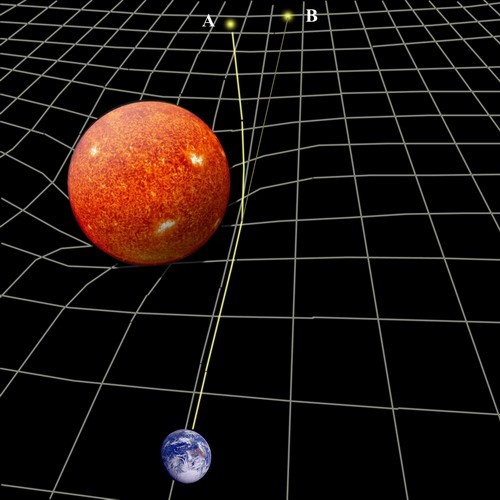
In his General Theory of Relativity, Einstein showed that matter causes space to curve, as in this illustration of starlight being bent by the sun's gravity.

But Einstein did not stop there. As early as 1911, he had predicted that light passing near a large mass, such as a star, would be bent. That idea led to his General Theory of Relativity in 1916. This paper established the modern theory of gravitation and gave us the notion of curved space. Einstein showed, for example, that small masses such as planets form dimples in space-time that hardly affect the path of starlight. But big masses such as stars produce measurably curved space.

The fact that the curved space around our sun was measurable let other scientists prove Einstein’s theory. In 1919, two expeditions organized by Arthur Eddington photographed stars near the sun made visible during a solar eclipse. The displacement of these stars with respect to their true positions on the celestial sphere showed that the sun’s gravity does cause space to curve so that starlight traveling near the sun is bent from its original path. This observation confirmed Einstein’s theory, and made Einstein a household name.

Interestingly, Einstein’s theories contained elements he himself could not accept. In some ways, he was loathe to break too much from the Newtonian/Maxwellian theories upon which his work was built.

He never accepted some of the precepts of quantum mechanics, for example, such as the idea ofindeterminacy. By the late 1920s, quantum mechanics had moved to the forefront of modern physics, yet Einstein never fully accepted many of the new theories. He declared:God does not play dice.

Also, Einstein’s 1916 theory suggested that the universe should be either expanding or contracting. Einstein could not accept that notion, and so in 1917 he introduced a cosmological constant into his theory, which would allow the universe to be stationary. In 1929, however, Edwin Hubble obtained observational evidence that the universe is indeed expanding. Einstein was forced to revise his theory. He called introducing the cosmological constant his greatest blunder.

This part of the Einstein legend illustrates, perhaps, a reason for his global popularity. The great genius could envision mechanisms of the universe in a way many of us have trouble even grasping. His imagination gave him answers to questions most of us would not think to ask.

Yet he remained prone to biases and frailties and thereby thoroughly human … just like the rest of us.

Bottom line: Albert Einstein was born on March 14, 1879. He published his Special Theory of Relativity in 1905 and his General Theory of Relativity in 1916. His work capped off the work of several previous centuries of science … and launched modern physics.

SOURCE:::::www.earthsky.org

Natarajan

Joke of the Day…” Message to Moon…” !!!

I used to be a taxi driver but I had to quit…

I couldn’t stand people talking behind my back.

…………………..

When NASA was preparing for the Apollo Project, it took the astronauts to a Navajo reservation in Arizona for training. One day, a Navajo elder and his son came across the space crew, who were walking among the rocks.

The elder, who spoke only Navajo, asked a question. His son translated for the NASA people:

“What are these guys in the big suits doing?”

One of the astronauts said they were practicing for a trip to the moon. When his son relayed this comment, the Navajo elder got all excited and asked if it would be possible to give the astronauts a message to deliver to the moon.

Recognizing a promotional opportunity when he saw one, a NASA official accompanying the astronauts said, “Why certainly!” and told an underling to get a tape recorder. The Navajo elder’s comments into the microphone were brief. The NASA official asked the son if he would translate what his father had said. The son listened to the recording and laughed uproariously. But he refused to translate.

So the NASA people took the tape to a nearby Navajo village and played it for other members of the tribe. They too laughed long and loudly but also refused to translate the elder’s message to the moon.

Finally, an official government translator was summoned. After he finally stopped laughing, the translator relayed the message:

“Watch out for these guys! They’ve come to steal your land.”….

SOURCE:::::: http://www.joke a day.com

Natarajan

Image of the Day… ” Return of Expedition 42 to Earth ” …

The Soyuz TMA-14M spacecraft is seen as it lands with International Space Station Expedition 42 commander Barry Wilmore of NASA, Alexander Samokutyaev of the Russian Federal Space Agency (Roscosmos) and Elena Serova of Roscosmos near the town of Zhezkazgan, Kazakhstan. The landing took place on the evening of Wednesday, March 11 in the U.S, and early in the morning on Thursday, March 12, in Kazakhstan.

The three crew members returned to Earth after a 167-day mission on the orbital outpost that included hundreds of scientific experiments and several spacewalks to prepare the orbiting laboratory for future arrivals by U.S. commercial crew spacecraft.

SOURCE:::: http://www.nasa.gov

Natarajan


This Date in Science…13 March…Discovery Of Uranus…Completely By Accident !!!

March 13, 1781. The 7th planet – Uranus – was discovered on this date, completely by accident. British astronomer William Herschel was performing a survey of all the stars that were of magnitude 8 – in other words, too faint to see with the eye – or brighter. That’s when he noticed an object that moved in front of the star background over time, clearly demonstrating it was closer to us than the distant stars. At first he thought he had found a comet, but later realized this object was a new planet in orbit around our sun – the first discovered since ancient times.

Later, it turned out, astronomers learned they had observed Uranus as far back as 1690. But it was Herschel who first realized the true nature of this distant light in our sky.

William Herschel's famous 40-foot telescope,  constructed between 1785 and 1789 at Observatory House in Slough, England. It was the largest telescope in the world for 50 years.   Image via Wikimedia Commons.

William Herschel’s famous 40-foot telescope, constructed between 1785 and 1789 at Observatory House in Slough, England. It was the largest telescope in the world for 50 years. Image via Wikimedia Commons.

Herschel proposed to name the object Georgium Sidus, after King George III, but those outside of Britain weren’t pleased with the idea. Instead, on the suggestion of astronomer Johann Elert Bode, astronomers decided to follow the convention of naming planets for the ancient gods. Uranus – an ancient sky god, and one of the earliest gods in Greek mythology – was sometimes called Father Sky and was considered to be the son and husband of Gaia, or Mother Earth.

King George III was still pleased, however. As a result of Herschel’s discovery, the king knighted him and appointed him to the position of court astronomer. The pension attached let Herschel quit his day job as a musician and focus his full attention on observing the heavens. He went on to discover several moons around other gas giant planets. He also compiled a catalog of 2,500 celestial objects that’s still in use today.

Voyager 2 gave us our first close-up image of the planet Uranus in 1986.  Its images showed a featureless gas giant world.

Voyager 2 gave us our first close-up image of the planet Uranus in 1986. Its images showed a featureless gas giant world.

In 1977, astronomers using the Kuiper Airborne Observatory made another serendipitous discovery – of rings around the planet Uranus. That discovery made Uranus the second known ringed planet in our solar system.

The closest we humans have come to Uranus was in 1986, when the Voyager 2 spacecraft swung by the planet. At its closest, the spacecraft came within 81,500 kilometers (50,600 miles) of Uranus’s cloudtops on Jan. 24, 1986. Voyager 2 radioed thousands of images and voluminous amounts of other scientific data on the planet, its moons, rings, atmosphere, interior and the magnetic environment surrounding Uranus.

Bottom line: British astronomer William Herschel discovered the planet Uranus – first planet to be discovered since ancient times – on March 13, 1781.

source::::: http://www.earthskynews.org

Natarajan

Message For the Day…” Understand the Power of Creator…God…”

The cosmos is a magnificent wonder, a source of continuous amazement. It will impress anyone, whoever you are, as a supreme marvel. When an object has to be made, we know it needs someone with skill, intelligence, and power to make it. Without a maker, it is just impossible. Therefore, how could these visible objects — the sun, moon, stars, and constellations— move and behave as they do without a Supreme Creative Designer? Can they exist and function with any ordinary power? No. After observing the creation with such mighty capabilities, intelligent people can easily infer how immeasurable the power of the Maker must be. Not just that, look at the uniqueness and variety in creation! No one thing is the same as another; no one person resembles another. This can only be the sport (leela) of the phenomenon with limitless glory – God! No lesser power could be the source. From the mystery inherent in creation, understand the Creator.

Sathya Sai Baba

Image of the Day…. ” Rare Straight Lightening …”

Rare straight lightning over Zimbabwe

No zig-zagging. No branching. A lightning expert said this single, straight bolt of lightning was extremely rare …

Animated gif by Peter Lowenstein in Mutare, Zimbabwe

A friend in Zimbabwe, Peter Lowenstein, created the animated gif image above from a video he captured of a rare straight lightning bolt. He wrote….

… a most unusual lightning strike occurred during an afternoon thunderstorm in Mutare on 15 February 2015. Unlike most lightning which travels in zig-zag fashion and has branches, this single bolt descended in an almost straight line to strike the ground about two kilometers away. This was followed a few seconds later by a very loud bang which was sufficient to cause alarm and then a distinct echo which returned from the surrounding hills. The lightning must have been very energetic as it was so bright that it completely over-exposed the first flash frame on the gif and produced thunder that was so loud that it frightened people over a wide area. I believe that straight lightning is very rare and wonder if anyone else has either observed it firsthand or seen it in other photos or videos?

Richard Orville, an expert on lightning from the Department of Atmospheric Sciences at Texas A&M University, wrote:

…straight lightning is extremely rare, indeed very rare.

The atmosphere appears to have a high amount of moisture which suggests many small droplets may be in between the channel and our eyes. This will obscure any branches. But there is no evidence of ANY branching. This is highly unusual. The straight channel suggests a lack of small particles in the atmosphere or in other words, a very clean atmosphere. It appears to homogeneously clean! A uniform atmosphere devoid of particles and with a uniform density.

Peter Lowenstein added that the consensus between experts consulted on this image is that his capture is:

… of a positive cloud-ground (CG) strike.

These are much less common than negative strikes and tend to be smooth and less branched.

Bottom line: Animated gif of a rare straight lightning strike over Mutare, Zimbabwe on February 15, 2015, as captured by Peter Lowenstein.

SOURCE:::: http://www.earthskynews.org

Natarajan